Novo Nordisk A/S Class B
Q3 FY2026 · Earnings Call TranscriptNovember 4, 2026
Operator
Good day and thank you for standing by. Welcome to the Q3 2026 Novo Earnings Conference Call.
At this time, all participants are in a listen-only mode. After the speakers' presentation, there will be a question-and-answer session.
To ask a question during the session, you will need to press star one and one on your telephone. You will then hear an automated message advising your hand is raised.
To withdraw your question, please press star one and one again. Please be advised that today's conference is being recorded.
I would now like to hand the conference over to your speaker today, Michael Novod, Head of Investor Relations. Please go ahead.
Michael Novod
Thank you very much, operator. Welcome to the Novo earnings call for the third quarter of 2026.
My name is Michael Novod, and I'm the Head of Investor Relations at Novo. With me today, I have CEO, Mike Doustdar; EVP, US Operations, Jamey Millar; EVP, International Operations, Emil Kongshøj Larsen; EVP, Research and Development and Chief Scientific Officer, Martin Holst Lange; and Chief Financial Officer, Karsten Munk Knudsen.
All speakers will be available for the Q&A session. Today's call is being webcasted live, and a recording will be made available on our website.
The call is scheduled to last one hour. Next slide, please.
The presentation is structured as outlined on slide two.
Operator
Please stand by while the speakers reconnect. Please stand by while the speakers reconnect.
Michael Novod
Oh, were we got disconnected?
Operator
Please continue.
Michael Novod
All right, sorry for that. We'll try to start it from the get-go.
On slide three, we need to advise you that this call will contain forward-looking statements. These are subject to risk and uncertainty that could cause actual results to differ materially from expectations.
For further information on the risk factors, please see the company announcement for the third quarter of 2026 and the slides prepared for this presentation. With that, over to you, Mike, for an update on our 2030 ambitions.
Mike Doustdar
Thank you very much, Michael. Next slide, please.
Back in September, at our Capital Market Day, we set out our 2030 ambition to deliver mid-single-digit compounded annual sales growth in line with our industry peers from 2026 to 2030. Three commitments drove that ambition: We will grow and diversify our pipeline, we will drive sustainable growth, and we will deliver attractive returns to our shareholders.
From this quarter onwards, we will hold ourselves accountable and report progress against each of them. On growing and diversifying our pipeline, we have initiated seven first-human-dose trials so far this year.
In addition, we have 10 ongoing phase 3 programs. Martin will cover the key pipeline developments about those later on.
In terms of driving sustainable growth, we are now reaching around 48 million people with our diabetes and obesity treatments. This is 2 million more than just a year ago.
Specially within obesity, we are treating 5.6 million people, almost doubling during the past 12 months. Obesity sales grew by 22% in quarter three, supported by continued GLP-1 volume growth across geographies, as well as the accelerated rollout of our innovative products, namely Wegovy Pill and Wegovy 7.2 mg, also known as Wegovy HD.
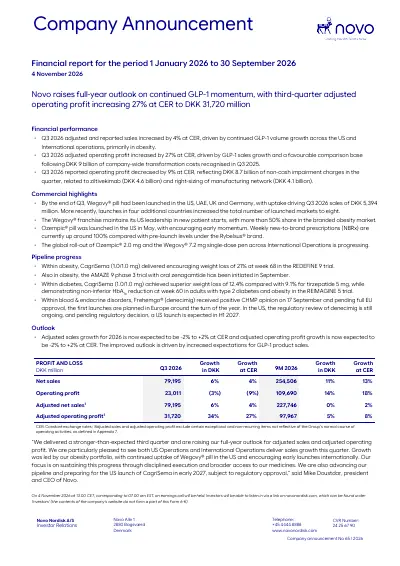
In terms of delivering attractive returns, we generated 32 billion DKK in adjusted operating profit and more than 28 billion DKK in free cash flow in Q3 2026. On the back of this strong quarter, we now expect adjusted sales growth of -2% to +2% and adjusted operating profit growth of -2% to +2%, both at CER.
Karsten will speak to the updated guidance later. Please turn to the next slide.
The quarterly development clearly shows that we are at the growth recovery phase, and that is progressing well. Following adjusted sales decline of 2% in the fourth quarter of 2025 and 4% in the first quarter of 2026, we returned to 7% and 4% growth in the second and the third quarter, respectively.
Additionally, we are happy to see that this quarter both operating units are in growth territory again. Behind this is a clear turnaround in patient volumes.
After a flat end to 2025 and a slight decline in the first quarter of 2026, we have now added 1.2 million patients in the second quarter and 1.3 million in the third, which is quite encouraging. What is promising is that growth comes from both obesity and diabetes.
In obesity, we've added patients every single quarter with 0.8 million in Q2 and 0.7 million in Q3. In diabetes, we have moved from losing 0.8 million patients in Q1 to adding 1 million patients in the past two quarters.
In short, more patients are choosing Novo treatments, and we are reaching them across both of our core therapy areas. Next slide, please.
In the third quarter, the adjusted sales growth was driven by both operating units. US Operations grew 1%, while International Operations grew 8%.
Within IO, Region U-CAN remained the key growth area, delivering 18% growth. Across therapy areas, obesity continued to be the main growth driver.
With that, I'll pass it to you, Emil, for a closer look at IO.
Emil Kongshøj Larsen
Thank you, Mike. Please turn to the next slide.
Growth in IO continued to be driven by our GLP-1 portfolio in the third quarter with total GLP-1 sales increasing by 8%. Obesity remains the key growth driver, delivering 24% growth, supported by continued volume uptake of Wegovy across regions.
From a regional perspective, U-CAN was the main growth contributor with strong performance across both GLP-1 diabetes and obesity. However, performance in Canada was negatively impacted by lower realized prices following the loss of exclusivity for semaglutide.
We continue to be the GLP-1 volume leader in IO with a market share of 54%. We're supporting this position with the rollout of Wegovy Pill, Wegovy 7.2 mg, and Ozempic 2.0 mg.
Please turn to the next slide. We continue to expand our oral obesity leadership across IO.
The pill has now been launched in seven markets, most recently in Mexico, France, Spain, and Poland, and with further launches planned during the fourth quarter. By first half of 2027, we now expect Wegovy Pill to be available in more than 20 markets.
The market response in the UK and UAE is encouraging. While it is early days, we're seeing that Wegovy Pill is leading the oral obesity segment with around 90% market share in the UK and around 80% market share in the UAE in recent weeks.
Six weeks into the launch in Germany, we've also seen solid uptake with approximately 100,000 packs sold, mainly driven by GLP-1-naive patients, which suggests market expansion. While the UK market share development is encouraging, we're starting to see a normalization in the uptake, which naturally follows a bolus launch with pent-up demand.
Our focus is now to further build the obesity market. We'll do this by driving continued GLP-1-naive patient initiations, supporting patients throughout their treatment journey, ensuring clear switch guidance from injectables, and expanding subscription options that can improve affordability and retention.
Overall, these early launches reinforce our confidence that Wegovy Pill can reach a broader group of people living with obesity and strengthen our leadership across IO. With that, over to Jamey for an update on the US.
Jamey Millar
Thank you, Emil. Please turn to the next slide.
Uptake of the Wegovy Pill has continued to outpace the oral competitor in Q3 with Wegovy Pill still capturing around 80% of NBRxs. This underpins the strong competitiveness of Wegovy Pill.
Since launch, we have seen more than 8 million cumulative prescriptions, which remains the strongest US pharma launch by volume in over a decade outside of vaccines. We see a long runway for the pill in the US with current and incoming initiatives expected to drive more uptake into the new year.
In Q3, Wegovy Pill volumes grew around 20% versus Q2, and injectable Wegovy volumes grew around 10% sequentially, Q3 versus Q2. Part of the volume growth comes from the Bridge Program where we see encouraging uptake over the last few months.
Further, we continue to see the Wegovy franchise leading new-to-brand prescriptions with more than 50% market share. The breadth of the franchise is central to our approach.
Wegovy injectable, Wegovy high-dose, and Wegovy Pill allow us to serve different patient preferences and treatment needs while building on the established profile of semaglutide. Please turn to the next slide.
Turning to diabetes, the transition from Rybelsus to Ozempic Pill is now complete with new patients starting directly on the Ozempic brand. Since launch, weekly new-to-brand prescriptions for the oral franchise have more than doubled, demonstrating the strength of the Ozempic brand and the opportunity in the oral GLP-1 segment.
Ozempic Pill strengthens the franchise by giving patients and physicians an oral treatment option under a well-known and trusted brand. It also creates opportunities to engage additional prescribers to compete more effectively across channels.
Importantly, more than 60% of Ozempic Pill new-to-brand prescriptions are from people who are new to GLP-1 treatment. This indicates that the launch is helping to expand the treated market rather than only switching patients within the class.
We will continue to build awareness, support the transition across commercial channels, and strengthen the combined Ozempic franchise. Over time, the oral and injectable offerings give us an opportunity to serve a broader range of people living with type 2 diabetes.
We look forward to the potential FDA approval of Ozempic Pill 25 mg by the end of the year, which will further strengthen our offering in diabetes with a highly competitive product profile. With that, I hand it over to Martin.
Martin Holst Lange
Thank you, Jamey. Next slide, please.
During Q3, we continued to advance our pipeline. Starting with CagriSema, we've continued to build the evidence base ahead of the potential launch.
In type 2 diabetes, we completed the 60-week phase 3 REIMAGINE 5 trial, a robust head-to-head study enrolling over 1,000 patients comparing CagriSema 1 mg of each component directly with tirzepatide 5 mg. This is a very relevant comparison as around 50% of global patients on tirzepatide are on the 5 mg dose or less, thus doing a more or less real-world evidence study.
At 1 mg of each component, CagriSema demonstrated superior weight loss of 12.4% compared with 9.1% for tirzepatide while delivering on-par non-inferior HbA1c reduction of around 1.7 7% points. The results from REIMAGINE 5 will supplement the regulatory submission for CagriSema in type 2 diabetes.
In obesity, we completed REDEFINE 9, which also added evidence on the lower maintenance dose of CagriSema. In the trial, CagriSema confirmed a highly attractive weight loss profile as the 1 mg dose of each component demonstrated 21% weight loss at 68 weeks.
As Novo expands its focus in women's health as part of our broader consumer Rx ambition, we are building our understanding of how CagriSema may address women's treatment needs across different stages of life. Women represent a large proportion of people receiving obesity medicines, and the menopause transition is associated with change in body composition, including bone, increased abdominal fat, and rise in cardiometabolic risk, making effective weight management particularly relevant.
Two recent post hoc analyses of women in REDEFINE 1 may help address this evidence. Overall, CagriSema was associated with an average weight loss of 25% in women.
A separate analysis examining life stages, largely classified using age-based criteria, showed substantial weight loss across groups averaging 27, 25, and 23 percentage points respectively in premenopausal, perimenopausal, and postmenopausal women. Taken together, these data broaden the evidence base of CagriSema and support the potential for a more individualized treatment approach, recognizing that patients have different needs and may not necessarily require the highest dose.
Lastly on CagriSema, we conducted a phase 2 trial in people with type 2 diabetes and painful diabetic peripheral neuropathy. In the study, CagriSema reduced pain by 2.4% sorry, 2.4 points from a baseline on the PIN-RS score, corresponding to approximately 38% reduction in pain on top of standard of care with a more than 53% of patients reaching at least a 30% reduction in pain.
Based on these very encouraging results, we plan to initiate phase 3 trials in the neuropathic pain across the portfolio during 2027. Turning back to the broader pipeline, we advanced oral amycretin into phase 3 in the AMAZE-9 trial.
Oral amycretin brings GLP-1 and amylin dual agonism into a differentiated unimolecular oral treatment. AMAZE-9 is linked to the extensive subcutaneous AMAZE program through exposure response modeling and bridging data to support the planned regulatory submission of both oral and subcutaneous.
We expect AMAZE-9 to read out in 2028. Within blood and endocrine disorders, we are excited to potentially launch denesemic in European countries by the turn of this year with a broader rollout in 2027.
In the US, we're aiming to launch denesemic in the first half of 2027, pending regulatory decision. Next slide, please.
Looking ahead, we are set to deliver important pipeline and regulatory milestones. Following the comprehensive pipeline update at our recent Capital Markets Day, I will focus today on the few key highlights.
Starting with obesity, amylin 355 recently advanced into phase 2 with expected readout in the second half of 2027. The trial investigates both subcutaneous and oral amylin 355 in around 170 patients with overweight and obesity.
For the oral formulation, we see the potential to leverage the amylin biology to deliver a meaningful double-digit weight loss with potential fewer side effects. Continuing in the oral obesity space, we are anticipating the phase 1 results of the oral HCSL5 inhibitor in the second half of 2027.
HCSL5 inhibition is a non-GLP-1 oral small-molecule approach with the potential to deliver double-digit weight loss alongside a differentiated tolerability profile and no need for dose titration. As a small molecule, it also offers the potential for high scalability.
Cagrilintide, with its amylin-based biology, is expected to expand into a new patient pool and set a new standard for tolerability. Later this year, we expect to initiate phase 3 of the high dose of cagrilintide.
Further, we anticipate phase 3 results of the renew phase one sorry, RENEW 1 and 2 programs around mid-2027. Lastly within obesity, we anticipate phase 1/2 results for both of our tri-agonists in the first half of 2027.
These include UBT251, targeting the receptors of GLP-1, GIP, and glucagon, and our internal triple molecule targeting GLP-1, GIP, and amylin. Within liver disease, we submitted MASH data for oral semaglutide 25 mg in the US.
The submission is based on part one of the ESSENCE trial, investigating semaglutide 2.4 mg in MASH with moderate to advanced liver fibrosis. We're anticipating a US decision in the first half of 2027.
In addition, we are still anticipating phase 3 safety results from the SYNCHRONY Real-World trial of efruxifermin in people living with MASH and fibrosis stages F1 to F4. The trial's primary endpoint is safety and tolerability.
With that, over to you, Karsten.
Karsten Munk Knudsen
Thank you, Martin. Please turn to the next slide.
In the third quarter of 2026, our adjusted sales increased by 4%, reaching 79.2 billion Danish kroner. This was driven by continued GLP-1 volume growth across US and IO, primarily in obesity.
Adjusted operating profit increased by 27%, driven by GLP-1 sales growth and a favorable comparison base following approximately 9 billion Danish kroner of company-wide transformation costs recognized in the third quarter of 2025. This was partially offset by around 3.5 billion Danish kroner of one-time costs recognized in Q3 2026 within other operating expenses and R&D.
For the first 9 months of 2026, Novo has delivered better than expected sales and operating profit. As a result, we have raised our guidance again.
The adjusted sales growth is now expected to be from -2% to +2% at CER. The improvement in the outlook is mainly driven by increased expectations for GLP-1 product sales.
The outlook reflects expectations for sales growth within IO and expectations for sales decline within US Operations. In IO, the outlook is based on current growth trends, including continued volume penetration from GLP-1 treatments and market expansion.
Novo continues to roll out the Wegovy product portfolio in more markets during 2026, including the Wegovy Pill. In US Operations, the outlook is based on current prescription trends for the injectable GLP-1 portfolio.
Lower realized prices linked to investments in market access amplified by the MFN agreement are assumed. Uptake related to the launch of Wegovy Pill is reflected in the outlook based on a range of assumptions.
Adjusted operating profit growth is now expected to be from -2% to +2% at constant exchange rates. The raised adjusted operating profit growth outlook reflects the improved sales outlook combined with targeted investments in current and future growth opportunities within R&D and commercial.
This is partially funded by reinvestment of savings from the company-wide transformation program started in 2025, as well as further optimization initiatives and disciplined resource allocation. Our key modeling considerations for 2026 are shown on the slide, including the improved free cash flow outlook, now expected between 60 and 70 billion Danish kroner.
That was the outlook for 2026. Now over to you, Mike.
Mike Doustdar
Thank you, Karsten. Next slide, please.
As we close yet another strong quarter above expectations and another guidance raise, I would also like us to take a moment and focus on what comes next. I've been at Novo for more than 30 years, and I can truthfully say that few things energize this organization like new launches.
The coming period will bring two exciting potential launches: FreeHemGo and CagriSema. Let me start on the left side with FreeHemGo.
People living with hemophilia have been asked to accept the trade-off between good protection and a heavy treatment burden for way too long. FreeHemGo is designed to remove that exact trade-off.
The FRONTIER program demonstrated durable bleeding protections with the flexibility and convenience of a once-weekly, once-every-second-week, or once-monthly injection in a simple, safe, and easy-to-use device. That means more time living and less time managing a disease.
Our job now is to make switching from today's standard of care seamless, safe, and the preferred choice for patients and doctors. That is exactly why I'm excited to roll out FreeHemGo globally during 2027, pending approval.
Turning to CagriSema, here our job is simple: We need to get it to patients fast across channels. We are preparing as we speak, we can go from approval to launch as quickly as possible.
We will use NovoCare and our partners to reach consumers directly and make the customer experience as seamless and as simple as possible. To sum up: We have delivered a strong quarter, raised our guidance again, and introduced a new strategy, culture, and a brand for Novo.
Across the organizations, we're focusing on turning our innovation into successful launches that makes a meaningful difference for patients and society. I'm excited about what lies ahead for Novo and look forward to sharing our progress quarter after quarter.
Next slide, please. Before we open for Q&A, I would like to say a few words about the change in our executive management.
As announced earlier today, our CFO Karsten is leaving Novo after 27 years with the company. Throughout his career, Karsten has made a lasting contribution to Novo, most notably over the past nine years as CFO.
He has been a trusted colleague and a highly respected leader, known for his integrity and sound judgment and genuine commitment to patients and our people. On behalf of the entire Board of Directors, executive management, and all of our employees, thank you, Karsten, for your many years of dedication.
We wish you every success in the future. At the same time, I am excited to welcome Luigi La Corte as our incoming CFO.
Luigi joins us from Galderma as CFO, and he brings more than 30 years of international financial leadership experience across healthcare and consumer businesses. Karsten will remain with the company until end of this year to ensure a smooth transition, and therefore, we turn to Q&A now.
I would like, before doing that, though, give the word to you, Karsten, for a few words.
Karsten Munk Knudsen
Thank you for your kind words, Mike. As Mike mentioned, this will be my last conference call as CFO at Novo.
It has been a privilege to serve this company and to engage with all of you. Your questions, challenges, and insights have consistently made us sharper, and I have truly valued our open and constructive dialogue over the years.
I leave with great confidence in our strategy, our strong financial foundation, and above all, the people who drive Novo forward every day. Thank you all for your trust and support over the years.
With that, let's open up for Q&A. Over to you, Michael.
Michael Novod
Thank you, Karsten. Thank you, Mike.
Next slide, please. With that, we're now ready for the Q&A where we kindly ask all participants to limit her- or himself to one or maximum two questions, including sub-questions.
Operator, we're now ready to take the first question.
Operator
Thank you. As a reminder, to ask a question, you'll need to press star one and one on your telephone and wait for your name to be announced.
To withdraw your question, please press star one and one again. Our first question comes from the line of Peter Verdult from BNP Paribas.
Please go ahead, your line is open.
Peter Verdult
Thank you. Peter Verdult from BNP Paribas.
I rarely do this on a public conference call, but I will make an exception this time for Karsten to say thanks for all the interactions over the years and best wishes on your next career chapter. On to the questions.
Two for you, Mike. Just firstly, on the upcoming CagriSema approval, is the probability of CagriSema having some sort of halo effect of a Wegovy-containing brand name high, medium, or low?
Then secondly, I realize you're not going to provide any official guidance ahead of a CFO change, but a frequent question we get from investors is whether Novo can return to revenue growth in '27. I know there are many moving parts, I just wanted to kick the tires with you on your confidence that a positive growth number could feature in any guidance range you provide in February given what you're seeing across IO markets with the pill and post the Ozempic Pill launch.
Thank you.
Michael Novod
Thank you very much, Peter. That was sort of 1.5 question.
Both questions for Mike around, first, CagriSema and sort of the halo. Then secondly, pushes and pulls for '27, although we don't guide for '27.
Mike Doustdar
Thanks, Pete. To answer your question on CagriSema, the brand name ends with -sema, there's semaglutide in there, but there is more than sema inside, which actually makes us incredibly excited.
I think the introduction of amylin as the first to do that gives us a huge opportunity to build on the credibility that semaglutide has had for so many years and the Wegovy, of course, brand, but go beyond that. I would say, it's medium.
It's not high, it's not low, it's medium because we actually think that this is much, much more than semaglutide on the back of amylin being mixed with it. On the 2027, I think you are correct.
As usual, we're not going to guide. Let me go out of my way and provide even more building blocks for next year.
Maybe you can do your own math. I think the starting point, of course, is that we are nicely positioned in a growing GLP-1 market with a good runway and still quite a bit of unmet need, as we have been able to show this year with our volume uptakes both on the injectable side, as well as the pill.
We start 2027 with the current runway and how we will end December. We just guided a midpoint of 0% for the first 9 months.
We will monitor how October, November, and December will also look like. That's how really we build our own budget, as well as, of course, the guidance to you.
Now, as usual, we'll have some pushes and some pulls, some plusses and minuses. Let me give you three plus and three minus.
The plusses for us next year is the continued Wegovy Pill uptake in US and IO. I don't foresee why should that completely change, and how well we've done both in US and in IO does not change just because January comes after December.
The other plus is we've seen a good uptake in US Bridge Program. That program started mid this year, you need to annualize it when you make your calculation for next year.
Then the third positive element, I would say, is the two launches I just spoke about. CagriSema, FreeHemGo are two launches where we plan to introduce CagriSema in US, FreeHemGo in both sides of the Atlantic, and hopefully, both of those will prove to be fantastic launches.
On the negative side, I would say we've talked about the LoE this year in International Operations and the early LoE markets. We have seen some of that already, more of it in Q3 than we saw in Q2.
Next year, I would say annualize that, and see how that goes. Then the continued headwind that you currently see in China, -2% that we just showed, is not going to go away just because Christmas turns into, again, a new year.
In addition, in China, we have lost of exclusivity next year, which you need to take into consideration. Then last, maybe, but not least, you see some favorable gross-to-net in 2026 that we should, maybe under normal circumstances, not expect to the same degree next year.
I don't know that. Those are the plusses and the minuses as far as I can go.
Then we will, of course, guide with all of this in mind in 20 in 2027 at the full-year announcement.
Michael Novod
All right, thank you, Mike. To the brand name for CagriSema, that will come in when in due time.
Next question, please.
Operator
Thank you. Our next question comes from the line of Sachin Jain from Bank of America.
Please go ahead, your line is open.
Sachin Jain
Hi, there. Thanks for taking my questions.
One for Jamey, one for Emil. For Jamey, on the US Wegovy Pill script trends, thanks for commenting sequential growth.
On your own data, how much of that growth is the Bridge Program? Other data suggests the bulk is Medicare and that sequentially slowing, if you could comment to that and any color on why ex-Medicare trends are flattish, if that's correct?
For Emil, you commented on UK normalizing. I just asked for an updated pack number relative to the 65,000 per week you gave at the CMD.
If perhaps I can just squeeze in a clarification for Mike. When you talk about current momentum continuing, as I was a little bit confused in that answer to Pete's question, is the midpoint of guide 0% best proxy, or the recent 2Q, 3Q growth rate of mid-single digit?
Thank you.
Michael Novod
Thank you, Sachin. We'll stick with the two first questions as it's already beyond the number one.
First one question to Jamey on Bridge, and then a question to Emil on uptake in IO.
Jamey Millar
Thanks, Sachin. Relative to Bridge, latest weekly data, we're seeing about 60,000 TRxs across injectable and oral in terms of Bridge.
The sequential growth of 20% in the quarter is largely, but not exclusively, Bridge volume. For the whole category, if you look May to October and eliminate the contribution of the Bridge, the whole category is relatively flat, consistent with the seasonality that you see in that period, outside of the consumer activation that we see in the wellness period that starts here in the fourth quarter and really peaks at the beginning of the year with New Year's resolutions and a re-commitment to health, if you will.
Emil Kongshøj Larsen
On the UK, we are still very pleased. 90% [laughter] market share despite a competitor launch, of course, is very strong.
In terms of how we fare versus what we shared at the Capital Markets Day, we back then talked about 65,000 packs weekly sales. Now we're probably around 60.
Despite a competitor launch, super strong. Also with the seasonality, at the moment being a bit low, we move in to November, December.
That's typically peak where the online providers also invest heavily. I think what you should also take note of, which we really are keenly focusing on, is, of course, that this is not cannibalizing our injectable business.
That's perhaps what I'm most pleased about. This is really adding to our overall market share.
We're still faring more than 10 percentage points higher than we did prior to the launch overall. Very positive.
Now the focus, of course, is to build the segment, the class. That's probably up to us given our overall leadership with 90%.
We're focusing on subscription models, proving very successful for the providers who offer that. Focusing on clear switch guidance.
In the UK, there are a lot of people with obesity who have tried a GLP-1, if they've been on an injectable, we want to work with the private providers to ensure they start on the right dose. There's a lot of the long haul of building the segment.
Far, we really see good synergistic effects between injectable and the pill, and that's perhaps what we are really celebrating at the moment. Thank you.
Very clear, Emil and Jamey. Next question, please.
Operator
Thank you. Our next question comes from the line of Simon Baker from Rothschild & Co Redburn.
Please go ahead, your line is open.
Simon Baker
Thanks so much for taking my questions. Let me echo Pete's comments earlier and wish you the very best for the future, Karsten.
On Wegovy, I wondered if you could give us an update on the impact of the subscription program. Is that affecting the capture rate of scripts that we're seeing?
Because we kind of have to assume it's constant, but maybe it isn't. Then secondly, on Wegovy high-dose, you've helpfully told us that it's 5% of total Wegovy scripts in the US, but I wondered if you could give us any more color, both within and outside the US, on where that's coming from.
Are these predominantly titrations up from Wegovy, switches from tirzepatide, or patients starting afresh on that therapy? Any color on that inside and outside the US would be really helpful.
Thank you.
Michael Novod
Thank you very much, Simon. Questions for Jamey to start with, and then maybe Emil can add a bit of color at least on initial expectations.
Jamey Millar
First question related to capture rate. The relative low capture rates from IQVIA are not isolated simply to the subscription model.
We have a much more extensive ecosystem of partners for Wegovy than our competitor, and those partners don't report to IQVIA in absolute terms. We've consistently seen a lower capture rate for Wegovy Pill than the competitive oral product.
Not explained specifically by the subscription model. In terms of Wegovy high-dose, the 7.2 mg, as you stated, about 20,000 prescriptions a week, 5% of total volume.
If you look in the injectable business, both Lilly's and ours, about 15% of the TRxs are in the highest dose, there is still opportunity to move Wegovy HD further. 80%, your specific question, 80% of Wegovy high-dose is titration from 2.4 mg.
Those 20,000 scripts a week are scripts that otherwise would have been lost to the Wegovy franchise.
Simon Baker
Right. Thanks so much.
Emil Kongshøj Larsen
We talk a lot about the Wegovy Pill, but, of course, year to date, it really is Wegovy injectables that has been driving our growth in IO with a very, very strong volume uptake and, I would say, very disciplined pricing where we've not given up. Just to give you a sense that volume growth year to date has for Wegovy injectable been close to 70%, very, very meaningful.
That's, of course, why the high-dose launches, 7.2 we call them in IO, have top priority. We've promised more than 30 launches by the end of the year, and we'll get there.
We've had three so far. The one where we have the most meaningful experience from is the UK.
We launched back early June, and today, around 5% of our injectable patients have already started on a high dose. That's pretty good.
We, of course, keep supporting that. We over time will also look at, of course, how can we facilitate patients who have maxed out on Wegovy Pill 25 mg and also offer them an even more efficacious treatment with 7.2.
We give a lot of priority to this. Just launched in Germany, Poland, and the rollout continues these very weeks.
Simon Baker
Great, thank you very much.
Michael Novod
Thanks, Simon. Next question, please.
Operator
Thank you. Our next question comes from the line of Martin Parkhøi from SEB.
Please go ahead, your line is open.
Martin Parkhøi
Yes, good afternoon. Martin Parkhøi, SEB, with two questions.
Just a question for Martin Lange with respect to expectation ahead of the phase 1/2 readout in obesity of the two tri-agonists. I'm not expecting you to give some kind of indication where you see the weight loss.
I would more like to get you to get some expectations of how we should view the adverse event profile going into this, because there has been some noise when Novo Nordisk with the phase 2 results and high level of adverse events. How have the trials on the tri-agonists been set up with respect to this, just to control expectations?
Then secondly, maybe that is for Emil. We can see in US that the Ozempic pill rebranding has been quite a success so far.
Does that make any sense also to do that in some of the IO markets where Ozempic also is a high household name?
Michael Novod
Great. Thank you, Martin.
First question to Martin around triples reading out, and then to Emil on the IO question.
Martin Holst Lange
Yeah. Thanks very much, Martin.
I just want to clarify where we typically see adverse events rates being captured in a very rigorous way is in phase 1 because basically, we follow the patients very, very closely there. I think that is what you are referring to also because most of these trials are built with technicalities around how we capture the rates, but also how we want to drive the dose escalation in a meaningful way.
Those are a little bit technical, but also a little bit artificial. What we will see readouts of is proper phase 2 trials, and here we actually expect to see the, I would say, expected adverse event profile and tolerability profile of these two drugs.
You've actually seen some readouts from phase 2, albeit in Chinese patients, from UBT251. It looks very, very attractive with low adverse event rates and low withdrawal rates.
We cannot fully expect to see that in a global study, but our aspiration is to have adverse events in line with what we've seen with Wegovy and with other GLP-1 incretin-based therapies. Actually, for the triple, we potentially expect to see either in line and potentially even a more attractive safety profile and tolerability profile because the GIP component will come to its own right here.
Emil Kongshøj Larsen
On Ozempic Pill in IO, we have definitely taken note of the success that Jamey and team have delivered in the US. That's good inspiration.
You'll be the first to hear if we end up concluding that it's a good product for IO as well. At the moment, our focus is the 2.0 launches.
We've come late to that in IO. Launched in 13 markets year to date, 20 by the end of the year.
Far, we have good results. We shared the results from Germany and the Netherlands, two early launch markets, but a number of other markets are also proving promising here.
That's our focus. That will already reinforce the Ozempic brand at a moment where for your building blocks for next year, we, of course, are facing increasing competition, particularly in reimbursed markets across IO, from a well-known competitor to you all.
It will be key to reinforce Ozempic, first with 2.0.
Michael Novod
Thank you very much, Emil. Thank you very much, Martin.
Then just a kind ask again to limit yourself to one question so as many as possible can get to ask a question. Next question, operator.
Operator
Thank you. Our next question comes from the line of Matthew Weston from UBS.
Please go ahead, your line is open.
Matthew Weston
Thank you. I'm going to actually ask Sachin question, Mike.
Is the positive growth exit rate in the second half of '26 the best proxy for '27, or is the full-year 0% average at the midpoint of guidance that you referenced earlier the best baseline for next year? If I can slip in one because I managed to get to slide 83, efruxifermin, looks like you have no plans to launch until 2030 when you get the F4 data.
Can you confirm no plans to go early with F3? Thank you.
Mike Doustdar
Yep. The way that it works, we look at the totality of this year, we look at the plusses and the minuses that we had this year, and we look at quarter by quarter, frankly speaking, and then we look at the exact same thing for next year.
I told you that on some notes, we see positive results for next year. I think the Bridge Program is a great example of that.
We've had half of that, we're happy with it. Let's do that for the full year next year.
On the other hand, the LoE in International Operations is exactly the opposite of that. I would not give you numbers again today.
We're not guiding. What I do tell you is that right now we've guided 0% mid-term for the first nine years, nine months.
That's basically how we're going to look at this going forward. On the efruxifermin question, we have to follow the data.
We will look at the data for F2, F3, F4, and then make a decision. I don't know if Martin wants to add any more to that.
Martin Holst Lange
I think it's important to call out that F4 is where we see the big unmet need. We already have a drug on the market for F2 and F3.
It's called Wegovy. Therefore, to Mike's point, we'll be guided by the data as we see them.
Michael Novod
Thank you very much. Thank you, Matthew.
Next question, please.
Operator
Thank you. Our next question comes from the line of Richard Vosser from J.P.
Morgan. Please go ahead, your line is open.
Richard Vosser
Hi, thanks for taking my questions. One on Ozempic, please.
Maybe you could talk about the underlying price dynamics this quarter, throughout this year, whether there's any impact from lower 340B rebates flowing through to better prices and how you're thinking about that into next year. I noticed you didn't mention IRA next year.
I know we talked about that last quarter, but is that still a headwind in terms of price, or are there price benefits that offset that next year? Then the second question, maybe you could just talk about that oral rollout.
I think 12 or so incremental markets in the first half of '27. Maybe you could talk about the relative opportunity of those markets relative to the UK and how early days France, Poland, Mexico, et cetera, are going and their relative opportunity.
Thanks very much.
Michael Novod
Thank you, Richard. First question to Jamey, and then the second question to Emil.
Jamey Millar
Yep, thanks for the question, Richard, on Ozempic gross-to-net trends. As we've guided before, suggested the 10% to 15% price erosion on an annual basis is the way to think about it.
There's so much fluctuation, variability quarter-to-quarter. Obviously in the quarter, we saw a significantly better range than the 10 to 15, but year-to-date and over a 12-month period, we still feel 10% to 15% is reasonable.
The payer pressure on net prices in the type 2 diabetes category remain and will continue. That's our best judgment there.
To
Michael Novod
Emil.
Emil Kongshøj Larsen
On the rollout in IO, of course, I'm very pleased with our manufacturing colleagues because they keep upping their output. You noticed at Capital Markets Day, we promised 20 markets by end of next year.
Now we promise by end of first half, so that's, of course, incredibly positive. We also back then shared that this would correspond to 2/3 of the market potential, we reached that earlier, of course.
Then across the markets, I've learned to be rather humble predicting potential in this space. Of course, you could say markets with a low penetration and a propensity to tablets, such as Mexico, that is a relatively speaking bigger market expansion opportunity versus a Danish market, for instance, that's more mature with a 10% treatment rate.
There's something about where are we on treatment rates, what is the propensity to online and tablets all together. Overall, of course, we see it as a hugely important opportunity.
In the early innings, it will still be Europe driving the majority. Then, of course, we'll see, and that's what we will learn next year, in markets that have gone LoE, what does the fact that this will be a premium offering from a pricing perspective mean to the volumes we can secure there.
We'll keep you posted on those learnings as we move into next year.
Michael Novod
Great. Thank you.
Thanks. Next question, please.
Thank you.
Operator
Our next question comes from the line of Michael Leuchten from Jefferies. Please go ahead, your line is open.
Michael Leuchten
Thank you. I'll stick to one.
Karsten, thank you so much for the interactions over the years. Question is just a follow-up on your commentary, Jamey, on the Bridge contribution to the franchise.
Do I understand correctly that without Bridge, you wouldn't have grown the GLP-1 franchise, and what does that then mean as Bridge starts to annualize? Thank you.
Michael Novod
Thank you very much, Michael. Question to Jamey on Bridge in the US.
Jamey Millar
Without the Bridge contribution, there is less growth than the 20% sequential growth that we talked about. Bridge is definitely creating an inflection in the category, and without Bridge, the AOM category, not just Novo, but the category looks relatively flat in the May to October timeframe, reflecting the seasonality.
Michael Novod
Great. Thank you, Jamey.
Thanks, Michael. Next question, please.
Operator
Thank you. Our next question comes from the line of James Quigley from Goldman Sachs.
Please go ahead, your line is open.
James Quigley
Great, thank you for taking my questions. Also, thank you, Karsten, for all your help over the years and best of luck in the future.
Maybe one for you, Karsten. On the upgrade to guidance range for 2026, the implied range for Q4 is super wide.
I think it's a 12 billion DKK swing. What are the key factors we need to consider there?
Then, as we look into next year, with the gross-to-net is quite high this year, how should we treat that as we thinking for '27? Is that an unwind, or is that a new base from which tables need to grow from?
Then secondly, quickly for Jamey on the CagriSema launch in the US. As you prepare for the launch, how are you thinking about market segmentation?
Which patients or consumers will the initial marketing campaign target? Sounded a little like older women from Martin's comments, but will you have sufficient data for the launch here, and what is the best analog we should look at as we start to model the launch?
Thank you.
Michael Novod
Thank you very much. First question to Karsten on year to go in 2026, and then over to Jamey on CagriSema.
Karsten Munk Knudsen
James, thanks for the nice words. Specifically to your question on implied growth and guidance ranges, then I'll just say as to the guidance ranges the breadth we have here at Q3 is completely customary at this point in time.
The reason why we have this breadth is that we're navigating a rapidly growing category with a certain degree of volatility. That's why we keep it a little bit wider compared to the hay days when it was pure insulin and extremely linear.
That's really the reason there. In terms of implied growth, it's important to note that while we're growing 2% year-to-date and we have a midpoint of zero, then we do have a tough comparator in the fourth quarter due to US gross-to-net last year of 3 billion in the fourth quarter.
Then LoE mainly in Canada, Emil spoke to, also having a bigger impact in the fourth quarter compared to the first nine months. Those are really the two biggest ticket items impacting the fourth quarter and the implied growth there.
Michael Novod
Over to you, Jamey.
Jamey Millar
Yeah. As for segmentation, it's absolutely the right question, but you'll understand and appreciate if I don't graphically describe our launch strategy.
That said, I'll make two points. One, super excited about CagriSema and expanding the optionality for physicians and for patients.
Increasingly, as more competitors come into the category, having a portfolio of singlets, doublets, triplets over time is going to be really important from a competitive standpoint. As you described, as the information data emerges on CagriSema, there is a nice profile that is emerging in terms of the efficacy of the product even at lower doses, as Martin described, and the patient population, perimenopausal women, where we recently announced the 25% weight loss seen in the studies.
Thank you for your question, and we're super excited about the launch coming up.
James Quigley
Great, thank you.
Michael Novod
Thank you very much. Next question, please.
Operator
Thank you. Our next question comes from the line of Martin Brenøe from Nordea.
Please go ahead, your line is open.
Martin Brenøe
Hi Mike, Karsten, and Michael. Thank you for taking my questions.
I just have two left, please. First question would be whether you can provide a bit of color on how you see the price dynamics heading into 2027.
Just what's the main building blocks that we need to be aware of when we do our modeling? Second question is on the Wegovy Pill.
Now you're committing to rolling out the Wegovy Pill a bit faster than what you indicated just less than two months ago. Can you just help us understand what's been the main driver behind this assumption, and whether you still see some upside to this accelerated rollout that you are now promising here?
Thank you.
Michael Novod
Thank you very much, Martin. Some high-level comments from Jamey on the US, and then over to Emil on accelerating Wegovy Pill in IO.
Jamey Millar
Apologize if a bit repetitive, but on the Ozempic side, as we've suggested, that 10% to 15% price degradation trend is kind of our experience and what we would suggest, not guiding, but that trend continues. Then on the Wegovy side, we've again seen 30% to 35% in the quarter again with the variability, a little on the high end, but we expect that or a little better moving forward.
Just to clean up maybe one question that was asked before that I missed and has been answered previously, because of the Ozempic trend, MFP pricing, we don't expect to have an incremental negative consequence because that's been the trajectory we've been on. Someone asked that before, and I didn't cover it.
Emil Kongshøj Larsen
Thanks, Jamey. On the acceleration, it is really back to, of course, manufacturing stepping up, producing above what the lines are expected to be able to deliver.
I've been visiting myself to cheer on the teams, and they're really doing a great job working 24/7. Another aspect is regulatory.
We've actually taken some learnings from how we also rolled out Wegovy injectable very quickly, working with multi-country packs, et cetera. Great work to also optimize.
That simply means you can have launch batches serving more countries and hence speed up productivity and in manufacturing. That helped.
You saw maybe also the breaking news of the day, Australia. We got approval.
Also great local regulatory work, another front-loading there. It's a combination of manufacturing, regulatory work, and really close collaboration.
Michael Novod
Thanks, Emil. Thanks, Martin.
Next question, please.
Operator
Thank you. Our next question comes from the line of Seamus Fernandez from Guggenheim Securities.
Please go ahead, your line is open.
Seamus Fernandez
Thanks very much for the question. My question is just kind of going back to the comment about the sequential growth from March basically being flat and the contribution of the Medicare Bridge Program being the main accelerator.
That speaks to, I think, to some degree, a cautionary tale for payers potentially lowering the price or helping to lower the price of treatment. I guess the big question is how do you get commercial pay to really step in and start to reveal the benefits, the medical benefits that we all know GLP-1s actually have, given several appear to have pulled back from supporting the obesity opportunity?
Thanks so much.
Michael Novod
Thanks, Seamus. To Seamus on that question regarding dynamics in the US payer market.
Jamey Millar
It's a great question. It's a simple question with a difficult answer, but the reticence on behalf of the downstream payers, employers, government, private payers is increasingly about the volume concern side of the equation.
Price keeps coming down, net prices. Competition's working in that sense.
Our list prices will also come down 1/1/27, as previously announced. How payers control the cost trend that they see, which is the price-times-volume equation, is the challenge.
We're engaged daily with employers, third-party payers, PBMs on their behalf to try and manage the volume in a unique and different way so that they can manage the cost trend. You're right, whether it's Pepsi, Starbucks, other large employers, when they see the cost trend, they move against, despite the clinical and economic benefit long-term of medical cost offsets that have been demonstrated in the market.
We continue to fight that battle and seek greater access for the category, by the way. Again, not unique to Novo.
This is a categorical issue and opportunity that we're working on.
Michael Novod
All right. Thank you very much.
Last question, please.
Operator
Thank you. Our last question comes from the line of Kerry Holford from Berenberg.
Please go ahead, your line is open.
Kerry Holford
Thank you for taking my questions. For squeezing me in, and thank you again also to Karsten for the many years of interactions.
I will finish again on Bridge, just linking to that question in a way with regard to commercial opt-ins. As the dust now settles after the US midterms today, Jamey, I wonder if you can comment on your expectations for the Medicare Bridge, let's say the Medicare coverage extending beyond the end of Bridge, which I know is due to come to an end at the end of next year.
If that appetite is not there to provide access more broadly, how do you see it playing out within the Medicare channel?
Michael Novod
Thanks, Kerry. Last question to Jamey around dynamics again on Bridge and also how it's all panning out in the US.
Jamey Millar
It's difficult to predict what the political environment's going to look like at the end of '27, but as the '28 presidential elections come into play, healthcare continues to be a dominant topic for US citizens. Family insurance premiums have increased 28% over the last five years, healthcare costs are continued issue for both parties.
I think as more and more seniors enjoy this coverage for GLP-1s for weight loss, that'll put pressure politically on continuation of the program. The benefit of this demonstration project is to document eligibility, inclusion, cost, and outcomes so that they can make a determination.
Obviously, we'll continue to work with the administration, with CMS, with both parties to continue this access opportunity for seniors who are finding it beneficial and affordable.
Michael Novod
Great. Thank you very much, Jamey, and thanks, Kerry.
This concludes the Q&A session. Before we end it completely, I also would be remiss, even though there's been a lot of thank-yous, I also need to say thank you very much to you, Karsten, both from being an analyst on the sell side and most recently internally as my direct boss and leader.
Thank you very much and best of luck going forward.
Karsten Munk Knudsen
Thank you.
Michael Novod
That was it. Thank you for participating, and feel free to contact Investor Relations regarding any follow-up questions you may have.
Thank you very much.
Operator
This concludes today's conference call. Thank you for participating.
You may now disconnect. Speakers, please stand by.