Envista Holdings Corporation
Q3 FY2026 · Earnings Call TranscriptNovember 4, 2026
Operator
Hello, my name is Angeline, and I will be your conference call facilitator this afternoon. At this time, I would like to welcome everyone to Envista Holdings Corporation's third quarter 2026 earnings results conference call.
All lines have been placed on mute to prevent any background noise. After the speakers' remarks, there will be a question-and-answer session.
If you would like to ask a question during that time, please press the star then number one on your telephone keypad. If you would like to withdraw your question, please press the star and the number two.
I will now turn the call over to Mr. Jim Gustafson, Vice President of Investor Relations at Envista Holdings.
Mr. Gustafson, you may begin your conference call.
Jim Gustafson
Good afternoon. Thank you for joining Envista's third quarter 2026 earnings call.
We appreciate your interest in our company. With me today are Paul Keel, our President and Chief Executive Officer, and Eric Hammes, our Chief Financial Officer.
Our earnings release, the slide presentation supplementing today's call, and reconciliations and other information required by SEC Regulation G relating to any non-GAAP financial measures provided during the call are available in the Investor section of our website, www.envistaco.com. The audio portion of this call will be archived in the Investor section of our website later today under the heading Events & Presentations.
During the presentation, we will describe some of the more significant factors that impacted year-over-year performance. The supplemental materials describe additional factors that impacted our results.
Unless otherwise noted, references in these remarks to company-specific financial metrics relate to the third quarter of 2026, and references to period-to-period increases and decreases in financial metrics are year-over-year. During the call, we may describe certain products and solutions that have applications submitted and pending certain regulatory approvals or are available only in certain markets.
We will also make forward-looking statements within the meaning of the federal securities laws, including statements regarding events and developments that we believe or anticipate may occur in the future. These forward-looking statements are subject to a number of risks and uncertainties, including those set forth in our SEC filings, and actual results may differ materially from any forward-looking statements that we make today.
These forward-looking statements speak only as of the date that they are made, and we do not assume any obligation to update any forward-looking statements, except as required by law. With that, I'll turn the call over to Paul.
Paul Keel
Thanks, Jim, and hello to everyone joining us today. I'll start with an overview of the quarter, including strategic and operational progress made in support of our longer-term value creation plan.
Eric will then take us through the numbers in more detail. I will wrap things up with a few closing thoughts before we take your questions.
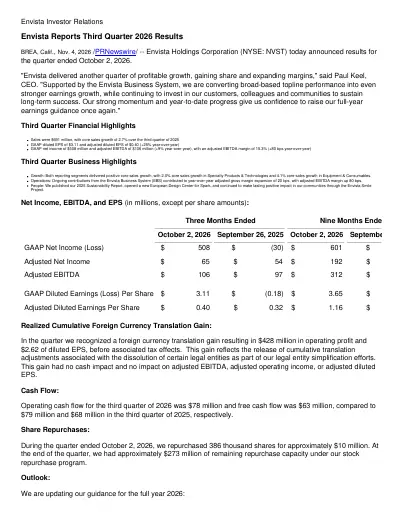
As shown on slide 4, we delivered core sales growth of 2.7% in Q3, with adjusted EBITDA growth of 9% and adjusted EPS growth of 25%. On a global scale, we did not observe any material shifts in the dental market in Q3 relative to the first half of the year.
From a sector perspective, insurance-covered categories like prevention, diagnostics, and restoration displayed their characteristic resilience, while more elective categories like ortho and implants continued to run below their higher historical trends. From a geographic perspective, developing markets, excluding China, continued to grow most quickly, followed by Europe.
As indicated in the latest ADA survey, on a relative basis, the US market remains soft, as macro uncertainty is impacting both patient and clinician confidence. China was also slow in Q3, as it is now in the middle of two dental VBP processes, of which I'll say more shortly.
Specific to our business, we continue to generate growth across the portfolio, with both reporting segments and all major geographies aside from China once again in positive territory. As has been the case now for the past several quarters, we converted good top-line performance into even stronger earnings growth.
Behind continued factory and G&A productivity, gross and EBITDA margins grew 20 and 80 basis points, respectively. EPS grew 25% in Q3 and is up more than 40% year to date.
Free cash flow conversion remained strong in the quarter, supporting continued share repurchases. Net debt to adjusted EBITDA now stands at 0.6 times.
Based on our strong momentum and year-to-date performance, we are once again raising our full-year profit and EPS guidance. Our updated 2026 expectations call for core growth of 3.75% to 4.25%, adjusted EBITDA growth of 12.5% to 14%, and adjusted EPS of $1.54 to $1.58, up more than 10% at the midpoint from our initial 2026 guide.
Eric will say a bit more about the assumptions underlying our revised guidance in his section. Let's now turn to the progress we're making in support of our priorities of growth, operations, and people.
Starting with growth, Spark was up high single digits, diagnostics and implants were both up mid-single digits, and consumables grew low single digits against a high 2025 comp and following a strong H1. Geographically, developing markets ex-China were up high single digits, Europe grew in the mid-single digits, and consistent with my earlier comments, North America was up low single digits.
Coming back to China, as expected, our business contracted at a low double-digit rate in Q3, principally driven by preparations for VBP, which is now underway. We expected a roughly $10 million impact from VBP in Q3, and that is about how things played out.
The latest government communications point to mid-December timing for results to be announced, although as we know, due to the complexity of these processes, VBP timelines often run long. We expect VBP implementation most likely to commence in the first half of 2027.
Turning now to operations, we continue to make progress on multiple fronts, underpinned by our Envista business system. Our price, procurement, and factory productivity efforts once again offset inflationary pressures and helped to deliver gross and EBITDA margin expansion that I noted earlier.
We continue to make good progress on the tax front as well, with our effective tax rate down in the quarter almost 6 points versus Q3 of 2025. With respect to people, progress also remained strong.
Last quarter, we opened a new European design center for Spark in Madrid, complementing facilities already operating in North America and Asia. We conducted more than 40 kaizen events in Q3, including a CEO kaizen that I was honored to host, covering a half dozen projects across three continents.
We also published our 2025 sustainability report, detailing the work we're doing to expand access to dental care, reduce environmental impact, and further increase investment in our colleagues and communities. Specific highlights include a 17% year-over-year reduction in lost-time injuries, a 19% reduction in water consumption, and a 40% reduction in waste generation.
The report also outlines the important work we're doing through the Envista Smile Project, serving close to 20,000 patients last year alone. We further built on this momentum in Q3 of this year, delivering care across multiple US locations as well as internationally in Ghana, Mexico, Honduras, and Costa Rica.
As we covered in some detail at our capital markets event in September, innovation is foundational to Envista's long-term growth strategy. We launched a number of new products across the first half of this year, and our momentum continued in Q3 with several additional high-impact introductions.
Slide 6 highlights just three of these. On the far left, NOMAD Pro 3 is the next generation of our handheld X-ray system that created the category, bringing high-quality imaging directly to the chairside.
Pro 3 delivers improved image quality with optimized exposure presets designed to support faster, more consistent workflows. As safety is fundamental in imaging, NOMAD Pro 3 is engineered with multiple layers of protection and delivers 10 times less redirected radiation than the leading competitor.
In the middle of the page is our new Ultralight HDL prismatic loupe, the latest innovation from Orascoptic. Prismatic loupes are used by clinicians for more specialized procedures to achieve superior image clarity at higher magnification.
The new Ultralight HDL platform delivers this performance with a significantly lighter design, resulting in better ergonomics and greater comfort. Finally, the frame on the right provides an overview of our new Endo module for DTX Studio.
This module uses AI-assisted canal segmentation to identify and characterize precise tooth anatomy. Resulting insights help customers with clinical decision-making, treatment planning, and patient communications.
Root canal treatment is amongst the most common of endodontic procedures, with over 15 million performed last year in the US alone. While general AI diagnostics are increasingly common in competitive systems, the depth and specificity of our latest Endo module is unique and compelling.
Early feedback from clinicians has been encouraging. Consistent with innovation's central role in our growth agenda, we have meaningfully increased new product investment each of the last 2 years.
The returns from these investments in terms of growth, brand, and share gains are becoming increasingly clear. Our new product pipeline has never been richer, and we'll continue to share our progress as programs develop.
Having now provided an overview of the quarter, I'll turn the call over to Eric to walk us through the numbers.
Eric Hammes
Thanks, Paul. Third quarter sales were $691 million, up $21 million from the prior year.
Core sales grew 2.7%. Total growth was 3.2%, with neutral FX and a slight tailwind from acquisitions.
As Paul noted, growth was well balanced across the portfolio by business, by geography, and between volume and price. Developed markets grew mid-single digits, while emerging markets grew low single digits all in, or high single digits excluding China.
China declined double digits, driven by the orthodontics channel reducing inventories in preparation for VBP. Adjusted gross margin expanded, reaching 56.3% in Q3, a 20 basis point increase over last year that was driven primarily by price and factory productivity.
Adjusted EBITDA increased 9% to approximately $106 million, with a margin of 15.3%, up 80 basis points. Volume, price, and productivity each contributed to our profit growth and margin expansion, more than offsetting the headwinds from China, as well as our continued investment for growth.
Adjusted EPS was 40 cents, up 25% from Q3 of last year, driven by both improved operating profitability and a lower tax rate. You may have noticed that the GAAP financials in our earnings release reflect the realization of a large foreign currency gain in net income and EPS.
This gain is the result of an international legal entity dissolution, which relates to the significant intercompany loan resolution announced in Q3 of last year. Overall, this change aligns with our strategy of simplifying our legal entity structures.
Important to note, the GAAP gain was a non-cash event and is not reflected in our adjusted net income or adjusted EPS. Free cash flow was $63 million, representing 97% conversion of adjusted net income.
Now let's turn to our bridges, starting with growth. Core sales grew 2.7% in the quarter, and total revenues grew by more than 3%.
Volume was the largest single contributor to growth, adding approximately $13 million before the separately shown impact of decreasing China sales. Price was positive again in Q3, delivering $12 million of sales increase year-over-year.
Acquisitions contributed approximately $3 million over the prior year. The integration of our Versa acquisition continues to go well, with growth and profitability both ahead of plan.
FX was neutral to revenue in the third quarter. Finally, China was a revenue headwind of approximately $7 million, as implant sales growth in the quarter was more than offset by brackets and wires destocking in preparation for VBP, consistent with the expectations that we communicated back in September.
Slide 9 shows the drivers of approximately $9 million increase in adjusted EBITDA. Price contributed approximately $12 million.
Net productivity added approximately $2 million, while volume net of mix added $1 million. Note, the volume impact year-over-year includes the positive impact from strong growth in developed markets and the majority of emerging markets, offsetting the headwinds in China.
As with revenue, FX was roughly neutral to EBITDA in the quarter. We continue to invest in new product and commercial capabilities to support future growth, a year-over-year incremental outlay of approximately $6 million in Q3.
Overall, our adjusted EBITDA margin was 15.3% in the quarter, an improvement of 80 basis points over last year, reflecting solid price growth and productivity while investing in the business. Turning to segment performance, in the third quarter, Specialty Products & Technologies revenue was $444 million, up nearly 3% year-on-year, with core growth of 2%.
In Orthodontics, Spark sales again grew high single digits. Conversely, brackets and wires were down high single digits, principally due to VBP preparations in China.
Implants grew mid-single digits, with growth across all geographies and positive growth trends from new product introductions, regenerative biomaterials, and the Versa acquisition. Adjusted operating profit was $67 million, a margin of 15% compared to 15.5% a year ago.
Contributions from price, volume, and Spark factory productivity were offset by growth investments globally and VBP preparations in China. Moving to Equipment & Consumables third quarter performance, we delivered over 4% core growth, with consumables growing low single digits and diagnostics up mid-single digits.
Diagnostics growth was solid across geographies and the portfolio, with growth in hardware, software, and services. We once again gained share in the diagnostics category, as our integrated offering supports both quality of care and practice productivity for clinicians.
Adjusted operating profit in this reporting segment increased more than 15% over the prior year, supported by volume, price, and operating efficiency. Now I'll turn to cash flow and our balance sheet.
Q3 free cash flow was $63 million, including roughly $16 million in tariff refunds, offset by $14 million of net CapEx. We have now received refunds for essentially all IEEPA tariffs paid in 2025, and as a reminder, we do not include these amounts in our adjusted P&L results.
We repurchased around 400,000 shares of stock in the quarter, returning roughly $10 million of cash to shareholders. Our balance sheet remains strong, with net debt to EBITDA of approximately 0.6 times, providing both stability and capital deployment flexibility.
As Paul mentioned, we are raising and narrowing our full-year guidance. We now expect core sales growth of 3 and 3/4 to 4 and 1/4 percent, compared with our prior range of 3.5% to 4.5%.
We expect adjusted EBITDA growth of 12.5% to 14%, moving to the upper half of the range we provided last quarter. Our updated adjusted EPS range is $1.54 to $1.58, compared with our prior range of $1.50 to $1.55.
We continue to expect free cash flow conversion of approximately 100% for the full year. A few thoughts underpinning this revised guide: at the midpoint, our guidance implies slightly negative core sales growth in the fourth quarter.
As we outlined at the start of the year, Q1 had four more selling days than in the prior-year period, while the fourth quarter will have four fewer. Excluding this impact, implied fourth quarter core growth would be consistent with our full-year range.
As we now anticipate VBP implementation in the first half of 2027, we expect no significant VBP-related impact in the fourth quarter. With the recent strengthening of the US dollar, we expect foreign exchange to reduce reported fourth quarter revenue growth by approximately 1 percentage point.
Acquisitions should contribute approximately half a percentage point, about the same as Q3. We expect our full-year tax rate of around 25.5% of adjusted pre-tax income, consistent with Q3 and the year-to-date average.
Summarizing our Q3 financials, we once again delivered good all-around performance. With that, I'll turn the call back over to Paul.
Paul Keel
Thanks, Eric. A few closing thoughts before we open it up for your questions.
Market conditions in Q3 were largely unchanged from H1. Macro uncertainty remains high, and we expect this to continue in Q4.
As was the case in Q1 and Q2, we delivered solid top-line performance this quarter, with even stronger EBITDA and EPS growth. We expanded gross and operating margins while continuing to invest in future growth.
Behind good momentum and year-to-date performance, we are again raising our full-year 2026 earnings guidance. Our plan is working: grow our impact with customers, continually improve operations, and actively support our people, who make all this progress possible.
That completes our prepared remarks for today. We'll now open it up for your questions.
Operator
Thank you. Ladies and gentlemen, we will now conduct a question-and-answer session.
If you would like to ask a question, please press star one on your telephone keypad. A confirmation tone indicates your line is in the question queue.
You may press star two if you'd like to remove your question from the queue. For participants using speaker equipment, it may be necessary to pick up your handset before pressing any keys.
One moment, please, while we poll for questions. The first question comes from Brandon Vazquez with William Blair.
Please go ahead.
Brandon Vazquez
Hi, everyone. Thanks for taking the question.
Wanted to start a little high level. Appreciate you guys aren't giving '27 guide at this point, maybe we won't get too many specifics.
Can you at least talk a little bit about puts and takes and going into 2027 and what kind of opportunities you have here to kind of keep the momentum you've been building over the past couple of years?
Paul Keel
Sure. Good afternoon, Brandon.
Thanks for kicking us off. Let's see.
Maybe to start at the highest level, our value creation plan is working pretty well, so as they say, we'll keep working the plan. Maybe just to recap progress since we first introduced the plan about 2 years ago, year-to-date 2026 core growth is up over 6 points from where we were the same period in '24, and year-to-date EBITDA dollars have grown over 50%.
Now to be fair, 2024 was a fairly modest starting point, but nonetheless, our progress has been steady, momentum is good, and Q3 provided further evidence that our plan is working. With that as a backdrop, I'd point to a couple of things we need to accomplish in '27 to keep the momentum going.
Let's see. First, on the growth front, in addition to maintaining our improved new product development cadence, we also need to deliver on the commercialization side of the equation.
As we covered during the capital markets event back in September, we launched a good number of new products over the past couple years. For example, in implants, we launched S-Series, Empreo, and SmileGrid.
In diagnostics, we have all-new platforms for CBCT, IOS, and 2D handheld, plus a number of new AI software offerings. In ortho, there's a half dozen or so additions to Spark plus a novel new adhesive platform.
In consumables, we've launched new solutions in Resto, Endo, lights, and loupes. That's a lot of new product introductions.
While we're encouraged by early market uptake, to be honest, most of these programs are still well below their full long-term potential. In 2027, in order to scale these platforms, we really need to commercialize well, and that's a team sport.
Sales, marketing, regulatory, customer service, manufacturing, everyone plays a role here. In terms of operations, I think I'd give our teams high marks on driving G&A productivity.
As that's down as a percent of sales almost 3 points in 2 years. That's helped us deliver predictable earnings growth, but it's also helped fund the double-digit increases in R&D and sales and marketing that we've talked about, which in turn of course is key to growth acceleration.
As important as G&A productivity is COGS productivity, and we allowed our gross margins to compress about 3 points from 2022 to 2024. We were able to stem that decline last year, and then as we talked about in our prepared remarks, we've now posted three consecutive quarters of gross margin expansion.
We've been able to do this in parts of our portfolio. Spark, for instance, being a particularly good example.
In 2027, we have to do it more broadly across our portfolio. We have good enterprise-wide efforts underway in price, in procurement, and in factory productivity, I'd say we have good line of sight to further progress in 2027, but of course we got to make it happen.
Then finally, with respect to people, this is another area of strong focus for us. Many of our peer dental participants are now in the early innings of leadership transitions.
We went through ours a few years back, and the stability that we now have is really helpful in terms of speed, in terms of execution, engagement, etc. Maybe to illustrate the point, our employee scores have increased for three consecutive years.
We put in place a number of new talent development programs to deepen our bench, and we have further stepped up investment in our communities through the Envista Smile Project. In short, I guess, as you see, we have a lot of work to do in 2027.
To be clear, we're mindful of the headwinds that we all face: macro volatility, the relative US dental market softness, inflationary pressures, etc. We'll cover the details of our 2027 outlook on the Q4 call, but momentum is pretty good for us, and the fundamentals are generally moving in the right direction.
Thanks again for the question.
Brandon Vazquez
Got it. Thanks.
Operator
Thank you. The next question comes from Tycho Peterson with BMO Capital Markets.
Please go ahead.
Tycho Peterson
Hey, good afternoon. Congrats on a nice quarter and all the progress you've made here.
Paul, I'm not sure who this question is for, but with net leverage at 0.6 times EBITDA, just help us understand how you prioritize additional repurchases, bolt-on M&A, debt reduction, and internal investments. I'm just curious why repurchasing stock is currently more attractive at these levels.
Thanks.
Eric Hammes
Thanks for the question, Tycho. Listen, first off, I would say we're tracking with the spirit of your question.
As we've been working the last few years very much internally, getting our growth consistently in a positive direction. I think we've shown many, many quarters in a few years of that, getting our profitability up, generating cash flow.
Admittedly, our focus, while having capital allocation priorities, has been building the fundamentals of the business to be able to then support an advancement, if you will, of those allocation priorities. As a reminder, we've been pretty consistent.
The three priorities we have are investing organically in the business. That clearly won't consume all of our capital, and you've seen I think a proof point and a track record of that, as we've doubled or put, let's say, double-digit increases in our R&D year-over-year the last few years, and then continue to invest in commercial.
M&A is our second priority. We've been rebuilding the pipeline there.
Three good acquisitions, but bolt-on acquisitions, primarily in the implant space the last year, all of those performing well. As we build that capability, right, as we understand better the market, where we want to acquire, how to integrate well, and how to make sure that we're sharp in where we look to acquire, portfolio compliments and geographic expansion has been the two places we've talked about.
We'll continue to roll out more there, but we will be careful with how far, how fast we go. I think we've prudently added a return of capital, a return to shareholder, to our capital allocation playbook.
We want of course to be able to return cash to shareholders. We have a strong balance sheet.
We've told I think the Street and yourselves that we'll probably do that at a rate of around a third of our annual free cash flow. I think that suggests as well that our capital allocation priorities will lean towards organic and M&A.
The M&A side of the house, as you all know, takes time, right? Maybe there's a slightly larger acquisition we can do.
We've talked about the challenger implant space. We'll continue to be active in good geographic expansion opportunities.
That will come over a period of time as we lean into buying back our shares. We do that at a pace and a rate that keeps us still, I think, consistent with our organic and M&A priorities for capital allocation.
Operator
Hello, Tycho?
Tycho Peterson
Hey, thanks. Can I ask one more then?
I'm going to ask one more if you don't mind. You said that price contributed about $12 million in Q3.
I'm just curious how sustainable that pricing contribution is heading into 2027 and then what happens to margins if pricing moderates? Thank you.
Paul Keel
Many of us on the leadership team have been in dental for a long time, and prior to COVID, kind of the stable algorithm was that dental pricing would run 100 to 150 basis points. For people newer to the category, that was disrupted in COVID, it was disrupted in a lot of different categories, and it wasn't really until mid-2024 that at Envista, we again started to focus on price.
We've built all kind of the basic fundamentals of how you have a good price strategy and execution in a company. We configured our ERPs to capture it, we put price on all the P&Ls, we put it in everyone's objectives, etc.
Then that price activity accelerated in 2025 as tariff activity picked up. Across 2025, pretty much every dental participant raised price, starting with the providers.
The stable sort of model is that the manufacturers raise price at maybe half the rate of what procedure prices go up. Procedure prices in turn are informed by reimbursement increases.
Writ large, think of that as about 3% year-on-year. A stable dental market, the insurers are reimbursing at about a 3% rate, increased rate.
Procedure prices are going up by about 3 points, and manufacturers are raising by about a point to a point and a half. Of course, you saw much bigger numbers than that, Tycho, over the last year or a year and a half, first because of tariffs, then because of inflation.
I think the market will settle back into that 1 to 1.5 points. Specific to us, take out China, and you should expect about the same thing.
China represents 7, 8% of our sales. Half of that is in ortho, and we think ortho VBP is going to cut price by about 50%.
If you run the algebra on that, we'll have a 1-year price offset in China that'll be basically equal to the point, point and a half increase everywhere else. Let me pause there and see if that gets at your question.
Tycho Peterson
That's super helpful. Thank you.
Operator
Thank you. The next question comes from Jeff Johnson with Baird.
Please go ahead.
Jeff Johnson
Paul, maybe I'll just follow up on that last question, then I have one other follow-up as well. You just talked about China, 7, 8% of your revenue, price cut maybe 40 to 50% in ortho, offsets kind of other pricing actions next year.
Is that price headwind from China VBP not being realized in the $7 million figure you recognized here in 3Q? Was that just an inventory drawdown, and we expect a priced-in headwind from China VBP next year?
Just help level-set us on exactly where the pricing dynamics and/or just overall China VBP headwinds come in and go out of the model maybe over the next four quarters or so.
Paul Keel
That's a good question, Jeff. They are related, but distinct effects.
What happened in Q3 is the government formally started the two VBP processes. It begins with the government asking the manufacturers to submit what portfolios they want to participate in VBP.
The second step is then they ask the public hospitals and participating private clinics to submit their historic usage and their future demand forecast. That's where we're currently sitting in the process.
When you kick it off, it formally begins the destocking of the channel. Neither manufacturers nor the distributors want to have excess inventory in the channel, because it all gets revalued once that new price comes out, in this case, 50% less, and then there's a negotiation between supplier and distributor who pays for that revaluation.
That is the $7 million net that we talked about in Q3. We expected it to be a $10 million reduction in channel inventory in Q3 specific to ortho.
We had a little bit of growth on our implant side, and the net was $7 million. The second effect here is going to happen once the third step in the VBP process happens.
That's when the government invites the manufacturers to formally bid, and they announce the winners at that new price. We think again that's going to be 50% lower for ortho, 10% to 15% lower for implants, and that will be the price impact next year that I referenced in the prior question.
Jeff Johnson
Do you still expect in implants that 10% to 15% price down to be made up by incremental share, and then in ortho, probably can't make up 50 points of share, and I know in past conversations maybe not expecting end markets to accelerate dramatically if patient pricing doesn't change? Just how do we think about that 50% price down in ortho and the 10% to 15% in implants?
What's your latest thinking? I know we've talked about this 8 million times, but what's your latest thinking on how that flows through to overall China revenue, for example, in 2027?
At one point, I think you had talked about China being up in 2027 year-over-year. It sounds like now maybe China down year-over-year in 2027, at least in the early phases.
Just help us with the updated comments there. Thanks.
Paul Keel
Yeah. Jeff, you'll know this, but maybe in the interest of completeness, the healthcare reform that the Chinese government executes, basically has three upsides for participating manufacturers in exchange for the reduction in price.
In some cases, some VBPs, they lower the total procedure price. That's what happened in VBP 1, which leads to a big increase in patient demand.
In the case of the first implants VBP, it essentially doubled patient demand, and so the suppliers who prevailed in the process got twice as much volume. That's the first upside.
The second upside is that the government reduces the number of suppliers who are allowed to sell to the public hospitals, and that the excluded share from those who don't prevail is redistributed across the winners, you get extra volume from that. Then the third, in this particular case, the government isn't reducing the procedure price, but they are breaking the materials costs and the procedure costs out on the patient invoice.
They will reduce the material costs, and the patient will see that, which will lead to a reduction in total costs, but it won't be as significant as VBP 1, where the procedure cost was also cut in half. That's kind of the bargain for those who want to participate in VBP.
Typically, a high-share player comes out with more share at the end, and then the net of those three effects that I just described indicates what the volume change to the winning bidders are.
Jeff Johnson
Any response on just China being neutral next year, good guy, bad guy to growth overall?
Paul Keel
We think our ortho business will grow. This is the first VBP, we think will benefit from that.
We think we're going to grow on the implant side as well. Net-net in terms of growth, we think of VBP as a good guy.
In terms of margin, we think of it as a bad guy.
Jeff Johnson
Thank you.
Operator
Thank you. The next question comes from Elizabeth Anderson with Evercore.
Please go ahead.
Hey, Paul and Eric. This is Ali on for Elizabeth.
Thanks for taking my question. Looking back at pricing again, I'm curious on if customers are understanding of the impacts of the inflationary environment and are you seeing a greater degree of product switching as a result?
Paul Keel
I guess I'd say two things. Yes, customers are very aware of what's happening in the different pricing environments.
They're very aware of changes in insurer reimbursement to them. They're very aware of the procedure price changes that they initiate.
Depending upon the category, they're more attuned to price increases by suppliers. In most procedures, the material cost is a small percentage.
In some, it is a negligible percentage. If you have a category that is in a covered procedure where materials costs are a very small percentage of the total procedure cost, think of a basic restoration, getting a cavity filled, that would be a relatively price-inelastic category.
The procedure is reimbursed, the doctor had an increase in reimbursement, and the materials are a tiny fraction of the cost. The other end of the spectrum would be an uncovered procedure where the material costs are not insignificant.
Say you're doing a full arch restoration, four to six implants, an entire prosthetic, and the procedure's likely not reimbursed in full. In that case, price sensitivity would be greater to a doctor.
The net of all that is in most of '25 and here for the first three quarters of '26, dental inflation has been running above its historic trend, consistent with Tycho's earlier question. We think that's going to moderate to more kind of traditional levels here rolling into '27 and beyond.
That makes sense. Thank you.
Operator
Thank you. The next question comes from Jon Block with Stifel.
Please go ahead.
Jon Block
Thanks, guys. Good afternoon.
Maybe two for me, and I'll break them apart. Just first, Paul, Spark, high single-digit growth now for a handful of quarters once we ex out the deferred.
Solid taking share, growing north of market. Can you remind us of where the Japan opportunity sits, the timing, and how do we think about that?
Is that something that can take that division and reaccelerate it back to low double digits, or is that something that maybe allows you to sustain that high single-digit growth once you open up that incremental opportunity? Then I'll ask a follow-up.
Paul Keel
Spark, you're correct. Consistent high single-digit grower.
We think the category for clear aligners is probably more like mid-single-digit growth, yes, we continue to capture share there. Specific to Spark, it is a big clear aligner market.
I wouldn't know exactly where it would stack up in terms of specific country market size for clear aligners, but certainly top 10, probably top 5. Our rough number is it's probably a $200 million clear aligner market.
We started with zero share, launched in January, it's growing very, very quickly, and we expect to compete for as much of that $200 million as we can get.
Jon Block
Fair enough. Then you might have answered my second question earlier, but I'll sort of ask it anyway.
I was going to ask for 2027 moving parts. There's been a lot of talk on the revenue impact for VBP, but I was going to ask what about on the margin side of things?
Do we have to be aware of any headwinds there, as a function of VBP, or do you think margin expansion can continue? Maybe I'll ask the question and then almost answer my own one based on your earlier color.
Is the thought that VBP '27 is a tailwind relative to where it was in '26 on the top line, but it's a headwind in '27 relative to '26 on margins? Is that sort of what shook out earlier and just asking for clarity there?
Thanks.
Paul Keel
Yeah. Let me do my best and then maybe I bail and have Eric give you the details.
You're asking about the margin impact in 2027 from VBP. First, just to kind of set the frame, again, China, think of it as 7% of sales, of which 40% of that is ortho, 3% of sales is impacted by VBP.
We think the price is going to drop 50% on that 3% of sales, and all of that will come out of gross margin. Yes, it is a headwind, clearly for ortho in China, it's a headwind for margins in China, and it's a small headwind for total Envista.
Offsetting that, we expect to continue getting margin expansion outside of China, and so I would expect our total margin expansion to more than offset the impact of ortho VBP in China. Said another way, you should expect continued gross and EBITDA margin expansion from total Envista in 2027.
I'm just looking at Eric to see if that's close enough.
Eric Hammes
Jon, I think Paul got it right. Maybe one just piece of data, we've talked about this before on prior calls and conferences, recognizing that all VBPs are not exactly the same.
Our implant 1.0 experience, if you will, was a version of what Paul just described. We got price down through the VBP.
We were able to get volume and share capture. That maintained the operating profit levels of our implants business in China at roughly the same dollars with a margin rate degradation within there, okay?
We expect something not dissimilar for the basket of ortho and implants in 2027. I would even point to just an example of what Paul just described playing out.
In third quarter, we had good margin expansion, on relatively good growth while absorbing another version of what we're just talking about here. We did have profits in China reduced as a result of the slower growth.
That put a little bit of pressure on our margin rate. We've had programs, right, whether it's other core growth categories, factory productivity, G&A, procurement, the things that we've talked about externally, that are helping us to get profit growth across Envista and a bit of margin rate expansion.
I think our experience in China leads us to believe the confidence level to do that is high. We'll get some growth.
We'll maintain profits roughly neutral, and we'll probably see a rate reduction in China alone from that.
Jon Block
Okay. That was great.
That was the color I was looking for. Thanks, guys.
Operator
Thank you. The next question comes from Lily Lozada with J.P.
Morgan. Please go ahead.
Lily Lozada
Hi, great. Thanks for taking the question.
Not to beat a dead horse, but another clarification on VBP, with the headwind in the third quarter, I think the guide now implies a step-up in growth ex selling days in the fourth quarter on a organic basis. I know a lot of that rests on some of those VBP revenues starting to come back, can you just speak to your visibility and confidence in those revenues coming back in the fourth quarter?
I think the prior commentary was some in fourth quarter, some in early 2027. What's the latest there?
Is all of that step-up in growth explained by VBP, or is there anything else to keep in mind as we think about organic growth in the fourth quarter?
Eric Hammes
Lily, I can just give you a couple points on that. Earlier in the call, if you didn't catch it in the pre-read remarks, Paul basically reinforced what we expected to see in Q3 relative to ortho VBP.
We talked about roughly a $10 million number in mid-September in a couple public investor conferences. That did happen, so that part of the equation played out like we said.
During those same conferences, we said, based on the timing of VBP, we felt like the majority of that would come back in Q4. That's probably shifted a little, right?
Also in the pre-read remarks, what we confirmed is we think VBP in China's likely in late Q4, but that means that the impacts on price and channel sort of going here through the end of the quarter are likely to be kind of insignificant, right? Things kind of moving sideways just because of the likelihood of a late VBP Q4 implementation and or the possibility of it moving into 2027.
I'd say no significant sequential impact moving from Q3 to Q4 in terms of channel or pricing or volumes. Maybe that means there's a little bit of that kind of benefit that we were projecting into 2027, but you got to put a question mark around it just based on the timing of things.
Lily Lozada
Got it. Then separate question on margins.
You had a pretty sizable step-up in Equipment & Consumables operating margin this quarter, hoping you can unpack that a little bit more. What's step-up and what's the right level to be thinking about for this business moving forward?
Thanks so much.
Eric Hammes
The first thing I think I would say is the margins in the quarter, if you're thinking about margin rates going forward for E&C, I would say it was a very strong margin quarter, but it's not inconsistent with how we see the E&C business going forward, right? A couple reasons for that.
We do still continue to see stability in the dental market in consumables. That means that we see our consumables business as being a call it a solid low single-digit grower.
That's what we said in our investor day in September. We're also relatively upbeat about our diagnostics business and the comprehensive solutions, right?
The combination of hardware, services, and software, giving us the ability to grow. I would also just add to that that in third quarter, and really just year-to-date through E&C, some of the things that drove our margin performance, price, volume, some really good work in terms of new products and the cost structure of those new products, primarily in diagnostics, right?
Those are all sustaining profit levers and/or margin rate levers. I wouldn't judge a quarter, sort of individually as the new benchmark, but we don't see a significantly different trend as we look at E&C over the call it the next multi-quarter horizon.
Operator
Hello, Lily?
Lily Lozada
Oh, sorry. I'm all set.
Thank you.
Operator
Thank you. The next question comes from Michael Cherny with Leerink Partners.
Please go ahead.
Ahmed
Hi, good evening. This is Ahmed on for Mike.
Congrats on a great quarter. You mentioned that you are gaining share in the diagnostic space.
Can you speak more towards what's driving that and what is your expectation for the category in 2027, and specifically as it relates to the innovation, especially with new AI functionality? Has that also been a meaningful helper in getting better growth at better profitability?
Paul Keel
Yeah. You are correct.
In diagnostics, I guess I'd bifurcate the world into two geographic groups: developed markets and developing markets. We're particularly strong in developed markets, and the biggest diagnostics market is North America, where we're particularly, particularly strong, where the number one player.
We have the largest installed base globally. That's the first advantage.
In some cases, a clinic will actually be architected and built around the imaging equipment, and so if you're the installed base, when it comes time to update equipment, just the engineering of it, you have an advantage. Second is we are the most active from a new product perspective.
Our kind of role in the market is as the innovator. I mentioned in the prepared remarks, or maybe it was actually Brandon's first question, we updated all of the major platforms in our portfolio over the last 2 years: CBCT, IOS, and handheld 2D.
Doctors are interested in increased functionality in devices and that helps. A third advantage we have is a full sort of integrated portfolio.
We don't just do the hardware. We also do the service and the software that integrates the workflow.
As dentistry becomes increasingly digitized and workflows become increasingly digital, if you're the hardware, you're the software, and the service, you get a wider and wider moat. Our diagnostics business, again, in North America started out as number one, but has actually been gaining share for those three reasons that I just described.
Ahmed
Great. If we thinking about 2027 again, can you speak towards the efforts you're making on the commercialization front, especially as it relates to DSOs or other channel partners, anything to call out on the positive end or things that you're working to improve for the next year?
Paul Keel
Yeah. Maybe think of commercialization along three axes: think of it geographically, think of it as customer type, and then think of it as go-to-market model.
Geographically, every new product launch has a built-in series of commercialization opportunities. As you get the product registered in more countries, the registration timelines are different country by country.
You just have a built-in opportunity if you have the global reach and the capabilities to get it registered in every country, and you have market access to scale it, that is a gift that keeps on giving. The second you referenced in your question is customer type.
Different products are more attractive to different customer types. Some are very attractive to multi-clinic players like a DSO, some are more designed for an individual stand-alone clinic.
Going back to that workflow component, that typically is even more attractive to a DSO that manages a network of clinics, whereas the individual device features would be the first thing an individual clinician would look at. Then the third element is whether you sell it direct or whether you go through distribution, and then that informs how you scale up the product.
If you're selling it direct, you have complete control, your marketing strategy, your sales training, etc. If it goes through distribution, the programs would be done in collaboration with your distribution partner.
Ahmed
Great. Thank you so much.
Operator
Thank you. The next question comes from Jason Bednar with Piper Sandler.
Please go ahead.
Jason Bednar
Hey, good afternoon. Thanks for taking the questions.
Paul, since you opened the door here on margins for '27, I'm going to walk through it, if you don't mind. The expected margin offsets to VBP that you referenced for next year, does that come from harvesting some of the investments that you and Eric made over the last couple of years?
Can you speak to maybe the sensitivity of that expected margin improvement to the dental macros just still being somewhat sluggish here?
Paul Keel
Yeah. At the Envista level, as you're thinking about modeling margin next year, just take our medium-term outlook and the math that it describes.
That will get you to the right place. The VBP margin impact from the ortho price down, will not interrupt that overall algorithm.
Jason Bednar
Okay. All right.
Maybe follow up offline. I got a couple other follow-ups to that.
I did want to ask on consumables as well. Low single-digit growth in the third quarter.
Can you talk about how volumes performed across your major geographies? I think you said growth across all of them, but I think you were also probably picking up some price as well.
Correct me if I'm wrong on that. I'm just trying to understand more on a volume level, not just a revenue level, how consumables are performing across your major end markets.
Paul Keel
Let me start with the Envista answer, cuz those numbers are more readily in my head. It is true that Envista grew in every major geography, with the exception of China.
In some cases, like India, it was double-digit growth, or in Latin America. In some cases, like North America, it was low single-digit growth.
Now specific to consumables, I don't have at my fingertips consumables every country, but it was broad-based growth for consumables. You are correct that it slowed in Q3 relative to the high single-digit rate in H1 and the very strong performance in 2025.
That was principally driven by a couple of factors. The first is the high comp.
The second is just category performance. Consumables as a category tend to be low single-digit market growth.
The trade-off there is that it's a much more stable low single-digit grower. You get more stability, but you get kind of less of the upside.
The third reason, coming back to an earlier question, is that category pricing was above trend over the last 18 months for the reasons that we've discussed on a number of calls, and that is now beginning to moderate. In particular, the tariff-related price increases of early 2025 have now been fully lapped.
Those come out of the base.
Jason Bednar
All right. Thank you.
Operator
Thank you. I will now transfer the call over to Paul for closing remarks.
Please go ahead, sir.
Paul Keel
Okay. Thanks everybody for your questions, and today let me just underline a couple of thoughts, and we'll wrap it up.
First, we delivered another quarter of core sales growth, with contributions from both reporting segments and most major geographies. Second, our strong operations helped convert that growth into even higher adjusted EBITDA and EPS growth, and we continued to invest in innovation, commercialization, and talent development.
Third, we maintained focus on our growth, operations, and people priorities. The product launches and operational improvements that we discussed on today's call are all good examples of that progress.
Finally, our performance and momentum support an increase again in our full-year earnings outlook. I think we'll leave it there for today.
Thanks again for your interest in Envista. Have a good day and a great week, everyone.
Operator
Thank you. Ladies and gentlemen, this concludes the conference call for today.
Thank you for participating. You may now disconnect your lines.