Nextpower Inc.
Q2 FY2027 · Earnings Call TranscriptOctober 28, 2026
Operator
Good afternoon everyone, and thank you for standing by. My name is Hillary, and I will be your conference operator today.
Today's call is being recorded. I would like to welcome everyone to Nextpower's second quarter fiscal year 2027 earnings call.
After the speakers' remarks, there will be a Q&A session. If you would like to ask a question, please raise your hand.
If you have dialed into today's call, please press star nine to raise your hand and star six to unmute. At this time for opening remarks, I would like to pass the call over to Ms.
Sarah Lee, Head of Investor Relations. Sarah, you may begin.
Thank you for standing by. We will just pause this broadcast momentarily before proceeding with the opening remarks.
Sarah Lee
Thank you, and good afternoon, everyone. Welcome to Nextpower's second quarter fiscal year 2027 earnings call.
I'm Sarah Lee, Nextpower's Head of Investor Relations, and I'm joined by Dan Shugar, our CEO and Founder; Howard Wenger, our President; and Chuck Boynton, our CFO. As a reminder, there will be a replay of this call posted on the IR website along with the earnings press release and shareholder letter.
Today's call contains statements regarding our business, financial performance, and operations, including our business and our industry, that may be considered forward-looking statements. Such statements involve risks and uncertainties that may cause actual results to differ materially from our expectations.
Those statements are based on current beliefs, assumptions, and expectations, and speak only as of the current date. For more information on those risks and uncertainties, please review our earnings press release, shareholder letter, and our SEC filings, including our most recently filed Quarterly Report Form 10-Q and Annual Report on Form 10-K, which are available on our website at investors.nextpower.com.
This information is subject to change, and we undertake no obligation to update any forward-looking statements as a result of new information, future events, or changes in our expectations. Please note we will provide GAAP and non-GAAP measures on today's call.
The full non-GAAP to GAAP reconciliations can be found in the appendix to the press release and the shareholder letter, as well as the financial section of the website. Now I'll turn the call over to our CEO and Founder, Dan.
Dan Shugar
Good afternoon, and thank you for joining us. We're very pleased to report another quarter of strong execution and record financial results.
Before discussing the company's performance, I'd like to remind everyone we will be hosting our Capital Markets Day in Las Vegas at RE+ on November 16th. We look forward to sharing our progress on our 2030 outlook and the long-term strategy we unveiled last year, both of which have accelerated meaningfully.
Given that upcoming event, we'll keep our prepared remarks brief today. Now turning to our Q2 performance, Nextpower delivered record financial results in the second quarter.
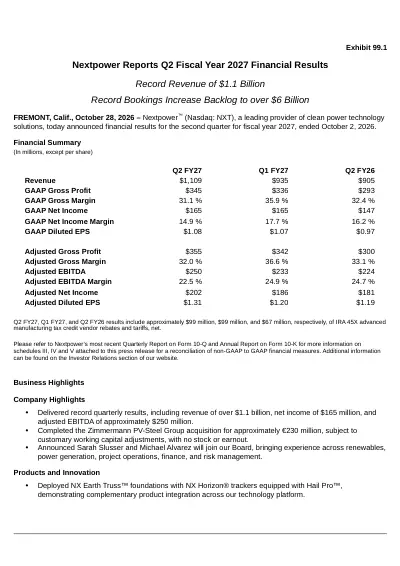
Revenue was over $1.1 billion. Adjusted EBITDA was approximately $250 million, and we had record quarterly bookings, growing our backlog to over $6 billion.
Our core tracker business strengthened further, extending the momentum from the first quarter of fiscal 2027. We continue to see strong customer demand for our tracker products and solid execution across our global operations.
At the same time, demand for our non-tracker products is ramping fast and accounted for approximately 22% of revenue this quarter. Energy storage contributed approximately $100 million of revenue and more than $20 million of adjusted EBITDA, including revenue from a behind-the-meter storage project for a Tier 1 hyperscaler's AI data center.
We also achieved record bookings in our foundation and eBOS businesses, with eBOS bookings over $100 million in the quarter. Additionally, we secured a 1.1 GW inverter framework agreement covering five projects, and we shipped our first Nextpower-branded power conversion system to customers in the quarter.
These results reflect the value of our customer relationships, differentiated technology, and execution discipline. Customers are looking for partners who can help them accelerate project schedules, reduce risk, improve economic outcomes, and execute at scale.
Our strategy remains grounded in that customer-led approach: expanding our participation across the project life cycle, solving important customer problems, and growing profit dollars while maintaining attractive margins. Electricity demand continues to accelerate, driven by end uses such as electric mobility, industrial growth, and reindustrialization, and the rapid build-out of AI data centers.
Solar and storage are the fastest, lowest-cost, and most scalable ways to add new capacity. We believe Nextpower is well-positioned to help customers meet these needs as the market moves toward terawatt-scale deployment.
Finally, before turning the call over to Howard to discuss customer demand and commercial developments from the quarter, I want to thank our customers for their continued partnership and trust, and our employees for their passion in driving innovation and customer satisfaction.
Howard Wenger
Thank you, Dan. Q2 was another great quarter, as we saw strong demand in both the U.S.
and rest-of-world markets, with bookings well over $1 billion in the quarter. Tracker sales drove sequential backlog growth to a new record exceeding $6 billion, while our non-tracker businesses continued to gain momentum.
Customers choose Nextpower because of our technology, execution, supply chain, bankability, and customer focus. We believe these attributes are reflected in our growing backlog and leading market position.
Our eBOS business delivered record bookings of over $100 million for the quarter, a clear proof point of our ability to integrate and scale acquired businesses. Our patent-pending NX PowerMerge solution was a material portion of these bookings, and we are off to a great start having secured over 2 GW of firm orders.
Further, we have now deployed PowerMerge at commercial scale and achieved an important milestone with a 100% pass rate in post-installation functional and quality testing at the project site. Our foundations business also achieved record quarterly bookings, reflecting growing traction for Nextpower solutions addressing all soil conditions.
Finally, on the new product line front, we are pleased to announce a 1.1 GW inverter contract, which marks a major milestone in the build-out of the Nextpower technology platform. Regionally, the U.S.
remained our largest market, accounting for approximately 82% of quarterly revenue. As a complement to our very strong U.S.
market position, we continue to expand our international business. After quarter-end, we completed the acquisition of Zimmermann PV-Steel Group, which will significantly increase our European market footprint as well as adding structural solutions to our product portfolio, with products such as fixed-tilt, agri-PV, and wire management.
Zimmermann brings more than 20 GW of cumulative project experience and established customer relationships, and extends our reach into 15 additional countries, growing our global footprint to 68 total countries. This acquisition broadens the range of ground-mount solar applications we can serve and creates an opportunity to attach products across our platform through an extended European channel.
Turning to project timing, our projects are large scale and typically span multiple quarters and years. It is normal for our projects to accelerate or push out based on things like weather, project schedules, and permits.
Project timing for this quarter follows this pattern, with manageable movements across a large and diverse portfolio of customers and geographies. As Chuck will explain, we expect that our second-half revenue will be weighted more toward Q4 deliveries due to project timing factors.
Average project sizes for both solar and storage are expanding in key regions with increasing attention to bankability and quality. This dynamic further plays to our strengths.
We believe we are positioned well for the future with our technology, track record, customer relationships, and expanding product portfolio. We are excited by the multiple new growth vectors we have added in the past 18 months, including eBOS, power conversion, and storage, and we look forward to sharing more with you at our Capital Markets Day in Las Vegas.
With that, I will now turn the call over to our Chief Financial Officer, Chuck Boynton.
Chuck Boynton
Thank you, Howard. As Dan mentioned, Q2 was the strongest quarter in the history of Nextpower, with revenue of over $1.1 billion, up 23% year-over-year, and adjusted EBITDA of approximately $250 million, up 12% year-over-year, and driving a 23% adjusted EBITDA margin.
Adjusted free cash flow was approximately $135 million for the quarter and $240 million year-to-date, which helped to fund our acquisitions and stock repurchases in the quarter. We ended the quarter with over $1 billion of cash and no debt.
As our platform expands, we are managing the business for the long term with a focus on cash generation and driving adjusted EBITDA dollars while investing in future growth. The quarter included for the first time contribution from Nextpower Energy Storage.
Our storage business delivered a very strong quarter, with approximately $100 million of revenue and more than $20 million of EBITDA. The sales pipeline is strong, and we are on track for a solid second half of the year.
We also closed the acquisition of Zimmermann last week. We expect this acquisition to be accretive out of the gates.
The total deal consideration of €230 million is lower than we've previously announced and was changed to an all-cash deal. We are also reducing our expectations for this business to approximately $100 million of revenue and $10 million of adjusted EBITDA for the balance of the fiscal year.
This transaction, while small, is strategic as it expands and diversifies our TAM with new products and new markets, leverages fixed costs, and allows us to drive attachment of our new suite of products, such as eBOS, power conversion, foundations, and storage. Driven by strong execution and bookings across all our businesses, we are increasing our fiscal year 2027 outlook.
We expect revenue of $4.2 billion to $4.45 billion, adjusted EBITDA of $890 million to $940 million, and adjusted diluted EPS of $4.61 to $4.87 per share. We are also increasing our free cash flow estimates from $450 million to over $500 million.
We will expand on our financial outlook at our Capital Markets Day on November 16th. Based on current customer delivery schedules, we expect second-half revenues to be more heavily weighted toward Q4, with Q3 revenue down sequentially from our record Q2, but up approximately 10% year-over-year.
This dynamic sets us up for a very strong finish to the fiscal year, with potential record revenue and adjusted EBITDA in Q4. Now some details on what we see for second half of the year and first part of fiscal 2028.
We are building out the NX power conversion product line for both solar and storage. Over the next 12 months, we expect to invest approximately $40 million of CapEx to build out our U.S.
manufacturing plant and, as previously disclosed, expect a P&L impact of approximately $50 million, primarily R&D and COGS, as we ramp and scale this business. This ramp recently started and is accelerating since we closed the transaction in Q2.
We expect to ship products by the end of next summer and achieve over 10 GW of capacity by the end of calendar 2027. On the supply chain side of our business, we are seeing significant cost increases in diesel, steel, freight, and logistics.
Our globally distributed supply chain allows us to partially mitigate the impact of these cost increases and helps protect Nextpower and our customers. We treat our customers as partners and are working with them to share the increased costs where appropriate.
These dynamics are not new to our industry. At times they are headwinds, and other times they are tailwinds.
We expect logistics and freight costs to eventually revert back to a more normal baseline, but likely beyond our fiscal year 2027. For full year 2027, we continue to expect adjusted gross margins in the low 30s and adjusted EBITDA margins in the low 20s, while in the back half of the year we expect adjusted gross margin and adjusted EBITDA margin to be in the high 20s and high teens respectively.
We are investing for the future in both R&D and M&A, but also buying back stock to offset dilution. We remain focused on long-term growth of both free cash flow and EBITDA dollars.
With that, I'll pass it back to the operator for Q&A.
Operator
Thank you. We will now begin the question-and-answer session.
Please limit yourself to one question and one follow-up. If you would like to ask a question, please raise your hand now.
If you have dialed into today's call, please press star nine to raise your hand and star six to unmute. Please stand by while we compile the Q&A roster.
Your first question comes from the line of Philip Shen from ROTH Capital. Your line is open, please go ahead.
Philip Shen
Hey guys, thanks for taking my questions. Can you hear me okay?
Chuck Boynton
Yes.
Philip Shen
Great. Okay.
On bookings, congrats on the very strong bookings quarter. Just want to make sure we got our math right.
We have greater than $1.6 billion in bookings. Are we close?
Then if you can give us a sense for what the non-tracker contributions were to the bookings number, eBOS was $100 million, but were there dollar contributions from BESS and inverters? Then going forward, would you expect this strength to continue in FQ3?
Thanks.
Howard Wenger
Hey, Phil, this is Howard. As we noted in our letter and in our remarks, over $1 billion in bookings, and I will say that it was well over a book-to-bill of 1, well over that.
Non-tracker bookings in the quarter were greater than 20%. We're very pleased with the performance there and adoption of other elements of our platform.
As far as the outlook, we have a lot of momentum there, both on the tracker front, a lot of demand for that, as well as our non-tracker elements. We're feeling very good about the quarter overall, the demand environment both in the U.S.
and in select markets internationally, and overall just a very strong bookings and sales quarter across the board.
Philip Shen
Great. Thanks, Howard.
Second question here is on margins and the margin trend here. Clearly, back half is weaker.
Can you give us a sense for the drivers? Is it the other kind of new businesses that's bringing margin down?
We wrote a little bit about the shortage of truck drivers causing maybe an increase in freight rates by 20%. Is that a headwind in your FQ2, 3, or 4 kind of period?
If so, when can that resolve? Then if you can, give us maybe a little bit of a peak, Chuck, you talked about in your prepared remarks, into FY '28, can you give us a feel for do margins improve from the FQ3/4 levels, or do you think they stay kind of in that range for FY '28?
Thanks.
Chuck Boynton
Thanks, Phil. We'll address '28 at Capital Markets Day in a couple weeks, we're going to keep this call limited to talking about this current fiscal year.
On the back half, yeah, it's going to be quite a strong back half. If you look at the overall margin profile, it's a little bit lower than where we were in the first half, but for the year, the structural margins are intact.
It's important to think of our business on an annual or multi-year basis, you can't look at one quarter in isolation or even two and draw a conclusion. Having said that, we've seen significant inflation in things like diesel and freight, logistics, and steel.
That's not a surprise to people. What we're seeing is effectively the margin impact kind of quarter-over-quarter Q2 to Q3 is really a story of those cost increases that I think beyond '27 should stabilize.
It's hard to predict when that will happen. Our assumption is they stay elevated in the back half of the year.
The other part of the margin impact, as we've talked about, are really investments for the future. Think about that as mix of new products to our older products, and ramping these new product categories.
What's really exciting, if I look at something like foundations or eBOS, those margins initially out of the gates are low, but as you perfect the technology, ramp and scale, margins improve. We've seen that over and over again with the various deals that we've done going back years and years.
This is really an exciting time for us because we're injecting hardcore engineering into these new products. That creates durable advantage, and durable advantage manifests in terms of higher gross margins.
Operator
Your next question comes from the line of Dimple Gosai from Piper Sandler. Your line is open, please go ahead.
Dimple Gosai
Hi, good evening, Howard and Dan. Thanks for taking the question here.
Just coming back to the cadence of new orders here, project timelines, whether so forth, is any of the delay today tied to module supply or commerce's Section 232 and customers waiting for some type of clarity before December, or permitting, interconnection? How do you feel about confidence on 4Q execution versus slippage into '28?
Then I have a follow-up. Thank you.
Howard Wenger
Hi, Dimple, this is Howard. We are seeing continued demand strength.
When you talk about 232 and modules, we're talking about the U.S. here now.
We're seeing continued demand strength in the U.S., both on the bookings, and we're managing to customer schedules when it comes to the P&L. We can have some movement across quarters, and we've talked about that before.
As far as the modules go, we're not seeing significant pain there in terms of near-term projects, and there's nothing to indicate to us right now that there are concerns for Q4 execution. Suffices to say that the 232 and tariff is having an impact on module pricing.
That's going to kick in further in December. A lot of what we're hearing when we talk with owners is they've largely secured supply for safe harboring, and also on the panel side, and we're not hearing that there are breaks in contracts or anything like that.
This is very predictable at the moment.
Dimple Gosai
Okay. I think and
Howard Wenger
on the permitting side, that was another thing that you asked about, there are some projects that are impacted with permit delays, but there are other projects that are accelerating. For us, for our company overall, we're seeing across a broad portfolio of projects, we're able to manage our outlook in a way that we're able to provide predictable results, just like we did this quarter, where we again beat plan and had a great quarter.
We're not seeing permitting being a material impact to our outlook.
Dimple Gosai
Very good. Thank you, Howard.
Then the follow-up is just non-tracker mix is up from 14% to 22%, which you spoke about. Does that mean that there is more acquisitions or slower tracker growth?
How should I be thinking about that on a '27 basis? It was a lot bigger than I had anticipated, which is great, but just how to think about it on a go-forward?
Howard Wenger
No, we're seeing strong tracker growth. In fact, our record backlog of over $6 billion would have been over $6 billion without the storage acquisition.
We're feeling very good about the core business. It's really the backbone of our overall solution, and that's driving attach.
We feel confident about the growth in tracker. Clearly, the new acquisitions are going to grow much, much faster because you're starting with a small base.
The 22% is a solid number, and hats off to our storage team for delivering a fantastic quarter as well.
Operator
Your next question comes from the line of Ben Kallo from Baird. Your line is open, please go ahead.
Ben Kallo
Hey, good evening, guys. Thanks for taking my question.
Maybe first just with Zimmermann closed, could you just loop that in with the international opportunity that you see, and what that acquisition helps with on that front? How we should think about that, I know you're going to do that analyst day coming up here, but anyway we should think about that kind of mix going on a go-forward basis, and where that Zimmermann helps you out?
Then I have a follow-up.
Howard Wenger
Thanks for the question, Ben. Howard here.
We're really excited about this acquisition, and very pleased that it's closed. It had to go through some government approvals, and we've got all those, and we're off to the races now.
We have a great team there. We've really gotten to know them well, and that's the first thing we look at with every acquisition that we do is will that team perform?
Do they fit into our culture? Do they have the same ethics?
We've got that in the Zimmermann team. That's foundational.
They have a really excellent footprint in Europe that's complementary to ours. They're very strong in Germany, for example.
A very material part of their business is in Germany. They have a strong brand, the Zimmermann brand in Germany is very well known.
They're a leader in structures in Germany for solar, both in DG and ground-mount, and utility scale, both in fixed-tilt and tracker. That's very complementary.
In fact, they're adding 15 countries to our active country list, we're now in 68 countries. They brought 15 countries, very complementary on the market footprint.
Then they've got products that are complementary to ours. We don't have a fixed-tilt product in Nextpower; they do.
They have some agri-PV products that are very interesting and complementary. They have a wire management system.
They have a number of things that they're doing that we can cross-sell on. Then their team can cross-sell on our products.
We're going to extract a lot of synergies there on the sales side, market side, cost side with our supply chain. We have a much bigger supply chain footprint than they do.
Unlock synergies across the board in products, market, and cost, and winning. We're very excited about that.
Thanks for the question.
Ben Kallo
Thank you. Just as a quick follow-up, maybe Chuck on the fuel costs, and maybe Dan, Howard too, just how is it possible to negotiate a pass-through on fuel costs similar to other raw material costs that are pass-throughs, or just kind of any kind of appetite for that from customers on a go-forward basis, obviously with old contracts it's probably impossible.
Dan Shugar
Hey, Ben, this is Dan. Great question.
First off, let's pull back and contextualize. We've seen large increases in logistics costs and steel, similar to the early days of the pandemic.
What's different now is that we strategically built out our domestic supply chain to provide a natural hedge to that, because we're manufacturing finished goods much closer to the project sites. Our total logistics spend on a per-unit basis is way down from what it was, protecting our customers and Nextpower from the lion's share of what would have been a really huge spike in logistics.
Diesel year-to-date is up roughly 80% as a result of the Gulf War, okay? We've massively reduced it, but we still have to get finished goods from a factory to a job site.
As mentioned earlier on this call by Phil Shen, it was a bit of a double hit, because you had reported over 15,000 truckers that were disqualified from driving in the United States due to English language speaking requirements, combined with this massive increase in diesel. It does have an impact.
It typically would be a relatively minor impact on the overall cost of the system. In this case, with that combined impact, it was pretty significant.
We're considering ways to work with customers. Unlike other things like steel, there's not readily available logistics commodity indices that one could easily apply and without overly complicating things.
We're taking a look at that. I think the main thing is, when this happened before, we still made money, but we suffered, 5 or 6 years ago, a disproportionately higher impact.
We made strategic moves to reposition our supply chain closer to our customers, both in the United States as well as other major markets. We protected customers.
We think our strategic footprint provides us an advantage. Customers are better served by working with us.
That generally is delivering a lot of value for customers, as evidenced by our record bookings last quarter and continued growth of our backlog, which went up from over 5.5 billion to over 6 billion in a single quarter.
Operator
Your next question comes from the line of Christine Cho from Barclays. Your line is open, please go ahead.
Christine Cho
Good evening. I just wanted to start on this energy storage comment of $100 million of revenue and $20 million of adjusted EBITDA.
Are these the sort of economics that we should assume for this business? If you could just maybe talk about how you expect the cadence to go, is it going to move around depending on customer delivery?
Can you also talk about the opportunity for LTSAs with this business? If so, does the $100 million include any LTSAs?
Thank you, and I have a follow-up.
Chuck Boynton
This is Chuck, Christine. Thank you.
The $100 million is a number of customers, but primarily one larger customer, Tier 1 data center hyperscaler customer. Depending on the application, you'll see different margin ranges.
At the initial announcement of the acquisition, we did outline a model where the operating margins or EBITDA margins would be in kind of the mid-teens. This is a bit higher, and you'll see some fluctuations over time depending on the applications and where we're selling.
Dan Shugar
I'll pile on there, building on Chuck's comment. We just couldn't be more pleased with the performance of the energy storage unit, our first quarter after closing this, transaction.
It's really a testament to the outstanding team, that we have, the legacy Prevailon team that's in, domiciled in Florida predominantly. The other thing, this this team has a lot of know-how, and I would also point out that, as Chuck mentioned, on a previous call, the the overhead structure They're very efficient.
They know what they're doing. They're very efficient.
The overhead structure is in the mid-single-digit areas for that unit, and, we're really excited. We've we've had a a lot of customer engagement on the, the battery offering, and there's, seems to be, tremendous appetite for what we can bring to that market.
The margin profile is a function of the use cases and the the end customer profile, and, the market is is definitely ramping strongly, and we're, fielding many, many inquiries from qualified customers that really appreciate our investment-grade status. Then
Chuck Boynton
Christine, your your part the other part of your question on the LTSA side, immaterial, for the quarter. What I would say is we're very excited about the long-term opportunity for LTSA for both power conversion and for storage.
We think that as an American company, that's will provide a significant value, to our customers long term by providing those services agreements across the portfolio.
Christine Cho
Great. Then just as a follow-up, a clarification question.
I think you guys said that the Zimmermann deal closed after the quarter, does the backlog and updated guidance incorporate Zimmermann, or does it exclude it? I think you said $100 million of revenue and $10 million of adjusted EBITDA for balance of the year.
If we could get a backlog number, and then, I'm sorry, was the Prevailon backlog included last quarter, or was it added this quarter?
Chuck Boynton
On the backlog, Nextpower Energy Storage was not in the opening numbers for Q2, because that deal closed in Q2. We've added it to our end of Q2, but as I mentioned before, even without their backlog, we'd be over $6 billion in backlog.
We said over $6 billion, but with or without, it's still over $6 billion. Then, yeah, Zimmermann is included in our outlook, but their backlog is not included in our backlog.
They're more of a turns business, I don't expect that to be a very material impact to our backlog when we report in Q3.
Operator
Your next question comes from the line of Mark Strouse from J.P. Morgan.
Your line is open, please go ahead.
Mark Strouse
Great. Good afternoon.
Thanks for taking our questions. Maybe just following up on Christine's question there on Zimmermann.
Chuck, I think you mentioned that you lowered the consideration. You also are lowering the financial impact from what you talked about back in June.
Can you just give a bit more color on what's going on there?
Howard Wenger
This is Howard, and then Chuck can follow up. We announced the deal in June, and we just closed it, I don't know, a week or two ago, couple weeks ago.
A few months went by, and during that interval, we looked very closely at their backlog, their forecast, their pipeline, and we conformed it to the way we look at things and how we put forecasts together. As a result of that, we've updated our outlook for them, and we updated the deal consideration accordingly.
The deal is still accretive to the company. The fundamentals of the deal are intact.
Nothing fundamental has changed. The pipeline is there, etc.
It's just a different way of forecasting. They had a very strong first half, and the outlook looks very good for Zimmermann.
We just want to reiterate that their business has been around for quite some time, very mature leadership. They make money.
They're very much like us, but they're a private company, and now they're part of a public company. Chuck, did you want to add anything?
Chuck Boynton
No, you said it well, Howard. Thank you.
Mark Strouse
Okay. That makes sense.
Thank you, Howard. Then can I ask, the 1.1 gig inverter contract that you got, has that been in the works for a while, or did that potentially come about because of the FCC ban, or the bulk power executive order?
Just trying to get a sense if you're starting to see some traction because of the political environment.
Dan Shugar
Hey, Mark, this is Dan. That opportunity has been in the works for a while.
We try to ask customers in every meeting, "What are your biggest pain points?" That particular customer told us, "Inverter, inverter, inverter," a while back.
That request from that customer and a few others that we hold in highest regard really motivated us to move forward with an inverter offering, which we take very, very seriously. We're really focused on delivering products that, when you look back at the performance on an annualized basis, they do to inverter what our tracker system does to tracker, and some of our other products do in their areas, which is deliver unrivaled top-tier global performance that helps customers realize more energy from their solar power plants.
Now the FCC ban that came out, and some of the cybersecurity and BPO concerns we've seen coming, add a tremendous tailwind to our decision. That decision was made several years ago to launch in this space.
We went through quite a diligence process. We looked at I think the entire industry.
We're also incubating a next-generation product to continue working on that. We really see now a tremendous need in the U.S.
market and potentially European market and other places. I want to underscore that the technology we acquired, it's a skid.
We have a 4.6 MW PV inverter skid with a parallel architecture that we and customers really like, and we have a 5.2 MW battery power conditioning skid that has a similar architecture. We have both UL listing on that inverter.
We shipped our first UL-listed units to the United States with Nextpower brand recently, and we've shipped IEC-listed units to the global seas market. We're in market.
We're building out double-digit capacity in the United States for a new factory that will be operating next summer, as we've discussed, and we're seeing tremendous interest from our customers for that product line. The timing is really perfect.
The fundamental need was for bankable, reliable suppliers that delivered very, very high reliability. That drove it, and then all these other tailwinds are complementary to the decision we were in the process of making.
Operator
Your next question comes from the line of Brian Lee from Goldman Sachs. Your line is open, please go ahead.
Brian Lee
Hey guys, good afternoon. Thanks for taking the questions.
Maybe just going back to some of the questions around the energy storage segment, I know the shareholder letter mentioned a BTM project. Be curious if you guys had any additional commentary you can provide around kind of the outlook in terms of traction for data center/hyperscaler wins, maybe color around customer engagement there specifically.
Dan Shugar
First off, Brian, as mentioned on the prior call, this is such an exciting category and something at least I didn't anticipate a few years ago that a battery inverter system could do something to help new customers come online to the grid that the grid can't do and a rotating machine can't do. If you have these loads like a data center with learning models, the building can go from 0 to 100% in fractions of the second.
We measure these in tens of milliseconds, these huge swings in power. For this type of technology, the grid could not support without massive reinforcement, some of these particular loads.
Rotating machines, you can't put a rotating generator out there, be it a turbine or recip engine, to support those loads, it'll physically damage the machine. It's a very, very exciting new category, because it's kind of like a new pie.
You have this situation where customers want to get connected, okay, number one. Number two, it's really hard to build new electric transmission, distribution substations, okay?
Point three, this technology is available and can deliver quick. That helps these customers get on.
There's a bigger macro here, which it not only helps those customers get on, but now you have typically a couple hours of battery storage. Now you can actually, they can use more solar as part of their overall energy mix.
We're very pleased. I spoke with the hyperscaler in diligence of this when we were considering acquiring the former Prevailon unit, now Nextpower Energy Storage.
They were very complimentary on the technology, and had witnessed factory acceptance testing, and recently The product is called the Hybrid Power Stabilizer, and you can see that on our homepage. It just recently passed full-scale testing at a major national laboratory, which is really exciting.
The tech works. It's UL listed.
We have both a DC block and an AC block UL listed to be able to support a variety of use cases and configurations for customers, and have a team very experienced battery storage professionals that successfully delivered 38 projects over the last eight years. Now with this new data center segment growing quickly, we provide a solution to help them come online, which also then provides help for additional renewables to deal with the intermittency issue.
We just couldn't be more excited about that.
Operator
Your next question comes from the line of Julien Dumoulin-Smith from Jefferies. Your line is open, please go ahead and select star six to unmute.
A kind reminder to, oh. Julien,
Carter Goldman
please unmute.
Operator
Please go ahead.
Carter Goldman
Hey, sorry about that. This is Carter Goldman on for Julien.
Just a follow-up on the inverter business, the 1.1 GW framework agreement, over what time period would that deliver? Then if we zoom out a little bit, the 10 GW you're talking about for next summer, how should we think about the ramp in volumes there?
Obviously there's a lot of demand coming with the inverter ban, but does that show up in '27, or is that a little bit longer-dated? Just on the ramp there would be helpful.
Dan Shugar
Thanks. We'll be providing more color on the ramp at Capital Markets Day in three weeks from now.
We are going to start delivering units this summer, they'll be shipping to job sites. I think that's as far as I'm prepared to go right now on that.
Very exciting stuff, timing is perfect, and we're really focused on quality, reliability, and making sure our customers' needs are met.
Operator
Your next question comes from the line of Corinne Blanchard from Deutsche Bank. Your line is open, please go ahead.
Corinne Blanchard
Hey, good afternoon, everyone. Thank you for the time and taking the question.
Maybe two distinctive question. The first one on the upcoming midterms election, do you have any view on maybe what can be the outcome there, 45X, maybe tax credit being extended?
I think those are the kind of talks that we have been hearing from the Congress. Then maybe the second question, coming back on the international revenue, maybe can you comment, what's your view or expectation as a percentage of total revenue maybe for the rest of '27 and '28, and the margin impact from having that international diversification?
Dan Shugar
Thanks, Corinne. I'll speak high-level about the 45X, and then Howard jump in on the international markets.
Look, I think with respect to the manufacturing credits, they're really strongly supported across the aisle. We've seen incredible job growth here, as in the U.S.
with new manufacturing build-out. Nextpower has catalyzed new or expanded existing facilities with over 35 factories shipping finished goods.
It's a huge thing just what we've done. We've seen on the solar panel manufacturing side just very exciting activity.
We think over time, we'll see the U.S. again enjoy a robust module manufacturing environment.
Over time, that'll help costs come down for domestically made product. We see it as sort of a supply security, national security issue that's being supported for solar, for storage, and for critical power infrastructure.
We're doing our part, obviously, with the inverter. We expect our inverter program to participate in the 45X.
We've seen strong support for it. We're not calling the outcome of the election.
I will say, we gave a presentation at the BNP conference a few weeks ago. One of our customers spoke there, and he said generally the market tends to overreact to both on the positive and the negative side to what's happening federally.
Mostly the action is at the state level, I'll just leave that there. Howard, international?
Howard Wenger
I'll take it.
Dan Shugar
Thanks, Chuck.
Howard Wenger
Corinne, yeah, international is quite frankly having a really nice kind of run here. We saw in Q2 international was up 25% quarter-over-quarter, whereas the U.S.
business was up 17%, both impressive numbers. We're excited to see acceleration of international, and then when we add in Zimmermann, we'll see yet even more international.
We're really excited about that. This is part of an intentional diversification play.
For the full year, it looks to be about 80/20, but the back half, it'll be more high 70s for U.S. and kind of low 20s for international.
We're really pleased with the team for executing and accelerating international. The only thing, this is Howard, I might add is with storage, it's mainly focused right now in the U.S., and so that could skew the percentages somewhat.
Operator
Your next question comes from the line of Chris Dendrinos from RBC. Your line is open, please go ahead.
Chris Dendrinos
Great. Thanks for taking the question.
Just one for me and, I think your last commentary is a good segue into this and, can you maybe just talk about the cross-sell opportunities here over in Europe right now and what kind of products are positioned to go to market and sort of leverage that Zimmermann relationship today? Thank you.
Dan Shugar
Yeah. Just generally speaking, both for the Nextpower legacy and Zimmermann teams in Europe, and we have significant teams there, we see a lot of opportunity to extend beyond the tracker.
We're doing that with foundations first, kind of go from the tracker outwards to the inverter and then storage, and that's been the sequence. We're also looking at bringing eBOS, and then one of the things that we're quite interested and excited about, we're getting a lot of demand pull for, are in specific countries that have excess solar generation during the day, they're looking at increasing storage.
Places like Germany and Spain, as examples, are quite interesting for storage, and that's part of our go-to-market plan. That's not something that will hit revenue in our fiscal year 2027, but we would expect to see that fiscal year 2028, and we'll have more color at our Capital Markets Day in Vegas in just a few weeks.
Operator
Your next question comes from the line of Sean McLoughlin from HSBC. Your line is open, please go ahead.
Sean McLoughlin
Thank you. Good afternoon.
I just wanted to come back to the cost inflation part, just understanding, first of all, what level of cost sharing you think you have with your customers. Secondly, thinking about the commodity side, what is your level of indexation?
What has changed effectively in terms of your ability to protect yourselves against things like steel price volatility if we think back to 2022? Lastly, has anything changed in your discussions with customers when factoring in higher costs?
Chuck Boynton
Certainly. First on the freight and logistics, as Dan mentioned, we have an advantage with our model, which protects us and our customers given the 100-plus factories we have around the world with our partners.
Those are costs that basically we build into projects and quotes, and those quotes could be a year old or 6 months old, and they typically have not fluctuated that much. We could do some sort of hybrid derivative contracts, but I think it would be too difficult and too risky.
Those are just costs that, in general, for long-term contracts, that we will absorb, and for ones that are in flight, we would share with our customers. In terms of steel, we do have cost-sharing arrangements that are structured, and we've talked about this before in our BCA contracts, but it depends on the timing, and there are other components that are not part of the BCA contract.
Operator
There are no further questions at this time. I will now turn the call back to Dan for closing remarks.
Dan Shugar
Thank you all for thoughtful questions and your continued interest in Nextpower. We're focused on executing against the opportunities in front of us, and basically strengthening demand in our core tracker business, bringing our expanded inverter power conversion product to market, and helping customer meet growing needs about solar, storage, and power conversion.
We'll continue to invest thoughtfully, scale with discipline, and keep our focus for delivering for customers and creating long-term value for shareholders. We hope to see you all at our upcoming Capital Markets Day.
Thanks for dialing in.
Operator
This concludes today's call. Thank you for attending.
You may now disconnect.