Old Dominion Freight Line, Inc.
Q3 FY2026 · Earnings Call TranscriptOctober 28, 2026
Operator
Good day, and welcome to the Old Dominion Freight Line third-quarter 2026 earnings conference call. All participants will be in listen-only mode.
Should you need assistance, please signal a conference specialist by pressing the star key followed by zero. After today's presentation, there will be an opportunity to ask questions.
To ask a question, you may press star then one on your telephone keypad. To withdraw your question, please press star and then two.
Please note this event is being recorded. I would now like to turn the conference over to Jack Atkins, Director of Finance and Investor Relations.
Please go ahead.
Jack Atkins
Thank you, Dave. Good morning, everyone, and welcome to the third-quarter 2026 conference call for Old Dominion Freight Line.
Today's call is being recorded and will be available for replay beginning today through November 4th, 2026, by dialing 1-855-669-9658, access code 1955363. The replay of the webcast may also be accessed for 30 days at the company's website.
This conference call may contain forward-looking statements within the meaning of the Private Securities Litigation Reform Act of 1995, including statements, among others, regarding Old Dominion's expected financial and operating performance. For this purpose, any statements made during this call that are not statements of historical fact may be deemed to be forward-looking statements.
Without limiting the foregoing, the words believes, anticipates, plans, expects, and similar expressions are intended to identify forward-looking statements. You are hereby cautioned that these statements may be affected by the important factors, among others, set forth in Old Dominion's filings with the Securities and Exchange Commission and in this morning's news release.
Consequently, actual operations and results may differ materially from the results discussed in the forward-looking statements. The company undertakes no obligation to publicly update any forward-looking statements, whether as a result of new information, future events, or otherwise.
As a final note before we begin, we welcome your questions today. We ask that you limit yourself to just one question at a time before returning to the queue.
At this time for opening remarks, I would like to turn the conference over to our President and Chief Executive Officer, Marty Freeman. Marty, please go ahead.
Marty Freeman
Good morning, everyone, and welcome to our third-quarter conference call. With me on the call today is Adam Satterfield, our CFO, and after some brief remarks, we will be glad to take your questions.
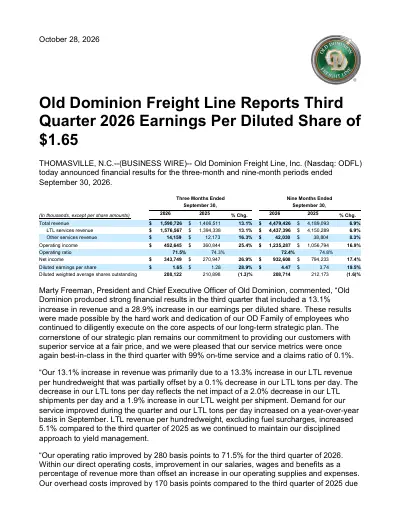
Old Dominion produced strong financial results in the third quarter that include a 13.1% increase in revenue and a 28.9% increase in earnings per diluted share. In addition, our operating ratio improved by 280 basis points to a 71.5.
While the underlying macroeconomic environment remains stable, demand for our service continued to improve during the quarter, and our LTL tons per day increased on a year-over-year basis in September. The strength of our third-quarter results is due to hard work and dedication of our OD family of employees, who continue to execute on the fundamental aspects of our long-term strategic plan.
I want to thank our outstanding team for their dedication and commitment to our customers and our company. Our ongoing focus on providing our customers with superior service at a fair price is the cornerstone of our long-term strategic plan.
Our ability to consistently deliver the highest standard of service through the ups and downs of the economic cycle has created an unmatched value proposition in our industry, and this is something that we take tremendous pride in. As a result, in the third quarter, we were pleased to once again provide our customers with on-time service of 99% and a cargo claims ratio of 0.1%.
That said, we also know that there is much more to providing best-in-class service to our customers than simply picking up and delivering freight on time and without damages. During its annual survey of shippers and logistics professionals, Mastio & Company measures 28 different service and value-oriented attributes.
We were honored earlier this month to be named the number-one national LTL provider for the 17th consecutive year. In addition, we finished first in 24 of the 28 categories that Mastio evaluates, and we increased our already sizable advantage against our competition.
Our teams remain highly motivated to continue delivering superior customer service every single day. We know that the strength and consistency of our service drives value for our customers and differentiates us from our competitors.
It also supports our long-term pricing initiatives. Our disciplined approach to yield management, which focuses on individual account-level profitability, is designed to offset our cost inflation over the long term while also supporting our ability to make strategic investments back into our business.
Our ability to take a long-term approach to the investments in our network, our people, and our technology provides us with significant flexibility to respond quickly to changes in the operating environment. This flexibility allows us to support our customers with the capacity that they require while also continuing to effectively manage our costs.
As a result, we once again generated strong operating leverage on our incremental revenue this quarter. We produced strong third-quarter results by remaining focused on executing our long-term strategic plan.
Due to our disciplined execution and consistent investment, we have all the necessary elements of capacity in place to effectively handle incremental volume opportunities while also continuing to operate efficiently. In addition, our business model contains significant operating leverage, which will allow us to further improve our profits as we regain density in our network.
As a result, we continue to believe that we are uniquely positioned within our industry to win market share, generate profitable revenue growth, and increase shareholder value over the long term. Thank you for joining us this morning, and now I will turn it over to Adam to discuss our third quarter in greater detail.
Adam Satterfield
Thank you, Marty, and good morning. Old Dominion's revenue increased 13.1% to $1.59 billion for the third quarter 2026, while our operating ratio improved to 71.5%.
The combination of these factors resulted in a 28.9% increase in our earnings per diluted share to $1.65. The improvement in our revenue for the quarter was primarily due to a 13.3% increase in LTL revenue per hundredweight.
While our LTL tons per day decreased 0.1% for the third quarter, we were pleased with the continued improvement in demand for our service that contributed to a 1.6% year-over-year increase in our LTL tons per day for the month of September. On a sequential basis, our revenue per day for the third quarter increased 2.4% when compared to the second quarter 2026, with LTL tons per day increasing 1.2% and LTL shipments per day increasing 2.4%.
For comparison, the 10-year average sequential change for these metrics includes an increase of 2.4% in revenue per day, a decrease of 0.2% in LTL tons per day, and an increase of 1.2% in LTL shipments per day. The monthly sequential changes in LTL tons per day during the third quarter were as follows: July decreased 0.5% as compared to June, August decreased 1.6% as compared to July, and September increased 3.9% as compared to August.
The comparative 10-year average change for these respective months is a decrease of 3.0% in July, flat in August, and an increase of 3.1% in September. While there are still a few workdays remaining in October, our month-to-date revenue per day has increased by approximately 22% when compared to October 2025.
This includes an increase in our LTL revenue per hundredweight as well as an increase in our LTL tons per day of 1.6%. Based on these results, I currently anticipate revenue of $1.54 to $1.58 billion for the fourth quarter, which would be above our normal seasonality.
As usual, we will provide the actual revenue-related details for October in our third-quarter Form 10-Q. Our operating ratio improved 280 basis points to 71.5% for the third quarter 2026, with improvements in both our direct operating cost and our overhead expenses as a percent of revenue.
Within our direct operating cost, improvement in our salaries, wages, and benefits as a percent of revenue more than offset an increase in our operating supplies and expenses. Our team has continued to leverage the quality of our revenue growth while also operating very efficiently to support this improvement.
The increase in our operating supplies and expenses as a percent of revenue was primarily due to the increase in the cost of diesel fuel and other petroleum-based products. The improvement in our overhead cost as a percent of revenue was primarily due to the overall decrease in our depreciation expense that's attributable to the decrease in the size of our fleet as compared to last year.
With that said, we are confident that we continue to have plenty of service center and equipment capacity to accommodate additional growth opportunities. The improvement in our overhead cost also reflects the leverage gained from our revenue growth as well as a continued focus on controlling our discretionary spending.
Old Dominion's cash flow from operations totaled $469.5 million for the third quarter and $1.1 billion for the first nine months of 2026, respectively, while capital expenditures were $67.1 million and $206.7 million for those same periods. We utilized $160.9 million and $400.6 million of cash for a share repurchase program during the third quarter and the first nine months of 2026, respectively, while our cash dividends totaled $60.0 million and $180.7 million for those same periods.
Our effective tax rate for the third quarter of 2026 was 24.5% as compared to 24.8% in the third quarter 2025. We currently expect our effective tax rate to be 24.8% for the fourth quarter 2026.
This concludes our prepared remarks this morning. Operator, we'll be happy to open the floor for questions at this time.
Operator
We will now begin the question-and-answer session. To ask a question, you may press star then one on your telephone keypad.
If you are using a speakerphone, please pick up your handset before pressing the keys. If at any time your question has been addressed and you'd like to withdraw your question, please press star and then two.
Our first question comes from Chris Wetherbee with Wells Fargo. Please go ahead.
Chris Wetherbee
Hey, thanks, and good morning, guys. I guess maybe we could start off with some thoughts around the maybe operating ratio progression as we think about the fourth quarter in the context of what sounds like is maybe a little bit better than normal seasonality from a revenue standpoint for the fourth quarter.
Can you maybe just help us sort of bridge that gap?
Adam Satterfield
Sure. Normally, the operating ratio, we have a sequential increase of about 200 to 250 basis points.
At least that's the 10-year average change, and that excludes any impact from the annual actuarial analysis that we conduct in the fourth quarter of each year. I always look at that as just a reconciling item to whatever we give for our guidance there.
Based on what we've seen in October so far, I'm anticipating a few cost headwinds, but I still think that the low end of that normal range is appropriate for a target if our revenue trends continue to hold steady, and we continue to outperform seasonality there from a top-line standpoint. That would put us at around a 73 and 1/2 for the quarter overall, but I would add a plus or minus 20 basis points to maybe give us a little flexibility.
Above seasonality top-line, and kind of at the low end of our seasonality from an operating ratio standpoint, or maybe even slightly better.
Chris Wetherbee
That's helpful. I appreciate it.
Thank you.
Operator
The next question comes from Scott Group with Wolfe Research. Please go ahead.
Scott Group
Hey, thanks. Adam, can you give us a little bit more color on some of the revenue trends?
We got tonnage. Can you help us maybe break down the yield trend in October with fuel, without fuel, and just sounds like revenues better than normal seasonality, just give us How is tonnage trending relative to normal as well, if you can?
Adam Satterfield
Like I said, the tons are up, at least month to date 1.6%, and so that would imply that the revenue per hundredweight with fuel is right around 20%, without fuel is between 5 and 1/2 to 6%, and some of that is, it's still very strong. It's a little bit below where we were in August, but I think that, just slightly, but what we've seen is further acceleration in our weight per shipment.
To keep that revenue per hundredweight ex-fuel, pretty steady there, I think shows the continued strength of our pricing philosophy and what we've been able to achieve. It also does reflect our general rate increase went into effect at the 1st of October this year versus the 1st of November last year.
Continuation of good trends. Like we said, demand continues to remain stable, and we'll look for continued revenue growth and the quality revenue growth in the fourth quarter as a result.
Scott Group
Thank you.
Operator
The next question comes from Tom Wadewitz with UBS. Please go ahead.
Tom Wadewitz
Good morning. Wanted to get your thoughts on comp and benefits expense.
I want to say you've talked about at a meeting group life and some, I guess fringe-type of pressures. What did that look like in 3Q, and is there an element that is incentive comp, or just what are the big pieces that are driving that up, and then how do you look at that kind of 4Q or go forward?
Thank you.
Adam Satterfield
If you just look at the total compensation, salaries, wages, and benefits on a per-employee basis, we continue to see that up on a year-over-year basis. The majority of that is related to the increase that we continue to see in our fringe benefit cost.
We also have increased performance-based compensation. Obviously, we gave a wage increase that was between 3 to 3 and 1/2%, and then just our people are working more hours.
If you look overall, our average head count in the third quarter was down 4%, comparing favorably to the 2% decrease in shipments per day, all those factors kind of contribute, but a lot of that increase in the per-employee cost is really coming from the fringe benefits. That was something that we talked about at the end of the second-quarter call that we anticipated that that would be further pressure on our cost in the third quarter, and they were.
They came in actually a little bit higher than what I had originally anticipated. We generally talk about that fringe benefit as a percent of our salaries and wages, and that came in in the third quarter at 42.8%.
Third quarter last year was 39.7%, so that's about a full operating point headwind, just based on those costs. It's mainly been driven by our health and dental costs, and that's just something that, I think overall, not just us, but the entire medical inflation has been pretty significant the last couple years.
Based on what I'm seeing in October, we'd expect that that's going to be potentially a headwind in the fourth quarter as well, but that that's baked into the operating ratio guidance that we gave.
Tom Wadewitz
You think kind of the type of pressure you're seeing, I guess obviously wage is going to be impact, but the magnitude of pressure from fringe and from incentive comp, that's probably similar in 4Q to kind of what you saw 3Q?
Adam Satterfield
I think so. I think that that's something that don't really see changing much, and especially with respect to the fringe cost, but, obviously, we continue to manage all of our costs, really, but I think looking at the sequential change from 3Q to 4Q, a lot of that normal 200 to 250 basis point progression is in salaries, wages, and benefits, and then op supplies and expenses.
You may see a little bit of variance. We've obviously got, it looks like, based on October, some fuel cost pressure, you might see that those two line items combined, I expect them to trend about in average, but probably what normally is more of an increase in salaries, wages, and benefits as a percent of revenue, probably going to see that more of an increase in our op supplies and expenses, and just the reverse, the salaries, wages, benefits as a percent of revenue will probably outperform on a similar basis relative to what our 10-year average change would be.
That's all as a percent of revenue.
Tom Wadewitz
Right. Great.
Thank you.
Operator
The next question comes from Jason Seidl with TD Cowen. Please go ahead.
Jason Seidl
Hey, thanks, operator. Gentlemen, good morning.
Adam, I just want a clarification question and then a question about drivers. You said you have basically plenty of capacity at your service centers.
Can you put a number around the excess capacity to sort of give us a feel for the progression? Then, two, when you look at the driver market, it's clear that at least on the truckload side of things, it's been tightening and tightening per terms of qualified drivers.
Now, I know there's not always a direct overlap, but there's always an indirect impact on LTL drivers, especially as we think about wages going forward and into '27 and beyond. Maybe you could talk to expectations there.
Adam Satterfield
First, the spare capacity number that we generally talk about is really just on the real estate side, and that number continues to be north of 35%. We're in great shape when it comes to real estate capacity.
We're in great shape when it comes to equipment capacity as well. We've trimmed the fleet back a little bit, as mentioned earlier, and that's helped us from an overall depreciation standpoint.
The depreciation dollars were down, actually, on an absolute basis in the third quarter versus third quarter of last year, but we continue to have plenty of power and trailing equipment capacity. From a people capacity standpoint, I think we're in great shape there as well.
Our head count's been pretty flat all year, somewhere a little over 20,000 full-time employees, and if you think about where we are from a volume standpoint in the third quarter versus where we were in the first quarter, we've been able to keep our head count steady, and our volumes are up 5-6%, if you compare just those two quarterly periods. We've been kind of holding steady all year there, but that's intentional, and that's always part of our strategy is we try to keep our people employed and keep as many drivers as we can to make sure when we come out on the other side, we've got plenty of capacity there.
Hours worked had been trending back a little bit on average, and now you're starting to see some of those step up, and like I mentioned earlier, that's why the average wage per employee is up a little bit is we're just seeing more hours worked on average. We've got plenty of capacity to be able to step up.
We've got drivers, in some cases, that are trained to have their CDL that they're working on the platform, and we can put them right back in the truck when dictated. We continue to take advantage of our truck driving schools.
We produce the majority of our own drivers internally. We train them internally.
That's a big benefit for us, and when demand dictates, we can always go to the market, but where we've needed to hire, you may have some spotty issues here and there, but overall, given the culture that we have, and the quality of wage, generally paying a wage at the top of the industry, we've not had any major issues attracting drivers when we've needed them.
Marty Freeman
Jason, also keep in mind that, LTL versus truckload, our turnover ratio is less than 8%. Full truckload, it's probably in your high 90s to 100% turnover, but we're not having any issues hiring drivers when we need them.
Jason Seidl
That's good to hear. Adam, just to follow up on your comments there about sort of the fleet, if we just have normalized growth into '27, should we expect a sort of an increase in CapEx as we move throughout '27 for purchases?
Adam Satterfield
We haven't finalized that at this point yet. In a few weeks, we'll be going through our annual strategic planning process to really fine-tune what our plan for next year will be, but I would anticipate just like we saw this year, that our total CapEx will likely be lower than the 10 to 15% of revenue spend that we typically see, just based on the size of the fleet that we can grow into.
Of course, we have a normal replacement cycle that we go through every year, and then we'll continue to have and evaluate real estate opportunities, that's on the scale that we look at, what's our growth potential look like not just next year, but what does our market share look like over the next 10 years? We've been the biggest market share winner over the past 10 years, and I'm confident that we'll be the biggest market share winner over the next 10, it's always about where are the right places to add real estate capacity along that spectrum of growth that we would anticipate seeing.
When does it make sense to add it? When do you get the opportunity in some high-demand markets, and evaluating all those things that will go into the real estate strategy when we think about '27.
Jason Seidl
Gentlemen, that's great color. Appreciate it, and nice job in the quarter.
Adam Satterfield
Thanks, Jason.
Operator
The next question comes from Jordan Alliger with Goldman Sachs. Please go ahead.
Jordan Alliger
Hi, morning. I just wanted to come back.
I think you mentioned demand seems fairly stable. It's reflected positive, which is certainly good news.
Maybe share some thoughts on the overall tenor of demand, other than maybe comping against easy comps, is weight per shipment still being positive a couple percent for a few quarters, are we indicative of that maybe a true firmer market is upon us? Thanks.
Adam Satterfield
The, the weight per shipment, that that's continued to be positive, and, I don't know if I gave the number, but in in October, the weight per shipment is up about 3%, compared to October of last year. We continue to see, that flexing up, and, that generally is a a positive indicator for demand.
I think that just based on customer conversations that, we've had throughout the year, but but even recently, we just continue to, to see stable demand trends and, feel like that that potential is there. Obviously, there's a lot going on in the the world and and with the broad economy that, that our customers are are managing through when they think about inventory trends and whatnot, but, but that's something that that we just continue to to stay in front of.
We feel like we're seeing some some good market share opportunities as we go through, bids and, seeing some [bids?] , seeing customers asking about multi-year, contracts, things that, that when you read the tea leaves are more indicative of of an improving, demand environment.
And, obviously, we've we've continued to see the industrial economy with positive ISM, through the year. It it's it's been in kind of the low to mid-50s, but it's been in expansion territory, so that's been good.
Other macro figures that, that continue to, to be positive, but just balancing those with with customer conversations. We've been above seasonality when you think broadly about it, all year, and, certainly we've seen, some months that have, when you look, more granular, some months have been above seasonality, some months below.
October tonnage is is below what the normal seasonality is, but, fully expect just based on the broader trend that we'll continue to see, kind of that up-down, up-down trend that that we've seen, throughout the year, and and, think that, as we go through November and December that that, we can, can see that trend being above seasonality.
Jordan Alliger
Thank you.
Operator
The next question comes from Brian Ossenbeck with JPMorgan. Please go ahead.
Brian Ossenbeck
Hey, good morning. Thanks for taking the question.
Just a kind of a two-parter here. I want to hear a little bit more about the GRI stick rate, obviously another great year in Mastio, with high value for high service, I wanted to see how that's being accepted, I guess, in the current market.
You're seeing any benefit from truckload spillover? Obviously, rates have been up for a while now, I would expect that there's something in there that you might be seeing at this point.
Then just to maybe to wrap it all up, just a broader commentary on density in the network, how to think about incremental margins, as we start to see, hopefully, a more continued rate of volume and tonnage and shipment improvement. Thank you.
Adam Satterfield
There was a lot in there to try to unpack, but maybe I'll leave the last one for someone else, but I'd say, from a GRI standpoint, we have a pretty simple philosophy of being cost based, and when you think back over time, we generally target getting around a 5% increase, and our GRI has been 4.9%. That's been pretty consistent year in and year out for about as long as I can remember.
I think when you've got a simple strategy like that, it's pretty effective to be able to go in and sit across the table and ask for an increase to help offset the cost inflation that we're seeing in our business. Frankly, in the third quarter at least, cost inflation when you look on a per-shipment basis has been trending higher than what we anticipated.
We thought core inflation would be 5 to 5 and 1/2% this year, and we've seen that trending a bit higher, but so that's been steady, and I think that supports when you look at our overall revenue per hundredweight excluding fuel in the full quarter was at 5.1%. Our revenue per shipment, which is really how I think about revenue per shipment and cost per shipment, has been trending higher, but some of that reflects the fact that we're seeing higher weight per shipment.
Our length of haul was a little bit higher in the third quarter as well. All of those are favorable and lead ultimately to long-term operating ratio improvement.
Those have been good trends to continue to see, and we'd expect to see that same type of consistency as we move forward.
Brian Ossenbeck
Thank you, Adam.
Operator
The next question comes from Eric Morgan with Barclays. Please go ahead.
Eric Morgan
Hey, good morning. Thanks for taking the question.
I guess I'll just ask one on fuel. I was curious if there is a lag impact in the third quarter that maybe you could quantify.
I don't know if that presents a tailwind sequentially in 4Q. I think the surcharge as a percent of base revenue moved down a little from 2Q, even though I think diesel prices were higher, just curious how to think about any catch-up in 4Q, and if that's baked into the margin guidance.
Adam Satterfield
Our surcharge program resets every week, there's always a little bit of a lag effect there, if you will, and certainly that is baked into the guidance that we gave for the fourth quarter, both from a revenue standpoint and margin standpoint. Fuel prices continue to be elevated, and I think that's something that we need to see come down, and that's what we're hoping for.
At some point, we've got to have some resolution on this to help the broad economy, but I think that the way we talk about the surcharge is most of our large contractual customers, they give us the fuel scale that we have to build our rates around, and surcharge just becomes a variable component of pricing, and in a perfect world, whether it goes up or it goes down, we've got the same type of profit contribution regardless. I know there's some broad concern about the fuel, and I've given some of these examples before, but for example, from the fourth quarter '25 to the first quarter this year, fuel sequentially went up 10%.
Our bill count, our shipments per day, those were consistent between those two quarterly periods, and our profitability was consistent, it worked in that regard. I think there's some broad concern that I've read out there about when fuel eventually unwinds, and I guess I would point people back to 2015.
That's at least in the past 15 years, the last period where we had the biggest change in fuel. Price per gallon that year was down 29%.
We had good tonnage growth that year. We still produced about 6 and 1/2% revenue growth, and our earnings per share were up 15% that year.
I think those are a couple of broader examples where the variability in fuel, if we've done our job appropriately, in terms of how we've priced out and built our base rates, we can see that come down and be just fine from an overall profitability standpoint.
Eric Morgan
Thank you.
Operator
The next question comes from Jonathan Chappell with Evercore ISI. Please go ahead.
Jonathan Chappell
Hey, thank you. Adam, I just want to go back on something you noted earlier.
I know we've talked about salaries, wages, and benefits. I know you talked about operating supplies.
We've even spoken about fuel, but if revenue is going to come in above normal seasonality, yield ex-fuel up 5 and 1/2 to 6%, which is a great number, like you said, only maybe a smidge worse than August, but otherwise really strong, why would the OR still be at the low end of the range? You'd mentioned a few cost headwinds you're expecting in 4Q.
Is that just fuel, which conceivably should be offset with the fuel surcharge mechanism, or is there something else that's kind of timing, or more just kind of inflationary pressure where the OR shouldn't also be following the revenue down a path of better than normal seasonality?
Adam Satterfield
Look, we'd love for it to come in better than seasonality, but that is one thing. Obviously, we're going to have overall inflation that we'll continue to see from fuel prices being higher, and some of that comes through in other things that you don't just think about, and we've seen increased prices in practically anything that's petroleum-based, but there are some other costs that are revenue-driven more than anything, that could be in G&A or miscellaneous expenses and so forth that will also continue to be elevated because of the overall revenue level.
Look, we're going to continue to work hard and produce the best operating ratio and profits that we can, but I think that we're looking at with the implied guidance that we gave, incremental margins in about the 45% range, and so we think about where our cost structure is, our cost structure from an overall standpoint, if I look at the third quarter, our direct variable costs were about 51%. You go back to third quarter of 2022, they were about 52 and 1/2% then, we're about 150 basis points better from a direct variable cost standpoint than we were at a period where we had our best operating ratio ever at a 69.1.
We've got tremendous leverage that will continue to take advantage of from an overhead cost standpoint as we continue to grow our revenues, and we've got continued opportunity from a direct variable cost standpoint as well when you think broadly. Just going quarter to quarter, there's 10-year averages for a reason.
It's the average type of change, and we'll see where the weight ultimately lands and the overall revenue and so forth and how we continue to manage all of those direct costs as a percent of revenue. I can tell you we're working hard every day to manage every element of cost that we can to produce the best operating ratio that we can.
Jonathan Chappell
Thanks, Adam.
Operator
The next question comes from Ravi Shanker with Morgan Stanley. Please go ahead.
Ravi Shanker
Good morning, everyone. I wanted to follow up on your commentary on the fleet and the excess door capacity.
It's a little bit contradictory to reduce the size of your fleet when you're sitting on 35% excess doors here, especially when ISMs are running in the mid-50s, which most people would say is a decent, if not gangbusters, type environment. Can you just help unpack that and kind of distill the message on what do you think happens to demand over the next two or three quarters, because if you have that much excess capacity and things are getting better, I'm surprised that you're reducing the size of your fleet.
Adam Satterfield
Just going back to each of the elements of capacity, if you think about where we are from a shipments-per-day standpoint, the amount of door capacity that we have, I think we're in really great shape there. I mentioned we've got north of 35%, we can grow into the network that we have from a service center and a door capacity standpoint.
That's not to say, and like I mentioned earlier, we're continuing to look at kind of where we are and where we think we can get to when you look over the next five or 10 years, and kind of look through the current cycle, but just continue to think big-picture where our industry is and where we are within it. Just looking broadly at the number of tractors that we have, we didn't have a major decrease in the size of our fleet, but we have continued to spend pretty aggressively over the last 3 years that we've been in this freight recession, and had built our fleet size up quite a bit, and we've just been selectively reducing it.
That's one of the things you don't want to be short-sighted and try to match exactly your tractor count and your trailing equipment account on a pure per-shipment-handled basis or per-service-center kind of metric, because you could end up over-reducing your fleet and then having to come right back in and purchase even more equipment. Every year we go through, the cost of new power equipment in particular, continues to accelerate pretty aggressively.
We're not doing anything other than just strategically trimming around the edges, if you will, but making sure that we've got plenty of power equipment and trailing equipment in place to accommodate the needs of our customers. We're not concerned in any way about overdoing it as we manage the fleet and manage the related expenses.
Having an extra piece of power equipment is expensive to maintain. You've got maintenance on it.
You've got taxes, efficiencies and so forth, and so that's something that we're pretty strategic about.
Ravi Shanker
Very helpful. Thanks, Adam.
Operator
The next question comes from [Richa Harnain?] with Deutsche Bank.
Please go ahead.
Richa Harnain
Hey, gentlemen. Thanks for the time.
I wanted to go back on the October tons being up 1.6%. I don't think it was said what it was up from a monthly sequential perspective, and if it did underperform, it seems like it might have.
What do you think was the likely rationale, and I know September was a solid month relative to normal seasonality, I guess what's it going to take, do you think, to get us out of this sort of uneven recovery we've had so far year to date despite ISM manufacturing continuing to be solidly over 50?
Adam Satterfield
I think that for us, the September change in tons per day was up 3.9%. The 10-year average is 3.1%.
In October, the 10-year average is down about 3 and 1/2%, and right now we're trending down about a little over between 5 and 5 and 1/2%. Kind of what I mentioned earlier in a previous question is month over month, we've had one month where we've outperformed, and then one the next month that we've underperformed, but broadly speaking, if you look for the quarters and even if you just go back to the first of the year, we've been exceeding overall seasonality all year.
That's something that I think demonstrates the success within our industrial book of business. Industrials 55 to 60% of our revenue, and so we've had good performance there.
We continue to have really strong performance with our retail-related customers as well, and that's something that our retail has probably outperformed the company average. Some of that reflects some pretty unique market share gains that we've had, we've had some really significant growth with a few really large accounts as they've given us an increased share of their wallet spend on LTL.
I think it's a multitude of factors, and while it's not come in completely in alignment with what the 10-year average change by month is, broadly speaking, we just continue to see things as positive and try not to get too hung up on what one month relative to the 10-year would be. The same type of thing happened in April where we started out about 200 basis points under what seasonality for the month was, and we basically brought the full quarter back to what normal seasonality would be for tons.
I think like I mentioned in a previous response is we continue to get good feedback from customers. We're seeing success in bids that were participating in, but we also hear some feedback as well that there continues to be some broad concerns about inflation and the consumer that's probably holding some things back from just completely taking off, like I think they could be, and that's why we say we continue to think that there's got to be some improvement in the overall fuel environment to take some of that concern that some shippers have about the consumer away and to where we can really see things take off and have gangbusters-type of growth.
Richa Harnain
All right, thank you.
Operator
The next question comes from Bascome Majors with Stephens Inc. Please go ahead.
):
Bascome Majors
Adam, you talked earlier about seeing some good results in some of your bids. I think you even mentioned multi-year contracts, which I don't think we've heard much about in LTL before.
Can you go into that a little more, and maybe, as part of that, the decision to add to net head count sequentially after really managing the super-seasonality with hours in the first half of the year, how much of that is protecting service in the network today, and how much of that is getting ahead of growth tomorrow? Thank you.
Adam Satterfield
From a head count standpoint, it's been pretty steady all year. Go back to January through September, you'll have some months that our full-time head count can be up or down slightly, but it's been pretty steady as she goes all year.
Some of that, though, could reflect we've got some service centers that are seeing really strong growth, and so you've got to add in some places. Then you've always just got to balance the number of hours that are being worked on average for your people in one particular location, and knowing and understanding what opportunities there are there at any one of our 261 service centers, and to make sure that you've got the appropriate number of people to not only accommodate managing what we have today, but what we think may be coming to us tomorrow.
Now, with all that said, I think where our head count is, I don't really see any type of material change as we go through the fourth quarter. Seasonally, fourth quarter and 1Q is a little bit slower, and so I'd expect that we'll see consistency with our team, and no major change there, unless we see a major change coming from an overall demand standpoint.
I think we can accommodate what we would see from now through early spring, and easily handle that with the number of people that we have in place across the US.
Marty Freeman
Bascome, multi-year contracts have been around for a long time. I think some of your larger customers that we see come in here for negotiations are seeing the future bright, they want to go ahead and negotiate their rates upfront so that when there is an inflection in the economy, you don't take a 4% rate increase this year and a 10 next year.
They want to negotiate that now, foreseeing that could happen at the inflection in the economy. It's really nothing new.
It's been around for a while. ):
Bascome Majors
Just the terms of that typical contract, do they specify pricing and not volume? Is there some flexibility on both?
Can you just give us a sense of what you're committing to and what the customer's committing to when you do sign up for 2-3 years at a time?
Marty Freeman
It's prevalent for a two-year contract, not really beyond that. We don't like to negotiate beyond a two-year.
It's basically based on base rate increases and not really a volume increases. ):
Bascome Majors
Thank you, Marty.
Adam Satterfield
Just the contracted terms, Bascome, there's no volume commitments in there, but, obviously, it's built around understanding what lanes we'd be awarded and whatnot. That's just another indicator point, like Marty said, another kind of point of positivity, if you want to call it, that people are trying to get ahead of some things that they perceive changing in the space overall and perhaps with competitor behavior and so forth.
):
Bascome Majors
Thank you.
Operator
The next question comes from Ari Rosa with Citigroup. Please go ahead.
Ari Rosa
Hey, good morning. I wanted to kind of continue on Bascome's line of questioning, just on this subject of somewhat more constructive customer conversations.
I was hoping you could speak to what might have changed in the environment that's driving that. As we think about kind of taking a step back, volumes have been under pressure now for several years at least.
How should we think about the opportunity to kind of get back to growth, get back to that trajectory that we're used to seeing from OD of kind of taking share? Adam, I think you spoke about a lot of confidence on continuing to win share over kind of a 10-year period, but kind of as we think about the next one to two years, how should we think about kind of the opportunity to do that in a meaningful way, and what would drive that beyond just kind of a macro inflection?
Thanks.
Adam Satterfield
At the end of the day, service is what wins share in our industry, and as indicated by the most recent Mastio analysis, it's our 17th straight year of winning that award, being the number-one national LTL carrier, and the gap is bigger than it's ever been. I think that's some of the feedback that we've heard this year is that some competitors increasingly have had some service issues.
That's something that I think continues to play in our favor. We've got a stronger value proposition than anyone in the space, and I think that's ultimately why we're confident that we'll continue to win more market share than anyone.
The other piece of that, though, is having capacity, and while capacity is not really been at the forefront of many shippers' minds, perhaps the last couple years that overall demand is been lackluster, that is something that we're hearing come into play a little more, especially when it comes to equipment and driver availability. By trying to keep cost as low as they possibly can, think that that's leading to some competitors that are struggling to make consistent pickups, and so when customers need to make sure their freight's picked up and delivered when promised, they know who they can call on for that.
Those are the factors that I think will continue to support our ability to win more market share than anyone else, and don't really foresee that capacity piece. When we look at some capacity metrics of shipments per day per service center, there's a lot of similarity for where some of our competitors are at the end of 2025 similar to where they were in 2022.
We continue to see a capacity-constrained industry, but an industry overall that's got favorable tailwinds for it. Sitting as the carrier that's got better service and a tremendous amount of capacity, those are the main factors that support why we believe we'll be the biggest market share winner over the next 10 years.
Marty Freeman
Ari, as we said earlier, we're also seeing an increase in our weight per shipment, and that basically means that customers are putting more widgets on a pallet, and we think some of that's coming from the full truckload industry that's having capacity constraints at the moment. I think that's where some of that's coming from as well.
Ari Rosa
Very helpful. Thank you.
Operator
The next question comes from Stephanie Moore with Jefferies. Please go ahead.
Stephanie Moore
Great. Good morning.
Thank you so much. Maybe as I think about just long-term your strategy as it relates to the 3PL channel, I just think, given the capacity you have in the network today, is there an opportunity to maybe be a bit more flexible in using three- 3PLs?
Would love just to get some updated thoughts there. Thank you.
Marty Freeman
Stephanie, if you're talking about dynamic or transactional-type pricing, the answer to that's no. 95% of what we do with 3PLs is basically contract business per customer so we can look at their handling characteristics and so forth.
We have, as I said earlier on earlier calls, we have 3PLs in here every week. Far this week, we've had two large ones, and they're in here discussing long-term contractual business, which we like better.
It operates better for us as well.
Stephanie Moore
Understood. Thank you so much.
Operator
The next question comes from Ken Hoexter with Bank of America. Please go ahead.
Ken Hoexter
Hey, great. Good morning.
Adam, just to follow up on your last answer to Ari, you gave a balanced econ view, yet you're guiding unseasonable revenue jump and improving weight per shipment as Marty just mentioned. Hearing that regional capacity pressures, is that popping up as for why the unseasonable revenue jump?
Then you mentioned data centers as a driver, obviously, we hear about that as for ISM. What participation does the sector, the LTL sector, play in terms of data centers, or is there not much, and that's why, given that's really kind of been a big driver, that's why you're not seeing much of the growth flow down to the sector?
Adam Satterfield
A couple things. All year, we've seen, as we've talked about, our volumes be above seasonality, and so we want to see continued strong volume performance as we go through 4Q.
October benefits a little bit, that 22% revenue growth that we're seeing benefits a little bit by having the GRI in there 1 month earlier than last year, but I think just overall reflects the consistency and strength that we've continued to see with our pricing this year and continuing to win business. All of that kind of goes into the revenue guide being above seasonal.
From an overall data center and AI infrastructure build-out, it's hard to put a number on it, but the size and scale of many of those facilities, I think a lot of that freight is maybe ending up on flatbeds and some other sectors, but a lot of that freight is very high-value, and it's something that we can serve, and, in some cases, we are serving, and being able to handle. Based on the quality of our service and these very high-value goods, that's something where shippers can trust that we'll deliver that freight, get it in there, and I think a lot of that is very time-sensitive as well, not just the security, based on the value of the product.
That is some incremental opportunity, I think, for us in particular.
Ken Hoexter
Thanks, Adam.
Operator
The next question comes from David Vernon with Bernstein. Please go ahead.
David Vernon
Hey, good morning, guys. Long-time listener, first-time caller.
Appreciate you taking the question here. As you think about the capacity for the industry itself, you mentioned earlier some competitors having trouble making pickups, maybe some volume bleeding in, share-take opportunities, things like that.
If you just step back and think about the constraints the industry might have dealing with more volume if and when it shows up, does it come down to drivers? Does it come down to dock labor?
Does it come down to real estate? Where do you think the real advantage you'll have in terms of being able to spool up the network is relative to the rest of the LTL industry?
Adam Satterfield
It's all of the above. I think that service center capacity generally for the industry is tight.
It was before Yellow closed their doors in '23, and I think it remains tight to this day, when you think about the number of service centers that have left the market overall. The overall volume environment, net-net, has been down since '22, but I think that when looking at the allocation of real estate capacity, I don't see that would be something that is going to materially change from now going forward, because adding new service centers is incredibly expensive, and we've got returns on invested capital of 25 to 30%.
We've done our due diligence from a capital allocation standpoint where we've added capacity and making sure that we get an appropriate return. I think the lack of return for some of the other carriers in the industry was probably part of the reason why practically every other carrier had shrunk their service center network overall in the 10 years leading up to that event in 2023.
I think that'll be something that will continue to be more of a longer-term advantage for us. I think the other challenge in the short run is generally more confined by labor capacity, and we're fortunate that we're operating where we are, that we can maintain excess labor capacity as we discussed earlier, but I think that for some of our competitors, at least the publicly traded competitor group, on average, operated in the second quarter at about a 90.
If you're operating in a 90, even with tonnage growth, probably got some other issues, and you're probably trying to manage cost in a little different way. Most carriers, at least for us, 65% of our total costs are salaries, wages, and benefits, and so that becomes the element that you try to trim back as tightly as you can, and so I think that's the reason why you hear the service disruptions and missed pickups, it's generally a lack of labor capacity in the short run.
David Vernon
Has the frequency of those comments from customers changed since the second quarter, or has it just been kind of consistent? You mentioned that you'd expect it to pick up a lot if volumes got a little stronger.
I'm just wondering if that has followed through.
Adam Satterfield
I think it's been pretty steady all year, but I think that's something that, as generally the industry was busier in the third quarter than the second, any incremental shipment is probably putting more pressure on some of those that maybe have labor or equipment constraints. It probably picked up a little bit, and it's probably evidenced too in the Mastio results.
I think a few of the carriers went backwards, if you will. Some of that all comes into play.
Feedback that we might hear through our sales team and from customers directly kind of manifest itself in what those results often look like.
David Vernon
All right. Thank you.
Operator
This concludes our question-and-answer session. I would like to turn the conference back over to Marty Freeman for any closing remarks.
Marty Freeman
Thank you all today for your participation. We appreciate your questions, and please feel free to give us a call if you have anything further.
Thanks, and I hope you have a great day.
Operator
The conference is now concluded. Thank you for attending today's presentation.
You may now disconnect.