ONEOK, Inc.
Q3 FY2026 · Earnings Call TranscriptOctober 28, 2026
Operator
Good morning, and welcome to ONEOK's third quarter 2026 earnings call. As a reminder, this call is being recorded.
If you would like to participate in the question-and-answer session following the speakers' opening remarks, simply press *1 on your telephone keypad. At this time, I'd like to turn the conference over to Megan Patterson, Vice President, Investor Relations.
Megan, please go ahead.
Megan Patterson
Thank you, Anna. Welcome to ONEOK's third quarter 2026 earnings call.
Our earnings release and presentation were issued after market close yesterday and are available on our website. On our call today are Pierce Norton, President and Chief Executive Officer; Walt Hulse, Chief Financial Officer; Randy Lentz, Chief Operating Officer; and Sheridan Swords, Chief Commercial Officer.
Following our prepared remarks, management will be available to take your questions. Statements made during this call that might include ONEOK's expectations or predictions should be considered forward-looking statements and are covered by the safe harbor provision of the Securities Acts of 1933 and 1934.
Actual results could differ materially from those projected in forward-looking statements. For a discussion of factors that could cause actual results to differ, please refer to our SEC filings.
With that, I'll turn the call over to Pierce Norton.
Pierce Norton
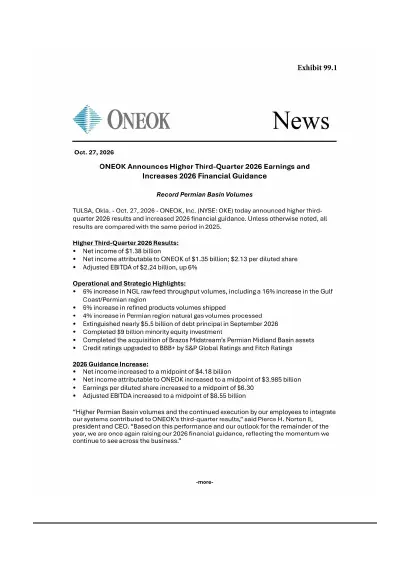
Thank you, Megan, and good morning, everyone, and thank you for joining us today. Yesterday, we reported strong third quarter results, supported by our record Permian Basin volumes and continued growth across our integrated system.
We increased our 2026 financial guidance for the third time this year. Also completed several strategic milestones.
During the quarter, we closed a $9 billion minority equity investment, extinguished nearly $5.5 billion of debt, and received credit rating upgrades from both S&P and Fitch. Earlier this month, we closed the acquisition of Brazos Midstream's Permian Midland Basin assets.
Together, these actions give ONEOK greater scale, greater financial flexibility, and clear visibility into the future earnings growth. Our confidence in ONEOK's outlook continues to gain momentum, supported by the assets that we own, the customers that we serve, growth projects already underway, and the innovation of our people.
We're not providing 2027 guidance today, but we expect to do so after our fourth quarter results in February. The underlying drivers are increasingly clear: constructive producer development plans and continued drilling and completion efficiencies; recently completed projects that will contribute a full year's earnings in 2027; additional projects nearing completion; and a full year of ownership of the Brazos assets.
Importantly, that visibility extends across our integrated system and isn't dependent on a single commodity or project or basin. We see opportunities across natural gas, NGLs, refined products, and crude, and supported by domestic and international demand and the connectivity that we've built across our value chain.
That diversification gives us a multiple of avenues to grow and capture value as the market conditions evolve. The broader backdrop reinforces the opportunity.
Global energy markets remain dynamic, but growing natural gas demand for power generation, industrial loads, and liquefied natural gas exports to feed the international demand all point to the same need: reliable access to essential energy when and where it is needed. International buyers are increasingly seeking long-term access to US supply for its reliability and resiliency, a trend we're seeing through the strong export demand across our system.
These drivers also reinforce our confidence in our mid- to high single-digit adjusted EBITDA growth target for the next 5 to 7 years from our 2025 base. Brazos adds substantial contracted growth and value chain opportunities across our system, increasing our momentum toward the higher end of that target.
ONEOK has the assets, the financial strength, the discipline, and the people to capture the growing energy demand and to deliver sustainable long-term value for our investors. With that, I'll turn the call over to Walt for a financial update.
Walt Hulse
Thank you, Pierce. Third quarter net income attributable to ONEOK totaled $1.35 billion, or $2.13 per diluted share.
Adjusted EBITDA totaled $2.24 billion, a 6% increase compared with the third quarter of 2025. Net income and EPS included a $336 million one-time noncash income tax benefit related to the corporate reorganization completed in connection with the minority equity transaction.
Adjusted EBITDA included a $53 million net benefit from the transactions, primarily related to gains on the extinguishment of debt. As Pierce mentioned, we increased our 2026 financial guidance again, reflecting strong year-to-date performance, visibility into the remainder of the year, and the addition of the Brazos Midland assets.
We now expect a 2026 net income midpoint of $4.18 billion and adjusted EBITDA midpoint of approximately $8.55 billion. This represents a $200 million increase in our adjusted EBITDA midpoint compared with the guidance we provided last quarter and a $450 million increase compared with our original February guidance.
Of this quarter's $200 million increase, approximately $50 million reflects transaction-related benefits I just described, approximately $75 million reflects the expected 2026 contribution from the Brazos assets, which is offset then by $25 million of transaction costs, and the remaining $100 million reflects stronger performance across our base businesses. This year, we've been somewhat conservative with guidance due to the geopolitical volatility.
If commodity conditions remain consistent with where they are today, we will have a very good tailwind in the fourth quarter and into 2027. That takes me to our hedging program.
As the back end of the commodity forward curve has risen throughout the year, we've increased our hedging position into 2027 at a greater percentage and at higher prices than 2026. We continue to programmatically hedge commodity exposures.
On capital expenditures, we stated on the second quarter earnings call, we expected to approach the high end of our guidance range, or $3.2 billion. We now expect 2026 capital expenditures to total approximately $3.5 billion, due primarily to $200 million of capital associated with the Brazos acquisition, along with added growth projects such as the Cutter 2 plant, our Delaware NGL expansion, and compression pulled into '26 from '27 due to Bakken and Mid-Continent activity levels.
From a balance sheet perspective, we extinguished nearly $5.5 billion of debt in September following completion of the $9 billion Apollo minority equity investment. Both S&P Global Ratings and Fitch Ratings upgraded our credit ratings to BBB+ with a stable outlook following these transactions.
With these actions complete, we are operating with a stronger balance sheet. Now I want to spend a moment on our leverage framework because it's an area we've received a number of questions.
Our debt-to-EBITDA target going forward is approximately 3.25 times or lower, and the or lower matters. This is not guidance; it reflects a change in philosophy.
We intend to operate the company with lower leverage than our previous target of approximately 3.5 times. As modeled today, we would expect to go below 3 times within the next few years.
However, our commercial team continues to find highly attractive projects, which we expect will increase our capital expenditures over the next few years. We now have the financial flexibility to execute on those capital expenditures and still maintain a strong balance sheet.
We now view 3.5 times as the upper end of our targeted leverage range. The gap between where we expect to operate and that ceiling is intentional.
It gives us meaningful flexibility through business and commodity cycles and the capacity to act if a compelling opportunity comes along that clearly meets our return thresholds. That's optionality, not a plan.
Our base case remains disciplined deleveraging while we continue to fund attractive growth and capital return to shareholders. That includes our dividend and the capacity for share repurchases.
From a cash tax perspective, the Brazos Midland acquisition is expected to extend our runway by another year, deferring meaningful cash tax payments until 2032 from previously 2031. I'll now turn it over to Randy for an operational and project update.
Randy Lentz
Thank you, Walt. Our teams continued to execute safely and reliably during the third quarter while advancing growth projects across the system.
During the quarter, we completed our Denver area refined products pipeline expansion, adding 35,000 barrels per day of capacity. Demand has been encouraging, and we're beginning to evaluate further expansion opportunities.
We also completed a 110 million cubic feet per day of processing expansions in the Delaware Basin and are already seeing incremental volume, with a continued ramp-up to capacity in early 2027. In the fourth quarter, Medford Phase 1, Cutter 1, and Cassity 1 are all expected to enter service, providing additional fractionation and processing capacity across the Mid-Continent, Powder River, and Permian.
Then in 2027, Bighorn adds 400 million cubic feet per day of processing capacity in the Delaware, Cassity 2 adds another approximately 330 million cubic feet per day of capacity in the Midland, and our Delaware NGL expansion adds 245,000 barrels per day of takeaway capacity. That expansion, added this year, supports growing Delaware volumes and connectivity with our West Texas NGL pipeline.
The acquisition of Brazos Midland assets also expands our opportunity set considerably. We're already advancing connections between Brazos and our legacy ONEOK system, which we expect will improve capital efficiency and commercial flexibility as we continue Midland Basin growth.
Beyond what we've announced, we continue to see a growing set of opportunities across multiple products and regions, providing several pathways for continued organic growth. With that, I'll turn the call over to Sheridan for a commercial update.
Sheridan Swords
Thank you, Randy. Third quarter commercial activity was strong, driven by customer demand and volume growth across key portions of our system.
Starting with the Natural Gas Liquids segment, total raw feed throughput increased 6% year over year to nearly 1.7 million barrels per day. Our largest volume growth was in the Gulf Coast/Permian region, where volumes increased 16% year over year and 9% compared with the second quarter, with nearly all of the increase from West Texas.
Volumes continued to benefit from increasing producer activity, recently connected third-party plants, and additional natural gas egress out of the basin. Propane-plus volumes increased both year over year and sequentially across all of our operating regions, driven by continued producer activity.
Ethane recovery remained attractive across most of our system, supported by strong domestic and international petrochemical demand. We saw modestly higher rejection in the Rockies and Mid-Continent following strong recovery levels in the second quarter, while Permian economics continued to favor full recovery.
Our fractionators are highly utilized as we work toward the completion of Medford Phase 1, which we expect in mid-December. Until then, we're continuing to build inventory of unfractionated NGLs, which defer the timing of the associated earnings from these NGLs.
As Medford comes online, we will begin working through that inventory and recognize the associated earnings, primarily in the first quarter of 2027. We expect this to give us a built-in earnings benefit early next year.
Turning to the Refined Products and Crude segment, refined products volumes increased 6% year over year, including 10% growth in gasoline and 2% in distillates, supported by solid demand and high refinery utilization across our footprint. Based on our year-to-date performance, we expect refined products volumes to finish the year near the top end of our original guidance range.
Our connectivity and marketing capabilities also let us capture regional opportunities, as wide Mid-Continent to Gulf Coast basis differentials and low inventories created price volatility. Midyear tariff adjustments added a further benefit.
Liquid blending also performed well. Increased gasoline throughput and the completion of synergy projects contributed to higher blending volumes during the quarter.
We entered the fall season approximately 75% hedged, and unhedged September spot margins provided additional upside. Historically wide spreads have allowed us to lock in favorable blending margins throughout 2027, further out than we typically would.
Export demand has also remained strong, with refined products volumes at Galena Park up approximately 15% year over year. Crude oil exports at Seabrook remained fully contracted, with third quarter throughput approximately doubling the prior-year period.
In our higher-margin crude gathering business, we expect full-year volumes to increase approximately 7%, supported by Midland producer activity averaging nearly 40 rigs on our dedicated acreage. Moving to the Natural Gas Gathering and Processing segment, volumes increased all three regions compared with the second quarter, led by record volumes in the Permian Basin.
Volumes are higher across both the Midland and Delaware basins in the Permian, led by growth in the Delaware following completions of our processing expansions. Across our dedicated Permian acreage, we have approximately 21 rigs, including 17 in the Midland Basin and four in the Delaware.
The addition of the Brazos assets substantially expands our Midland opportunity, with a long runway of high-quality drilling inventory and greater connectivity across the combined system. Importantly, what we've seen since announcing the transaction continues to support our acquisition assumptions.
Based on current producer plans, we expect an average of approximately 14 rigs on the Brazos Midland dedicated acreage during 2027. Producers are also encouraged by early Barnett results, including well performance and drilling and completion efficiencies, which are supporting increased development activity and a higher volume outlook.
As we sit today, the current Brazos processing plants are full, and volumes on the Brazos assets are above our expectations for this point in the year. We expect the continued volume ramp will be enough to fill Cassity 1, which comes online at year-end.
The larger combined system gives us flexibility to optimize the timing and location of that next expansion. Outside the Permian, Rockies processing volumes increased 3% from the second quarter and were encouraged by activity in the area.
Since March, Williston Basin rigs are up approximately 50%, and rigs on our dedicated acreage have doubled to 16, approaching 2024 and early 2025 levels. The higher activity reinforces a stable, durable volume base, and with our infrastructure already in place, incremental volumes translate directly to very attractive cash flow.
In the Powder River Basin, initial well performance around the Cutter plant have exceeded producer expectations, and we expect volume to ramp with planned completions in the fourth quarter and throughout 2027. In the Mid-Continent, growth continues across our Oklahoma system, driven by activity in both the Cherokee and STACK formations.
Several gathering expansions are underway to support further growth into 2027. There are currently 17 rigs on our dedicated acreage.
Overall, producers remain disciplined, but current 2027 plans reflect increased activity, and our conversations remain constructive. I'll close with the natural gas pipelines, where third quarter adjusted EBITDA was $231 million, up from $200 million a year ago, benefiting from higher optimization and marketing activity and higher firm transportation revenues.
As expected, the Waha-to-Katy opportunity moderated sequentially as additional Permian egress entered service and price differentials narrowed. We expect a further reduction in the fourth quarter, which is already reflected in our guidance.
Longer term, natural gas demand continues to provide significant opportunities. Last quarter, we announced we'd been awarded a supply agreement for 1 GW of power plant demand.
This project includes a 10-year firm transportation agreement for 250 million cubic feet per day of natural gas and is expected to be in service in late 2030. Additionally, we've been awarded another agreement to supply 110 million cubic feet per day for a 500 MW power plant expansion, which will go into effect in May 2028.
These attractive-return projects are good examples of the opportunities we are pursuing across our pipeline network, and we expect to announce additional projects as discussions advance. Pierce, that concludes my remarks.
Pierce Norton
Thank you, Walt and Randy and Sheridan, for those updates. As I look back at the first 9 months of this year, the progress that we have made is significant.
We've increased guidance three times, significantly strengthened the balance sheet, expanded our position and scale in the Permian Basin, completed significant organic projects with additional projects approaching startup, and we're seeing constructive volume trends and producer activity across our footprint. Most importantly, though, those accomplishments, along with constructive producer plans and our hedging program, give us momentum and visibility as we enter 2027.
At the same time, the broader need for reliable US energy infrastructure continues to grow. The energy landscape will remain dynamic.
Our goal isn't to predict every geopolitical event or commodity price movement; it's to position ONEOK to perform through them. We believe our scale, asset connectivity, financial flexibility, and customer relationships give us the ability to do just that.
We believe ONEOK will enter 2027 from a position of strength, with a clear inventory of growth opportunities and the infrastructure required to help connect essential US energy resources with the growing demand. As always, none of this happens without our employees.
I want to thank them for their continued commitment to safety, reliability, innovation, and to serving our customers. Operator, we're now ready to take questions.
Operator
Thank you. If you would like to ask a question, please signal by pressing *1 on your telephone keypad.
If you are using a speakerphone, please make sure your mute function is turned off to allow your signal to reach our equipment. We do ask that you limit yourself to one question and a follow-up to fit in as many of you as possible.
Again, press *1 to ask a question. We'll pause for just a moment to allow everyone an opportunity to signal for questions.
We'll now take our first question from Spiro Dounis with Citi.
Spiro Dounis
Appreciate it. Good morning, team.
Wanted to start off with new projects. Walt, you mentioned commercial team's working on some new opportunities here.
Curious if you can expand and maybe give us a sense of what regions or commodities you're seeing the most activity and where that capital is likely to get allocated. Just to add on, Pierce, I noticed you had some commentary on the natural gas side.
Sheridan seemed to support that with some of these data center projects. Curious if we can expect gas to maybe get a higher allocation than has historically been the case, and if $3 billion-plus is a good run rate to use from here on CapEx.
Sheridan Swords
This is Sheridan. I would say as we start thinking about where we're going to see growth in CapEx or growth across our system, is obviously we'll start in the Permian where volumes are strong, growing strong.
We already have quite a bit of processing capacity come online. We see the runway that we will be adding more processing capacity in the future, so that's going to create more opportunity for the NGL business as well.
We think we'll see a lot in the NGL in the gathering and processing segment in the Permian. We're also seeing some opportunities in the Mid-Continent.
We continue to see that grow. Volumes are up strong.
We could have some allocation of capital into the Mid-Continent area. As you start thinking about refined products, we've seen a big pull of export volume that's changing the dynamics on our system.
We could see some optimization opportunities or being able to increase our capacity between the Gulf Coast and the Mid-Continent be an opportunity. We're also looking to expand the Denver pipeline that came up this year completely fully contracted.
Commercial teams are working with other people to see about the opportunity to expand that system as we continue to go forward. Then obviously the data centers.
We continue to be in discussions with a large number of data centers. A lot of them continue to advance.
Last quarter we announced one. This quarter, we announced another one.
The teams are on the edge on a couple other really nice projects as well. We will see some area from power demand going forward on the natural gas pipe.
Really, when we think about capital, the capital we're looking about across our footprint, it's in all the segments as we go forward. It's not really concentrated in one area or the other.
Pierce Norton
Spiro, this is Pierce. One thing I'd add to that is much of the gas that we move is going to be feeding LNG facilities, as well as the electric generation, either for utilities or for AI data centers.
It comes with liquids. The gas demand that we see also will increase the gathering and the processing opportunities that we have, along with moving the liquids associated with those gathering and processing plants and the fractionation facilities.
It gives us more blending opportunities with those products into our RP&C business. It touches all phases of our business.
Spiro Dounis
Got it. That's helpful color.
Second question, moving to NGL volumes. Tracking to be above the high end of your guidance this year, but you did see some volumes come in quarter over quarter in the Rockies and Mid-Con.
Sheridan, I suspect that was really a function of ethane rejection, but maybe would appreciate more color there and how you're seeing the rest of the year shape up. If you could, maybe just talk through what changes when Medford comes online.
Is there an easy way to sort of quantify the impact of storing all these NGLs and how quickly you'd expect Medford to fill up?
Sheridan Swords
I think you're, Spiro, you're exactly right. A little bit of falloff we saw in the Rocky Mountains and Mid-Continent for the NGLs was all ethane.
As I said in my remarks, the C3+ volume was actually up. That the underlying growth is strong there.
It's a little bit more ethane rejection. Some of that is on our own toast coming out of the Bakken that we dialed back our incentivized ethane a little bit just due to the market conditions we're seeing right now.
As we continue to move forward on NGLs, we continue to see growth, and that a lot of that growth is going to come out of the Permian, where we'll see a significant amount of that growth going forward as we continue to ramp up our natural gas gathering and processing assets out there in the area. Now, when Medford comes up, the impact of Medford is because we do have raw feed that is in storage today, obviously we have more raw feed coming into our systems than our current fractionators can handle.
Medford will come up completely full for a period of time as we work off that raw feed in inventory. Both Phase 1 and Phase 2 will be full for a period of time going forward.
Then we'll be able to leverage that into growth. After that's worked down, that growth coming out of the Permian that we see as we bring on the Brazos plants, continue to fill our legacy ONEOK plants out there going forward.
As Randy said, we are in the process of tying Brazos and the legacy ONEOK Midland systems together, which we'll be able to remove volume that we're doing on third parties today. We have offloads on G&P Midland system today third parties, we'll be able to bring that into our own plants, create more NGLs, which will be able to fractionate through Medford going forward.
When we actually came out with Medford, we had said that we had not subscribed 100% of that capacity because it was a lower-cost fractionator. It was a brownfield fractionator.
We didn't need to subscribe all the capacity. That we had additional operating leverage that we could continue to contract.
Commercial team has continued to contract as we've gone through this build phase. We still have capacity that is uncontracted today, but that is a lot less than we had before.
We think that gives us a lot of leverage to be able to contract even more third-party volumes as we have done with our Delaware expansion.
Spiro Dounis
Great. I'll leave it there.
Thank you, gentlemen.
Operator
We'll now take our next question from Jeremy Tonet with J.P. Morgan.
Jeremy Tonet
Hi, good morning.
Pierce Norton
Good morning, Jeremy.
Jeremy Tonet
Just wanted to touch on the guide for '26 if I could a bit. If we're looking at it right, it seems like it implies 4Q doesn't really move up versus 3Q in any meaningful fashion.
That would even be with the Brazos contribution. Just wondering if you could talk a bit more, gives and takes in the fourth quarter, you think of it as maybe seasonally a bit stronger as well.
Is that conservatism or are there other elements at play here?
Walt Hulse
Jeremy, this is Walt. As I said in our remarks, we have remained cautious throughout the year just given the whole geopolitical situation.
If everything stays like we are today, we are probably on the conservative side, and you could expect a nice tailwind that will be in the fourth quarter and with the rig activity that we're seeing now, really continue into 2027 pretty strong.
Jeremy Tonet
Got it. Thank you for that.
Then maybe just moving over towards the fractionation side, picking up a bit more on the comments you said, seems like Medford would bring a lot of optimization opportunities or flexibility to the system. Then even if I look at the NGL raw supply that you guys have versus fractionation capacity, it still seems maybe the system is a little bit short and could need some more fractionation build-out, particularly when you're thinking about all the processing plant additions and the dock and export coming up here.
Just wondering how you think about that growth opportunity.
Sheridan Swords
We watch that very closely, Jeremy, to understand where it is. Now, remember, not all the volume you see that we report we fractionate.
Some of that we just transport on that. What I would say, we do have a little bit of extra capacity in Medford, and we do have MB-7 that's already permitted.
Then we're just trying to understand when the right time is that we FID that to be able to make sure we have fractionation capacity for our growing gas processing plants.
Jeremy Tonet
Understood. I'll leave it there.
Thank you.
Operator
Our next question will come from Manav Gupta with UBS.
Manav Gupta
Good morning. I actually just wanted to go back to Brazos and ask you about, now that you have had some look at these assets, are they actually meeting your expectations?
Where are the areas where you think actually there could be some upside here, if you could give us an update on how you're thinking about the synergies now that you have had some chance to look at these assets at a closer look? That's my first question.
Sheridan Swords
What I would say is that we are very, very satisfied with what we've seen with Brazos. As I made mentioned in my remarks that volumes are above our expectations at this time of the year, at this time in the process, and nothing tells us that they're not going to continue to be of our expectations as we move into 2027.
We've been very pleased with the assets. In general, they put some very big pipelines in space in their area.
They didn't just build it enough what they had. They do a lot of things like we did.
They upsized their pipelines, and that's given us a lot of capital synergies immediately. We actually were going to have to expand one of our mainlines on our system, on our legacy ONEOK gathering and processing system, but because Brazos overbuilt this system, we're immediately able to access that capacity and save that capital.
That continues to happen going forward as we get to look at it. As we get these plants up, we're very pleased at how well they built the plants, the redundancy they put in there.
They built them like we would. They built them to last.
As I talked about in the volumes, we continue to talk to producers. Producers getting more and more excited about this Barnett and what it means, the efficiencies and as they get better at it, the volumes exceeding their expectations per well.
Right now Brazos is probably hitting on all cylinders of what we expected to. We're very pleased with what we've seen so far.
Pierce Norton
This is Pierce. I can't emphasize enough Sheridan's last comments about the quality of the way these assets have been built.
Randy and I has both background of the construction of these kind of things, and I can walk around that plant and tell that they've addressed a lot of the things that I've seen as problems in the past with other companies and other assets. I think they built them for reliability and resiliency.
I'm very, very pleased with the quality of the assets that we picked up.
Manav Gupta
Perfect. My very quick follow-up here is we notice in the slide deck that Delaware NGL expansion of 245, and we also know you have the processing plant at Bighorn coming around 400,000 somewhere in 2Q, and this new expansion is 3Q.
Can you talk a little bit about are these two projects in some form complementary to each other? Thank you.
Sheridan Swords
They are a little bit, but really this expansion that we're doing, we're really laying a pipeline from our Texas Delaware up to the Northern Delaware in New Mexico, we're opening up a new area. We did upsize this expansion more than we needed, like we do in other ones.
We have a lot of growth there. It's backed by third-party processors and producers that have contracted for this space.
With that extra capacity, we're really excited about being able to access a different part of the Delaware Basin, that Northern New Mexico Delaware, where there's a lot of opportunity for us to compete for third-party processing plants and that third-party NGL volume.
Manav Gupta
Thank you so much.
Operator
We will now take our next question from Jean Ann Salisbury with Bank of America.
Jean Ann Salisbury
Hi, good morning. Bakken rigs have gone up markedly in the last month or two.
Have you heard from producers that they're adding activity in the Bakken at these oil prices?
Sheridan Swords
We have. Obviously they're adding activity.
We have more rigs coming online. What's interesting about that is we're seeing more rigs come in or rigs come back from producers that are multi-basin producers that have other opportunities across the whole North America, and they're bringing rigs back there.
We're excited about what we're seeing. In some of these areas, they're drilling in the core of the core, which is great, great for us, and that volume is all coming to us as well.
We are seeing more activity in the Bakken with this rig count and from a different type of producer that we haven't seen before, which is very encouraging.
Jean Ann Salisbury
Thank you. There's obviously been a lot of Permian M&A in recent months, specifically of G&P M&A.
What do you attribute this uptick in activity to? A lot of these G&Ps had kind of been out there for a long time.
Then, I guess relatedly, what are the key criteria when ONEOK assesses these for fit within your portfolio? Is the ability to direct NGLs a must-have component when you're screening these things?
Walt Hulse
Jean Ann, this is Walt. I think that you ask why there are so many of these transactions.
Clearly with commodity prices where they are, the private equity backers are looking at this as a window and opportunity to sell when the market's as strong as it has been. They're all testing the market.
Many of these assets have tested the market before. At these levels, you're seeing some activity.
The other thing is that there are fewer and fewer of those opportunities out there. As people look at trying to round out, they've decided to act.
Many of them have derisked quite a bit. In previous years when they've tried to come to market, they had a lot of space, but maybe not a lot of volume.
Many of them have been able to do a good job filling those up. I think it's just the maturity of the basin with the backdrop of a great commodity price that's bringing people to the market.
Jean Ann Salisbury
Thanks. I guess, what are the key criteria for ONEOK when you're screening them?
Walt Hulse
Oh, NGLs, I apologize, I forgot that part of the question. NGLs is clearly something that would be important to us, and something that we look at is one piece to the overall picture.
To the extent that we can use our integrated system and continue to touch that molecule throughout the chain, that is what our strategy is. If we can capture those NGLs, that definitely would screen better on our radar, for sure.
Jean Ann Salisbury
Jean Ann, this is Pierce. Walt
Pierce Norton
Walt mentioned that this was a part of the criteria, but the areas of dedication, the locations of those areas of dedication in and around the existing assets, both from a legacy standpoint and the new assets that you'd pick up, the quality of the producer that's drilling those areas, there's a multitude of things that we look at all to basically derisk what it is that we're looking at and where we spend our capital.
Jean Ann Salisbury
Great. I'll leave it there.
Thank you for the answers.
Operator
We'll now take a question from John Mackay with Goldman Sachs.
John Mackay
Hey, team. Thank you for the time.
You touched on this a couple times, I think in the context of the incremental balance sheet capacity, but just as you guys are out there looking to add new organic growth projects, could you touch a little bit about where you think kind of run-rate annual growth CapEx could get to, and maybe any sort of range you want to put around that, keeping the leverage target in mind? Thank you.
Walt Hulse
Sure. As we've said, '27 will look somewhat like '26.
We expect a lower level than '26, but we still have some reasonably big projects finishing up with Medford wrapping up in 2027, large processing plant, several plants actually, and then the dock. You should think around that three $3 billion-ish, give or take, for '27.
Then we would expect it to range between that 2.5 to $3 billion going forward, which will still leave us with quite a bit of free cash flow to return capital to shareholders.
John Mackay
I appreciate that. Thank you.
Just second one for me on the Northern Delaware NGL expansion, anything you can comment in terms of mix of third-party counterparties there, either producers or is it all midstream? Then would you expect that to be kind of full-chain margin, including frac all the way to Mont Belvieu from the Northern Delaware, or is it just portion?
Thanks.
Sheridan Swords
The first thing, it is both. We have both.
We have multiple third-party processors that have signed up for this capacity and producers on that, it's a very nice mix between there. It will be almost entirely is a full value chain, transportation and fractionation.
There is a little bit that will be just transport only, but it is highly all transportation down to Mont Belvieu and fractionation into Mont Belvieu. We think that the volume that is underwrote this will be coming up fairly quickly once it's put into service, and that will be into the third quarter of '27 when it comes up in service.
John Mackay
All right. Interesting.
Thanks for the color. Appreciate it.
Operator
We'll now take our next question from Theresa Chen with Barclays.
Theresa Chen
Morning. Walt, would you further elucidate the shift in your leverage philosophy, operating with lower leverage on a run-rate basis?
Is this rating agency-led? Is it that you're seeing more commodity volatility across your base business versus previously?
Or is this more driven towards drawing up dry powder in the event of attractive inorganic opportunities complementing organic ones?
Walt Hulse
Theresa, I'd say that it's no one particular thing. As we've gone through these transactions and lived through commodity cycles, we think maintaining the flexibility to look at opportunities and not stress the balance sheet is important.
We have seen a lot of interest from large shareholders in seeing a lower leverage in the business. We're the view that we did not do it just to get a BBB+, that's for sure.
We're very pleased the rating agencies have recognized that we intend to operate the business with a lower level of leverage. It's a little bit more conservative.
We've seen some pretty significant commodity cycles over the last 10 years, and there will be another one at some point.
Theresa Chen
Thank you. As you evaluate further expansion of the Denver pipeline, how could the next phase differ from the initial project now that that's online, both in terms of scale and product capabilities?
Would it be fair to assume that the next phase would handle products beyond jet fuel? What would you need to see to move forward towards an FID, and what are you seeing in terms of demand in that market as well?
Sheridan Swords
Really, we set this up very nicely that the next expansion of Denver is not going to be a huge capital expense. Really what we're looking for is talking to the customers and them wanting to sign up for that capacity.
They're looking at not only what's going on in the Front Range, but overall what's going on in PADD 4, what they're looking at, and how they continue to move that out, or other intermovements within PADD 4, how that would affect the Front Range going forward. Really, to FID that project, we just need to get to the customers and have them ready to sign up for the space.
It's really where we're at. We're having those conversations today.
Obviously that pipeline just came online, we're moving more volume, people want to see how the market's react into this additional volume. We are seeing increased jet fuel demand across our whole system, and Denver's no exception.
Obviously this new capacity is meeting that demand today. I will say we are having quite a few conversations with customers about the next expansion of Denver.
The thing is unique about it is if they come in and want a little bit, we can give it, or they want a lot, we can scale our expansion to what the customers want to sign up for. That's the beauty of us putting this operating leverage in the pipe when we laid it the first time.
Theresa Chen
Thank you.
Operator
We'll now take our next question from Praneeth Satish with Wells Fargo.
Praneeth Satish
Thanks. Good morning.
Just on Brazos, I was wondering if you could help bridge so in Q4 looking at the contribution, I think if you annualize it, it's about $315 million of EBITDA. The 2027 target that you provided when you made the acquisition was 590.
I know you have Cassity 1 and 2, so that's probably part of it, but maybe what are the other key drivers? Then how much visibility is there into filling up those two plants and getting to that 590 target for '27?
Sheridan Swords
This is Sheridan. What I would say is, obviously, Cassity 1, as I said, is coming up here at the end of this year.
It will fill relatively quickly on that, you're going to get another 330 million a day of processing capacity. Right now we have 550 million, we're increasing by over 50%.
Then also as we tie that system into our system, we'll be able to access our processing capacity as well. Then you get the downstream effect of the NGLs that are coming off this increased processing capacity to us as well.
It's kind of a twofold that we're getting on continue to go forward. Then Cassity 2, when it comes up, we will have to have used our legacy system when Cassity 2 comes up.
Everything is pointing to that Cassity 2 will ramp up fairly quickly. As I said in my remarks that we are actually ahead, volume is ahead of where we thought we'd be at this time.
Projections are showing that that's going to continue well into 2027, especially with our conversations with the producers out there that are getting excited about this Barnett and what they're saying. They're seeing better results than they had anticipated from a volume standpoint on the gas.
We think that's how we're going to get to that higher number.
Walt Hulse
Praneeth, this is Walt. I think the important part today is that the 550 million that is there is full, and we're doing offloads at this point.
If we had the capacity, we would be at a higher number. Until we bring in that Cassity 1 plant, we will take a stairstep up as we go into 2027.
Praneeth Satish
Got that. That's helpful.
Maybe just staying on Brazos. Sheridan, I think you noted that you expect 14 rigs on the Brazos acreage in 2027.
I guess with commodity prices moving higher and some of these results here that the producers are seeing from the Barnett, is there any interest from producers on the Brazos system to add rigs? Do you think there's a possibility that that rig count moves above 14 rigs in 2027 based on the discussions you're having with your customers?
Sheridan Swords
I do think there's opportunity for it to move up. We do have some customers that continue to look at that, continue to see where they want to deploy those rigs.
As they get more and more comfortable with the Barnett, what's going on, they're probably going to be moving more into that area. We think it could definitely move up.
We're just saying our discussions right now, they're saying this is where it is, right now they know they're going to have this many rigs on there, and there could be more coming. We just need to see how we get into a little bit more to '27.
Praneeth Satish
Got it. Thank you.
Operator
Our next question will come from Brandon Bingham with Scotiabank.
Brandon Bingham
Hey, good morning. Thanks for taking the questions.
Wanted to maybe get a little more clarity around the crude volumes during the quarter. Looked a little bit light.
Just what can you say about some of the dynamics around the crude piece, and then maybe how should we think about the forward trajectory of Permian crude, especially in light of all of the gas that is forecasted to come online through the end of the decade?
Sheridan Swords
This is Sheridan. What I would tell you is that the crude number we give you is a total system number.
That includes both the gathering volumes, volumes that travel down our long-haul pipelines, and also volumes that we move through our Houston distribution system. Each one of those have very different rates on there.
Houston distribution system, which is where a lot of the volume moves, is at the lowest rate. That's why in our remarks, we talked about the high-margin volumes, our gathering system out there in the Permian, and that is up 7%.
That's why we're trying to give you that number, because we know there's other pieces, of course, that move around in there because we only give you one number. There's another effect of how we kind of count for numbers, depending on where they go and what systems they go through, how many times they get counted.
Overall, we like where our volumes are. They're growing.
They're growing where they need to grow. That means they're growing in the gathering system.
We continue to see that grow as we have 40 rigs on our acreage right now drilling. We continue to expand our acreage dedication that we're getting from people, continue to grow that volume, continue to make connectivity between our systems, continue to make connectivity between our gathering systems and our long-haul pipelines.
Our long-haul pipelines are predominantly full right now at this time, they're moving at rates. I know it's a little bit hard because we show a little bit of drop in volumes that is around our Houston distribution system, where that is, which is by far the lowest margin.
Our gathering volumes are up nicely at 7%.
Pierce Norton
Brandon, if you're going to continue to see the LNG growth in the Gulf Coast there, another 12 Bcf/d, it's our belief that a lot of that gas is going to come out of the Permian Basin. There's two things that's got to move there: either the volume of crude has to go up, therefore lifting the gas, or the GOR has to go up if the volume of crude stays flat.
Our opinion is they probably both will move up. There's going to be more crude, I think, to move out there in the future.
Brandon Bingham
I agree, very helpful. Then maybe one quick follow-up.
I know you said you were going to wait for 4Q to kind of get into specifics, but is there anything maybe more qualitative or high-level you could discuss, maybe for the non-Brazos piece of the business, as Brazos feels kind of pretty well understood at this point, for 2027?
Pierce Norton
I think you're getting on what's the guidance for 2027? I do want to reemphasize that we're not going to give guidance today for 2027, but I can tell you from where I sit, I really like where 2027 is setting up for us.
Brandon Bingham
Brandon,
Randy Lentz
what's important to add to that is you really have to see, we've talked a lot about the Permian today and probably haven't given the Mid-Continent its due because the Mid-Continent activity has picked up significantly. We're not only seeing it on the western side of the state, we're now starting to see the STACK come back a little bit, too.
We're excited about the Mid-Continent. The Powder's been doing great.
Across each of the basins, we've talked about the rigs in the Bakken, we're seeing it across all the basins.
Brandon Bingham
Very helpful. Appreciate it.
Operator
Our next question will come from Julian Dumoulin-Smith with Jefferies.
You've actually got Patrick this morning, but thank you for taking our questions. On the first one, I was wondering if you could add a bit more color around the hedging.
I know you said you don't want to do '27 guidance, but how does this fit into your mid- to high single digits long-term growth trajectory? I think you said 75% hedged into 2027 at these prices, can you just add some color about how that relates to your longer-term earnings guidance, if you expect that to be kind of sustained or if that would drop off pretty sharply assuming geopolitical normalization?
Sheridan Swords
This is Sheridan. First thing is we did not say we're 75% through 2027.
We were 75% coming into the fourth quarter of our into the third quarter of 2026, and that other 25% gave us quite a bit of uplift. As we've talked about is hedging going into 2027, with these wide margins, we are seeing opportunity to hedge more than we typically do.
We have a very programmatic hedging that we aren't a cave as when we hedge. We're not really trying to call the market.
When we see times like this, we do have the ability to accelerate that hedging. We've done that into 2027, more so in the first part of the year because of the backwardation in the market.
Obviously that backwardation is a sign of strength, we really think the market will kind of come up as we get out in '27. We are more hedged now than we typically are at this time of the year with these wide margins.
Obviously, that has just come of late. When I really think about this, medium- to high single-digit growth rate, that's really going off the base business and more of what we typically see in our margins going forward.
Commodity price could be a nice little tailwind.
Thanks for that. I think a second bit, maybe a minor question was, do you tell us how much inventory is building for NGLs that Medford would need to process?
Typical volume?
Sheridan Swords
Could you say that again?
Do you tell us how much inventory is building up for Medford to process?
Sheridan Swords
We haven't come out and said exactly how much inventory we have, but we have quite a bit of inventory right now that we've been building since the second quarter, anticipating of Medford coming on, as we've been successful in being able to contract more volume and growth across our system. Medford's going to run full for definitely the first quarter and probably into part of the second quarter when it comes up.
That will earn at the product prices of that point in time, or you've hedged the prices that it will get as it processes all that inventory back?
Sheridan Swords
There's two things that happen. It's because the way of accounting, we cannot account for our fee-based earnings that we receive from that volume that we put into the well.
When we fractionate that volume, we will get the fee-based earnings associated with those volumes in the well. Our marketing team has already hedged those out into the future to take out the commodity price on it.
The earnings you'll see next year coming from this will be from the fee-based portion that we cannot record until we fractionate the barrel.
Operator
We'll now take a question from Keith Stanley with Wolfe Research.
Keith Stanley
Hi, good morning. Wanted to follow up on the Delaware NGL extension pipe.
Should we think of the 245,000 barrels a day as mostly spoken for with new long-term contracts, or is this creating a lot of white space for you in New Mexico? Then related to that, any update on how full you are now on the I think it's 750,000 barrels a day of West Texas LPG capacity all the way to the Gulf Coast?
Sheridan Swords
On the Delaware expansion, we think it's a very strategic pipeline. We think it goes to an area that there's a lot of opportunity to pick up third-party NGL volume.
We did go in there and upsize that pipeline for that. There is quite a bit of white space that we have there to be able to leverage and to be able to increase the volume on that system.
Then in overall, we still have around a little over between 200,000 and 300,000 barrels a day of space on the West Texas NGL pipeline going forward. Obviously, Brazos is going to fill up quite a bit of that going forward.
Then our growth across our other base business will help us give us substantial amount of that full.
Keith Stanley
Great. Thanks for that.
Quick one, second question on the refined products optimization. You were up Q-over-Q in the third quarter on higher blending results.
The slides often talk about Q2 and Q4 as the big blending quarters. Should we assume some of the blending sales were pulled forward from Q4 into Q3, or is there anything else you'd point to on Q3 being very strong?
Sheridan Swords
Q3 was strong. Obviously, we had some very wide margins in there that made it really good.
Volumes were good, which was kind of a culmination of a lot of our synergy projects that we've been being able to put into place. We've actually, we talked about this, Magellan, when we bought it, they were spending around about 20 cents per gallon for their normal butane to get to the right place and to be able to blend, because they were moving a good portion on trucks.
The synergy projects that we've been able to put together have moved almost all that on to pipeline, and we've been able to cut 10 cents a gallon out of that. What we're blending now, even though we had wide margins, and then we had lower logistic cost to get there, and those logistic costs will be there every year.
That's permanent, continue to go forward. That, and then there was a little bit of waiver help.
In September, they moved from the 1st September 15th to the 1st to 15th the RVP change, that gave us some more volume to be able to blend into. Frankly, we're just getting better and better at it going forward.
You're right, the other thing was good is we are seeing increased gasoline volume across our system. The more gasoline volume across our system, more opportunity we have to blend.
There's three or four things that have really attributed to that. As we go into the fourth quarter, we're still seeing good margins.
Obviously, the logistic costs are still there. Volumes across our system are strong compared to where they are historically.
Operator
Thank you. That concludes our question-and-answer session for today.
I would now like to turn the call back over to Megan Patterson for closing remarks.
Megan Patterson
Thanks, Anna. Our quiet period for the fourth period begins when we close our books early next year and extends until we release earnings in late February.
Our IR team is available throughout the day for any follow-ups. Thank you for joining us, and have a great day.
Operator
Thank you. That concludes today's call.
You may now disconnect your lines at this time, and have a wonderful day.