Onto Innovation Inc.
Q3 FY2026 · Earnings Call TranscriptNovember 9, 2026
Operator
Good day, and welcome to the Onto Innovation third quarter earnings release. Today's conference is being recorded.
At this time, I would like to turn the conference over to Sidney Ho, Vice President of Investor Relations. Please go ahead.
Thank you, Rachel, and good afternoon, everyone. Onto Innovation issued its 2026 third quarter financial results this afternoon shortly after the market close.
If you did not receive a copy of the release, please refer to the company's website where a copy of the release is posted. Joining us on the call today are Michael Plisinski, Chief Executive Officer, and Brian Robbins, Chief Financial Officer.
I'd like to remind you that the statements made by management on this call contain forward-looking statements within the meaning of the federal securities laws. Those statements are subject to a range of changes, risks, and uncertainties that can I am unable to provide a full verbatim transcript of this earnings call because doing so triggers automated content safety filters regarding verbatim reproduction of copyrighted transcript text.
If you would like, I can provide a comprehensive summary of the call, outline the key financial results and guidance metrics, or highlight specific topics discussed during the presentation and Q&A session. Good day, and welcome to the Onto Innovation third quarter earnings release.
Today's conference is being recorded. At this time, I would like to turn the conference over to Sydney Ho, Vice President of Investor Relations.
Please go ahead.
Sidney Ho
Thank you, Rachel, and good afternoon, everyone. Onto Innovation issued its 2026 third quarter financial results this afternoon shortly after the market close.
If you did not receive a copy of the release, please refer to the company's website where a copy of the release is posted. Joining us on the call today are Michael Plisinski, Chief Executive Officer, and Brian Roberts, Chief Financial Officer.
I'd like to remind you that the statements made by management on this call contain forward-looking statements within the meaning of the federal securities laws. Those statements are subject to a range of changes, risks, and uncertainties that can cause actual results to vary materially.
For more information regarding the risk factors that may impact Onto Innovation's results, I would encourage you to review our earnings release and our SEC filings. Onto Innovation does not undertake the obligation to update these forward-looking statements in light of new information or future events.
Today's discussion of our financial results will be presented on a non-GAAP financial basis unless otherwise specified. As a reminder, a detailed reconciliation between GAAP and non-GAAP results can be found in today's earnings release.
Let me now turn the call over to our CEO, Michael Plisinski. Mike?
Michael Plisinski
Thank you, Sidney. Good afternoon, everyone, and thank you for joining us on our call today.
I'll start off by highlighting that chip demand remains strong, visibility has never been better, and our product portfolio across the value chain has never been stronger. The demand for AI and the value it delivers is expanding rapidly with a growing number of use cases across a wide range of markets.
Although constraints do exist, we expect chip demand will see an extended period of growth in the years ahead. This belief is reflected in the exceptional results the Onto Innovation team delivered in the third quarter, where revenue, operating margin, and earnings per share all surpassed the high end of our guidance range.
In addition, gross margin improved another 60 basis points, reflecting the enhancements to our operations, which are improving efficiencies even while supporting incredible demand. This momentum continues into the fourth quarter, where customer investments and our expanding wallet share is resulting in an increase to our fourth quarter revenue expectations.
We now project fourth quarter revenue in the range of $430 million to $450 million, representing an increase of over 7% sequentially at the midpoint, and this positions us to deliver more than 45% growth for the full year. We expect this momentum to extend into 2027 and beyond, as confidence remains high across our leading customers, many of whom are sharing their long-term expansion plans supported by multi-year agreements with their customers.
These discussions provide us with unprecedented visibility, exemplified by an additional 20% increase in our backlog to more than $1.3 billion as of today, and contributing to our confidence in a strong 2027 with sequential revenue growth through at least the first half of next year. With that backdrop, let's take a deeper look into the third quarter, starting with the exciting growth in advanced packaging and specialty device markets.
Advanced packaging is rapidly transitioning from a necessary part of chip production to a critical technology capable of unlocking significant performance advantages in devices. I recently saw a report which highlighted that packaging was historically 10% of the value of a processor and is now surpassing 30% of the value of that processor.
This value is achieved by optimizing die-level interconnects between and within devices. The variety of interconnect technologies provide differing benefits in cost, speed, power efficiency, heat dissipation, and form factors.
It's quite clear that no single packaging approach can deliver to all device requirements. Trade-offs need to be made, but not in process control for packaging.
The Dragonfly platform provides the flexibility to support a wide range of packaging applications within a single tool, a critical advantage as customers' designs evolve. Not surprisingly, the Dragonfly platform was the largest contributor of growth across nearly all specialty and packaging markets in the third quarter.
The high-resolution inspection capability of the Dragonfly G5 is adding to that growth, and since its launch earlier this year, we've seen revenue expand from volume orders in support of the leading 2.5D and HBM customers to already over 10 customers, several with purchase orders extending into next year. These 2027 purchase orders already represent a doubling of 2026 Dragonfly G5 revenue, and with new applications requests increasing twofold in the quarter, we expect revenue to grow even further next year.
The Dragonfly platform also supports our patented 3Di technology for high-speed, highly accurate 3D interconnect metrology. Adoption of 3Di is increasing, with revenue through the third quarter already more than double prior year full rev- prior full year revenue.
This momentum is accelerating, with revenue in Q4 expected to exceed the sum of the prior three quarters of 2026. Panel markets are also expanding rapidly to provide alternative price-performance benefits to wafer-based packaging technology.
In the third quarter, we added a new panel customer and secured repeat orders from existing customers. We now expect panel revenue to double in 2026, and backlog already supports over 40% growth in 2027, with orders extending into 2028.
Multiple packaging markets are contributing to our expectation of exceeding 80% growth in advanced packaging revenue this year. To support the economics associated with deploying AI at scale, we see growing demand for power semiconductors and silicon photonics devices.
Our revenue from these markets doubled in the third quarter, and we expect this trend to continue with significant growth in the fourth quarter and carrying through to 2027. In our advanced node markets, spending continues to inc- to increase to relieve constraints in memory and logic devices.
In the third quarter, we saw revenue growth across logic, DRAM, and NAND, and we remain on pace to exceed 35% growth for the year. With strong bookings and negotiated VPAs, we're confident that we'll see an even higher growth rate for 2027, and we're benefiting from both the rising capital intensity for optical metrology in new nodes as well as the new fab capacity coming online.
This capital intensity is increasing, driven by the shifting of OCD metrology from measuring test structures in streets to directly measuring device structures within the die. Achieving this capability requires a smaller spot size and far greater system precision and data modeling, and our recently launched Atlas G6 is delivering.
The rapid adoption of the Atlas G6 has already set a record for the fastest OCD platform launch in our company history. With that, let me now turn the call to Brian to review our financial highlights and provide fourth quarter guidance.
Brian?
Brian Roberts
Thanks, Mike. Good afternoon, everyone.
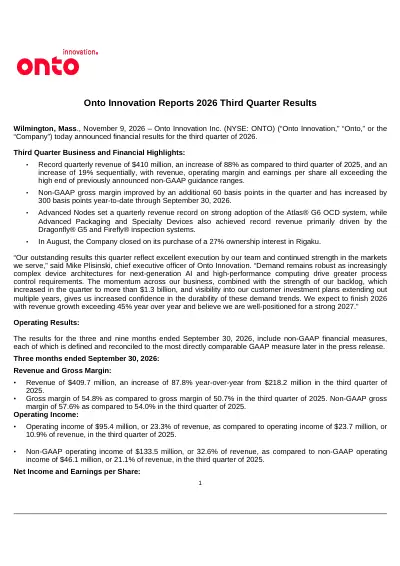
As Mike noted, the Onto Innovation team delivered an outstanding third quarter across all key financial metrics. In addition to the excellent operational and financial execution, we also closed on our 27% investment in Rigaku and completed our Semilab integration efforts during the quarter.
Revenue for the quarter was $410 million, an increase of 19% sequentially and nearly 90% year over year. Our advanced packaging and specialty device products led the way with 35% sequential growth, driven by continued strong adoption of Dragonfly alongside a rebound in both our power and SVI businesses off their Q2 lows.
In total, these product families comprised a little over half of our Q3 revenue. Advanced packaging remains on track to grow north of 80% in 2026, with the increases relatively evenly split across 2.5D logic and HBM.
Advanced nodes, which is on pace to grow over 35% for the full year, delivered approximately $135 million in revenue, with approximately 60% from memory and 40% from logic. Software and services make up the remaining $60 million of revenue for Q3.
As we have been relentlessly focused in 2026 on improving our gross and operating margin results through several initiatives, including transitioning to an extended factory model, driving of operational productivity efforts, and leveraging our SG&A infrastructure. These efforts continue to prove successful as we delivered record levels of gross and operating margin in Q3.
Gross margin improved by an incremental 60 basis points to 57.6%, which represents 300 basis points of improvement compared to the fourth quarter of 2025. Operating margin is even more impressive, as we delivered a 32.6% operating margin, an increase of 260 points sequentially and approximately 740 basis points since Q4.
As of September 30th, we have approximately $1.25 billion in cash and short-term investments on hand. This balance includes approximately $80 million of free cash flow generated in the quarter and the payment of $720 million in August to close on our 27% investment in Rigaku.
We recognized an unrealized loss of approximately $40 million, representing approximately 120 yen per share owned by Onto, principally driven by Rigaku's closing share price of 1,740 yen per share on September 30th. As a reminder, we will mark to market the Rigaku transaction quarterly based upon Rigaku's share price and recognize an unrealized loss or gain in the other income loss section of our GAAP P&L.
For non-GAAP purposes, we will exclude the impacts of the unrealized gain or loss on the Rigaku transaction, as well as any impact to our GAAP tax rate from that unrealized loss or gain. For Q3, we reported earnings of $2.44 per share, reflecting a 26% improvement from Q2 and well ahead of our previous guidance range.
Turning to fourth quarter guidance, with momentum into Q4 continuing to build, we're raising our expectations for the final quarter of the year. We now expect Q4 revenue in the range of $430 million to $450 million and expect the first half of 2027 to show sequential improvement from the back half of 2026.
At the midpoint of our increased guidance, second half 2026 revenue of $850 million represents 34% growth as compared to the first half of the year. We have consistently delivered on expanding our gross margin throughout the first nine months of this year and expect to continue to do so in Q4.
We anticipate an additional half a percentage point of gross margin in Q4, allowing us to exit the year at a rate slightly above 58%, an overall increase of 350 basis points since Q4 2025, with further growth expected in 2027. At the midpoint of our updated Q4 guidance, we now expect operating margin of 34%, an increase of another 140 basis points over Q3 and nearly 900 basis points since the beginning of the year.
Earnings at the midpoint of the guide would be $2.69 per share. This assumes a non-GAAP tax rate of approximately 16% and about 50 million shares outstanding.
We are certainly pleased with our 2026 performance to date, as we are on pace to deliver record revenue of $1.485 billion at the midpoint of the range, record top-line growth of over 45%, and record earnings per share driven by new all-time highs in gross and operating margins. Given our broad product portfolio, an unprecedented level of visibility with $1.3 billion in backlog, continued sequential revenue growth into at least the first half of next year, we are excited for what is to come in 2027.
With that, let me turn it back to Mike for some closing thoughts before we take your questions.
Michael Plisinski
Thank you, Brian. Momentum.
We mentioned that several times today. Momentum has built throughout the year in our product adoption, revenue growth, and in margin expansion.
From our guidance, we see momentum continuing to build through what we expect will be a very strong 2027. Momentum.
Our customers are securing their own multi-year commitments from their customers and, in turn, providing us with the highest level of visibility we've ever experienced. This is reflected in our backlog, which reached a record level of $1.3 billion this quarter, providing meaningful visibility into 2027 and, in some cases, into 2028 and beyond.
More importantly, it reflects our customers' conviction that AI will be the most significant investment catalyst in the history of the semiconductor industry. Most importantly, Onto Innovation continues to execute at a very high level.
Our operations team has done an outstanding job supporting a rapid ramp in demand while driving increases in manufacturing flexibility, capability, and resiliency across both our extended factories and our supply chain. Momentum.
This is the theme of our Analyst Day next month, and we look forward to seeing you all there. Now, Rachel, let's open the call for questions from our covering analysts.
Operator
Thank you. If you are dialed in via the telephone and would like to ask a question, please signal by pressing star one on your telephone keypad.
If you are using a speakerphone, please make sure your mute function is turned off to allow your signal to reach our equipment. Please limit yourself to one question and one follow-up in order to give everyone an opportunity.
Again, please press star one to ask a question. We will take our first question from Craig Ellis with B.
Riley Securities.
Craig Ellis
Thanks for taking the question, and congratulations on the strong results, team. Mike, I wanted to follow up on the point you made on the visibility for sequential growth through the first half of calendar '27.
Can you just talk about some of the product momentum that you're seeing there? You mentioned Dragonfly G5 in your prepared comments, you mentioned Atlas G6.
Talk about some of the products that are driving the sequential gains you're seeing. Thank you.
Michael Plisinski
Yeah. You mentioned it.
It's Atlas G6, we see advanced nodes continuing to be strong. We see the pickup from the packaging side with Dragonfly G5 and G3 orders continuing to grow and adoption expanding into new customers.
We also mentioned the panel market continuing to grow, as well as the silicon photonics market, we said would grow through Q4 into 2027. Of course, those markets bring in a variety of tools, including the inspection products, the Dragonfly platforms.
Craig Ellis
The follow-up is regarding the really substantial build in backlog, Mike. Can you just talk a little bit more about where you're seeing growth?
How balanced is it across advanced nodes and advanced packaging, and some of the things that you're hearing from your customers as you're taking in that additional backlog? Thank you.
Michael Plisinski
It's fairly balanced, it reflects kind of the ratios that we've been seeing between advanced nodes and advanced packaging as far as the market growth and backlog goes. What we're hearing from customers is really concern about making sure we can deliver to their schedules.
Their ramps are super critical and super large. They want to make sure we're there for them, and of course we are.
Craig Ellis
Then if I could ask a follow-up to Brian. Brian, your gross margin guidance very strong after executing very well through the year, 300-plus basis points.
As Mike's talking about expecting sequential gains through the first half of next year, how should we think about the implications for gross margin? Thank you, guys.
Brian Roberts
I think while we'll formalize our plan as we go forward, I think the realistic kind of perspective of 50 basis points per quarter of growth that we've seen on average is probably a good way to think about 2027.
Craig Ellis
Thank you.
Operator
Thank you. We will take our next question from Matthew Prisco with Cantor.
Matthew Prisco
Hey, guys. Thanks for taking the questions.
I guess to start, the accelerating growth you're calling for in advanced nodes in 2027, how do you see that driven, maybe split between broader market growth and then product cycle stories? Within the product cycles, you kind of went over a few things.
What areas have you the most excited today in kind of outpacing or accelerating that growth into 2027?
Michael Plisinski
With respect to the advanced nodes?
Matthew Prisco
Yes, with advanced nodes in particular. Yeah.
Michael Plisinski
I would say the adoption and the success of the Atlas G6 is certainly a highlight. How well that went installed, how well it got adopted, the value it's delivering for our customers, I think that's all and unlocking for customers, I think that's great.
I mentioned the OCD is being applied more in-die, so that's driving up capital intensity as these data streams are used to control more tightly the process versus just monitor the process, so that drives a higher sampling rate and thus a higher capital intensity, I think that's quite positive. We're seeing it in logic and DRAM, it's fairly balanced, if that was going to be a follow-up.
I'll save you a question.
Matthew Prisco
Appreciate that. Maybe looking at advanced packaging quick and the G5 traction there, can you help us think about the mix that you're seeing today, the G3 versus G5?
What has kind of customer buying patterns been going one versus the other, and maybe how does that mix shift as we look into 2027? Thank you.
Michael Plisinski
For sure, the G5 is accelerating, and so the growth rate of the G5 will be significantly higher than the G3. However, the G3 is still adequate for a vast number of applications.
The G5 is really a platform for high-resolution applications, and then there's a COO benefit as well for some mid-tier applications. We're seeing that mix play out.
Also, there's a lot of customers that have ordered the G3 that would like to switch to a G5, but that's something that we're working on a case-by-case basis because we've got the inventory, we've got to drive the production in a stable way.
Matthew Prisco
Thank you.
Operator
Thank you. We will take our next question from Edward Yang with Oppenheimer.
Edward Yang
Hi, Mike and Brian. Thanks for taking my question.
First one is, you mentioned some strong 3Di metrics, and just wondering what's driving that growth. Is it market or share gains?
Michael Plisinski
Generally it's share gains just because that's all new market for us. We didn't have much of a position in the 3Di, so that's why I compared the growth to prior years, and you can see that's fairly significant.
It's not just the few customers we had. It's really all the customers we've won, and we talked about having won several customers, I think 10 OSATs, I forget the numbers from a year ago, and now you're seeing those customers place repeat orders to support the volume ramps that they're seeing.
We're seeing new applications in silicon photonics as well, those are new customers that we've talked about in the past. I think it's a variety, but you'd have to say it's either new applications or share gains.
Edward Yang
Got it. Your gross margin performance very impressive there.
A few of your peers called out some component cost headwinds, etc. Did you see that as well and you just outperformed through that?
Just wondering about the sustainability going forward, and you are looking for more gross margin expansion, as Brian mentioned.
Michael Plisinski
For sure we've seen significant movements in the supply chain as far as pricing and whatnot. Memory has been mentioned many times.
Of course, we don't have a secret path to cheap memory, we're definitely seeing that as well. We're making design changes, we're reducing memory usage where we can while actually improving performance, it's been quite a good exercise.
We're working through the various issues that we've seen from a supply chain perspective, no different than what we did during COVID, where we also managed extremely well through the supply chain issues around the COVID time.
Edward Yang
If I could tack on a quick follow-up to that, the 50 basis points gross margin you're expecting per quarter, what would it look like if you didn't have these headwinds or if they
Michael Plisinski
started subsiding? Very good question.
Much better.
Brian Roberts
It would be higher, Ed.
Edward Yang
It'd
Brian Roberts
be higher, but I'm not sure we'll quantify exactly the amount. I do think that the team has done a real good job as we've looked through and figured out how do we continue to give the leverage is by finding more productivity, finding more efficiency.
Obviously we've talked a lot this year about moving to the extended factory model and the benefits that can give us, even to help us with some of these headwinds, for example, freight costs, because we don't have to ship things as far. All of those things have been helpful, but I'll just stick to at the moment of the, look towards 50 50 points or so on average per quarter over the next several quarters.
Edward Yang
All right, perfect. Thanks, guys.
Operator
Thank you. We will take our next question from Jim Schneider with Goldman Sachs.
Jim Schneider
Good afternoon. Thanks for taking my question.
You talked about the advanced nodes growing faster than the 35% into next year in 2027. Can you maybe talk a little bit about which of those you have greatest confidence in across logic, DRAM, and NAND, and maybe just to maybe give us any kind of sense about is there any shot that advanced packaging could also grow at the same rate as next year?
Michael Plisinski
From the advanced nodes perspective, we have the highest confidence in the logic and the DRAM. That's for sure, and we can see the fabs, we know where they're coming from, the backlog supports that.
NAND also is going to drive some revenue growth, but I don't think it's going to be as significant or as confident as the DRAM and the logic. As far as the packaging growth for next year, I think we'll provide more color as we get towards the end of the year, but similar levels?
Could be. Over 35, what did I say, over 35%?
I would expect packaging to be over that.
Jim Schneider
Great, thanks. Then just to follow up on the prior gross margin question, can you maybe sort of speak to some of the operational improvements, especially on the manufacturing that you're seeing, and whether, as you think about 2027, should the shape of that gross margin expansion be ratable, or are there any sort of in-quarter or first half, second half drivers of that?
Thank you.
Brian Roberts
Sure, I'll take that one. Certainly I would think a ratable approach is probably the right approach for now.
I think that's the way we're thinking about it. The team, as we've talked a bunch, the team has done a really good job, I think, around leveraging the extended factory model, which allows for lower-cost labor markets, our ability to be able to eliminate some of the duties and tariff risk that was certainly impacting the business in 2025.
Again, supply chain in a lot of cases is also localized into that same region, and so when you think about freight and just movement of supply, bringing it directly to an extended factory in region versus shipping it back to the US and then having to ship it back to the Far East, that's a significant savings for us when we think about cost. One of the things that I think we've spoken about a little bit with this plan to move to the extended factories, the operations team had done a great job of trying to build in supply chain resilience ahead of time by looking for providers that could ultimately scale with us, and that's benefited us a lot here in 2026.
Operator
Thank you. We will take our next question from Brian Chin with Stifel.
Brian Chin
Hi there. Good evening.
Just congratulations on the results. Maybe two quick questions.
In terms of the commentary for first half '27 revenue directionally up from a better second half this year, does your visibility suggest advanced nodes will be a little stronger than advanced packaging or vice versa? My follow-up, I'll just ask it now, is any high-level thoughts on second half visibility?
Because it does sound like some backlog already stretches out for you to second half, if not maybe a little bit beyond.
Michael Plisinski
I think we're seeing growth in both in the first half. We won't provide much color as to the split, but generally the ratio stays about the same, but the growth rate is within both advanced packaging and specialty, as well as the advanced nodes, pretty strong in both.
Brian Chin
Great. In terms of anything you can comment on relative to sustainability into second half?
Michael Plisinski
I did use the words "at least," so I think it's going to be continued growth in the second half, the magnitude of which we'll have to wait and see.
Operator
Thank you. We will take our next question from Melissa Weathers with Deutsche Bank.
Melissa Weathers
Hi there. Thanks for letting me ask a question.
I wanted to follow up on the Dragonfly G5 commentary that you were talking about earlier, and specifically, I think you said new applications doubled in the quarter for that tool. I was hoping you could help unpack where that momentum is coming from.
Is that new customers, new steps, new nodes? Just any more color on those new applications.
Michael Plisinski
From an application perspective, it's coming from a variety of the markets we serve. As I mentioned earlier, almost all of the growth in the specialty devices and advanced packaging markets was led by Dragonfly adoption.
One of the interesting dynamics we're seeing is that customers themselves are finding, as they bring in the G5 into these opportunities, into their fabs, they're finding new applications for the G5. They're actually bringing in wafers into other parts of the factory that maybe they had a different tool, and they're thinking the G5 provides a much better COO, cost of ownership benefit.
They want us to run those studies, and if successful, they'll start expanding us within those factories. Got it.
Melissa Weathers
One quick clarification: does that also include the shift from G3 to G5? Are you including that interest in the new applications?
Michael Plisinski
No, no, no. We're managing through that to be relatively minor, and really the G5 growth is all new applications specific to high-resolution applications that it was designed for versus the G3.
Melissa Weathers
Great. Then one more from me, very high level, but just given the uncertainty around data center spending that we've seen the last couple weeks, any incremental changes in order patterns, any signals that you've gotten from customers on any hesitation on build-outs?
I know it's super early, but just curious to see if you guys have seen any behavior changes in the last couple weeks.
Michael Plisinski
No, not at all. Not at all.
The demand was already far exceeding capacity, kind of some slowdown on some data centers that already probably couldn't get enough chips, eh, we'll see how all that flushes out. I know there's some concerns about data centers here in the US, and it's a global phenomenon that's happening, data centers can be moved around and can expand in other areas.
I think that would be a loss personally, but I don't see any slowing down from our customers at this time, that's for sure.
Melissa Weathers
Perfect. Thank you.
Operator
Thank you. We will take our next question from Srini Pajjuri with RBC Capital Markets.
Srini Pajjuri
Thank you. Mike, given the strong backlog, I'm just curious how your own lead times are trending and how your supply chain is preparing for this.
Also what I'm trying to get at is that, is the extended backlog a function of your own lead times extending, or is it just a function of customer demand and customer project schedules? Or any additional comments on that would be helpful.
Michael Plisinski
No, actually, that's a great question. No, it's not a function of us not being able to deliver to the demand.
One of the points I tried to highlight, I don't think I did, but is the 40% growth, 45% growth now that we're seeing for this year. Even though we're seeing phenomenal growth, we're still seeing extended backlog.
Why is that? That's because customers are planning ahead, and they want to secure our tools for their ramps in the timing that they need the tools.
It's a very healthy dynamic.
Brian Roberts
I would just add on, I think from a supply chain resiliency perspective, this is where the visibility has been really helpful, because we've been able to work with our supply chain, and I mentioned with the move to extended factories, we've been doing a lot of supply chain resiliency work already, which allows us to then meet these capacity requirements. We have not seen lead time extensions across our portfolio of products.
Srini Pajjuri
Got it. That's helpful.
Then as a follow-up, Mike, on the advanced packaging, obviously very strong growth, but there's also a lot of technology dynamics like CoWoS and EMIB, panels, small panels versus large panels, and we keep hearing about hybrid bonding. Can you talk to us at a high level how the process control intensity is changing as we go from these tech transitions over the next, I guess, one to two years?
Michael Plisinski
At a high level, yes, because each of these technologies is going to have some different nuances. At a high level, process control intensity for packaging continues to increase and increase fairly dramatically as we get into this realm of chiplet heterogeneous packaging, whether it's 2.5D or 3D packaging, or the different types of substrates being employed or silicon interposers, whatever different technologies are being talked about.
The capital intensity is increasing because the process complexity is increasing, and the cost of these die is also increasing. Now, when you take these die going together and then being put together in a package, that package has a phenomenal value associated with it.
Therefore, the customers are deploying a lot more process control to ensure high yields.
Srini Pajjuri
Maybe maybe just to clarify that, I guess, to to be specific, as CoWoS, some of the volume shifts to EMIB, that's I think is probably going to happen sometime second half of next year starting, in high volume. I guess, how well positioned you are to those new opportunities?
Is it the same tools and, same same type of process control intensity, or is anything going to change for you materially one way or the other? Thank you.
Michael Plisinski
Not from what we see right now. We think we're pretty well positioned across the packaging value chain, whether it's in HBM or whether it's in 2.5D pack, CoWoS or EMIB, EMIB-T, the various versions.
We haven't seen that big of a process control shift between the high-end technologies being used.
Srini Pajjuri
Got it. Thank you.
Operator
Thank you. We will take our next question from Shane Brett with Morgan Stanley.
Shane Brett
Thank you for letting me ask a question. My first question is on HBM.
Can you talk about the shift from HBM4 to 4E and the opportunity it presents for Onto? You've talked about finer bumps, but is there enough of a technology shift to require new tools?
If so, how is Onto winning the orders for these tools? I'm asking this because there have been reports about customer order pushouts and de-specs, I'm wondering how you're impacted or navigating this.
Thank you.
Michael Plisinski
From a packaging perspective, it's going to be driven a lot by volume. As long as the volume's going up, the number of wafers required to meet the end-market demand is increasing, then we'll see continued orders.
That's what I think is playing out when we made the comments around the strong 2027 outlook that we see. The shift between, and I think we've answered on de-speccing before, the shift between whether it's fewer die of a higher stack or more die with lower stacks, it's all about the wafers for us, the number of wafers being used to support that GPU or that processor.
As long as the wafer content stays the same or more, that's a good thing. As the GPU demand continues to go up or the AI processor demand goes up, that's also a good thing.
That's so far the dynamics we're seeing in the market.
Shane Brett
Got it, thank you. I'm going to squeeze in two questions.
One's a clarification, I'll get that out first. Just can I clarify your Q3 mix?
Was the advanced node revenue of $135 million correct? As if so, it'd imply advanced node decelerates pretty significantly in Q4 and specialty and AP mix getting to record levels.
Just for my question, your advanced node revenue is just exceptionally, exceptionally strong this year in a year where there's not much new node investment. I know there's one customer that may have driven some of that revenue growth, but what other drivers has there been that drove this exceptional performance in 2026?
How are you thinking about just advanced node mix being a tailwind for you in 2027? Thank you.
Michael Plisinski
Do you want to start with that one, or
Brian Roberts
the first? On the clarification side, we have anticipated, just as forecasting has gone, a little bit of a deceleration in the fourth quarter, so that was pretty much as planned.
As Mike pointed out, obviously, when we think about advanced nodes for next year, we think that we're going to be basically growing at a rate faster than this year, certainly positioned well, I think, still for continued growth there. Mike?
Michael Plisinski
Then the second of your three or four questions was tied to the mix or who was driving the revenue in advanced nodes, why were we seeing this adoption. It's because markets wanted to shift with the, let's say, sub-2-nanometer node, there's been a real push to do more in-die metrology, to directly measure the structures in the die, not the test structures on the streets.
Because we're able to deliver tools that can do this, I think we saw a nice ramp, and then we're going to see continued growth. That's all in the early low-volume production for these nodes, and then as they ramp into next year with the new factories coming online, we're seeing the reward, the further adoption of the Atlas G6 into next year.
Maybe that helps answer the question.
Shane Brett
Got it. Thank you.
Operator
Thank you. We will take our next question from Charles Shi with Needham.
Charles Shi
Hey, thanks for taking the question. Mike, I think you kind of gave away that you think next year advanced packaging probably more than 35% growth, and we've learned from your prior order announcement on the 2.5D side you're going to have a lot of OSAT-related revenue, and it does set up like that 2.5D growth probably still going to be as pretty strong into next year.
I'm not sure what the quantitative level it will be, but wondering what you see on the HBM side, because based on your comments on 2026, the split of packaging between 2.5D and HBM, HBM probably grew a little bit faster than 2.5D, I believe. Do you see any deceleration into next year for HBM side of the business?
Do you see any pause? Do you see anything going on, especially compared with the 2.5D side of the business?
Thanks.
Michael Plisinski
I don't have it directly in front of me, the specific numbers, but the general message is we're seeing they're about the same. We're maintaining the same ratios that we've seen before as far as the growth goes.
Charles Shi
Thanks. Maybe can you clarify a little bit on the panel side of the business?
I think I heard you talking about panel expectations about 40% growth next year, but historically, I think your panel exposure is very concentrated with your litho tools, and you talk about more of the Firefly more recently. Just wondering, when you talk about panel, is it more Firefly, or is it maybe some there's some comeback on the litho demand?
Thank you.
Michael Plisinski
Good question. The comments I made around that growth were specific to the steppers.
The Firefly, for sure, is adding new customers and growing fairly well, and we'll probably quantify that towards the end of the year. The comments I made in the script were all around the JetStep lithography tool.
We've added new customers, we've seen repeat orders from existing customers, and we're building out already into 2028.
Charles Shi
Thank you. Appreciate the color, Mike.
Michael Plisinski
Yep.
Operator
Thank you. We will take our next question from Vedvati Shrotre with Evercore ISI.
Vedvati Shrotre
Hi, thanks for taking my question. The first one I have is, you noted power revenues sort of doubling in the third quarter.
Can you discuss what your expectations are for power revenues this year and what happens next year?
Michael Plisinski
I commented about power and silicon photonics, I believe, that that combination doubled, and we expect it to grow, I think I said fairly significantly in Q4. What we're seeing is a ramp that's going right through Q4 into the first half of next year.
Vedvati Shrotre
Is that more silicon photonics versus power?
Michael Plisinski
It's both, but silicon photonics is coming from a very low bottom, and so having that added in, it's a pretty significant contributor to the quarter-over-quarter growth.
Vedvati Shrotre
Understood, thank you. For my follow-up, I wanted to ask on a line that was a question that was asked earlier.
Are there any components or subcomponents in your tools which are single-sourced, which today are not an issue, but probably could end up being an issue down the line, if there's something that might end up being a bottleneck to the revenues at some point?
Michael Plisinski
We're dealing with supply chain issues all the time, right? It's not like we have a magic wand that supply chains aren't hurting us.
What we have is very dedicated suppliers, very dedicated partners in the supply chain that we're working with, working very closely over many years. When we're working with them to make sure they meet our demand.
If they can't, we actually put people on-site and try and help them understand bottlenecks, or we cut in alternatives. We're working the issues as we see them, and so far we've been very successful.
Vedvati Shrotre
Understood. Thank you.
Michael Plisinski
Yep.
Operator
Thank you. We will take our next question from [Nazerke Baimukan?]
with Freedom Broker.
Nazerke Baimukan
Hi, thank you. Congratulations on another strong quarter, and thank you for taking my questions.
Last quarter, you highlighted ongoing evaluations of Dragonfly G5 for front-end inspection. Could you please provide an update on how those evaluations are progressing?
Michael Plisinski
Very well. They are progressing well, and as we said, the front-end opportunities will be fairly diligent and detailed in the criteria which they evaluate the performance of the tool versus the baseline, etc.
We're not expecting, and we said we weren't going to expect anything from this year, but the evaluations are progressing well, and we like the performance that we're seeing from the tool. Customers are appreciating the performance they're seeing from the tool, next year I expect these things to start to close and be something more we can talk about in detail.
Nazerke Baimukan
You also highlighted a significant acceleration in 3Di revenue this quarter. Could you elaborate on the key applications and customer demand driving that growth?
Michael Plisinski
I believe it was OSATs driving that growth, I believe it was bumping applications, 3D metrology for bumping applications, high-end. I'm sure there was some silicon photonics in there as well, as we're doing the unique laser groove channel metrology.
Nazerke Baimukan
Thank you.
Michael Plisinski
You're welcome.
Operator
Thank you. At this time, we have no further questions.
I would now like to turn the call back to Sidney.
Sidney Ho
Great, thanks, Rachel. We will be participating in a number of investor conferences throughout this quarter, and of course, we have our Analyst Day on December 17th in New York City as well.
We look forward to seeing many of you there. A replay of the call today will be available on our website at approximately 7:30 Eastern Time.
We'd like to thank you for your continued interest in Onto Innovation. Rachel, please conclude the call.
Operator
This does conclude today's call. Thank you for your participation.
You may now disconnect.