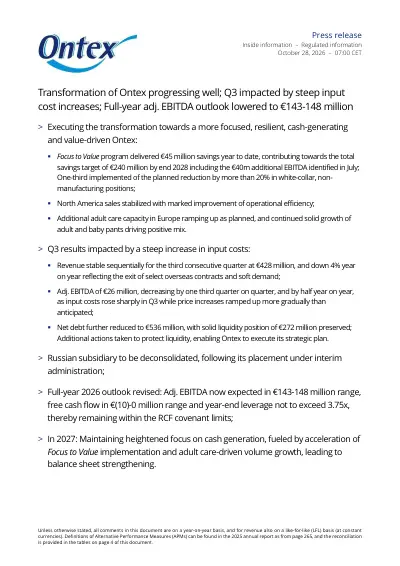
Ontex Group N.V.
Q3 FY2026 · Earnings Call TranscriptOctober 28, 2026
Jeff Raskin
Good afternoon, everyone, and thank you for joining us today. I'm Geoffroy Raskin from IR, and I'm pleased to have with us Laurent Nielly, our CEO, and Stéphane Re, our new CFO, to present the results of the third quarter of '26 and an update on our strategic transformation.
Before that, let me remind you of the safe harbor regarding forward-looking statements. I will not read them out loud, but I will assume you will have duly noted it.
With that cleared up, Laurent, over to you.
Laurent Nielly
Thank you, Jeff, and good afternoon to everyone. Today, we have reported the results of a challenging quarter and a further revision of our outlook.
We thought it was important to put this in the broader context of our transformation, let me start with that. Last July, we articulated our direction and in particular four major strategic shifts to improve our performance and restore value creation.
Together, they aim at increasing both volume growth, margin expansion, and better cash flow generation. Our Q3 results, if anything, just reinforce the need to execute this shift even more.
We're making progress on each of the strategic shifts. We provided some concrete examples in our press release this morning.
I will not have time to go through all of them, but I just wanted to give you a bit more flavor on the important Focus to Value program. Focus to Value brings together several work streams that ladder up to our €240 million savings target by the end of '28 relative to the 2025 baseline.
This program delivered a solid €45 million year-to-date. I wanted to share a couple of the progress we're making in different work streams.
First, in manufacturing excellence, we're improving plant efficiency, including overall equipment effectiveness and scrap rates, while also adapting our production footprint. We're progressing well on what we had announced earlier this year, on ceasing manufacturing in Australia, which will be finalized in Q4, and on right-sizing the tampon plant in Germany.
Second, on logistics and planning, we have completed the new end-to-end planning blueprint and are moving into implementation, including a new advanced planning system to go live in the course of '27. On complexity reduction, our current focus is on standardization of raw materials, which will support procurement savings and lower inventory requirements.
Here again, assessment has been completed and we started to implement. The fourth work stream that we highlight today is on streamlining our organization.
We had shared in July a target of reduction of more than 20% in white-collar positions outside of manufacturing, of which around one-third has already been completed or in execution. As you can see, we are attacking many fronts, and I'm proud of the energy and the resolve that our team are showing in finding new ways to drive efficiency and strengthen our competitiveness.
I also wanted to highlight an important view on our business regarding financial performance because I believe it underpins our confidence in our recovery and improved future. Looking at our group overall does not do justice to our starting position.
If you split our total business by broad geographies, you'll find that our business in Europe—and for clarity, this excludes Russia—represents around three-quarters of our total group. It is the home of our adult business, and it's very encouraging that it has maintained a double-digit adjusted EBITDA margin over the first 9 months of this year, while the overseas operations, which include, for instance, North America and Australia, remain a source of margin dilution.
Our transformation addresses this exposure directly, and in addition, we're systematically reviewing every product and customer combination across all markets to continue to drive mix and to improve the robustness of our portfolio. This is why we're confident we have a strong enough core platform upon which to build our value creation model.
Clearly, it was not enough to help us address what we need to say is a very challenging environment. Our third quarter performance and our financial results were disappointing.
I want to be clear about that, about what drove the shortfall, how we're responding, and why it does not change our confidence in the direction we set out in July. Let me start with revenue, that were broadly stable compared with the previous three quarters at €428 million.
The decline of around 4% year-on-year reflects soft market demand and some contract exits we had anticipated. The decline in adjusted EBITDA, however, was greater than we expected.
Raw material costs reached their highest level of the year, while pricing and cost-saving benefits are taking longer to materialize that we had planned. Closing that gap is a clear management priority.
Disciplined cash management, however, allowed us to reduce net debt slightly despite the weaker operating results. The decline in adjusted EBITDA pushed leverage up to 3.75 times at the end of September, while liquidity remained solid above €270 million.
Stéphane will discuss leverage and liquidity in more detail. Let me explain the factors driving our operating performance.
This chart should be familiar to the one that follow us quarter after quarter. On the left, it shows our quarterly revenue since the onset of '25, and you can see that revenue have stabilized sequentially in '26.
On the right, the adjusted EBITDA, where you can see the pressure on profitability as we face an exceptional external environment. After a broadly stable first half, Q3 took the full impact of the raw material price sharp increase.
Now let me go deeper into what drive raw material prices today. The chart shows the indices that drive our main raw material costs.
The indices rose sharply at the end of Q2, and that increase is what hits our Q3 costs. Although the indices have eased slightly since, they remain well above the start of the year, and we actually continue to see volatility as a result of the ongoing Middle East crisis.
Overall, raw material prices rose by about 10% on the third quarter compared to the start of the year, and transportation costs increased by a similar percentage, with high diesel prices impacting us since March. This is why continued pricing, together with mix and productivity, remain absolutely essential.
Before I comment further on our revised outlook for the year, let me turn to Stéphane Re, who joined us as CFO mid-September. He will now take you through the detailed Q3 financial results and our financial position.
Stéphane Re
Thank you, Laurent, and good afternoon. This is my first results presentation with Ontex.
Let me briefly introduce myself. I bring experience in fast-moving consumer goods, where understanding customers and maintaining cost discipline are absolutely essential.
I have also led transformation and cash-focused programs in private equity-owned businesses. That experience has reinforced the importance of cash management and a realistic assessment of performance.
My focus is on financial discipline and supporting the operational improvements needed to restore sustainable returns, and I'm looking forward to contributing to Ontex's transformation. Revenues: on this slide, you'll find, as usual, the revenue bridge from Q3 last year to this year.
As Laurent explained, revenue declined by around 4%, with volume down 5%. Let me break down that performance for you.
Adult care volumes were stable overall. Continued growth in European healthcare offset weaker sales in retail.
We continue to see adult care as an important source of future growth, while recognizing the near-term softness in retail. Feminine care volumes fell by 12%, mainly reflecting the planned contract exits in North American contract manufacturing and other overseas markets.
The largest volume impact came from baby care, where volumes declined by 9%. Contract exits overseas and weaker diaper demand, mainly in Europe, were the main factors.
At the same time, baby pants continue to grow, especially in North America, thanks to the ramp-up of previously secured contracts, providing an important positive within the category. The change in our product mix contributed to a positive price/mix effect of around 1%.
The pricing actions to recover inflation have not yet made a significant contribution, and passing higher costs through is taking longer than we anticipated in those categories, with weak demand and strong competition. We remain focused in securing that recovery while managing our customers' relationship very carefully.
Currency translation added approximately 0.5% to revenue, mainly reflecting the appreciation of the US dollar and the British pound. Now, the stronger dollar works the other way on transactional cost exposure, as part of our raw materials is dollar-linked.
Laurent will come back to that in the outlook. Let me now explain how these developments affected adjusted EBITDA.
Here you have the same bridge for adjusted EBITDA, and you immediately see the €7 million negative effect of volumes, not yet balanced by price increases. The net cost effects reduced adjusted EBITDA by a further €18 million.
As Laurent explained, the impact of higher raw material costs, but other costs are up as well, by about 10% year-on-year. Our savings offset the cost increase partially, i.e., by reducing the cost base by some 4%.
Those savings are making a real contribution. Focus to Value, our program, delivered €16 million in the quarter.
Lower volumes nevertheless limit the benefit that we can realize in manufacturing, which is why both commercial recovery and productivity improvement remain important. In the SG&A expenses, we more than offset inflation and reduced absolute costs, and this demonstrates progress in the areas where we can directly control, with further opportunities still to capture.
Currency translation provided a small positive effect, but it was insufficient to change the overall picture. Taken together, adjusted EBITDA declined by 49% to €26 million.
The margin fell by 5.3 percentage points to 6.1%. These results show the size of the gap we need to close through pricing, savings, and sustained cost improvement.
I will now turn to net debt, leverage, and liquidity. Preserving liquidity is a central management priority for us.
At the same time, the lower last 12 months adjusted EBITDA is putting pressure on leverage, we need to manage cash and covenant headroom very closely. We reduced net debt slightly, despite the lower results.
Working capital inflows helped, including improved payment terms under our Focus to Value program. We manage our capital expenditures much more carefully, taking into account demand and the timing of our investment requirements.
Leverage nevertheless increased to 3.75 times at the end of September because the last 12 months adjusted EBITDA declined. The revolving credit facility tests leverage at the end of June and December, with a 3.5 times threshold and a one-time allowance up to 3.75 times.
September is therefore not a test date for us, but the ratio highlights the limited headroom we have. As Laurent will explain, our year-end objective is to remain at or below 3.75 times, supported by earnings recovery and disciplined cash management.
As the headroom covenant is limited, however, we are engaging with our banks to secure a temporary adjustment to the leverage covenant. Liquidity at the end of September was €272 million, comprising €82 million of cash and approximately 70% of our €270 million revolving credit facility remaining undrawn.
This supports our operations and transformation program execution, and preserving that capacity remains a priority for us, and the available liquidity does not lessen the need to manage leverage. Before handing back to Laurent, I will address the recent development affecting our Russian operations and the financial implications we can assess as of today.
As we announced on October 16, our Russian entity was placed under interim administration by decree of October 15. We remain the legal owner, but we currently have effectively lost control of its operations.
We're assessing the situation, and it is too early to predict how the relationship between Ontex and the subsidiary will evolve. The business was already operating autonomously and in compliance with applicable regulations.
The loss of control triggers deconsolidation from October onwards. On a pro forma basis, at the end of September, net debt would decrease by around €10 million, reflecting the removal of about €19 million of cash and approximately €30 million of lease liabilities.
Our liquidity position reduces to €252 million pro forma. We had originally expected around €2 million of adjusted EBITDA contribution into Q4, and following that deconsolidation, that contribution is likely to be minimal.
With that, I will hand back to Laurent.
Laurent Nielly
Thank you, Stéphane. Let me now turn to what we see ahead with our revised outlook for the year.
Yes, we are lowering our adjusted EBITDA range for the year versus our previous guidance. Four factors led us to changing the outlook.
First, and with the greatest impact, costs are staying higher for longer than we anticipated at mid-year. Diesel is an example, but it also includes the negative impact of the US dollar against the euro since mid-September, which raises the cost of our dollar-linked raw materials.
Second, recovering these costs through pricing, as we said, is taking more time, with customer concern about consumer sentiment and footfall. Third, we have seen a lower volume than what we had expected initially.
Our stable sales are encouraging, but frankly, we expected more, both in North America and in Europe. Fourth, the impact of the deconsolidation of Ontex Russia entity.
These factors, already included into our Q3 low results, meant that our previous guidance was no longer within reach. We are bringing down, therefore, the full-year adjusted EBITDA range from €165 to €180 million down to €143 to €148 million.
Let me now share what it means for Q4. For Q4, we expect adjusted EBITDA to be in the range of €39 to €44 million, thereby recovering at or above the level achieved in the first half and of Q4 of last year.
This is underpinned by confirmed pricing ramp-up, a modest quarter-on-quarter easing in cost inflation, and continued delivery of savings, in addition to slightly higher volumes linked to small seasonality of our sales. It also anticipates some slight impact from the deconsolidation of the Russia entity, as Stéphane indicated.
Going to the other outlook KPIs, we are improving our guidance on free cash flow, that is now expected to improve to €0 to -€10 million versus the previous guidance of -€15 to -€25 million. This despite the lower EBITDA, as Stéphane explained, thanks to our continued strict cash management.
Our year-end leverage is not to exceed 3.75 times, and we have a full plan in execution, and we're confident we will maintain the necessary liquidity and operate within our covenant limits. Let me close with our immediate priorities for Q4.
First and foremost, preserve financial flexibility. Second, continue pricing action in the face of sustained higher input costs.
The contribution from pricing is expected to increase in Q4. Third, deliver further productivity and efficiency gains through Focus to Value.
We're making progress, and this will accelerate also in '27. Of course, in parallel, we continue to progress on all the other shifts, like adult strategy or North America reset, but those are our immediate priorities.
As I said in my opening, we're starting to see some progress on all key initiatives, but we're not satisfied with where we stand. We have significant work ahead to deliver the potential of the business.
We have strong positions and assets to build on, and we're confident in the direction we're taking. With that, Stéphane and I are ready to take your questions.
Jeff Raskin
Thank you, Laurent and Stéphane. We will now open the Q&A.
To join the queue, please press the pound key followed by 5, and to withdraw your question, press the pound key followed by 6. Now, first question comes from Karine Elias from Barclays.
Karine, we listen.
Karine Elias
Hi, thank you for the presentation and thanks for taking my questions. I had a few, if I may.
You mentioned that pricing action have ramped up more gradually than you had anticipated, and this is, to be honest, very in line with what we're hearing from some of your peers and some of the paper and packaging companies. Some of them have compared the current environment to 2017, where I think at that time it took about five to six quarters to recover inflation.
They also mentioned overcapacity that needed to clear, just to re-establish that balance. Is that a fair assumption?
Is that consistent with what you're seeing? That would be my first question.
My second question: it's great to see you upgrading the free cash flow guidance despite the decline in the EBITDA, but I also noticed that you've drawn more on your factoring line, just wondering if that's helping a little bit on the working capital. If you can help me just square that up.
Then my last one was on the Q4 guidance. Obviously, I think part of you cutting outlook is because of the lower volumes.
Just kind of wondering how confident you are about volumes in Q4 because I remember last year round about that same time you had reiterated guidance, and then obviously, we had the profit warning in December. What could go wrong in Q4?
Are we clear that the 39, 44 would happen? Thank you.
Laurent Nielly
All right, thank you, Karine. I will address your first and third question, and Stéphane will answer on the factoring.
On pricing, I think you're right. I think our current assumption is going to take more time to recover the pricing.
I think you were mentioning the four, five quarters from probably the 21-22 episode where we had steep inflation. I don't have an exact view on that, but yes, it's fair to assume that it will take another few quarters for that to be fully implemented.
For the reason that you've mentioned in terms of concern of our customers about their consumer sentiment and the fact that there is, in some categories, a bit of capacity where we have many players are protecting their volume position, so that's a fair assessment. On your Q4, in the bridge that we present, most of the elements are pretty mechanical, I feel pretty strong about the forecast that we have for Q4.
You're right that the one that has still a little bit of range is the volume, and we expect higher volume in Q4 versus Q3 on a like-for-like basis. We have plans in place in case that volume will not 100% materialize.
We are pretty confident about the range we're providing today. Now I'm going to pass it to Stéphane to answer on the factoring question.
Stéphane Re
This is an excellent question. Look, you're right, we have taken a bit more from our factoring program.
What you need to know is that we're managing within our Focus to Value program a very strong payment terms management process. Therefore, the improvement that we've seen in our working capital does not come from the change in the factoring arrangement.
It is mostly driven by the way we manage our inventories on one hand, and then the way we managing our payment terms on the other hand with lots of possibilities. It's factually correct, we're taking some opportunities to do better with our clients that are part of our factoring agreement.
Karine Elias
That's very clear. I appreciate the color and best of luck.
Laurent Nielly
Thank you.
Jeff Raskin
Thank you, Karine. The next question comes from Maxime Stranart from ING.
Maxime?
Maxime Stranart
Hi, good afternoon. Hope you can hear me well.
Two questions on my side, if I may. Looking at the article in the Spanish newspaper yesterday mentioning that Navarra is planning to claim €25 million damage fee to Ontex.
Any color you can provide on this topic? Secondly, looking at the performance in Q3, baby care down more than 8% like-for-like, fem care more than 10.
Could you elaborate what's the impact of the exit of contract manufacturing versus actual performance of the category itself? Be very helpful.
Thank you.
Laurent Nielly
All right, thank you, Maxime. Laurent, I will address your two questions.
On your first question, you're referring to an article published in the Spanish newspaper yesterday that was also taken partly by the De Tijd newspaper also yesterday concerning a damage claim of one of the region in Spain against a consortium of companies. It's not just Ontex; it's a consortium of companies on which we were part.
It's an old claim. Very good.
We have not had been receiving any official notification to that date, I cannot really comment on rumors. What I can tell you is that we have a pretty strong legal position, and then we don't expect that it would have, if it were to be confirmed, any material impact on Ontex.
That's on the first question. On the second question, yes, on fem care, I would say most of the decline is related to contract exits.
If you look at the underlying category trend, it's flat, about flattish, okay, in Europe. On the baby, conversely, here, most of what is driving the decline in baby diaper is market-related, where it's a high single-digit decline in baby diapers both in North America and in Europe.
That would be the key driver, while in pants, we're driving growth ahead of the market. I hope I answered your question.
Maxime Stranart
It does, thank you. Just maybe if I can squeeze a quick follow-up on this one.
Could you maybe elaborate a bit on what's the mix in baby care, pants versus diapers, or is it something you're not keen on providing at the moment?
Laurent Nielly
No, I think the mix is pretty consistent with the market, which is, if you look at in volume, it's 25 to 30% to baby pants and the rest to baby diapers.
Maxime Stranart
That's very helpful. Thank you for the answers.
Jeff Raskin
Thank you, Maxime. The next question comes from Rebecca Clements from JP Morgan, and just as a reminder, if you want to join the queue, please press the pound key followed by 5.
If you want to withdraw, followed by 6. Rebecca, the line is yours.
Rebecca Clements
Hi, thanks for taking my questions. I had a couple.
Just regarding Russia, can you give us a sense for what the sales mix was there, across your different product categories and what the full-year EBITDA contribution would have been? You said €2 million in the fourth quarter, but I didn't know if there was any seasonality in that.
That's my first question. The second question is just regarding discussions with banks.
I believe your credit facility is currently unsecured, and I was curious, to get some headroom here and give yourselves an appropriate amount of space to operate in, do you think that you're going to have to provide security, or that they may require that you change that credit facility to secured, and would that impact your ability to factor receivables at all? Then just lastly, is there any change in the CapEx outlook?
I see that you're obviously being quite disciplined about CapEx right now. Thank you.
Laurent Nielly
Yeah. All right, thank you, Rebecca.
I'll take your 1 and 3, and then Stéphane will comment on the bank discussion. On Russia, our sales are a majority of adult care products and the rest is baby.
It's very no fem care sales. The EBITDA for full year, if you look at the historical data, we had indicated into our press release a 7 to 8%.
It's running a little bit below that, so, if you wanted to have a full-year impact, you could take approximately the indication on Q4 and annualize it, you would not be very far from what you think. It's still not 100% confirmed on what the relationship will be between the two subsidiaries.
That's why it's a difficult for us to predict, okay? On the CapEx, you're correct that we will end up the year below our initial target, so, we will probably end up the year below 4% of spend of sales in CapEx.
Now I'm going to let Stéphane comment on the bank.
Stéphane Re
All right, it's a good questions. Look, as I was saying before, we have engaged with our banking partners to get a temporary adjustment of our leverage.
We do not anticipate any change as far as the core terms and conditions of the RCF. Once again, I repeat, this is a temporary adjustment only.
We're not changing the mechanics or fundamentally the content of the RCF arrangement. To the other part of the question, no, we do not anticipate, therefore, as a consequence, any change in our ability to factor receivables.
The bank that is factoring our receivables is also one of the bank within the pool, and we are progressing very well with all of those banks as we speak.
Rebecca Clements
Could I slip in one more question?
Laurent Nielly
Go ahead.
Rebecca Clements
Just regarding your guidance, given the spike that you had in your raw material costs in the third quarter, I think your updated guidance sort of implies that you'd be flat in the fourth quarter with 2025 fourth quarter. If that's the case and you have commented that the price increases are slower to come through than you would like, I'm just curious how you're going to be able to manage around that from a margin perspective, especially when you factor in as well the deconsolidation of Russia, etc.
What am I missing here? Are there hedges that came into effect on your raw materials, or is there some other factor that I'm missing, or is pricing coming through better than maybe I'm thinking it will just to kind of help on the margin front, given how much of an impact it was for you in the third quarter?
Thank you.
Laurent Nielly
Yeah. Thank you, it's a good question.
I think if you look at versus last year, which is your question, you would find more productivity than what we had delivered last year, which is incremental. You would find that, yes, we're reducing the gap between the cost inflation and the price, a big contribution going from Q3 to Q4 will be on price that has been confirmed.
Mathematically, some of our price increase only started in September, so that's a mechanical effect into Q4. You'll find a better mix and slightly better volume Q4 this year than last year.
Then finally, we're making progress on improving our profitability in North America, which also will be a positive contribution. Last but not least, because we're looking at also productivity across all the line, the SG&A is contained, right?
That's all would be positive contributors. No there is no magic trick or hedging or things included in that guidance.
Thank you.
Jeff Raskin
All right, thank you very much, Rebecca. There are no further questions, Laurent, I will hand it over to you.
Laurent Nielly
Thank you. Thank you, Jeff, and thank you, Stéphane, and thank you all for joining the call and for the questions that we received.
We're moving forward and started the execution of the transformation towards a more focused, resilient, and cash-generating Ontex. At the same time, this quarter financials fell short of our expectation, and while we expect a recovery in Q4, we have to continue to work harder on all the elements against an external backdrop that remains difficult.
Our core business is really resilient, and we have many opportunities for profitable growth and clear actions to tackle where we have margin-dilutive operations. We remain focused on converting those strengths and initiative into better earnings and cash generation, and we look forward to updating you on our progress.
Have a good day.