Ormat Technologies, Inc.
Q3 FY2026 · Earnings Call TranscriptNovember 5, 2026
Operator
Good morning, and welcome to Ormat Technologies third quarter 2026 earnings conference call. All participants will be in listen-only mode.
After today's presentation, there will be an opportunity to ask questions. If you would like to ask a question, please press *1 to raise your hand.
To withdraw your question, press *1 again. Please note that this event is being recorded.
I would now like to turn the conference over to Josh Carroll with Alpha IR. Please go ahead.
Josh Carroll
Thank you, Operator. Hosting the call today are Doron Blachar, Chief Executive Officer; Assi Ginzburg, Chief Financial Officer; and Smadar Lavi, Vice President of Investor Relations and ESG Planning & Reporting.
Before beginning, we would like to remind you that the information provided during this call may contain forward-looking statements relating to current expectations, estimates, forecasts, and projections about future events that are forward-looking as defined in the Private Securities Litigation Reform Act of 1995. These forward-looking statements generally relate to the company's plans, objectives, and expectations for future operations, and are based on management's current estimates and projections, future results, or trends.
Actual future results may differ materially from those projected as a result of certain risks and uncertainties. For a discussion of such risk and uncertainties, please see risk factors as described in Ormat Technologies' annual report on Form 10-K and quarterly reports on Form 10-Q that are filed with the SEC.
In addition, during the call, the company will present non-GAAP financial measures, such as adjusted EBITDA. Reconciliations to the most directly comparable GAAP measures and management's reasons for presenting such information are set forth in the press release that was issued last night, as well as in the slides posted on the website.
Because these measures are not calculated in accordance with GAAP, they should not be considered in isolation from the financial statements prepared in accordance with GAAP. Before I turn the call over to management, I would like to remind everyone that a slide presentation accompanying this call may be accessed on the company's website at ormat.com under the presentation link that's found on the Investor Relations tab.
With all that said, I would now like to turn the call over to Ormat CEO, Doron Blachar. Doron?
Doron Blachar
Thank you, Josh. Good morning, everyone, and thank you for joining us today.
Let me begin with the key highlights from the third quarter starting on slide 4. Ormat delivered a strong third quarter, building on the momentum we have sustained throughout the first 9 months of the year.
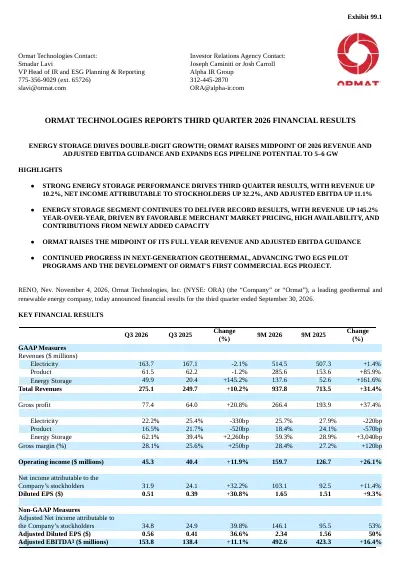
During the third quarter, revenue increased 10.2% and adjusted EBITDA grew 11.1% compared with the prior-year period, reaching a third quarter record. As a result of this growth and our visibility into the fourth quarter, we are raising the midpoint of our full-year revenue and adjusted EBITDA guidance.
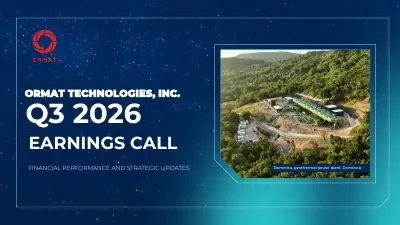
Energy storage was the main driver of our growth this quarter, supported by new capacity, high asset availability, and favorable merchant pricing in PJM. In our electricity segment, our 10 MW Dominica geothermal plant began commercial operations in July, and generation at Olkaria continued to improve following our resource utilization work.
These gains were partially offset by lower generation at our Puna plant due to a hurricane-related forced outage. On the EGS front, we continue to advance two pilot projects with SLB and Sage while negotiating power purchase agreement for Dixie Valley, our first planned commercial EGS project, and for other potential project.
I will provide more details shortly. Finally, as many of you are aware, we hosted an Investor Day in September where we outlined our growth targets for 2030.
While it is still early, we believe today's results reflect solid initial progress towards these goals. Before I dive deeper into some of our operational highlights, I would like to turn the call over to our CFO, Assi, to cover the financial results for the quarter.
Assi?
Assi Ginzburg
Thank you, Doron. I will begin my review of the financial results on slide 6.
The third quarter revenue was $275 million, marking an increase of 10.2% compared with the prior-year period, led by strong energy storage performance. Gross profit increased 20.8% to $77.4 million, and consolidated gross margin expanded by 250 basis points to 28.1%.
Net income attributable to the company's stockholders was $31.9 million, or 51 cents per diluted share, compared with $24.1 million, or 39 cents per diluted share, in the prior-year period. The year-over-year increase of 32.2% was mainly driven by higher energy storage revenue and gross profit.
Adjusted net income attributable to the company's stockholders in the third quarter of 2026 increased 39.8% to $34.8 million, or 56 cents per diluted share, compared with $24.9 million, or 41 cents per diluted share, in the third quarter of 2025. Adjusted EBITDA increased 11.1% to a third quarter record of $153.8 million.
Slide 7 provides additional details on our segment performance. Electricity segment revenue in the third quarter declined 2.1% to $163.7 million.
The decline was driven by a temporary lower generation at Puna following a hurricane-related forced outage, which had a $5.1 million revenue impact in the quarter. In the fourth quarter, we plan to clean out wells in Puna.
While this work will temporarily reduce revenue, we expect it to support higher generation in 2027. The Puna impact was partially offset by $2.2 million in revenue from our new Dominica plant and $1.9 million from higher generation at Olkaria following improved resource utilization.
Segment gross margin was 22.2% compared with 25.4% in the prior-year period. Excluding the Puna impact, electricity gross margin would have been approximately 24.5%.
The fourth quarter, we expect electricity gross margin to be slightly above last year's level, as improved operation at the remaining of our plants should more than offset the temporary impact of the Puna well cleanouts. Product segment revenue was $61.5 million, down 1.2%, mainly reflecting the timing, manufacturing, and construction progress.
Gross margin was 16.5%, an improvement from the second quarter compared with 21.7% in the prior-year period. We continue to expect full-year product segment gross margin of approximately 18%.
Energy storage segment revenue increased 145.2% to $49.9 million. High assets availability enabled us to capture strong merchant pricing in PJM, while capacity additions over the past 12 months contributed incremental revenue.
The segment generated a gross margin of 62.1%, reflecting our strategy of optimizing the mix of contracted and merchant revenues. We expect energy storage segment gross margin for the full year to be approximately 50% to 55%.
Slide 8 and 9 summarize our 9 months results. Revenue increased 31.4% to $937.8 million, driven mainly by strong growth in the product and energy storage segments.
Adjusted EBITDA increased 16.4% to $492.6 million, while adjusted diluted EPS increased 50% to $2.34. Turning to slide 10, during the first 9 months of 2026, we collected approximately $69.3 million of proceeds from tax credit monetization transaction.
For the full year, we now expect approximately $90 million in proceeds, including approximately $68 million related to ITCs and approximately $22 million related to PTCs transfers. During the third quarter, we recorded $10.6 million of ITC benefits.
For the full year, we expect to record $59.9 million in ITC benefits, which should result in effective income tax benefit rate of approximately 15% in the fourth quarter, excluding changes in law and any other one-time items. Slide 11 presents the change in our cash position during the first 9 months of the year.
Cash and cash equivalent and restricted cash totaled approximately $512 million as of September 30, 2026, compared with approximately $281 million at year-end 2025. The increase reflected the proceeds from our convertible notes offering and recent financing activities, cash generated from operation, and tax credit monetization, partially offset by capital expenditures, debt repayments, acquisitions, and investments.
As of September 30, 2026, total debt was approximately $3.3 billion, excluding deferred financing costs, as shown on slide 34. The weighted average interest rate on our debt was approximately 3.9%.
Turning to slide 12, total liquidity was approximately $977 million as of September 30, 2026. Net debt was approximately $2.8 billion, equivalent to 4.3 times net debt to adjusted EBITDA.
Net debt represented approximately 50% of total capitalization. We expect capital expenditure for the remainder of 2026 to be approximately $287 million.
Of the total, approximately $157 million is allocated to electricity segment for construction, exploration, drilling, and maintenance; approximately $90 million for the storage segment asset construction; approximately $18 million to the SLB pilot and other EGS activities; and approximately $22 million to the product segment and business development. Our detailed capital expenditure plan is on slide 35 of the appendix.
Our liquidity and access to capital provide us with the flexibility to fund our development pipeline while continue to service our debt and return capital to shareholders. On November 4, 2026, our Board of Directors declared a quarterly dividend of 12 cents per diluted share, payable on December 2nd, 2026, to shareholders on records as of November 18, 2026.
I will now turn the call back to Doron to discuss our recent operating and strategic development.
Doron Blachar
Thank you, Assi. Turning to slide 14, our total operating portfolio now stands at approximately 1.85 GW.
On slide 15, our electricity portfolio stands at approximately 1,358 MW globally, with 13 MW added during the quarter. We currently have 204 MW of electricity projects under construction and development through the end of 2028, including 89 MW of geothermal capacity and 115 MW of solar capacity.
All of these projects are supported by long-term PPAs with attractive pricing, providing strong visibility for future growth. Slide 16 details the electricity segment third quarter drivers, as mentioned earlier.
Moving to slide 17, recontracting remains one of our key priorities. We're actively negotiating blend-and-extend agreements with several utility customers, engaging well ahead of contract expiration to expand terms and capture a meaningful share of today's higher geothermal pricing without significant incremental capital.
With market pricing for new geothermal PPAs still above $100 per megawatt-hour, we see recontracting as a multi-year opportunity. We expect it to be a primary driver of electricity gross margin recovery towards our 2030 target of 40%.
Turning to slide 18, our product segment backlog stood at approximately $183 million as of November 4, 2026. The backlog remains geographically diversified, with the majority associated with projects in Asia and New Zealand.
Moving to slide 19, the increase in energy storage revenue includes $19.6 million of higher revenue from existing PJM assets and approximately $9.3 million from newly commissioned facilities. The operating portfolio now stands at 495 MW or 1,358 MWh.
While we continue to benefit from strong merchant pricing in our storage portfolio, our long-term strategy does not depend on today's high electricity prices to drive long-term performance. Our future US storage projects are expected to come online under full tolling agreements, providing strong, stable, long-term revenues and reducing the portfolio reliance on PJM.
Slide 21 outlines our long-term portfolio growth targets. We remain on track to achieve our 2028 portfolio targets of 2.6 to 2.8 GW.
Looking further out to our recently released 2030 targets, we expect to approximately double our year-end 2025 capacity by year-end 2030, with our electricity segment reaching 2 to 2.1 GW and storage reaching 1.5 to 1.6 GW. This growth is supported by projects already under construction or in advanced development, many with interconnections, permitting, and contracting in place.
As a reminder, these targets do not include any contribution from EGS. Slides 22 and 23 provide details on our geothermal and solar development pipeline.
Construction and development continues across our US and international portfolio, including the Puna expansion and Lone Mountain projects. Turning to slide 24 and 25, we have seven energy storage projects under construction and development with total capacity of 497 MW or 1,888 MWh.
This includes the 100 MW, 400 MWh Denali energy storage facility in California, which we decided to move forward with in August. Upon completion, expected by the end of 2028, the project is anticipated to provide energy storage services under a 20-year tolling agreement with Clean Power Alliance.
Our broader US energy storage pipeline now totals approximately 3 GW or approximately 11.6 GWh across 31 named prospects. Turning to EGS on slide 26, as we outlined during our Investor Day, our EGS approach leverages the full range of capabilities that we have developed over the past six decades as a leading geothermal developer, owner, operator, and technology provider.
We believe EGS has a credible path to commercial viability, but that path must be demonstrated site by site. The question that matters is not whether initial flow can be achieved, it is whether a project can sustain temperature, flow, water balance, and well integrity over many years, with seismicity safely managed, at a cost the PPA support.
That is exactly what our pilots are designed to answer. We continue to advance two subsurface pilots through our alliance with SLB and our collaboration with Sage Geosystems, with drilling planned for late 2026 to early 2027.
In parallel, we are building commercial and operational foundations. At Dixie Valley, an existing Ormat site, we have the land, water rights, and an executed interconnection agreement for the first omega-100 unit, and we have filed interconnection for the rest of the project.
We are negotiating a PPA structure to reflect the risk profile of a new technology, with commitments that scale as the technology matures. We continue to secure land and file for interconnection across Nevada, Utah, and New Mexico.
In September, the Department of Energy selected Ormat alongside SLB and the University of Utah for up to $35 million in funding to advance EGS at Dixie Valley and hydrothermal development at Cove Fort, Utah. Moving to slide 27, since our Investor Day in September, we have significantly expanded our EGS land position.
We added approximately 16,000 acres of new BLM leases through Nevada's October lease sale, and identified additional acres with EGS potential within our existing portfolio. As a result, our EGS land position has grown from approximately 70,000 acres to approximately 170,000 acres in the last two months.
We estimate it could support 5 to 6 GW of future EGS development, up from the 3 to 4 GW we outlined at our Investor Day. Longer-term, we are targeting 1 GW of operating EGS projects between 2033 and 2035, subject to the pilot results, project economics, and final investment decision.
Our experience as an owner, operator, our land, water, and interconnection positions, and our manufacturing capabilities give us a strong foundation to pursue this opportunity with discipline. Please turn to slide 28 for updated 2026 guidance.
Based on our strong performance in the first 9 months and continued business momentum, we are raising the midpoint of our full-year revenue and adjusted EBITDA guidance. We now expect total revenue of $1.17 billion to $1.2 billion, representing growth of approximately 19.7% at the midpoint compared with 2025.
By segment, we expect electricity revenue of $700 million to $710 million, reflecting the Puna impact in the third and fourth quarters; product revenue of $310 million to $320 million; and energy storage revenue of $160 million to $170 million. We now expect adjusted EBITDA of $640 million to $650 million, representing growth of approximately 10.8% at the midpoint compared with 2025.
Approximately $13 million of adjusted EBITDA is expected to be attributable to minority interest. Let me close on slide 29.
The third quarter showed the strength of our diversified model. We delivered double-digit revenue growth, expanded gross margin, and raised the midpoint of our full-year guidance.
As we look ahead, we remain focused on executing the plan we outlined at our recent Investor Day: doubling our year-end 2025 capacity and reaching annual revenues and adjusted EBITDA of more than $1.5 billion and $1 billion run rates, respectively, by the end of 2030, excluding any contribution from EGS. With growing demand for reliable power and our expanding portfolio of contracted geothermal and storage projects, we believe Ormat is well-positioned to execute this strategy and deliver sustainable long-term growth for our shareholders.
With that, I will conclude our prepared remarks. Operator, we are now ready to take questions.
Operator
We will now begin the question-and-answer session. If you would like to ask a question, please press *1 to raise your hand.
To withdraw your question, press *1 again. We ask that you pick up your handset when asking a question to allow for optimum sound quality.
If you are muted locally, please remember to unmute your device. Please stand by while we compile the Q&A roster.
Your first question comes from the line of Noah Kaye with Oppenheimer. Your line is open, please go ahead.
Noah Kaye
Hey, good morning all, and thanks for taking the questions. I would like to start with electricity.
I think Assi you mentioned in the prepared remarks what gross margin would have been in 3Q ex the Puna factor, and then you mentioned that we should see some slight year-over-year expansion in 4Q. My question is just broadly on how expansionary trends start to play out as we lap some of these items and see some of the benefits of blend-and-extend.
Because I think last year, there was a one-time headwind, if I remember correctly, of about $5 million related to some discrete costs that I presume didn't recur. Just when do you in your views expect the segment to start seeing some real expansion on an underlying basis, and what drives that?
Thank you.
Doron Blachar
Hi Noah, I will start, and Assi can follow. We see the electricity segment gross margins increase over time, and as we said on our Investor Day, that we're looking to reach 40% at end of 2030.
The increase is expected to come from ongoing enhancements that we are doing, from blend-and-extend that we are doing on contracts, for new power plants coming online. There's a variety of things that we are doing in order to increase the gross margin, and we have a detailed plan that as time passes, we will share with you and show you in the future guidance that will give to the market.
Assi?
Assi Ginzburg
First thank you for the question. I'll start by saying that we should start seeing an increase in margin already in Q4.
We expect to see a jump already in 2027. In general, there are three main items that will impact our profitability going forward.
One is the blend-and-extend opportunity that will kick in. Every year, we will see additional megawatts.
Two, Puna, for example, we expect next year to have a brand-new facility towards the second half of the year. Expectantly, we should not have the issues that we've seen this year with Puna.
Three, as we are adding more assets to our Google and other data centers portfolio, the average price of the PPA of new facilities is expected to be newer. In addition to that, we're looking and we're turning every, I would say, a quarter to make sure that we are running our plants at the most efficient way.
We expect this to start seeing an improvement already in Q4.
Noah Kaye
Very helpful. Turning to EGS, I would say that to have this kind of expansion of the pipeline in such a short period of time is very positive and encouraging.
Maybe just help us understand when you talk about that pipeline potential, how exactly are you assessing the gigawatts of potential capacity there? At a high level, what assumptions are you making about the new land position?
What kind of gives you confidence in the development potential of those new resources?
Doron Blachar
On the EGS, the significant increase is basically when we acquire land, private or through BLM, for our traditional hydrothermal projects, we usually take land that is also surrounding the asset, the hydrothermal system, in order to make sure that we maximize the system. What we've seen is that adjacent to hydrothermal systems many times there is potential for EGS.
That's what we've seen. We've analyzed the land positions we have across our assets.
This is the big jump that you see in the potential that we have. Obviously, there are some locations that have potential for significant megawatts in the hundreds of megawatts, and other places have in the tens of megawatts, and some are not relevant for EGS.
At this stage, when we look at the land, we have all the information from the hydrothermal system, and through geological analysis and models, we estimate what is the potential we see. Obviously, until you don't drill, actually drill, you don't have to confirm the number, but this is a range that we give, and we expect it to be in that range, and hope it might be even higher than that, but we usually take the more conservative view on the numbers we give to the market.
Noah Kaye
Very helpful. I won't ask a question on energy storage, I'll just say well done and good job on the quarter, guys.
Thank you.
Doron Blachar
Thank you, Noah.
Operator
Your next question comes from the line of Justin Clare with ROTH Capital Partners. Your line is open, please go ahead.
Justin Clare
Hey, good morning. Thanks for taking the question here.
I wanted to just touch on the PPAs here, and the 60 MW that you've already recontracted at this point, can you share how those contracts will start and how those will layer in over the coming years here? Could we see a meaningful portion of those that have been recontracted kind of kick in in 2027?
Then there's the longer-term opportunities, 2031 to '34, I think 200 MW there. Just I wonder if you can give us a little bit more color on the conversations you're having and how willing customers are to renegotiate and then how far in advance of those contracts could you recontract them?
Doron Blachar
The contracts that we already blend and extend, one of them started in October, the other one is expected to recontract sometime next year. These are the one that we've already negotiated.
The discussion basically with the utility of off-taker basically starts with the fact that prices are going up. The demand for electricity is very high, and power plants that end their contract in 2, 3, 4 years down the road, there is a joint and basically willingness by us and by the off-taker to extend the relationship.
Then the question comes at what price. We'll negotiate what price.
The blend and extend from our perspective, we would like to get the price today. They would like to get the extension.
It's a negotiation when it starts and what price do you reach. On slide 17, you can see the potential upside that we have split into years.
Obviously, to try today to recontract a PPA that ends in 2034, 2035, it's very hard. As time passes, these PPAs are getting closer, and we're speaking with the utilities.
Justin Clare
Got it, okay. Maybe then just shifting over to storage here, wondering if you could just share how merchant pricing has been trending into Q4 here?
Have you seen any normalization at this point? Then just curious on the expectations for Q4 in your guidance.
Are you assuming kind of normal merchant conditions? Then just looking into 2027, what potential do you see for this year's outperformance to extend into next year given what you're seeing in terms of market conditions?
Doron Blachar
When when we look in to to Q4 of this year, what we do see is that October was much more stable or normal months with not very high merchant pricing. November, December, we don't know yet, it's coming and we'll see how it unfolds.
2026 was a very, very high year, high year for merchant prices in PJM. When we look into 2027, we hope the prices will be will be the same, but it's very hard to forecast so high prices.
'26 prices are more than double of the '25 prices. For '27, we expect to be a bit lower than the '26 numbers, but it's merchant, you know.
It depends on climate, depends on prices, and we will see as time passes.
Justin Clare
Got it. Thanks very much.
Operator
Your next question comes from the line of Derek Podhaizer with Piper Sandler. Your line is open, please go ahead.
Derek Podhaizer
Hey, good morning, everyone. Wanted to ask about just some of the new details around your EGS build-out with the leased acreage purchases.
You now have land that could be up to 5 to 6 GW, it's up from the 3 to 4 GW we heard during the Investor Day. I think there's some concern as far as interconnection delays and what those gigawatts can look like.
Can you talk about what your expectations are for behind-the-meter with the EGS projects, and when you think these should be coming online? Just some more thoughts around how we should balance interconnection delays, but also the appeal of deploying behind-the-meter projects with EGS.
Doron Blachar
Sure. Thank you.
I'll say one, we gave on our Investor Day our 2030 targets, excluding EGS, and that basically doubles the megawatts that we have today. These are our projects that most of them have permitting, interconnection, land, and others.
When we look on the EGS front, we expect the first phase of the Dixie Valley EGS project to come online between 2029 to 2030. For this first phase, we have interconnection, we have water, and land.
We're basically looking at the pilots that we are developing to get the right technology to develop it. Interconnection for additional EGS projects down the road after the pilot basically, 2030 and onwards, these are interconnection requests that we are filing today.
We already filed in '26, we will be continuing to file in '27 and onwards. We expect that by the time that the projects will be ready, we will have the relevant interconnection to develop them.
We said on the Investor Day that we're looking for 1 GW between 2033 to 2035. We assume this will not be behind-the-meter.
We'll have interconnection by that time. On behind-the-meter discussions, we have discussions on behind-the-meter.
None of them have moved to a very advanced stage. Taking the risk of behind-the-meter, it's not a risk that we will be taking, obviously, it's the data center risk that we'll be taking.
I think that it can maybe compensate for a period of time waiting for interconnection and actually having a data center earlier. At this stage, we don't see somebody going all-in on a behind-the-meter 1 GW project.
Derek Podhaizer
Great. No, I appreciate all that color.
Moving over to energy storage, I know a couple months ago there was a Bulk Power executive order out by the administration and included the battery energy storage systems. Just wanted to get your thoughts and color on how this could potentially impact your energy storage segment just given the supply chain out of China.
Just some thoughts around that would be helpful. Thanks.
Look,
Doron Blachar
we follow very closely the regulation that continues to come up. We obviously meet all the requirements.
We buy batteries from China if we can and if it is allowed based on the regulation. We buy from Tesla.
We buy from others. We feel very comfortable with the guidance we gave to the market on getting to about 1.5 to 1.6 GW of energy storage project by end of 2030, taking into account all of these limitations.
Derek Podhaizer
Great. Thanks, Doron.
I'll turn it back.
Operator
Your next question comes from the line of Julien Dumoulin-Smith with Jefferies. Your line is open, please go ahead.
Hey guys, this is Parker on for Julien, and thank you for taking our questions. Just another one on PPA pricing.
As we think about the gross margin improving to that 40% level and blend-and-extend and new projects coming online driving a lot of that, just wanted to touch on what you're seeing in terms of leading-edge pricing data points as you have some of these discussions. I think at the Investor Day, you were talking about $110 to $120 a megawatt-hour if you wanted to recontract the whole portfolio today.
I'm curious if anything has changed in your view on pricing given some of these discussions you're having today.
Doron Blachar
We talked in the Investor Day and before that, PPA pricing today are well above $100 per megawatt-hour. We don't see any trend of reducing these pricing.
On the contrary, we see the potential interest to these prices. That's why we're looking for the blend-and-extend, and I think that interest in prices actually pushes the off-taker to actually come early and do a blend-and-extend earlier rather than later, managing the risk of increase PPA pricing.
As on slide 17, you can see the potential upside that we have today on the blend-and-extend. Assi, do you want to add something?
Assi Ginzburg
No. No, no.
Great. Thank you for that.
Then shifting to EGS, we talked about the pipeline expansion a little bit here. You called out the PPA negotiations at Dixie Valley as well as other potential projects.
You guys have been talking, I think about, in the illustrative slide you laid out at the Investor Day, roughly $120 a megawatt-hour. Curious, as you're having some of those discussions on EGS specifically, what you're seeing on pricing?
Doron Blachar
On EGS, PPA pricing, this is a much more complicated discussion than a traditional one, hydrothermal, due to the fact the technology is not fully proven yet. We're working on the pilots to prove the technology, and obviously, even once the technology will be proven, there's a question of scalability and long-term operations.
We are trying to negotiate a bit of a different PPA that has a balance between the return that we can get from the project versus the PPA price. I think in today's pricing and technology, $100 PPA for EGS project is not high enough in order for it to be economical.
Maybe over time, when the cost to develop EGS project will continue to go down, it will become economical. Today, we believe we need higher pricing than that.
These are the discussions we have on the Dixie Valley EGS project, as well as other projects.
Operator
Your next question comes from the line of David Anderson with Barclays. Your line is open, please go ahead.
David Anderson
Hi, good morning. Just in relation to the two pilot projects that are going on with Sage and SLB.
Presumably both are going to be starting to effectively test the concept and make sure it works, but beyond that, the key will clearly be the economics around commercialization. Can you talk about how you see some of those economics kind of lining up today versus commercial geothermal, and whether or not they're superior as of now?
What are some of the metrics that you're looking at? Can you talk perhaps say on say capex to megawatt?
Is there a target that you're trying to get to, is there a hurdle that you need to see in order to move ahead with commerciality on these two projects?
Doron Blachar
Yes, we have our target for the long-term on the EGS, and as we presented on the Investor Day, it's between $5.5 to $6.5 million per megawatt. These are the long-term targets that we have.
I can tell you that internally we have lower targets, but at this stage, these are the targets that we feel comfortable with, the $5.5 to $6.5. I believe the first project will be higher than that.
It takes time to have all the lessons learned and reduce costs. From the pilot, I think the pilot needs to demonstrate on one hand the technological feasibility of the EGS, and on the other hand, it needs to give us comfort how the cost will go down to the levels I mentioned.
On the above-surface, we are the largest ORC supplier in the world by far. We are working on the omega-100 and building the right supply chain to get the above-surface cost to around $1.5 to $2 million per megawatt.
On the subsurface, we need to see the pilots, see the technology that we with SLB will develop or Sage will develop, and see how we are able to reduce this to economical pricing. Now as I said before, we need higher PPAs for the first project with EGS to make them economical.
David Anderson
You now have 170,000 acres that you're looking at. Let's assume that Sage and Schlumberger and the SLB pilots are both successful.
What then? On that 170, are you going to be licensing SLB or Sage?
Will you be taking equity interest in this? What does that arrangement look like going forward in terms of developing that 170,000 acres either with Sage or SLB?
How does that work in terms of a framework?
Doron Blachar
Ormat is a developer and an owner of power plants. We're not going to license any technology to anybody else.
We don't own the Sage technology. As a starting point, we have license to their technology.
With the SLB, it's a joint development. On the 5 to 6 GW, if the technology does well as we expect and economically, we will develop them.
I don't know to tell you timing-wise because we need first to see the pilot. Then we have the project Dixie Valley EGS that we expect the first phase to start end of '29, beginning of 2030, and after that we will develop.
We're not licensing or selling the land to anybody else. Not what we do.
David Anderson
Thank you.
Operator
Your next question comes from the line of Ben Kallo with Baird. Your line is open, please go ahead.
Ben Kallo
Hey, thank you, guys. Good day.
I know it's very soon after the US elections, but is there anything I know there's very good policy support for geothermal and batteries, but anything that you think that the industry, either industry, storage or geothermal, will be looking for, and then I have a follow-up.
Doron Blachar
As you say, I'd say that geothermal has had always both bipartisan support. Geothermal started receiving PTCs and grants in 2010 regardless of the President, if it was Democrat or Republican.
All of them extended them, similarly to what Trump did. Democrats will obviously support it more.
On the energy storage, the OBBD law that came into supports energy storage. It has some limitation on China, but that's a limitation that doesn't relate specifically to renewable, it relates to the relationship between the US and China on many aspects.
A Democratic regime or Republican regime, both we see them as supporting our business model.
Ben Kallo
Great. Thank you.
Just as we look ahead to the product segment, could you just talk about what you guys see out there in early stages, not necessarily guidance for next year, but just how you think about that business and the growth rate?
Doron Blachar
The product segment, third-party sales, what you see on the P&L, relies basically on other developers developing projects. We see projects being developed in Indonesia, in New Zealand, and in other locations.
We don't see too many projects being developed over time in the last few months, but we do see some. Usually there is some kind of a wave when there's more project, after that's some less project, and then again higher number of projects.
We don't see today that many projects coming online.
Ben Kallo
Thank you very much.
Operator
Your next question comes from the line of Sunaina Ocalan with Bernstein. Your line is open, please go ahead.
Sunaina Ocalan
Hey, good morning, good afternoon. I think I'll stick with EGS for my question.
Thank you for all the color that you've been providing on the previous questions. Maybe as much as possible without going into names because it's early, if you can provide some color on who the counterparties are in your PPA negotiations.
Are they data centers, are they hyperscalers, are they utilities? Any color would be great.
Then I have a follow-up on schedule of the first 100 MW, but I'll wait for that.
Doron Blachar
Obviously, we cannot come with specific names on our negotiations, but we are negotiating with data center company, we are negotiating with hyperscalers, and we are negotiating with utilities. All of them, we are negotiating with them on different kinds of PPAs, different duration.
We have the structure of a PPA for a technology that we are developing, basically managing the risk in a way that a public company like Ormat can manage without taking risk that is not reasonable when you don't have a confirmation for the technology, the scalability of it. We are speaking with all of them.
Sunaina Ocalan
Excellent, thank you. Then maybe if I can just follow up on the schedule.
I'm trying to understand just sort of if you can provide any color on the first 100 MW coming online. What's sort of the critical path between now and then, and then how much contingency do you have in the project planning?
How do we sort of think about when it comes online?
Doron Blachar
The timeline that we said is that we will have the first phase end of '29, beginning of 2030. The critical path for this are the pilots, because we do have already the interconnection, we do have the land, and we have the water rights.
Effectively, we need the technology to develop. The pilots are due to start end of '27, and as the pilot operates for a few months, we will at that time, we need to make a decision when we feel comfortable enough with the pilot performance to start drilling the first phase of Dixie Valley.
It's really a question of the pilots, because the development part or the business development part of the first phase, we have it. We have it because that's what Ormat has been doing for decades.
We are working now on the business development of the other phases of the project and other projects. For the first phase that you asked, the one critical milestone is the pilot success.
Sunaina Ocalan
Great. Thank you so much.
I'll hand it back.
Operator
There are no further questions at this time. I will now turn the call back to Doron Blachar for closing remarks.
Doron Blachar
Thank you. This was another strong quarter for us.
We are very focused on our geothermal and storage operating assets, while continuing to develop new assets. In parallel to that, we are developing the new EGS technology and increasing the pipeline for EGS projects.
Thank you for joining us today, and thank you for your continued support.
Operator
This concludes today's call. Thank you for attending.
You may now disconnect.