Oscar Health, Inc.
Q3 FY2026 · Earnings Call TranscriptNovember 5, 2026
Operator
Thank you, everyone. Good morning, my name is Erica, and I will be your conference operator.
At this time, I would like to welcome everyone to Oscar Health third quarter 2026 earnings conference call. I will now turn the call over to Chris Potochar, Vice President of Treasury and Investor Relations.
Please go ahead.
Chris Potochar
Good morning, everyone. Thank you for joining us for our third quarter 2026 earnings call.
Mark Bertolini, Oscar Health's Chief Executive Officer, and Scott Blackley, Oscar Health's Chief Financial Officer, will host this morning's call. This call can also be accessed through our Investor Relations website at ir.oscarhealth.com.
Full details of our results and additional management commentary are available in our earnings release, which can be found on our Investor Relations website at ir.oscarhealth.com. Any remarks that Oscar makes about the future constitute forward-looking statements within the meaning of safe harbor provisions under the Private Securities Litigation Reform Act of 1995.
Actual results may differ materially from those indicated by those forward-looking statements as a result of various important factors, including those discussed in our annual report on Form 10-K for the period ended December 31st, 2025, and the quarterly report on Form 10-Q for the period ended June 30th, 2026, each as filed with the Securities and Exchange Commission, and other filings with the SEC, including our quarterly report on Form 10-Q for the period ended September 30th, 2026, to be filed with the SEC. Such forward-looking statements are based on current expectations as of today.
Oscar anticipates that subsequent events and developments may cause estimates to change. While the company may elect to update these forward-looking statements at some point in the future, we specifically disclaim any obligation to do so.
The call will also refer to certain non-GAAP measures. A reconciliation of these measures to the most directly comparable GAAP measures can be found in the third quarter earnings press release available on the company's Investor Relations website at ir.oscarhealth.com.
We have not provided a quantitative reconciliation of estimated full year 2026 adjusted EBITDA, as described in this call, to GAAP net income, because Oscar is unable, without making unreasonable efforts, to calculate certain reconciling items with confidence. With that, I will turn the call over to our CEO, Mark Bertolini.
Mark Bertolini
Good morning. Thank you, Chris, and thank you all for joining us.
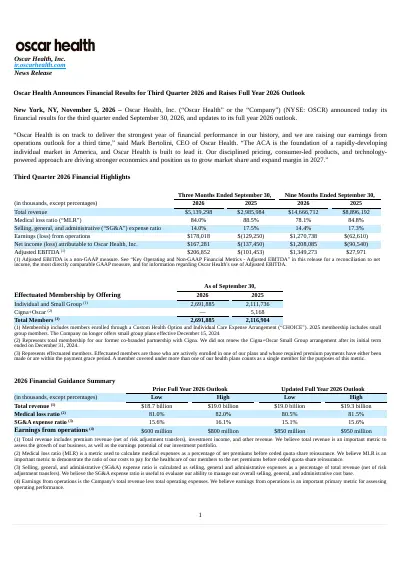
2026 is the strongest year in Oscar Health's history. We delivered record profitability for the first 9 months of the year, reporting earnings from operations of $1.3 billion and net income of $1.2 billion.
We also expect to achieve several of our 2024 Investor Day commitments 1 year ahead of plan. Based on our performance year to date, we are raising 2026 earnings from operations guidance for a third time to a range of $850 million to $950 million.
Our strong third quarter performance exceeded our expectations with improvement across all core metrics. Revenue grew roughly 70% year over year to $5.1 billion.
Our SG&A expense ratio improved 350 basis points year over year to 14%, another record low reflecting disciplined execution, greater fixed cost leverage, and AI-driven efficiencies. MLR improved 450 basis points over the prior year period to 84%.
Earnings from operations increased $307 million year over year to $178 million, and adjusted EBITDA increased $308 million to $207 million. Before I turn to our business highlights, I will share our perspective on current market trends.
The ACA is the foundation of a rapidly developing individual market. Americans are building careers on their own terms.
They are starting businesses, combining part-time work, participating in the gig economy, and retiring early. More than 19 million people rely on the ACA, yet 28 million American workers remain uninsured.
Affordable coverage gives people greater financial security to pursue new opportunities and helps employers build a more stable workforce. Both parties understand healthcare is a priority for the American people.
We have a significant opportunity to expand the ACA into a competitive marketplace that improves affordability and supports a resilient economy. Our 2026 performance demonstrates the strength of our operating model.
We remain focused on growing market share and expanding margin in 2027. Our weighted average rate increase of approximately 14% for 2027 open enrollment period reflects elevated trend and higher market morbidity.
Pricing is 1 lever of our growth model. We also target markets where our products and distribution network address consumer needs, including opportunities created by competitor exits.
These strengths, combined with our medical cost management, operating efficiency, and superior technology, will drive sustainable financial performance in 2027 and beyond. Now I will review our business highlights.
Oscar insurance ended the third quarter with 2.7 million members, up 27% year over year. We are entering open enrollment with a 24% larger footprint spanning 713 counties.
We are also expanding into South Carolina. Our expansion increases our total addressable market to approximately 10 million consumers across 21 states.
Oscar is launching a new wave of consumer lifestyle products. Our newest product, RetireEase, is live in select markets and serves a growing segment of 2.5 million early retirees in the ACA.
Members keep their trusted doctors and receive set prices for preventive services, physical therapy, and heart, bone, and joint care. We are also addressing affordability through bundled benefits.
Hundreds of Oscar plans now include dental and vision coverage. In addition, our new Allstate Health Solutions partnership pairs Oscar plans with low-cost supplemental coverage to help bronze members manage out-of-pocket costs.
Each product meets a distinct consumer need and extends our reach into high-value, underserved segments. Our Oscar team is also scaling CHOICE.
Our Hy-Vee Health with Oscar product is expanding from Iowa into Nebraska, Missouri, and Kansas. This product's concierge care model earns a 92% satisfaction rate and can now serve more small businesses, part-time employees, and gig workers.
We are also launching Hello Menno off-exchange to better serve women across the workforce. Employer demand is building.
CHOICE adoption is growing fastest in healthcare, technology, construction, and manufacturing sectors across Oscar states. Oscar's health technology puts consumers in control of their healthcare decisions across 2 platforms.
The Oscar platform now includes new AI capabilities that make our product suite easy to understand. The LUCY platform serves the broader market, personalizing the healthcare shopping experience at scale.
LUCY instantly matches consumers with plans from major ACA carriers and select supplemental carriers, and guides brokers through CMS eligibility. No other platform brings these capabilities together in 1 place.
LUCY is on track to sell approximately 800,000 new policies in 2027, driven by growing broker and consumer demand. Oscar Health's third quarter performance puts us on track to deliver strong results 1 year ahead of plan.
Our disciplined pricing, product innovation, and technology-powered support are delivering superior member experiences and efficiency across the company. The individual market opportunity is growing.
People expect healthcare to work like the best consumer products: simple, transparent, and personalized. We are building a consumer healthcare company that meets those expectations and serves a much larger market.
The team is positioned to grow market share and expand margin in 2027. We are also on track to deliver our long-term targets, including at least $4 earnings per share by 2029.
Thank you to the Oscar Health team for giving people power over their healthcare. With that, I will turn the call over to Scott.
Scott?
Scott Blackley
Thank you, Mark, and good morning, everyone. Sorry for the voice, I'm recovering from a cold today.
Through the first 9 months of 2026, we delivered net income of approximately $1.2 billion, or $3.59 per diluted share. Earnings from operations were approximately $1.3 billion.
Based on these strong results and underlying trends, we are raising our full year 2026 outlook. Turning now to third quarter results.
We ended the quarter with approximately 2.7 million members, an increase of 27% year over year. Sequential decline in membership primarily reflects disenrollments from CMS's industry-wide eligibility review, which was in line with expectations.
From a second, smaller CMS review, we expect a small number of additional disenrollments in the fourth quarter. Total revenue increased approximately 70% year over year to $5.1 billion, driven by rate increases and higher membership.
During the quarter, we received updated risk adjustment data. We saw significant improvement in Oscar's risk relative to the market, and market morbidity was modestly favorable to our expectations.
These factors drove a $250 million revenue benefit in the quarter. Risk adjustment as a percentage of premiums was 11.8% in the third quarter and 17.2% through the first 9 months.
While the additional data gives us greater visibility and more confidence in our risk adjustment accruals, we continue to take a cautious approach to our risk adjustment reserves. The third quarter medical loss ratio was 84%, an improvement of 450 basis points year over year.
The improvement was primarily driven by our disciplined pricing strategy. Overall, year-to-date utilization was moderately favorable to our expectations.
By category, inpatient, professional, and pharmacy utilization were favorable, while outpatient was elevated. We believe some of the elevated outpatient utilization reflects a rotation from inpatient to outpatient care, driven in part by our affordability initiatives.
Switching to administrative costs. The third quarter SG&A expense ratio was 14%, the lowest in the company's history.
The approximately 350 basis point year-over-year improvement was driven by lower risk adjustment as a percentage of premium, higher fixed cost leverage, and disciplined expense management, including an increasing impact from technology and AI initiatives. We reported earnings from operations of $178 million in the third quarter, a $307 million year-over-year improvement.
Operating margin was 3.5%, an improvement of approximately 780 basis points year over year. Net income was $167 million, a $305 million increase year over year.
Adjusted EBITDA was $207 million in the quarter, an increase of $308 million year over year. Shifting to the balance sheet.
We ended the third quarter with approximately $9 billion of cash and investments, including $360 million of cash and investments at the parent. The sequential decline in cash and investments primarily reflects the payment of our 2025 risk adjustment payable during the third quarter.
As of September 30th, our insurance subsidiaries had approximately $2.3 billion of capital and surplus, including $1.4 billion of excess capital, which was driven by our strong operating performance. Turning now to our 2026 full year guidance.
Based on the results through the first 9 months, we are raising our full year earnings from operations guidance to a range of $850 million to $950 million. At the midpoint, this is $200 million above our prior outlook and $550 million above our original guidance.
Our improved outlook reflects favorable risk adjustment and utilization that was moderately favorable to our expectations. We now expect total revenue in the range of $19 billion to $19.3 billion, an increase of $300 million from our prior outlook.
We expect to end the year with approximately 2.5 million members, which reflects the additional disenrollments from the second CMS review. We expect risk adjustment as a percentage of premiums to be between 17% and 18%, compared with our prior expectation of 20%, which is based on year-to-date risk adjustment experience.
Turning to the medical loss ratio. We now expect a full year MLR in the range of 80.5% to 81.5%.
On administrative expenses, we expect our SG&A expense ratio to be in the range of 15.1% to 15.6%. We expect adjusted EBITDA to be roughly $110 million higher than earnings from operations.
Our performance this year positions us well for 2027. We will provide formal guidance on the fourth quarter earnings call, but let me spend a moment on our planning assumptions.
We expect overall ACA marketplace membership to be stable compared with year-end 2026, and we are positioned to gain market share. We continue to take a disciplined approach to pricing, balancing growth and profitability.
As Mark mentioned, our weighted average rate increase for 2027 is approximately 14%. Our pricing reflects incremental increase in medical cost trends and higher market morbidity from ongoing program integrity initiatives.
Our competitive positioning, differentiated products, and strong member experience gives us confidence as we head into 2027. We expect improved medical cost performance and administrative efficiency to drive further margin expansion next year.
In closing, we are on track to deliver a strong financial performance in 2026, and we remain focused on driving sustainable earnings growth and achieving our long-term target of at least $4 in earnings per share by 2029. With that, I'll turn the call over to the operator for the Q&A portion of our call.
Operator
Thank you. If you would like to ask a question, please press the star and one on your keypad.
To leave the queue at any time, please press star two. We do ask that you limit yourself to one question and one follow-up.
Once again, that is star one to ask a question. We'll pause momentarily for questions to queue.
We'll take our first question from Andrew Mok with Barclays. Please go ahead, your line is open.
Andrew Mok
Hi, good morning. G&A came in meaningfully better in the quarter, but updated guidance appears to imply a 400 basis point sequential increase.
Can you elaborate on the drivers of the strong 3Q outperformance, and what's driving the higher-than-normal step-up for 4Q? Thanks.
Scott Blackley
Good morning, Andrew. On SG&A, I think that in Q3, you're seeing the benefit of our continuous disciplined expense management, growing impact of AI that we're deploying across the business, and those are the themes that I would call out.
We're also picking up a pretty healthy amount of fixed cost leverage. Those are the drivers of Q3 performance.
As you think about Q4, there is a step-up in the Q4 SG&A ratio. A portion of that is being driven by things like I would say these are Q4-specific spend: things like OE ramp, some of our risk adjustment operations where we do a lot of our chart collection activity in the fourth quarter, and then we've got some typical investments that we make for '27 growth in the fourth quarter.
I would say these are kind of seasonally expected spend, but we like the trajectory of SG&A.
Andrew Mok
Great. I think I heard you say membership is expected to be stable with year-end 2026 results while you take market share.
Can you flesh out a little bit more how you're thinking about your share gains in the context of how market growth might play out for 2027? Thanks.
Mark Bertolini
Sure. Thanks, Andrew.
This is Mark. We'll start with the market growth that both Scott and I highlighted, where we're now going to be 713 markets.
We've added South Carolina. Secondly, I would offer new program extensions and products into the marketplace like RetireEase, where we tend to have very high retention and opportunistic growth in those marketplaces.
Then finally, there's about 850,000 lives coming to market as a result of competitor exits. All of that, as we add that into our mix, and our ability to price appropriately, disciplined, and competitively in the marketplace, we believe that we'll pick up share.
Operator
Thank you. Our next question comes from Jessica Tassan with Piper Sandler.
Please go ahead, your line is open.
Jessica Tassan
Hi. Thanks very much for the question, and congratulations on the phenomenal results.
Our estimates imply, I think, that year-over-year med ex PMPM increased 19.9% in 3Q from down 1.5% in 2Q. Can you maybe just give us some color on the utilization behavior you're observing by metal level?
Curious to know how MLR seasonality is evolving both for bronze members and then also whether you're observing any changes in silver member behavior year over year, or relative to historicals, or relative to expectations and why that might be. Thanks.
Scott Blackley
Jess, let me start with the claims PMPM. One of the challenges that you guys have this year in looking at claims PMPM is that we do have our member months because of some of these CMS-driven disenrollments, the member months are reported are a little bit different than those that are actually generating claims.
There is a little bit of a skew in that. When I unpack that and kind of put Humpty Dumpty back together, what I see is that in Q1 to Q2, there's a meaningful step-up in claims PMPM.
You see another step-up in Q3 from there. Then Q4, we're anticipating, and this has historically been the case, that there's less movement, a fairly stable Q3 to Q4 PMPM somewhere.
When I look at utilization, we're seeing utilization across the metals which is consistent with the risk that we see there. We're not seeing any specific thing that I would call out for one metal to the next.
I think that the risk that we have in the book is being supported by the claims that we're seeing. As you think about the MLR that we've got embedded for our fourth quarter, we are expecting a normal seasonal uptick in MLR into the fourth quarter from where we are in Q3.
Jessica Tassan
Got it. That's really helpful.
Thank you. Then appreciate that the midterms changed the EAPTC outlook considerably for '28, but maybe hoping you can help us better understand just the membership outlook for 2027.
Where are we in terms of CMS's fraud and marketplace integrity efforts, and how do you expect those efforts to evolve in '27? Then can you just clarify that despite the expectation for flat enrollment year over year in 2027, you all are priced for an increase in market morbidity within that 14%?
Thanks again.
Mark Bertolini
Yes, Jess, I'll start, and then I'll turn it over to Scott on market morbidity. We do expect stable membership year over year.
We do still see more program integrity programs coming through. We believe that will have an impact on the marketplace.
Obviously, as I said before, it's going to be offset by some of the other things: new markets entered, new products, and other competitors leaving. Overall, we see the whole market being relatively stable.
I don't think the midterms are going to have much of an effect, if anything, in the near term, because there's a lot of bargaining that would need to go on given that the administration still will hold the veto pen. Getting the kind of things we would need to get done to, for example, reintroduce enhanced subsidies and others would have to be part of a grander deal, and we're not quite sure how the dynamics of that will move forward.
We always plan for these things in our operating plans and risks and opportunities, and we always see what we would need to do should these things begin to happen. Right now, I don't know that much of anything's going to happen over the next year at least.
Scott?
Scott Blackley
Yeah. Jess, with respect to market morbidity, I have a couple thoughts there.
One is we are seeing and expecting to see a stable ACA in '27. A lot of the big change events happened in '26, and we expect fewer going into '27.
We are expecting that program integrity will have an impact, and we have built that into our pricing. I would comment that on our average 14% rate increase, the three things that are really driving that 14%, kind of in ranked order of impact, number one is trend, which is in the I'll call it high single digits.
Then market morbidity coverage is second. Then we also have built in a little bit of margin expansion into pricing.
We feel like we've got a very competitive price and some really terrific products in markets. We're optimistic about our ability to grow share in '27.
Operator
Thank you. We'll take our next question from Parker Snurr with Raymond James.
Please go ahead.
Parker Snurr
Thanks, and good morning. Just kind of piggybacking on the previous few questions, just curious on your view for this annual enrollment period.
There's some additional friction that's being added to the enrollment process, some enhanced Social Security verification, broker consent, text verification, things like that. I understand that you think the market will be flat, but just curious if you view these procedural measures as being a material driver in this year's annual enrollment process, and could this lead to some people being thrown off, and I guess just kind of general expectations in terms of market morbidity.
I know you touched on that, but just related to that specific dynamic.
Mark Bertolini
Parker, I'll start by describing, obviously, we've had a lot of preparation to try and get in front of the things for brokers and the enrollment program this year. It will slow down the start.
These systems are new to them. We did a lot of training over the summer.
We even built our own capabilities on our own platform to help them as they navigate through this. There will be a learning curve.
It will be something new for them, and it will have an impact on their productivity. I think that is something that they will pick up quickly enough.
We're watching it every day and watching how it evolves. Obviously, we only have 4 or 5 days under our belt anyway from the standpoint of enrollment.
Scott, you want to talk about market morbidity?
Scott Blackley
I'd maybe call out two things. Just to reiterate, we're expecting that '27 will be flat to year-end '26.
We do expect that some of these enhanced eligibility checks will result in some of the membership from '26 not being able to continue into '27. We also anticipate that we're going to see a continuation of new people coming into the marketplace.
We saw that in '26. We expect to see similar types of drivers for '27.
Net-net, we expect the market overall to be flat to the '26 endpoint.
Parker Snurr
That's super helpful. If I can just get one more.
Just curious on the fourth quarter guidance as it pertains to medical costs and MLR. It appears that it implies actually a decline in actual medical costs sequentially.
I understand you'll have fewer members in the fourth quarter, but if I look back over the last 5 years or so, I don't know if 4Q medical costs have actually declined sequentially ever. Just curious if you can give more color on that dynamic, if there were some one-time items in the third quarter or fourth quarter, or is it just simply lower enrollment that's driving that?
Scott Blackley
I think you and I probably don't have the same math, because when I look at implied fourth quarter MLR, it's in the range of let's call it low 90s. We finished the third quarter with an MLR of 84.
If you add back PPD, that gets you to something like 84.8. I think it's important when you think about the $250 million benefit of risk adjustment, all of that doesn't fall to the bottom line.
It comes with claims, and so you shouldn't be taking the risk adjustment out of the numbers. I think that's fundamental to the business, and it is offsetting the actual claims volumes that we're getting.
If you want to think of a comparison, I would say I would start with an MLR in the third quarter of probably 84.8, and you can add a couple points if you want to kind of say some of that favorable risk adjustment related to the first half of the year. From there, it is still a step-up into Q4 based on everything we're seeing around people reaching their maximum out-of-pockets, utilization that continues to be favorable to our expectations.
We feel like the step-up in Q4 MLR makes sense to us and is consistent with the trends we're seeing through this part of the year.
Operator
Thank you. We'll take our next question from Stephen Baxter with Wells Fargo.
Please go ahead.
Stephen Baxter
Hi, thanks. Kind of similar theme question.
You're lowering the risk adjustment payable expectation by 200 or 300 basis points, you're improving the MLR by 50 basis points, and then you're pointing to medical costs that I think that you're saying are modestly favorable to your expectations. Seems like there's a pretty big difference there, and I know that you're a conservative company, but just thinking about the difference between those two items, if you can maybe help us bridge that, that would be super helpful.
Scott Blackley
Yeah. Steve, I would say a few things.
We have $250 million of favorable risk adjustment, and then we've got $45 million of PPD. As I talked about, not all of that favorable risk adjustment drops to the bottom line.
There's a portion that's being offset by claims, which are appropriate given the risk of the book, but are creating higher claims cost for us. When I think about full year guidance that we just put out, I would say we've only got midway through July.
We're being prudent in making sure that we are thoughtful about the continued morbidity risk that's inherent in this marketplace. We feel like we have more than adequately covered for that in the guidance, and we're walking into good news.
Feel like we've got a very balanced target for full year operating earnings.
Stephen Baxter
Got it. Thanks.
Then, yeah, just be curious on your latest thinking on the latest CMS regulation governing 2028 open enrollment. I think this was mostly codifying changes that were already made by OB3.
Would just love to have your feedback on that, and I guess how are you thinking about this potential dynamic around maybe having less of an ability to utilize auto-enrollments in 2028? Thank you.
Mark Bertolini
Steve, we're working on that for our 2027 plan and we'll prepare ourselves to handle those new provisions and believe it will be in the guidance that we provide going forward. It's just from our perspective, program integrity is really important because it stabilizes the risk pool.
We want to keep those programs moving forward. Our biggest fear is that we make sure that the people who should be excluded are excluded, and that the people who need coverage get coverage.
That work with CMS, because the sort of eligibility and enrollment responsibilities are split between CMS and the plans, we have to make sure that our data synchronizes. In our latest review of this information, we have information going back and forth between CMS and us, and I'm sure our competitors as well, to say, "Well, wait a minute.
Let's look at this population and talk about what you see versus what we see, and what we need to do to make sure these people, if they are eligible, get access to coverage." That's an ongoing, I would call it, a flaw in the system is that we have dispersed eligibility too far between plans and CMS.
You don't see that much anywhere else. We're working through those changes as we go through program integrity.
We support program integrity, and believe it's important.
Operator
Thank you. Our next question will come from Scott Fidel with Goldman Sachs.
Please go ahead, your line is open.
Scott Fidel
Hi, thanks, and good morning. Mark, thought might be helpful just given the midterm elections results yesterday.
If you want to, one, talk us through in terms of now as you go to the Hill and sort of speak with members and the expanded Blue Caucus, from a policy perspective, what, in particular, you'll maybe be advocating for the ACA? I know that in the prepared comments you talked about opportunity to expand the ACA, but just curious in terms of I don't think it's probably as simple as you'll just advocate for sort of renewing the enhanced subsidies.
I would assume that there's probably suggestions that you want to make as well around strengthening the foundation of the program longer term. Then from a timing perspective, do you think that '28 would be possible in terms of potentially getting the subsidies restored, or curious on your thoughts on timing as the Congress sort of starts in 2027?
Thanks.
Mark Bertolini
Yeah. I think the first thing, Scott, you should know is that we have been working both at the state level and at the federal level.
We've actually made a lot of progress at the state level around things like CHOICE, and I mean at the state level versus federal. At the federal level, we've been pushing through CMS and through the administration ideas about how do we best support the changes that we need to make to make the ACA TAM bigger.
Part of that is this whole eligibility issue. How do we get that right?
One of our suggestions has been that we create wallets, enhanced HSAs, if you will, that will allow people, by having KYC criteria, will allow them to be more sure of eligibility as people come into the program. We can stabilize that piece of the business, that does great things for the risk pool and for growth, and for our distribution channel that has to work through all these issues.
Piecemeal, every so often, as has happened over the last couple of years, is difficult. On the enhanced subsidies, we shall see.
That's a financial discussion. We shall see how much of that comes back in.
Will it change in form? It's going to have to be a deal before '28 between the administration and the new caucus.
We don't know how that's yet going to work. The President has made comments that he can work with the caucus.
We have the caucuses been talking about the things that they want to have happen. We need to see how that relationship is actually going to work and evolve into legislation and then regulation.
I'm not holding out a whole lot in '27 toward '28 at this moment, other than we will keep going forward. We continue to work with the administration on working on the eligibility piece, and on regulations like tax treatment for HSA purchases and defined contribution for employers, where we see a huge opportunity if we can clear some of that roadblockage out of the way for them in the future.
That makes the TAM bigger, that makes the ACA framework work, and we've also been talking to the Democrats as well while we've been talking to the administration about what we could do to make CHOICE a reality. In a lot of ways, my point of view is that what we are talking about in making a bigger individual market is very much what some of the aims of the ACA were in its initial construction.
I think we have a lot of common ground there. It could be a great place for both parties to get together and actually do something that could advantage the American public and, more importantly, our economy.
Scott Fidel
That's helpful, thanks. For my follow-up question, wanted to toggle just over to pricing.
Sounds like the average rate increases that you talked about are quite in line with the market. Curious just if from the average perspective, obviously every pricing MSA is going to be different, but sort of a general just sort of breakdown as you think about those sort of mid-teens, 14% or so, sort of pricing, how would you say that sort of breaks down between underlying cost trend versus morbidity versus any other sort of key actuarial underwriting factors?
That's it for me. Thanks.
Mark Bertolini
I'll start off, and then I'll toss it to Scott on the morbidity stuff. The very basis of our pricing structure and our plan design in every market starts with the network.
Where we have a great network relationship, and where we can again, all the most successful players in the ACA use narrow networks, and so you get a discount, and that passes through to the customer, number one. Number two, what are your distribution relationships like, and what can you rely on in getting distribution done?
Those are the two first most important requirements we assess when we go into the market, and then we look at the competitive framework, the pricing tolerance in the marketplace, and then we build our models. Think of it as us underwriting that network and distribution model first as a way of deciding where our price points need to be in the market.
Relative to morbidity and the intricacies of pricing, Scott, I'll just toss it over to you to add anything that you would.
Scott Blackley
Yeah. Scott, a few other thoughts.
First off, we are starting from a position of strength in '26. Our relative price increase this year was probably a bit lower than some of our competitors, we've already got a very advantaged priced position.
Then you go to a 14% price increase from there, we think that from a competitive position, our pricing looks, as you said, it's an MSA by MSA game, but we like how we look on the book in aggregate. When you think about the build-up of that 14%, again, is in ranked order, starts with trend, which we built in something that's in the high single digits for trend.
Then you've got that impact from market morbidity related to some of the PI initiatives that we've discussed. Then on top of that, we've got a bit of margin enhancement that we also built into pricing.
Those are the building blocks on the pricing.
Operator
Thank you. As a reminder, it is star and one to ask a question.
We'll go next to the line of Jonathan Yong with UBS. Please go ahead, your line is open.
Jonathan Yong
Hey, thanks for taking the question. I guess just based on the landscape file, it does look like one of your competitors has gotten a little bit more, I'll call it, aggressive in terms of how they're pricing and coming in as the cheapest option in the market.
I guess from your perspective, how do you consider your pricing relative to that, and is it most important to be at the cheapest end of the market, or how are you viewing that alongside metal tier mix for 2027? Thanks.
Mark Bertolini
I'll start. Go ahead, Scott.
Scott Blackley
No, go ahead, Mark.
Mark Bertolini
I was just going to say that obviously metal mix that matters very much, number one. Number two, we believe that it's not just price, it's the quality of the product, call quality of customer service.
We tend to have higher retention than our competitors do as a result. We have higher NPS scores.
As we look at all of that, it's a mix of capability and our relationship with our customers and our distribution channel that matter. It's not just the price point.
Scott?
Scott Blackley
I think you hit on it. The point that I was going to make, Mark, is that it's really a question of you have to be within a relatively reasonable range of the lowest.
We feel like we've got really strong price positions in our markets. Mark talked about the distribution and the right products, and we feel like we've got great relationships with our distribution partners, and we have a product that, we're a member-centric company.
We've got a very good brand when it comes to supporting members, and that's a big part of our selling package, and that we think that matters beyond just price.
Jonathan Yong
Great. Then just going back to the proposed rules for payment year or for 2028, I guess in relation to the pre-verification open enrollment period that is being proposed, do you see this as kind of a a benefit in terms of making sure members, get enrolled given the pressure on auto-enrollment?
Then similarly, does this create pressure on G&A from your perspective where brokers may ask for more in terms of commissions, etc.? Just curious how you're thinking about that.
Thanks.
Mark Bertolini
We solved that problem first, Jonathan. I always like to say, brokers like to maximize revenue per joule of energy expended.
If we can provide tools to them, which we have through LUCY and our EDE, the opportunity is for them to be able to keep their productivity while being able to go through each of these steps. That's part of what we've been doing all along.
That's what we did when the enhanced subsidies went away. We made it easy for them to move people to new products, and they moved so many of our competitors' people to our new products as a result.
I think you have to look at it, again, from the perspective of what do they need to do, how can we help them with tools, and it doesn't necessarily mean that we have to have the highest commissions. As a matter of fact, and Scott, I'd check with you on this, I believe we are not the highest commission program in the country.
Scott Blackley
That's right. Our commission strategy generally is to be competitive, but we don't feel like we need to be the highest.
I think that the products and the service sells itself.
Operator
Thank you. We'll take our next question from Michael Ha with Baird.
Please go ahead, your line is open.
Michael Ha
Thank you. As you look at '27, I know you're expecting stabilizing metal mix next year, but I wanted to ask your thoughts on a potential scenario where bronze members could trade up into gold, meaning could there be an environment where bronze members, maybe they deferred care this past year because of higher deductibles?
Could that have worsened their health or acuity, and so next year then they shift to gold, lower deductibles, unlock care for members that previously deferred? How are you thinking about the possibility that happening, how much of that migration have you assumed, what allowance would you build in your '27 pricing that has some sort of catch-up utilization beyond your normal gold plan assumptions?
Scott Blackley
I will start off by saying you are correct, we do expect a similar metal mix. We're not seeing any kind of thematic things that would suggest that there's some delay in utilization, right?
It's not like 2026 where we were worried and when we built in an expectation of higher fourth quarter utilization because people knew they were losing their subsidies. I don't think that's quite what we're seeing.
On the move side, at maximum out-of-pockets, we are seeing a progression there which looks to us like behavior that we have seen over a longer period. Again, it doesn't look like people are not using care because they've got a deductible that they have to cover a portion of those costs.
When I kind of pull back and I look at the pricing build that we did for '27, we think we've done the appropriate amount of risk analysis of where in the metals do we see people growing, what does utilization look like, and we're excited about the products we got out in the market and about our opportunity for the year.
Mark Bertolini
Michael, I would add just one thing about LUCY. LUCY helps people find the right plan in the ACA, not necessarily an Oscar plan, but also connects them to a thing called Allstate Health Solutions that offer coverage for higher deductibles on a premium basis.
People can actually buy protection based on that underlying coverage. They have more than an option of just going up to gold.
They could consider a plan like Allstate Health Solutions that helps cover some of those expenses when they occur.
Michael Ha
Interesting. Helpful.
Thank you. My next question, just the one key remaining question to me after your I-Day was really the latest Wakely data that confirmed a stabilizing risk pool even after all these CMS lives were removed, identified lives.
Just wanted to ask if you can provide a bit more detail on what that Wakely file showed about market morbidity relative to your assumptions, and also of all the new integrity measures, all the verification checks, everything new happening next year, be curious which one do you think has the biggest range of uncertainty and how it could impact membership into next year? Thank you.
Scott Blackley
Yeah. A lot to unpack there.
I would say that with respect to Wakely, latest Wakely white paper shows market morbidity moving as we would have anticipated, and I think that it just reaffirms that the estimates that we've been making are appropriate, slightly favorable to our pricing expectations. I do think it's important to note that the first Wakely risk report we got in the first quarter was quite favorable.
We got that in the second quarter. Then the report that we received in the third quarter is now moderately favorable.
We think that is the effect of these CMS program integrity efforts and removing some lives, and those are mainly not utilizers. We still believe, though, that market morbidity continues to be moderately favorable to where we priced, and we think that gives us a good position.
We're closing out '26.
Operator
Thank you. We'd like to take our next question from Kevin Fischbeck with Bank of America.
Please go ahead.
Kevin Fischbeck
Hey, this is Joaquin Arreguin Martinez on for Kevin. I just wanted to ask about on the 17% to 18% risk adjustment range that you guys gave.
Is this something that would continue in 2027, or does that reset back to the 20% range? Thanks.
Scott Blackley
I would say that the 17% to 18% for this year is specific to the risk of the book. We'll give you guidance on where we think next year is going to come out, and it really depends on the books and the markets and the metal mix, I wouldn't want to get ahead of our full year guidance.
Kevin Fischbeck
All right, thank you. Could you give us some more color on the trend commentary?
What's specifically in outpatient is higher, and how are you translating that to your initiatives? Thank you.
Scott Blackley
Yeah. We do see a bit of a trade-off between inpatient and outpatient, which is honestly beneficial for the cost to the member.
It's beneficial to us. It's typically a lower cost of care.
Some of it is being driven by affordability initiatives that we're executing, which is really kind of just the fundamental blocking and tackling of how you run a health plan. It's things like making sure that we're doing clinical reviews that are looking at distinguishing observation from inpatient admissions, things like discharge planning, making sure that is done in appropriate timeframes.
Nothing that I think is out of the ordinary in terms of what we see with the health plan. As Mark likes to say, we're constantly trying to progressively eliminate failure, and we're seeing the benefits of that strong operating cadence in both the results on the MLR side, on lower TCPs.
Overall, I think that you can see the evidence that we're running a very effective health plan in the numbers.
Operator
At this time, we have reached our allotted time for questions. We'd like to thank everybody for joining today's conference call.
Please feel free to disconnect at any time.