Salmon Evolution ASA
Q3 FY2026 · Earnings Call TranscriptOctober 28, 2026
Trond Håkon Schaug-Pettersen
Good morning, everyone, and thank you for joining Salmon Evolution's presentation for the third quarter. This is a very important moment in our company's history as phase two now is nearing completion, and we are on the verge of substantially increasing production.
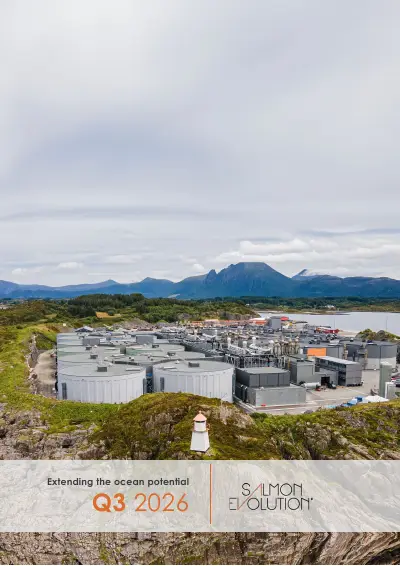
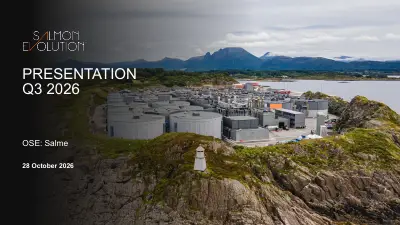
We've had a very high activity level at the site for some time now, and as you can see here, the scope of what we have built is quite massive. This will fundamentally transform our company, and with phase two, we will reach critical mass, which is a prerequisite for being able to achieve sufficiently attractive unit economics.
Also, coupled with a salmon market that looks considerably more promising next year, we are well positioned to reap the results from years of heavy investments. My name is Trond Håkon Schaug-Pettersen.
I'm the CEO of Salmon Evolution. With me here today is also our CFO, Trond Vadset Veibust, and we will take you through this presentation.
As normal, we'll start this presentation by going through the highlights. Then I will go through the operations and our ongoing expansion project at Indre Harøy before our CFO will take us through the financials.
Finally, we will end the presentation with a Q&A session. For those of you who are attending virtually, you can submit questions via the webcast.
On the highlights, our priority is very clear. It's about delivering on our production targets and demonstrate what this business can achieve at scale.
That means full focus on unlocking more biomass growth in phase one. That work is ongoing, and our focus is on translating that work into measurable and consistent operational gains.
As to phase two, this is progressing according to plan, with performance also in line with our expectations. The third smolt release was completed in July, and we will stock two additional fish groups this quarter.
Financially, low salmon prices naturally weighed on the quarter with a farming EBITDA of minus 13 million NOK and a group EBITDA of minus 20 million. Our focus is on addressing what we can control, production volume, which again impacts the cost of each kilo we produce.
Here, we expect to see a meaningful improvement over the coming months and quarters on back of increasing volumes, and also dilution of our fixed cost base. For 2027, we expect to harvest 11 to 12,000 tonnes gutted, which is a doubling from 2026, where we now expect around 5,500 tonnes gutted.
We had initially planned to harvest some volume from phase two this year, but we have flexibility in our phase two production plan, we will move that into Q1. We are also pleased to report that we have secured new bank facilities totaling 300 million NOK, ensuring also adequate liquidity buffers in this very important phase for the company.
Moving over to the operations. Biomass growth during the quarter ended at close to 2,000 tonnes liveweight, and we continue to see stable operations and minimal mortality.
Overall growth was somewhat lower than expectations, but this was mainly due to one underperforming fish group in phase one that represented a large part of the total biomass and utilized tank capacity during the quarter. This group was, however, fully harvested out by quarter end.
As to phase two, performance has been strong, with growth rates according to plan. We completed the third smolt release in July, as I mentioned, and we have now fish in four out of 12 tanks with more tanks very soon to be taken into operations.
We remain very focused now on unlocking the growth potential in phase one. We have a wide range of targeted initiatives ongoing centered around continued improvement in water quality, and we expect these initiatives to result in improved growth over the coming months.
Also, with phase two production ramping up, we expect to see a material increase in overall production over the coming quarters. From Q4, we also move to monthly stocking of smolt, and this is a key step in building the production volumes that we are targeting next year.
In phase one, we already are stocking smolt every second month, and in phase two, we will be at the same frequency from this quarter. Hence, we will now be building biomass and laying the foundation for reaching our near-term production target, which is a run-rate production of 14,600 tonnes gutted by the middle of next year.
That means 85% capacity utilization in phase one, full utilization in phase two, and consistent average harvest weights above four kilo gutted. During the quarter, we harvested about 1,600 tonnes gutted, with an overweight of harvest taking place in August and September.
The superior grade share of 94% was in line with previous quarter quarters, whilst the average harvest weight of three kilo gutted was impacted by the underperforming fish group I mentioned earlier. This was also fully harvested out in Q3.
All-in price realization ended at 64 NOK per kilo, up 5% compared to last year, but still reflecting a salmon market with very high volumes and pressure on prices. Looking into Q4, we see a uptick in harvest weights and expect to end up in the mid to high end of the three to four kilo gutted category.
Also, even though salmon prices has for some time now been low, the underlying demand growth is strong, and with supply growth now expected to finally come down, we are quite optimistic about salmon prices next year. For 2027, as I mentioned, we expect to harvest approximately 11 to 12,000 tonnes gutted.
This is a substantial step up in the scale of our business. The volumes for 2026 has been revised down to 5,500 tonnes gutted as we will be using the flexibility in our phase two production plan to move the first harvest into Q1.
That's shifting approximately 350 tonnes gutted across year-end. This will give both higher harvest weights, and hopefully also somewhat better prices, and is also enabled by the fact that we've had a diligent phase two project execution.
As mentioned, the target is to reach an annualized production run-rate of 14,600 tonnes gutted by middle of next year. The task now is to deliver on that increase in production, and reaching these targets means that we'll have a substantial operation, delivering volumes at scale, and with unit costs sufficiently attractive to ensure sound economics.
With scale, that also gives us the opportunity to become a regular supply partner for our customers. Predictable weekly harvests support stable supply programs and contracts, and hence also reducing our reliance on the spot market.
Looking into next year, we have already secured fixed price arrangements for around 9% of our expected volumes at approximately 86 NOK per kilo on average through a mix of physical and financial contracts. This gives us an initial base of revenue visibility as production now increases.
Our target is to increase fixed price coverage up to 30% on a rolling 12 months basis, and we are particularly focused on the second half of next year, taking normal salmon price seasonality into account. This will be more and more important going forward, also with the story we offer.
We have a strong value proposition for our customers, and now with regularity on harvests, as we will have now with phase two, we see new opportunities opening up, and I think what we have done here is a good example of that. Moving over to the expansion project at Indre Harøy phase two.
We are entering a very attractive phase for the company, and we have a very focused strategy now delivering on phase one and phase two production targets. That's the key strategic priority.
At the same time, the opportunity for growth on our current site remains substantial. We see the potential to more than double the existing operations to around 36,000 tonnes gutted, building on the same infrastructure, same licenses, and experience that we already have.
Full expansion also includes a conceptual fourth phase that may take production even higher. Also, longer term, we have ambitions beyond Indre Harøy both at attractive locations in Norway and abroad.
We will pursue growth with discipline. With phase two, we are already achieving critical scale, which is very important, and now it's all about converting that into sound financial results and cash flow, which in turn can support the next step in our growth story.
We are also approaching completion of phase two, with construction activity expected to be completed by year-end. The focus is now increasingly on bringing the remaining tanks into operation through a controlled, gradual handover following a comprehensive testing and commissioning regime.
By year-end, we expect to have taken over 10 out of 12 tanks. The formal handover of the last two tanks is moved into Q1 2027, but we expect no material impact on either cost or operations.
Further investment and capital allocation will remain disciplined. Starting construction of the pre-grow-out tanks is contingent on an improvement in salmon prices, and our near-term focus is on achieving our production targets on installed capacity.
Then I leave the word over to you, Trond.
Trond Vadset Veibust
Thank you. All right.
As already mentioned, we harvested 1,597 tonnes in the third quarter, and recorded revenues of 104.8 million. Farming costs ended at around 71 kroner per kilo, an improvement of around 10 kroner per kilo year-on-year.
This resulted in a farming EBITDA of -13.3 million. Harvest of the previously mentioned underperforming group negatively impacted the farming costs with around three kroner per kilo in the quarter.
Adjusting for this, the underlying farming cost was around 68 kroner per kilo, highlighting that we are on the right path to reach our near-term cost targets. With increasing volumes in phase one and scaling effects from phase two, driving fixed cost dilution, we expect farming costs to continue to decline in the quarters to come.
More on this in a minute. The other segment reported an EBITDA in line with Q2, but it represented an improvement of approximately 30% year-on-year.
At group level, EBITDA was negative with 20 million. Summing up 2026, the harvest volumes are up, approximately 35%.
Harvest costs are down, approximately 10%. The farming EBITDA is slightly positive, in spite of relatively weak salmon prices through 2026.
In Salmon Evolution, cost is always a focus. Given the reassessment of our growth priorities, as well as a response to weaker than expected salmon prices over the last couple of years, we have had high focus on reducing the cash burn.
This has resulted in reductions of approximately 20 million kroner on an annual basis, using 2024 as a baseline, with full effect from year-end 2026. It includes seven fewer FTEs at administrative level, lower growth-related burn, and general spending cuts.
Not all of these reductions flow directly through the P&L. At full phase one and two installed capacity, it equals approximately 1.2 kroner per kilo in reduced cash burn.
The initiation of operations in phase two doubles volumes, but it also doubles the negotiating leverage. We target 20 million kroner in cost reductions by mid-2027 to mitigate inflationary pressure and support our existing cost targets.
By mid-2027, we target a run-rate farming cost of approximately 60 to 65 kroner per kilo, compared with the current reported cost of around 70. The reason for the interval is the development in the feed prices and the uncertainty of where this will land over the next few quarters.
As previously communicated, over the last few years, we have established the operational platform and core infrastructure needed to operate phase one and two, resulting in a high operational leverage as phase two is brought online, and these costs scale. This will become increasingly visible as phase two ramps up.
Alongside scaling, we have initiated an operational cost reduction program, as mentioned, to support our long-term targets. The phase one and two cost target at full installed capacity is to produce salmon at approximately 55 kroner per kilo.
Reaching that level depends on capacity utilization, feed conversion at target, and a feed price normalization. As we often say, we are now transitioning from CapEx to cash flow.
Years of investment have created a platform with a substantial earnings potential, and demonstrating this is our core priority. This illustration highlights that even at reasonable salmon prices, the expected cash generation is strong across different production scenarios.
We expect salmon to be repriced in 2027. Strong underlying demand and limited supply growth will see to that.
However, this illustration also highlights that earnings improvement is not achieved through scale alone. With high operating leverage, higher utilization drives the unit cost sharply down.
Even at current salmon prices, EBITDA will increase fivefold through scale alone, with production at full capacity, underlining that our dependency on salmon prices are decreasing, and that viable economics is not up to the salmon price alone. Then, just a brief look at the balance sheet and cash flow.
Most of our assets are related to our grow-out facility at Indre Harøy, biomass, and other inventories, and cash. The net interest-bearing debt increased compared to Q2, primarily reflecting drawdowns on the construction financing.
With the phase two expansion project being close to completion, investments in the project are decreasing, and we expect further decreases in Q4. Also, as announced, we have taken proactive steps to secure additional funding through a new credit facility with DNB, up to 200 million kroner.
We will continue to evaluate our financing and capital structure and consider available funding sources. In addition, as also mentioned, we have also increased our overdraft facility with Nordea from 200 to 300 million, with the increase under this facility fully undrawn at the end of the third quarter.
Yeah. We have spent years building our platform at Indre Harøy.
Replicating this will require more than construction. Starting from scratch requires land, permits, and power, as well as building the necessary capabilities and operational know-how, and establishing sufficient scale to achieve viable economics.
At Indre Harøy, we already have these elements in place. Another important question is, what would it take to build this platform again today?
We estimate that the replacement cost would be materially higher than historical cost, while access to land, permits, and power adds value beyond the physical asset base themselves. I think that provides a useful reference point, but asset backing alone does not deliver returns.
In the coming periods, our job is to demonstrate the earning power behind the asset base and turn investment into sustained financial returns. That is the next chapter of our investment case.
Trond Håkon?
Trond Håkon Schaug-Pettersen
Thank you, Trond. We enter next year with real confidence in the opportunity that lies ahead of us.
The heavy lifting is largely behind us. Phase two brings the scale that we have now spent years preparing for.
Volumes will increase materially. We expect to approximately double harvest volumes to 11 to 12,000 tonnes gutted next year, and also get to an underlying production of 15,000 tonnes by middle of next year.
Higher volumes will make a meaningful difference to our economics. As phase two ramps up, we expect the benefits of scale also to become increasingly visible, supporting our farming cost target of 60 to 65 NOK per kilo by mid next year, as Trond mentioned.
The market outlook also adds to that confidence. Strong underlying demand and limited supply growth point toward a more favorable salmon market just as we prepare to bring substantially more salmon to our customers.
We also retain significant growth opportunities, but our immediate ambition is clear: demonstrate the earning potential of Indre Harøy and turn years of investments into strong financial results and cash flow. That's why I'm really excited about the year ahead.
More production, improving unit economics, and a good market outlook that gives us a compelling opportunity. Now it's all about delivering on that, and that's what we plan to do going into next year.
Thank you. That concludes the presentation.
Now, we will open up for questions. I think we will start here, the audience, and then we'll move over to those who have sent in questions via the webcast.
Henrik Knutsen
Henrik Knutsen, Pareto Securities. You now made the pre-grow-out tanks contingent on salmon prices or profitability, but, at earliest, when do you think you could initiate building?
Trond Håkon Schaug-Pettersen
I think I will not go into specifics, but obviously, now phase two, the grow-out tanks, they are completed sort of very soon. We are ramping up production during the first half.
Obviously we need to see that salmon prices improve, and obviously if we're able to, which we think we are and believe we are, reach the targets that we have, then the pre-grow-out tanks, that's something we're going to do, but we need to ensure that we have sort of delivered on what we have said before doing that. Also, obviously we want to see that the market recovers, which we believe it will.
Henrik Knutsen
Thank you.
Alex Aukner
Hi. Alex Aukner, Carnegie.
Could you maybe explain what happened to the underperforming fish groups? Also on your guidance of 85% capacity utilization in phase one and 100 in phase two, why you are so confident you will achieve 100 in phase two when you're only at 85 in phase one?
Trond Håkon Schaug-Pettersen
Yeah. I think as to the fish group that it was underperforming, that is from time to time, we will have groups that don't perform.
Now we've had that group sort of in its last phase, it had a different growth profile than what we have been used to seeing. I think it's sort of a one-off event, and it looks very different from what we typically see.
I think as to the 85 and 100%, we're looking at phase two now, production is going very well and the growth is in line with expectations. The largest fish now is about 2.5 kilo, and it's following the curve basically perfectly.
We're very satisfied with what we are seeing there. The plan is to continue that, and that will sort of take us to where we want to be.
As to phase one, we are and have been working on a wide range of targeted initiatives over a long time. We see that that have had an effect, and we think that there's much more to come in the coming periods.
That is why we're going to see this from being at say 70, 75% take it to 85%. It's not that much that is required to get us to 85% on phase one, and we expect that over the coming months, we will continue to see sort of a gradual uptake in production, and then by the middle of next year, that's where we're going to be.
Alex Aukner
Just remind us on the remaining CapEx to complete phase two?
Trond Vadset Veibust
That is relatively minor at this point in time. We're down to the very last stretch now.
Alex Aukner
Thank you.
Trond Håkon Schaug-Pettersen
Anyone else? We have a bunch of questions in the web solution.
Trond Vadset Veibust
All right. Okay.
What are the main drivers behind further cost improvements? I think we covered that quite well during the presentation, but there are two primary factors that will deliver cost improvements or a lower cost per kilo in coming periods.
That's scale and a consistent feed conversion at target. As we have said a few times before, over the last few years, we have established the platform needed to operate both phase one and two.
We have essentially front-loaded a significant part of the cost base. This results in high operational leverage as we increase production in phase one and bring volume from phase two online.
Additionally, even though we have shown that we can produce salmon at a very low economic feed conversion, we are not there consistently yet. This has high focus, and it's also represents a meaningful part of the cost per kilo in improvements.
As I said, by mid-2027, the target is about 14,500 tonnes in production run-rate, and that should result in a farming EBITDA cost of between 60 and 65 kroner per kilo. All right.
How much of the harvest guidance reduction is timing, and how much is underlying production? Maybe you can.
Trond Håkon Schaug-Pettersen
As I mentioned about we had initially planned for around 350 tonnes of phase two volume being harvested this year. That's sort of the timing, and then you have 150 tonnes in sort of underperformance, which is related to this underperforming fish group.
Just to highlight again, as to phase two, obviously, and first harvest, we want to sort of maximize that. We have opportunity and flexibility in the production plan.
We were a little bit more conservative when we planned for it. We've had a good project execution, we have the opportunity to wait a little bit.
Then hopefully we will have better prices, but we also have better weights.
Trond Vadset Veibust
Yeah. Okay.
There's been a decrease in the value of salmon stocks, and yours as well, with the ramp-up of production being closer than ever. Where do you think the pessimism is coming from?
Trond Håkon Schaug-Pettersen
Yeah. No, we we we we think that from from here and going for- forward, it's onwards and and upwards.
We we are very optimistic about 20- 2027, and also, as I mentioned, finally more a lot more volumes in a hopefully better market, that I think that's a good combination.
Trond Vadset Veibust
I actually see a lot of people in this room that share that optimism, Trond Håkon, we look forward to that. All right.
Then a question on capital structure and projected minimum liquidity. On minimum liquidity we have no guidance on the minimum liquidity through next year.
I think overall, okay, 2026 has been a little bit more challenging than what we anticipated. The salmon price did not end up to be what we thought it would be at the start of the year, and that has, of course, resulted in a weaker cash flow than expected.
As highlighted earlier in the presentation, we have secured additional funding through a facility with DNB, and we will evaluate our financing and capital structure and consider the different funding sources we have available. I also think a very important point is that we are on the brink of completing phase two, as I got the question from Alex on how much CapEx remains in phase two.
There's not much CapEx left now. Just look at the pictures.
It's nearly complete. We are soon done with construction.
We are ramping up volumes. Harvest volumes will double next year.
The salmon market will be better. Of course, the result for us is a completely different cash flow than what we've had in the past.
Our financial position will look very different going forward. All right.
Okay. You have changed your communication a little bit around growth.
How do you view your growth opportunities in the years to come?
Trond Håkon Schaug-Pettersen
Yeah. No, I think we have substantial growth opportunities.
Now with Indre Harøy as is, now we have phase one and phase two. We have the licenses, we have the land, we have the infrastructure, we have the organization.
We have everything to do phase three in a very efficient manner. Obviously, that is still the plan.
At the same time, we need to make sure that we are delivering returns. That's why we are now very focused on sort of getting both phase one and phase two up to full capacity, generate earnings and cash flow, and obviously when doing that, then you have a very solid base to support further growth.
Obviously we're going to grow, but we need to sort of do things in the right order and prioritize. The priority now is sort of delivering on what we have said we are going to deliver before sort of embarking on a new massive construction project.
Trond Vadset Veibust
In summary, we pursue growth with discipline. It's all about also achieving the financial results and showing the cash flows.
That is what it is about now for Salmon Evolution. All right.
Why is the first phase two harvest being moved? Is it a pricing decision, or is the fish growing more slowly than planned?
I think we have covered that, but maybe you can.
Trond Håkon Schaug-Pettersen
It's just a commercial decision. We can harvest it before year-end, but we have room to wait, and then grow it even bigger, and also hopefully the salmon prices are even better going into next year.
Obviously we want to maximize the output, and performance has been very good.
Trond Vadset Veibust
A commercial decision. Then on the harvest weights in the quarter, could you just elaborate a little bit more on the harvest weight in Q3?
Trond Håkon Schaug-Pettersen
It was weighed down by one underperforming fish group. Looking into Q4 now, we expect a material uptick in harvest weight, as mentioned, in the mid to high of the three to four gutted range.
It was a low harvest weight in Q3, but it was also driven by this specific group, so that will improve now in Q4 and going forward.
Trond Vadset Veibust
All right. I think we're start can start to sum up here.
Okay. What return on invest in capital invested capital do you expect in phase one and two at normalized salmon prices and full production capacity?
That of course that depends on a lot of different factors. I I I think, in general, we can say that we expect the ROIC to be well above 10%.
Of Also, importantly, it will increase further as we we add projects and leverage to the existing platform and and infrastructure. Okay.
I think we can start to sum up here. Yeah.
I think that concludes the Q&A.
Trond Håkon Schaug-Pettersen
Yeah.
Trond Vadset Veibust
for the third quarter. Thank you, all.
Trond Håkon Schaug-Pettersen
See you next time.