BCE Inc.
Q3 FY2026 · Earnings Call TranscriptNovember 5, 2026
Operator
Good morning, ladies and gentlemen. Welcome to the BCE Q3 2026 Results Conference Call.
I would now like to turn the meeting over to Kris Somers. Please go ahead, Mr.
Somers.
Kris Somers
Thank you, Matthew. Good morning, everyone, and thank you for joining our call.
With me here today are Mirko Bibic, BCE's President and CEO, and our CFO, Curtis Millen. You can find all of our Q3 disclosure documents on the Investor Relations page of the bce.ca website, and these were posted earlier this morning.
Before we begin, I'd like to draw your attention to our safe harbor statement on slide 2, reminding you that today's slide presentation and remarks made during the call will include forward-looking information and are subject to risks and uncertainties. We disclaim any obligation to update forward-looking statements except as required by law.
Please refer to our publicly filed documents for more details on assumptions and risks. With that out of the way, I'll turn the call over to Mirko.
Mirko Bibic
Thank you, Kris, and good morning, everyone. It's been a year since our Investor Day, and you'll recall that at that event, we laid out a clear operating and capital market strategy, which was tied to our core strengths and backed by very public targets.
We're focused on execution, and we are confident in the path we're on. You can see this across the business.
Postpaid churn reached its lowest third-quarter level in four years. Wireless pricing was certainly more in keeping with the significant value we provide customers.
AI-powered solutions revenue grew 41%, and Bell Media delivered its second consecutive quarter of strong revenue and adjusted EBITDA growth. Last week, we announced that La Caisse will acquire a 49.9% stake in TowerCo, our newly formed wireless tower company, for $2.45 billion.
The transaction surfaces significant value from our passive wireless infrastructure, while Bell retains control of the business and our network. This is our capital allocation plan at work: strengthen the balance sheet, invest in growth, and deliver total returns to shareholders.
Our commitment to 3.5 times net debt leverage by the end of 2027 remains unchanged, and the transaction gives us flexibility to fund key growth areas, and that includes AI-powered solutions. In the U.S., Ziply continues to grow its fiber base.
Our focus remains on picking up the pace of the build. We're making progress, and there's a significant opportunity ahead, and I'll come back to that shortly.
Let me now walk through our progress against the four strategic priorities, and that starts on slide 3. As we outlined at Investor Day, our first strategic priority is putting the customer first.
It's something we take very seriously, and you can see the momentum building. Postpaid churn improved 7 basis points to 1.06 in Q3, a bigger improvement than the 4 basis points we delivered in Q2.
That reflects our continued focus on customer service and retention, and we achieved it while pulling back on promotional offers. Customers are staying.
Independent recognition of our network continued. In September, PCMag named Bell the best overall mobile network and the best 5G network among major carriers.
Bell was also the fastest 5G network. Bell Business Markets launched Bell On Demand Network.
Business customers expect simplicity and control over their network services. Now they can provision, scale, and adjust their connectivity in real time on the strength of our fiber network.
It starts with On Demand Internet in Ontario and Quebec, wherever we have fiber. Our second priority is delivering the best fiber and wireless networks, and I'll start with wireless.
We added more than 24,000 postpaid mobile phone customers. That reflects continued execution across all customer segments, including net adds in the consumer segment in line with our major peers, as well as strong results in enterprise, where we benefited from a government sector contract in Q3, the same as we did in Q2.
We continue to execute our plan for significant loadings on our main Bell brand. With slower population growth, we're choosing quality over volume, and we compete on our network, our service, and our fiber and mobility bundles.
The focus remains on attracting higher-value customers, improving handset economics, and building profitable, long-term customer relationships. It's working.
The economics of new customer contracts improved meaningfully in Q3, with new customers coming on at higher rates and lower handset subsidies. On fiber, we added 67,000 residential FTTH subscribers across Canada and the U.S., contributing to 5.1% Internet revenue growth.
In Canada, churn in our fiber footprint reached a record low, and we see a significant opportunity to bring more customers onto the fiber we've already built. We're also seeing continued progress in product intensity, as more customers combine Bell Internet, Bell Mobility, and content services.
At Ziply, we continue to reprioritize our build plan, and that includes two small acquisitions. Together with Network FiberCo, our partnership with PSP Investments, Ziply completed the first one in September and has agreed to the second, which is expected to close in the first quarter of 2027.
Each brings an established network and build engine in a new market, serving as a launchpad for further expansion. Ziply has made significant progress on permitting, with submissions up approximately 60% from Q2 and nearly eight times Q1.
Penetration in newer fiber markets continues to track historical performance. Turning to our third priority, leading in enterprise with AI-powered solutions: Bell Business Markets delivered strong revenue growth of 9.2%, and we're seeing continued momentum in AI-powered solutions, with revenue up 41%, driven this quarter primarily by Ateko and Bell Cyber.
A good example of what we're building is our work with Cohere. We've developed our own cybersecurity AI model using Cohere's secured enterprise AI technology and Bell Cyber's cybersecurity data and expertise.
It's already running on Bell AI Fabric infrastructure in Canada, helping our security analysts investigate threats faster and respond more effectively. Turning to Bell AI Fabric, construction continues on the fully contracted initial 300 megawatts of capacity in Saskatchewan.
In September, we signed a non-binding MOU with the Government of Saskatchewan for up to 900 megawatts of additional capacity, creating a potential path to 1.2 gigawatts in the province. I'll come back to our progress on that shortly.
Turning to our fourth priority, building a digital media and content powerhouse: Crave continues to be a real success story for Bell Media. Subscribers grew 21% year-over-year to more than 5.1 million, with direct-to-consumer streaming subs up 41%.
That success is being recognized beyond the subscriber numbers. Strategy magazine recently named Crave one of its 2026 Brands of the Year, highlighting its distinctly Canadian original content and storytelling.
Digital revenues grew 20% year-over-year in Q3. Think about where we started.
In 2020, digital represented just 19% of Bell Media's revenue. Today, we're essentially at 50%.
It's a very different business today than it was then. We're also seeing the benefits of our investment in Canadian original content.
Heated Rivalry is now available in 130 countries, and Yaga, our newest Crave original, is off to a strong start with global viewers and buyers. It's another way to grow Bell Media, creating content for Canadian audiences and generating revenue through international distribution.
Now, turning to slide 5 and the construction of the initial 300 megawatts in Saskatchewan: it's advancing well. As you can see from the photograph, structural steel is complete on three of the four buildings and nearly complete on the fourth.
The buildings are enclosed, and the interior fit-out is underway in the first building. Long-lead components are progressing, and the substation and SaskPower connection remain on schedule.
More than 1,100 people are employed on the project, and we continue to expect the first data hall to come online in the first half of 2027. We're building a significant infrastructure business here.
Our existing data centers are backed by long-term customer commitments, and there's considerable growth potential. With the contracts we have in hand, Bell AI Fabric is on track to be an over $500 million EBITDA business, and that value is definitely not reflected in BCE's share price today.
As our data centers come online and begin contributing to our financial results, that value will become increasingly evident. Let me close on slide 7 by coming back to Investor Day.
A year ago, we laid out a clear plan with specific operating and financial objectives. As you can see on this slide, we're making progress against those commitments.
One example is how we're allocating capital. While reported capital intensity was 21.5% in Q3, excluding our investments in Bell AI Fabric and Ziply Fiber, it was below 12%.
That reflects the efficiencies we've driven in our core business so we can direct more capital toward growth opportunities. We're still early in our three-year plan, and we're delivering against the commitments we made.
That's thanks to the hard work of our teams across Bell, who are leaning into the strategy with a laser focus on execution. I thank all of them.
With that, I'll turn it over to Curtis to take you through our financial and operating results in detail. Now Curtis, over to you.
Curtis Millen
Thank you, Mirko. Good morning, everyone.
I'll begin on slide 9 with BCE's consolidated financial results. Overall, Q3 reflected solid execution of our operating plan, continued capital discipline in our core business, and strong free cash flow generation.
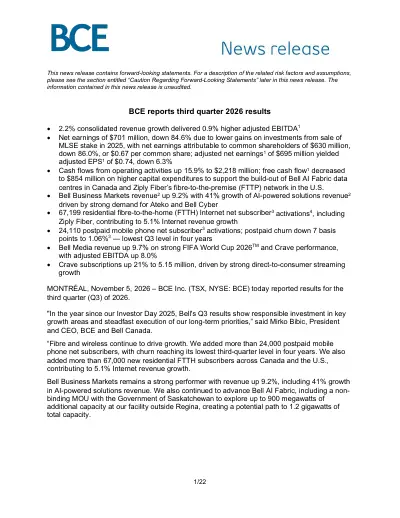
We delivered 2.2% revenue growth in Q3, supported by strong performance at Bell Media and Bell Business Markets, together with the contribution from Ziply Fiber. Adjusted EBITDA increased .9% year-over-year, driven by Ziply Fiber and 8% growth at Bell Media.
EBITDA margin was 45.1%, down 60 basis points, partly due to a greater contribution from lower-margin product sales. Excluding Ziply Fiber, BCE revenue grew .9% year-over-year, while adjusted EBITDA was stable.
The year-over-year decline in net earnings and statutory EPS were primarily due to the $5.2 billion gain recorded on the sale of our minority stake in MLSE in Q3 of last year. Adjusted EPS was down 5 cents, reflecting an expected increase in D&A expense and lower year-over-year tax adjustments, consistent with our 2026 guidance assumptions.
Total capital expenditures increased $439 million year-over-year, reflecting investments in Bell AI Fabric and Ziply's fiber build-out in the U.S. Excluding AI Fabric and Ziply, underlying Canadian telecom capital expenditures continued to decline year-over-year, reflecting significant efficiencies in our core business while maintaining the investments needed to support our networks and customers.
We continue to expect approximately $5 billion of total capital expenditures in '26, consistent with our capital intensity guidance. Capital spend is expected to increase in Q4 compared to Q3, driven by continued investment in Bell AI Fabric, including ongoing construction of our Saskatchewan data center.
Free cash flow was $854 million in the quarter. While down year-over-year as expected due to higher capex, the result benefited from the timing of working capital and cash taxes.
Turning to Bell CTS Canada on slide 10: we delivered just over 24,000 postpaid mobile phone net adds in Q3, including the onboarding of customers under a government sector contract. Postpaid churn improved 7 basis points year-over-year to 1.06, our lowest third-quarter level since Q3 of 2022, as our customer first initiatives continue to take hold.
On ARPU, the year-over-year decline was 1.7% in Q3, reflecting the first full-quarter impact of the CRTC-mandated elimination of certain connection fees, together with the onboarding of lower-ARPU government sector customers. Importantly, underlying pricing trends continue to improve, with billed monthly recurring rates on new consumer postpaid activations increasing approximately 11% year-over-year.
We're also seeing a meaningful improvement in existing customer renewals, with customers completing hardware upgrades now recontracting at higher billed recurring rates than their previous plans. In broadband, fiber continues to deliver, with 58,643 residential fiber-to-the-home Internet net adds in Canada.
Turning to the financial results for Bell CTS Canada: Bell Business Markets revenue grew a very strong 9.2% in Q3, supported by continued growth in AI-powered solutions, where revenue increased 41%, as well as higher enterprise equipment sales, which typically carry lower margins. Wireless product revenue declined modestly by 1.1% year-over-year, reflecting lower device sales volumes, mostly offset by higher handset prices and reduced discounting, which also helped improve wireless product margins.
Wireless service revenue declined 1.3% year-over-year. Excluding the CRTC-mandated elimination of certain connection fees, service revenue was fairly stable, down approximately .5%.
Pricing has improved through Q2 and Q3. If that momentum continues, we would expect to see wireless service revenue and ARPU growth by mid-2027.
Turning to Bell CTS U.S. on slide 11: we continue to see good fiber performance at Ziply.
We delivered approximately 8,600 residential fiber-to-the-home Internet net adds in Q3, with gross additions higher than in Q2. Penetration in newer fiber markets remains consistent with historical performance, and residential fiber ARPU is up year-over-year.
While fiber represents a growing share of Ziply's revenue, we continue to absorb the decline in legacy residential services, which is small in dollar terms, about $6 million U.S. year-over-year.
Adjusted EBITDA was $95 million in Q3, in line with Q2, representing a margin of approximately 40%. The year-over-year comparison reflects about $9 million of costs that weren't in last year's base, from aligning Ziply's compensation structure and accounting policies with BCE's, and from higher property taxes following the acquisition, which were not reflected in the 2025 metrics.
As Mirko mentioned, the focus is on accelerating the build. Permit submissions were up about 60% from Q2, and most permitting activity is now outside the incumbent footprint.
Over to Bell Media on slide 12: Bell Media had a very good quarter. Total revenue up 9.7%, adjusted EBITDA up 8% year-over-year.
Revenue growth supported by continued Crave growth and higher program sales. Advertising revenue increased 9%, supported by strong sports performance and digital video advertising growth of 41%, another solid step forward in monetizing our streaming audiences.
Subscriber revenue was up 9.5%, driven by direct-to-consumer streaming growth, and Crave now has 5.15 million subscribers. EBITDA growth reflected higher revenue, which more than offset increased costs for sports and other premium programming.
Turning to the balance sheet on slide 13: we ended Q3 with $3.7 billion of available liquidity, and our defined benefit pension plans remain in a strong solvency position. Our net debt leverage ratio was approximately 3.7 times at the end of Q3, and nominal net debt declined approximately $680 million since the start of the year, to $39.6 billion.
On TowerCo, the $3.45 billion purchase price implies a valuation of approximately $4.91 billion, in line with recent Canadian tower precedents. We expect the deal to close in the first quarter of 2027.
Post-closing, we will continue to consolidate TowerCo's results. This transaction provides additional financial flexibility to fund key growth areas, including AI-powered solutions, while our commitment to 3.5 times net debt leverage by the end of '27 remains unchanged.
To wrap up on slide 14: Q3 was a good quarter, growth in revenue and adjusted EBITDA, as we continued to fund investment in Bell AI Fabric and the U.S. fiber build.
Our priorities from here are clear: continue reducing capital spending in our core Canadian telecom business, invest in growth, and deliver on our commitment to reach 3.5 times net debt leverage by the end of 2027. With nine months behind us, I'm reconfirming all of our financial guidance targets for 2026.
I'll now turn the call back over to Kris and the operator to begin Q&A.
Kris Somers
Thank you, Curtis. Before we start Q&A, just want to keep the call as efficient as possible, please do limit yourself to just one question and a brief follow-up before getting back in the queue, so that we can get to as many as possible.
With that, Matthew, we're ready to take our first question.
Operator
Thank you. If you are on the phone and wish to ask a question, please press star one.
The first question is from Drew McReynolds from RBC Capital Markets. Please go ahead.
Drew McReynolds
Thanks very much. Good morning.
Two for me. First, with respect, I guess, Curtis, on the Ziply footprint expansion, just your level of confidence in terms of tracking to that 3 million footprint by the end of 2028, just given how everything's accelerating and ramping up.
Then secondly, probably for you, Mirko, just with respect to Bell AI Fabric, obviously there's a lot of neocloud debate out there, a lot of attention on CoreWeave, etc. I think the world knows there's an insatiable demand for compute.
Demand in aggregate is still there. This is kind of probably more a financing issue of neoclouds, but wanted to get your updated thoughts on just kind of how you see Bell AI Fabric kind of navigating what could be a little bit of a choppier kind of customer environment as we look forward.
Mirko Bibic
On the second one, it's Mirko, on the second one, Drew, look, the demand signals for the capacity we have continue to be very strong. We have a strong funnel of potential customers for expansion opportunities.
As far as current customers are concerned, I'm not going to comment on any one customer in particular, but I would say that every single one of our customers, the two in Saskatchewan and our customers elsewhere, continue to be very engaged, very eager for us to deliver In Saskatchewan, they're very eager for us to deliver on the four buildings. They continue, our customers across the board, continue to interact with us, make the payments that are required.
There's no changes to the contracts. We're forging ahead.
I said there's 1,100 people on-site. It's a pretty exciting project delivering a lot of value to the communities.
When those buildings are up and running, those customers are going to be taking possession and continuing to make the payments. The engagement is very solid.
Curtis Millen
Hi, Drew. Thanks for the question.
It's Curtis. In terms of Ziply and fiber footprint, look, the team is doing a very good job of selling fiber where we have fiber.
This quarter, next quarter, and the next quarter, and frankly till eternity, I will always want more fiber. The answer is always going to be yes, because we know ultimately where we have fiber, we're going to win subscribers.
In my role, I'm never going to be happy with pace of build. The team is making real good progress in terms of permitting and building.
Again, it takes a little bit longer than we would all want, but a lot of the build is now outside of the four states, there's a lot of groundwork that needs to get done as they're expanding footprint outside the Pacific Northwest. Look, 3 million is still the plan, but the focus is on driving shareholder value and executing our plan.
That's being first fiber in markets, that's in driving subscriber penetration once we have fiber. Again, the team has done a very good job, and frankly, consistent job of driving consumer and subscriber loads where we've built fiber.
Again, this is a build initiative, and like you, we want to keep accelerating the footprint expansion.
Drew McReynolds
Okay. Thank you both.
Operator
Thank you. Our next question is from Maher Yaghi from Scotiabank.
Please go ahead.
Maher Yaghi
Great. Thank you for taking my question.
I just wanted to double down first on the capex profile for Saskatchewan, and my second question is more on the capital allocation. If you can maybe update us on how much money has been spent so far on AI Saskatchewan specifically this year, how much is left in Q4, and to complete your 300-megawatt facility data center operation, how much is left to be spent in '27 and in '28?
That's if you don't add more capacity. Maybe we'll start with that if you can maybe update us on those numbers.
Curtis Millen
Hi, Maher. Curtis.
Thanks for the question. Originally, we had said we'd spend 1.3 billion of capex in-year, but ultimately we manage capex as a as an envelope, and we're still targeting the 5.0 billion.
Some dollars shift across quarters because it's it's not a hard line. Again, still think the $5 billion is a good number.
I'd say relative to our original estimates, we've been able to push some of the equipment capex spend out a little bit. Originally, remember we talked about ordering probably earlier than we needed to and warehousing it for a little longer than we needed to, and we've been able to push some of that warehousing timeline off a little bit.
Q4 is is clearly, you can run the math, but Q4 is expected to be a much heavier capex quarter. Again, we're managing to the 5.0 portfolio guidance.
Maher Yaghi
Yeah. That's what I was trying to figure out, because it does seem like some money that was supposed to be spent in '26 is being pushed out to '27.
Is that because equipment is there, but you don't have to pay for it, or the equipment is slightly pushed out in terms of timing of delivery?
Curtis Millen
I think, Maher, the simplest way is we were a little conservative in terms of our original budget assumed we were going to have to warehouse equipment for longer than we actually need to in the real world. I'd say, importantly, there's no change to our delivery timelines at all.
We still expect to deliver the first hall by middle of next year and all of the halls up and running by the end of next year. No change in timing at all, just an ability for us to not warehouse equipment for as long as we had budgeted for.
Maher Yaghi
Okay. Fair.
In terms of a couple of transactions on the go, Northwestel and the wireless transaction, for Northwestel, can you maybe update us on where you think this transaction is headed towards and what kind of implications it would have on how much cash you could bring out from that operation down the road?
Mirko Bibic
Okay. Thank you, Maher.
It's Mirko now. I'll give you a very high-level answer and then a more specific one on Northwestel.
I'm going to refer back to the commitments we made in early 2025, when we laid out a general roadmap, which we then solidified at Investor Day, right? We were going to strengthen the balance sheet, and one of the ways we were going to do that is to generate $7 billion of proceeds from non-core divestitures.
Essentially, we're executing against that. We're serious about deleveraging, but we're also serious about funding growth and showing results.
That remains the plan, and we're executing against it. Now to your question on Northwestel: there is still the distinct possibility of a transaction to be done, although at this stage it's looking like it might take a different form.
It's unlikely to be the sale of the entire asset, but there is a transaction to be done. If it proceeds, and I think it will, be expected to have the exact same leverage impact or deleveraging impact as the original transaction that we announced a couple of years ago would have had.
From a deleveraging point of view, same impact, and generally speaking, on track overall on our plan and our deleveraging targets.
Maher Yaghi
Great. Thank you.
Operator
Thank you. Our next question is from Stephanie Price from CIBC World Markets.
Please go ahead.
Stephanie Price
Hi, good morning. Congratulations on the tower partnership that was announced last week.
Just curious on how we should think of use of proceeds here, and whether the Street should expect some of the proceeds to be redeployed into the data center and Ziply opportunities. My follow-up is maybe around the Ziply footprint here, and if you can talk a bit about buy versus build thoughts in Ziply at this point.
Curtis Millen
Great. Hi, Stephanie.
Thanks for the questions. In terms of towers, look, we are obviously pleased with that transaction.
We think La Caisse is going to be a great partner going forward. There's clearly a growth opportunity as it's run independently.
We are quite pleased. In terms of the proceeds, $2.45 billion is providing us financial flexibility, but our priorities remain the same.
We'll hit 3.5 times net leverage, and we have financial flexibility to fund growth initiatives, including AI Fabric. As Mirko said previously, there remains strong demand for AI Fabric.
Nothing to announce as of yet, but clearly, it requires capital going forward, but nothing to announce. It's just financial flexibility.
Mirko Bibic
Stephanie, on the second question, I think it was what's the buy versus build equation in the U.S. at Ziply?
Was that it?
Stephanie Price
Exactly, yeah.
Mirko Bibic
Okay. The base plan and the primary objective is to build, and there is a little bit of buy in there, but it's buying to build faster.
We consistently have said that we'd look at some launchpad acquisitions over time if they came at the right value and at the appropriate total purchase price. The two transactions that I mentioned in my opening remarks hit those two criteria: the right value and the appropriate total purchase price.
Importantly, what we're buying here are existing fiber networks, small number of locations passed, but construction teams, established presence in communities, and it basically gives us a running start to expand our build in geographies that we have targeted as part of our overall plan. Consider them launchpads.
In this case, the two companies are two small private companies that are outside the four states, and they also fit our prioritized criteria of being first to fiber and unlocking, obviously, as I've already said, unlocking build opportunities. The base plan remains: we build, and then if there are small launchpads that can allow us to build faster, we'll take a look at those, and these are two examples of that.
Stephanie Price
Thank you for the color.
Operator
Thank you. Our next question is from Tim Casey from BMO Capital Markets.
Please go ahead.
Tim Casey
Thanks, Mirko. Could you just sort of rank for us your priorities in terms of recycling capital into growth opportunities?
What do you think are the most likely in terms of AI Fabric and other powered solutions versus Ziply versus other things? Then as a follow-up, how should we think about the non-binding MOU in Saskatchewan?
What are the signposts investors should be looking for that tangibly starts to gain traction, and I guess maybe just how you pay for it? Is that going to be with potential partnerships, or is that where the tower deal gives you flexibility?
Thanks.
Curtis Millen
Hi, Tim. Thanks for the question.
In terms of the non-binding MOU, as we've said previously, we need access to power, we need access to land, and then customers before we're going to announce financial impacts. In this case, again, it's an important partnership, important line of sight into incremental power.
Now it's a matter of working through contracts before we announce something. Again, demand is strong, conversations ongoing, but we need all three lined up before we're going to announce that type of transaction.
Ultimately, recycling capital, look, we do think in the AI Fabric world, the returns are quite strong, it is an attractive opportunity, somewhat endemic opportunity for us to drive shareholder value and financial growth. That's clearly part of our capital allocation priority.
Again, similar to how we discussed it at Investor Day, we're going to hit our leverage target, strengthen the balance sheet, and fund growth, which includes fiber, it includes AI Fabric, it includes continued conversion of media into a digital platform, and our continued transformation internally so that we can rip out run-the-business costs and be more efficient in both our opex and capex, which allows us to allocate more of our funding toward growth initiatives. It's a little bit all of the above, but as you pointed out, AI Fabric has very strong returns and is towards the top of the list.
Mirko Bibic
Then, it's Mirko. I'll add one thing.
It's a very important on the point that Curtis made around digital transformation, allocating capital there as part of the core areas of priority for capital recycling. The reason that's super important is what we're doing there is investing to improve the customer experience.
Better customer experiences at lower cost allows us to lower churn, increase NPS, and that's driving profitable or more profitable transactions in our wireless and fiber businesses in Canada, which we talk a lot about AI Fabric, we talk a lot about Ziply, but the Canadian wireless and fiber business are massively important drivers of success at BCE. The reason we're allocating capital on digital transformation is to drive more profitable transactions in those two extremely important segments, and you're seeing the results.
It's working, and again, I'll repeat what Curtis said in the opening remarks: we are pleased with the pricing improvements in the market, while we continued to deliver significant value to customers, and we see those improvements continuing into Q4 and into next year. If that does happen, we will see service revenue and ARPU growth by mid-next year, and perhaps even earlier if things go well.
Thought it was important to say a few words on the core wireless and Internet businesses.
Tim Casey
Thank you.
Operator
Thank you. Our next question is from Vince Valentini from TD Securities.
Please go ahead.
Vince Valentini
Hey, thanks. I will ask another question about the core wireless business, but first just to clarify, when you say there's a strong demand funnel for the new data center opportunity you're looking at, Mirko, can you clarify, are there better quality credit-rated companies that do have demand for these facilities, whether it be government agencies or hyperscalers directly?
Do you think there's an opportunity to pick and choose who you have as tenants, given these aren't short-term contracts. You can't just look at somebody's financial health if they're paying you for the next quarter.
You've got to think about the next 10 years of financial health. If you can clarify the quality of the types of people you'd have in that funnel, I think that would help everybody a lot.
My question on wireless, I'll just throw it out at you now so you can think about both. Look, we've seen Quebecor's numbers, I'm sure you've seen them.
It looks like they're going to add over 50% share of the net adds in the wireless market in Q3, but it hasn't seemed to hurt your churn. Your churn is nicely down year-over-year.
I guess they're just taking a bigger chunk of the gross adds in the market as opposed to stimulating more Bell customers to switch over to Freedom. If that's the case of what's happening, is it reasonable to assume you basically just ignore what they're doing and let them have it, or do you feel like there's a need for a response here to take back a bigger share of gross adds for Bell next quarter?
Mirko Bibic
Thanks, Vince, for the two questions. On the first one on AI Fabric, yeah, I did mention that.
Thank you. I did mention the strong demand funnel.
And 20-year 20-year you're right, 20 years is a long time, and we can't predict how the market's going to evolve over 20 years, and it's moving fast. I think what we're going to do is continue to focus on how we've been executing.
Very important elements, right, being extremely disciplined. Point one is, we're going to make sure that we have a diversified customer base, and yes, we'll be looking at the mix between the direct hyperscalers, public sector, Canadian enterprise, etc.
We'll make sure we have a diversified customer mix, not investing directly in GPUs, and making sure our agreements have the right protections. It's an important point you raise, and that's how we're going to be tackling it.
Or yeah, another point on AI Fabric before I go to wireless, another element of discipline is we're not building on spec. We get a contract, then we build.
Back now on wireless: look, some general points here. The market is normalizing around lower population growth, and in the context of lower volumes, we are choosing quality over volume.
Again, I've said this for many, many quarters, we're prioritizing the Bell brand, and more than 100% of our net adds this quarter came on the Bell brand, and that would be in enterprise and in consumer. We continue to deemphasize our flanker brand.
We are focused, and we will continue to be focused, in Q4 on lifetime value of customer additions, we're not here to maximize gross adds through short-lived promotional pricing. Our approach and our philosophy is based on the fact that higher transaction quality year-over-year or more is going to more than offset declining net adds, and ultimately ARPU growth has a higher EBITDA flow-through than subscriber growth.
We're seeing that in the stronger build rates that we're generating now, and we're generating higher build rates by offering more value on our ultra plans, and we're giving customers options on device residual values, and that helps to reduce the subsidy and to deliver affordability. The point you made about churn, the reason churn is coming down is because the investments we've made, and it's been investments on digital transformation that we've made over several years now, and those investments are starting to bear fruit.
Our churn's performing well, that leads to higher transaction quality, that allows us to not chase every single loading, and ultimately, we'll be able to deliver better ARPU and service revenue growth, as I said, by mid-next year, if not sooner. That approach, Vince, we plan to continue through Q4 and beyond.
We're already a couple of weeks into or a week into November, and on the horizon, we have Black Friday. Look, the U.S.
Thanksgiving holiday is an amazing holiday, but it's not a Canadian holiday, and kind of always wondered why we engaged so vigorously in deeply discounted Black Friday sales during a U.S. holiday, especially when a couple of weeks later, we're going to have the festive holiday selling period.
Our focus is going to continue to be what I've just outlined and what we've been doing for a few quarters now. It's been a long answer, but an important one.
I hope it's responsive.
Vince Valentini
Very helpful. Thank you.
Operator
Thank you. Our next question is from Jérôme Dubreuil from Desjardins Securities.
Please go ahead. Hey,
Jérôme Dubreuil
good morning. Thanks for taking my question.
First one, on free cash guidance, you've been clear that there's a bit of a timing in working cap and capex is going to be picking up in Q4, but still it seems a bit conservative at this point. Is it fair to expect you to be landing at the higher end of the range?
Also maybe a longer-term one, it's a question that's being asked from the U.S. calls, but when do we see large AI deals in Canada, and maybe that could accelerate at some point?
Is there any fiber lift for you guys that you expect could dematerialize at some point? I 100% understand that we don't have the same type of ecosystem around data centers here, but just wondering if it's a longer-term opportunity.
Thank you.
Mirko Bibic
Right now on the AI data centers, the real short- to medium-term lift, revenue and EBITDA, is on the powered shell delivery. That's where the significant benefit's going to come from.
Again, I said at the beginning, none of that, it's massive growth potential, imminent in terms of 2027, and I don't think any of that's reflected in the share price right now. The other value generator that's very linked to this is the full-stack offerings that we're able to provide, and across the infrastructure layer, the technology services layer with Ateko and the cybersecurity protection with Bell Cyber, the partnerships we have with domestic Canadian technology players and global players as well.
The full-stack offering is going to be kind of a mid-term revenue and EBITDA generator. The way I look at this, there are three layers of demand.
There's kind of the powered shell demand, and then overall, I think ultimately we're going to see some public sector demand in Canada, and then after the public sector demand, I do see a high potential for Canadian enterprise demand across multiple layers of the stack. Then,
Curtis Millen
hi, Jérôme. Thanks for the question.
In terms of free cash flow, look, I do think we're doing a very good job driving free cash flow and free cash flow growth. Still feel comfortable with the guidance range.
Look, we spend day in, day out trying to generate more free cash flow, so that's our focus from here to the rest of the year, but still feel comfortable with that guidance range.
Jérôme Dubreuil
All right. Thank you.
Operator
Thank you. Our next question is from Sebastiano Petti from J.P.
Morgan. Please go ahead.
Sebastiano Petti
Hi, thanks. Can you hear me now?
Mirko Bibic
Thanks.
Sebastiano Petti
Okay. Sorry about that, Mirko.
Just as we kind of think about the on the other side of the TowerCo, I guess, monetization, as you think about the Bell AI Fabric opportunity over the next several years, with the additional I guess balance sheet capacity that you do now have on the other side of this TowerCo transaction, do you have any preference versus own, build, versus JV structures at this point? Is JV kind of off the table now that maybe you don't necessarily need it, or every opportunity is a unique opportunity, and never say never?
Then a couple quick housekeeping kind of questions, as well, if I may. Mirko, any way to perhaps unpack the contribution from the provincial government win in the third quarter?
Is it comparable to what we saw in the second quarter, just because I think within the slide deck and I think in your prepared remarks, you guys touched upon taking share in each of your individual cohorts? Just trying to think about what the non-government, non-provincial win growth kind of looked like in the quarter, in light of your churn comments and the gross add performance.
Thank you.
Mirko Bibic
Thank you, Sebastiano. On the seconds, as I said in my opening remarks, you can consider our consumer net adds to be generally in line with what you saw from one of our peers who reported early, and again, massively tilted towards the Bell brand, and same thing with the enterprise segment.
We're pleased with our performance across those two important segments, obviously consumer and enterprise. Our prepaid loadings were pretty good, too.
On AI Fabric partnerships and the like, you kind of answered the question at the end when you said never say never. I'd be in the never say never category, Sebastiano.
There's nothing to discuss or point to at this point in time, but again, the key takeaway here is the significant value we've created in only 18 months, which actually is the reason you're asking the question, I really like the question. It underlines that there's significant value here that we've created, and so you're trying to ask how do we take advantage of that massive value?
Right now, I put it in the never say never category. We're just charging ahead trying to deliver in 2027.
Sebastiano Petti
All right, I'm glad you liked it. Real quick follow-up on Ziply.
As we think about the build pace accelerating here, are you confident in achieving the 2028 Investor Day outlook on Ziply? Because it kind of seems like there's just more of a hockey stick getting pushed into 2027 and 2028.
I guess, how should we think about that? Thank you.
Mirko Bibic
I like that question, too, actually, because you've framed it around the three-year outlook. What I'm focused on with the team is our three-year plan and our three-year trajectory, and not just at Ziply, right, just across the board, across all the things we said we were going to do.
We're only nine months into that plan, and again, that's across the board and including at Ziply. We're only nine months in.
What I'm going to do is I'm going to assess the team's execution across all our initiatives over that time period, not after nine months. On Ziply in particular, and now I'm going to move away from my three-year view to Q3 over Q3, our fiber sales in the U.S.
are still strong. Our penetration is still very good.
New-in ARPU, ARPU that generate from new customers at the beginning of 2026, a bit pressured because of some Québécois activity, but that stabilized. Our blended total ARPUs increased in Q3 compared to the beginning of the year, and we're still generating significant fiber revenue.
Our fiber revenues over the three months of Q3 2026 compared to the full three months of Q3 in 2025 were up 10%. We generated 10% fiber revenue growth in Q3 year-over-year at Ziply.
We're going to be focused on accelerating the pace of build, clearly, that's important. The big win here will be generating revenue and EBITDA growth, and climbing further up that hockey stick, as you put it, so that we can get as close as we can to 3 million by the end of 2028.
Sebastiano Petti
Thank you.
Operator
Thank you. Our next question is from Aravinda Galappatthige from Canaccord Genuity.
Please go ahead.
Aravinda Galappatthige
Thanks for taking my question. I'll start with a quick follow-up on the service revenue growth for wireless.
I know that in the prior call with Rogers, they gave a sense of with the CRTC decision how that impacted the numbers. Can we assume it's generally similar?
I guess what I'm trying to get at is if you adjust for that, do you kind of crossover into positive territory already in Q3 with service revenue growth? Then a broader question for Mirko.
With obviously the conversations you're having with the government on the infrastructure side, for the overall telecom sector thesis, do you sense that if the relationship at the regulatory level, at the government level, is changing, that can kind of flow through to the broader sector? Obviously a lot of the decisions that have been coming through have not been favorable to this group.
Wanted to know kind of your high-level take at this stage.
Mirko Bibic
Curtis can answer the first one. I'll tackle the second question right now.
I definitely am encouraged by generally speaking what the current government is trying to do to encourage and generate investment in the country writ large, and with its focus on infrastructure investment. I think that bodes well.
I think the AI for All strategy that was unveiled several months ago is a clearly positive step, particularly since well before that strategy was announced, we had developed our own AI strategy, I think we can certainly be a key driver of that AI strategy for the country and for the government based on the things we're already doing. I think that is an opportunity to collaborate and work together.
We're seeing the relationship with the provincial government in Saskatchewan deliver significant economic benefits for the local communities, the province, of course for our customers and our future customers, and for Bell. All that is trending definitely in a positive direction, Aravinda.
It's way too early to judge, and I'm not anywhere near close to sounding positive on the core regulatory framework, our traditional typical regulatory framework, whether it's on the telco side or the broadcasting side. I haven't seen any change there, I'm certainly not going to give you any positive vibes on that front.
It's unfortunate, because you are seeing the tremendous impacts those decisions over the last several years have had on the direct investments that the larger players have been making. They've shrunk dramatically.
I highlighted what our capital intensity is, core business, if you exclude AI Fabric investments and Ziply investments, and they're dramatically lower than they were only 2 years ago. I'll leave it at that.
Then,
Curtis Millen
hi, Aravinda. It's Curtis.
Just on your other question. Wireless service revenue excluding the fee impact, would have been down about .5%, and on a blended ARPU basis, it would have been just inside call it a .9 decrease year-over-year.
Aravinda Galappatthige
Thank you. Appreciate that.
Pass the line.
Operator
Thank you. Our next question is from Matthew Griffiths from Bank of America.
Please go ahead. Oh,
Matthew Griffiths
good morning. Thanks for taking the question.
I wanted to ask about Bell AI Fabric and the Saskatchewan build and the kind of the future potential. Obviously, NIMBYism across the sector with related to data centers is something that's growing.
Unlike in the U.S., you have kind of supportive provincial government, looks like the utility is very supportive and a Crown corp in Saskatchewan. Community opposition is something that gets headlines.
I just wanted to get your take on what you're facing for in the community, and kind of what steps you're taking to sort of build a consensus. Related, obviously, in Canada, there's a duty to consult.
I think there's good examples of where you worked very collaboratively with different communities, and I can think of an example in B.C., where it seems very positive and collaborative. As it relates to Saskatchewan, sort of, if you could comment on what your activities are, and more importantly, perhaps, whose duty it is, and where your responsibilities for that lie, where the government's lie, and where maybe the utility's responsibilities lie, so that people can have a good sense of which ball is in your court.
Thanks.
Mirko Bibic
Thanks, Matthew. Clearly an important issue that we manage with diligence and with care.
The issue is about engaging with all the stakeholders and communities where we build. I would say the same thing as it relates to fiber in our other businesses.
We always have to be responsive to the communities we serve and the communities where we operate. No different here.
I would say that the first principles that we adopt is, the federal government has outlined what it believes to be responsible AI data center development, the Saskatchewan government has its own principles, we wholly endorse those, we signed on to them, and we plan to continue to respect them in how we operate and how we build and how we manage environmental issues. That's the starting point.
We engage directly with communities and neighbors in Saskatchewan. I'll highlight that we have had the support from day one from the George Gordon First Nation, which is our immediate neighbor, and we're working collaboratively in partnership with them to make sure that the community there benefits directly as well through employment and other co-development ideas.
We're doing that. There are some sectors or segments of the community that are concerned.
I fully understand that, and we try to address as best we can what those concerns are. More broadly speaking, the community in and around Regina and the regional municipality of Sherwood are very supportive, actually.
They see the economic activity, and it's benefiting them and their neighbors and their families and their nephews, etc. We spend a lot of time there.
I was just there two weeks ago, and one of the adjoining neighbors came up to me and talked about how positive this was for the communities. Local restaurants are thrilled because they're full every day.
There's 1,100 people on-site. All hotel rooms are taken.
There's a steel-making capacity that was built not too far away in the town of Clavet, $20 million investment so that they can supply steel to the site. The folks who are working there and are feeling the direct economic impacts are thrilled about the investment.
We can't lose sight of the broader endorsement of this project, and at the same time, we do have to address the concerns that are arising in some segments. That's how we're handling it, Matthew.
Matthew Griffiths
All right. Thanks, Mirko.
Operator
Thank you. There are no further questions registered at this time.
I would now like to turn the meeting over to Mr. Somers.
Kris Somers
Thank you, Matthew. Thank everybody for your questions.
Before we close off here, I am going to turn it back to Mirko for some final remarks. Mirko?
Mirko Bibic
Yes. Thanks, everyone.
Thanks for the time and the questions. I do want to to reiterate a couple of things.
We're only one year into our three-year plan, and we're delivering against the commitments we've made. We know there's more to do because we got two years and a quarter to go, but the progress across our businesses reinforces our confidence in the strategy and certainly reinforces the direction we're heading.
That's really good. If I I I name a few of the key things: on capital allocation, you've you've all asked the questions, they're good questions, we're making significant progress on capital recycling.
You've you've you've asked us about that. We spent some time on Bell AI Fabric, and again, think about this: in our 2028 plan in in October, our 2028 plan announced in October of 2025 was to monetize 73 megawatts of capacity.
We've increased that to 373 megawatts. 335 megawatts are contracted, and we have a a 900 megawatts of additional pipeline to that we can sell in Saskatchewan alone.
There's significant value there not reflected in the share price. Our customer first initiatives are working.
I talked about that. You can see that in our churn results.
The wireless discipline and the focus on profitable transactions, the significant growth in in AI-powered solutions, even if you exclude Bell AI Fabric, complete transformation momentum continues at Bell Media. The last point I'll make is, we win where we have fiber.
You see it in Canada, and and and we're generating strong fiber revenue performance in Ziply as well. It shows you the the strength of the fiber platform.
I'll stop there. I thought it was really important to highlight that.
Thank you for your time this morning.
Kris Somers
Thank you, everyone, and have a great day.
Operator
Thank you. The conference has now ended.
Please disconnect your lines at this time, and we thank you for your participation.