CellaVision AB
Q3 FY2026 · Earnings Call TranscriptOctober 29, 2026
Steve Ferguson
Welcome, everyone, and thank you for joining us on our call this morning. My name is Steve Ferguson, and with me is our Chief Financial Officer, Monica Jönsson.
We appreciate you taking the time to join us as we present CellaVision results for the third quarter of 2026. Following the presentation, we'll be happy to take your questions.
Before I jump into the quarterly results, I'd like to take a moment to thank our employees, our customers, our partners, and our shareholders for their continued trust and commitment to CellaVision. It's through our combined efforts, bringing together innovation and strong commercial execution, that we continue to create long-term value and fulfill our mission, which is to advance laboratory workflow and diagnostic certainty through intelligent microscopy.
With that, let's turn to our performance for the third quarter. CellaVision's third quarter reflected really solid progress across the group.
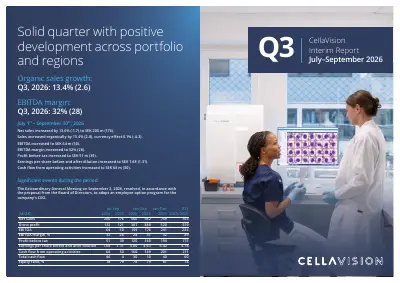
The quarter delivered an increase in net sales of 13.6%, and we reached 200 million SEK in the quarter. Sales increased organically by 13.4% with only a minor currency effect.
EBITDA amounted to 64 million SEK, which corresponds to a 32% EBITDA margin. Across the regions, Americas continued to build on the strong second quarter that we saw earlier this year.
Sales were up 32% to 89 million SEK, with the primary drivers being strong demand for large connected instrument platforms and, in this quarter, a notable software contribution. Small instrument sales also continue to recover, which is a positive sign for the overall product mix.
EMEA was down 10% compared to a very strong quarter last year. That said, the picture is much more balanced.
Sales have sequentially progressed since quarter one. Key update from the region focuses on the bone marrow application, our most recent launch, and this has gone from customer evaluations to generating first revenue, with the initial installations in EMEA marking the beginning of customer adoption.
APAC grew 91% organically. Broad-based growth outside of China with solid performance for both instruments and reagents is the picture here.
The standout is Japan, where we're seeing notable momentum in converting the installed base to CellaVision reagents, which strengthens the recurring revenue stream going forward. The bone marrow aspirate application has generated growing revenue in EMEA, and that's a meaningful milestone in our expansion into specialized microscopy.
The rollout is progressing across the region, and we're seeing continued positive customer interest. On the regulatory side, the FDA 510(k) review is ongoing in the United States, and our aim is to obtain market clearance before the end of this year.
On the development side, the FPM technology and our next-generation hematology analyzers are progressing through key phases towards a future market introduction. We see this technology platform as a significant step forward for digital cell morphology in hematology.
It combines meaningfully higher image quality with substantially higher throughput than compared to what's available today on the market. It also opens the door for CellaVision to adjacent fields, such as pathology and cytology.
Now let me hand over to Monica, who will present us with an overview of the financial results for the quarter.
Monica Jönsson
Thanks, Steve. Let's unpack the P&L and cash flow.
Net sales was 200 million SEK in the quarter, representing 14% growth or 13% organic growth against the same quarter last year. Also worth to notice is that year-to-date organic growth is 4% despite the weaker Q1.
We had a gross margin of 66% in the quarter. That entails amortization of capitalized development expenditures for bone marrow and upgraded software program launched in Q1.
This quarter we are amortizing 5 million SEK versus 2 million SEK last year. The gross margin was also negatively impacted by the sales mix.
Operating expenses landed at 82 million SEK, equaling 41% of net sales. If we unpack that, we see that sales and marketing expenses are kept on stable levels.
Administration expenses were impacted by costs of 4 million SEK associated with the final settlement of the CEO transition. R&D costs before capitalization were 39 million SEK, somewhat lower than last year and reflecting lower consultant and personnel costs during summer vacation period.
Comparing to same quarter last year, we have a higher capitalization of 16 million SEK, and that results in a R&D cost of 23 million SEK. The higher capitalization is mainly due to the fact that some projects have recently advanced into more mature phases.
EBITDA increased to 64 million SEK with an EBITDA margin of 32%. We are continuing to invest in R&D with 19% of net sales, and our R&D investment programs are developing well and maturing according to plan.
Finally, operating cash flow was 68 million SEK. The higher sales and the reduced inventory contributed positively to the cash flow, and the cash flow was 46 million SEK for the quarter.
Our financial position remains robust, with cash and cash equivalents of 290 million SEK sitting on the balance sheet. Let's look into the regional highlights.
Steve Ferguson
Thank you, Monica. At a regional level, America continues to perform exceptionally strongly.
Sales in the quarter were 89 million SEK, which is up 32%. This has really been driven by demand for large connected platforms.
Our platform has flexibility to connect smaller and large laboratories, and demand for that as laboratories consolidate is really helping drive sales in that region. In this quarter, the most notable win was a significant tender in Canada, which has led to a large installation in that region.
If we look at EMEA, sales were 86 million SEK, like I said, down on last year, but after the inventory correction in quarter one, we've now seen underlying growth represented through two consecutive quarters of growing sales. Interesting here, looking to the future, bone marrow aspirate has started, as I mentioned earlier, evaluations are generating positive feedback and that is leading to early adoption, which is leading to growth, and we expect sales in the quarter to be around 1% to 2% of the growth.
Reagent growth continues to strengthen across EMEA, and this is positive for us because this is recurring revenue, and this is an important part of the combined value offering or value proposition of CellaVision. Both the reagents and the microscopy combined gives a good platform and makes us a more attractive proposition for laboratory customers.
If we then look at APAC, really pleasing sales here, 90% growth in the quarter, all outside of China. This has been driven across the portfolio, both instruments and reagents are growing strong there, and it's across the region, both in South Asia and East Asia.
I do want to call out the Japan performance here, which was fantastic, and really has been driven by a conversion to CellaVision reagents in the largest national laboratory chain there. A very pleasing result when you look at it across the three regions.
If we look briefly at sales by product group, instruments represented 105 million SEK in the quarter, up 14%, as I've said, driven by the larger platforms in Americas. Reagents were up 12% at 45 million SEK, and again, this is pleasing for us.
This is a region that we have focused on, and sales have positively developed there in Asia, as I mentioned, and in EMEA. Then finally, a word on software and spare parts.
Sales there of 49 million SEK were up 15%, again, driven by increased software sales, again, driven by America. If we summarize then on the key takeaways, the quarter really resulted in net sales that are up 13.6%, as I've said, driven by Americas, 32% growth there.
EMEA is 10% down on last year, a tough comp last year, but quarter-on-quarter, we're seeing underlying growth on both the reagents and on the BMA platform. In APAC, really strong performance there, driven by Japan.
All of this is outside of China, and it's across both the reagents and the instrument platform. I just want to call out before we close today that the Power of Focus strategy was put in place to cover the five years up to 2025.
That strategy has delivered across multiple areas for us. We've made commercial and regulatory progress with the bone marrow aspirate, a meaningful milestone, that's our first significant launch in that period, and following quick on that will be the development of the FPM technology.
Our innovation pipeline is extremely strong, and I'd like to highlight to you that we plan to take you through the revised strategy. We have a new strategy period, a new strategy focus, and we plan to launch that and to give you more insight into that in our Capital Markets Day, which will be on February the 17th next year in Stockholm.
A heads-up for now to hold that date. Those are the final remarks today, with that, I'll pause and hand over for any questions.
Operator
If you wish to ask a question, please dial pound key 5 on your telephone keypad to enter the queue. If you wish to withdraw your question, please dial pound key 6 on your telephone keypad.
The next question comes from Simon Larsson from Danske Bank. Please go ahead.
Simon Larsson
Yes, and good morning, Steve and Monica. My first question relates to the price increases that you mentioned in the report.
Could you give us any hint of the magnitude of those? Would be the first one.
Monica Jönsson
They came in place from Q2, but we really see the full effect now in Q3. The magnitude, yeah, more or less I would say, very rough, following inflation.
Simon Larsson
Okay. Good.
I was also wondering on the gross margins, because obviously they contract a bit here quarter-over-quarter, and you're mentioning, of course, increased amortization, but also a bit mix effect in this. It would be super helpful if you could maybe split those two factors out and separate them so that we understand what is sort of the more long-term, maybe call it pressure on gross margin from the amortization and what could maybe be recouped, if you will, when mix improves?
Monica Jönsson
Great question. On the amortization, I would say that that will stay on this level until we launch the next product, you will be aware of that when you see that we will start launching and you will see new effect on amortization.
Until then, we expect to stay on this level. When it comes to sales mix, that is really due to the fact within the quarters where we see different mixes of small and large instruments, for example, as well as the total mix of more or less reagent, software, and so on.
It's a natural swing between the quarters.
Steve Ferguson
Yeah. That sales mix can vary quarter-to-quarter, Simon.
There's no surprises in there. It's something in line with the nature of the business.
Simon Larsson
Yeah. Maybe to rephrase the question a bit, I think you have 3 million in increase of amortization.
Do you know roughly how much of those 3 million that ends up in the COGS department or line item? Just trying to back out sort of underlying gross margin.
Oh,
Monica Jönsson
okay. All of that moves in there.
Simon Larsson
That full 3 million, Simon, in COGS,
Monica Jönsson
yeah. Yeah.
For sure. Oh,
Simon Larsson
okay. Very helpful.
Lovely. Perfect.
Then I was also wondering about sort of this larger tender in Canada that you are mentioning driving growth in Americas region. Do you think it's possible to keep up this sort of level of sales in Americas also going forward, or should we expect it to be a slower development now after two two quite strong quarters?
Not talking about you giving us any percentage guidance, but more on a sort of absolute level, if there's anything to be mindful of looking at Americas specifically in the future here?
Steve Ferguson
We're still confident that America is a growth case for us. The demand for connected laboratory solutions is high in those developed markets, as the laboratory customers are looking for efficiencies.
Our solutions combined can afford them with that. We obviously are working with our partner there.
There's a really strong and positive relationship. We have reasonable visibility into the future.
We still see opportunities for growth there in that region.
Simon Larsson
Good. You're talking in the CEO letter, Steve, about continued pressure on healthcare investments in some markets.
Would you mind breaking those markets out for us? Just put some more color on which markets you see headwinds in, and if we should expect that headwind to increase or decrease as we move into the final quarter of the year?
Any color on that would be nice.
Steve Ferguson
I think probably no surprises here that globally that China is the market that's undergoing most pressure, as government policy tries to drive cost from the healthcare system. That's probably the most notable one.
Then I think generally across Europe or EMEA, most of the Western governments are trying to get more value for money out of what they're investing there. It's a headwind, but it's something we feel as though we can navigate positively.
We have the solutions in place to deal with that.
Simon Larsson
Okay. Very good.
Thanks so much.
Monica Jönsson
Thanks, Simon.
Steve Ferguson
Thanks, Simon.
Operator
The next question comes from Ludvig Lundgren from Arctic Securities. Please go ahead.
Ludvig Lundgren
Yes, hi, guys. Thank you for taking my questions.
I wanted to start out on instrument sales in Europe. It was down against a quite tough comp year-over-year, but it sounds like the demand trajectory is turning slightly more positive compared to H1.
With the comparison base getting a bit easier, I believe, in Q4, would you say it's possible for this segment to return to growth this year, but also how to think about into 2027?
Steve Ferguson
Thanks, Ludvig, for the question. I think clearly with the inventory correction in Q1, there's clearly been a comparative there from Q3 last year that maybe is slightly inflated.
We expect the underlying business is robust. We expect that we have solutions there that are needed by our customers, we expect that the instrument sales will continue to grow.
Ludvig Lundgren
Thanks. Very clear.
Then I wanted to also jump over to reagents. Very strong growth there.
I guess it was a bit boosted a few million from the delayed orders in France, but I think it's typically not that much seasonality in this business. Is it fair to somewhere similar sales level on absolute level into Q4 as well on the group reagent sales?
Steve Ferguson
There's some seasonality there, but this is really a volume-driven part of the business. As more tests are done, more reagents are consumed.
We grow in line with market volumes, and the nature of that business is recurring. Whether it's quarter-on-quarter or over six-month period, that's the nature of our business.
You can have fluctuations, but this is recurring revenue, and we expect that to develop positively.
Ludvig Lundgren
Okay. Is there any seasonality difference, Q3 versus Q4?
Is Q4 a bit slower quarter in general or how to think about just that difference?
Steve Ferguson
No, not particularly. I think you just see, if you look at the in vitro diagnostic industry, you do see seasonal variation or quarter-to-quarter fluctuations.
I've said before that judging the performance of the company on a single quarter is a real challenge because it's a much more long-term orientated business than that. We don't expect any particular trends in Q4 that will poses any surprises.
Ludvig Lundgren
Very clear. Then a final question from my side on the R&D cost, thinking now before capitalization.
I believe this is down 10% versus same period last year, and you highlight related to less consulting cost and headcount. I believe this can also fluctuate a bit between quarters, but it sounds to me that current run rate of the R&D organization is down a bit versus last year.
Is that a fair conclusion? Is it something we can extrapolate as well?
Monica Jönsson
Yeah. We have the impact here from the vacation period in Q3, but we also have an impact of in which phase each and every project is in.
It's kind of natural fluctuation as well between the quarters that we see. I would still expect us to be on a more towards 20%, 21% of sales level, rather than the 19% that we are at today in Q3.
Ludvig Lundgren
Thanks. Very clear.
Just a final little follow-up on that. I see that number of employees is still growing while opex is quite stable, where is those additional employees going currently, what item in the P&L?
Monica Jönsson
Majority is still towards R&D in Lund where we are growing, but they are also in some places replacing then consultants. That's why you might not see that directly impacting opex.
Ludvig Lundgren
Thanks. Those were my questions.
I'll jump back into the queue. Thank you.
Operator
As a reminder, if you wish to ask a question, please dial pound key 5 on your telephone keypad. The next question comes from Elvin Rolder from DNB Carnegie.
Please go ahead.
Elvin Rolder
Yes, good morning, Steve and Monica. Hope you can hear me.
I have a couple of questions, some are perhaps a bit of a follow-up nature, but perhaps beginning in Americas. You obviously have very strong organic growth here again.
Is it possible to kind of quantify or split out partly the effect from the tender in Canada, but also how much of the growth is coming from replacement of an installed base and from what is coming on new, to say, customers or installments?
Steve Ferguson
Elvin, thank you for the question. The short answer there is that this is a mix across the portfolio.
The tender win in Canada is a win, it's incremental for us, but there are a mix of instruments in there that will be refreshed as part of that. We look at the installed base globally, and there are opportunities for refreshes and new business in equal measure there.
There's a real balance across the quarter in terms of new business wins and instrument refreshes there.
Elvin Rolder
Great. Thank you.
Then perhaps on APAC, obviously very strong growth here in Q3. I hear what you say that you have a strong demand if we look beyond China.
Are there any timing effects in installations that we should have respect for here in Q3 when we look towards Q4, Q1, or would you say that the pace of installation of instruments has been normal, to say?
Steve Ferguson
Nothing on timing effects that we are noting, Elvin. The one thing I would say is that any quarter can fluctuate.
The timing of a tender, the timing of an install, the timing of qualification by the laboratories, that can have an impact. I think looking longer term than any single quarter, we're really pleased with the development of the reagent business.
We have won the business with one of the largest national laboratory testing centers in Japan, one of the largest chains there. We expect that to be recurring over years, not just over a single quarter.
We think this is really stable and recurring revenue for us.
Monica Jönsson
Maybe if I just add to that, one thing to have in mind is that in Q4 last year we had some sales still in China, while as we have mentioned, we have very limited sales now. Next quarter compare in APAC will be a little tougher versus this quarter compare where there was no sales in China last year either.
Mm.
Elvin Rolder
Very clear. Thank you.
Then just the final one from my end, perhaps a bit tied to reagents part. What has been kind of driving adoption in APAC as you're seeing it now?
Would you say that there's a lot of tenders coming live that you've been strongly positioned in, or is there anything particularly that you've done within the product portfolio that is causing this to kind of take off now? Is it possible to comment on that?
Steve Ferguson
I think, not to oversimplify it, but this is actually a result of sustained focus on that part of the business in that region. The team have worked in a dedicated fashion, particularly on Japan and other major markets in that region, to really promote and ensure that customers are clear on the value proposition of combining our microscopy solution and our reagent solution.
Customers benefit from both of those together. It's really a commercial execution topic.
This is an exemplar now for us. We can take that as a cookie-cutter and start to look at, right, where's the next region that we could replicate that in?
It's really down to commercial focus and strong execution there.
Elvin Rolder
Okay. Great.
Thank you so much. I'll get back in line.
Monica Jönsson
Thank you.
Steve Ferguson
Thank you, Elvin.
Operator
There are no more questions at this time. I hand the conference back to the speakers for any closing comments.
Steve Ferguson
Thank you everyone for joining us this morning. Once again, a really solid quarter, very, very pleasing to be part of this.
It's my first full quarter with the company. I just want, before we close, to call out our employees in particular for the way that they have responded to the new leadership.
I'm grateful to the work that they have done previously, which has actually driven the results in this quarter. I just want to call out the team and thank them sincerely for all their hard work and all their efforts and for the way that they've embraced the change, but also for their focus in sustaining the business through another successful quarter.
In terms of financial calendar, our year-end bulletin will be published on February the 4th, and I'm looking forward to commenting on that report and take your questions then. I'd like to remind you to save the date for the Capital Markets Day event on February 17th next year in Stockholm.
We'll present at that our updated strategic direction and our priorities between now and 2030. We'll hopefully be able to give you a greater level of granularity and more insight into the exciting prospects we have when it comes to our innovation pipeline.
With that, I'll close the call today. Thank you for joining, and have a great day.
Thank you, Monica.
Monica Jönsson
Thank you.