Melexis NV
Q3 FY2026 · Earnings Call TranscriptOctober 28, 2026
Philip Ludwig
Good morning. Welcome everyone joining us today for the Melexis third quarter 2026 earnings call.
I'm Philip Ludwig, Investor Relations, and with us today are our CEO Marc Biron and CFO Karen van Griensven. Earlier today, we published our press release and presentation, which can be found on our website.
We'll start with some brief remarks on the business and financials before taking questions, starting with Marc Biron. Marc, the floor is yours.
Marc Biron
Thank you, Philip. Hello, everyone, and welcome to this earnings call.
I will start with an overview of the strategic developments and the operational highlights of the third quarter, and then Karen will walk you through the financial result and outlook. We made further significant progress in executing our strategy to win in high-growth market.
In China, we signed a master purchase agreement with BYD. It means that we become a direct supplier within BYD's procurement ecosystem.
We are excited to work even more closely with BYD's team and align our technology roadmap to drive the next generation of electric vehicles. We have also introduced our first chip fully localized manufacturing in China, demonstrating our commitment to match our local customer operational requirements.
Order momentum from China remains very strong. Our sales reached a record level in Q3, and the order book points to further sales growth in Q4.
We have opened a new office in Pune, in India, to expand our local engineering and sales team with the ambition to accelerate growth in this emerging market. In particular, we see significant growth opportunities in two-wheelers, vehicle electrification, solar market, and smart energy metering.
Now turning to some operational highlights. Steering and braking and thermal management application continue to drive our core automotive demand, which has represented 80% of total sales in Q3.
Outside of automotive, sales for energy applications such as solar panel and heat pump their positive trend. The third quarter also marked a major milestone for robotics as our design wins are translating into active customer production volume.
These ramps, with solid order already placed for 2027, establish a clear growth trajectory for Melexis. Our commitment to accelerate growth visible in the product launches of the third quarter, with an even split between automotive and non-automotive applications.
In addition to the product I've just referred to, a current sensor with a full local Chinese supply chain, we introduced a cooling fan driver optimized for demanding applications such as the supply system of data centers. We have also introduced a low-cost magnetometer that provide robust tampering protection for smart utility meters, especially well suited for the Indian market.
We have also extended our Triaxis technology, which measures gas and liquid pressure in the liquid cooling system used in the EV and in the AI data center. Looking ahead, we will continue to invest in areas that grow faster, such as thermal management, steering and braking, and the battery management system.
At the same time, we are also winning new business as we have sharpened our competitive offering, which will translate into increased sales over the next quarters. I will now hand it over to our CFO, Karen van Griensven, to provide more details on our financial result and outlook.
Karen van Griensven
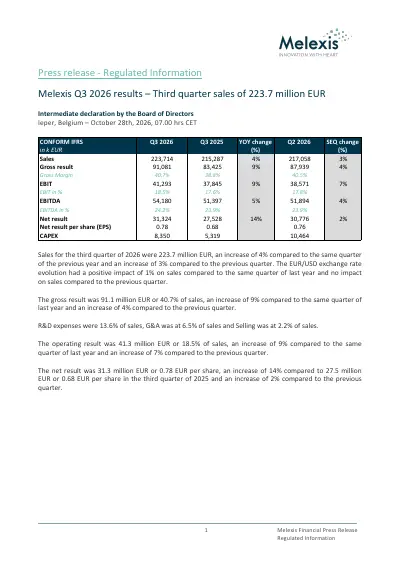
Thank you, Marc. Sales for the third quarter of 2026 were €223.7 million, an increase of 4% compared to the same quarter of the previous year and an increase of 3% compared to the previous quarter.
The euro-US dollar exchange rate evolution had a positive effect of around 1%. The gross result was €91.1 million, or 40.7% of sales, an increase of 9% compared to the same quarter of last year and an increase of 4% compared to the previous quarter.
R&D expenses were 13.6% of sales, G&A was 6.5% of sales, and selling was 2.2% of sales. The operating result was €41.3 million, or 18.5% of sales, an increase of 9% compared to the same quarter of last year and an increase of 7% compared to the previous quarter.
The net result was €31.3 million, or €0.78 per share, an increase of 14% compared to €27.5 million, or €0.68 per share, in the third quarter of 2025, and an increase of 2% compared to the previous quarter. Now looking ahead, Melexis confirms its second half 2026 outlook, which is for sales to be between €445 and €455 million, with a gross profit margin around 41% and an operating margin around 18%, all taking into account a euro-US dollar exchange rate of 1.12 for the remainder of the year.
For the full year 2026, Melexis expects capex to be around €40 million. This concludes our remarks.
We can now take your questions.
Philip Ludwig
Thank you, Marc and Karen. For the Q&A, we would request one question and one follow-up at a time.
If you have more questions, you can rejoin the queue. Gaia, could you please give the instructions for the Q&A?
Operator
Ladies and gentlemen, if you wish to ask a question, please dial pound key 5 on your telephone keypad to enter the queue. If you wish to withdraw your question, please dial pound key 6.
The first question is coming from Alexander Peterc from Bernstein. Your line is now open.
Please go ahead.
Alexander Peterc
Yes, good morning, and thank you for taking our question. My first question would be actually on your gross margin development.
Although you reiterate your guidance in full for the second half, I do notice that gross margins were slightly below consensus for the third quarter and the implied guide for the fourth is also something like 20 to 30 bps below the street. I just would like to understand if you see any input cost pressure on gross margin at all, or is everything exactly as you planned?
Maybe you can then also provide a comment on how we should think about pricing into next year, as you're one of the rare suppliers in automotive that hasn't raised prices so far in this cycle. Is this going to change next year?
Thank you.
Karen van Griensven
Gross margin overall, our main target was to increase gross margin of working on cost of yield, and there we have been successful as expected. Of course, there are small fluctuations from quarter to quarter, many parameters that impact our gross margin, but in general structurally, moving forward, we expect gradual further improvement in gross margin.
I wouldn't focus too much on temporary, yeah, changes from quarter to quarter. Structurally, we expect further improvement going in '27 on our gross margin.
Alexander Peterc
Thank you, and on pricing?
Marc Biron
On the pricing, I think it's too early to say. We are in the middle of the price negotiation and the forecast with the customer, and I think it's too early to make a strong statement.
Alexander Peterc
Thank you very much.
Operator
The next question is coming from Janardan Menon from Jefferies. Your line is now open.
Please go ahead.
Janardan Menon
Hi, good morning. Thanks for taking the question.
I was just going to your comments on the China market, where you said sales are strong and Q3 was a record and things are strengthening into Q4 as well. Just wondering, what exactly are the drivers of this strength in China?
Is it because the car sales numbers seem to be quite weak, is it that the content growth story in China is stronger than other parts because Chinese OEMs are moving faster on technology transitions, etc.? Or is it design win and share gains like you are talking about at BYD?
In that context, following the launch of the domestic localized produced current sensor that you've announced, does that kind of chip trigger additional demand because of either pricing or localization? I have a brief follow-up after that.
Thanks.
Marc Biron
There are multiple reason. I think the first one, as you mentioned in your question, I think the electronic content of the Chinese car is by default higher than on the European one.
We have win some business in China. I mentioned in the past that the design win in China were very strong.
I would say four years ago, we had more design win in Europe than in China, but since two years, we have more design win in China than in Europe, and this will be the result of this design win. We have also defined some action two years ago that were the China strategy.
I do believe this China strategy is now paying off. One of the actions you mentioned in your question was the local supply.
Now we have the first product which is fully localized in China, but since one year, we have already the assembly and the test which is localized in China. I think this is something which is recognized by our customer.
Part of the China strategy was also to create an autonomous commercial team in China that can take the decision by themselves, independent of the, let's say, of the headquarters. A last aspect, I would say, is our innovation.
There is a lot of electrification in China. There is a lot of thermal management, as an example.
There is also a lot of braking and steering application in China. Coming back to the high electronic content of the Chinese car, and I think this is all those reasons that explain why indeed we have a good success in China.
Janardan Menon
Understood. Then my follow-up is on the robotic side.
You said that you are seeing volume now. You talked about orders in your Q2 results, and now you're talking about converting into volume ramps.
Is this broad-based? Is it mainly coming from one customer in the US, or is it a number of customers across both China and the US, which is driving this conversion into volume?
Marc Biron
The big part of the ramp is indeed linked to a customer in the US, but we see also many smaller customer in China, which is growing. Then yes, the large effect is due to this customer, but there is a lot of smaller customer that are also ramping, mainly in China.
In term of product, for the time being, those are the product in the joint, and then the position sensor in the joint, and also the driver in the joint that are ramping up. The tactile sensor will ramp in a second step.
For the time being, the tactile sensor is still in the opportunity pipe, increase and maturing, let's say, and the production is really via the joint product.
Janardan Menon
Understood. Thank you.
Operator
The next question is coming from Amelia Banks from Bank of America. Your line is now open.
Please go ahead.
Amelia Banks
Hi, thank you for taking my question. Just the first question is on the second half guidance.
It's based on 1.12 EUR to USD. I just wondered if you could remind me of what it was that you were using before for the second half, and I'm just trying to figure out based on a constant-currency basis if there's been any changes in the underlying revenue outlook versus last quarter.
Thank you.
Karen van Griensven
We had 1.15 previously in the guidance. Now it's 1.12.
The overall impact is limited. It is like 1 in the range of 1% for Q4.
Amelia Banks
Thank you. Then just secondly, just how are we thinking about opex growth now going forward, particularly R&D?
Just should we expect sort of continued investment in these new growth areas going forward?
Marc Biron
We plan to keep the R&D as it is today. We will keep it under control without change.
There is no change planned on this aspect. We have to because the let's say, the product portfolio is shifting, and we need to add specific skills, for example, in mechatronics, for mechanical engineer, because we are developing some module, which is a new, let's say, discipline for Melexis.
We will shift some skills toward the future product, but we will keep the R&D cost stable.
Amelia Banks
Thank you very much.
Operator
The next question is coming from Guy Sips from KBC Securities. Your line is now open.
Please go ahead.
Guy Sips
Yes, two questions from my side. First is, your feeling, how much of your growth reflects market recovery versus content share gains because of your strategy?
Is it fair to say that, yeah, going into 2027 that Western OEM weaknesses could offset the stronger momentum you see in China? The second question is on, yeah, NXP's news this morning.
NXP remains cautious on automotive. What are you seeing differently at Melexis, and does NXP outlook make you more cautious on the pace of the 2027 recovery?
Thank you.
Marc Biron
Coming I think from your last question, let's say, on NXP. I would say the product portfolio is rather different versus NXP.
We are really on the sensor and the drivers, where we see still plenty of growth opportunities. The thermal management is more and more complex, more and more important for the car.
The steering and the braking are really part of the novel car and part of the novel platform. Same for the battery.
Then this is, let's say, our portfolio, and we do believe that this type of application will go also in 2027. The positive momentum that we see in '26 quarter after quarter, we believe that it will continue in 2027.
To answer your first question about what is the mix in the growth, but first, I would say we don't see at Melexis any effect of inventory. When we analyze the inventory of our distributors or the inventory of our main customer, it is stable.
There is, since six months, there is no increase, there is no decrease, and we don't see inventory effect. For the future, I personally do believe that we are winning some new business, and the growth is mainly fueled, let's say, by the new business that we are winning, mainly with our position sensor, with our drivers, and also with the lighting products.
Those are the three main growth area. Is that
Guy Sips
lighting interior lighting?
Marc Biron
Yes, interior lighting. If I link those products with the application, it's what I mentioned before, the thermal management, it's plenty of drivers, plenty of position sensor, and we have launched end of last year a very good driver product with the SOI technology from X-FAB, Corbeil.
This product has a lot of traction. In braking and steering, it's mainly our position sensor, inductive or magnetic, with a high level of safety level, what we call ASIL D, is a lot of traction for the braking system.
Then we have our lighting products, which have traction for the time being. Did I answer the two questions?
Operator
I guess, yeah, I guess he said this. Thank you.
The next question is coming from François Bouvignies from UBS. Your line is now open.
Please go ahead.
François Bouvignies
Thank you very much. I just wanted to come back on your comments on the inventories because I think it's a bit difficult to understand the dynamic in the market right now.
You mentioned that you have normalized inventories at your customers, so, if I quote, customers have normalized their inventories. That's what you said in the release.
Now, I thought the inventories were quite low, and if it's normalized now, it would have suggested that they refilled inventories in the last few quarters, which doesn't seem to be the case when we look at your automotive revenues. You didn't really outperform your seasonality significantly, and all the comments from your peers suggest that either inventories are very low or some are already increasing inventories as we speak.
I'm just trying to understand this comment. Do you mean that they increased inventories in the last few quarters and now the refill is done?
Or you just believe it's low, and your normalized comment means that it's flat? I just wanted to understand this dynamic here, if that's okay.
Marc Biron
I did not say, or at least I did not want to say, that the inventory were normalizer. What I wanted to say is that there is no change.
Since six months, we don't see any change in the inventory of our distributor or of our customer. It's really flat: no increase, no decrease since six months.
François Bouvignies
When you say in the release that customers have normalized their inventories, you mean flat? 'Normalized,' i.e., it increased?
Marc Biron
Flat, yes.
François Bouvignies
Okay. Just wanted to understand that.
There is a possibility of increase of inventories going forward?
Marc Biron
I would say it's the decision of our customer, let's say. It has been that the inventory has been higher in the past, indeed.
François Bouvignies
Okay. Thank you for the clarification.
The second question is on China. Just wanted to understand how you see your business.
You have local sales, right, and you have export sales.
Marc Biron
Do you have
François Bouvignies
different share between the two? Do you sell mostly on the exported cars, or are you agnostic, i.e., you sell to a car and you don't know if it's going to be sold locally or externally?
How do you sell your business in China?
Marc Biron
We don't know exactly in which car the products are landing, but what I know by experience, let's say, is the Chinese OEM give preference to the, let's say, non-Chinese IC supplier for their export car. This is quite clear in our discussion, but practically and in detail, we don't know exactly where our products are going to.
François Bouvignies
Thank you.
Operator
The next question is now coming from Ruben Devos from Kepler Cheuvreux. Your line is now open.
Please go ahead.
Ruben Devos
Good morning. Thank you.
I just had one on the BYD agreement. Just curious whether you could tell us a bit more about that agreement.
Does it come with volume or pricing commitments? What type of product families does it cover?
When should we see it in revenue? I'm also interested whether that has any type of changes for your pricing exposure to BYD now that you have a direct agreement like this.
Thank you.
Marc Biron
There is no LTA, and there is no volume or price commitment. It's a pure purchasing agreement.
It means that, let's say, we are part of their preferred supplier, if I can say like that. Then all the purchasing discussion are facilitated because they have been already cleared out in this agreement.
Thanks to this, yeah, we have, let's say, an easier access to the engineers, easier access to the innovation team in order to, yeah, to launch or to design in new products in the car.
Ruben Devos
Okay. Are you seeing other Chinese OEMs also willing to move to these direct agreements with chip suppliers?
Marc Biron
No, this agreement is indeed valid for BYD. There is no other agreement with other Chinese supplier.
Ruben Devos
Okay.
Marc Biron
Chinese OEM. You ask also what kind of family of products, but that cover the full Melexis products.
Indeed, we see since we have made this agreement that we have, let's say, more access with the engineer, we have more discussions with the engineer in order to build more business at the end.
Ruben Devos
Okay. Then maybe just on your own inventory.
I think that one came down to €260 million roughly. Earlier in the year, I think you talked about holding it stable or even higher.
Is that lower level deliberate, or is demand pulling it down faster than planned And maybe what do you see by year-end in terms of your own inventory management?
Karen van Griensven
Yeah. Structurally, we want to rather further increase our inventory to support growth.
Over the last quarters, yeah, the volume didn't come down so much, but it's more the value that has come down. This effect is now fading out, volume increases will become more visible moving forward it's still the intention to rather increase the inventory than deplete to be ready for further growth moving on.
Ruben Devos
All right. That's it for me.
Thank you.
Operator
The next question is coming from Marc Hesselink from ING. Your line is now open.
Please go ahead.
Marc Hesselink
Yes, thank you. First question is actually on the sequential improvement for the fourth quarter.
I think throughout the rest of the year you've talked quite positively on the sequential improvements, also talking about a little bit of order pull-ins during the quarters. If I take the midpoint of the guidance, that actually is a very small sequential improvement going into the fourth quarter.
Just want to know if that's just seasonality or that you indeed see maybe a little bit less of this pull-in effect or anything linked to that?
Marc Biron
There is no real change in our view. There are still, indeed, a bit of pull-in within the quarter as it was in the past.
Why we have confirmed our guidance, because we do believe that this is the right guidance, let's say. What is perhaps important to mention that we don't see push-out toward the end of the year.
Marc Hesselink
That's clear. Thanks.
Second question is actually a follow-up on that inventory question just before. You mentioned that the value came down.
Can you explain what it is? Is that the mix of the product, or is that, yeah, given what's happening that you had to lower the value of that inventory a bit?
Karen van Griensven
It's, in the first place, price decreases at suppliers, but also, yeah, there can also be some mix effect, but mainly price decreases.
Marc Hesselink
Should that then have a positive effect on the gross margin going forward, or is that not the right way to look at it?
Karen van Griensven
This is one of the reasons to be confident in further improvement moving on.
Marc Hesselink
Yeah.
Karen van Griensven
We need to add that for some suppliers, and particularly assembly, there's also inflation. We have mixed impact indeed.
Marc Hesselink
Clear. Thank you.
Karen van Griensven
Overall, it is positive.
Operator
The next question is coming from Michael Roeg from Degroof Petercam. Your line is now open.
Please go ahead.
Michael Roeg
Good morning. I have a question about pricing, and I also have a question about trade.
First, pricing: you mentioned you're still in negotiations for the prices for 2027. If I'm not mistaken, you typically negotiate prices which are then set for the entire year without in-between.
Is that also the case in your negotiations with your wafer suppliers, one price for the entire year irrespective of changes in materials? That's my first question.
Marc Biron
The goal, or the principle, is to define, indeed, the price for the year depending on the volume. Usually, we have a matrix, price versus volume.
This is the way it is done.
Michael Roeg
Okay. Then about your price negotiations with your customers: one price for the entire year.
Some of your competitors have raised prices several times in 2026. You haven't done that, I was wondering, is that something that drives some customers more towards you because suddenly you become more affordable versus the competition, or have your competitors only raised prices for other types of chips and sensors?
Marc Biron
From my experience, our competitor has increased their price indeed for different kind of products for sure, the AI type of product, or the memories. This is not part of our product portfolio.
Then I don't see that our competitor have increased their price in our type of portfolio, and for sure not on the big customer. It's not impossible that for their small customer they have increased the price, but for the big customer that we have in common with our competitor, I don't have the information that the price has been increased for our type of product.
Michael Roeg
Generally if you and your competitors would like to raise prices, then there would have to be very high utilization and shortages. Is there any kind of indication on what the utilization rates are for sensors at the foundries?
Marc Biron
I can speak for Melexis. We have, for the time being, on the wafer, there is no capacity discussion.
We have enough capacity of what we need at our foundries. We have diversified our foundry offer, and we have also co-financed the capacity increase of X-FAB.
For those reasons, we don't see capacity bottleneck in the foundry. On the assembly house, it's clear that it's a bit more tense, but together with our inventory, together with the relationship we have with the assembly, there is no drama.
Michael Roeg
Good. That's clear.
Then the final question is about tax rate, just a small question. I noticed in the past five quarters the tax rate has been higher than the usual 17%.
I was wondering if the tax rate is going up because of the change in the sales mix more towards China or whether perhaps there have been changes in tax incentives? Has something changed, or is it just coincidence?
Karen van Griensven
No, there can be quarterly deviations, but overall we expect our tax rate also in 2026 to be in the 17%-18% range. No major deviations to be expected from other years.
Quarter-on-quarter, indeed, there can be deviations.
Michael Roeg
That's also why I took the past five quarters to look at over a slightly longer period. Then I noticed a slightly upward trend of about 150 bps.
That's nothing that will continue or worsen?
Karen van Griensven
No, there is no reason why structurally we would see it really higher than in the past.
Michael Roeg
Good. That's it from my side.
Marc Biron
Thank you.
Operator
The next question is coming from Robert Sanders from Deutsche Bank. Your line is now open.
Please go ahead.
Robert Sanders
Good morning. Maybe a question for Karen just firstly on the gross margin.
In the past, you had a few headwinds from the X-FAB LTA, partly yield, partly because you maybe didn't buy enough wafers, you had the inventory revaluation, you had gold price, you had tester utilization challenges. As we look into next year, how many of those headwinds sort of go away, and how many things do you think will maintain into '27?
Thanks.
Karen van Griensven
Some headwinds like cost of yield indeed has improved a lot. There is still further improvement possible, but a big part of the improvements is behind us.
You mentioned the supplier cost roadmap. It's will, for sure, help with the gross margin next year.
We also have been working on the footprint, and the effect of that will also be felt next year. There are other headwinds like the gold, for example, something, yeah, that's very unpredictable.
If gold goes up further, yeah, then it will have a negative effect on our gross margin. We are taking some actions where we can to go from gold to copper to eliminate, but it's for sure not across the board that we can do that.
That is an effect that is still a headwind today.
Robert Sanders
Got it.
Karen van Griensven
That also had a negative effect in Q3.
Robert Sanders
Got it. Maybe just a question on the growth into next year.
I know you're not going to give a guidance, but at your CMD you talked about high single-digit growth as being your goal. Given that you appear to be ordering quite aggressively from X-FAB and you're not raising prices, should you at least look to outgrow the market next year after you had lost some share in the past?
Can you at least say whether you think you'll outgrow your addressable market? Thanks.
Marc Biron
As I mentioned, it's too early to give some accurate figures. For sure I confirm what we say on the CMD, the long-term target is to grow high single digit, but we will not give any accurate answer for next year.
Robert Sanders
All right, thank you.
Operator
We have a follow-up question coming from Alexander Peterc from Bernstein. Your line is now open.
Please go ahead.
Alexander Peterc
Yes, thank you for the opportunity to ask a follow-up. It was just regarding BYD.
Do you have any design wins already there that will generate traction quite soon, as early from the fourth quarter on, or is this a bit more longer-term? When should we start to see a difference here?
Marc Biron
No, we have even more First, we had historical business with BYD, which is more current sensor, but we have new business that will start in 2027 linked to magnetic position sensor, inductive position sensor, and latch and switch for a specific application. We are, let's say, in some case we are after the design we are in ramping the production.
Alexander Peterc
Excellent. Thank you very much.
Can I just ask a very small follow-up on the snubber product? Do you have any traction there?
I think that was a new product for you. Thank you.
Marc Biron
If we consider, let's say, the maturity of the funnel of the snubber, we have still very good traction with customer in China, very good traction with customer in Europe. We have traction in automotive for the battery.
We have also a good discussion on the server, on the AI server. We plan to launch the product soon.
I think the first production will start, I would say, in summer '27. We are now, Melexis and our customer, are in the verification phase of the product.
We continue to increase the maturity of the opportunity.
Alexander Peterc
That's very helpful. Thank you.
Operator
There are no further questions at this time, I hand the conference back to Marc Biron for any closing remarks.
Marc Biron
Thank you, operator. To summarize, Q3 demonstrates that our strategic choices are delivering tangible results.
We achieve in-line financial performance with sales and margin growth. We have reached a record sales in China, we experiment strong growth in India, and we enjoy the start of active customer volume ramps in robotics.
By combining a high rate of product release with continued cost discipline, we are taking the right steps to execute against our long-term target. We look forward to updating you on our full-year result on February the 3rd in 2027.
Thanks, you all, for joining us today, and goodbye.
Operator
Thank you for joining today's call. You may now disconnect.