Wizz Air Holdings Plc
Q2 FY2027 · Earnings Call TranscriptNovember 12, 2026
Operator
Good morning and welcome to the Wizz Air results for the first half of the fiscal year 2027. In a moment, we'll start with the presentation from the management team before turning over to Q&A.
With that, I'll hand over to József Váradi, CEO.
József Váradi
Good morning, everyone. Thank you for coming to this presentation.
I guess I shall start by saying that, well, we made more profit in Q2 than anyone else relative to year-before performance, and this is across the whole profit metrics. Effectively, when you look at H1 of the financial year, it is a tale of two quarters: a poor, highly affected Q1 and a strong, recovered, good performance Q2.
Q1, we discussed three months ago, it was hit hard by the fuel spike, by geopolitical events, capacity we had to remove, and revenue came under pressure. Nice recovery by Q2, to an extent that revenue performance much improved, probably beyond any expectations, costs were kept under control, and we were able to absorb the fuel spike quite well through the fuel hedges.
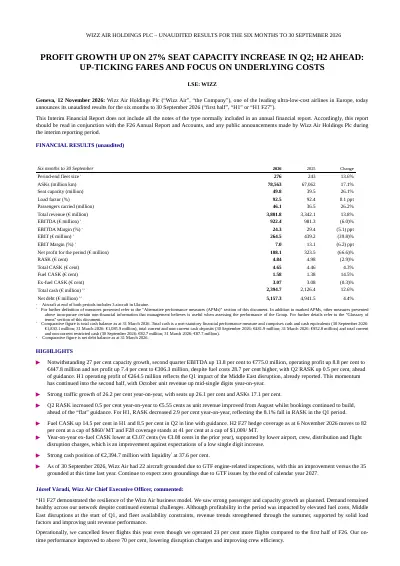
When you dig into the details, as said, profit is up on EBITDA, EBIT, or net profit, respectively. If you look at the RASK revenue trend, that's probably the most impressive catch-up, and this is all achieved by delivering 27% more seats to the market.
High growth, but still improvement, somewhat helped by the stage length deduction, but at the same time, stage length deduction hit the cost line. If you look at the CASK side of the business, it was kept under control very well, and on a H1 basis, effectively, we improved ex-fuel unit cost performance.
Liquidity remains strong: €2.4 billion of cash at the end of the period, translating into 37% liquidity ratio. This is one of the highest in the industry globally, and as you can see, hedges continue to play a significant role in the business planning process, not only through the winter period where we are 82% hedged, but also going into the next financial year, which is significant because depending on what expectation you have on the fuel price environment, we're seeing that there is a higher chance of that environment remaining elevated, and we would be well-positioned against that set of assumptions.
We've already got 51% of our capacity hedged throughout the entire summer period, 41% throughout the financial year. We kept rolling the hedges forward with that regard, likely giving us a significant competitive position versus the rest of the industry.
Again, good Q2 performance, with some of the strengths flowing into the second half of the financial year, but we're going to be talking about it somewhat later. I would like to move to the next slide.
I think this slide is important and probably increasingly important in the current fuel price environment because the structure of the fleet, the very act of airlines fly, actually make a significant difference not only to the operating metrics, but also to the financial metrics airlines are capable of delivering. Nearly 80% of the Wizz fleet has transitioned from CEO to NEO aircraft.
The one notable difference between the two aircraft types is the fuel burn advantage of the NEO aircraft, up around 20%. If you look at the fleet age, Wizz Air makes 4.5 years on average versus the industry, and we just picked the European-registered AOCs' fleets, up around 14 14 years.
This is fuel burn on the one hand, but it is also maintenance cost, durability, reliability, rosterability, on the other hand. We believe Wizz fleet is a source of a very significant competitive advantage for the company.
We also think that the GTF is catching up better than the LEAP in the market. Both engines suffer from immaturity, and both have been causing significant reliability issues and supply chain constraints, but we are seeing a stronger recovery on the GTF than on the LEAP, but you can talk to other people, experts in the industry, to verify that statement.
We are seeing fuel consumption improvements continuing, another 0.5% what we were tracking, and we believe that when you kind of add up all these factors that are putting us significantly forward versus the rest of the industry. We did a bit of a comparison on the fleet out there registered in Central Eastern Europe, but you can see that of the 700 narrowbody aircraft registered under Central Eastern European AOCs, 20% of that fleet falls into the category of 20 years plus.
In the current environment, that's a terrible fleet on fuel burn, maintenance, and everything. If you look at how the industry is affected by cost structurally, there are two lines that have been spiking considerably.
One is fuel, you are all aware, given the geopolitical events, and the other one is maintenance. Maintenance costs have been through the roof for the industry over the past few years, the operators of that kind of aircraft are under severe pressure, and those operators tend to be the ones of lacking operational scale, certainly market scale, to impose pass-through on ticket fares, and they tend to be the ones weakest on liquidity.
We think that those airlines, those operators, that segment of the market are subject to fail in the current environment. If you look at the carbon footprint, the chart below, it is showing our performance versus the rest of the industry, and this is comparing our performance versus the European mainstream industry, and you can see that we have a significant advantage here versus any other airlines in terms of carbon footprint, and again, given the elevated fuel price environment, it's a significant competitive advantage.
All in, we believe that it's worth investing into upgrading the fleet, renewing the fleet, completing the transition, and you see that there is a short-term cost element of that when we are coming to the guidance on the second half of the financial year. Once you make that investment, that translates into a very significant structural competitive advantage for the airline.
With that, I would hand over to Ian.
Ian
Thank you, József. Good morning.
In terms of the revenue and the commercial side of the business, as József said, there's a tale of two quarters. Q2—
Veronika
Can you move to the next page, please?
Ian
Q2 is the quarter where unit revenue turned. If you look at Q1, we grew capacity 14%, 15%, and RASK declined year on year 8.1%.
In Q2, we grew capacity 33% more, 19%, and unit revenue started increasing. That's against a guidance of down or flat single-digit a flat RASK decline, or flat RASK performance.
We outperformed in terms of that, and we're really pleased about it. Now, what did the swing drive?
If you look in the middle, you can see that our revenue was €2.29 billion, up 20%. That's up with passengers up 27%, load factor up, and seats up 27%.
The fares per seat-kilometer held. Stronger close-in bookings in August and in September drove a neutral July performance.
We started to see the turn really happened through the end of the summer, and that performance is continuing in terms of what we saw in October. Now, I'm going to preempt the questions that I'm sure people will talk about, which is you said at the capital markets day that you're going to be measuring yourself at a stage-length-adjusted basis for RASK, and you're right.
In terms of stage-length-adjusted, our RASK declined 2.5% year on year. That's anticipated and planned, and that's driven predominantly by the stage length that's happening, in terms of the shortening of our network, the condensing of our network.
It's mainly a stage length problem, I wouldn't say it's a pricing problem, and we're putting in place measures there. Don't forget this is on top of 20% growth.
The message here is about discipline, and you'll see that in the agility slide next. In terms of the message on this slide, the model is working as designed.
Veronika
Still one slide back, please.
Ian
We're still... Thank you.
The model is working as designed: shorter sectors, full aircraft, and unit revenue is back in positive territory while we grow. On top of that, profitability came through.
Now we can go to the next slide, or stay at that slide.
Veronika
Okay.
Ian
Our markets are consolidating. Six competitors pulled back across our core markets this year, and in each case, Wizz was either already there or we moved quickly, and mostly on airports that we already serve.
We have the two hardest-hit locations, which is the Baltics and Romania. In the Baltics, we're already pressuring that territory.
We had been flying Vilnius-Prague, Vilnius we have a base, we added Vilnius-Berlin. When these opportunities present themselves, Wizz is already there or able to increase our presence.
Romania, we had two unfortunate chapter 11 or restructuring situations, and there we're adding a new base in December, already announced, in Brașov. We have a special announcement that's going to be happening in Romania later today that we look forward to sharing with you when that's made.
Keep your eyes tuned to what's happening in Romania with regards to Wizz. You have Southern Europe, and you have Moldova.
In Italy, we saw Volotea pull out of Naples, and we immediately backfilled with a fourth aircraft deployed to that base, an existing base for Wizz, where we have presence, where we have crew, where we have recognition, and we have scale, and we can build that scale. In Moldova, we saw going into the summer a severe retraction in terms of seat capacity, and as a result, we now have 3 million annual seats in Moldova, six aircraft equivalent, we're the market leader by far.
Then even Ryanair, lots of reductions and reallocations, and Wizz is there to fill the gaps. These are not opportunistic or opportunisms on new airports.
Most of our new routes link airports that we already serve, and this is the benefit of having the available fleet to our disposal, and now an increasingly denser network allows us to move into the gaps with low risk. As a result, one might argue that we're also cutting capacity, but we're not, in terms of this winter.
We're reshaping capacity, and we're deploying that discipline in a very measured way to make sure that we're able to benefit from the yield improvements that we're seeing happening, as well as the efficiency through our network. With that, I'll hand over to the financial side, for Veronika.
Thank you.
Veronika
Thank you. Thank you, Ian.
Thank you, Joe. Good morning, everybody.
As we have heard from Joe and from Ian, Q2 was a strong quarter in terms of the financial performance. We delivered the RASK ex-fuel CASK numbers ahead of our guidance.
RASK improved by 0.5%, ex-fuel CASK in first half went down 0.3% on the guidance of single digits up. On the revenue side, revenues increased by 20%, and on the profitability profile level, all EBITDA, EBIT, and net profit after tax were all higher than the last year.
This is despite the increased fuel prices which we have seen on the market. Now the key component of our longest strategy is to establish and to keep the cost leadership across the industry.
This is one of the goals which we have communicated over the capital markets day, and this is what we are diligently focusing on. We set our longer-term target to get to the €0.03 ex-fuel CASK in F '30, and we are pleased that we are making gradual progress towards that goal.
What I would like to do in my input is to take you through the main cost trends which we have seen compared to the first half of the last year and the second quarter of the last year, and also spend some time on providing more details on our cost structure, because it's important to distinguish between the components of the and the breakdown of the underlying or operational costs, and then transition costs which are, as Joe mentioned, investments into the into the future and into the more efficient, even more efficient cost structure. On that slide in that context, we are pleased to see the ex-fuel cost decrease by 0.3% in H1, even with a shorter stage length by 7%, and in Q2, the ex-fuel CASK went up slightly 1.1% with again with the stage length decreasing by 5.9%.
On the breakdown, we are happy to see the decrease of the staff costs, and on the airport handling and en-route, which shows the efficiency of the staff, and also mix of the airports and the notable improvement of the airport cost structure due to the network mix and the airport deals. Now what we have here is that we laid out the cost structure, as I mentioned, and broke it down into two parts: the operational or underlying costs, which are the core costs and the BAU for the business, business as usual; and then a couple of items which are transitional or temporary in the nature, and they will be normalizing over the course of the next years, mainly already in the next financial year.
On the operational costs and the operational ex-fuel CASK, what you can see that these are the core operating costs. This is staff, maintenance, airport and handling, and the core depreciation.
This is the depreciation without the depreciation which is related to the renewal of the fleet, to the CEO redeliveries, okay? Then what we have there are other costs also, disruption, overheads, and the net interest costs.
The second group, these are the transitional costs, and these are related to the items which are more temporary. One slide back, please.
They have uneven impact on our costs, and they will normalize over the time, majority of them already in the next year. These are, as we mentioned, we have a heightened impact of the depreciation related to the redelivery of the CEO fleet, and we have also a lower impact on the sell and leasebacks, which we have seen decreasing, yeah?
Now, one important element which I wanted to make on this slide is that when you look at the comparison of the ex-fuel cost, the ex-fuel CASK goes down by 0.3%, as reported, right? If you take a look only at the operational, the underlying ex-fuel CASK, it goes down by 4%, actually.
It further underlines the message of the decreasing operational costs that we have here, and that's for both if we compare the half of the year and the Q2. Now, if we can go to the next slide, please.
This is a more graphical view, actually, of the cost structure, and also what we wanted to provide here is the more details on the elements which are transitional in the second half of this year and how they are normalizing into the next year. In the first two columns, you see the historical comparison.
This is the H1 '26 to H1 '27. You see that, when we take away the fuel part of the cost, we see the decrease of the ex-fuel costs, and then, again, if we take out the CEO-related depreciation and the impact of the other income, then we are looking at the operational cost decrease by about 4%.
Now, for the H2, what is important is that we have a temporary headwind of the transition costs, which will increase compared to the same period of the last year, and then they're getting more to a more normalized level starting first half of the fiscal year F '28, right? These are mainly the two elements.
First is that the CEO redelivery-related depreciation is expected to be €110 million up in the second half on a year-on-year basis. In the full year, it's about €170 million.
Then going into the F20 F '28, then the absolute amount decreases. This is really the transitional element of redelivering the older fleet.
The second is the other income. The SLB income and compensation will be on the year-on-year basis is down by €170 million, and this is driven by the delivery profile of the aircraft and the engines.
This is corresponding with the SLB transactions. We had 18 of the spare engines SLBs in the second half of the F '26.
This is expected to go down to 10 in the second half of this year. We had 18 SLBs related to the new aircraft in the second half of last year, and that's expected to go down for the second half of this year.
Again, normalizing more to the even year-on-year level, going into the first half of the F '28. Really the message here is that the cost structure, as you can see, that these transitional costs are normalizing year on year in the first half of the F '28, while the ex-fuel reported unit costs, they are broadly flat for this year or again decreasing when we go into the next year.
Next slide, please. Just a couple of points on the cash flow.
As it was mentioned, we finished the quarter with a strong cash position of total cash of €2.39 billion of euro, which is up from the last year, free cash flow of €200 and €230 30 million, and you can see that our 12-month liquidity ratio is 37.6%, which is one of the strongest in the industry. In summary, we continue focusing on the ex-fuel costs and on all of our cost structure while maintaining a high liquidity, which is providing us for running the business and being opportunistic within new areas, and really following the goals and working towards the goals and the forecast which we outlined for the longer term at the capital markets day.
That would be from my side, and I turn back to you.
Ian
Can I just make one one more point on this slide?
Veronika
Yes, please.
Ian
I think, going into winter, liquidity, net debt, very important topics. If you look at our ASK growth, our capacity growth, 19% for the first half year on year, but our net debt has only gone up about 4%.
How is that possible if every time we take a delivery and we need airplanes, we take on debt? It's because we're actually getting more efficient out of the fleet.
We're actually unparking more aircraft. We're actually being more productive with our aircraft.
We're actually generating that growth out of stuff that we're already paying for, out of aircraft we're already paying for. I think that's a really important point here as you see what's going to be happening.
As we get through next year, and our unparking continues and our parked aircraft fleet comes down to zero, that's all going to be funded with investments that we've already made. That's going to be driving even more when it comes down to the leverage ratio, when it comes to the profitability, and it comes to the cash flow.
We don't have to actually incur more debt and pay more rent in order to fly more.
József Váradi
Thank you, Ian. That's a really good point.
Could we please move to the next slide? Yeah.
Capacity, I think that's really important because you shall understand that we are bringing very cheap capacity to the market, already paid for, capitalized, and we are creating capacity not through fleet growth with additional asset acquisition and capital cost employed, but through productivity of redeploying existing assets. This is resulting predominantly from the GTF ungroundings.
Q3 is up ASK terms 12%, seat terms 19%. I think Q4 is going to be somewhat similar to that number if you want to model it.
The most important issue here is that it is not inflating fleet. It is capacity gained from productivity by ungrounding the GTF aircraft.
Load factor, it's important that we are not running the business for load factor. We are running the business for maximizing unit revenue.
Revenue is a function of load factor and yield. We believe that there are good trade-offs for the benefit of revenue maximization when you are pushing for yield more than for load factor, especially in an environment where we are into right now that you have significant costs associated with fuel, maintenance, etc.
It is a better way of running this business. We used to be talking about concept of being load factor active and yield passive, but that concept is actually never true because you effectively have to manage revenue as a whole, and yield is an important component of that and especially important within the current environment we are into.
You can see that our RASK performance continues to improve, but not necessarily driven by load factor. It is more driven by yield, certainly the combination of the two.
With that regard, RASK, we are expecting it to move up low single digit. I think that's good given the level of growth we are delivering to the market.
Again, this is against the backdrop of 19% capacity growth. With regard to cost, this is for the entire financial year, fiscal '27, we are expecting ex-fuel CASK up mid single digit, driven by the transition of costs, but keeping underlying operational cost flat, at least.
Again, when we are talking about stage length, Ian elaborated on that, stage length kind of hurts revenue, but penalizes cost, when you adjust. We've seen that this is a very significant effort what the company's making to make sure that costs are under control.
Actually, on a stage-length-adjusted basis, unit cost ex-fuel is declining if you net out the transition of costs. Hopefully you got good explanation on the transition of costs, why they are occurring and how they are getting phased out in the fairly short space of time.
All in, we're saying that we are up against a much improved performance metrics coming through the Q2 performance. Most of the strengths we experienced there continue to unfold in the second half of the financial year.
This second half is going to be a tricky period for us with regard to overall performance, given the peaking transitional costs negatively affecting the performance of the company. Rest assured that we are investing relentless efforts into controlling the controllable costs, the structural costs, the underlying costs, and doing everything to maximize revenue performance going through this period.
We think that H1 fiscal '28 is going to see a lot more normalized environment in terms of revenue maturity and also some of these one-off or transitional cost issues we are exposed to throughout the current period, but will ease going into the next financial year. With that, I would hand it over to Q&A.
Harry Gowers
Morning, it's Harry Gowers from J.P. Morgan.
First question just on those load factors. Maybe any thoughts as to why exactly they've been trending down, or a bit weaker for November and December especially?
To your point on maximizing RASK, does that matter? Will you just continue to push price even if load factors are down a couple of percent over the next few months, because I'm thinking about what that might mean obviously for airport costs potentially as well?
Then secondly, again kind of on pricing, but higher level, do you think the whole industry can achieve the kind of price increases on tickets that is required to offset fuel costs in 2027? Is the demand there if we see price increases in unison across the industry, and maybe do you expect that to be achieved or not?
Thanks.
József Váradi
I can pick it up. If you look at load factor versus yield, in an elevated cost environment, actually delivering higher yield at the expense of load factor is a good thing because you pay airports for load factor, and you pay fuel burn for load factor because it's an increased weight on the aircraft.
Given the elevated level of the latter, actually it's a good trade to concede load factor for the benefit of yield. The point is that we look at revenue maximization, we want to optimize the performance of load factor against that objective as opposed to for its own sake.
We think it's a good trade, especially given the environment we are into. With regard to pricing for '27 and how that affects demand, it is the whole equation of supply, demand, and pricing, how that equation comes out.
The industry is constraining supply of capacity. I don't know if you guys tracked it, I'm sure you did, back a few months ago, the industry winter capacity was projected to be up 3%.
Now it's zeroed, and quite likely by the end of winter, this is going to be contracted. Once you start supplying less seats to the market, you can elevate your pricing against demand.
I think this is what's happening. The pass-through is not a matter of having a vodka in the bar and then, let's increase the price.
It is very capacity-related. You take capacity out, you change the equilibrium between supply and demand, and you increase fares.
We are seeing that happening. The various airlines clearly position differently in that exercise.
Hedging is important. We think hedging remains important because that gives you an easing or a hardship, whether you are hedged or not, kind of managing this pass-through.
For everyone, the fuel cost is a significant increase, but dependent on your hedging, the magnitude is different. If you are unhedged, you're going to have a bigger issue to deal with versus if you are hedged if the environment remains the same as what we are observing today.
You will see, I think, different behaviors dependent on the airline you are talking about. All in, this is a good news for us because our competitors, as they fall more under pressure to increase fares, that gives us more room either to ease the pain on the customer or take more profit on the situation.
Our objective is to optimize and maximize profitability. If we have a market opportunity to increase fares, of course we will be increasing fares.
If we have a market opportunity of backfilling some of the vacuums, staying agile, what other airlines are leaving behind, we would be also eager to consider that opportunity. It is a bit of both.
You are trying to take profit on market moves, but at the same time, you may want to invest into market opportunities as they arise.
Ian
I would also just add, it's a lot more nuanced than just one dogma, one sort of philosophy. It depends on things like seasonality, where you are in the year.
In summer, you may want to pursue a different approach, but the ultimate objective is to maximize RASK. We're RASK-active at the end of the day.
How you get there depends on a number of factors: competition, where you are in terms of your market share. We have extremely high market share in certain places, and then other places we're competing vigorously with competitors.
We're really looking at how we deploy the two levers to maximize RASK, and in each case, it depends on the circumstances. The more that we are able to stabilize, and the more we're able to mature the network, which is something that we're focusing on, we talked about that being a tailwind into next year in terms of what we think that will do for our performance, because evidently, if you look at our competitor, they have a very stable network, and they're not delivering the kind of results that we are currently.
Just imagine when our network stabilizes, what that's going to do for the overall picture. It's really nuanced about that, and as we continue to drill into the business and understand it and understand those nuances, the better we'll be able to play with those levers to maximize RASK.
RASK-active is the message you want to take away.
Jamie Rowbotham
Morning, Jamie Rowbotham from Deutsche Bank. Two from me, please.
Obviously, slide five, lots of interesting developments with competitor capacity. I suspect some more helpful than others.
When you talk about filling in gaps left by Ryanair in places like Berlin and Vienna, I just wondered if they are leaving gaps because they feel the economics don't work, what's the logic in Wizz stepping in? Why do you feel that you can make a better fist of it than say Ryanair in those particular places?
Then secondly, with reference to slide seven, thanks, Veronika, for splitting out the costs the way you have done, which I think is really helpful. We can probably back it out, but maybe you can give us a bit of help.
The operational ex-fuel CASK that was down 4% in H1, is down 4% a sensible run rate for H2? Is there a bit of phasing?
Is it going to be different Q3, Q4, or is it going to track steadily through to the end of the year? Any help you can give us on that would be much appreciated.
Ian
I think the answer to the first question is pretty short. If you want to pick Berlin as an example, we're not setting up a new base there.
They had a base there. For whatever reasons, and I'm sure there's multiple reasons, that didn't work out for them.
What we're doing is picking off those particular markets that make sense for the business that we're building. That's the answer.
We're not going all in just to fill in the gap and replicate what maybe didn't work there. We're building the network that works for us, using the combination of origin and destination in a way that works.
Don't forget, our gauge is larger, right? We have a different equation to bring to the table.
There's different incentives for different types of capacity that we can put in place. That's something that we continue to prune and continue to evolve, but it's not a cookie-cutter copy and paste.
We're just going to mirror what didn't work for somebody else. That would be foolish at the end of the day.
Veronika
Jamie, on the cost, you can see a reference also on the slide eight where we make a reference to the H2 labor and airport unit cost. They are expected to fall in the similar levels to those ones which we have seen in H1.
The maintenance cost, we have seen the increase in the H1, but this is expected to slow down in the second half. Then, again, going into the first half of the F '28, we expect the further decrease of the operational cost because the network densifies, and then it brings us the ability to bring further operational savings.
Dudley Shanley
Morning, it's Dudley Shanley from Goodbody in Dublin. Just a quick question on airport deals.
If you think of Wizz as one of the few European airlines with significant capacity growth over the next few years, are you able to use that to your advantage and carve out better deals with airports?
József Váradi
I think you should inherently assume it. Otherwise, we would be stupid not to.
If we are the only game in town delivering growth, of course you want to leverage that with the airports, and we are doing it. We are doing it.
Andrew
Hi, it's Andrew from Barclays. Can I just come back to what the outlook is for capacity as we go into the next financial year?
Are we still looking at 10 to 12, or does the deceleration that you've given us this winter, which I think most of the financial community celebrates, but is that going to lead to a higher capacity growth in the next year or not? Then there's not a lot of chat, I think, in the presentation about ancillaries.
Obviously your beloved competitor argues that high load factor is good so they can harvest the ancillaries from the full aircraft. Clearly I appreciate your argument on the marginal cost, but yeah, what happens with ancils?
You guys have been very innovative with stuff like holidays and your business class, and Starlink to come, but yeah, we don't quite know when or how that gets monetized. How do those things work, and what can we expect out of ancils?
Thanks.
József Váradi
Maybe I will start with capacity. I think we said it a good year ago that H1, if you just look at it on an H1 basis, H1 fiscal '27 is kind of a lost period with excessive capacity growth for the business.
That was the result of the previous delivery schedule of Airbus. While we were renegotiating the delivery schedule, on a very short term, we were unable to affect it because of industrial lead times.
H1 fiscal '28 falls out of that industrial lead time. That period will benefit from the reduced deliveries of new aircraft.
Secondly, we were kind of feeding the Pratt & Whitney ungrounding model into the capacity recovery. So '28, H1 '28 is going to be the first period with kind of normalized reduced capacity level.
You should be expecting what we said kind of somewhere between 10% to 15% capacity, dependent whether you look at it on an ASK basis or a seat basis. We are now on the new track when it comes to H1, and it will continue from there on.
Ian
Look, on ancillaries, we've already identified that they have been under pressure for us, and we're still wildly ahead of our competition when it comes to ancillaries. Because of the combination of stage length and the changes to that in the network, as well as the mix of our network, we're having to redefine what our ancillary offering is, and that's one of the core, fundamental elements of our RF30 plan.
That's something that's under progress, and that's all I'll have to say about it right now.
Operator
We will now begin the virtual Q&A session. If you wish to ask a question, please use the raise hand function at the bottom of your Zoom screen, or use the ask a question button on the SparkLive page.
We ask that you please limit your questions to a maximum of two. Our first question comes from Jarrod Castle with UBS.
Please unmute your line and ask your question. Jarrod Castle, your line is now unmuted.
Please unmute and ask your question.
Jarrod Castle
Great. Morning, everyone.
Sorry about that. I was just wondering if you've given some comments on RASK in 3Q.
Can you just give a bit of color how you're seeing 4Q? I know it's probably not much booked.
Certainly probably less than 20% booked. Anything you can give on that.
You've obviously got Easter falling in, any thinking on that. Then maybe one for you, József.
I know there's been some comments, but there are always, inverted commas, hoaxes going on about potential terrorist attacks, etc. I wanted to get your view on what, if anything, can be done, what happens if a flight's delayed, does that fall into EU 261, is it causing a lot of disruption, I guess, and additional costs for you in terms of your operations?
I'll limit it to those two. Thanks very much.
József Váradi
Maybe I start with the second one. Security, as you can imagine, is a huge topic inside the company and maybe beyond that as well.
You see that this hoaxes of bomb threats spread across the industry over the last few weeks, all fake alarms. You can argue this is a manifestation of hybrid warfare, and now it is not just limited to the airline industry, but you are seeing it spreading into the school system in the UK and in other countries in Europe.
You don't know how far this is going to go. Security is one of our utmost priorities.
Safety and security we would never concede on. We take everything very seriously, take for real.
Of course we try to manage the best we can to avoid as much as possible any detrimental impacts on operations, to limit disruptions to passengers. We were involved into 14 incidents over the past few weeks, of which only on two occasions we had to divert flights.
The rest of the issues were managed within the normal operating parameters. Of course, when you get an alarm like that, the aircraft becomes subject to inspection, searches, etc., and we are doing it.
I wouldn't say that the level of disruption arising from events like this went beyond the scope of a medical diversion or weather-related disruption. Yes, it was a hiccup, but I wouldn't classify this wave of events as a major disruption to the business with very significant detrimental impacts on the customers.
I think we have been absorbing these issues pretty well, learning very quickly how to become more efficient in handling it. You also have to take note of the fact that when it comes to security issues, this becomes subject to nation states' sovereign kind of considerations.
There is no such thing as European security. That's only a media term, but in reality, every country is a sovereign state with security falling into the jurisdiction.
In certain occasions, you saw jets scrambled to follow and accompany the flight. In certain places, airliners were ordered to divert to a military base, etc.
Different countries took very different types of actions on that, and I think that kind of begs the need at European level to get more harmonized, to have a European approach to security, which we don't have at the moment. There is no body, there is no organization in Europe in charge of security issues like this.
There is no efficient coordination mechanism that would deal with issues like this. I personally had a meeting with the European Commission very recently, trying to address this issue and urging these people to act together and find ways of getting coordinated.
This is a very hot potato because of the sovereign nation state concept, and no country wants to concede on this matter. We are down to ourselves to make sure that we apply very robust procedures behind a very robust operational and organizational structure.
We are beefing up our security team. We are engaging with not only the government organizations, but also with private organizations to make sure that we apply necessary screenings, capture intelligence ahead of time to make better decisions and more effective rectifications of situations and actions.
We take security very seriously, and probably given that we are the closest airline to the red lines, like the wars coming out of Central Eastern Europe, probably our security approach is as robust as it can be in the industry at this point in time. Probably we are investing more than others just because of the proximity, just because of our geographical position.
This is something very serious, but I don't think it is as disruptive as it looks like on the operations. Certainly I would say that the need for European coordination is articulated, and we will see what happens then.
Ian
Jarrod, on your question about Q4, the book loads right now are actually less than what you said, you said 20%, it's actually much less than that right now, very limited visibility. What's the trend in the business talking about net RASK, our RASK position right now is in the high single digits on what that is, and that's based upon November 12th today versus November 12th last year's position.
Where we are relative to last year looking at that Q4, we're seeing RASK performance at least right now, looking even healthier than what we've seen so far. I hope that answers your question.
I will also take the stage while I'm talking to be able to disclose what I alluded to earlier, because now all the processes are in place and we're pushing the button to put these things on sale. You may not know that, but we're a domestic airline in three different countries currently as it stands today: Italy, Spain, and Slovakia.
We're pleased to be adding a fourth today. Starting imminently, we will be adding a double-daily service between Cluj, Romania, and Bucharest-Otopeni.
That will go on sale today for flights starting on December 18th. Now, you may ask what's the big deal about that, why is that so exciting?
If you have to go between Cluj and Bucharest, you have to take a train, and that can be 8 or 9 hours, or if you want to take a bus, it's about 6 to 7 hours. This is again Wizz looking about how we can serve our customers where in Romania we have more than 50% market share, filling the gap of incumbents who have pulled out of the market for the reasons that we've discussed: high costs, high fuel, weaker balance sheets, administrative processes, and we're able to fill that void.
We're very excited because that continues to allow us to drive the productivity and the efficiency, and fares will start at 199 lei, or roughly €36.
Operator
Thank you. As a reminder, if you would like to ask a question, please use the raise hand function, or the ask a question button on the SparkLive page.
We'll pause a moment to allow the queue to form. There are no further questions.
I will hand over to management for closing remarks.
József Váradi
Thank you again. Thanks for coming.
Thank you for your interest and for your questions. Again, just to reiterate, H1 is really a tale of two very different quarters: a highly spoiled and tainted performance in Q1, and a much improved, strong performance coming through Q2, with the strengths observed there continuing into the second half of the financial year.
As you can see, this variation of various cost lines in the business, especially transition of costs, they are all going to moderate going into the next financial year, which will ease the predictability of performance of the company. Thank you again.
Operator
Thank you for joining. That concludes today's call.
Have a nice day.