Oxbridge Re Holdings Limited
NNASDAQ:OXBRQ1 FY2026 · Earnings Call TranscriptMay 11, 2026
Operator
Good afternoon. Welcome to Oxbridge's first quarter 2026 earnings call.
My name is [Denae?] , and I will be your conference operator this afternoon.
At this time, all participants will be in a listen-only mode. Joining us on today's presentation is Oxbridge's Chairman, President, and Chief Executive Officer, Jay Madhu, and Chief Financial Officer and Corporate Secretary, Wrendon Timothy.
Following their remarks, we will open up the call for your questions. I would like to remind everyone that this call will be available via telephone replay until May 25th, 2026.
Details for the telephone replay are included in the press release issued today. Now, I would like to turn the call over to Wrendon Timothy, Chief Financial Officer of Oxbridge, who will provide the necessary cautions regarding the forward-looking statements that will be made by management during this call.
Please go ahead, sir.
Wrendon Timothy
Thank you, Operator. During today's call, there will be forward-looking statements made regarding future events, including Oxbridge Re's future financial performance.
These forward-looking statements are made pursuant to the Private Securities Litigation Reform Act of 1995. Words such as anticipates, estimates, expects, intends, plans, projects, and other similar words and expressions are intended to signify forward-looking statements.
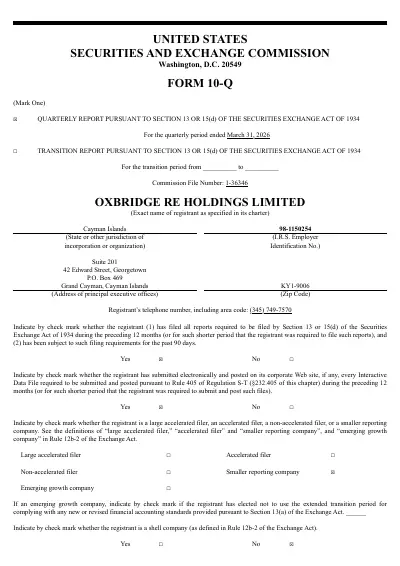
Forward-looking statements are not guarantees of future results and conditions, but rather are subject to various risks and uncertainties. A detailed discussion of risks and uncertainties that could cause actual results and events to differ materially from such forward-looking statements is included in the section entitled Risk Factors contained in our Form 10-K filed on March 30th, 2026, with the Securities and Exchange Commission.
The occurrence of any of these risks and uncertainties could have a material adverse effect on the company's business, financial condition, and the volatility of our earnings, which, in turn, can cause significant market price and trading volume fluctuations for our securities. Any forward-looking statements made on this conference call speak only as of the date of this conference call, and except as required by law, the company undertakes no obligation to update any forward-looking statements contained on this call or in any company presentations, even if the company's expectations or any related events, conditions, or circumstances change.
Now, I would like to turn the call over to our Chairman, President, and Chief Executive Officer, Jay Madhu. Jay?
Jay Madhu
Thank you, Wrendon, and welcome, everyone. Thank you for joining us today.
Let me start by saying we're proud of the strong performance of our business and progress we've been making executing on our long-term strategy. At our core, we are a disciplined reinsurance business writing fully collateralized policies covering property catastrophe risk.
We compete through selective data-driven underwriting, with a focus on generating attractive risk-adjusted returns and long-term growth in book value per share. Our strategy centers on low-frequency, high-severity risks where sufficient data exists to rigorously evaluate the risk-return profile.
We emphasize disciplined risk selection, appropriate pricing, and thoughtful structuring, supported by fully collateralization to ensure transparency and alignment. At the same time, we continue advancing SurancePlus and our broader real-world asset initiatives, expanding access tokenized reinsurance opportunities through strategic ecosystems relationships involving Solana, Alpha Ledger, and LayerZero.
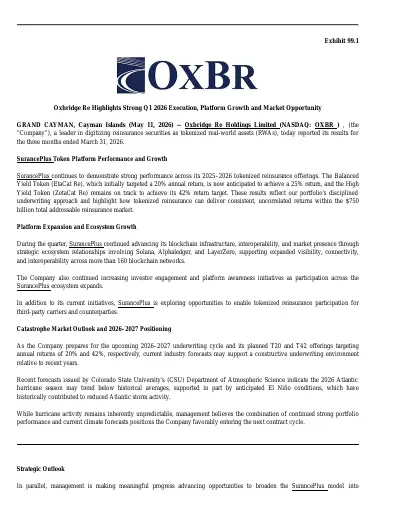
As we approach May 31st, 2026 conclusion of the current contract season, our existing tokenize reinsurance offerings remain unaffected, with the BalanceShield token currently tracking 25%, ahead of its original 20% targeted return, while the High Yield token remains on track towards its 42% targeted return. We believe this combination of underwriting discipline, platform development, and expanding ecosystem relationships positions Oxbridge well as we continue executing on opportunities within the growing real-world asset market.
I will now turn the call over to Wrendon to take us through our financial results. Wrendon?
Wrendon Timothy
Thank you, Jay. I would like to remind you that our typical contract period is from June 1 to May 31st of the following year.
Net premiums earned for the 3 months ended March 31, 2026, decreased to $555,000 from $595,000 for the quarter ended March 31st, 2025. The decrease is due to a lower weighted average rate on reinsurance contracts in force during the quarter ended March 31, 2026, when compared with the prior period.
Our net investment income and other income for the 3 months ended March 31, 2026, decreased to $68,000 from $79,000 from prior comparable period. Along with net premiums, our total revenue amounted to $623,000 for the 3 months ended March 31st, 2026, compared to $692,000 in the prior year comparable period.
For the 3 months ended March 31st, 2026, total expenses, including policy acquisition cost and general and admin expense, increased to $583,000 from $570,000 for the quarter ended March 31, 2025. The increase is primarily due to professional costs, investor relations, and our Web3 subsidiary marketing.
Net income for the quarter ended March 31, 2026, was $22,000 or $0 basic and diluted income per share compared to a net loss of $139,000 or 2 cents basic and diluted loss per share for the prior year quarter. The decrease in net loss is primarily due to a decreased allocation of underwriting income to token holders, as the company itself is the major contributor in the 2025-2026 treaty contracts in place, coupled with a decrease in unrealized loss on other investments during the quarter ended March 31, 2026, when compared with the prior period.
As we have discussed before on our investor calls, we use various measures to analyze the growth and profitability of our business operations. For our reinsurance business, we measure underwriting profitability by determining our loss ratio, acquisition ratio, expense ratio, and combined ratio.
The loss ratio is the ratio of losses and loss adjustment expenses incurred to premiums earned, and it measures the underwriting profitability of our reinsurance business. The loss ratio remained consistent at 0% for the 3 months ended March 31, 2026, when compared with the prior year comparative period.
Our acquisition cost ratio, which measures operational efficiency, compares policy acquisition cost and net premiums earned. The acquisition cost ratio increased marginally to 11% for the quarter ended March 31, 2026, up from 10.9% for the prior year quarter.
Our expense ratio, which measures operating performance, compares policy acquisition cost and general and admin expenses with net premiums earned. For the 3-month period ended March 31, 2026, the expense ratio increased to 105,000 from 95.8,000 for the 3 months ended March 31, 2025.
The increase is primarily due to increased professional cost, investor relations, and our Web3 marketing and operations. Our combined ratio, which is used to measure underwriting performance, is the sum of the loss ratio and the expense ratio.
For the 3 months ended March 31, 2026, the combined ratio increased to 105,000 from 95.8% for the 3 months ended March 31, 2025. The increase again is primarily due to increased professional cost relating to investor relations and our Web3 subsidiary marketing and operations.
Now turning to the balance sheet, cash and cash equivalents and restricted cash and cash equivalents increased by $1.21 million to $8.19 million, up from $6.98 million as of December 31st, 2025. The increase is a net result of premium deposits made during the 3-month period ended March 31, 2026, as well as the $1 million proceeds from a short-term loan that was secured.
I'll now turn the call back over to Jay to wrap up before we take your questions. Jay?
Jay Madhu
Thank you, Wrendon. We are encouraged by the strong performance of our 2025-2026 tokenized reinsurance contracts.
As we approach the conclusion of the current contract season, our existing offerings remain unaffected, with the BalanceShield token currently tracking 25%, ahead of its original 20% targeted return, while the High Yield token remains on track towards its 42% targeted return. These results reflect our disciplined underwriting approach and further demonstrate the ability of tokenized reinsurance structures to provide differentiated, uncorrelated returns with the approximately $750 billion global reinsurance market.
We have also continued advancing the reach and visibility of the SurancePlus platform through strategic relations groups involving Solana, Alpha Ledger, and LayerZero, supporting expanded interoperability and ecosystem access across more than 160 blockchain networks. We believe these relationships position SurancePlus within a growing ecosystem for real-world asset adoption.
As we look ahead to the 2026-2027 underwriting cycle, we are preparing our T20 and T42 offerings, targeting annual returns of 20% and 42% respectively. Recent forecasts from the Colorado State University indicate the potential for a more constructive hurricane environment relative to recent years, supported in part by anticipated El Niño conditions.
In parallel, we are making meaningful progress in advancing opportunities to broaden the SurancePlus model into additional high-quality cash-generating asset categories, including initiatives involving tokenized data center revenue streams and infrastructure aligned with the continued growth of artificial intelligence. As of March 31st, 2026, the company reported $8.19 million in cash and restricted cash, supporting our ongoing strategic initiatives and long-term growth opportunities.
Overall, we remain focused on disciplined execution, expanding ecosystem relationships, and scaling our business through our growing real-world asset initiatives as we continue building long-term shareholder value. With that, we are ready to open the call for questions.
Operator, please provide the appropriate instructions.
Operator
Thank you, sir. Ladies and gentlemen, we will now begin the question-and-answer session.
For those on the conference, if you would like to ask a question, please press star and then 1 now. If you would like to remove yourself from the question queue, please press star and then 2.
Again, if you would like to ask a question, please press star and then 1 now. We'll pause a moment while the question queue builds.
The first question we have comes from Kent Engelke of Capital Securities. Please go ahead.
Kent Engelke
Hey, Jay. Hey, Wrendon.
I'm, again, very interested in the comments that you're making about using tokenized data center for revenue streams and the like, and just the infrastructure growth within AI and stuff like that. Larry Fink the other day predicted that there's going to be a massive futures market for computing power using tokenized assets and the like.
Can you give a little bit more color on that really, I think really cool part of your organization?
Jay Madhu
Thank you, Kent. We've been tokenizing reinsurance contracts, right?
Reinsurance is a significantly large TAM market, and the AI data center space over here could probably dwarf that significantly as well. Since we've been tokenizing reinsurance, we made great strides over there.
We could potentially tokenize other opportunities as well. While it's a little early for us to talk about that just yet, but in the past, people had asked us, when would you probably consider tokenizing other items, right?
I think the timing is right. As you just mentioned, not only Larry Fink, but various other folks have talked about tokenization, and we seem to be doing this under the four corners of the SEC.
I believe we have an amazing opportunity ahead of us, and we definitely plan on seizing that.
Kent Engelke
Cool. Hey, this is an exciting new industry on so many different levels, competing with some very deep-pocketed people that see something as similar as you do.
Obviously hoping that Oxbridge is going to be at the forefront of all this.
Jay Madhu
Yes, absolutely.
Operator
Thank you. Ladies and gentlemen, just a reminder, if you would like to ask a question, please press star and then 1 now.
We'll pause a moment to see if we have any further questions. We have a question from Duane Roberts of Charis Industries.
Please go ahead.
Duane Roberts
Hi, gentlemen. Hope you guys are doing well.
When you're saying that you're looking to tokenize Maybe I didn't hear it right. Looking to tokenize other assets, is that correct, besides reinsurance?
Jay Madhu
Yes, potentially yes, but we I, unfortunately, Duane, can't speak in detail about that. It's opportunities we're still evaluating.
As I just mentioned, if we're able to tokenize an elusive asset such as reinsurance, it gives us it it gives us We feel We feel well about, the potential of SurancePlus moving forward with other assets.
Duane Roberts
You may not be able to comment on this either, but how hard is that, the process? One thing that you mentioned earlier with the other caller was that you was under the SEC, which is, I would assume, is significant.
How, when you're looking at other potential assets, the back office part, all of the software, all of that, how hard is it?
Jay Madhu
It's extremely hard, right? Because if it wasn't hard, other people would be doing it.
Because the barrier to entry is also high, it's an opportunity that Oxbridge can take advantage of it.
Duane Roberts
Okay. All right, thank you.
Jay Madhu
All right, thank you, Duane.
Operator
Thank you. Just a final reminder, if you would like to ask a question, please press star and then 1 now.
At this stage, there seems to be no further questions on the conference. I will now hand back to Jay Madhu for closing remarks.
Please go ahead, sir.
Jay Madhu
Thank you for joining us on today's call. Before we conclude, I would like to extend my gratitude to our employees, business partners, and investors for their unwavering support.
I particularly want to acknowledge our dedicated Oxbridge team, whose extensive experience has been instrumental in navigating and advancing our business amidst these challenging circumstances. We anticipate providing you with future updates on our progress during our next call, and should you have any additional questions, please do not hesitate to reach out to us anytime.
Once again, thank you for your time and attention today, and for your ongoing interest in Oxbridge. Operator?
Operator
Thank you, sir. Ladies and gentlemen, that then concludes today's conference.
Thank you for joining us. You may now disconnect your lines.