Prestige Consumer Healthcare Inc.
NNYSE:PBHQ2 FY2027 · Earnings Call TranscriptNovember 5, 2026
Operator
Good day, and thank you for standing by. Welcome to the second quarter 2027 Prestige Consumer Healthcare Inc.
earnings conference call. At this time, all participants are in a listen-only mode.
After the speakers' presentation, there will be a question-and-answer session. To ask a question during the session, you'll need to press *11 on your telephone.
You will then hear an automated message advising your hand is raised. To withdraw your question, please press *11 again.
Please be advised that today's conference is being recorded. I would now like to hand the call over to your speaker today, Phil Terpolilli.
Please go ahead.
Phil Terpolilli
Thanks, operator, and thank you to everyone who has joined today. On the call with me are Ron Lombardi, our Chairman, President, and CEO, and Christine Sacco, our CFO and COO.
On today's call, we'll review our second quarter fiscal 2027 results, discuss our full year outlook, and then take questions from analysts. A slide presentation accompanies today's call, and it can be accessed by visiting prestigeconsumerhealthcare.com, clicking on the Investors link, and then on today's webcast and presentation.
Remember, some of the information contained in the presentation today includes non-GAAP financial measures. Reconciliations to the nearest GAAP financial measures are included in our earnings release and slide presentation.
On today's call, management will make forward-looking statements around risks and uncertainties, which are detailed in a complete Safe Harbor disclosure on page 2 of the slide presentation that accompanies the call. These are important to review and contemplate.
Business environment uncertainty remains heightened due to supply chain constraints, high inflation, geopolitical events, which have numerous potential impacts. This means results could change at any time, and the forecasted impact of risk considerations is a best estimate based on the information available as of today's date.
Additional information concerning risk factors and cautionary statements are available in our most recent SEC filings and most recent company 10-Q that was released this morning. I'll now hand it over to our CEO, Ron Lombardi.
Ron?
Ron Lombardi
Thanks, Phil. Thanks to everyone for joining us today.
We are pleased to report that we exceeded sales and earnings expectations in the second quarter. Revenue grew nearly 23%, reflecting our first full quarter of ownership of both the Breathe Right and Lacorium acquisitions, which are off to a good start.
As we expected, organic revenue declined slightly due to Q1 order timing. Total first half organic growth was up approximately 1%, helped by strong base business consumption trends led by continued strength in Dramamine, TheraTears, Compound W, and Hydralyte.
The solid sales growth translated into strong profitability, with gross margins up, as expected, thanks to both cost savings and accretion from the acquisitions. Adjusted EPS increased to $1.13, up approximately 6% versus the prior year.
Adjusted free cash flow was down due to working capital timing, but our financial profile remains strong. Now that we funded the Lacorium acquisition, which closed on July 1st, we intend to use our strong free cash flow towards debt reduction through the balance of the fiscal year.
With that, let's turn to slide 5 for an update on our acquisitions. Q2 was our first full quarter of ownership for the Breathe Right portfolio and the Lacorium Health acquisitions.
One quarter in, we have delivered results consistent with our expectations and have confidence we have great long-term opportunities for each. Breathe Right is now the largest brand in our portfolio.
It's a brand with strong heritage, an accretive financial profile, and an established presence in multiple geographies. The business was largely integrated in August, which now allows us to focus on a number of future opportunities as shown on the page.
There is a large and growing opportunity in sleep by expanding with a broader consumer base seeking better quality sleep. Our future marketing efforts will build on the progress and marketing success Breathe Right targeted with this opportunity.
In tandem, we're investing in adjacent opportunities like the recent launch of Breathe Right Sports for better breathing during physical activity. Lastly, the business previously utilized numerous third parties across its operations.
By leveraging our in-house resources, we see opportunities to accelerate innovation and distribution. Now for our acquisition in Australia, Lacorium Health.
It's made up primarily of the Dermal Therapy brand, which represents over 70% of portfolio sales. It has a proven history with consumers in therapeutic skin care since the 1990s, built on need-state solution products.
Currently, we are nearing the completion of major integration efforts, which we expect to be completed in November. Over time, we also expect to realize additional synergies that should further enhance profitability.
Similar to Breathe Right, Lacorium is also well positioned for long-term brand building. Let's turn to slide 6 and review this in greater detail.
As I just mentioned, Dermal Therapy is the vast majority of Lacorium sales, with the brand sold mainly in Australia and New Zealand. The brand stands for therapeutic skin care solutions across numerous categories, the largest of which are shown on the left side of the page.
From lip care, which is Dermal Therapy's largest sales category, to acne, which is a small but fast-growing opportunity, the brand leverages its local heritage to drive success. These solutions have driven share results.
In lip care, it's the clear number one category leader using unique, ultra-moisturizing formulations superior to competition. In foot care, Dermal Therapy holds a solid market position as a fast-growing player with solutions for dry, cracked heels and feet, and is recommended by doctors.
Its product offerings also extend to other foot care needs like wart and nail fungus treatments. With this strong base, we anticipate future sales and market share growth in Australia.
This is driven by two proven strategies that we expect to enhance and continue. First, we intend to leverage the brand's heritage as a highly efficacious need-based solution with the "It Works" campaign.
With a proven mix of influencer engagement and traditional advertising methods, we expect further opportunity for positive marketing impacts of this strategy. Second, the brand has a proven history of innovation.
As an example, under its prior ownership, the brand extended into new categories by seeking unique formulations that can truly be additive in the marketplace. Dermal Therapy's cold sore lysine gel is an excellent example of this, as it brought a unique combination of ingredients to combat all stages of a cold sore, not just treatment or healing individually.
In summary, Dermal Therapy has a history of success in Australia, offering proven solutions across skin care for consumers and growing its market share over time. By continuing to execute proven brand-building tactics, we are well positioned to continue rapid growth.
Now, let's turn to slide 7 for an update on e-commerce. A component of our successful marketing tactics is investment in the channels where consumers are shopping in the most.
The fastest-growing channel by a wide margin remains e-commerce, with a strong first half performance further driven by consumers seeking value in an inflationary environment. Our e-commerce business, led by Amazon and Walmart, continues to deliver consistent mid-teens consumption growth and market share gains for many of our leading brands, thanks to the impact of our long-term investments.
As shown on the right-hand side of the page, we continue to make strategic investments to make sure we are driving long-term, sustainable success. First, we are continually refining our content by individual brand to help drive consumer engagement and conversion, both directly through websites and through generative search.
Second, we are making digital media investments with our partners, which can help drive returns across all retail channels. Third, we are optimizing and leading banner events for each of our retail partners, identifying the highest-return and most relevant opportunities for our needs-based portfolio.
Finally, we are doing this in a strategic way, ensuring we are profit-agnostic by channel wherever consumers decide to shop. In summary, we are focused on consumer takeaway, have a history of success, and have put the capabilities in place for sustained growth moving forward.
With that, I'll turn the call over to Chris to review the financials.
Christine Sacco
Thanks, Ron. Good morning, everyone.
Let's turn to slide 9 and review our second quarter fiscal '27 financial results. As a reminder, the information in today's presentation includes certain non-GAAP information that is reconciled to the closest GAAP measure in our earnings release.
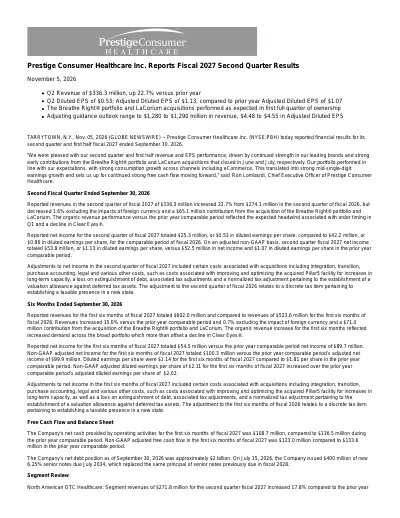
Q2 revenue of $336.3 million grew 22.7% from $274.1 million in the prior year, and declined 1.6% excluding the effects of foreign currency and the acquisitions of the Breathe Right and Lacorium portfolios. The revenue change was expected, resulting from favorable Q1 organic revenue order timing and the first full quarter of ownership for both acquisitions.
Adjusted EBITDA grew double digits versus prior year, and we delivered an approximate 33% EBITDA margin, consistent with our long-term expectation in the low to mid-30s. Adjusted diluted EPS increased approximately 6% versus the prior year, as the profit increase was partially offset by higher interest expense from the acquisitions.
Let's turn to slide 10 and discuss consolidated results for the first six months. For the first six months of fiscal '27, revenues increased 70 basis points organically versus the prior year.
By segment, excluding FX and acquisitions, North America segment revenues increased 60 basis points, and International segment revenues increased 110 basis points versus the prior year. In North America, many of our GI brands continue to experience growth.
This includes Dramamine and its new marketing tactics implemented over the last year related to support for GLP-1 users, who face nausea as the number one side effect of GLP-1 use. We also experienced strong growth in TheraTears related to continued category growth, along with Compound W, which is experiencing success in its new skin tag product that extends the brand into an adjacent category.
International segment revenue growth was led by Hydralyte and growth of the brand and category heading into Australia's summer season. Finally, revenues from the Breathe Right and Lacorium acquisitions, which closed in June and July respectively, totaled $71 million to date.
This is on track to our plan for the fiscal year, and both acquisitions are rapidly integrating into our business operations, as discussed earlier. Moving down the P&L, total company adjusted gross margin of approximately 57% in the first six months was largely as anticipated, and has improved sequentially due to mix from acquisitions.
We continue to anticipate adjusted gross margin of just over 57% for the full year, which equates to just over 58% gross margin for the remainder of the year. Advertising and marketing came in at $86.9 million, or 14.4% of sales in the first half, similar to the prior year on a percent of sales basis.
For the full fiscal year, we still anticipate an A&M rate of approximately 14.5% of sales. We expect Q3 A&M to be the highest of the year on both a dollar and percentage of sales basis.
Adjusted G&A expenses were 10% of sales in the first half, and we still anticipate adjusted G&A of approximately 10% as a percent of sales for the full year, thanks to the scale associated with additional acquisition revenue. Adjusted diluted EPS of $2.11 increased approximately 5% versus last year's adjusted diluted EPS of $2.02.
Strong revenue growth from acquisitions was partially offset by higher associated interest expense and amortization. For the full year, we now anticipate interest expense of approximately $104 million and amortization expense of $32 million.
Now let's turn to slide 11 and discuss cash flow. For the first half, we generated $123 million in adjusted free cash flow, down versus the prior year, driven entirely by the timing of working capital.
We continue to maintain industry-leading free cash flow, and now expect to generate at least $265 million of adjusted free cash flow in fiscal '27, down slightly to account for our updated revenue and higher interest expense assumptions. At September 30th, our net debt was approximately $2.1 billion, which reflects the purchase of Lacorium on July 1st for approximately $150 million.
We also closed $400 million of new unsecured notes on July 15th, which replaced previous notes coming due, and as a result, our closest debt maturity is now 2031. Looking forward, we intend to utilize free cash flow to focus on reducing debt over the balance of the fiscal year.
Now let's turn to slide 13. Back in May, we outlined a strong three-year outlook built on our leading business profile and strong financial returns.
In many ways, our key actions taken in the last 12 months, which are shown on the left side of the page, underpin this favorable outlook. Six months into the year, we remain confident that the three investments we've made over the last 12 months, Pillar5, Breathe Right, and Lacorium, will further fuel our formula for organic growth, leading free cash flow generation, and superior capital deployment.
First, we continue to reinvest in our diversified portfolio of brands. Focused new investment opportunities, like those in the GI category, lay the groundwork for a favorable organic growth outlook.
We are experiencing strong consumption trends excluding Clear Eyes year to date, and expect this to continue. Second, we are winning where consumers are shopping and continue to win in fast-growing channels like e-commerce.
We remain focused on driving consumer takeaway to ensure we continue to grow and win with consumers in this channel. Third, after acquiring Breathe Right and Lacorium, we quickly began integrating both businesses to underpin the future success of each.
As we head into fiscal '28, we expect to see the benefits from these acquisitions on long-term growth and value creation. Fourth is the acquisition of Pillar5 last December.
Taking over an important element of our supply chain was a beneficial strategic decision, and we are laser-focused on stabilizing and supporting the site. We have made a number of changes this year that will set us up for long-term success for the Clear Eyes brand.
Now I'll turn it over to Ron to review these in greater detail on slide 14.
Ron Lombardi
Thanks, Chris. Today, we want to spend time on Clear Eyes, given the supply variability the brand has experienced over an extended period.
Although we are adjusting our fiscal '27 outlook this morning to reflect production variability, we see returning Clear Eyes to its position as the leading redness relief eye care brand as a very attractive opportunity. The underpinning of this recovery is our acquisition of Pillar5, which we believe was the right decision to support this long-term leadership plan.
On the left side of the page are just some of the reasons why this is compelling. To start, the category demand trends and overall outlook are positive.
Eye care is a roughly $2 billion category at retail, with a history of growth rates in the mid-single digits. This is expected to continue, helped by multiple factors, including an aging population, increased screen time, and more.
Second, there is also pent-up demand, particularly for redness relief products. Availability disruptions are currently an industry-wide challenge that has resulted in some consumers leaving the category temporarily, unable to find trusted solutions.
Eye care is also a need-based category where consumers are willing to pay for quality and reliability of a brand that they trust. Lastly, the eye care category remains very attractive for retailers, with a solid price point in relation to its minimal shelf requirements, as well as its ability to start a trip to the store and fill a basket.
Why is Clear Eyes particularly well suited to capitalize on these trends? For starters, as with many of our brands, it defines the category, with a 50-plus-year history and proven heritage in redness relief, selling nearly 50 million bottles annually at its peak.
This success was supported by memorable marketing, including Ben Stein, Vanessa Williams, and Hilary Rhoda, to today's social-focused marketing campaigns, as the brand evolves with consumer preferences. These tactics resulted in a proven history of winning market share and bringing new users to the eye care category, and we believe we are well positioned to return to this.
With this as the underpinning, we believe there is significant upside opportunity, and we've made three major decisions to position us to capitalize on this in fiscal '28 and beyond. First, we made the strategic decision to acquire Pillar5 last year, which gives us vertical integration and direct control that supports the long-term, high-volume demand required for Clear Eyes.
Less than a year into ownership, we continue to believe this was the right decision based on industry trends and significantly decreased third-party supply availability across the industry. Second, a benefit to owning Pillar5 is direct control of quality oversight that ensures we achieve our high-quality product standards.
This strategy is paying off. Pillar5 has had multiple regulatory inspections, and they have concluded favorably since we have acquired the business, which reinforces our confidence in this commitment.
Third, we've made investments in site management changes to fuel these two objectives. Less than 60 days into a number of management changes, we are solely focused on near-term, consistent output in production.
These changes take time. Due to the unique nature of sterile manufacturing, this can at times result in longer-than-expected production downtimes.
In summary, our outlook for Clear Eyes remains favorable. Once our recovery objectives deliver a more consistent output, we expect an opportunity for growth.
Now, let's turn to slide 15 and discuss our updated fiscal '27 outlook. Six months into the year, we are pleased to have delivered results consistent with our expectations.
Consumption trends across the base business remain healthy, and we are pleased with the initial results for Breathe Right and Lacorium. For fiscal '27, we now expect full year revenue of $1.280 billion to $1.290 billion, which equates to about 2% organic growth excluding Clear Eyes.
When we began the year, we said Clear Eyes production variability would be the largest factor affecting where we land in our outlook range. While the first half was largely in line with our outlook, we've since experienced production volatility that began in late September and continued into October.
The impact of this is felt immediately due to zero safety stock availability. As a result, we are proactively adjusting the second half to reflect this output and to give room for a slightly longer transition period as we prepare production lines for a more predictable and repeatable output in fiscal '28.
Importantly, the updated revenue outlook is primarily attributable to this supply availability and does not reflect a change to the consistent performance we've seen with our broader portfolio to date. There's also no change on our expectation for approximately $190 million of revenue in fiscal '27 from Breathe Right and Lacorium, which performed well in our first quarter of ownership.
For Q3, we are expecting revenues of approximately $328 million, with organic revenue decreasing year-over-year. This is due to Clear Eyes, which is lapping a high quarter of sales in Q3 last year.
For adjusted diluted EPS, we now anticipate $4.48 to $4.55 for the full year, reflecting the updated revenue range as well as an assumption for slightly higher interest expense. For the third quarter, we expect adjusted diluted EPS of $1.05.
Lastly, we expect adjusted free cash flow of $265 million or more and a year-end leverage ratio of approximately 4x. We will remain focused on reducing debt throughout the balance of the year, which will further strengthen our balance sheet and create additional flexibility for future capital deployment that can maximize shareholder value.
In summary, our base business is delivering what we expected for the year in a dynamic consumer environment. We are focused on the right actions to drive success for the remainder of the year and beyond.
With that, I'll open it up for questions. Operator?
Operator
Thank you. Ladies and gentlemen, if you have a question or a comment at this time, please press *11 on your telephone.
If your question has been answered or you wish to remove yourself from the queue, please press *11 again. We'll pause for a moment while we compile our Q&A roster.
Our first question comes from Keith DeVas with Jefferies. Your line is open.
Keith Devas
Hey, good morning. Thanks for the question.
I guess we'll just start with Clear Eyes. I think you gave good color on the revised second-half expectations, but maybe you can just comment a little bit more on what specifically might be taking a little bit longer than anticipated, and then maybe more so importantly, kind of your visibility into your fiscal '28, and I guess the confidence in the supply coming online next year.
Ron Lombardi
Hey, good morning, Keith, and thanks for the question. I think maybe this is a good starting point just to step back and provide an additional little bit of color on Clear Eyes in addition to what we had in the prepared remarks.
For starters, we're all anxious to see improvements in Clear Eyes. As we walked through in the prepared remarks this morning, there's a lot of opportunity for the brand in the market based on category supply shortages and strong underlying demand for the brand that we saw in consumption levels late in September and into October as we had product show up, right?
These are the reasons why we are still very positive that there is meaningful benefit to our direct ownership of Pillar5. When we gave our original outlook for the year, we knew supply would be hard to predict.
For the first half, we delivered results consistent with our expectations, including improved production levels in July and August. However, as we began October production, we experienced a limited output that was short of our expectations due to a few separate reasons.
We've taken steps to address these factors, but remediation takes time. As we discussed earlier, with zero safety stock, it has an outsized impact on near-term results.
With this variability in mind, we took a look at the forecast and felt it was prudent to give ourselves room to the prior outlook based on the visibility we already had for Q3, and taking a more cautious approach for Q4. For context of the remaining risk, we're now forecasting less than $20 million in Clear Eyes sales for the full year, with limited improvement in the second half expected, right?
In terms of your question about the medium term and for fiscal '28, there's really no change to the opportunities heading into fiscal '28 and beyond, right? There's a new management team in place that we've made changes to in the last couple of months, and we feel good about the things that we've done to this point, and we're all set up for improvements off of this low base.
Christine Sacco
Keith, this is Chris. If I could just add a little color for the back half also, you asked about what gives us confidence.
For the third quarter, the Q3 call for Clear Eyes has already been produced, and the Q4 call assumes productions at levels that were previously produced prior to the shutdown that we talked about in October. That's what gives us confidence for the back half of this year.
Ron Lombardi
Again, just one final comment on Clear Eyes. There's no one thing that's impacting production.
As things popped up, we're stepping back, taking a holistic view, and making sure that we address things so that we're better positioned going forward.
Keith Devas
Got it. That's very helpful.
Maybe just rounding out with capital allocation, I think in the commentary you mentioned prioritizing debt paydown, and you're also investing a little bit more in Pillar5, you're in a couple of categories now that are a little bit more competitive. If you could just maybe talk through being able to balance some of those priorities for needing a little bit more cash and kind of your visibility into your free cash flow guidance for the year.
Thanks.
Christine Sacco
Keith. As I think about the structure of our P&L, right, we stepped up our gross margin for the acquisitions, and you're right, those acquisitions are faster-growing categories, and we always say that gross margin will support the appropriate levels of A&M.
No change to the company structure in that way, and you can see it in our EBITDA margin for the quarter at just under 34%. We'll continue to manage the P&L in that regard.
We're paying down debt very rapidly. We'll continue to focus on deleveraging for the remainder of this year.
Still have about $90 million left in our share repurchase authorization, which we will, of course, consider, but at least for the remainder of this fiscal, we're going to be focused on paying down debt.
Keith Devas
Got it. Thank you.
Pass it on.
Operator
One moment for our next question. Our next question comes from Susan Anderson with Canaccord Genuity.
Your line is open.
Susan Anderson
Hi, good morning. Thanks for taking my question.
I guess just maybe a quick follow-up on Clear Eyes. You did mention the higher compare, but it sounds like still struggling to get inventory out, which is maybe causing the lower outlook for the back half.
Then also, I'm just curious if you could talk about just in your core organic brands not including the acquisitions, any surprises versus your expectations in performance, whether that's positive or negative? Thanks.
Ron Lombardi
Good morning, Susan. Why don't I start with some comments on our broader business and broader performance.
I'm delighted to talk about the other 98.5% of our sales, and then I'll let Chris go back to the other 1.5% and give a few comments on Clear Eyes. One of the things I think that's important to emphasize with Q2 results and really the outlook for the rest of the year is the organic business excluding Clear Eyes and the two major acquisitions that we just closed on and got integrated are performing well, right?
Our broad-based portfolio continues to have us situated to perform well. You hear others talking about a tough cough-cold season, a tough start to cough-cold season, that doesn't play a big role in our portfolio, we're not impacted by things you're hearing others talk about.
Having said that, our GI brands and platform continues to do well. We're taking advantage of all of the opportunities related to GLP-1 marketing for both Dramamine and Fleet.
The number one and number two side effects are nausea and constipation, and we're the leaders in those two spaces. GI is doing well.
Hydralyte in International had a good quarter, in particular. The two acquisitions, as I commented on the prepared remarks, are off to a great start, and we feel really good about their performance for the rest of the year.
Christine Sacco
Yeah. Susan, just the first half of your question on Clear Eyes.
The Q2 beat was driven by two things, right? A little bit better timing on the acquisitions Ron mentioned, and actually some higher-than-expected Clear Eyes sales in the second quarter, which is really just timing.
When we think about Q3, Q3 we expect to be our lowest level of the year for Clear Eyes. We've just talked about lapping the highest level of sales in the prior year.
Again, what we've seen for October production has Clear Eyes at the lowest level for Q3. We are expecting it then to step up in Q4, but now to levels that we've previously produced at versus the previous expectation for a step-up.
Again, as Ron mentioned in the prepared remarks, really giving ourselves a chance to step back for more predictable and repeatable outlook for fiscal '28, and taking the appropriate actions in this year for the transition period.
Susan Anderson
Great. That's helpful.
Then maybe just one follow-up on the women's health business and the performance there. I guess how did Monistat and Summer's Eve perform in the quarter?
Are you expecting any new launches there this year as well?
Ron Lombardi
Our Women's Health category was up slightly for the quarter. Truly comps, I think, on a year-to-date basis, were down slightly.
We continue to focus on both of those brands. Monistat continues to do well, but we're seeing a declining incident levels in yeast infection.
With a 50-plus percent share, we're feeling the decline in the category and incident levels there. Summer's Eve, we continue to think about long-term, continue to do well with our recent product launches for that brand as well.
Susan Anderson
Great. Thanks so much for all the details.
Good luck the rest of the year.
Ron Lombardi
Thanks, Susan.
Operator
One moment for our next question. Our next question comes from Rupesh Parikh with Oppenheimer & Co.
Your line is open. ):
Rupesh Parikh
Good morning, and thanks for taking my question. I guess just going back to your M&A, Lacorium and Breathe Right, it sounds like the acquisitions are going well so far.
Just curious, any positive or negative surprises under your ownership the last few months? Thank you.
Ron Lombardi
Yeah. Good morning, Rupesh.
Both of the acquisitions off to a great start. One of the things we do well here is diligence our M&A opportunities, right?
We always start with and focus on the state of the brand, how the brand is doing with consumers, what's the state of retail, what are the longer-term new products and innovation and marketing investment opportunities. Based on that work that we've done going in, we're a quarter of full ownership, plus a little bit, for both of the brands, and so far no surprises, and we continue to feel very good about the long-term opportunities for them.
):
Rupesh Parikh
Great. Then on the retailer inventory front, I know at times one of your customers, you've seen a lot of volatility out there.
Just curious, how are inventories in the channel, and are you still seeing that volatility, I guess, from that one particular customer?
Christine Sacco
Hey Rupesh. Yes, we've talked about visibility to our inventory levels broadly at our largest customers, and again, still feel that we're in a good position, not sitting on a whole bunch of inventory at retail.
The one exception, as you just mentioned, right, we are continuing to see order variability in e-com, but our consumption remains consistent. It's up double digits again this year so far, and we see a long runway for growth there.
):
Rupesh Parikh
Great. Then maybe my last question, just given your higher variable interest rate debt, do you see any opportunities to mitigate the risk out there if rates continue to rise?
Phil Terpolilli
Hey Rupesh, it's Phil. Something we'll continue to actively assess.
You just asked about the acquisitions. We re-established prepayable debt back in June when we acquired Breathe Right, and one of the benefits to very strong free cash flow is we worked down that variable debt quickly.
We want to have access to that prepayable debt, but certainly will assess potentially fixing some of that moving forward. Continues to be an ongoing dialogue.
):
Rupesh Parikh
Great. Thank you.
Operator
One moment for our next question. Our next question comes from David Shakno with William Blair.
Your line is open.
David Shakno
Hey, David Shakno on for Jon Andersen. Thanks for taking the question.
First off, I just wanted to understand, I know you're typically channel-agnostic, but was wondering if you could comment on what you're seeing with the consumer overall. Have you seen some channel shift away from drug and into club, for example?
Then one follow-up after that.
Ron Lombardi
Sure. Good morning, David.
What we continue to see is the continuation of shoppers looking for better value for their trusted brands. As a result of that, they're moving to channels where they're finding better value.
We're seeing dollar, mass, and e-commerce growth well above drug, regional grocer, and other channels that are viewed by shoppers as higher price. More of that.
One of the benefits we have from that is when you go online to shop, it's a bigger shelf. Consumers are clicking the extra couple of clicks to go find exactly what they're looking for, for that trusted brand.
We're seeing ourselves over-index in share in e-commerce versus brick-and-mortar. Again, it's a trend that we've been investing behind and have been very successful with over a long runway, and continue to see lots of opportunity in that channel for us as we continue to connect with shoppers when they move there.
David Shakno
Got it. That makes sense.
Then secondly, you said in the prepared remarks that many of the GI brands continue to experience growth. It looks like in the Q that came out that GI was down in North America.
I know you said Dramamine has experienced growth with the GLP-1 positioning. Wanted to understand where the challenges are in the rest of the category there, kind of what the offsets are, because I take it that Dramamine and Fleet, for example, are both doing pretty well.
Christine Sacco
Hi David. GI category is doing well, the brands are doing well.
There's a little bit of retail order pattern timing variability that we just talked about in response to Rupesh question, but consumption remains strong for those brands, not in any outlier other than timing.
David Shakno
Got it. Great.
Thank you. I'll pass it on.
Operator
One moment for our next question. Our next question comes from Mitchell Pinheiro with Sturdivant & Co.
Your line is open. ):
Mitchell Pinheiro
Hey. Good morning.
Just a couple quick questions. I noticed CapEx was a little lower than your what sort of annual run rate.
Is that just timing, or is there any change to your CapEx outlook?
Christine Sacco
No, Mitch, that's just timing. ):
Mitchell Pinheiro
Okay. Somewhere in the mid-20s, is that the right number for not only this year, but as you look a couple years out, or will CapEx needs be down a little bit?
Christine Sacco
We've talked about a 1% to 3% of sales CapEx number, that's still a good number to use over the long term. Some years could be with certain initiatives, right, a little bit higher, a little bit lower.
We'll continue as we work through the back half of this year, particularly around longer-term initiatives for Pillar5 to take a look at that $26 million for this year, but anything else would be timing-related, really. ):
Mitchell Pinheiro
Okay. Then I know your gross margin has been fine, but is there any inflationary impact to that that you could call out, anything noteworthy?
Christine Sacco
Everybody's talking about diesel these days, right? I guess I would just say it's impacting us, as it is in others.
It's in the guide for the back half of the year, even though we're anticipating stepping up, right? We've been able to offset it with various actions.
Also just if you remember, freight for us is low as a percent of sales, right, think mid-single digits. We don't get impacted to the level that maybe some others are talking about.
It's in the guide, and that's probably the biggest mover for this year. ):
Mitchell Pinheiro
Okay. Then one last question.
You mentioned the category supply issues in the eye care and redness and, what is the industry issues? Why the shortage is there?
Is it just Clear Eyes, or are there other issues in the other brands?
Ron Lombardi
Good morning, Mitch. Ron here.
As I mentioned in the prepared remarks today, we're seeing out of stocks across the industry, all right? What has happened over the last few years, right, is that regulatory agencies really across the globe have heightened inspection criteria in the industry.
What we've seen is that foreign-based suppliers or foreign-owned suppliers are being impacted and being taken out of the supply. If you go to retail, you're going to see across redness, multi-symptoms, in the itch category, which is where the third-party suppliers and the foreign suppliers tend to supply into, vast out of stocks.
It's not a Clear Eyes-only issue, right? It's across the industry.
Where you're not seeing disruptions is generally in the dry eye category, where those brands tend to be owned by large players with in-market supply, which has not been disrupted, or they've done well with regulatory inspections. As we mentioned earlier, the Pillar5 facility has fared well during these regulatory inspections.
Over the last year or a bit longer, they've had numerous regulatory inspections, and they've all come out satisfactory and have been closed, right? This is another reason why we continue to feel that the direct ownership and the investment in Pillar5 has us very well positioned for recovering not only the Clear Eyes volume it's had historically, but being well positioned to compete successfully against others who do not have the direct ownership in these spaces.
):
Mitchell Pinheiro
Okay. Thanks for the color, Ron.
That's all for me.
Ron Lombardi
Okay. Thanks, Mitch.
Operator
I'm not showing any further questions at this time. I'd like to turn the call back over to Ron for any further remarks.
Ron Lombardi
Thank you, operator. I want to thank everybody for joining us today, and we look forward to providing our next update.
Have a great day.
Operator
Thank you, ladies and gentlemen. This does conclude today's presentation.
You may now disconnect and have a wonderful day.