Pitney Bowes Inc.
Q3 FY2026 · Earnings Call TranscriptOctober 29, 2026
Operator
Good morning, and welcome to Pitney Bowes' third quarter 2026 earnings conference call. Today's call will include remarks by Pitney Bowes management, followed by a question-and-answer session.
In order to ask a question, please press the star key followed by the number 1 on your touch-tone phone at any time. I will now turn the call over to Alex Brown, Assistant Treasurer and Director, Investor Relations.
Please go ahead.
Alex Brown
Good morning, and thank you for joining us. Included in today's presentation are forward-looking statements about our future business and financial performance.
Forward-looking statements involve risks and uncertainties that can cause actual results to be materially different from our projections. More information about these items can be found in our earnings press release, our Form 10-K, and other reports filed with the SEC that are located on our website at www.pb.com and by clicking on Investor Relations.
Please keep in mind that we do not undertake any obligation to update forward-looking statements as a result of new information or developments. Also included in today's presentation are non-GAAP measures.
Specifically, EBIT, EBITDA, EPS, and free cash flow are all on an adjusted basis. You can find reconciliations for these items to the appropriate GAAP measures in the tables attached to our press release.
We have also provided a slide presentation and a spreadsheet with historical segment information on our website. With that, I'd now like to turn the call over to Kurt.
Kurt Wolf
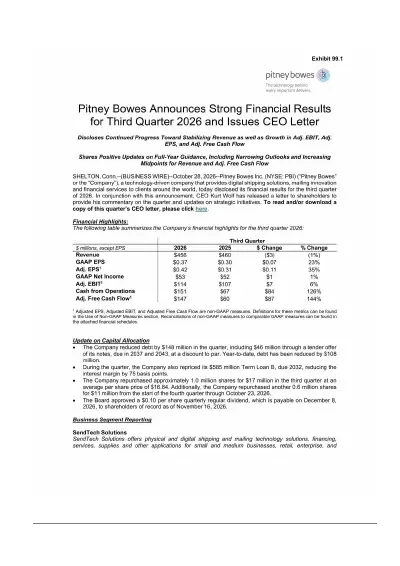
Good morning, and thank you for joining us today. We continued to deliver strong results in the third quarter with year-over-year improvements in EPS, adjusted EBIT, and adjusted free cash flow, despite our increase in investment in growth.
Our results in Q3 and the start of Q4 have given us confidence to up the midpoints of our revenue and adjusted free cash flow guidance range. Now, I'd like to quickly address our five key strategic priorities.
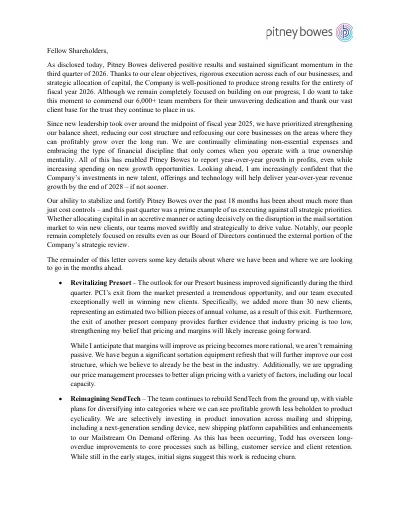
Presort picked up significant volume late in the quarter as a result of PCI's exit from the market. These volumes will create a year-over-year tailwind over the next four quarters, but I also believe this exit is further evidence that the industry margins are near a cyclical low and that more rational industry pricing is likely in the near future.
Regarding our SendTech segment, we were able to achieve higher margins despite increased growth and focus investment, thanks to continued cost discipline. That said, the previously mentioned termination of a non-core contract during Q4 will create a headwind for this business during 2027.
Moving to Pitney Bowes Bank, we continued to invest in technology and infrastructure to support future lending platforms, and all three pilot programs continue to make progress, particularly our logistics lending platform. With respect to capital allocation, we completed a tender offer for $46 million worth of our long-dated debt at a discount to par and also reduced our Term Loan B interest rate by 75 basis points through a repricing.
Finally, our strategic process has entered the external review phase. As mentioned at the start of our last call, we will not answer questions related to the process, but will provide updates as appropriate.
In summary, we executed well across all of our strategic priorities, and momentum continues to build as we focus on achieving profitable revenue growth by the end of 2028. As always, I will end the call by thanking the exceptional team of more than 6,000 Pitney Bowes employees that I have the pleasure of working with.
The results we are delivering and the momentum that we are building is entirely thanks to their hard work and dedication. With that, let's open the call to questions.
Operator
Thank you. We will now conduct the question-and-answer portion of the call.
Again, in order to ask a question, please press the star key followed by the number 1 on your touch-tone phone. Our first question will come from the line of Aaron Kimson with Citizens.
Please go ahead.
Aaron Kimson
Great, thank you guys for the questions. I'll start with Presort, good morning.
I'm modeling mail volumes of about 130 million pieces sequentially in the quarter, so that'd be 520 annualized, but obviously ignores any seasonality. You commented you won 2 billion pieces annualized from PCI since its shut down in August, and a lot of that volume came late in the quarter, you just mentioned.
Can you help us think about how much of the net new volume in the quarter was driven by PCI versus the net new logos and boomerang customers you've previously spoken about? To the cadence of how the PCI volume may come into the network over the next few quarters?
Kurt Wolf
Thank you for the question, Aaron. We don't have specific numbers on that to offer.
We don't go to that level of granularity. I'd just say the majority of the volume gain was tied to gains from PCI.
Aaron Kimson
That's helpful. Then on the decision to invest in the Presort network organically with the sortation equipment refresh, how should we think about any initial capital outlay for that equipment and what the payback period on those investments might look like?
Paul Evans
Yeah. Hi Aaron, this is Paul.
It's great opportunities for us. Generally, we see the paybacks two to three years.
Sometimes it can be a little bit longer, but on average just about two to three years. We are putting out capital this year, we'll put out capital next year for that.
We're doing this because we believe in the Presort business, and this is the right thing for us to do.
Aaron Kimson
Got it. Congrats on strong results.
Kurt Wolf
Thank you, Aaron.
Operator
Our next question will come from the line of Curtis Nagle with Bank of America. Please go ahead.
Curtis Nagle
Great, thanks so much. Obviously really interesting news on PCI, and I think you mentioned a second competitor.
I guess in terms of just maybe A, sizing the opportunity set, and perhaps how much business you can win, and Kurt, I think you alluded to this, potentially some near-term pricing investments, maybe scaling the scope of that. Ultimately longer-term, how should we think about I guess the degree of how underpriced you think the industry is now, and how that affects longer-term margins?
Kurt Wolf
Good morning, Curtis, and thanks for the question. With respect to pricing, I guess what I could say is what really happened, and I apologize for a long explanation, but hopefully this will make it perfectly clear.
In July of 2024, there was a rate case that increased price or increased the workshare discount substantially. Margins expanded across the entire industry, which set off a gold rush for customers.
What you saw is competitors being increasingly aggressive trying to win new customers because the margins just had expanded significantly. PCI in particular, this is just our opinion, got extremely aggressive on pricing to the point that they left themselves no margin, presumably due to transportation costs, diesel, etc.
My view is they more or less drove themselves out of business being too aggressive on pricing. I think this was driven by a rate case that created these high margins.
What you're seeing now is much lower margins. You're seeing it for us.
Capital Presort exited service, I think December of last year. PCI exited September of this year.
You can never make too much of rumors, but Debbie's heard scuttle of other competitors having some serious problems. The reality is I think that you would expect there to be a recognition from the industry that pricing as it stands today is not sustainable for the long term.
We're a dominant player, but we can't set price. We can only react to the price that's out there.
Our expectation is that based on where competitors and us stand in terms of margin, that pricing should start to go up just to get players to a sufficient ROI to justify continuing to operate in this space. As we said in the letter, again, we expect that to happen, but we're not resting on our laurels.
We're doing a lot to integrate the PCI volumes. There's a lot of work to be done there, we expect to get a lot of margin pick up from that.
We can talk more about it if you'd like. Also as Paul spoke to, we're making a lot of investments to continue to bring down our costs of operations so we can get higher margins and better ROI on the business.
Curtis Nagle
Okay. Since you mentioned it, yeah, if you could, I guess, elaborate more on the margin rate you expect to get from PCI, that'd be awesome.
Appreciate it.
Kurt Wolf
Absolutely. With PCI ceasing operations, this just demonstrates some of the value that we offer in the space.
We're the one national player. When people looked and said, 'Hey, we have a lot of volume we need to move,' we were the natural choice.
We picked up a disproportionate share of the volume out there. Some of it is we want to secure clients, we want to have good partnerships.
These tended to be larger customers that we picked up, the pricing there was lower, it's just the economics of the industry. As far as margins going forward, we've absorbed an additional 14%, 15% roughly of our volume.
As you can imagine in an industry where you're trying to run at 100% capacity, if you add 15% capacity immediately, you end up with a lot of overtime, you end up with suboptimal operations in the short term. Our thought going into this was to take the volumes we could and then adjust on the back end to start to hire permanent employees, set our network such that we can handle the volumes without having to go to extraordinary length.
Over time, as we adjust to the new volumes, we expect margins to improve.
Curtis Nagle
Yes, thank you.
Kurt Wolf
Yep, thank you, Curtis.
Operator
Our next question will come from the line of George Tong with Goldman Sachs. Please go ahead.
George Tong
Hi, thanks. Good morning.
With respect to SendTech, can you size the revenue associated with the non-core contract that's winding down, and if you exclude that, what the underlying revenue trajectory could look like in 2027?
Kurt Wolf
George, good morning, and thanks for the question. It's a decent chunk of revenue.
I think of it in the $60 million to $80 million range in terms of revenue. It's a pretty big hit for us.
The thing that we really want to accentuate is, this truly is non-core. This was a part of the old GEC.
This was a fulfillment business. We don't do fulfillment.
It's not even close to any other business that we do. It was just a profitable business that was left over from GEC.
We always knew this business was going to go away. That's going to be roughly a $60 million to $80 million hit for 2027.
I would say absent that, there's now no doubt in my mind that we would be at growth in 2027 were it not for the loss of this one contract.
George Tong
Got it, that's helpful. Then with respect to Presort, in the quarter, revenue per piece fell a bit.
Can you talk a little bit more about that, what drove that, and whether that specific pressure should persist?
Paul Evans
George, this is Paul. I think Kurt touched on it in his previous answer, but obviously we brought in some of PCI in September.
I don't think we'd go down to the granularity of the volume, but that had an impact on our RPP, as we call it. At some point, we will mean revert.
We ingested what Kurt said around 15% of our overall volume, and so that just as we optimize, there will be some mean reversion over time as we get back to what we think are more normal, sustainable pricing.
George Tong
Got it, that's helpful. Thank you.
Kurt Wolf
Thank you, George.
Operator
Our next question will come from the line of Jasper Bibb with Truist Securities. Please go ahead.
Jasper Bibb
Hey, good morning, guys. Maybe wanted to follow up on a prior answer.
I guess I'm wondering what the incremental margin might look like on those PCI volumes or maybe if you don't want to comment on PCI specifically, typically what those incremental margins look like for Presort when you see volumes rising like this?
Kurt Wolf
Jasper, good morning. Generally, what I'd say, and this is true of just about any business, the larger the customer is, typically the lower the pricing, the lower the margin.
This was disproportionately large customers, overall, the pricing, you could assume, was below our typical pricing, just because of the size. Same with the margin, it's going to be lower-margin customer.
Just to be clear, that's something that will persist. This is because they're larger customers.
We do see pricing in the industry, or expect pricing in the industry, to start to adjust and become more rational, but to be clear, it's not like these customers, we're going to increase price on specifically, it's just that we expect margin to come across the entire portfolio of customers, if that comes through. I would just say lower margin due to larger size.
It's not a one-time hit. It'll be a persistent hit because they just are larger customers and going to naturally be at a lower margin for the long term.
Jasper Bibb
Thanks. No, that makes a lot of sense.
I think you mentioned in the letter this quarter, you're increasingly confident that the business returns to growth by the end of '28 or sooner. I guess my question is, what are you kind of seeing that gives you increased confidence?
Maybe I'll point my question a little bit more specifically at the SendTech segment given we've already talked about a lot of the good things going on in Presort on the call.
Kurt Wolf
With respect to that, and I'll get to SendTech, one thing I'd say is, historically, as a company, I would say we made two mistakes typically. One is we identified one idea that we jumped on to wholeheartedly like GEC and pursued, and it may not have always been the right idea, or we've made a lot of peppered investments across a whole variety of opportunities.
I will get to SendTech, but when we think about growth, we're trying to think very holistically using a very broad aperture. Not to get too wonky here, but I previously was a founder of three successful startups, and the discipline that a startup has is that you have to go in front of a VC and convince them of an amazing idea.
The problem that happens with corporate startups, for lack of a better idea, is you have a parent that says, 'We need growth. What do you have?'
Then it's much easier to get an idea through. What we're doing is being deliberately thoughtful and not just saying, 'Hey, shipping's an opportunity for growth.'
We think it is, but we're going to wait for the great idea or make sure that we have the right idea. Beyond that, when I talk about broadening the aperture, are there other things we can do beyond just what the obvious is?
Is there opportunities to use the bank to help grow Presort? That's something that the bank is now doing.
We're thinking more holistically, what are all the good ideas out there, we have more ideas to choose from. When we talk about growth, it's not a guarantee it's going to come from one place or the other.
There's ways we're looking at use of our data within the organization. We think we can help generate growth, just the information that we have, we can use that to make better decisions with our customers, etc.
There's a lot of initiatives we're talking about. I do think with SendTech we'll get there.
Obviously, shipping software is an amazing opportunity. I don't want to say by 2028 necessarily that SendTech itself will be at a pace of growth.
There's just confidence with all of the initiatives we have across the three business, SendTech, bank, which is currently a part of SendTech, and Presort, as well as other ideas we have that are more holistic and use the advantages we have with our existing business. We're very confident that we have enough good ideas that if you think of it from a VC standpoint, we have enough good ideas in the hopper that some of those are ultimately going to pan out as we pilot and test them and we'll get to growth overall for the company.
I know it's a non-answer answer. I'd like to think that SendTech is going to get to growth in 2028, but the increased confidence really comes from the fact that we have a lot of really good ideas internally that we're exploring.
Jasper Bibb
No, that's really helpful. Maybe one last quick numbers question.
I think the kind of 4Q adjusted EBIT implied by your guide is seasonally a little below where things kind of normally are as you go from the third quarter into the fourth quarter. Could you just frame that for us?
Would you say that's more conservatism? I know you have some expense timing things this quarter versus the third quarter.
Just any kind of context there would be great. Thanks.
Paul Evans
You've seen what we've done through the year. Where we have more clarity, we've adjusted our guidance, and I don't mind if you call me conservative in the way I approach things, that's okay.
Look, there's some things that we look back on Q4 of last year, it was exceptional in some respects, we think of that back, but right now what we've given for our annual guidance is where we're comfortable. I understand the exercise that you've done.
You've backed out the full year to isolate the Q4 EBIT, and I respect the question, and we thought about that, too, but we're comfortable with our guidance for the year,
Kurt Wolf
and
Paul Evans
we've shown that how we've tightened the range.
Kurt Wolf
Jasper, a few things that Paul mentioned, we've talked internally as well. Last Q4, we had I believe it was a $5 million benefit to EBIT as a result of I think it was equipment revaluation.
We did have some things that helped us last year. The other thing, and again, thankfully, I have Paul and Alex and the whole finance team to help me on the accounting questions I don't fully understand.
I think when you get in the Q4, there's a lot of questions in terms of bonus accruals and things like that that create a lot of variability for your Q4. We've wanted to keep a large range, not because we're not comfortable with where the business is going and we're not trying to be overly conservative, it's just a recognition that there's a lot of things that can come up in a Q4 from an accounting standpoint that could ultimately lead to results that are a little harder to predict.
So.
Jasper Bibb
That makes sense. Thanks for taking the questions, guys.
Kurt Wolf
Yep, thanks, Jasper.
Operator
Our next question will come from the line of Anthony Lebiedzinski with Sidoti. Please go ahead.
Anthony Lebiedzinski
Thank you, and good morning, everyone, and thanks for taking the questions. With the exit of PCI in 3Q and you guys strengthening your position as the dominant player in the sortation market, or presortation market, do you think there's an opportunity for you guys to be more of a price leader as you talk about improving pricing and margins?
I guess, as we look back historically, late '24, the Presort margins were high 20% range, even got to a little over 30% in the early part of '25. I know there are some headwinds with higher fuel and transportation costs, but maybe if you could just talk to us as far as the timing of the pricing and margin improvements that you expect, how do you guys think about that?
Kurt Wolf
Anthony, good chatting, and good morning. What I would say is we're not a leader.
I would argue we're not a leader in terms of pricing, but we are going to do what's right for our business. Right now, our belief is, across the entire industry, margins are particularly low.
We look at our business, assume that we're one of the smaller players, I can only imagine the margins they're seeing, not as attractive as we are. Right now, it doesn't make a whole lot of sense to be investing in a space just based on the low returns people are getting.
Our expectation is we're focused on getting price, in part because as you highlighted, our costs have gone up dramatically, diesel prices, lack of drivers, there's a whole host of issues that are really facing the industry, us and our competitors. There is a flow-through effect to ultimate customers.
Our expectation is that as we do that, that a competitor is not necessarily going to come in and have a significantly better pricing offer simply because they're facing the same costs that we are. Likewise, as we're trying to compete to get other people's business, we have to be very cognizant, particularly given that we've taken this volume on, that our costs are higher.
I think in general, everybody's doing what's right for their business. As people price, the margins just aren't sustainable at these low levels in our view, our expectation is pricing is going to be higher on a go-forward basis.
Added to that, we are looking at things like fuel surcharges, etc. We may have signed a contract when diesel was at $3 a gallon, now it's at $7 a gallon, that's dramatic cost increase.
A contract we might have signed two, three years ago that was profitable may not be profitable anymore just because of diesel prices and lack of drivers. I'm sorry, there was a last part of your question that I know I didn't address.
Can you repeat what that was?
Anthony Lebiedzinski
Sure, absolutely, yeah. In terms of looking back at the Presort margins, I know this goes back to your comment, Kurt, earlier about how margins got expanded back in '24, but as we look at historical EBIT margins for Presort, they were in the high 20% range, even got to a little over 30% in the early part of '25.
I guess the question is, at some point, do you think you can get back to those types of margins, or not perhaps, given some of the headwinds that are out there?
Kurt Wolf
I think you saw what happened when our margins got to that level is, pricing just came down. I don't want to say we can get back into the 30s.
I'm not so sure that's the case. A few more things to note, by the way, something to keep in mind is we have corporate expense that we can't efficiently allocate or effectively allocate down to Presort.
Presort margins for us are actually lower than what we report because of that. Again, apply that to our competitors, their margins are lower.
When we look at our Presort business, as we think about where our margins are now, the distress in the industry, the fact that we've seen presorters going out of business at this level of margin, it's almost tautological or it just follows logically that margins need to go up industry-wide. I've only been in this chair for 16 months, something like that.
I continue to learn now that I'm inside the company, and it's giving a much better sense of what's probably reasonable. I think mid-20s on margin is probably mid and I think maybe even a little above mid-20s, but I don't see us getting back into the 30s for a sustainable period because I think at that point, pricing will kick in.
One last thing to add, I know it's a long answer, but, again, we continue to invest. The investments we're making, we believe, are continuing to give us a better cost structure than our competitors, which will support higher margins in the long term simply because it's a higher level of investment.
We'll be at a higher investment level than competitors conceivably, but also hopefully that should translate to higher margins as well. That's another thing that gives me confidence on getting to the mid to upper 20s for margins in the Presort business.
Anthony Lebiedzinski
That's very helpful. Just one other question that I have.
As far as the corporate expenses, so, this year, it's kind of bounced around. Roughly $22 million first quarter, $27 million almost in the second quarter, here it was $33 million roughly in the third quarter.
How do we think about the corporate expenses going forward, and if you could just also explain as to why we saw a pickup here on a sequential basis, that would be very helpful. Thank you.
Paul Evans
Sure. Hey, Anthony.
What happened in Q3 is we reclassed some of our costs, we gave the benefit down to our business units. The long-term trend is we see corporate SG&A continuing to decline, as we further sort of find efficiencies in how to run this overall business.
We still are looking for ways to sort of allocate more of our corporate costs to the business to appropriately sort of value those businesses. The big number in Q3 is approximately a $10 million reclass from Okay.
from
Anthony Lebiedzinski
Okay. All right, well, thank you very much.
Kurt Wolf
Thank you, Anthony.
Operator
Our next question will come from the line of Kartik Mehta with Northcoast Research. Please go ahead.
Kartik Mehta
Hey, good morning. Kurt, maybe just understand a little bit about the SendTech margin.
You guys have done a great job expanding those margins, and you talked a little bit about this non-core customer or this revenue going away. As you look at that segment of the business, is there opportunity to reduce costs or do other things to be able to sustain the margins that you have in this business, or do you think as we go into 2027 with the loss of that customer, the margins will be pressured in 2027 compared to 2026?
Kurt Wolf
Yeah. Thank you for the question, Kartik.
Just let me make a few comments on that. Losing this non-core piece of business will be negative for margin just because you lose some of the leverage.
The margin on that business on a internal accounting basis, is about equal to other businesses, but the reality are we're going to end up with effectively stranded costs that we can't eliminate because it was shared services across the overall business. Again, a non-core piece of business, but it was an attractive piece of business.
Unfortunately, that will be a hit to margins. Then another hit to margin in the short term, and then I'll address sort of the counteracting piece of it, is we're really focused now on getting to growth.
We're already investing, that's one of the things I'm really proud of the team for delivering. We're hiring people, we're purchasing software, we're investing in growth in the business, and we're still able to improve our margins or improve profitability.
We're going to continue to invest in growth as we come up with more and more of these opportunities and we start to grow into those opportunities. That will create a headwind in SendTech as well.
The one thing I will say is what we've really focused on, even prior to me stepping in, for the last almost three years now or 2 1/2 years, has been a culture of continual efficiency improvement. We're not looking to do RIFs, we're not looking to do significant cuts, but it's a part of running a business these days.
I think what was it, Microsoft recently announced I think a cut. There's been some large companies that are very successful out that are reducing costs.
We're constantly looking at opportunities where we can reduce costs, and Todd and his team, Debbie and her team, Steven or his team are all doing a good job of balancing investment and growth while also figuring out ways to save, and create efficiencies within their business, so that we can offset some of the costs that we're putting into growth initiatives. It's a longer answer,
Kartik Mehta
but
Kurt Wolf
I guess what I'd say is, in the short term, I would say that SendTech margins, probably roughly in the right ballpark. The one thing to note is assuming we break out the bank, the bank is currently reported as a part of SendTech, you naturally see a change in the margin reported for SendTech if the bank is no longer reported as a part of it.
If you combined SendTech and the bank, you'd get back to those same level of margins more or less.
Kartik Mehta
Fair enough. Then just a follow-up question on the free cash flow.
Obviously, you raised your free cash flow guidance. I think there were some net working capital benefits as a result.
As you look at your free cash flow over the next 12 months or maybe going into 2027, how much of the free cash flow is sustainable because of just improvements in the business versus improvements in working capital?
Paul Evans
Look, obviously, we've realized a lot of the benefits and improvements in working capital, and Kurt talked about, we're continually improving our cost structure, we realized benefits from that. I'll tell you how I look at.
I look back at the LTM free cash flow, and it's just astounding what this business provided with the right focus. Obviously, we were confident to up it for the year.
Again, it's just a strong sign of how much free cash flow opportunity is available here. I don't believe '27 will be as high as '26, but it's certainly still a commendable where our cash flow will be going forward.
To break it down into the components, I would say we're always looking for opportunities for working capital benefits, and we naturally have some built into our business by its design. I think we've used those in a very appropriate manner, as you can see how we've allocated capital and the shares that we've repurchased and how we've kept our debt flat and we've cut our interest expense and done a number of other things.
Kurt Wolf
Kartik, to add to that, a couple of quick things. I think that 20, there's a lot of variabilities you've seen within our business from a working capital standpoint.
2026, we're having tailwinds as a result of it, and you don't always have tailwinds. At some point, unfortunately we will face headwinds, and all analysts, I'm sure you'll sit there and look at our business and normalize, one year is going to be too high, one year is going to be too low, and reality is somewhere in the middle.
Another thing that just to call out is twofold. One is as I mentioned, we're increasing investment just because we've identified attractive areas for investment.
We do expect, with the sorter refresh, we're leaning heavily into that, we've underinvested in prior years. We're going to be accelerating investments, CapEx, we have a catch-up that we may get to a point where we're over normalized CapEx, but we're going to need to catch up for years of underinvesting.
Compounding that is that historically because we were in such tight financial conditions, we would typically lease a lot of equipment. Those payments were spread out over years.
What you may see, for example, is a year like '27, when you compare that to a year like '24, let's say, in '24, we were leasing, our CapEx on sorters might have been low, first of all, because we were underinvesting, but even lower still because we were leasing instead of just outright purchasing. We're going to get double hit in the short term because we're going to increase our expenditure on sorters, but we're also going to continue to have lease payments when we couldn't just outright buy the equipment.
There's going to be a small transition period where we're paying old leases and new CapEx that won't carry those future lease payments with them. We'll talk more about it, as we discuss guidance for 2027, but those are some things just to keep in the back your mind as you try to model for '27.
We're always going to do what's right for the business, and sometimes that means taking a short-term hit to cash flow just to get the business where it should be in terms of how we operate on a go-forward basis.
Kartik Mehta
That makes sense, and thanks for the explanation. That is helpful.
Thank you both. Appreciate it.
Kurt Wolf
Absolutely. Thank you, Kartik.
Paul Evans
Thanks.
Operator
At this time, I see no further questions in the queue. I'd now like to turn the call back over to Kurt Wolf for any closing remarks.
Kurt Wolf
All right, yeah, thank you everybody today for joining. Just like to make a few final comments.
I can't express enough gratitude to all the employees here at Pitney Bowes. I opened by saying that, and I close by saying it.
I would say what we're accomplishing right now is nothing short of amazing, and it's due to, like I said, the 6,000 employees here. Hopefully investors and analysts are starting to realize the discipline and excellence that we're showing in execution and that we're starting to get some appreciation and credit for our ability to execute on plan.
Then the second point I would go from there is what's really exciting for me is, as the CEO of this company, is for so long we've been focused on trying to fix what we have, and now we're really pivoting to a focus on how do we grow and how do we have success going forward. This will be a new chapter, and as analysts, what you're going to see is increased investment.
You're going to see increased investment not just from a CapEx standpoint, but also from a cost standpoint. We hope that we've earned people's respect and appreciation that we can execute on plans.
We do expect a period of transition where we are investing in growth before we get the revenue from that growth, but it's important for the success of this business that we get to revenue growth. That's ultimately what all investors want, and it's going to be a period of transition.
You acquire something, which we did when we bought the new logistics business. It's an easy way to get revenue growth right out of the gate.
We're trying to do what I believe to be the right way, which is to prudently build for the future. We're in a period of transition, but again, I think our ability to execute gives me a lot of confidence that as we're making these investments, these investments will pay off.
I'm looking forward to the day where we start talking about all the growth initiatives and the actual positive revenue that we're starting to put on the board that is also tied to increased profitability. Thank you, everybody, for listening, and thank you for your continued trust in us and in the management team and the employee base.
Thank you, all.
Operator
This concludes today's Pitney Bowes third quarter 2026 earnings conference call.