PENN Entertainment, Inc.
Q3 FY2026 · Earnings Call TranscriptNovember 5, 2026
Operator
Greetings, and welcome to the PENN Entertainment Third Quarter 2026 Earnings Call. I would now like to turn the conference over to Joe Jaffoni, Investor Relations.
Please go ahead.
Joe Jaffoni
Thank you, Aaron. Good morning, everyone, and thank you for joining PENN Entertainment's 2026 third-quarter conference call and webcast.
We'll get to management's comments and presentation momentarily, as well as your Q&A. During Q&A, we ask that everyone please limit themselves to one question and one follow-up.
I'll quickly review the Safe Harbor, and then we'll get right into the call. Please note that today's discussion contains forward-looking statements.
Forward-looking statements involve risks, assumptions, and uncertainties that could cause actual results to differ materially. For more information, please see our press release for details on specific risk factors.
It's now my pleasure to turn the call over to PENN's CEO, Jay Snowden. Jay, please go ahead.
Jay Snowden
Thanks, Joe. Good morning, everyone.
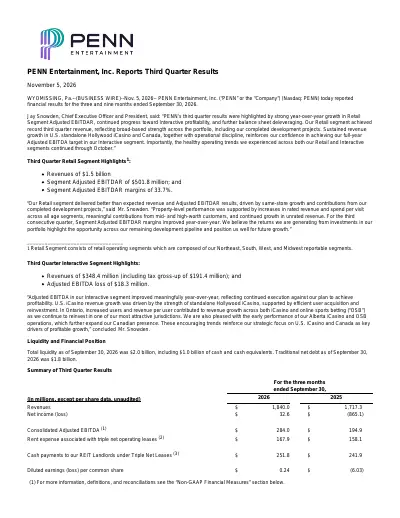
I'm joined in Pennsylvania by Felicia Hendrix and Aaron LaBerge, as well as other members of our senior team. As you can see in our release and accompanying investor presentation, PENN delivered record third-quarter revenue and strong year-over-year adjusted EBITDAR growth, driven by same-store performance and contributions from our completed development projects.
The impressive returns from our recent investments in our portfolio underscore the opportunity across our remaining development pipeline and position us very well for future growth. The retail performance by our best-in-class property management teams was supported by increases in rated revenue and spend per visit across all of our age segments, meaningful contributions from our mid- and high-worth customers, and continued growth in our unrated revenue.
For the third consecutive quarter, segment adjusted EBITDAR margins improved year-over-year, despite unfavorable table game hold in the quarter at the M Resort, and increased gaming tax rates in Illinois as a result of Aurora and Joliet moving into higher gaming tax tiers due to their continued success. As Felicia will cover in a moment, we are raising our full-year 2026 retail revenue and adjusted EBITDAR guidance to reflect our better-than-expected results in Q3 and our current trends.
Slide 8 in the investor presentation highlights the success we're continuing to see from our completed development projects. The new tower at M Resort has improved performance by capitalizing on previously unmet demand, helping drive record Q3 revenue, slot volumes, and table volumes for the property.
During the third quarter, the property also booked its largest group by revenue and room nights, twice the size of its next largest group. Looking forward, contracted group business revenue for 2027 is pacing 55% ahead of where 2026 bookings stood at the same point last year.
At Hollywood Columbus, we achieved all-time records for gaming volumes, revenue, and adjusted EBITDAR. The 18% year-over-year revenue growth reflects hotel-driven increases in visitation and spend per visit, and 86% of hotel cash revenue was generated by guests coming from over 3 hours away, signaling our expanded market reach.
In Aurora, we saw our active database grow by 96% year-over-year and two times higher revenue versus prior year, supported by strong growth across gaming and non-gaming amenities. In addition, similar to Columbus, 90% of hotel cash revenue was generated by out-of-market guests.
Finally, our other new Chicagoland property, Hollywood Joliet, continues to deliver strong results. We also have continued to see revenue growth on a year-over-year basis despite lapping our opening in August of last year and since the opening of the Aurora property in June of this year, which is very encouraging.
We look forward to building on this momentum as the property ramps and the surrounding mixed-use development progresses. Upcoming projects in our development pipeline include the relocation of Hollywood Council Bluffs, expected in 2028, and the new Hollywood New Orleans, expected in 2029, both of which are highlighted on slide 9.
We couldn't be more excited to begin advancing both of those projects. In our Interactive segment, adjusted EBITDAR improved meaningfully year-over-year, reflecting continued execution against our plan to achieve profitability.
U.S. iCasino revenue growth was driven by the strength of our standalone Hollywood iCasino app, which is supported by efficient user acquisition and targeted reinvestment.
In Ontario, increased users and revenue per user contributed to revenue growth across both iCasino and online sports betting as we continue to reinvest in one of our most attractive jurisdictions. We're also pleased with the early performance of our Alberta iCasino and OSB operations, with volumes and users showing continued growth into October.
This launch has expanded our presence in Canada and positions us well for future growth should additional provinces privatize. Additionally, we saw significant year-over-year improvement in gross profit margin in the quarter, driven by a more targeted promotional strategy and with iCasino representing a larger share of our gaming revenue mix year-over-year.
We also continued to realize efficiencies across the entire Interactive business, including a reduction in third-party variable costs. We expect these drivers to support additional margin expansion going forward.
Growth in U.S. iCasino and Canada, coupled with our disciplined approach to customer value and cost management, reinforces our path towards sustainable, profitable growth in Interactive.
Importantly, the healthy operating trends we experience across both our retail and Interactive segments continued through October. Of note, this past Halloween weekend marked one of our top revenue-producing weekends in all of 2026.
Regional gaming in the U.S. continues to benefit from customers staying closer to home in this environment of elevated inflation and gas prices, and we're not seeing any signs of this slowing up.
With that, I'll turn it over to Felicia.
Felicia Hendrix
Thanks, Jay. Our retail segment generated third-quarter revenues of $1.5 billion and adjusted EBITDAR of $502 million, which reflects year-over-year growth of 5% in revenues and 7.7% in adjusted EBITDAR, respectively, while same-store revenues and adjusted EBITDAR grew approximately 1% and 5%, respectively.
Adjusted EBITDAR margins were 33.7%, which represented an improvement of 84 basis points year-over-year. We generated flow-through of 50% in the third quarter, which was higher year-over-year and quarter-over-quarter, reflecting our property teams' best-in-class cost discipline and execution.
Importantly, we saw broad-based strength across the portfolio as demand remains stable and our completed development projects continue to ramp. Further, rated revenue has grown for eight consecutive quarters, with the third quarter delivering the second-largest increase over this period.
We are raising our full-year 2026 retail revenue and adjusted EBITDAR guidance by $16 million and $10 million, respectively, to reflect our better-than-expected results in the third quarter and current trends. As such, our revised 2026 revenue guidance is now $5.89 billion, and for adjusted EBITDAR, our new guidance is $1.973 billion.
Our Interactive segment generated revenues of $348.4 million in the third quarter, including a skin tax gross-up of $191.4 million, and an adjusted EBITDAR loss of $18.3 million. Notably, excluding our third-quarter investment in our Alberta launch, adjusted EBITDAR has improved sequentially in each quarter of 2026.
We experienced growth across our key focus areas, U.S. iCasino and Canadian operations.
These increases were offset by expected lower volumes across U.S. online sports betting and U.S.
integrated iCasino, as well as customer-friendly OSB outcomes. As Jay mentioned, we generated significant improvement in year-over-year gross profit margin in the quarter.
As we look ahead, we expect fourth-quarter revenue of $445 million for our Interactive segment, including a $242 million including $242 million in skin tax gross-up, and revenues excluding skins tax gross-up of $203 million. Fourth-quarter adjusted EBITDAR guidance is $18.7 million, which will bring us to a loss of $20 million for the full year, inclusive of a $20 million investment for our Alberta launch.
Our fourth-quarter guidance assumes continued revenue growth in two of our key strategic focus areas, U.S. standalone iCasino and Canadian operations, while we expect U.S.
online sports betting and U.S. integrated iCasino trends to continue adjusting to normalized levels post the theScore Bet rebrand.
Additionally, our outlook reflects continued year-over-year improvement in unit economics, building on third-quarter results where adjusted gross profit margin expanded significantly year-over-year. We note that our updated 2026 skins tax gross-up guidance is approximately $25 million lower than our previous guidance, with slightly less than half of that reduction reflected in the third-quarter results.
The remainder reflects updated fourth-quarter assumptions based on recent tax payment trends, primarily related to partners with fixed fee agreements. It's important to note that our revised skin tax gross-up guidance has no impact on our projected revenue share from our skins partners given the fixed fee arrangements I just mentioned.
We expect the other category adjusted EBITDAR to be negative $122 million for 2026. The $3 million increase from our previous guidance reflects legal fees associated with obtaining a favorable tax ruling in the third quarter.
The table on page 8 of our earnings release summarizes our cash expenditures in the quarter, including cash payments to our REIT landlords, cash taxes, cash interest on traditional debt, and total CapEx. Of our total $59 million of CapEx in the quarter, $17 million was project CapEx, primarily related to our development projects.
We ended the third quarter with total liquidity of $2 billion, inclusive of $1 billion in cash and cash equivalents. We ended the third quarter with lease-adjusted net leverage and traditional net leverage of 5.6 times and 2.3 times, respectively, as we continue to delever.
Looking towards the end of the year, and as we highlight on slide 5 of our earnings deck, we anticipate 2026 lease-adjusted net leverage to improve by approximately 1.5 turns and traditional net leverage to improve by approximately 2.4 turns year-over-year. For 2026 cash interest expense net of interest income, we continue to project $150 million.
As of the third quarter, our mix of fixed and floating debt on a traditional leverage basis was 50/50, and on a lease-adjusted basis, our fixed to floating mix was approximately 85 to 15. Our debt maturity profile provides us with a significant runway.
Our strong and improving liquidity position provides us with the flexibility to address our $400 million of 5 and 5/8 notes maturing in January 2027, after which we will have no additional maturities until 2029. We're reiterating our 2026 maintenance CapEx guidance of $220 million, while our 2026 project CapEx has been refined to $170 million from our prior $180 million guidance, bringing our total 2026 CapEx guidance to $390 million from our prior $400 million guidance.
We continue to expect total cash payments under our triple net leases to be $1 billion in 2026. For cash taxes, our outlook is unchanged: we do not expect to be a cash tax payer in 2026.
Our fully diluted weighted average common share count at the end of the third quarter was 135.4 million shares. RSUs and stock options are dilutive by about 2 million shares annually.
Now I'll turn it back to Jay.
Jay Snowden
All right, thanks, Felicia. As you can see, we continue to execute against our 2026 strategic priorities during the third quarter.
As always, I'd like to take the opportunity to thank our amazing team members across PENN for continuing to provide our guests a best-in-class customer experience, and for helping us achieve record quarterly retail segment revenue and improved Interactive profitability. During the balance of the year and as we head into 2027, we will remain focused on growing cash flow, reducing leverage, optimizing our corporate overhead, and maintaining a disciplined approach to capital allocation.
With that, Aaron, we'll open up the line for questions.
Operator
Certainly. If you'd like to ask a question, please press *1 on your keypad now.
To leave the queue at any time, press *2. Once again, that is *1 to ask a question, and we'll pause for a moment to allow everyone the chance to queue.
Once again, that is *, then 1. We will take our first question from Brandt Montour with Barclays.
Your line is open.
Brandt Montour
Thanks for taking my question. Congratulations on this result, everyone, and in raising your guidance here.
Maybe just starting off, the implied fourth-quarter guidance has a little bit of a sequential downtick. I just want to make sure, is there anything sort of one-time that you're rolling over or lapping in any of the segments in particular?
Of the growth that you do imply in the fourth quarter, which is a solid growth rate, don't get me wrong, what's the split of that between new projects and sort of unaffected same-store?
Jay Snowden
Brandt, the mix would be very similar to Q3 in terms of contribution to that revenue and EBITDAR growth as we continue to ramp our development projects and continue to feel really positive about same-store sales growth across the rest of the portfolio. The guidance itself, when you break it down, it would represent the second-highest growth rate both on the top line and bottom line of the year, right behind the third quarter.
Does it turn out to be conservative? We'll have to wait and see.
We didn't feel like we want to get over our skis. We're one month into the fourth quarter.
We posted a strong month. The next two months you can have weather impacts we have a lot of properties in the Midwest, Northeast.
We also just broke ground on Council Bluffs. We don't expect there to be any material impact.
We're building in the parking lot, but it does eat up into a little bit of parking, we're just I think trying to play it safe here, and we'll see where we come out, but we're off to a good start here in the fourth quarter.
Felicia Hendrix
I would also add, our fourth-quarter guidance does imply growth both with the development projects and then also excluding the development projects, growth on a same-store sales basis as well.
Brandt Montour
Perfect. Thanks for that.
Then a follow-up: maybe if you could talk a little bit more about the start in Alberta and what you've seen so far from competition there. How have folks sort of launched?
Is it similar in effect to Ontario, and where are you sort of tracking versus your internal expectations?
Jay Snowden
I'm happy to lead, and Aaron, feel free to jump in. It was busier at the starting gate than it was in Ontario.
You'll recall in Ontario there were some staggered starts by some of the big names, and in this case, I think everybody was pretty much at the starting gate at the same time. You also had incumbent grey market operators that were flipping over to a regulated business model, and so it was busy at the starting gate.
I would say that we're pleased with how we've started in Alberta. The market results came out for July, which was partial month, and then August, September, we got 2 and 1/2 months' worth of data.
Two things of note, I think, at a high level is that we're off to a really strong start on online sports betting. We're already scratching at our same market share levels that we deliver in Ontario through the first few months in Alberta, so that's very encouraging.
I would say on the iCasino side, we're about halfway to where we are in Ontario. The more encouraging part on the iGaming side is that, perhaps because it's a more mature market in Alberta from the grey market, the TAM on iCasino looks a lot larger than we anticipated.
Sports betting TAM looks about what we expected, market share we're performing very well, very close to Ontario-level market share. Alberta iCasino, the TAM looks larger than we expected, and our market share, we've got a lot of running room, but we're off to a solid start with more opportunity for upside.
Aaron LaBerge
Not much to add. I would say that the theScore brand in Canada is really helping us.
Our share of voice in our marketing is very good. On the OSB side, our handle share grew each month since launch, faster than market, too.
As Jay said, we feel really good about our start.
Brandt Montour
Helpful color. Thanks, everyone.
Jay Snowden
Brandt.
Operator
Thank you. We will take our next question from Barry Jonas with Truist.
Your line is now open.
Barry Jonas
Hey, guys, thank you for taking my questions. Jay, can you maybe talk about any potential implications you see for PENN from the midterm elections?
We're hearing more enthusiasm for Texas, maybe talk about your positioning there. Any other potential state implications would be great.
Thank you.
Jay Snowden
Happy to, Barry. I would say, just sort of taking a step back before I get into the particulars of certain states, I think Tuesday night was a good day and a good night, I think, for the sector, and in a lot of ways.
It was certainly a really good day and night for PENN specifically. We don't talk about it every call because it just hasn't been a topic of conversation, and it hasn't really been, I would say, not even hot, it hasn't even really been warm for a variety of reasons.
We have been making investments in the state of Texas for decades, and we have been operating as we own two of the three Class 1 thoroughbred racetracks in Texas, which is Retama, right outside of San Antonio, kind of a little bit in between San Antonio and Austin, great location, and our other Tier 1 or Class 1 racetrack, thoroughbred racetrack, is Sam Houston, obviously in Houston, Texas. The third of those tracks is owned by the Chickasaw Nation, who we have a great relationship with, in the Dallas-Fort Worth market.
We actually have been operating in the gaming space through horse racing in Texas for a long time. We've got two great assets there, and we're ready to play offense.
It's not a defensive play for us. We also, I think, are positioned well in that we have great relationships with the movers and shakers in Texas.
We don't need to get into names and entities, but we've got very strong, aligned relationships there, and we have a great lobbying team, I think one of the best we have across the country. We feel really good about the opportunity.
It's always hard to predict what's going to happen. Obviously, you have a new governor, new party there.
The House flipped, the Senate did not. What does that all mean when you put it in and kind of stir it around?
We're not sure what comes out, but we will be spending even more time than we typically do in the state of Texas, and we'll be ready for whatever comes out of Texas. We think we're positioned as well, if not better, than really anybody in the sector if something does happen in Texas.
Look, the other states, I would say, before I get into potential retail gaming expansion, for example potentially in Georgia could happen, given the changes there, I do think that when you're looking at some of the states that we've talked about from a skill-based gaming perspective, Tuesday was a great day. You had, I would say, most of the pro-skill-based game advocates at the state lawmaker level either lost outright or lost a lot of influence and power in those elections in those two states.
That's good for the industry. It's really good for PENN because we have a lot of properties in those two states: four in Pennsylvania plus a VGT route operation business, as well as three in Missouri.
We've talked before about how in Missouri, since the AG, who I think is a rock star in Missouri, has been shutting down the skill-based games there, Missouri's been producing very strong revenue numbers on a year-over-year basis in 2026. I don't think that's by coincidence.
As we highlight Pennsylvania, which, as the law was changed, skill-based illegal, should have always been illegal, but determined by the Pennsylvania Supreme Court, the shutdown date was October 14th, I also don't think it's a coincidence that October represents the strongest year-over-year gaming revenue growth that we've seen in Pennsylvania in all of 2026, and it was largely fueled by the back half of the month. I don't know if that continues into future months.
I don't know how long it lasts. We'll see what happens legislatively.
I do know that was a very good day overall for the industry and certainly for PENN. Then I think the last one probably worth highlighting was there was a potential license that was floating in Indiana.
There were three counties that had a referendum on whether they wanted to host that last casino license. All three of them said no.
I think that's good as it relates to the incumbent operators in Indiana and Illinois and in Ohio. For us, that was also a really good outcome.
As you talk about and look out over the coming quarters, what's been really helpful on that same-store sales basis is we just haven't had the headwinds, the Whac-A-Mole of these markets are doing great, but two new casinos across the state or in this market are hitting us. It looks really good for PENN as you look out into '27, '28.
We don't have any new big competitors hitting us, same-store sales look healthy, regional gaming's strong, and our development projects are delivering, and we got more in the queue. We're feeling really good about that.
Barry Jonas
That's extremely helpful. Just as a quick follow-up, any updated thoughts on the M&A environment and your appetite there?
I know there's some open processes going on, and your balance sheet is obviously getting better and better. Just curious if any updated thoughts there.
Jay Snowden
I'm going to try to be as crystal clear as I can on this. I feel like we try to be on the calls, and then we hit conferences and I feel like it's a mixed message.
Here's the capital allocation priorities for PENN. Number one: delever.
We've been delevering. I think that is great for the company, it's great for our shareholders.
We have been talking and spending more and more time with quality, long-only, long-focused, long-term shareholders because they see the leverage profile coming back down. We're going to have a 1 handle in front of our traditional net leverage in the very near future, and our goal is to have a 4 handle in front of that lease-adjusted net leverage in the very near future, and they're both within sight.
That is going to be priority number one, has been, will continue to be for the foreseeable future. Do stock buybacks look interesting when your free cash flow yield is over 20% and your business feels as strong as PENN's does?
Absolutely, and that's a conversation that we will continue to have at the board level as we go into 2027. I would say delevering is still priority one, but we have to be talking about potentially buying back shares, returning capital to shareholders at these free cash flow yields.
Number three: we have already opened four new growth projects. We have two more that we've announced that are in the queue: one opening in 2028 in Council Bluffs, one opening in 2029 in New Orleans.
We have a handful of others that we're continuing to analyze internally, and when we have the conviction that the return profile on one or two or more of those projects looks similar to the ones we've opened and/or announced, then you'll hear more about that, and that's within our control. That's why we love those projects, because we've now opened four: two water-to-land projects, two new hotels.
The ones that we're analyzing is a combination of those two things, and we feel like we have a good handle on what to expect based on where you're building and what you're building and what the market looks like. The conviction around the return profile would be much stronger on those internal projects than they would be necessarily on something externally.
Then last on that order of four would be potential M&A. Think about the hurdle you have to cross if you're going to do something from an M&A perspective.
It's going to have to be a very high implied free cash flow return and carry very little risk. As I've said before, it also needs to have strategic value for us.
Is it a new market? Is it a large database?
Those would be the factors that we would be considering. Strongest would be delevering, definitely looking at share repurchases as we head into '27 as an option for capital allocation, internal projects high priority, continuing to analyze, and last would be M&A, not a high priority at PENN right now.
Barry Jonas
Perfect. Thank you.
Operator
We will take our next question from Sam Nielsen with J.P. Morgan.
Your line is open.
Sam Nielsen
Hey, good morning, guys. It's Sam on for Dan.
Thanks for taking our questions. The margins in the South were higher than we had expected and up meaningfully year-over-year.
I know you're lapping the launch of a competitor opening last year in the market, which had had an impact, but wondering if there's anything else that drove the strength there, or any one-timers to call out.
Jay Snowden
No one-timers to call out, which is good. I would say it's more of what you said.
We did have a competitor that opened in Bossier City, Louisiana, in Q1 of last year, and so every quarter that you've lapped that from an anniversary perspective, business tends to look a little bit better. Our team in Bossier City, led by Maureen Wasloski, is doing a fantastic job, continues to.
Harold Rowland, who oversees all of Louisiana and his primary day job is running our L'Auberge Lake Charles property, our largest revenue-producing property, had a fantastic quarter. Top line, bottom line, gaming, non-gaming, we've been making a lot of investments: hotel renovation, new restaurants, gaming floor changes, and Harold and team, Maureen and team are doing a fantastic job in the South.
Sam Nielsen
That's great. Then if I could follow up quickly, wondering if you could talk about costs in Interactive in the quarter.
Looking back at the second quarter, I think comp and benefits were down about 36%, advertising was down more than 50%. Should we expect a similar rate of kind of decline across those two buckets in this quarter?
Aaron LaBerge
I think what you can see is we continue to be very meticulous in our marketing, very focused. G&A is coming down.
I think if you think about our business, when we were built to be a mass-scale business on the technology and vendor side, we've been finding a lot of opportunity there, and that still continues. We still see a line of sight of continuous improvement there.
I think you can continue to see that happen through future quarters.
Sam Nielsen
Thank you very much. Good luck.
Jay Snowden
Thanks, Sam.
Operator
We will take our next question from Joe Stauff with Susquehanna. Your line is open.
Joe Stauff
Good morning, Jay, Felicia. Can I just follow up on the earlier Pennsylvania question and is it possible to analyze essentially the Pennsylvania AG's approach or views in terms of trying to figure out if he's going to prosecute the illegal games now, similar to what the Missouri AG has done?
Jay Snowden
I would just say that enforcement since October 14th has been real. We're encouraged by the fact that this is not just a date and words, there's been some force behind that.
We've seen these games being shut down. I think the AG and others, local law enforcement, are doing a very good job across the state of Pennsylvania.
It's a large state, there's a lot to do. I'm guessing that not all of them have been turned off, but I would say that most of them probably have, and you'll continue to see that.
I think what is interesting, in addition to the comments I made earlier about the state of Pennsylvania and our strongest year-over-year revenue result of the year in October, again back-end fueled, is that most of that growth is coming from the unrated segment, which to me tells you exactly what's happening here. A lot of these guests are guests that maybe used to be in our database or are no longer in our database, or were never in our database, but these are customers that do like to play on machines.
They may not know the difference between skill, illegal, and going to a casino and play a real slot machine. That's by design by these skill-based operators.
We are seeing some nice growth there. Now, if you take a step back even further, if you're a state lawmaker, if you're the governor, House speaker, Senate president, anyone in Pennsylvania, I think this is a great opportunity to take a step back and look at what's happened here.
You've shut down an illegal business. That's great.
That's what we're supposed to do. In addition to that, customers that were engaging with these machines are now going to your regulated and highly taxed business.
We're taxed at over 50% of our slot revenues in Pennsylvania. They're going to see, I would imagine, if others are feeling what we're feeling, the state of Pennsylvania from a tax revenue, tax generation perspective in the industry is going to have a very good month in October.
I don't think that's by coincidence, and I think that that's something that should be eye-opening for everyone here about whether you regulate and tax or you just keep these things shut down because they were illegal. If it's VGTs and it's done the right way, and it's done in partnership with the land-based industry that's made all these investments and employs thousands of people and pays hundreds of millions of dollars in tax revenue every year, that's a different conversation.
Skill-based games should be gone forever.
Joe Stauff
Thanks for that. Just to clarify, a quick one on Alberta and share or so, you had said it was similar to Ontario or approaching what you have in Ontario, and is it still fair to say that number's 9% to 10% share?
Jay Snowden
Yep, you're exactly right, Joe. We've always said, very low double digit on the OSB market share in Ontario, and we're super close to hitting that number after the first three months in Alberta, and it has momentum, as you heard from Aaron.
Our sports betting handle has actually been outpacing the market when you look on a month-to-month basis over the first four months. We're encouraged by what we're seeing.
It's early days, but we are off to a really encouraging start there.
Joe Stauff
Thanks, Jay.
Operator
We will move next to Jordan Bender with Citizens. Your line is open.
Jordan Bender
Hey, everyone. Morning, and thanks for the question.
Looking at the non-development retail property performance, if my math is correct, I'm getting flow-through something around 60% in the third quarter, and Jay, based on your commentary, it might be something around that in the fourth quarter as well. As I think to the back half of the year here, are you guys seeing an acceleration, whether it's in underlying performance, whether the cost structure is looking better, just any comments you have there.
Jay Snowden
I would say it's really more, Jordan, steady than anything else. It's been a steady year for us.
I do think sometimes the investors get caught up in the monthly reporting of numbers, and July there was exuberance, August there was depression, and then September it all kind of settled out. You have to look at combining multiple months.
Calendars mean a lot in this regional gaming business. July was a perfect calendar.
August was as imperfect as you could get in terms of weekend days and the Labor Day orientation, which fell almost entirely in September or did fall entirely in September this year and almost entirely in August last year. September was a good month.
Not quite July, because we didn't have exactly the calendar orientation, but it was a great month and or very solid month. July was great, August was not great for lots of reasons, and October, we're off to a really strong start here in the fourth quarter.
I would say it's really more, you look at same-store sales growth and the flow-through, our teams are doing an amazing job of growing revenues responsibly, which is why you see the same-store sales Felicia talked about earlier, outside of our development projects, top line 1%, bottom line 5%. You don't see a lot in the space producing that right now, and I think it's all by design, sharing of best practices, and doing what I think PENN does better than anybody, which is just constantly getting better.
It helps that we don't have new openings impacting us negatively, as I talked about earlier.
Jordan Bender
Helpful. Thank you.
Just a follow-up: in the West segment, margins compressed again. I think you called out bad hold in the quarter.
Is that the primary factor there?
Jay Snowden
Primary, yes. Look, there's I would say three things.
You had a low table hold at M Resort, cost us a couple million bucks. You had a couple of one-time accounting items at two other properties in the West that cost us roughly $1 million.
That's $3 million. I think that's clean to add that back in if you're looking at true performance.
The last factor is Vegas was a little soft in the third quarter, but you've heard that from others that have a more concentrated position in Las Vegas. I don't think anybody was happy with their results in the third quarter in Las Vegas.
The hotel's performing well, occupancy is at or above where we expected it to be in the new tower, our rates are good, and the forward bookings around group business and banquet business look a lot stronger as we start '27 and all the way through '27, as far out as we can book right now, up 55% year-over-year. We expect great things from Las Vegas.
It was a little bit of a soft quarter for all of Las Vegas. M felt a little bit of that, but there were also some one-time items that impacted us in the quarter.
Jordan Bender
Great. Thanks, Jay.
Jay Snowden
Thanks, Jordan.
Operator
We will move next to Lizzie Dove with Goldman Sachs. Please go ahead.
Hi, this is Joey on for Lizzie. Thanks for taking the question.
Obviously, you've shown very solid momentum in your retail business over the course of 2026. Just curious to get your thoughts as you look to 2027.
Can you talk about some of the factors that give you confidence that momentum can continue, any key considerations as we head into next year, including the health of your consumer, the ramp of some of your recently opened properties, and any other factors that we should consider as we head into 2027? Thank you.
Jay Snowden
Happy to. I think, look, '27 looks like a pretty clean year for us in terms of more of what we talked about: stability from a same-store sales perspective.
We don't see any significant impacts to us from a competitive perspective in any of our key markets with new properties or major expansions. There's always little ones here and there, but I don't think anything noteworthy or material that's worth mentioning.
Our development projects, we're going to have all four of them that are continuing to ramp. Those businesses do get better over time in terms of revenue generation and margin profile, we should benefit from some of that.
Then we have a portfolio of 40 properties across 19 markets. You're always going to have some that are just a little on the softer side.
Tunica is not a super robust market right now. I give our team a ton of kudos for continuing to work really hard to generate improved results on a bottom-line perspective because top line is strained.
You've always got some markets, like in Mississippi, small property in Illinois, that are challenging environments. I would say we always have that in the portfolio.
When you peel that out, you're looking at a same-store sales growth environment that should continue to be good for regional gaming, all things being equal, from a macroeconomic perspective, and our development projects are going to continue to ramp. We're feeling like 2027 should be a pretty clean year for retail.
Great. Thank you very much.
Operator
We will take our next question from Jeff Stantial with Stifel. Your line is open.
Jeff Stantial
Hey, good morning, everyone. Thanks for taking our questions.
Wanted to follow up on Barry's question from earlier on M&A. Obviously, the priority for now is deleverage and execution on the growth CapEx pipeline.
Jay, in the past you've talked about sort of longer term, more high level, potential interest in expanding onto the Las Vegas Strip, given some compelling rationale around marketing and really the cross-sell and things of that nature. I guess my question is, does the softer summer results out of Vegas, and what seems to be yet again another cycle of sort of proving out better resilience in your regional markets, does that sort of temper your enthusiasm at all, as you think about sort of that rationale?
Jay Snowden
I don't know. Look, that hub-and-spoke model to Las Vegas Strip, it works.
We know that. I used to work at Caesars.
Caesars Rewards, powerful database. It works for MGM, regional feeding into Las Vegas.
Tax rate differential, there's arbitrage to some degree there. It works.
There's no question. It would have to be really compelling: right price, right location, who is the seller, what happens when they unplug their loyalty program versus when you plug yours in?
We've been through this before in terms of acquiring assets from large companies that have large databases and really powerful loyalty programs, and have a good feel for what the impact, usually negative, obviously certainly the first couple of years, would have. I don't know that there's going to be a lot of alignment, at least currently or anytime in the near future, from the buyer and the seller of what is the value of those assets, what's the true EBITDAR on a standalone basis when you take it out of the loyalty program.
It really does depend. I'm not super optimistic that something like that would be in our near future.
Would we always be interested in kicking tires? Of course.
Hub-and-spoke works. We have an extremely valuable regional database.
We have the broadest footprint, we operate in more states than anyone in the country, anyone in the sector. Plugging that into a Las Vegas quality asset at a great location would provide a lot of value, but we're not going to do that for anyone else unless there's a lot of value opportunity, realization opportunity for PENN.
It'll happen at some point, I believe. I don't know when, but it's going to have to be the right opportunity.
I wouldn't get caught up in the Las Vegas Strip and leisure travel and some destination business is a little soft right now. It tends to be cyclical.
Las Vegas has had some great years, mostly great years, and some challenging years. Overall, it's a great market.
There's nothing like Las Vegas in the world, and we would love to be there. Again, it would have to be the right opportunity: right price, right location, right everything.
Jeff Stantial
That's great. Thanks, Jay.
Maybe switch gears over more to the line of gaming on legislation. I think there was a proposal earlier this week out of Colorado that would raise the effective tax rate on the brick-and-mortar side.
I'm curious, Jay, just how do you think about sort of that secular risk here that, as states need to plug deficits with federal funding cuts and things of that nature, that they look to brick-and-mortar, as opposed to online, as a source of tax revenues? I guess from your standpoint, is there anything you are currently doing to sort of educate lawmakers on potential negative ripple effects to jobs and investment and things of that nature?
Jay Snowden
Happy to, Jeff. Look, we were as surprised as you were to read that one.
Usually, if there's even a thought of something like this, then you would have the governor and team, administration reaching out to the industry to have a conversation. We've been, as an industry, very good to Colorado.
My gut tells me that the incoming governor is going to take a fresh look at that proposed budget by the outgoing governor. That was a weak move to do something like that on your way out, bunch of tax increase proposals, and then, oh, by the way, hand it off to the new governor.
I anticipate cooler heads will prevail, common sense will prevail. Look, if you take a step back specifically about the industry, we're not hearing any of this.
We weren't hearing it in Colorado. I think that the gaming industry is recognized as a legitimate entertainment industry and is viewed that way.
We pay significant tax dollars already. We invest a lot of money with constituents in those states and the communities in which we operate.
Very proud of that as a participant in the sector, and certainly our track record at PENN speaks to that as well. I think that Colorado specifically, if you're the incoming governor, you can do something like that, think about the implications.
You raise taxes in Colorado, the market there, remember the retail casinos are all based in the mining towns in the mountains, you have to really want to visit because it's an hour and a half to 2-hour drive from the major metro areas of Denver and Colorado Springs into those mining towns. If you increase the tax rates, then the casinos are going to have to make cuts to payroll, make cuts to marketing, and now people, instead of driving to the mining towns, maybe fly to Las Vegas, and you wake up one day and say, 'Wow, we raised the tax rates, we didn't generate more taxes, and look what's happened here, the aftermath.'
We look forward to sitting down with the new governor and his team, and look forward to engaging in this exact conversation and helping out and educating, to your point. We're not hearing this or seeing this in other markets.
I think our industry has been embraced as a legitimate business partner in almost every state where we operate over the years.
Jeff Stantial
Thanks very much.
Operator
We will move next to Steve Pizzella with Deutsche Bank. Your line is open.
Steve Pizzella
Hey, good morning, and thank you for taking our questions. As we lap the opening of Joliet and continue to see the monthly GGR data out of Illinois, can you talk about what you're seeing on the cost side, even as revenue growth moderates as expected?
Is the property continuing to become more profitable as you optimize the OpEx base?
Jay Snowden
Absolutely, Steve. Again, we just closed the books on October, and I would tell you that top-line growth, there's a little bit there, which we're encouraged by, given that Aurora's opened and we've already lapped the anniversary with some very strong opening months at Joliet that we're now comping on top of.
What's most important, and we talked about this when we first opened Joliet, is that once you get to that 12- to 14-, 15-month post-opening, you really start to stabilize from a margin profile perspective, and our margins year-over-year in October look very different in Joliet. That'll be the same when we hit the 12- to 15-month point post-opening of M Resort, of Columbus, and of Aurora as well.
We're delivering on what we said we would at Joliet, and we will at the other three projects as well.
Steve Pizzella
Thank you. Then on the Interactive side, as we look into 2027 and begin to lap some of these Interactive cost reductions also, how much additional OpEx opportunity remains?
Aaron LaBerge
I touched on this a little bit earlier, this is Aaron. Look, I still think we're going to continue to right-size the business based on what we're seeing, especially since we've rebranded.
There continues to be opportunities in our vendor and technology costs, and we're still going to stay really smart, focused on our marketing, making sure that we're retaining the best mid- and high-value users as well. That will continue through all of next year and beyond.
Steve Pizzella
Thank you.
Operator
We will move next to John DeCree with CBRE. Your line is open.
John DeCree
Hi, good morning, everyone. Jay, you provided great color on kind of the post-election outlook and where you might see some opportunities.
If I missed, I apologize, but wondering if you could kind of give us thoughts on any changed trajectory for iGaming or iCasino legislation post-election, and I guess I'll throw Quebec in there, which seems to be thinking about opening up as well.
Jay Snowden
I think I'll start with the second part of your question. I would be surprised if there won't continue to be conversation at the other provinces in Canada.
Ontario's been a really good story, both from an OSB and iGaming perspective, tax generation, and delivering on what the province there was hoping to deliver on. Alberta's off to a great start, I imagine other provinces are going to be looking at what Ontario and Alberta were able to achieve and probably continuing to take a close look at that.
I'm encouraged that will likely play out over the coming quarters and years. We're positioned, as Aaron said earlier on the call, very well in Canada.
I think Alberta's early results are proving out that theScore is a Canadian brand, it's not an Ontario brand, and our market share results are going to I think showcase that as well. I think as it relates to iGaming, not a whole lot changed, I think, on Tuesday, even if in some cases, governor position may have changed or flipped parties, but maybe the House didn't or the Senate didn't.
Take Ohio as an example. I think Governor Acton, who's now going to be in office at the start of the year, was definitely more pro- or at least open to iGaming expansion.
You still have a Senate and a House there that are Republican, and so it's always hard to handicap how those things will play out. We look forward to spending time with the new governor and her team and talking about the benefits, if done right, with iGaming legislation in a state like Ohio.
I think D.C. and Virginia seem to probably be the warmest in terms of what's next from an iGaming legalization perspective.
Outside of that, I didn't really see much that happened on Tuesday night changing the trajectory of iGaming. I think it's going to continue to probably roll out, but it'll be a slower rollout obviously than sports betting was.
Although, as I've said before, I think once you hit one of those Midwest states that are all kind of clustered together—Iowa, Indiana, Illinois, Ohio—one of those, I think that the other states will probably start to accelerate in terms of how they think about the timing of legalizing iGaming.
John DeCree
Thanks, Jay. That makes sense.
If I can ask a quick follow-up on the stat about out-of-market guests at the two new hotels, the 86% and 93% coming from maybe 3 hours away on cash pay, was that something that you guys had kind of contemplated when you underwrote? Is that a surprise to the upside?
Curious if you have any thoughts on kind of that consumer and what's pulling them to the property. Are they gaming first trips, are they coming to see you, or are these customers that just need a good hotel capacity in the area and you're the beneficiary of putting in a brand new product and it's kind of an additional customer acquisition channel for you?
Just curious on your thoughts. That statistic seemed really interesting to us.
Jay Snowden
I would say probably more the latter of the two that you laid out, although I'd say both. In the case of Columbus, you don't have much supply in the market of quality hotel product, and we delivered on that.
There's a lot of demand even for people that are not gamblers. Our cash revenue, we call it non-gaming, but just call it our non-gaming cash revenue in both Columbus and Aurora out of the hotel and food and beverage and entertainment has been higher than what we anticipated, and I think that speaks a lot to that demand from the outer markets.
Some of that's gaming, but a lot of it's just leisure, it's business, it's transient, and we're very pleased because they are spending when they're on property. We have great food and beverage venues and entertainment venues, and so the monetization on the non-gaming side of things, both in Columbus and Aurora, we knew it would be at M, and it has been, but I would say Aurora and Columbus have been a pleasant surprise for us, and we don't see that slowing down as word of mouth continues to get out about what a quality experience we're offering there.
John DeCree
Great. Thanks, Jay.
Appreciate the questions.
Jay Snowden
Thanks.
Operator
We will move next to Chad Beynon with Macquarie. Your line is open.
Chad Beynon
Morning. Thanks for taking my question.
Aaron, understanding that most of your profits in Interactive are going to be driven from Canada, are you seeing any prediction market impact down here in the U.S. in terms of customer acquisition cost or overall consumer MAUs, maybe moving to a different product?
Thanks.
Aaron LaBerge
Nothing material. If you look at our investment strategy, we're really focusing on iCasino in the U.S.
because it is challenging on the acquisition side for sports and noisy. We're seeing a lot of growth on the casino side and in Canada, so that's where most of our investment is.
We're not getting sucked into the noise of prediction markets. It is aggressive on a user acquisition side.
We're staying away from that, though.
Chad Beynon
Thank you. Then Jay, when you talked about I guess the priority ladder in terms of your capital allocation, third was growth projects.
As we look beyond the two that you've announced, are there additional locations where you would look to potentially expand? With the rising interest rates and rising cost of projects, how's that factoring into potentially adding new growth projects?
Thanks.
Jay Snowden
Chad, I would say our design and construction team is, like our operations teams, best-in-class. They've done an amazing job.
As the four that we've opened, there was a lot of cost creep in the years that we were under construction. We didn't change the budget at all.
I would say that our design and construction team feels very comfortable with the budgets that we've publicized for Council Bluffs and for New Orleans, and we'll make sure that's the case for any of these other projects as well. If that factors into the return profile, then you may punt on that for a year or two until things stabilize.
I would say right now, our teams are doing such a good job on keeping control of this cost creep and delivering on budgets and on the product and delivering on time. We have not seen that as an issue.
If it were becoming an issue because of the data center build-out that's happening across the country, or at least proposed build-out, looks like Tuesday night may slow that down a bit, which could be good for bringing construction costs back in line maybe from where they were a year ago versus where they were projected to be a year out.
Chad Beynon
Thanks, Jay. Appreciate it.
Jay Snowden
Thanks, Chad.
Operator
We will move next to Ben Chaiken with Mizuho. Your line is open.
Ben Chaiken
Hey, thanks for taking my question. Maybe a follow-up, recognizing it's only a few weeks of data, Jay, but your comments on Pennsylvania are very encouraging.
Are you considering doing anything differently, knowing that there's a potential group of unrated customers coming out of hibernation, to speak? Meaning, do you try and get more proactive with this group?
Thanks.
Jay Snowden
It's a great question. We were actually emailing with our property leaders in Pennsylvania last night on this very topic, and the answer is yes.
That there's going to be more customers out in the market, and so making sure that we're speaking to those customers through social media, other marketing channels, and maybe advertising. Nothing crazy, I think all within how we budget today, but maybe just the allocation of dollars would target maybe more of a retail, unrated customer, and then really continue to focus on your direct communications with your database customers and VIPs.
There's definitely an opportunity during this period of time where skill games have been shut down and customers do like to engage in slot machine-like devices. Yeah.
Remember too, in Pennsylvania, beyond the four casinos that we have, we also are a route operator, a VGT route operator at truck stops, and the business there has been robust in October. We're talking 30%-plus growth, which again, that's all taxed at a very high level with states because it is regulated and taxed.
Pennsylvania, even beyond what you see in the reported numbers, these truck stop locations and route operations are seeing even more pronounced growth so far since the ban went in place.
Ben Chaiken
That's very helpful. Then maybe switching gears, just any more color on the M that you can provide, maybe what's resonating with consumers?
Also remind us, I know we've talked about it in the past, but maybe just remind us, is this destination or more local clientele that have driven the sequential improvement post-investment? Thanks.
Jay Snowden
M definitely is hybrid. You were correct on both.
I would say during the week, it is more local casino-focused and convention, group business-focused. On weekends, it's much more of a destination for Southern California, 2-day trip, 3-day trip.
We have great non-gaming amenities. Our food and beverage there is as good as anything on the Strip.
We have a great pool area, great spa, destination entertainment, and we have hundreds of thousands of square feet of meeting space, and the group business is a significant business for us. That second tower was a no-brainer, because groups that liked us were outgrowing us, and we would lose them to the Strip.
We're seeing them come back to the M starting in late '26, '27. A lot of those group planners don't want to go off of a drawing, they actually want to see the finished product, and so they waited until it opened 10, 11 months ago, and now they're starting to book again, and obviously we're generating a lot of new business at the M Resort as well.
Gaming volumes have been great, we're breaking records every quarter since we opened the hotel, non-gaming, we're continuing to see really nice progress, and it looks better as we look out into 2027. Why don't we, Aaron Sorry, Ben.
Why don't we grab one more question, Aaron?
Operator
Certainly. We will take our final question from Trey Bowers with Wells Fargo.
Please go ahead.
Trey Bowers
Hey, guys, thanks for the question. I guess first question would be, really appreciate the commentary on just kind of where the stock's at and how cheap it is, and you guys targeting some leverage ratios for next year.
I guess my question is, why not do both in the interim? Why not continue to delever and buy back stock, or is there something from a covenant perspective that precludes you guys from doing any buybacks before you cross that maybe 5x rent-adjusted line?
Felicia Hendrix
Trey, there's nothing in our covenants. This really reflects the strategy that Jay laid out, and one that we've stood by all year.
I think that the one thing to think about is, as an OpCo, one of the best drivers of value, in our view, is to de-risk our balance sheet, and it's not only our view, the majority of the investors that we talk to also view that similarly. As our $1 billion of rent gets capitalized on our balance sheet by the majority of our investors and the sell-side research analysts, returning to that sub-5x and sub-2x level is really important, and it's an important objective of ours because we believe that it drives shareholder value.
Given our strong liquidity, we can also invest in our business while delevering, and those are our two priorities. Now, as Jay mentioned, at a free cash flow yield of about 20% on 2027 consensus estimates, share repurchases are also front of mind, but when we think about our priorities right now, it's delevering and investing in our own growth.
Trey Bowers
Great. Then just a quick one then on digital.
I think some other questions have kind of flirted around this, but one, you guys I think are about to put up the best EBITDA quarter ever in that business, and so two, any thoughts on kind of a margin target for that business? Post new market launches, are the days of negative EBITDA in the digital business kind of behind us at this point?
Thanks.
Jay Snowden
We won't get into the margin profile. We'll guide on our February call for 2027, and I think we'll be in a position to probably talk a little bit about 2028 as well in terms of how we're thinking about '27 and '28.
2027 will be profitable for the year. You can take that to the bank.
Q4 this year will be profitable. We were in October and actually a little bit ahead of where we expected to be, we're feeling really good about that.
I would say it's largely in the rearview mirror. There could always be an anomaly of a low-hold quarter that impacts us or a new market that's opening, a new province in Canada, and so similar to what we did with Alberta here in Q3, you'd make an investment.
I would say generally speaking, we're at a point where we have a really good handle on the business, we have a really good handle on the cost structure, it's going to continue to get better, and we love that our iGaming mix is now roughly 50% of our Interactive revenue, non-skin revenue, and that should continue to grow as time goes, and that's a much more predictable revenue stream at a much higher margin profile. Feeling really good as we look out on the Interactive business.
Trey Bowers
That's great. Thanks for the color.
Jay Snowden
Okay. Trey, thanks for the question.
Thank you, everyone, for joining, and we look forward to speaking with you next quarter. Bye for now.
Operator
Thank you. This brings us to the end of today's meeting.
We appreciate your time and participation. You may now disconnect.