Phathom Pharmaceuticals, Inc.
NNASDAQ:PHATQ4 FY2025 · Earnings Call TranscriptFebruary 26, 2026
Operator
Hello, and welcome to Phathom Pharmaceuticals fourth-quarter and full-year 2025 earnings results call. At this time, all participants are in a listen-only mode.
After the presentation, there will be a question-and-answer session. To ask a question, please press star one one on your telephone keypad.
Please be advised that today's call is being recorded. With that, I would like to turn the call over to Eric Sciorilli, Phathom's Head of Investor Relations.
Please go ahead.
Eric Sciorilli
Thank you, operator. Hello, everyone, and thank you for joining us this morning to discuss Phathom's fourth-quarter and full-year 2025 results.
This morning's presentation will include remarks from Steven Basta, our President and CEO, and Sanjeev Narula, our Chief Financial and Business Officer. A couple of notes before we get started.
Earlier this morning, we issued a press release detailing the results we'll be discussing during the call. A copy of that press release can be found under the news releases section of our corporate website.
Further, the recording of today's webcast and the slides we'll be reviewing can also be found on our corporate website under the events and presentations section. Before we begin, let me remind you that we'll be making a number of forward-looking statements throughout today's presentation.
These forward-looking statements involve risks and uncertainties, many of which are beyond Phathom's control. Actual results may materially differ from the forward-looking statements, and any such risks may materially adversely affect our business and results of operations and the trading prices for Phathom's common stock.
A discussion of these statements and risk factors is available on the current Safe Harbor slide, as well as in the risk factors section of our most recent Form 10-K and subsequent SEC filings. All forward-looking statements made on this call are based on the beliefs of Phathom as of this date, and Phathom disclaims any obligation to update these statements.
Later in the call, we will be commenting on both GAAP and non-GAAP financial measures. Specifically, in the scope of this discussion, when we refer to cash operating expenses, please note we are referring to the non-GAAP form of this measure, which excludes non-cash stock-based compensation.
As always, detailed reconciliations between our non-GAAP results and the most directly comparable GAAP measures are included in this morning's press release. With that, I will now turn the call over to Steve Basta, Phathom's President and CEO, to kick us off.
Steve?
Steven Basta
Thank you, Eric. Thank you to our investors and analysts for joining our call this morning.
Thank you even more to the Phathom colleagues for your diligence and dedication throughout 2025. It was a transformational year for the company, and we're now set to execute our growth and profitability plan.
Let me start by summarizing the key points Sanjeev and I will be discussing today. We had a successful Q4.
We delivered on expectations for both revenue and cash operating expense levels, coming in at the better end of our guided ranges. We've taken key steps in the recent two months to enhance our capital structure, reduce our interest expense, and modify our outstanding term loan obligations.
As a result, we believe our cash on hand, along with anticipated future cash generated from operations, will be sufficient to satisfy all obligations under both our term debt and our revenue interest financing agreements. We're on track and guiding to operating profitability beginning in Q3 of this year and for full-year 2026.
Our $320 million to $345 million revenue guidance for 2026 reflects our operating expectation of continued solid growth for our GI-focused strategy and includes an accounting-related classification change, which Sanjeev will cover in more detail. Our sales organization is positioned to deliver, and we're seeing clear signs that our GI strategy is working.
I'm very proud of what our team accomplished in 2025. We believe we've set ourselves up for success both financially and operationally.
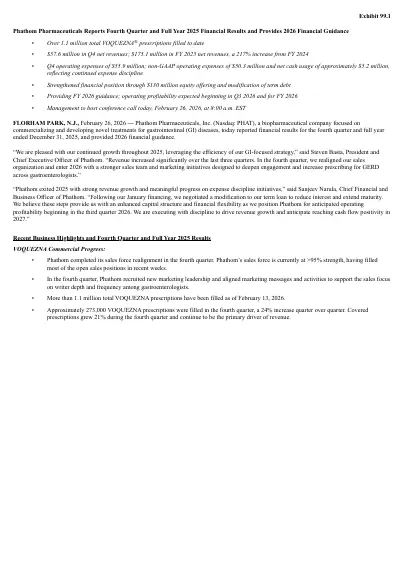
Beginning the update today with our financial highlights for Q4 and full-year 2025, our results are in line with our pre-announced estimates from January and incrementally a bit better on expenses and on cash usage. We've delivered on the plan we set forth on our May earnings call and reiterated on our earnings calls in August and in October.
Net revenues were $175.1 million for the full-year 2025, representing 217% year-over-year growth. Q4 sequential quarterly growth was solid during a period of sales force alignment, as we had discussed in our October call.
In August, we guided to $165 million to $175 million for 2025 revenue. We updated that in October to $170 million to $175 million, narrowing it to the top half of the range.
Ultimately, we delivered at the high end of that range. Our Q4 revenue was $57.6 million, in line with our pre-released January estimate of $57 million to $58 million.
Cash operating expenses, excluding stock-based compensation, were $50.3 million for Q4, better than both the less than $55 million target we guided to and to our pre-announced range of $51 million to $53 million. We delivered solid growth through the last three quarters of 2025 while cutting quarterly cash operating expenses by nearly 50%.
Our net cash usage for Q4 of 2025 was approximately $5 million. That's 64% lower than Q3 and consistent with our expectations of reaching operating profitability beginning in Q3 2026 and cash flow positivity in 2027.
We've taken significant steps to enhance our capital structure. Our goals were, one, to reduce any financing overhang or potential risk stemming from repayment obligations or cash covenants, and two, to reduce our interest expenses.
In 2025, we got the fundamentals of our business in order, growing revenue and reducing expenses. That improved financial profile enabled us to complete a successful equity offering in January and to renegotiate our debt terms as we announced today.
We have modified our term loan agreement to extend the maturity date, which had previously been December of 2027, we've extended it to February 2029, and we've reduced our interest expense obligation and reduced the total outstanding principal amount. As a result of these capital structure enhancements, we believe our current cash, plus the cash that we're expect to generate from operations in the coming years, will be sufficient to meet all obligations under both our term loan and our revenue interest financing agreements.
Sanjeev will provide further details on these items and take you through our 2026 guidance. I'm very proud of our operating and financial progress these last 12 months.
The entire Phathom team is dedicated to our objectives of growing revenue while being disciplined on expenses. We're exhibiting strong momentum, which we expect to carry forward throughout 2026.
A few quick notes on our commercial progress. I said before how fortunate we are to be able to positively impact the lives of so many patients.
Through February 13th, over 1.1 million VOQUEZNA total prescriptions have been filled to more than 230,000 patients. We believe we're just starting to penetrate an enormous market.
About 65 million patients have gastroesophageal reflux, of which 40% experience inadequate symptom relief from PPIs. About 273,000 prescriptions were filled in Q4 alone.
174,000 of these were covered prescriptions, growing 21% quarter-over-quarter and representing approximately 64% of the total prescriptions filled in Q4, while 99,000 were filled as cash-pay prescriptions. Covered prescription volume drives our revenues, while cash-pay prescription volume improves physician perception of access and makes it easier for physicians to prescribe VOQUEZNA with confidence that their patients will be able to get the drug.
Most importantly, both paths enable us to help patients in need of VOQUEZNA. Additionally, in November, we turned on a GoodRx offering, providing an alternative payment option for patients filling VOQUEZNA prescriptions sent to retail pharmacies.
Looking forward, we have confidence in 2026 growth. We just completed our national sales meeting, and the sentiment from the field is terrific.
We start March with more than 285 of our 300 sales positions currently filled, a nearly full-strength sales organization. Our strategy to drive depth and frequency of calls to gastroenterologists is solid, and we believe it will ramp utilization and writing frequency among GIs treating GERD.
2026 will be an important year for us as we drive sales growth and transition to profitability. Overall, we continue to deliver as we guided on each of our previous earnings calls.
Our 2025 results ended at the better ends of our revenue and cash operating expense guidance ranges we communicated, and we believe we're on track to transition operating profitability beginning Q3 of this year and to reach cash flow positivity in 2027. We've taken important steps to enhance our capital structure and mitigate any covenant or repayment concerns.
The sales force is nearly full strength and energized following our national sales meeting. We're well-positioned to execute and deliver on our strategy in 2026.
I'll now turn the call over to Sanjeev to take you through our detailed financial updates.
Sanjeev Narula
Thank you, Steve, and hello, everyone. I'm pleased to report our Q4 and full-year 2025 results today.
I'm encouraged by the changes we've made throughout 2025 and excited about what's on the horizon for '26 and beyond. We have a lot of important updates on the financial front, let me get right into it.
Steve provided some top-level highlights for the quarter, and I'll provide additional color commentary. Our revenues for Q4 of $57.6 million were consistent with pre-release and demonstrated 16% sequential quarterly growth.
Aligned with the full year, the quarter also came in at the very top end of our guidance. As always, covered script volume primarily drive our revenue, while contribution from cash scripts and inventory dynamics remain minimal and consistent.
Our gross-to-net for Q4 came in at the higher end of 55% to 60% range we provided last quarter as a result of shifting rebating mix. Our full-year gross-to-net was within our expectations.
Our gross margin remained consistent in Q4 and full year at approximately 87%. After accounting for quarterly cash expenses, we reported a loss from operations, excluding stock-based compensation, of approximately $320,000, a 95% improvement compared to Q3.
As you can see, this is a meaningful change in the operating profile of our company. As always, please refer to this morning's press release for reconciliation between non-GAAP measures and their most directly comparable GAAP measures.
Q4 cash operating expenses were about $50 million, notably favorable than the less than $55 million guidance we set forth earlier last year due to continued expense discipline. Similarly, our full-year cash operating expenses of approximately $284 million came in at low end of the range we provided on our Q3 call.
We ended the year with about $130 million in cash and cash equivalents, which roughly reflects a $5 million cash usage in Q4 and signals a very clear path to operating profitability this year. Now let me turn to the enhancement in our capital structure.
In January, we improved our capital structure via an oversubscribed equity offering, and today we're announcing a modification of our term debt. As a result of these deliberate steps, we believe we now have a cost-effective and sustainable capital structure to meet our business needs and all of our debt obligations.
The offering raised $130 million in gross proceeds, which brought our cash balance just north of $250 million at the start of the year. I'm pleased to announce today that we have successfully modified the terms of our outstanding term facility, which we believe will greatly benefit the company going forward.
We reduced the remaining principal to $175 million outstanding and paid certain end-of-term fees and accrued paid-in-kind amounts from the original agreement. In total, we used approximately $56 million of our cash balance to streamline this facility.
Additionally, we were successful in lowering the interest rate from 12% to 9.85%. Lastly, we extended the loan maturity date from December 2027 to February 2029.
Partial monthly repayments will begin in 2028, which are anticipated to reduce the outstanding principal as well as our interest expenses. We expect we will be generating positive operating cash flow beginning in 2027 in advance of these repayment obligations.
Overall, these modified terms reduce our interest expense, remove near-term payment hurdles, and provide greater financial flexibility. Following our capital structure enhancement, we believe our cash on hand, along with anticipated future cash flow from operations, will be sufficient to invest in our operations as needed and to satisfy all liquidity covenants and repayment obligations.
For complete clarity on our covenant, we expect our highest cash hold requirement between now and September 30th, 2027 will be approximately $120 million. The cash hold requirement is derived from our covenant in our revenue interest financing agreement, which becomes effective for the first time on October 1st, 2026.
All cash hold requirements relating to our term debt are substantially lower than those from our revenue interest financing agreement. Beginning October 1st, 2027, we expect revenue interest financing agreement covenants will require that we temporarily hold a modestly higher cash balance, which will decline thereafter as revenues increase and we make additional royalty payments.
To be clear, the cash hold covenants between the term debt and revenue interest financing agreements are not additive. We manage our liquidity to whichever covenant is the highest at any given point in time.
Rest assured, for all these periods, we believe our cash on hand of approximately $190 million following our term debt modification and our anticipated cash generated from operations beginning in 2027 will be sufficient to satisfy all covenants at all times. We refer you to our 10-K filed earlier this morning for more information.
While on the topic of our 10-K, I'd like to flag that in this year's document, we updated the business section and risk factors to reflect the company's transition to a primarily commercial entity. While a comparison against prior years will show significant text changes, I want to be clear that we believe important updates have been covered during this earnings call and in this morning's press release.
Now I'd like to move to our 2026 guidance. With our GI-focus strategy taking hold and our financial position enhanced, we're ready to deliver in 2026.
Today, we're issuing guidance in several financial metrics which reflect that sentiment. Before I get into the numbers, I'd like to provide clarity on the accounting-related explanatory note you saw in this morning's press release.
Beginning January 1st, certain third-party charges will be included in cost of goods sold instead of gross-to-net adjustments. All things equal, net revenue will be higher as a result of costs moving from gross-to-net adjustments to cost of goods sold, leading to a mostly net-neutral effect on our gross profit line in our P&L.
Importantly, this change is simply a different classification of these costs and does not impact the underlying operations of our business. We are estimating an approximately $17 million to $20 million shift in 2026 between two line items, which is reflected in following guidance.
We anticipate 2026 net revenue will be $320 million to $345 million, including the estimated effect of the classification change I just described. As for gross-to-net, we believe the discount will be between 55% to 59%.
We anticipate gross margin will be approximately 80%. As for spend, we are anticipating cash operating expenses, excluding stock-based compensation, of $235 million to $255 million, which at midpoint reflects a 14% decrease compared to 2025 results.
Now a few comments about the cadence of these items over the course of 2026. We believe revenue will exhibit a similar pattern to last year, with approximately 40% being achieved in first half and approximately 60% being achieved in second half, with quarter one being the soft quarter due to typical seasonality.
We expect expenses will be relatively stable on a quarterly basis, but will reflect a modest step-up from where we exited Q4 2025, accounting for nearly full-strength sales team, new marketing initiatives, and full-year cost of our EoE Phase 2 trial. Based on anticipated revenue, gross profit, and cash operating expenses, we anticipate achieving operation profitability, excluding stock-based compensation, by Q3 and in total for full-year 2026.
Finally, we believe we will achieve cash flow positivity in 2027. In summary, our financial profile has transitioned meaningfully, and I'm excited for this next phase.
This quarter results were strong, coming in at the better end of our guidance we previously provided. Our operational momentum is solid, which gives me confidence in our 2026 revenue trajectory.
I feel confident in our financial position and believe we have the resources we need to execute the plan and deliver on the guidance ranges we set forth today. With that, I'll now turn the call back to Steve for his closing remarks.
Steve?
Steven Basta
Thank you, Sanjeev, for the detailed financial review. I would like to extend my thanks to everyone at Phathom for their extraordinary efforts throughout 2025.
I was able to meet many of our sales team members during our recent national sales meeting, and I'm heartened by their dedication and exceptional talent. Our transition to focus on gastroenterologists and to reach operating profitability is well underway.
Thank you also to our shareholders for your support and confidence. We're dedicated to delivering value to reward your investment.
Operator, please open the line for questions.
Operator
Yes, sir. Ladies and gentlemen, if you have a question or comment at this time, please press star one one on your telephone keypad.
If your question has been answered or you wish to remove yourself from the queue, simply press star one one again. Again, if you have a question or comment at this time, please press star one one on your telephone keypad.
Please stand by while we compile the Q&A roster. In the interest of time, we ask that you please limit yourself to one question, one question only, and you may requeue up for questions as time permits.
Our first question or comment comes from the line of Kristen Kluska from Cantor Fitzgerald. Ms.
Kluska, your line is now open.
Kristen Kluska
Hi, everyone. Congrats on a really strong end of the year and the work you were able to do around the interest, definitely very favorable here.
The question I have for you this morning is just recognizing it's still very much early days, what can you tell us about the early signals that you're seeing from this strengthened sales force and strategy, especially coming out of that meeting? Are you seeing that more of the GIs that were new to your strategy are converting, and are you also seeing some early signals of growth within those current GIs where you added more touch points?
Thank you.
Steven Basta
Kristen, thanks so much for the kind thoughts and for bringing us what I think is the most important topic, actually, which is the core focus on our GI call point is the fundamental element of our growth strategy, and we are seeing consistent signs of momentum. It's interesting, as you characterize the two different paths of sort of converting new writers versus growing existing writers, virtually all gastroenterologists, not quite all, but a very high percentage of gastroenterologists have already written a script for VOQUEZNA.
We've got broad penetration within the gastroenterology community, both among physicians and among APPs, with high conversion success already. What we focus on, all of our sales force messaging in the context of our national sales meeting, in the context of the conversations that the regional managers are having with the territory sales representatives, is all about how to grow writing frequency.
We have what we refer to as an adoption ladder, where physicians try the product and then we are trying to improve their consistency of writing and they become consistent writers, and then we try to improve their consistency of writing, then they become adopters, and so on. As we grow in terms of the frequency of the physician writing an NRX for VOQUEZNA, and what we are seeing is very clear trends on those adoption ladders associated with physicians moving up in categories.
A tried physician will only have written two NRXs in the last quarter, a consistent physician will have written six or more weeks in the last quarter, etc., and we are seeing physicians move from one category to the next consistently, where on one of the metrics we'd only had 400 or 500 physicians last summer that were in the upper categories, now we've got well north of 2,000 physicians in the upper categories. We're seeing that adoption rate among not just the highest frequency writers, but very broadly within the GI community increasing, and that's the focus of all of our sales force conversations.
That was the focus of our national sales meeting, is how do we take physicians through that adoption ladder. It's the focus of each of our coaching conversations, and we're seeing clear evidence of it in our writing pattern.
One of the metrics that I find to be helpful as we think about the long-term opportunity for this product is what is the rate of adoption we've achieved among the top few hundred writers, and there we're already seeing that we're now passing on average 20% penetration in terms of their PPI volume being converted to VOQUEZNA, and when we get to 20% conversion across the broader GI community, that's where we're approaching $1 billion of revenue potentially in GI, and that's clearly where we're headed over the next few years.
Operator
Thank you. Our next question or comment comes from the line of Annabel Samimy from Stifel.
Ms. Samimy, your line is open.
Annabel Samimy
Hi. Thanks for that color.
Just following on from that comment, in the territories that you already have been pretty well-aligned as far as the focus on GIs, do you have any sense yet of the dynamic of patients transitioning back to primary care, if you're starting to see pull-through in some of those more mature accounts? Just curious to see if that dynamic, or if you've seen any pick-up in the primary care area organically from that effort.
When everyone is on board and humming, do you expect an inflection, or is this just a steady growth throughout the year? Thanks.
Steven Basta
Annabel, that's a really important component of the long-term growth path is building beyond just GI to capture the return of patients to primary care and the growth there. Candidly, we've not looked at it, at least I've not looked at it, I know our sales team is doing much more granular work on a physician-by-physician basis, at the specific referral patterns for specific gastroenterologists to see their referring physicians and how they've adopted.
I've looked at it much more broadly for the entire universe of primary care physicians, and we are seeing an uplift in primary care prescribing volume on a broad basis. The granularity that you're describing is very much an analysis that over time we will do much more frequently.
The near-term focus is on that core gastroenterology conversion point, and the expectation, exactly to your point, is over the next 6, 12, 18 months, we're going to see those patients returning to primary care and see those growing, and we'll be looking at that metric more precisely. What we are seeing on a broad basis when we look at the total prescribing in GI and the total prescribing in primary care is an uplift in both, even though the majority of our sales force time is going into GI, that uplift broadly in primary care prescribing volume would suggest that we are seeing exactly that effect.
Was there a second half to your question, or did that capture it?
Annabel Samimy
Expectation for any inflections once everyone is on board and humming.
Steven Basta
Oh, the inflection point question.
Annabel Samimy
We don't map out,
Steven Basta
we don't model out a specific inflection point. It's very hard to predict when does the slope change.
What we are driving toward is consistent growth month-over-month, quarter-over-quarter, because we're not trying to do a sea change kind of strategy at this point going forward. 2025 was very much a year of fundamentally shifting the strategy.
We were changing call points, we realigned sales territories, we went through some pretty significant change. 2026 is just going to be a year of heads-down execution.
It is making sure that we are doing all of the right things. We're getting into the right offices, we're calling on gastroenterologists with the right frequency, we are delivering really good messages every time we're calling on gastroenterologists, we're helping them with all of their access needs, we are working through the process of enabling them to write VOQUEZNA scripts more frequently, and that drives our growth.
We don't need to inflect at any one point to a specifically different strategy. What we need to do is just execute this playbook and execute it well quarter-over-quarter.
It's hard for me to predict exactly what the slope looks like on a quarter-by-quarter basis. I do expect that we're going to get steady growth.
Might it accelerate at some point in time? It's really hard to predict that.
What we're seeing is all the right signs of incrementally significant adoption among physicians and incremental success that our sales reps are having in each of these offices.
Operator
Thank you. Our next question or comment comes from the line of Dennis Ding from Jefferies.
Mr. Ding, your line is now open.
Anthea Li
Hi, this is Anthea on for Dennis. Thanks for taking our questions and congrats on the quarter.
First on Q1, do you expect sequential quarterly growth given the deployment of the expanded sales force, or are you seeing that seasonality plus the winter storms will still be headwinds here? Is there a plan to seek broader Medicare coverage for VOQUEZNA this year, and if that's baked into guidance?
Thank you.
Steven Basta
Anthea, I'll briefly address the first part and then I'll offer Sanjeev the opportunity if he wants to add more color on seasonality in this process. We're clearly seeing the typical seasonality that occurs, and the winter storms are clearly having some effect as well.
We've seen slow weeks whenever the entire country shut down because of an ice storm, that has an impact. We don't guide to revenue on a quarter-by-quarter basis with that granularity.
While we clearly acknowledge that Q1 is the weakest of the four quarters during the year, whether it's flat or up or down, we don't provide that quarterly guidance. What we've provided is full-year guidance, but the underlying metrics that we're seeing in terms of our sales call activity, the prescribing behavior of physicians, the growth patterns that we've been describing, all give us confidence in terms of where we're going to be on a full-year basis.
Sanjeev, if you want to chime in at all on the seasonality?
Sanjeev Narula
Yeah. I think you pointed out, Steve, that we don't provide quarterly guidance.
I think what I said this time, if you look in our kind of prepared remarks that we said earlier, if you look at the cadence of our business on a full-year basis, we'll be roughly a kind of same trajectory as we experienced in 2025. 40% of our top-line revenue will be in the first half of the year, approximately 60% in the second half.
As I said, Q1 is going to be the slowest quarter because of typical seasonality. I think that's kind of what we see.
What that exact number is going to be, obviously, you'll hear that on the first-quarter call that we talk about it. Clearly, it is the slowest and softest months because of typical seasonality.
Steven Basta
Right. Then the second half of your question, Anthea, I think was related to Medicare.
We're not anticipating a fundamental change in broad Medicare coverage, where we get coverage for all Medicare patients. What we are seeing is incremental Medicare prescriptions being covered either through medical appeals processes or through specific Medicare Part D plans.
As different Medicare Part D plans become more familiar with seeing VOQUEZNA prescriptions being submitted, they are beginning to cover those more frequently. We may see over time some increase in the number of Medicare scripts that are actually being processed and being covered.
It's not a broad coverage decision, nor do we anticipate that there's going to be any broad fundamental change in a broad coverage decision on a system-wide basis for the entire population of Medicare patients.
Anthea Li
Got it. Thank you.
Operator
Thank you. Our next question or comment comes from the line of Joseph Stringer from Needham & Company.
Mr. Stringer, your line is open.
Joseph Stringer
Hi. Good morning.
Thanks for taking our question. Just wanted to follow up on the previous question, looking at the IQVIA prescription data and that impact seasonality is.
Is the magnitude of the seasonality effect this cycle in line with your expectations, I guess all things considered? Maybe another way of asking, are there any nuances about the launch now with the refocused effort that would make it more or less sensitive to seasonality?
Thank you.
Steven Basta
Thank you for the question. It's really hard to characterize magnitude of seasonality one year versus another.
What we're seeing is very similar to the pattern that we saw last year in terms of January being particularly light, and then February is also light, and then by March last year it started to pick up, we would hope that that same pattern, not just hope, we actually expect that that same pattern is going to come to fruition because you get several uplifts in March. We're coming off of the national sales meeting, everybody's energized, we're going to have a full-strength sales organization, and physicians have had time to work through their plans, patients who have switched plans now have time to figure out how they're going to get the drug covered.
All of those things that create noise in January as everybody's switching to a new health plan gets worked out in the first month or two. That effect just is there every year for a branded product, and the specific magnitude of it varies by product.
We're starting to see what that pattern looks like for us, not seeing anything that's unusual in that regard. One thing that we have observed is the IQVIA-reported numbers seem to be somewhat greater underreporting versus our internal numbers than historic norms.
We think we've identified the cause of that and that that's going to work itself out, but there may be a little bit of extra softness or delta in the IQVIA-reported numbers versus what we're actually seeing. The softness is real in January and February, and we think it starts to improve meaningfully in March.
The other phenomenon that you cite is a real phenomenon, as Anthea's question also had suggested that winter storms clearly not just had an effect on us, had an effect on a whole bunch of companies in the context of the slowdown for a week in January and slowdown for a week in February in the Northeast. I don't want to overstate those.
I think the dominant effect is just the annual seasonality that we would expect to see every year.
Operator
Thank you. Our next question or comment comes from the line of Paul Choi from Goldman Sachs.
Mr. Choi, your line is now open.
Daniel Ni
Morning team, this is Daniel on for Paul. Thanks for taking our question.
We're curious about if you could provide colors on the proportion of prescriptions that are now filled through BlinkRx versus the new GoodRx that came online, and how is the economy of the channels versus the more traditional dispensary? Thank you.
Steven Basta
There's several different parts to that. Let me take GoodRx first.
GoodRx we just turned on in November, and what that is, already GoodRx had coupons on it for our co-pay support program. If someone is at a pharmacy with a retail script and they need to get co-pay support because their insurance co-pay is high, they can go to GoodRx, they can get our co-pay card, and in many cases bring down the co-pay amount significantly, and in some cases down to $25, which is our target co-pay where possible.
The other thing that we turned on with GoodRx is the opportunity to a cash-pay purchase through GoodRx, which actually still would get reported into the IQVIA script numbers because it would be dispensed from a retail pharmacy, but there's a $199 option for a patient to purchase that. That's intended really for a patient who either can't access the co-pay card because they're on a government plan, or for whom the co-pay would still be too high, would still be above $199, and it gives another alternative for a patient.
Those numbers are still relatively small. It's a very small percentage of the overall number.
It just got turned on in November. We'll give you a sense in future quarters if that grows to be a meaningful number, we'll give some color on that, but at this point it's a really small number.
It's not a driver of anything, but don't want anybody to be surprised that that option now exists. We're trying to provide multiple ways for a patient in different reimbursement circumstances in different access environments to be able to know that they're going to be able to get access to the product as reasonably priced as possible.
The percentage of scripts that are going through Blink, and I want to be sort of clear to distinguish between two things in this process. More than half of our prescriptions now in total are going through the Blink network to then be routed either as covered scripts to a pharmacy or as cash-pay scripts to be dispensed directly through the Blink network.
When a physician designates a prescription to go to Blink, Blink will first adjudicate whether or not the script is going to get covered. If it gets covered, it shows up in the IQVIA numbers.
It doesn't show up in our Blink cash numbers, even though Blink is an intermediary facilitated that process. About half of our scripts in total go to Blink, they get routed, if they get covered, they show up in the IQVIA numbers, if they don't, they show up in our cash numbers, and as we described, something on the order of 36% of our prescriptions now are Blink-dispensed cash scripts.
That's where the two different numbers are, that delta is scripts that are getting covered after they originally got sent to Blink. Matthew, did that address your question, or was there a second part to that?
Daniel Ni
That's fine. Thank you very much.
Steven Basta
That's all.
Operator
Thank you. Our next question or comment comes from the line of Chase Knickerbocker from Craig-Hallum.
Sir, your line is open.
Chase Knickerbocker
Good morning. Thanks for taking the questions.
Just a quick one. Steve, what inning do you think we are in as far as kind of getting reps to full productivity, or kind of where you expect them to be after kind of shifting the focus in the fall, but also kind of changing the lines of some of the geographical lines of a lot of these territories in the fall as well?
Where do you think we are as far as the inning there?
Steven Basta
Just to clarify, Chase, what inning of the sales force transition?
Chase Knickerbocker
Just as far as getting the sales force to full productivity, Steve. As far as full productivity,
Steven Basta
kind of
Chase Knickerbocker
with that transition in the fall.
Steven Basta
I think full productivity for a sales rep comes several months after the sales rep is on board, because there is a training process, there's a learning process. It takes a month or two to get to know the accounts in your territory and to schedule all of the lunch events.
We had a number of sales training classes that came in January, and then our national sales meeting in February. By March, April, all of those folks are hitting the ground.
They're hitting the ground immediately after their training program, but within a month or two they've met most of the accounts in their territory, and they've got their lunches scheduled, and they've got momentum within each of those accounts and you start to see the real impact. I would think we are to use the baseball analogy, at the seventh or eighth inning of that nine-inning process of sort of the sequence of events where the sales force gets to be fully effective.
Chase Knickerbocker
Sort of since that shift to focus in GI, have you seen kind of the increase in productivity that having more kind of condensed patient base at these prescribers would indicate, or do you think there's kind of additional efficiency that will continue to kind of harvest over the course of this year?
Steven Basta
It's interesting, even if the sales force is fully effective, you don't see the effect that day or that week or even that month in terms of sales, because the majority of our prescriptions come from prior patients who have been prescribed the product who are getting refills, physicians who have previously already adopted the product who are prescribing it to an incremental physician. What we're really doing is just moving the incremental adoption rate.
If you've sort of got a base 70%, 80% volume that's happening, you're really only impacting that 20%. Now, if you become 30% more effective, that 20% goes to 26%, but it's 26% on top of a base 80% that already exists there.
When you see greater effectiveness in our sales activities, you don't see an immediate change in revenue in a month. What you see is incremental effectiveness, but that incremental effectiveness is cumulative over time, because the increased conversions of patients in that month aren't just scripts that month, they are refilled the next month, and are refilled the next month, and are refilled the next month, and the incremental scripts the next month refill every month thereafter.
You see a cumulative growing effect. You don't have a sales force's activity turn into a sea change in revenue in that next month of revenue, if that makes sense, as sort of how these consistent use products end up building over time.
Chase Knickerbocker
Thank you for the thoughts, Steve.
Operator
Thank you. Our next question or comment comes from the line of Min Lee from Guggenheim Partners.
Mr. Lee, your line is now open.
Min Lee
Hi, guys. Thank you for the questions and congrats on the data.
One quick question for me. What is the company's long-term vision beyond VOQUEZNA?
Given that you guys have established this GI network, do you guys plan to utilize this network to consider maybe future partnership with companies that have already commercially-ready GI assets, or do you guys plan to maybe pursue any other indications beyond EoE? Thank you.
Steven Basta
Min, thank you for the question. At this point, the only new indication that we're pursuing actively is EoE for VOQUEZNA.
There are other indications and other populations that are of interest that we're evaluating. We've made no decisions.
For example, we did a Phase 2 trial for as-needed use, haven't made a decision yet about whether or not we wish to pursue that in a Phase 3 program. There are other populations that also could be of interest.
Our long-term growth plan, as we have indicated, is to build a GI company that will bring in additional assets. This year is very much a year of consolidating our execution plan, building deep relationships in every gastroenterology office.
The 300-person field force is going to have those deep relationships and is going to be fostering them and build a leverageable base that we could bring a second product into. We are also starting BD activities to explore what other products would make sense, either to bring in a commercial product potentially, or very possibly a Phase 2 or Phase 3 clinical-stage product that could launch in a 2030, '31, '32 time frame before we get to our LOE date, so that we're launching not just probably a product, but two or three products over the course of the next four or five years that would build out a GI pipeline.
We're starting those conversations. We have had people bring us several ideas that are interesting.
I don't feel any urgency that we need to distract our sales force with a second product right now. We just need to grow VOQUEZNA.
We need to just execute on our core activity set. We are actively thinking about what products would make sense to bring in and to launch over the next 2- to 5-year period of time, and that could mean products of various stages, from commercial down to Phase 2 stage.
It has to be launchable within the next 2 to 5 years so that it's launched before our LOE date in 2033 or '34.
Operator
Thank you. Our next question or comment comes from the line of Martin Auster from Raymond James.
Mr. Auster, your line is now open.
Martin Auster
Thanks. Congratulations on the successful 2025 and in particular the recent steps you guys have taken to strengthen the balance sheet.
Appreciate the comments you guys made on Q1 seasonality. I guess I was curious if the plan resets and other factors that kind of contribute to seasonality, do that drive an uptick in the rate of cash-pay patients you'd expect to see in the quarter?
Then also on the gross-to-net guidance that Sanjeev provided, curious if there's any trends that are assumed within that 55% to 59% range, or that metric is expected to be pretty steady overall throughout the year. Thanks.
Steven Basta
Thanks, Martin. Appreciate the kind thoughts on the questions.
I'll take the first half, which is around cash-pay, and the second half I'll give to Sanjeev in terms of GTN and sort of expectations. We would expect that we'll see some uptick in the amount of cash-pay patients.
I don't have any guidance on how much that is. I don't think it's going to be too significant in that process, but you'll see some patients who have a high-deductible plan where they will be able to get access to the product on a cash basis from Blink, and then as they work through their deductibles, they would then be able to get it covered at some later period.
You may see some movement in cash-pay percentage in the early months of each year. That's not just this year, that would just be in general of a pattern in this process.
We don't provide guidance on what that mix is going to be on a quarter-to-quarter basis, but that would be a typical feature of the seasonality patterns that one might expect. Separately, in terms of GTN and patterns and trends on GTN, Sanjeev, do you want to take that?
Sanjeev Narula
Yes, I'll take that, Steve. Thank you.
Martin, as you saw in 2025, we kind of narrowed the guidance, if you recall, at our Q3 call to 55%, 60%, and right through the last year we were kind of operating within that range. Quarter-to-quarter there are variations because your plan business may change from one quarter to the other.
Overall, it was very consistent and stable, and that's kind of what I expect. The guidance that we gave early this morning, 55% to 59%, overall for the full year will be within that guidance.
Quarter-to-quarter there could be changes, depending upon how the plan flows and the business flows from that perspective.
Martin Auster
All right. Thank you so much for the color, guys.
Sanjeev Narula
Thank you.
Operator
Thank you. Again, ladies and gentlemen, if you have a question or comment at this time, please press star one one on your telephone keypad.
Our next question or comment comes from the line of Matthew Caufield from H.C. Wainwright.
Mr. Caufield, your line is now open.
Matthew Caufield
Great. Hi.
Thank you, guys. We had one question on the landscape that came up from investors.
There's a separate private company with later-stage clinical development in non-erosive reflux disease and erosive esophagitis based on the P-CAB formulation. Just curious on your longer-term thoughts on any perspective entrants into the P-CAB space later into the future and maintaining VOQUEZNA's position.
Thanks again.
Steven Basta
Matthew, thanks so much for the question. I apologize, I muted for a second to cough.
I just have a little bit of a cold. I think you're likely referring to Sebela, which is a company that has tegoprazan in development.
There's actually an additional P-CAB that's in development, that's many years out. We clearly track competitive developments, all of the P-CABs.
Tegoprazan is a good product. We expect that it will go through the NDA process and they filed their NDA in January.
Reasonable to expect they may be approved by early 2027, but it's not really for us to predict exactly what that time frame is or what questions might arise. One of the things that we think about is how does this market evolve as a second entrant in the P-CAB space comes in.
It's interesting, there's one framework where a sort of a question can arise, are two P-CABs going to compete against each other? There's a different question, which is we're competing in a space of 110 million PPI prescriptions per year, and we've only done 1.1 million prescriptions overall since launch.
We're tracking now at a run rate that's running about a million prescriptions a year, we're at 1% of the PPI market. If a second entrant comes in, they're not going to be trying to take our prescriptions.
We're both going to be growing the P-CAB awareness in the context of the market where patients are on PPIs and are significantly in pain on PPIs. The entry of a second product in a new category actually does have a tendency to change the mindset of physicians, where it's no longer do I need to pay attention to this product if you're the first entrant, but it's do I need to pay attention to this category, and that increase in category awareness I actually think will accrue to our benefit, that the majority of prescriptions tend to go to the first entrant that has more history, with which physicians are more comfortable, that already has broad access.
The second entrant tends to grow the category broadly and tends to grow revenue for both parties in that process. We're actually thinking that it has a net positive effect on the P-CAB adoption broadly to have a second sales force out talking about P-CABs and how much value they can bring to a patient who is still in pain on a PPI.
We're looking forward to that broadening and that shift in mindset of physicians that you really do need to adopt PPIs. We think we've got a great product.
We know physicians have been really pleased with the effect this has for their patients, and patients who take this product love it. All of that is going to reinforce the fact that the lead product in the category gets the biggest uptick.
Matthew Caufield
Understood. That's really helpful.
I appreciate it. Congrats again on VOQUEZNA's trajectory.
It's great to see.
Operator
Thank you. I'm showing no additional questions in the queue at this time.
Ladies and gentlemen, thank you for participating in today's conference. This concludes the program.
You may now disconnect. Everyone, have a wonderful day.
Speakers, stand by.