Impinj, Inc.
Q3 FY2026 · Earnings Call TranscriptOctober 28, 2026
Operator
Welcome to the Impinj third-quarter 2026 financial results conference call and webcast. All participants will be in a listen-only mode.
Should you need assistance, please signal a conference specialist by pressing the star key followed by 0. After today's presentation, there will be an opportunity to ask questions.
To ask a question, you may press star and then 1 on a touch-tone phone. To withdraw your question, you may press star and 2.
Please also note today's event is being recorded. At this time, I'd like to turn the floor over to Mr.
Andy Cobb, Vice President, Corporate Finance and IR. Please go ahead.
Andy Cobb
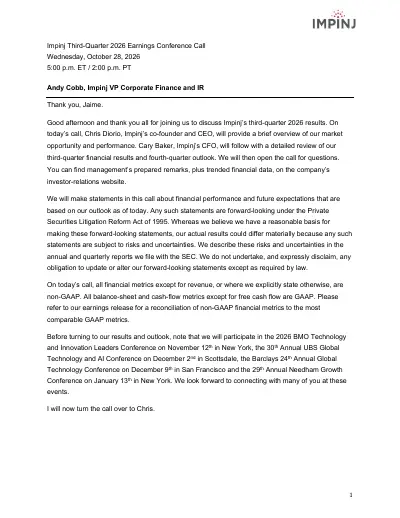
Thank you, Jamie. Good afternoon, and thank you all for joining us to discuss Impinj's third-quarter 2026 results.
On today's call, Chris Diorio, Impinj's Co-Founder and CEO, will provide a brief overview of our market opportunity and performance. Cary Baker, Impinj's CFO, will follow with a detailed review of our third-quarter financial results and fourth-quarter outlook.
We will then open the call for questions. You can find management's prepared remarks plus trended financial data on the company's Investor Relations website.
We will make statements in this call about financial performance and future expectations that are based on our outlook as of today. Any such statements are forward-looking under the Private Securities Litigation Reform Act of 1995.
Whereas we believe we have a reasonable basis for making these forward-looking statements, our actual results could differ materially because any such statements are subject to risks and uncertainties. We describe these risks and uncertainties in the annual and quarterly reports we file with the SEC.
We do not undertake and expressly disclaim any obligation to update or alter our forward-looking statements except as required by law. On today's call, all financial metrics except for revenue or where we explicitly state otherwise are non-GAAP.
All balance sheet and cash flow metrics except for free cash flow are GAAP. Please refer to our earnings release for a reconciliation of non-GAAP financial metrics to the most comparable GAAP metrics.
Before turning to our results and outlook, note that we will participate in the 2026 BMO Technology and Innovation Leaders Conference on November 12th in New York, the 30th Annual UBS Global Technology and AI Conference on December 2nd in Scottsdale, the Barclays 24th Annual Global Technology Conference on December 9th in San Francisco, and the 29th Annual Needham Growth Conference on January 13th in New York. We look forward to connecting with many of you at these events.
I will now turn the call over to Chris.
Chris Diorio
Thank you, Andy, and thank you all for joining the call. Our third-quarter results were strong, with endpoint IC revenue and unit volumes, as well as total revenue, all setting new quarterly records.
M800's market strength, resilient retail demand, growth at our lighthouse accounts, and Gen2X momentum all contributed to the record results. Looking forward, we see those trends continuing.
Starting with silicon, M800 demand, the custom ASIC conversion at our supply chain and logistics end user, and strength at our visionary European retailer anchored our strong unit volume growth. We met, but were unable to get ahead of market need, despite us ramping our back-end wafer post-processing throughput as quickly as we could.
We will continue ramping our back-end at an elevated pace for at least the next two quarters to meet the growing demand. With strong support from our wafer foundry partner, we remain confident in our ability to deliver.
Reader IC revenue also beat our expectations and was our fastest-growing product line, driven by enterprise pull for partner readers. Looking to the fourth quarter, we anticipate strong year-over-year unit volume and revenue growth for both endpoint and reader ICs, including returning specialty endpoint IC revenue.
Turning to solutions, today's revenue still derives primarily from hardware sales. Our software is in beta at our lighthouse accounts and not yet generating meaningful revenue.
As said, the enterprise need for our software is acute, with very tight end-user-driven delivery schedules, confirming our conviction in the long-term software opportunity. Third-quarter reader and gateway revenue was strong, led by sales into those lighthouse accounts.
We expect those accounts to burn down reader and gateway stock in the fourth quarter, despite us having a strong pipeline, fourth-quarter deliveries will not see the typical seasonal step-up. Looking into 2027, we expect that timing to reverse.
Even as we invest in and drive solutions in and beyond our lighthouse accounts, I encourage you to not lose sight of the fact that our solutions efforts at those accounts generate sustained sales across our entire platform, today contributing more than 20% of our total revenue. Turning to food, as we highlighted last quarter, there are four distinct types of food programs: store replenishment, in-store inventory, loss identification, and automated self-checkout.
The third quarter added a large new logo in replenishment and another in inventory. We are closely engaged with the former on operational improvements to reduce out-of-stocks and food spoilage.
Although it is still early days, we expect the solution to require our entire platform. For those of you who may have missed Kroger's recent Investor Day, their bakery pilot delivered nearly 70% faster inventory counts, 50% lower waste, approximately 200 basis points of sales lift, and nearly 50 basis points of share gains in the category.
With trusted item-level data, in our parlance, physical intelligence, Kroger is creating a better store routine with lower waste, higher availability, and more sales. We launched physical intelligence in September, spotlighting how our platform provides real, trusted item data to enterprise AI systems.
Physical intelligence tells enterprises what items they have and when and where the items are moving, enabling the enterprises to take action and, by learning from those actions, improve their business outcomes. Building on that launch, I'm thrilled to announce that Aileen Ryan, the outgoing president of the RAIN Alliance, will join us on December 1st as Chief Commercial Officer.
In her 4 years leading the alliance, Aileen built deep ecosystem and enterprise connections that will serve us well. She also brings 20-plus years of engineering and leadership experience at technology companies.
Aileen will lead lighthouse account success as well as our solutions go-to-market, including partnerships and whole solutions delivery. She will partner closely with Gahan Richardson, now EVP of Product Management, and Carl Brasek, our SVP who leads go-to-market for our endpoint and reader ICs, readers, gateways, and solution engines.
In closing, our strong market and product leadership, solutions focus, and enterprise engagements continue driving record results. Our secular growth opportunity in retail, supply chain and logistics, food, and a long tail of other applications continues expanding.
Our solutions pipeline also continues growing, with exciting emerging opportunities in food. As we continue driving our bold vision, I remain confident in our market position and energized by the opportunities ahead.
As always, before I turn the call over to Cary for our financial review and fourth-quarter outlook, I'd like to thank every member of the Impinj team for your tireless effort. I feel honored by my incredible good fortune to work with you.
Cary?
Cary Baker
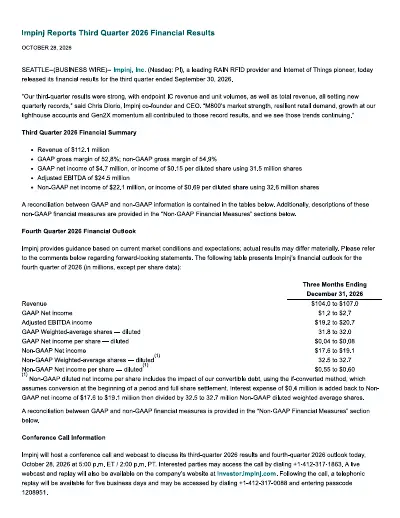
Thank you, Chris, and good afternoon, everyone. Third-quarter revenue was a record $112.1 million, up 3% sequentially from $108.4 million in second-quarter 2026 and up 17% year-over-year from $96.1 million in third-quarter 2025.
Notably, this quarter's revenue exceeded last quarter's record and did so without the benefit of licensing revenue. Third-quarter endpoint IC revenue was a record $97.3 million, up 1% sequentially from $96.4 million in second-quarter 2026 and up 24% year-over-year from $78.8 million in third-quarter 2025.
Excluding the $17 million second-quarter licensing revenue, endpoint IC product revenue grew 23% sequentially, exceeding our expectations. Looking forward, we expect a modest sequential decline in fourth-quarter endpoint IC revenue, yet on the favorable side of typical seasonality.
Third-quarter systems revenue was $14.8 million, up 23% sequentially from $12.0 million in second-quarter 2026 and down 15% year-over-year from $17.3 million in third-quarter 2025. Systems revenue exceeded expectations, with strength across all product lines.
Looking forward, we expect fourth-quarter systems revenue to decline sequentially for the reasons Chris cited. Third-quarter gross margin was 54.9%, compared with 60.9% in second-quarter 2026 and 53.0% in third-quarter 2025.
The sequential decline was driven primarily by licensing revenue. The year-over-year increase was driven primarily by endpoint IC product mix, specifically a higher contribution from M800.
Excluding the licensing revenue, third-quarter product gross margin increased 130 basis points sequentially, driven primarily by M800. Looking forward, we expect fourth-quarter gross margin to again increase sequentially, driven primarily by specialty ICs and M800.
Total third-quarter operating expense was $37.0 million, compared with $35.3 million in second-quarter 2026 and $31.8 million in third-quarter 2025. Operating expense met expectations.
Research and development expense was $21.5 million. Sales and marketing expense was $7.6 million.
General and administrative expense was $7.9 million. Looking to the fourth quarter, we expect operating expense to increase sequentially.
Third-quarter adjusted EBITDA was $24.5 million, compared with $30.7 million in second-quarter 2026 and $19.1 million in third-quarter 2025. Third-quarter adjusted EBITDA margin was 21.9%, well within the long-term range we provided at our 2023 Investor Day.
Third-quarter GAAP net income was $4.7 million. Third-quarter non-GAAP net income was $22.1 million, or 69 cents per share on a fully diluted basis.
Turning to the balance sheet, we ended the third quarter with cash, cash equivalents, and investments of $228.3 million, compared with $263.7 million in second-quarter 2026 and $265.1 million in third-quarter 2025. Inventory totaled $83.4 million, down $8.1 million from the prior quarter.
Third-quarter capital expenditures totaled $5.0 million. Free cash flow was $20.6 million.
Before turning to our guidance, I want to highlight a few items specific to our results and outlook. First, in September, when our 1.125% convertible notes due May 2027 became callable, we opportunistically repurchased $56.3 million aggregate principal using a mix of cash and shares.
This repurchase highlights our ongoing commitment to minimize dilution, in this case by roughly 300,000 shares, as we reduce our convertible debt. Second, we elected cash settlement for our capped call that matures in fourth-quarter 2026, increasing our flexibility to opportunistically manage our remaining convertible debt.
We now include the value of that asset, roughly $49 million, on our third-quarter balance sheet as a current asset. Third, as Chris highlighted, our growing endpoint IC demand requires additional back-end investment, specifically focused on throughput, site diversification, and capacity.
We expect capital expenditures to step up in first-quarter 2027, with overall 2027 capital intensity back in line with our long-term model after lower spend in 2025 and 2026. Finally, after a multiyear drought, we anticipate modest specialty endpoint IC revenue in fourth quarter and into 2027.
That revenue is gross margin accretive. Turning to our outlook, we expect fourth-quarter revenue between $104 million and $107 million, compared with revenue of $92.8 million in fourth-quarter 2025, a year-over-year increase of 14% at the midpoint.
We expect adjusted EBITDA between $19.2 million and $20.7 million. On the bottom line, we expect non-GAAP net income between $17.6 million and $19.1 million, reflecting non-GAAP fully diluted earnings per share between 55 cents and 60 cents.
In closing, I want to thank the Impinj team, our customers, our suppliers, and you, our investors, for your ongoing support. I will now turn the call to the operator to open the question-and-answer session.
Jamie?
Operator
We will now begin that question-and-answer session. To ask a question, you may press star and then 1 on your touch-tone phones.
If you are using a speakerphone, we do ask that you please pick up the handset before pressing the keys to ensure the best sound quality. If at any time your question has been addressed, you would like to withdraw your question, you may press star and 2.
As a courtesy to others, we do ask that you please limit yourselves to one question and one follow-up. If you do have additional questions, please requeue, and we will take as many questions as time allows.
At this time, we'll pause momentarily to assemble the roster. Our first question today comes from Harsh Kumar from BMO.
Please go ahead with your question.
Harsh Kumar
Yeah. Hey, guys.
Congratulations. Awesome guidance, awesome results.
First, I wanted to better understand maybe some more details on the driver for significantly less than normal seasonality. Historically you're down 5% to 10%, and I just wanted to understand which particular segments or maybe if you want to get into it, which particular customers might have driven the better than normal seasonality.
Then I've got a follow-up. Thanks.
Yeah.
Cary Baker
Hey, Harsh. This is Cary.
I think I'll actually take that one.
Chris Diorio
Harsh, I'm going to start by saying thank you for your comments, Harsh. Go ahead.
Harsh Kumar
Thank you.
Cary Baker
Harsh. Our endpoint IC bookings strength continued in Q3, not quite at the level of Q1 and Q2 where we set a record and then reset the record, but still very strong with a book-to-bill greater than 1.
We see several drivers of that strength. First, after a prolonged period of softness, we continue to see encouraging signs from retail.
New programs continue rolling, existing programs continue expanding, the retail consumer remains resilient, and retail sales overall continue to be growing. Then second, in supply chain and logistics, our second-large supply chain and logistics customer conversion to the custom IC was essentially completed in the third quarter, and we still have the international expansion on the horizon.
All of those factors are leading in. I think the other thing that I would add to the strength on Q4 revenue guide and being at the more favorable end of seasonality is we're also seeing the specialty IC revenue return, and we haven't had that in a while.
It's modest, but it is certainly helping that equation.
Chris Diorio
I'll just say a little bit more, Harsh. You also asked what segments.
Cary mentioned retail. It's kind of broad-based as well.
We see strength in supply chain and logistics, growing opportunities in food, as well as M800 market strength. There's not one particular area I can point you directly to.
It's broad-based demand.
Harsh Kumar
Hey, guys, congratulations on I think you added two new customers that you talked about in food. I think two new logos is what you said.
Maybe you could help us understand the size and the scope of these customers relative to the ones you're dealing with now.
Chris Diorio
Harsh, I'd say that the two logos are two logos. Didn't directly cite them as both customers.
They're both pretty early. One of them we're engaged directly with.
They are of the same size and magnitude as the existing ones that we have mentioned publicly or that you know about publicly. I can't cite their name or what we're doing with them, but it is a direct solutions engagement to solve some of their problems on replenishment and food freshness.
We're excited about that opportunity. It's very early days, but we believe that solving their problems will be a whole solutions play for us and require our entire platform.
More on that opportunity as we get going. It's obviously very early days, but exciting and corroborates the overall food opportunity that we see expanding.
Huge opportunity. The bigger they are, the slower they end up ramping.
With all the logos in food now that are engaging, we feel really positive about the food opportunity next year and beyond.
Harsh Kumar
Thanks, guys.
Cary Baker
Thanks, Harsh.
Chris Diorio
Thanks, Harsh.
Operator
Our next question comes from Jim Ricchiuti from Needham & Company. Please go ahead with your question.
Hi,
Jim Ricchiuti
thanks. Good afternoon.
I just want to hopefully get a better understanding of what you're seeing in terms of the reader and gateway portion of the business. You talked about strong sales in Q3.
Were there pull-ins that occurred because it sounds like we're not going to see the normal seasonality in Q4? If you could, just spend a moment on what may be transpiring in that part of the business.
Cary Baker
Yeah. Hey, Jim.
This is Cary. Thanks for the question.
I think the biggest thing that we're seeing in Q4 systems guide is that project timing has shifted a couple programs to the right that we previously expected in the fourth quarter. Systems was strong in Q3 across all of our product lines, and that really goes to the broad strength that Chris was highlighting earlier.
The gap in Q4 is the project timing of one of our enterprise deployments. As you think about seasonality, we're not going to hit the typical seasonal lift in Q4, but I think that reverses course in 2027 or in the first part of 2027.
Where we typically are down in the first quarter of 2027, we may be more flattish in the first quarter because of that timing reversal.
Chris Diorio
Jim, I'd like to say one more thing about systems. The way I think about our systems business is that it's the anchor that allows us to win enterprises, and with those wins, drive endpoint IC share, Gen2X pull, and going forward, gives us an opportunity to drive software sales.
Jim Ricchiuti
Okay. Thank you.
Thanks for clarifying that as well. Maybe just need some additional clarification.
When you say you were unable to get ahead of the market need, are you saying that you would have been able to ship more product had it not been for some of the challenges at the back-end post-processing part of the business? I'm not entirely clear on what happened there.
If you could spend a moment on that?
Chris Diorio
I'm happy to, Jim. If you look at my prepared remarks, I said that our back-end ramp is at least a three-quarter effort: the Q3 that we just went through and the two quarters ahead.
I also said we see market demand continuing. I encourage you to think about not just one quarter, but rather about us meeting our customers' multi-quarter supply needs and growing in market with them.
We're looking across at least three quarters and pacing our deliveries to meet the customer need, but making sure that we meet the customer need so we can grow in market. I guess while I have the chance here, I'm going to say just a little bit more there to drive some clarity about the back end.
We have sufficient capacity in the back-end semiconductor processing steps where we own the equipment. Our shortcoming or kind of where we're struggling to get capacity is in the shared process steps where we buy that capacity.
We're getting good support from our post-processors, no complaints there, but capacity in those steps is just tight because of the overall semiconductor market. We're also investing to own some of those process steps, which is where Cary said that our capital spend is going to increase going forward in line with our long-term model, whereas it has been down for the past 2 years.
Jim Ricchiuti
Okay. That's clear.
Thank you, Chris.
Chris Diorio
Thanks, Jim.
Operator
Our next question comes from Chris Rolland from Susquehanna. Please go ahead with your question.
Chris Rolland
Hi. Thank you for the question.
Just following up on the supply side of things. Just to be clear, are you talking about front-end capacity and owning?
Chris Diorio
No, Chris, we're talking about back-end. We have sufficient wafer supply.
We're getting good support from our wafer foundry partner. This is the back end, the post-processing.
Once we get the wafer, the thinning, bumping, dicing, testing, all those things that we have to do to the wafer to make it usable by our partners to take a bare IC and put it down on a label.
Chris Rolland
Oh, I see. Okay.
Got it. Then what has happened to lead times for your products and backlog just given the tightness?
Cary Baker
Chris, this is Cary. The backlog has definitely gone up.
We've had strong bookings throughout the year. Customers are ordering into Q1 already, so that explains some of the booking strength.
That's not every customer, but we do have backlog into the first quarter.
Chris Rolland
Okay. Thank you.
Then lastly, just for you, Chris, if you could just kind of speak more broadly about 2027 and the drivers of growth there, what you're most excited for, particularly in terms of end markets, what might be needle-moving as we think of growth at the margin for 2027?
Chris Diorio
Chris, I'm going to lean in and tell you where I'm most excited. If you look at where we engaged closely with our lighthouse accounts over the past few years, and with those accounts built solutions for and with them, the results are really nothing short of amazing.
Think about our visionary European retailer, our second-largest North American supply chain and logistics end user, our Asian retailer. The results they're delivering in market are just fantastic, and the technology advancements they've made are just fantastic.
Today, we are, quite frankly, oversubscribed with new enterprises who see those results and are asking for our help to do similar things for them. What I'm most excited about is our efforts to build repeatable solutions that we can drive more broadly into market and repeat some of our solution successes.
Are we there today? No.
Will we make progress next year? Absolutely.
That's where I'm most excited and where I'm pushing to drive those repeatable solutions that create pull for our entire platform.
Operator
Great. Thank you very much, Chris.
Chris Diorio
Thank you.
Operator
Our next question comes from Guy Hardwick from Barclays. Please go ahead with your question.
Nick Igneri
Hi, this is Nick Igneri on for Guy. I just wanted to ask about software.
It's still in beta, but I think you described customer delivery schedules as very tight. What milestones need to occur before software becomes commercially available, and then when can we start to see a contribution to revenue?
Chris Diorio
I'll take the first part of the question. We're on very tight delivery schedules.
We're still in beta. Because we are delivering enterprise-grade software that needs to be fully hardened, we're not rushing it.
Given that we're in beta, the time frame for us to go to full GA, at least for the first part of our software deliveries, is measured in months, not quarters. Cary?
Cary Baker
I would say that the timing of revenue will obviously follow that. Our expectations are aligned with our customers.
I think the revenue impact in 2027 is probably modest at first, and then, as we grow with our enterprise end users, there's a real opportunity for us to grow from that.
Nick Igneri
Great. Thanks.
That's helpful. Then maybe just on specialty endpoint IC revenue, it's nice to see it's returning after a multiyear drought, but I was wondering what's changed maybe in that market and how meaningful that could be during 2027.
Cary Baker
Think of this one as really a single customer that's focused on it. We've seen over the course of our time that the demand for this ebbs and flows a little bit based on their business.
We had strong specialty IC revenue in the 2022-2023 time frame, a little bit of a drought, and now it's coming back. I still think it's modest at this point.
At least that's what I'm modeling. Obviously given the high-margin profile of it, we'd love to sell as much as we can.
Nick Igneri
Great. Thanks.
I'll pass it on.
Chris Diorio
Thank you.
Operator
Our next question comes from Scott Searle from Roth Capital. Please go ahead with your question.
Scott Searle
Hey, good afternoon. Thanks for taking the questions.
Nice job on the quarter, guys. Hey, Chris, maybe quickly to follow up on the software front.
It sounds like as you're starting to get through beta, start to get some deployments in 2027, can you take us a little bit through how you expect this to monetize, is like traditional software, is going to be tied to unit volumes, how you guys are thinking about it? As we look out a couple years, what that might look like as a percentage of sale?
What's the goal there for the software portion of the business?
Chris Diorio
Scott, it's pretty early days for us to provide some thoughts on how we're going to monetize it. Obviously, we'll be selling the software, licensing the software directly.
The way I like to think about that software is it reaches down all the way and touches the endpoint ICs, because at the end of the day, it's the endpoint ICs that are on the items and deliver physical intelligence. We're going to be looking for a whole platform initiative that includes our endpoint ICs, our readers and gateways, reader ICs, and software as an integrated whole.
My vision going forward, not just to think about monetizing software, but to monetize the integrated whole. Now that's not something we're going to do quickly, but you should be looking at us over time and saying, how well are you as a company monetizing your platform sales, not just software, endpoint ICs, or the things we talk about today.
I know that's not a direct and immediate answer, but it's where I want to take the company. Cary, do you want to add a latter part of the question in terms of
Cary Baker
Cary,
Chris Diorio
or did I catch it?
Cary Baker
I think you got it, Chris.
Chris Diorio
Scott, did I answer your question adequately?
Scott Searle
You did. That's fine.
I know it's early days and it's going to be evolutionary. No, I appreciate that.
Just as a follow-up, the last 2 years, right, we've had some channel inventory issues as we've gone into the end of the year. There have been some changes from a customer standpoint in terms of what you guys have done from a custom IC standpoint, and I think just general visibility into your customers, I think more so.
Could you give us an update in terms of what you're seeing now and what your comfort level is going into the end of the year and managing that potential channel inventory issue, and seasonality as we go into the first quarter? Thanks.
Cary Baker
Scott, thanks for the question. The Q1 endpoint IC missteps that we've had the last couple of years were a result of our inability to see how our customers managed inventory in support of our second-large supply chain and logistics customer.
The improved visibility that the custom IC provides is already paying dividends on that front, especially from a channel management standpoint. We now see how customers order.
We see how they manage the channel inventory in support of that end user. Prior to the custom IC, we were unable to see that.
We were unable to discriminate between orders for supply chain and logistics versus orders for typical retail demand. Now we believe with that improved visibility, we now have our arms around this portion of our channel.
After back-to-back mid-teens sequential endpoint IC declines in Q1 of '25 and then again in Q1 of '26, we fully understand that we have to prove it to you in the first quarter of 2027. It's also worth highlighting as you think about first-quarter '25 and first-quarter 2026 that they were impacted by both annual price declines as well as the rapid ramp of the M800.
In the past, annual price negotiations impact Q1 revenue, driving endpoint IC revenue down slightly sequentially. What is different this year is that our costs are going up.
While our first move is to try and design around those cost increases, sometimes we need to pass along those cost increases to protect the integrity of our gross margin model. On the M800 ramp, we expect the M800 to reach its terminal mix in the fourth quarter 2026.
Then the final piece I would add as you're thinking about Q1 is our 4Q sequential comparison benefits from that modest specialty endpoint IC revenue.
Scott Searle
Great. Thanks so much, guys.
I'll get back in the queue.
Chris Diorio
Hey, thanks, Scott.
Operator
Our final question today seems to come from Jim Ricchiuti from Needham & Company as a follow-up. Please go ahead with your follow-up.
Jim Ricchiuti
Thanks. It sounds like things are going well with your second US logistics supply chain customer.
I'm wondering, can you talk about whether you're seeing increased activity in logistics outside of that customer, and yeah, any clarity on what might be happening in that market in terms of adding a more significant revenue stream from someone outside of that customer in logistics?
Chris Diorio
Jim, the simple answer to your question is a yes. We can't cite names or logos, but we do see opportunity outside that customer.
Notably, we also see 3PL opportunities with that customer to help them and us grow at their own customers. Those 3PL opportunities are driving additional endpoint IC sales, revenue opportunities, and ultimately solution sales opportunities for us.
Broad-based opportunities and because we have such a close relationship with our existing customer, we're significantly focused on our ability to help them win those 3PL opportunities in market, which benefit both of us.
Jim Ricchiuti
Okay. The other thing, Chris, I don't recall hearing you talk much about general merchandise.
How would you characterize demand in that segment of the market in Q3? I may have missed it.
Going forward, are you seeing either any signs of additional programs with some of the key players in that market or potentially even new players?
Chris Diorio
Yeah. Jim.
I'll do my best on that question. I didn't cite anything about general merchandise in our prepared remarks because it keeps going at pace, neither faster or slower than it has been, and so it was just one of the things that we had other stuff to talk about.
The work is progressing. We are doing what we can, doing our part to help drive additional general merchandise category expansion, and remain excited about the opportunity.
Of course, there is one lead customer, and we look to that customer to make statements about their progress, but their efforts are already bleeding over into other enterprises who are starting to track general merchandise as well. Overall, let's just say the momentum has not picked up, nor has it slowed down.
Additional categories are in play, not announced yet. We're working on them.
Continue to ask about it because you'll see more general merchandise pick up in the quarters ahead.
Jim Ricchiuti
Okay. Thanks a lot.
Chris Diorio
Hey, thank you, Jim.
Operator
We do have an additional question. This comes from Crawford Clarke from Jefferies.
Please go ahead with your question.
Crawford Clarke
Hey, guys. Congrats on the results.
Juggling a few different things tonight, but had a few quick questions. Hopefully, they haven't been asked.
Cary Baker
Thanks, Crawford.
Crawford Clarke
Of course. I think there was some commentary on March.
I wasn't sure whether or not that was specifically referring to systems alone from a revenue perspective or was that total revenue in terms of expectations for maybe how that might develop?
Cary Baker
We only guide one quarter at a time, we weren't guiding the March quarter. What we were highlighting was how to think about this Q1 versus prior Q1s.
Crawford, we've had missteps in the prior two Q1s, we were just highlighting how we believe we have our arms around the channel inventory situation as it relates to our second-large logistics customer, really the crux of the issue the last two Q1s. We highlighted how the pricing and the mix environment might be different this year than the last two Q1s, because our costs are going up, and when we're unable to engineer around those cost increases, we look to pass them on to protect our margin model.
We're exiting fourth quarter, we believe, with the M800 at its terminal mix, it won't ramp up, it won't have that ramp ahead of us as well. The other piece is on the systems side.
You probably noticed in the guide or the commentary that we are guiding systems down quarter-over-quarter in the fourth quarter. That's different than typical seasonality.
Typical seasonality is up. The reason we're not typical this Q4 is because of project timing.
We think that project timing reverses in the first part of next year, in 1Q, again, this is not a guide, this is just things to think about, in 1Q, where we're typically down seasonal on a systems business, we may have the opportunity to be flattish from a systems perspective. Then the other piece on the guide that you may be referring to, Crawford, is on gross margin for the fourth quarter.
Now we've got two benefits in gross margin: we've got the continued M800 ramp to its terminal mix, and we also have the layering in of the specialty ICs, and those are high-margin ICs, we think gross margin's probably up roughly 100 basis points in the fourth quarter sequentially.
Crawford Clarke
Got it. That's very, very helpful.
Thank you. Then I guess there was maybe a pretty healthy decline in inventory.
Is that a die bank drawdown, or is that what's going on there? Then if you could talk a little bit about maybe lead times for M800, that would be super helpful.
Thanks.
Cary Baker
The inventory decline is two reasons. Both were anticipated.
One is just the timing of wafer deliveries. They just slipped over into the first part of the fourth quarter.
We knew that going in. We knew that would impact us.
The other piece is, as you look through our inventory, you'll see our mix of finished goods is low. This goes to the back end having to catch up after being underutilized in the first part of the year.
As we move die from raw to WIP to finished good, we obviously increase cost. When our mix of finished goods is lower than usual, you see that in the overall inventory value.
Between those two things, that's what's driving mostly of the inventory coming down. We also outperformed on our revenue line, so that will impact it.
On M800 lead times, our bookings, as have been healthy. We're actually booking somewhat into the first quarter of 2027.
That's a little bit ahead of schedule.
Crawford Clarke
Terrific. Thanks, guys.
Cary Baker
Thank you.
Operator
We do have an additional follow-up question from Scott Searle from Roth Capital. Please go ahead with your question.
Scott Searle
Hey, thanks. Chris, I just wanted to sit a question in quickly on DPP, digital product passport.
Just kind of any updated thoughts in terms of what you're seeing on that front, progression in terms of adoption with RAIN as part of the standard or otherwise, and the kind of high-level thoughts of when we might actually start to see some benefits from that. Thanks.
Chris Diorio
Yeah. This is another item that I didn't touch on my prepared remarks.
The pace of DPP is basically following what we expect. RAIN is approved as a data carrier for DPP.
There is renewed push to get readability to consumer mobile devices, where of course not there yet, but today industrial devices are rolling forward with processors in them, delivered by Qualcomm and now by others that have support for RAIN RFID. What we're looking to is the delegated acts coming into force and DPP itself coming into force in the 2029 time frame.
Although all the pieces are in place, it takes time for all the acts to roll out and the deadlines to be in place. We're still 2 and a half years out,
Cary Baker
but as we get closer to the actual date, I think you'll start to see a pickup of DPP initiatives leading with, at least from a materiality standpoint, retail apparel.
Scott Searle
Great. Thanks so much.
Chris Diorio
Thank you.
Operator
With that, ladies and gentlemen, we'll be concluding today's question-and-answer session. I'd like to turn the floor back over to Chris Diorio, Co-Founder and CEO, for any closing remarks.
Chris Diorio
Thank you, Jamie. I'd like to thank you all for joining the call today, and a very special thanks for your ongoing support.
Have a good rest of your week. Bye-bye.
Operator
The conference has now concluded. We do thank you for attending today's presentation.
You may now disconnect your lines.