Park-Ohio Holdings Corp.
NNASDAQ:PKOHQ2 FY2026 · Earnings Call TranscriptAugust 6, 2026
Operator
Morning, and welcome to the Park-Ohio Second Quarter 2026 Results Conference Call. At this time, all participants are in a listen-only mode.
After the presentation, the company will conduct a question-and-answer session. Today's conference is also being recorded.
If you have any objections, you may disconnect at this time. Before we get started, I want to remind everyone that certain statements made on today's call may be forward-looking statements as defined in the Private Securities Litigation Reform Act of 1995.
These forward-looking statements are subject to risk and uncertainties that may cause actual results to differ materially from those projected. A list of relevant risk and uncertainties may be found in the earnings press release as well as the company's 2025 10-K, which was filed on March 5th, 2026 with the SEC.
Additionally, the companies may discuss adjusted EPS, adjusted operating income, and EBITDA as defined. These metrics are not measures of performance under generally accepted accounting principles.
For a reconciliation of EPS to adjusted EPS, operating income to adjusted operating income, and net income attributable to Park-Ohio common shareholders to EBITDA as defined, please refer to the company's recent earnings release. I will now turn the conference over to Mr.
Matthew Crawford, Chairman, Chief and President Officer. Please proceed, Mr.
Crawford.
Matthew Crawford
Thank you very much, and good morning to everyone. We're pleased to report a solid second quarter performance, which included a number of record or near-record financial performance metrics.
More important is the continued success of our transformation efforts to become a business driven by organic growth in our most durable products and services. This transformation has and will continue to provide increased operating leverage, as well as improved margin and cash flow performance.
Additionally, we are positioned to increase our expectations for 2026 performance as we gain deeper visibility into what is not only a stable and growing industrial economy, but one that also appears to continue to broaden out from some of the drivers of growth over the past several quarters, most notably electrical infrastructure, data center, as well as aerospace and defense. As it relates to our transformation, we continue to invest in productivity tools across the business and believe we are in the early innings of seeing these benefits both in operating expense reduction and reduced investment per dollar of revenue growth.
Examples include more robust data management tools, facility optimization and automation investments, and importantly, infrastructure enhancements, particularly in the Engineered Products segment, where we continue to see consistently increased order and backlog activity across end markets, but particularly in defense and electric power-related. I want to thank all of our global associates for their commitment to operating excellence and their participation in the transformational work we are undergoing.
Now I'll turn it over to Pat to review the second quarter results.
Pat Fogarty
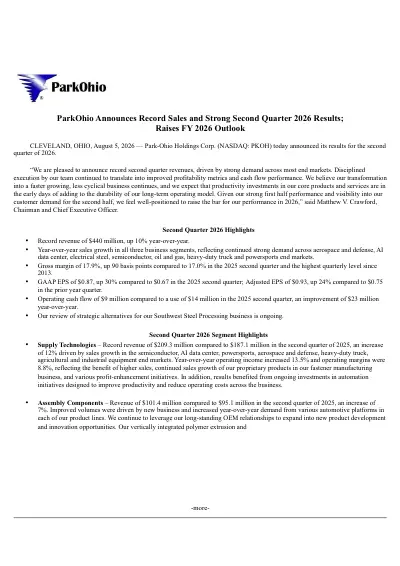
Thanks, Matt. Overall, our strong second quarter results exceeded our expectations and were highlighted by record consolidated revenues of $440 million, record revenues in both our Supply Technologies and Engineered Products segments, and continued sales growth in our Assembly Components segment.
Also, we continue to see strong demand across most of our key end markets, including semiconductor, aerospace and defense, AI data center, electrical steel, heavy-duty truck, oil and gas, and powersports. The strong performance in our Engineered Products segment resulted from strong new equipment and aftermarket demand in many end markets, and improved results from our forged and machined products business.
Finally, gross margin of 17.9% increased 90 basis points from a year ago, and operating income increased 22% year-over-year. Based on our record sales in the first half of the year, continued strong end-market demand in Supply Technologies, strong backlogs in Engineered Products, and ongoing operational improvements across several businesses, we are raising our full year 2026 guidance as follows: we are increasing net sales guidance to $1.7 billion to $1.73 billion; we are increasing adjusted EPS guidance to $3.10 to $3.30 per diluted share; we are increasing EBITDA as defined guidance to a range of 8.5% to 9%; and we are maintaining our previous guidance of free cash flow of $20 million to $30 million.
Turning now to the details of our second quarter results. Total sales in the quarter were $440 million compared to $400 million a year ago, an increase of 10%.
Sequentially compared to last quarter's, total sales were up 5%. Sales in each business segment increased year-over-year and also increased sequentially, resulting from strong demand from most key end markets.
Our year-over-year consolidated gross margin improvement of 90 basis points and the operating income increase of 22% were driven by margin flow-through from the record sales levels and profit enhancement initiatives implemented across several of our businesses. SG&A expenses in the quarter were approximately $53 million or 12.1% of sales compared to 11.7% of sales a year ago.
The increase was driven primarily by general inflation, increases in personnel costs, and support for the higher sales levels. Second quarter interest expense of $12.3 million was $1.1 million higher than last year, due primarily to the higher interest rate on our senior secured notes that we refinanced in the third quarter of last year.
This increase was partially offset by lower interest rates on our revolving credit facility during the quarter. Our effective income tax rate was approximately 17% in the quarter.
The favorable effective tax rate year-to-date was driven by federal research and development tax credit benefits estimated for the year. We expect our full year effective income tax rate to range between 17% and 20%.
GAAP earnings per share for the quarter increased 30% year-over-year to 87 cents per diluted share. On an adjusted basis, earnings per share increased 24% to 93 cents per share compared to 75 cents in the second quarter of last year.
During the quarter, cash flow from operations was $9 million, an improvement of $23 million compared to a year ago. The cash flow improvement was due to higher income levels and our ongoing efforts to reduce working capital in each business.
Capital spending totaled $11 million in the quarter, which included investments in information systems, automation equipment which will drive improved plant floor efficiencies, and growth capital. We expect our full year CapEx to be approximately $35 million to $40 million.
Our liquidity continues to be strong and totaled approximately $189 million at the end of the quarter, which consisted of $48 million of cash on hand and $141 million of unused borrowing capacity under our various banking arrangements. Turning now to our segment results.
In Supply Technologies, net sales increased 12% and totaled a record $209 million during the quarter compared to $187 million in the second quarter of last year. Higher sales were driven by strong customer demand in most key end markets, including semiconductor, AI data center, powersports, aerospace and defense, heavy-duty truck, and agricultural and industrial equipment end markets.
Our supply chain business continues to benefit from increasing demand in the semiconductor, electrical, and AI data center sectors, which in total increased 29% year-over-year. In response to the growing demand trends in these interrelated end markets, we are expanding our global service center footprint in support of key customers and the expected demand for our supply chain services over the next several years.
In addition, aerospace and defense demand continues to be strong and increased 10% during the quarter. Segment operating income in the second quarter was $19 million, an increase of 13% year-over-year, and operating margins were 8.8% compared to 8.7% a year ago.
We continue to be on track to open our new state-of-the-art North American distribution center in the third quarter of this year. We are confident that this facility will be a best-in-class service center operation with automated sorting and kitting and additional value-added services for our customers.
We expect to see the margin benefits of this strategic investment beginning in 2027. Our Fastener Manufacturing business performed well in the quarter as net sales grew 6% year-over-year.
Global customer demand for our proprietary products continues to grow, resulting from the expanded use of lightweight materials and increased global production of EV and hybrid vehicles. In our Assembly Components segment, sales for the quarter totaled $101 million compared to $95 million a year ago, an increase of 7%, driven by new product sales launched last year in each product line and higher customer demand from various automotive platforms.
Segment operating income totaled $5.3 million compared to $5.6 million last year, and increased from $4.9 million last quarter. We continue to focus on improving operating margins in this segment through improved margin flow-through from revenue growth from new programs, as well as through profit enhancement initiatives.
Several operating initiatives, such as increasing our rubber mixing production to support sales growth in our molded and extruded products, and plant floor automation investments, are expected to improve operating margins. In our Engineered Products segment, sales were a record $129 million, up 10% compared to last year and up 3% compared to last quarter.
The increase in sales was driven primarily by sales of aftermarket parts and services and strong new equipment backlogs in our Industrial Equipment Group, as well as higher sales in our forged and machine products group, which were up 25% year-over-year. New equipment bookings totaled $66 million in the quarter.
Year-to-date, new equipment bookings totaled $153 million compared to $129 million for the same period last year, an increase of 19%. Our equipment backlog at the end of the second quarter increased 23% to $252 million compared to $205 million at the end of last year.
The increased capital equipment sales in the quarter were driven by strong customer demand in several end markets, including defense, electrical steel processing, oil and gas, agriculture, AI data center, and semiconductor markets. Both our industrial equipment and forging businesses continued to experience strong demand from both defense and AI data center-related sectors.
We provide several products in support of these growing end markets, including transformer systems for IT equipment, induction furnaces for electrical steel processing, forgings for industrial turbines in various military applications, generators for emergency power, and various induction equipment used by data center cooling systems and for military applications, and forging presses used to produce munitions for military use. During the quarter, segment operating income improved 50% to $9 million compared to $6 million both a year ago and sequentially last quarter.
The improved operating income resulted from strong sales in the quarter and improved operating performance across many locations, including our forged product locations. Finally, as we announced last quarter, as part of our ongoing portfolio optimization strategy, we engaged an investment banking firm to assist us with a formal review of strategic alternatives for our Southwest Steel Processing business, including a potential sale or other transaction.
SSP is part of our Engineered Products segment. This review reflects our continued focus on aligning capital and resources toward higher-growth, higher-margin opportunities across our portfolio.
We expect the process to be completed toward the end of this year. Our revised outlook includes the impact of Southwest Steel, which is expected to generate approximately $15 million in revenue and a net loss of approximately 50 cents per diluted share.
The outcome of our strategic review with respect to this business represents potential upside to our current guidance. Now I'll turn the call back over to Matthew.
Matthew Crawford
Great. Thank you, Pat.
Before I open up to questions, I just want to draw some attention to both Pat and I discussing sort of the broadening out of demand. We've been very intentional over the last several years, as all of around aerospace and defense and the things related to data centers and electrical grid investments.
This quarter really demonstrated the depth and broadening of the demand cycle. Not only do we see growth for the year in all of our segments, but we also see it in most of our end markets and in almost all of our geographies around the world.
I think it's important to note that this is part of our intentional strategy, but we're also benefiting from, again, a broadening out of industrial demand throughout the world. With that, we'll open it up for some questions.
Operator
Thank you. We will now conduct a question-and-answer session.
If you would like to ask a question, please press star one on your telephone keypad. A confirmation tone will indicate your line is in the question queue.
You may press star two to remove your question from the queue. For participants using speaker equipment, it may be necessary to pick up your handset before pressing the star keys.
Once again, that's star one at this time. One moment while we poll for the first question.
The first question comes from Dave Storms with Stonegate. Please proceed.
Dave Storms
Morning. Good
Matthew Crawford
morning, David.
Dave Storms
Thanks for taking my call. Good
Pat Fogarty
morning.
Dave Storms
Congrats on the quarter. Congrats on the guidance raise.
Admittedly, I did want to start my first question maybe a little more in the weeds than normally. Starting with Assembly Components, it was mentioned that you called out specifically fluid transfer on the release last night.
I know that's been a big part of your business for a long time. Can you maybe spend a little more time just talking about some of the challenges and problems that you're solving in fluid transfer as it relates to the AI infrastructure buildout?
Matthew Crawford
Let me sort of kick that off, and I'll let Pat discuss more specifically where we may have said that. Let me point out, we have a very strong brand and very strong market presence in multilayer extruded hose, where we're vertically integrated, mostly in the automotive space, not entirely, but mostly in the automotive space.
There are numerous areas in our business where we touch on data centers and electrical infrastructure, but that would not be one of them per se, other than we are seeing more and more applications on the automotive side for fluid transfer for things like battery coolant technology and etc. Cooling systems and so forth, washer systems, more advanced vehicles on the hybrid and EV side.
On that transition, we are involved, but I think more broadly the themes that you're thinking about less so. Pat, any thoughts?
Pat Fogarty
One additional comment. When you think of our end markets, as Matt mentioned, automotive, heavy truck, industrial applications to transfer fuel, to transfer cooling fluids, to transfer hydraulic fluids, we also produce extruded plastic hose for air and other types of fluids.
There clearly is an opportunity to expand our makeup of customers outside of auto heavy-duty truck to other industrial applications, which might include data center activities or other parts of the industrial economy.
Dave Storms
Understood. I appreciate that clarification.
I think I was putting the horse before the cart a little bit there. That's perfect.
Thank you. As I'm looking then at the data center buildout writ large, obviously there's a lot of excitement you're able to take advantage of that.
Are you seeing any pushback? I'm starting to see a lot of headlines of local pushback to data centers.
Are you seeing that come through, or is that more a headline that maybe doesn't have as much real-world impact?
Matthew Crawford
I think the headlines are real. How it affects our business is, I think, a little bit differently than you may expect.
We touch really upstream and downstream on this area. For example, when you think about people like Caterpillar who are providing mining equipment for rare-earth minerals, when you think about a division of Caterpillar supplying stationary power, there's a lot of upstream investments that I think candidly have multiyear backlogs.
I'm not sure that they're real focused right now on what the latest sort of political headline is. Those are really durable opportunities.
I also think in some of the buildout for some of these data centers are also already commissioned. I'm going to call these sort of the midstream investments, if you will, to steal a term from the energy sector.
Switchgears, transformers, fasteners that really build out these things. I would tell you those are ongoing.
That might be affected over time by some of those headlines, but again, there is a multiyear catch-up period going on right now for what just has not been built. I think you're probably have watched this play out with Intel down near Columbus.
That's multiyears behind schedule. I think those could play out over the next 3, 5, 10 years, but it'll be interesting to see how that happens.
I don't see it anticipating our backlogs. I think our customers are trying to catch up.
Then, of course, you've got the semiconductor sector that I think is really strengthening as sort of the final piece of the puzzle, right? You've got all the upstream, now you got the facilities built, now you need semiconductor tools and you need things like that.
That's why I think that for so long people like Applied Materials were pretty flat, and everyone's like, "How is that possible?" , right?
Now they're booming as more of these things are stood up and the actual guts or the intelligence of the operations being invested. We really touch on all parts of that value stream.
At this point, I feel like it's more catch-up than it is real political risk from those headlines. Long term, there's a lot of discussion.
Is this a 5-year, 10-year, 20-year trend? I would tell you that over 10 or 20 years, the issue you mentioned will certainly play out.
Dave Storms
Understood. That's great commentary.
If I could maybe ask one more around defense, just trying to think about what the qualification, bidding, negotiating process is like there in the defense market. Are you seeing maybe manufacturing competence and time to market being on equal or close to equal footing as things like price that might maybe take the lead in other negotiations, or maybe, I guess, how would you qualify the defense new customer acquisition environment?
Matthew Crawford
Are you just referring to sort of more broadly?
Dave Storms
Correct. Broadly, and could be Engineered Products, could be Supply Tech.
Matthew Crawford
Again, I think that there are parts of the business that are expanding fairly quickly, and we've touched on some of them, data centers, we've touched on aerospace and defense, the capacity building, stationary power, mining, the capacity building is so important. I think these are all important issues, by the way.
Quality product, price, delivery, these are all triangulated every day in our business. I would certainly say in some of the segments we're discussing, delivery is the most important thing.
I think quality is the most thing. Delivery's, too.
Price is always an important part of the puzzle to deliver value, overall value to the customer. I would suggest to you that, by and large, those are the kinds of discussions that happen.
Again, not to suggest that price is still not very important, particularly in some of the more traditional sectors, whether it be auto or rail or truck. Delivering value to that supply chain, particularly after a years of price increases as inflation came through, is a little higher on their priorities than perhaps the people who are trying to build more missile shells or something like that, right?
It's an intersection of all three, unquestionably, especially after years of inflation, for sure, and cost increases on our side and theirs.
Dave Storms
Understood. Appreciate you taking my questions, and good luck in the next quarter.
Matthew Crawford
Thanks so much,
Dave Storms
David.
Operator
Thank you. The next question comes from Christian Zyla with KeyBanc Capital.
Please proceed.
Christian Zyla
Morning, Matt and Pat. This is Christian Zyla on for Steve Barger.
Thanks for taking the questions.
Matthew Crawford
No problem, Christian. How are you?
Christian Zyla
Good. First question from us.
Just you guys divested aluminum products a few years ago and now have Southwest Steel in a strategic review. What other business units have negative or flat earnings, and should we expect further portfolio actions as your other core businesses really start to accelerate with the industrial cycle?
Matthew Crawford
Let me first comment on Southwest Steel. Again, Southwest Steel has been an important contributor to Park-Ohio over the last 20 years, and until recently has been consistently profitable and accretive to our overall margin profile.
There's some fundamental things that have happened in their end markets that make it less desirable for us as part of our core business and our goals to grow with significant operating leverage. We're patiently trying to find the right fit for that.
Moving to your second question, I don't know, as we sit here today, that I would identify another part of our business which certainly has the negative impact that Southwest does on our overall financial statements. To be honest with you, we are always, particularly in this period of reinvestment, looking to optimize, looking to be more efficient.
While I would not call out any particular business, I would say that we always have what we call value drivers here across the business to optimize and improve the way that we come to market. Not to that level, nor would I call it any particular business other than SSP.
Christian Zyla
Understood. I guess sticking with Engineered Products, I know you guys have that silicon steel order that you're working through.
Was some of the year-over-year margin expansion driven by you fulfilling parts of that contract, or was the margin improvement in EP partially driven by better mix in the quarter? You guys have said in the past that EP drives Park-Ohio.
Ultimately what I'm trying to figure out is, is this a level of sustainable margin as a floor in your EP segment? Judging by the comments you made in the disclosure about Southwest Steel, it sounds like the answer is yes, but I'm just trying to frame out long-term trajectory and how you're thinking about EP.
Matthew Crawford
No. It's a great question.
More specifically, I think what Pat will tell you in a moment is we are benefiting from that order. I think what's more important to focus on is that order entry this year is up over last year.
Even with that big order, order entry continues to be very strong. Oh, by the way, there's certain dynamics about large orders versus small orders.
No, that business continues to be strong. There's no question we're benefiting from that large order last year, but I don't want you to suggest this is a lump going through the snake, to speak.
It may be operationally at times, I'm sure, but that's not the way I would think about it. Then secondly, I would say, I just want to comment generally, we are seeing, through I think great leadership out of that group and some really discreet investments that I discussed in terms of increasing the reliability of their equipment as well as their infrastructure to perform, I think we're beginning to see a return to the profitability metrics we saw consistently for 20 years until COVID.
I would not look at this as a one-off. I would look at this as an opportunity to return some of the profitability metrics to where they should be, and I also think an opportunity to invest in the business, and yes, also benefit maybe a little disproportionately around some of the sort of electrical infrastructure stuff we've talked about, transformers and so forth, AI, etc., as well as aerospace and defense, which is where a big chunk of that exposure is for us.
No, I don't view that particular order, while beneficial to this year's earnings, as being unusual or the sort of lump in the snake.
Pat Fogarty
Christian, I would also comment that this is a global business with global aftermarket presence as well as new equipment builds. We continue to see increased absorption in each of our plants based on the increase in bookings.
It makes perfect sense that, as a result, we're going to see higher margins. Our margins have continued to improve year-over-year, but still not where we need to be, and our team is working hard on that.
We expect continued improvement. EBIT margins north of 10% are not uncommon in this business over the long term, and we plan to get there.
Christian Zyla
That's great. I guess, back-of-the-envelope math, if I exclude Southwest Steel to Engineered Products, it looks like you guys are closer to a high-single-digit, 9-plus percent EBIT, sounds like you guys are kind of already there, which is great to hear.
Just if I could do one last question, thank you for the time again. For Supply Tech, what was the impact of the automation improvements and the new distribution center on the margin?
Just typically when you have double-digit sales in Supply Tech, you have some nice operating leverage and margin expansion there. Just trying to get a sense of what a clean operating margin level was excluding the investments that you guys made.
Thank you again.
Pat Fogarty
I'll address that, Christian. As I mentioned in the script, the effect of the North American distribution center will start to appear in our margins in 2027.
There was no impact relative to that. We continue to make investments in people to support that activity, but I wouldn't say in the current quarter that had a meaningful impact on our margin.
We'll start to see more of that over the next couple of quarters. Then in terms of the information systems investments that we're making, again, it's people-driven, supporting two systems as we implement our new information systems.
Will have an impact on our margins going forward, but we've seen continued improvement in the margins in this segment. We expect that to continue despite the investments that we're making.
Christian Zyla
Got it. Thank you.
Operator
Thank you. At this time, I would like to turn the call back over to Mr.
Crawford for closing comments.
Matthew Crawford
Great. Thank you very much for your questions this morning and your time, and we look forward to a very exciting second half.
Have a great day.
Operator
Thank you. This does conclude today's teleconference.
You may disconnect your lines at this time. Thank you for your participation and have a great day.