Pentair plc.
Q3 FY2026 · Earnings Call TranscriptOctober 27, 2026
Operator
Good day and welcome to the Pentair Third Quarter 2026 Earnings Conference Call. All participants will be in listen-only mode.
Should you need assistance, please signal a conference specialist by pressing the star key followed by zero. After today's presentation, there will be an opportunity to ask questions.
To ask a question, you may press star, then one on a touch-tone phone. To withdraw your question, please press star, then two.
Please note, this event is being recorded. I would now like to turn the conference call over to Mr.
Jeff Thompson, Vice President of Investor Relations. Mr.
Thompson, the floor is yours, sir.
Jeff Thompson
Thank you, operator, and welcome to Pentair's third quarter 2026 earnings conference call. On the call with me are John Stauch, our President and Chief Executive Officer; Bob Fishman, our outgoing Interim Chief Financial Officer; and Bob Hau, our incoming Chief Financial Officer effective November 1st.
On today's call, we will provide details on our third quarter performance as outlined in this morning's press release. On the Pentair Investor Relations website, you can find our earnings release and slide deck, which provide a reconciliation of differences between GAAP and non-GAAP financial measures that we will reference.
Any statements made during our presentation today about Pentair's anticipated financial results are forward-looking statements subject to future risks and uncertainties, such as the risks outlined in today's earnings release and Pentair's filings with the Securities and Exchange Commission. Actual results could differ materially from anticipated results.
Following our prepared remarks, we will open the call up for questions. Please limit your questions to two and reenter the queue to allow everyone an opportunity to participate.
I will now turn the call over to John.
John Stauch
Thank you, Jeff, and good morning, everyone. We appreciate you joining us today.
First, let's begin with an executive summary on Slide 4. We delivered a solid third quarter with sales inside of our guidance range and adjusted operating income and adjusted EPS exceeding our expectations.
Each of our three segments contributed to the quarter. Flow and Water Solutions continued to deliver sales and segment income growth along with meaningful margin expansion.
In Pool, we completed the previously communicated channel inventory destock, an important milestone that positions the business on a healthier foundation as we enter 2027. We also completed the acquisition of Taco Group Holdings on October 1st.
Taco adds a high-growth platform to Pentair and expands our presence in attractive commercial, infrastructure, and multi-family residential end markets. Finally, Bob Hau has been announced as Pentair's Chief Financial Officer.
Bob brings significant public company finance leadership experience, and we are excited to welcome him to Pentair. I also want to thank Bob Fishman for coming back to serve as interim CFO this past quarter.
His steady leadership provided important continuity during the CFO transition, and we greatly appreciate his continued support and commitment to Pentair. Bob Hau has been working closely with Bob Fishman over the past six weeks to ensure a smooth transition, and will officially assume the CFO role effective November 1st.
Overall, our third quarter results demonstrate the underlying strength of our portfolio and the continued execution of our strategy. Please turn to the Q3 overview on Slide 5.
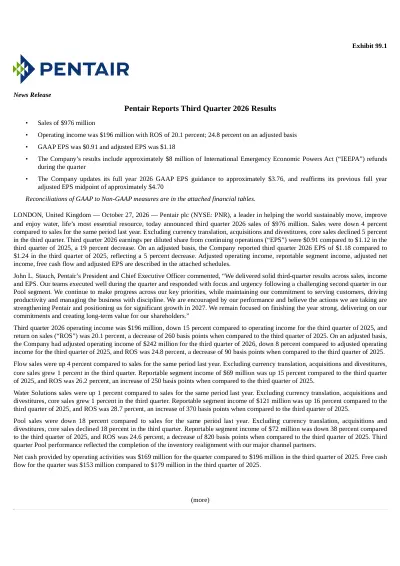
Turning to our third quarter results, sales were $976 million, adjusted operating income was $242 million, and adjusted EPS was $1.18, above our guidance range of approximately $1.05 to $1.08. The year-over-year comparisons primarily reflect the previously communicated Pool channel inventory destock.
This was a temporary impact, and aligned channel inventory with current demand. Beyond that dynamic, we saw strong execution across the portfolio.
Flow and Water Solutions both delivered sales and segment income growth, as well as return on sales expansion. Pool exceeded our expectations for both top line and income.
Adjusted operating income in the quarter included approximately $8 million in tariff refunds, significantly below the $35 million received in Q2. These refunds benefited the quarter, but they do not change our view of the underlying operating performance or the progress we are making across the businesses.
Cash generation also remained strong. We generated $153 million of free cash flow in the third quarter, and $620 million through the first nine months of the year.
Our Q3 performance was ahead of our expectations and gives us increased confidence in our execution as we close out the year. We are reaffirming the midpoint of our previous full year guidance of $4.70.
Please turn to Slide 6 for an update on the Taco acquisition. We completed the acquisition on October 1st, and we are excited to welcome the Taco team to Pentair.
Taco is a high-growth platform with a strong brand, differentiated technology, attractive customer relationships, and meaningful opportunities for continued growth and margin improvement. The business is performing ahead of our previous expectations and is entering 2027 with significant momentum.
Taco's estimated 2026 sales are approximately $560 million, representing growth of roughly 23% from 2025. For 2027, we currently expect sales of greater than $620 million, or growth of more than 10%.
EBITDA is estimated at approximately $90 million in 2026 and greater than $105 million in 2027, which would represent mid-teens growth. Beyond the near-term financial contribution, we see compelling opportunities to accelerate Taco's growth.
Its commercial and residential capabilities, established channels, and expertise in water circulation and hydronic flow control are highly complementary to Pentair. The combination expands our customer reach and creates opportunities to bring broader, more complete solutions to the market.
Importantly, Taco fits squarely within our disciplined approach to capital allocation. We expect the acquisition to be accretive to adjusted EPS in 2027 and to accelerate Pentair's sales and EBITDA growth, and we expect to delever rapidly due to our strong operating cash flow generation.
Now let's turn to the strategic rationale and benefits of the Taco acquisition on Slide 7. As we introduced last quarter, Taco strengthens Pentair strategically in several important ways.
First, it creates a broader water management platform by extending our capabilities into water circulation and hydronic flow control. Taco adds another leading brand to our Water Solutions portfolio, and complements our existing residential and commercial pump businesses.
Second, Taco provides Pentair with an additional growth engine. It increases our exposure to attractive end markets, including HVAC, data centers, and related infrastructure development.
Taco's portfolio is well aligned with these secular trends and with Pentair's broader focus on smart, sustainable water solutions. Third, the acquisition significantly strengthens our presence in commercial and institutional applications.
Taco has established positions in data centers, schools, hospitals, universities, commercial buildings, and other mission-critical water and HVAC systems. Fourth, Taco expands our access to specification-driven aftermarket revenue.
Its large installed base of pumps, valves, and controls generates ongoing replacement, maintenance, and upgrade demand, creating an attractive source of recurring revenue. Finally, the combination creates meaningful cross-selling opportunities.
Pentair and Taco have complementary products and channels, giving us the opportunity to broaden customer access, deepen channel relationships, and bring combined solutions to customers. For all of these reasons, we believe Taco is an excellent strategic fit, and is aligned with both our long-term strategy and our disciplined financial return criteria.
Let me now provide an update on Pool on Slide 8. First, we're pleased to announce Josh Cowley as Executive Vice President and Chief Executive Officer of Pentair Pool, reporting to De'Mon Wiggins.
Josh brings 25 years of leadership experience, deep industry expertise, and a proven track record of driving growth, strengthening organizations, and improving business performance. We believe his experience and leadership will be a great fit as we continue to build on the strong foundation of our Pool business and position it for long-term growth.
Shifting to the business performance, with the channel inventory destock complete, our focus is firmly on execution and returning the business to higher growth. We have a clear strategy built around four pillars, with one overarching goal: putting dealers at the center and delivering an elite customer experience.
The first pillar is to out-sell. We are strengthening coverage and local execution to outgrow the industry, improve customer acquisition and retention, and reinforce Pentair Pool as the industry's most trusted partner.
We've added resources to our inside sales team, as well as started to build out our regional structure, including enhanced regional reporting and targeted marketing programs designed to enable higher levels of dealer engagement. The second pillar is to out-support.
We intend to differentiate Pentair through an elevated customer experience by providing education and support across the entire customer journey. In Q3, we added capacity in critical areas to reduce call hold times and provide expertise to pool professionals.
The third pillar is to deliver quality. We are working to make quality an even stronger competitive differentiator by enhancing our end-to-end quality management system, and consistently delivering the performance our customers expect from Pentair.
When we don't meet that level of [expecty?] expectation, we will make it right.
During the quarter, we made investments in the quality organization, including capital expenditures within our testing processes. The fourth pillar is product excellence.
We are focused on competing effectively across our core product categories, delivering differentiated value, and creating a more visible pipeline of customer-led innovation. We've added resources to seek input from pool dealers to simplify their work and deliver a better experience for our pool owners.
These four pillars are designed to work together: better coverage, stronger support, consistent quality, and differentiated products should deepen our customer relationships and strengthen Pentair Pool's competitive position. While it's still too early to provide formal guidance for 2027, I want to provide some context around the Pool business because we believe the underlying dynamics are important to understand.
We estimate full year sell-through in 2026 will be approximately $1.45 billion, up 2% to 3% versus 2025. At the same time, channel inventory has been reduced significantly, particularly following the inventory actions in the second and third quarter.
This distinction is important: the decline in our 2026 reported Pool sales was driven primarily by the channel inventory reset, not by a corresponding decline in sell-through. With the inventory adjustment now behind us, we enter 2027 from a healthier starting point.
Importantly, our growth expectations for next year do not anticipate market recovery. We expect sell-through next year to remain about flat to this year at about $1.45 billion, with more modest price increases offsetting anticipated continued soft market conditions.
This would mean approximately $180 million of year-over-year sales growth, or about 14% versus our forecasted sales number for 2026, as 2027 Pentair sales mirror sell-through sales, reflecting steady channel inventory. We also expect to maintain our strong profitability, with Pool delivering approximately 30% return on sales for full year 2027, while continuing to invest in innovation, our brand, and our industry-leading position.
We are going to continue to compete for growth, and with the strength of our brand, the efforts we are investing in, Josh's leadership, and new product innovations that we expect to be able to return to volume growth in 2027 and beyond. We will provide a more definitive 2027 outlook during our Q4 earnings and 2027 guidance call early next year.
With that, I'll turn the call over to Bob Fishman to discuss our third quarter financial performance in greater detail. Bob?
Bob Fishman
Thank you, John, and good morning, everyone. Let's start on Slide 9.
As John mentioned, we reported sales of $976 million, adjusted operating income of $242 million, ROS of 24.8%, and adjusted EPS of $1.18, above the high end of our Q3 guide of approximately $1.05 to $1.08. Core sales were down 5% year-over-year, as an 18% decrease in Pool more than offset 1% growth across both Flow and Water Solutions.
Moving to adjusted operating income, the expected Pool volume decline drove headwinds year-over-year. Price offset inflation, and we delivered productivity savings of $15 million.
We received $8 million in tariff refunds in the quarter, which were previously anticipated to be received in Q4. Please turn to Slide 10.
Flow sales were up 4% year-over-year to $262 million. Sales were modestly below expectations due to delayed spending in food and beverage.
We are very pleased with the performance across the remainder of the portfolio, which delivered double-digit sales growth, including strong performance from the Hydra-Stop acquisition. Segment income grew 15% and return on sales increased 250 basis points to 26%, driven by strong productivity performance and the acquisition of Hydra-Stop in Q3 last year.
Please turn to Slide 11. In Q3, Water Solutions sales increased 1% to $422 million.
Core Water Solutions sales grew 1%, as commercial sales increased 4%, offsetting an anticipated reduction in residential due to end market headwinds. We are excited about the performance and trajectory in commercial, where the focus on large strategic accounts and convenience stores offers runway for continued growth.
Segment income grew 16% to $121 million, and return on sales increased 370 basis points to 29%, driven by disciplined pricing and productivity. Tariff refunds totaling $6 million provided the largest benefit across the three segments.
Please turn to Slide 12. In Q3, Pool sales declined 18% to $291 million, which was better than expected.
The previously communicated channel inventory reduction has now been completed, which we believe positions us for significant growth for our Pool business in 2027. Segment income was $72 million, down 38%.
Return on sales decreased to approximately 25%, which reflects the negative impact of volume deleverage, inflation, and investments in the growth initiatives described by John to deliver best-in-class customer experience. Please turn to Slide 13.
Our balance sheet remains strong and continues to provide optionality to deliver shareholder value. Our net debt leverage ratio was 1.4 times at the end of Q3.
As communicated earlier this year, we increased our dividend by 8% and achieved our 50th consecutive year of dividend increases, making Pentair a Dividend King while maintaining our Dividend Aristocrat status. Our significant annual free cash flow generation has enabled us to strategically deploy capital via debt paydown, dividends, share repurchases, and strategic acquisitions.
I would also like to welcome Bob Hau to Pentair. I have been working closely with Bob since his arrival and am excited about the leadership that he brings to the company.
Bob Hau
Thank you, Bob, and a special thank you to you and the team for assisting with the transition over the past six weeks. I am excited to be joining Pentair.
I will now discuss our outlook on Slide 14. For the full year, we've increased our confidence and reaffirmed the midpoint of our previous full year guide.
We expect adjusted EPS to be approximately $4.70. Also for the full year, we expect total Pentair sales in fiscal 2026 to be down approximately 3%.
We expect Flow sales to be up approximately mid-single digits; Water Solutions sales are expected to be up approximately high-single digits, including the impact of Taco, with core sales approximately flat; and Pool sales are expected to decrease approximately 18% to 19% for the full year. We expect total Pentair adjusted operating income to decrease approximately 6%.
We expect price to offset inflation and productivity of approximately $55 million, net of volume deleverage and Pool growth investments. While we have received $43 million of tariff refunds year to date, we do not expect further refunds in the fourth quarter.
As a reminder, we completed the Taco acquisition on October 1st. We financed this acquisition with $1.4 billion of debt of term loans at approximately 5.25% interest rate.
Our pro forma net leverage calculation is approximately 2.5 times at the beginning of Q4. For the fourth quarter, we expect sales to be up approximately 7% to 9%, inclusive of the Taco acquisition.
Core sales are estimated to be down 2% to 3%. We expect Flow sales to be up approximately low-single digits, which reflects the continued headwinds from the food and beverage business.
We anticipate Water Solutions sales to be up approximately 40%, with core growth of low-single digits. Pool sales are expected to be down approximately 12% to 15% due to a difficult top-line comparison versus the prior year.
We expect fourth quarter adjusted operating income to be up approximately 1%. We are also introducing adjusted EPS guidance for the fourth quarter of approximately $1.15.
The full year guidance reaffirms the midpoint communicated on our Q2 2026 earnings call, and reflects confidence in the actions underway to close this year strong and carry momentum for the expected robust growth in 2027. We plan to remain disciplined with our capital and have additional flexibility to strategically allocate additional capital to areas with the highest shareholder returns.
Following the Taco acquisition, we will prioritize deleveraging our balance sheet, supporting our dividend, and investing in our key growth initiatives. We will also continue to opportunistically repurchase shares in line with our commitment to returning capital to shareholders.
I would now like to turn the call over to the operator for Q&A, after which John will have a few closing remarks. Operator, please open the line for questions.
Thank you. Hey,
Operator
thank you, sir. We will now begin the question and answer session.
If you would like to ask a question, you may press star, then one on a touch-tone phone. If you're using a speakerphone, please pick up your handset before pressing the keys.
If at any time your question has been addressed and you would like to withdraw your question, please press star, then two. Again, that is star, then one to ask a question.
At this time, we will just pause momentarily to assemble our roster. The first question we have will come from Bryan Blair of Oppenheimer.
Please go ahead.
Bryan Blair
Thank you. Good morning, everyone.
Good
Bob Hau
morning.
John Stauch
Good morning. Hi, Bryan.
Bryan Blair
It sounds like your baseline or preliminary outlook for Pool's reset growth next year is largely unchanged, just working off of a slightly higher base. Within that, just to level-set, what are you assuming for Pool market share?
Is that stabilizing at that current level or is there any recapture of the, I believe you had framed it as two or three points of share loss that took place?
John Stauch
Bryan, really what we're just trying to do is say if we were to remain flat to the current year's sell-through, it would be $1.45 billion. Clearly that's a starting point, we would expect to do better.
We don't yet have the market dialed in for 2027 and we're going to compete for growth, we're going to compete to recover any lost share and continue to grow share. We don't know what that looks like yet.
We're just trying to get people's head around the 1.45 and how that moves over and creates that mid-teens growth rate, and then give you a starting point for what the ROS should do to model 2027 performance. More of a better insight into share, volume, markets, everything else when we come forward with our full-year earnings guide in early February.
Bryan Blair
That's perfectly fair. Appreciate it.
Your team sounds quite bullish on Taco's operating momentum. If we think about the 2027 outlook that you've provided, at least the preliminary one, how should we think about growth rates on the commercial and industrials side of the business relative to residential?
Then as we look forward, how meaningful should cross-selling be in terms of sustaining Taco out-growth and also accelerating growth for legacy Pentair?
John Stauch
I think first of all, we're teeing up a double-digit growth for Taco next year off of their strong greater than 20% performance this year. A lot of that's coming in the commercial and industrial side, but they are growing mid-single digits on the residential side as well.
I think that's a starting point again for next year. We have a significant funnel of opportunities, and we're working through that funnel to see how we build our confidence rate for how good Taco could be next year.
As far as the synergies, we've identified significant opportunities through their rep channel and how they go to market and opportunities to use the complementary portfolio to satisfy key demand. Don't have it yet quantified.
We will again as we head into next year give you a better number. First is to do no harm to Taco and make sure we take advantage of their business model and their tailwind, and then we start to add some of the Pentair growth to it and then I think it gets really, really exciting.
Bryan Blair
All makes sense. Thanks again.
Operator
Next we have Brett Linzey of Mizuho.
Brett Linzey
Hey, good morning, all.
John Stauch
Good morning.
Brett Linzey
Good morning. Morning.
Question on mix. I'm curious on the sales line within Pool, were there any mixed dynamics or trade-downs that you saw through the quarter?
Then I guess how do we think about mix going forward in the face of the consumer backdrop, and then also the potential re-entry into some of the lower tier end as you maybe go back into that marketplace and try to win back some share?
John Stauch
Yeah. I think we were encouraged by mid-single-digit sell-through in the quarter in Pool.
Not the high-single digits we're used to, but we're back in mid-single digits, we're pleased by that. As a reminder, we still had a lot of inventory burn in the quarter, that's reflected in what we'd say is a lower margin.
We're also investing significantly for sales, marketing, and targeted marketing actions. I don't think there's a mix issue, Brett.
I think we feel good about our product lineup, and it's about making sure that our customers and either if you're a service or a new pool builder, understand the value of our products and you're competing effectively with our products for those opportunities. I feel good about the progress in Q3, but we're a long way from declaring victory yet.
Brett Linzey
No, that's helpful. Then maybe just a follow-up on price and cost.
Just thinking about the inflationary uptick we've seen, obviously some movement on tariffs. Thinking about price/cost near term, what's your hedging position looks like over the next couple quarters?
For at least the front part of '27, any preliminary expectation on how to model price/cost? We're
John Stauch
going to take IEEPA recoveries and move them off to the side and make them clear for you, ourselves, and our customers. Then we have a strong belief that we will offset inflation next year, cost, with pricing, as we've done historically.
We won't be able to do that and recover IEEPA twice, right? We'll make sure that that clarity's there, but we've had some products running up in inflation and then we've had some positive movement in some other ways as you would expect across global supply chain.
Overall, our initial indications are we should be able to recover on the cost side price for 2027.
Brett Linzey
I appreciate the detail.
Operator
Next we have Nathan Jones of Stifel.
Adam Farley
Good morning. This is Adam Farley on for Nathan.
John Stauch
Hi, Adam.
Adam Farley
Staying on the Pool business, how do you think about pricing within the Pool business, just given all the dynamics? Do you think you'll have to eat some of the additional costs to compete for share?
John Stauch
No, I don't. Listen, when we talk about share, we would acknowledge that we have the most amount of existing pool pads in the country or inside the United States, just because of our strong positioning from decades.
When we talk about potential share loss, it's a onesie and twosie product on an existing pad that we feel has migrated at times to a more competitive offering or a dealer who has switched alliances. We think by going out and making sure that our products are understood and that they are like-for-like replacements to products we had and reminding consumers of the great experience they've had under the Pentair brand, that we can continue to compete effectively for that.
It was really about we were focused on new pool builds, and we weren't as focused on where those existing pads were. A big part of this regional structure and the investment we're making state-by-state with our dealers is to align our opportunities to where the long-term growth resides.
Right now that is in the aftermarket and service, and that's why we're going to be more competitive in that area. It's not a pricing play, it's a targeted marketing approach, it's making sure that our customers are well trained, it's making sure that we're providing the services that differentiate them, and that's part of the investment that we're making.
It's not a pure net price play.
Bob Hau
Hey Adam, it's Bob Hau. I'd point you to the conversation that John had in his prepared remarks, what we've talked about in the past, the four pillars for the, quote, "get well" plan for Pool around outselling, out-supporting, delivering on quality and product excellence.
It's supporting our dealers, putting them at the center of everything we do and competing based upon our offering and our service. It's not necessarily a price play.
For overall '27, in line with our communication to the dealer channel, we went out with 3% to 4% price increases, generally, which is more moderate versus last year, but we think that that's a good position to cover the inflation, as we've mentioned, and position us for the ability to support our dealers in a successful way.
Adam Farley
Understood. That's really helpful color.
If we change gears and look at the Flow business, maybe could you just talk about some of the near- and medium-term paths to growth within this segment? Maybe specifically on the volume side, and maybe some of the different market dynamics going on between residential and other markets within Flow.
Thank you.
Bob Fishman
Certainly in Q3, we saw some headwinds from the food and beverage piece of the business. Think, selling into the beer market as an example.
We saw that as delayed spending. Overall, I'd say, on the other pieces of the portfolio, we were very pleased to drive double-digit growth in the third quarter.
Slightly below our expectations for Q3, but, mainly driven by food and beverage delayed spending.
Adam Farley
Thank you for taking my questions.
Operator
Next we have Robert Davies of Wolfe Research.
Robert Davies
for taking my questions. Had two.
One was just on the confidence and clarity you have around where you are on that destock. I know you sort of said that was through.
Just kind of if you could flesh out a little bit more where that sort of comfort level comes from. Then the second one was just around the sort of targeting of those sort of mid- and small-sized pool builders.
Just be curious how the initial conversations with those customers have gone, how receptive were they to when you sort of went back and tried to sort of tap into them again. Any color would be great.
Thank you.
John Stauch
Sure. We'll tag team this one.
Go ahead, Bob. Take the first part on the inventory.
Bob Fishman
Our confidence around the destock comes from the information that we have. We've seen roughly $280 million of destock over Q2 and Q3.
Think call it roughly $190 million in Q2 of destock and $90 million in Q3. That puts us at an inventory position in the channel at the end of the third quarter that's roughly $110 million lower than it was last year.
Then when we look ahead to ending inventory at the end of the fourth quarter, we anticipate that we will be down versus the prior year roughly $180 million in the channel inventory. That information, that type of sell-through that we're seeing, puts us in a position for strong growth in 2027 when we use a flat $1,450 sell-through number.
This also includes the mid-single-digit sell-through that John talked about in the third quarter and again, roughly mid-single-digit sell-through in the fourth quarter. It's really that ending inventory position at the end of the year that gives us confidence that sell-in will equal sell-through in 2027.
John Stauch
As far as the conversation with customers, we've made sure that we've got a national accounts focus, primarily focused on the two largest distributors, making sure they're getting the service levels that they need, and then we've had a dedicated sales and account team on the all other, and specifically making sure that all of the non-affiliated distributor accounts are called on personally and that we're reminding them that we want them back and we want them part of the Pentair family, and we're working with them one-on-one on ways to bring them back to our coverage and support. Some of them are smarting on our desire to've asked them to go to distribution and their choice not to.
They might be a little bit longer coming back, but we're pretty pleased with some of the progress on opening up the buying opportunities across those independents and starting to make some progress on recovering the losses associated with those accounts.
Robert Davies
Very helpful, thank you.
Operator
Next we will have a question from Brian Lee of Goldman Sachs.
Tyler Bisset
Hey guys, this is Tyler Bisset on for Brian. Thanks for taking our questions.
Can we go back to the Flow segment? I know sales came in a bit lower than expected due to some delayed spending in food and beverage.
4Q only expected to be up low-single digits and I know last quarter you called out some key wins across data centers, commercial buildings, desalination market. Just curious how these wins are progressing in terms of revenue conversion and whether you had any incremental wins this past quarter, and then any expectations when that delayed spending across food and beverage could be realized.
Is that a first half of '27 event?
John Stauch
I think it's two things happening. There's also a sustainable process solutions business we have, which is biogas and a waste-to-management recovery.
If you recall, we had a really, really strong pipeline as we ended last year. We've got a year-over-year comparable there in Q4.
We're very encouraged about the continued order rate in that particular side of the business, but you're going to have a little bit of lumpier projects and that side. We're, outside of the food and beverage, which we're not counting on a significant recovery next year, we're seeing some pretty good infrastructure wins, we're seeing some pretty good municipal wins, and we're really building backlog as we head into 2027.
Tyler Bisset
Super helpful. Then just on the Taco acquisition, should we expect any meaningful changes in working capital or capex requirements?
How are you thinking about capital deployment from here and how fast do you expect to delever following the acquisition?
Bob Hau
Tyler, it's Bob Hau. From a standpoint of working capital and capex, I think current outlook remains consistent with how the kind of combined company has been operating.
Obviously, we'll bring Taco into the fold and they spend a bit more capital than we do, but overall, well within our capacity and continue to generate strong free cash flow and a very good, strong balance sheet. From a capex deployment or capital allocation philosophy, absolutely remains intact.
We'll continue to invest in the business to grow it organically. Our investment grade rating continues to be a priority and will remain a priority of ours.
Given the strong free cash flow we have, we have a direct path to delever as I said in my prepared remarks, on a pro forma basis, we start the fourth quarter at about 2.5 times or so. We'll delever over the next 24 months back into our more normal range of 1.5 to 2 times, and have a direct path to do that given the cash generation of the company.
Feel good about our current position and our ability to deliver quickly.
Tyler Bisset
Perfect. Thank you very much.
Operator
The next question we have will come from Andy Kaplowitz of Citi Group.
Andy Kaplowitz
Hey, good morning everyone. Good
John Stauch
morning.
Bob Fishman
Good morning.
Bob Hau
Morning. Good
Andy Kaplowitz
morning. Maybe just focusing on margin for a second in Flow and Water Solutions, good margin performance continues.
Maybe update us where you are now on your 80/20 initiatives and opportunities for continued margin expansion in those segments in 2027?
Bob Fishman
I would say we were also very pleased with the ROS expansion, even when you exclude the tariff refunds. For the Water Solutions business, the ROS margin expansion was significant.
In pieces of each of those two businesses, we're still running complexity reduction plays. There's opportunities in pieces of Flow and Water Solutions to continue to expand the ROS, and that's the path that we're on, Andy.
Andy Kaplowitz
Bob, maybe just focusing on Water Solutions a little more. I think you said core up low-single digits in Q4.
Maybe break down the businesses a little more and how they're faring. I think the US was doing better than international.
I assume that's still the case, and how that kind of looks going into 2027?
Bob Fishman
Very much so. The commercial water side continues to grow mid-single digits and do really well for us.
Residential still has the headwinds, primarily due to, low housing starts and higher mortgage rates. A very similar story to what we saw in the third quarter.
Andy Kaplowitz
All right, thanks.
Operator
Next, Joseph Giordano of TD Cowen.
Michael Anastasiou
Good morning, this is Michael on for Joe. Good morning.
John Stauch
Good morning.
Michael Anastasiou
Can you walk us through what's underpinning the 1.5 Pool guide for next year? Can you just unpack that between resi to commercial, new builds versus remodel and repair and replace?
We'd love to understand that better.
John Stauch
Not there yet. It's 1.45, I just want to make sure we're clear.
Our attempt and goal there was to make sure that everybody starting from the 1.45 is the starting point, recognizing that that's roughly this year's sell-through, which is modestly higher, call it a few points higher than it was in 2025, and not be focused on our ship-in numbers. The primary purpose of doing that was because we are expecting that this inventory level remains the appropriate level and therefore our sell-through equals our ship-in next year.
We haven't yet talked to our dealers, as we always do, about where they think the opportunities lie and how do we position ourselves. We don't have next year's numbers dialed in from a perspective of new pool builds and what that mix looks like by state, by region, and also where we're going to be from a market perspective in aftermarket service.
We are really pleased and excited about the new regional structure we have. We split the seven selling regions across two divisions and it allows us to get more local into the key states, and it allows us to keep the focus on what we need to do differently across those states to grow in a differentiated way.
We'll have all that when we talk to you after the end of Q4, and we'll give you a clearer path to the mix of how we expect to deliver next year's Pool expectations.
Michael Anastasiou
Thank you.
John Stauch
Thank you.
Operator
Next we have Jeff Reive of RBC Capital.
Jeff Reive
Thank you, and good morning, everyone. I want to follow up on the the regional sales structure that's part of your four-pillar growth strategy for Pool.
Can you just help us understand what's actually changing here, and maybe what was wrong with the prior structure and what you're doing differently now?
John Stauch
I'll give you a couple of examples. I appreciate the question.
Take something like a variable-speed pump, and the different features we have. Depending on your energy dynamics or the use of energy, that cost savings to a consumer varies widely.
From what the cost of energy might be in the Northeast or Southeast versus what it might be in an Arizona, or a Texas, or a California. We want to make sure that we're targeting and marketing the position and the value propositions of products effectively.
You have markets like Florida that are very heavy heat pump orientation with no natural gas. You got to compete differently for products in different regions.
If you're running a national strategy both on marketing campaigns or targeting a product, you miss the local nuances that you need to serve your dealers on. This regional structure's always been in place at the sales level, but we weren't making the investments on the service side, the both technical and field service capability and dealer training differently across those seven core regions.
We think by listening to what the needs are state-by-state, we're going to be able to effectively invest and go gain significant share from listening to our local dealers. That's the purpose of the structure.
Jeff Reive
Got it, appreciate that.
John Stauch
You got states like California and Arizona that are open 12 months a year and you got regions like the Northeast, Midwest that shut down pools for part of the season and you got to have different programs and different support mechanisms for those particular pool builders.
Jeff Reive
All makes sense. Maybe just as a follow-up, as you're kind of empowering your regional leaders to make more localized decisions, how do you maintain the discipline of 80/20 and maybe avoid reverting to the complexity that you've spent the last several years eliminating?
John Stauch
Listen, first of all, 80/20 is a very good tool and I'm a huge fan of the tool. I'm being honest, in this case, it was probably misutilized, as we talked about for purposes of driving some efficiencies and some systems changes.
The 80/20 says you have valued customers and most-valued customers, and the only difference is how you treat them slightly differently. You don't fire customers ever.
Customers choose to be with you or leave you based upon the set of parameters that you give them to how you're going to partner with them and service them. I still think all of those come from a more central led organization structure talking about what your discount rates are to a dealer, how do you balance the types of dealers that are more value to you, what are those accounts worth for you from a growth perspective, but you execute very locally based upon those parameters.
I think that it's a combination of using the tools appropriately and making sure we're empowering that salesperson to do what they need to satisfy that dealer that's going to go get that trust back from the dealer network.
Jeff Reive
Awesome, thank you.
John Stauch
Still think we have the most enviable brand in the industry, and I think it's really living up to the brand promise day-to-day. That's our goal.
Operator
Again, as a reminder, if you would like to participate in today's Q&A, please press star, then one on a touch-tone phone. Again, that is star, then one to ask a question.
Next, we have Shaun Calnan of Bank of America. Please go ahead.
Shaun Calnan
Hi guys. Thank you for taking my questions.
Just first, how should we think about the long-term trajectory for the operating margin in the Pool business, following the expectations for 30% next year? Are there any one-time investments next year, or should we think about this as sort of the long-term target to build off of going forward?
John Stauch
I'll start with I've arbitrarily set it. Let's just say that, when we had the inventory destock and we reset, I still think we've got the premium brand, I think we've got the superior product offering, I think we have the best selling organization and the service organization in the industry, and I think all that deserves a premium to competition.
That's where the 3-0 comes in from an ROS perspective. I think as we go forward, we're expecting volume contributions to really help leverage and drive margin performance, and then we expect to invest a portion of that back into the business, again around marketing campaigns, NPI, innovation, and out-servicing our competition.
I still think having a healthy 3 in front of it is the right answer, but I don't think it has to grow disproportionately every single year to add value. I think that this is a high-single-digit growth contributor when the market is set up where new pools are actually increasing and the aftermarket pads continue to grow.
I think between its high-end growth rate and its margin rate, it can contribute effectively to Pentair's portfolio.
Shaun Calnan
Great. Then just a follow up on capital allocation.
How does the pullback in the share price impact your decision to pay down debt versus repurchase shares at this point?
Bob Hau
Again this is Bob Hau. Certainly part of the equation, from a capital allocation standpoint, given the strength of our balance sheet and our free cash flow, we have choices to make, but are largely an and choice, not an or.
In other words, we can invest in our business organically, we can look at value-accretive acquisitions, we can continue to increase our dividend, and we can do share repurchase. It's about balancing those along with our commitment to maintain that strong balance sheet and delever, but we think we can do all of the above very effectively over the course of time.
Shaun Calnan
Great, thank you.
John Stauch
Thank you.
Operator
At this time, we're showing no further questions. We will go ahead and conclude the question and answer session.
I would now like to turn the conference back over to Mr. Stauch for any closing remarks.
Sir?
John Stauch
Thank you for joining us today. In closing, I'd like to reinforce some key takeaways on Slide 15.
First, the Pool channel inventory realignment is now complete. With channel inventory better aligned with demand and a clear growth strategy centered on our dealers and customers, we believe Pool is positioned for robust growth in 2027 without assuming a recovery in the end markets.
Second, the acquisition of Taco adds a high-growth platform to Pentair. Taco expands our presence in attractive commercial and in institutional markets, strengthens our water management capabilities, and is expected to be accretive to adjusted EPS in 2027.
Third, Flow and Water Solutions continue to execute their profitable growth strategies, delivering sales and segment income, as well as margin expansion in the third quarter. As we look to 2027, we will also manage through the year-over-year impact of approximately $43 million of tariff recoveries recognized in 2026 that we do not expect to repeat.
Overall, our third quarter performance reinforces our confidence in Pentair's long-term strategy. We have a strong portfolio, leading brands, attractive exposure to secular water trends, and multiple opportunities to create long-term shareholder value.
Thank you to our Pentair employees for their continued dedication and execution, and thank you to our customers and shareholders for their ongoing support. Thank you, everyone.
Have a great day.
Operator
All right, thank you, sir, and to the rest of the management team for your time also. The conference call has now concluded.
At this time, you may disconnect your lines. Thank you, take care, and have a very blessed day, everyone.