The Pennant Group, Inc.
Q3 FY2026 · Earnings Call TranscriptNovember 5, 2026
Operator
Good day, and thank you for standing by. Welcome to The Pennant Group third quarter 2026 earnings call.
At this time, all participants are in a listen-only mode. After the speakers' presentation, there will be a question-and-answer session.
To ask a question during the session, you will need to press star 1 1 on your telephone. You will then hear an automated message advising your hand is raised.
To withdraw your question, please press star 1 1 again. Please be advised that today's conference is being recorded.
I would now like to hand the conference over to your speaker today, Kirk Cheney, Executive Vice President. Please go ahead.
Kirk Cheney
Thank you, DeeDee. Welcome, everyone, and thank you for joining us today.
Here with me today, I have Brent Guerisoli, our CEO; John Gochnour, our President and COO; Lynette Walbom, our CFO; and Andy Rider, our Senior Living President. Before we begin, I have a few housekeeping matters.
We filed our earnings press release and 10-Q yesterday. This announcement is available on the Investor Relations section of our website at www.pennantgroup.com.
A replay of this call will also be available on our website until 5:00 p.m. Mountain Time on November 5, 2027.
We want to remind anyone who may be listening to a replay of this call that all statements made are as of today, November 5, 2026, and these statements will not be updated after today's call. Also, any forward-looking statements made today are based on management's current expectations, assumptions, and beliefs about our business and the environment in which we operate.
These statements are subject to risks and uncertainties that could cause our actual results to materially differ from those expressed or implied on today's call. Listeners should not place undue reliance on forward-looking statements and are encouraged to review our SEC filings for more complete discussion of factors that could impact our results.
Except as required by federal securities laws, Pennant and its affiliates do not undertake to publicly update or revise any forward-looking statements where changes arise from new information, future events, changing circumstances, or any other reason. In addition, The Pennant Group, Inc.
is a holding company with no direct operating assets, employees, or revenues. Certain of our independent subsidiaries, collectively referred to as the Service Center, contract to provide administrative services to the other operating subsidiaries.
The words Pennant, company, we, our, and us refer to The Pennant Group, Inc. and its consolidated subsidiaries.
All of our operating subsidiaries and the Service Center are operated by separate, independent companies that have their own management, employees, and assets. References herein to the consolidated company and its assets and activities, as well as use of the terms we, us, our, and similar terms, do not imply that The Pennant Group, Inc.
has direct operating assets, employees, or revenue, or that any of the subsidiaries are operated by The Pennant Group. Also, we supplement our GAAP reporting with non-GAAP metrics.
When viewed together with our GAAP results, we believe that these measures can provide a more complete understanding of our business, but they should not be relied upon to the exclusion of GAAP reports. A GAAP to non-GAAP reconciliation is available in yesterday's press release and is available in our 10-K.
With that, we'll turn the call over to Brent Guerisoli, our CEO. Brent?
Brent Guerisoli
Thanks, Kirk, and welcome, everyone, to our third quarter 2026 earnings call. We are pleased to report another quarter of strong performance across Pennant.
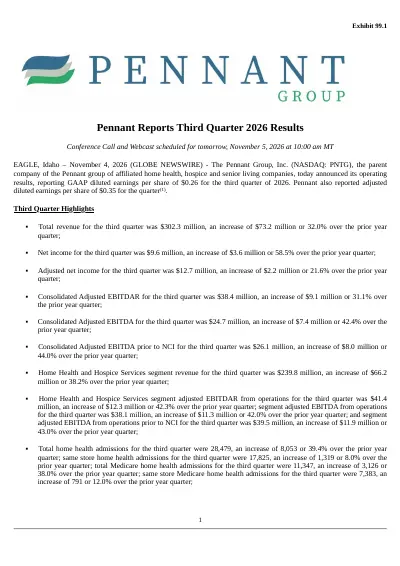
In Q3, we reported revenue of $302.3 million, an increase of 32%; adjusted EBITDA of $24.7 million, an increase of 42.4%; adjusted EBITDA prior to NCI of $26.1 million, an increase of 44%; and adjusted earnings per share of 35 cents, an increase of 16.7%, each over the prior year quarter. Pennant continues to grow and perform at a remarkable pace.
This quarter represents another important step forward in a multi-year track record of exceptional growth, consistent execution, and progress toward our long-term objectives. The strength of our performance is evident throughout our operations.
On a year-over-year basis, we are now serving nearly 40% more home health patients, 35% more hospice patients, and 10% more senior living residents than we were just one year ago. This is significant growth, and importantly, it reflects the effectiveness of our operating model and the continued execution of our local leaders and teams.
We have always approached building Pennant with a long-term perspective. Our focus is not simply on delivering results in the short term, but on building an organization capable of generating exceptional growth and performance over many years.
From that perspective, we see tremendous positive momentum across both of our core businesses. Our home health and hospice segment continues to perform at a high level, delivering strong year-over-year growth.
Our senior living segment likewise delivered solid results, even as our teams worked through the demands of integrating several new communities. While our underlying operating performance remains strong and in line with our expectations, we experienced higher than anticipated employee benefits costs during the quarter, including our newly acquired operations.
These costs created additional margin pressure and modestly impacted our earnings for the quarter. We are taking steps to more predictably manage these costs going forward and have incorporated our current expectations for elevated benefits expenses into our fourth quarter projections.
While additional volatility in these costs remains a potential variable, we continue to believe we are positioned to achieve our full-year guidance. We remain confident in the fundamental strength of our business, our strategy, and the significant opportunities ahead of us.
On the regulatory front, the home health final rule was released yesterday and includes a 2.1% net increase in the home health payment rates, or 1.5% as applied to our claims based on the proposed rule. After several years of negative rate updates, a small increase is a step in the right direction, but it is insufficient.
To preserve access to home health services, particularly in rural areas, home health reimbursement must account for the impacts of high inflation and must appropriately compensate high-quality providers. We will continue to work with our industry partners to advance positive home health policies, and we are encouraged to see the introduction of bills in the House and the Senate that call upon those bodies to redress the persistent underfunding of home health.
The home health final rule also includes several program integrity measures, which CMS intends to use to target fraudulent and illegitimate providers. We support CMS's efforts to root out fraud, but we believe several of these measures are unnecessarily broad and will impose burdens on legitimate providers.
That said, we are prepared and equipped to adapt to the changes. We continue to drive progress on the five key initiatives that have been our focus for multiple years: leadership development, clinical excellence, margin, growth, and employee experience.
Over the last several years, we have invested heavily in developing leaders, strengthening our clusters, expanding our geographic footprint, and building the infrastructure necessary to support a much larger organization. On the leadership front, we have added more than 100 CEOs-in-training this year and continued to deploy robust C-level training across key leader roles.
These investments are increasingly visible in our results. We have more talented leaders operating in more markets, a significantly broader portfolio of operations, and more opportunities to deploy the Pennant model than at any point in our history.
We believe the foundation we are building, combined with the momentum we are seeing throughout the organization, positions Pennant exceptionally well for continued growth and long-term success. With that, I'll turn the call over to John Gochnour to provide more detail on our third quarter operational results.
John Gochnour
Thank you, Brent, and good morning, everyone. As Brent highlighted, our Q3 results show robust year-over-year improvement across our operating segments.
Our home health and hospice segment delivered excellent results: segment revenue of $239.8 million, increased $66.2 million, or 38.2%; segment adjusted EBITDA of $38.1 million, increased $11.3 million, or 42%; and segment adjusted EBITDA prior to NCI of $39.5 million, increased $11.9 million, or 43%, each over the prior year quarter. This improvement was driven by strong performance at mature operations and the effective transition of newly acquired operations.
Of particular note is our strong same-store performance during a period of exceptional growth. Over the last two years, we have added 75 locations to our home health and hospice segment.
This growth has led to significant investments in leadership, infrastructure, and Service Center support, enabling us to transition larger and larger acquisitions more effectively. It has also demonstrated our ability to elevate leaders internally.
As we have described before, our transition process is not led by a traditional corporate development team. Instead, our local operations teams and Service Center resources directly support these transitions.
Our results, and especially our same-store performance, reflect the dynamic flywheel that this approach creates as local CEOs and CCOs elevate others within their teams so they can spend time supporting transitions. In many cases, these newly elevated leaders have driven improved clinical, financial, and growth results in our same-store operations, even as our CEO and CCO group have helped effectively integrate these new agencies.
As a result of these efforts across the segment, total home health admissions grew 39.4% and Medicare admissions grew 38%, offsetting a 2.2% decline in revenue per episode due to lower rates in our new Southeast locations. Our same-store locations saw total admissions increase 8%, Medicare admissions increase 12%, and revenue per episode increase 1.6%, each over the prior year quarter, as our operators drove accelerated growth and effectively offset the Medicare rate cut.
We also saw compelling hospice growth, with total admissions increasing 31.8%, total average daily census increasing 34.6%, and revenue per day improving 2.1%, each over the prior year quarter. Same-store growth was equally strong, with same-store admissions up 3.1%, ADC increasing 13%, and revenue per day improving 3.7%, each over the prior year quarter.
Our local leaders continue to manage the business effectively, as despite the significant increase in benefits costs that Brent described earlier, we saw same-store margin increase 80 basis points as compared to the prior year quarter. Clinically, we saw continued outperformance, as our potentially preventable hospitalization rate improved 10 basis points to 9.9% across the portfolio, compared to an industry average of 10.8%, and our CMS-reported hospice quality composite score increased to 98.3%, compared to an industry average of 96.2%.
We know our clinical outcomes drive our growth and financial performance and have made us an attractive partner for prospective referral, joint venture, and payer partners. Turning to senior living, segment revenue of $62.4 million is up 12.6% and adjusted EBITDA of $5.7 million is up 3%, each over the prior year quarter.
Since the beginning of last year, our senior living business has acquired 16 communities, including seven in this calendar year. This growth created some short-term operating challenges during the quarter, concentrated primarily in two markets with a high number of transitions.
In these markets, our growth temporarily outpaced leadership capacity, and several transitions and same-store operations did not perform at the level we expected. Combined with the elevated benefits costs that Brent described earlier, this impacted segment margins and caused segment-level adjusted EBITDA to be roughly flat compared to the prior year quarter, rather than the quarter-over-quarter growth we have seen over the last few years.
It is important to keep these challenges in perspective. They are concentrated rather than systemic, and they come against a backdrop of substantial growth in the senior living business as a whole.
We are excited about each of our newly added communities, many of which were acquired at low occupancy and at a substantial discount to market rates and the opportunity they present for organic growth for years to come. As we have discussed many times, in periods of heavy expansion, we expect lumpiness in our short-term results, especially in communities we have acquired with low occupancy.
This lumpiness in senior living may continue in the short term as we integrate and fill these communities. Experienced leaders are actively engaged, concrete improvement plans are underway, and we expect steady operational progress in the near term and significant growth over the long term.
Turning to growth, on August 1st, we acquired the real estate and operations of River Center Assisted Living, a 63-unit assisted living community in Tucson, Arizona. This acquisition contributes to Pennant's strong and growing position in the Tucson market.
During 2026, we doubled the number of communities we operate in Tucson, which has created a robust cluster of senior living operations in the market and complements our existing strength on the home health and hospice side. Despite recent capital expenditures and an attractive building, River Center's low occupancy and poor financial performance allowed us to acquire it at a significant discount to market rates.
This reflects our opportunistic acquisition approach, which can create short-term financial drag, but significant mid- and long-term upside. In September, Pennant acquired the real estate associated with one of its existing operations, Mainplace Senior Living, located in Orange, California.
The transaction reflects our disciplined real estate investment strategy and our conviction that selective real estate ownership is a natural complement to operational success, supports long-term operating stability, and creates enduring value. We have been operating Mainplace under a triple-net lease since 2019 and have created significant value through improved performance, which is reflected not only in the operating cash flows, but in the real estate.
This purchase allowed us to capture much of the value we created through the operational turnaround. Our integration of the 54 locations we purchased from UnitedHealth and Amedisys in the Southeast is nearly complete.
In the third quarter, we transitioned the two largest and final waves of operations. As expected, the agencies experienced ordinary disruption associated with a transition of this size, which may modestly impact results through the end of the year.
We continue to perform ahead of initial expectations and look forward to completing the transition in Q4 and shifting our focus toward optimization and long-term value creation. We continue to field numerous acquisition opportunities in each of our segments.
On the home health and hospice side, we expect to be active as opportunities emerge and as we complete the integrations I just described. On the senior living side, we are working to stabilize and optimize the numerous operations we have added in 2026 and intend to focus primarily on those efforts, though we may selectively pursue compelling and non-disruptive acquisitions in well-performing markets.
With that, I'll hand it over to Lynette for a review of the financials. Lynette?
Lynette Walbom
Thank you, John, and good morning, everyone. Detailed financial results for the three months ended September 30, 2026, are contained in our 10-Q and press release filed yesterday.
We reported total GAAP revenue of $302.3 million, adjusted EBITDA of $24.7 million, adjusted EBITDA prior to NCI of $26.1 million, GAAP diluted earnings per share of 26 cents, and adjusted diluted earnings per share of 35 cents. Key metrics for the three months ended September 30, 2026, include: $103 million outstanding on our line of credit and $18.4 million cash on hand at quarter-end; 1.95 times net debt to adjusted EBITDA; and cash flows provided from operations of $25.1 million in Q3 and $43.5 million year-to-date.
I would now like to spotlight a few of our leaders in our organization who have achieved exceptional results. Their stories demonstrate how our operating model enables local leaders to create life-changing impacts with their patients, employees, and communities.
CEO Chela Silver, CCO Ryan Withers, CMO Deena McCloud, and future CEO Casey Woodworth lead Symbii Home Health and Hospice in the Provo, Utah market. Symbii knows that delivering great care to patients is the foundation of all we do, and its clinical results are excellent, including a five-star home health rating and a potentially preventable hospitalization rate of 6.9%, compared to a national average of 10.8%.
In addition, Symbii has cultivated a positive culture where employees celebrate wins and support one another. Propelled by their extraordinary clinical and cultural performance, Symbii has become a local powerhouse, as demonstrated by its record high census.
This is the most recent chapter in a multi-year growth story that includes 33% compound annual revenue growth and 35% compound annual EBITDA growth over the last three years. At Harvest Home and Inwood Crossing in Tomball, Texas, future CEO Rod Phillips and future CCO Pearl Morrison are creating a community that blesses the lives of residents in the Greater Houston area.
Harvest Home joined the Pennant organization through acquisition in early 2025. Since then, Harvest Home's turnover has improved by over 20%, demonstrating the team's commitment to driving culture and creating an exceptional employee experience.
Over the same period, Harvest Home has increased occupancy to 91%, leading to revenue growth of almost 20% and EBITDA growth of 276%. Harvest Home's story is a recent example of Pennant's ability to acquire and transition underperforming senior living communities, apply our local leadership model and operating principles, and create meaningful benefits for residents, families, employees, and all Pennant owners.
With that, I'll turn the call back over to Brent for concluding comments.
Brent Guerisoli
Thanks, Lynette. As we conclude, I want to thank our local leaders, clinicians, and team members.
Rapid growth demands a great deal from our teams. Your willingness to take ownership, respond to challenges, and remain focused on providing life-changing service to patients and residents is what makes our model work.
We are grateful for all that you do. With that, we'll open it up for questions.
DeeDee, will you please instruct the audience on the Q&A procedure?
Operator
Thank you. As a reminder, to ask a question, please press star 1 1 on your telephone and wait for your name to be announced.
To withdraw your question, please press star 1 1 again. Please stand by while we compile the Q&A roster.
Our first question comes from Raj Kumar of Stephens. Your line is open.
Raj Kumar
Hi. Good morning.
Maybe just wanted to touch on just the Amedisys integration. I know you guys kind of talked about this disruption there a little bit kind of going through the year-end.
I know you guys had put out kind of a guidance framework in terms of expectations from that book of business. Has that changed?
If it has, kind of any updated kind of revenue or EBITDA contribution expectations from that business as we kind of think about the remainder of the year?
John Gochnour
Thanks for the question, Raj. Just to give you a little update on the integration, as I described in the script, we have completed on October 31st the EMR transition.
We've gotten through sort of the three main touch points. We completed the branding transition.
We completed the leadership transition. Now we've completed the EMR transition.
There's still some transition items remaining, things like collecting prior system AR and working through patient portal transitions, things like that. For the most part, the core events in the transition have been accomplished, and we're very excited to turn towards optimizing that business.
The disruption that I described is sort of the ordinary disruption that we built into our guidance. We always anticipate that during a large-scale EMR transition, that there's going to be some impact on census as clinicians are pulled from the field to attend trainings and then carry multiple devices.
We saw essentially what we expected there. I think the things that I would highlight is we remain ahead of sort of the progress that we initially projected in our guidance and in our updated guidance.
We're not making any changes to our expectations, and we're very excited about the future. The delta between where those businesses are performing and where our traditional same-store operations perform remains significant, and the opportunity to close that gap creates significant upside for our operations over the next couple of years.
Really excited about the Southeast, about the quality of the teams, the quality of the people. It's just a really remarkable opportunity for Pennant, and we're happy to have the main key sort of milestones in the transition complete.
Raj Kumar
Got it. Appreciate all that color.
Then maybe as a follow-up, kind of thinking about senior living, looking at occupancy kind of on a same-store basis, kind of down year-over-year. I know you kind of talked about in your prepared remarks in terms of some of the other impacts.
I guess kind of curious on kind of the timeline in terms of recovery there. I know there's a larger Medicaid component to your business as well, and we've been kind of seeing some payers being stringent upon those Medicaid waivers for senior living.
Kind of curious on any of those impacts that you might have experienced during the quarter.
John Gochnour
Raj, we're fortunate to have Andy Rider, who leads our senior living business here, and so he's going to take this question.
Andy Rider
Hey, Raj. Thanks for the question.
Really appreciate your thoughts there. We have described in the script there some of these pressures that are really occurring related to the acquisition lift.
We're through kind of that initial phase of pressure that comes from just all the work that goes into transitioning. Now we kind of have our feet under us.
We completed our last acquisition early August. They're at varying stages of kind of finalizing that transition challenge.
This is really related to two primary markets where we have challenges related to this lift. The occupancy challenge that went into same-store is also in those two markets.
We rely heavily on our local clusters and operators to complete acquisitions and these transitions. What can happen is we can get a little thin as we really tug on existing operators to make those transitions.
It can create a distraction. We're focused on recovery.
We expect Q4 to be a step in the right direction and are pushing on that. As we get further away from those transitions, we expect those two markets to really bounce back.
Raj Kumar
Thank you.
Operator
Thank you. Our next question comes from Brian Tanquilut of Jefferies.
Your line is open.
Brian Tanquilut
Hey, good morning, guys. Maybe just to clarify, you're maintaining guidance across the different KPIs.
Then maybe just a follow-up related to that, what would you think about the recovery, how do we think about that pace as we think about reramping census and the levers you can pull on the cost side with the higher medical expenses? Thanks.
John Gochnour
We are sort of reaffirming that we expect to hit our annual guidance. I think Brent commented in his section that we're consistent, operating consistent with our expectations and kind of right where we want to be.
Outside of the benefits charge, I think that was something that we wanted to call out because it did have an impact on the quarter. As you look forward, as far as the occupancy in senior living, I think that, as I described, we've got great operators engaged, resources engaged.
There's a significant push being made across the organization, and we expect that those efforts will quickly bear fruit and that we've got the opportunity to turn that into a real positive for 2027. These deals that we've done are uniformly high upside deals.
They come with low occupancy, and because of that, we're able to get them at favorable prices, favorable rents, which really create the long-term opportunity that we're focused on. When we look to the fourth quarter, I think we've projected a elevated benefits expense in that fourth quarter.
Obviously, that is happening right now, and so we'll have better color on it as the quarter ends and be able to speak more to it. Assuming things hold consistent with our projections, we do feel that we're on pace to hit our guidance.
Brian Tanquilut
All right, got it. Then just as I think about your comment on Southeast markets driving the decline in home health rates, is there an opportunity to renegotiate any of those MA contracts, I'm guessing, to drive better rates in those geographies?
John Gochnour
Just to be clear, Brian, that's specifically related to Medicare revenue per episode, where the wage index is significantly different in Tennessee versus California or Oregon or Washington. To your question, though, we do think that there's an opportunity.
Our focus right now has been on transitioning those contracts over from Amedisys and LHC into our portfolio, and our payer strategy team has done a great job there. In the long term, certainly we see upside as we bring our high-quality care to the Southeast and get an opportunity to demonstrate to those payers that we've really got coast-to-coast operations that can meet their needs from Connecticut to the Southeast, over to all across the West Coast.
We're excited about the managed care opportunity, for sure.
Brian Tanquilut
Awesome. Thank you, guys.
Operator
Thank you. Our next question comes from Ben Hendrix of RBC.
Your line is open.
Ben Hendrix
Thank you very much. Just wanted to kind of revisit the kind of recovery timeline on the senior housing side.
I think a question for Andy earlier, just to ask that from a different direction. It sounds like you've put some administrators-in-training, 100 individuals into that program.
Just wanted to see kind of what that looks like on the graduation side, you have members coming out there who could backfill those senior housing administrator shortfalls, and if we would still see a shortfall after new kind of graduates come out of that. Just kind of what does the kind of pipeline for administrators look like relative to the kind of administrative shortfalls you saw on those acquisition markets?
Thanks.
Brent Guerisoli
Ben, this is Brent. I'll just sort of maybe provide some clarity.
A lot of the stretch on the leadership was actually the existing leaders. Andy kind of addressed it in terms of the market partners and whatnot.
I think we've graduated probably 30-plus CITs this year on the senior living side. In terms of having folks that can step into those seats, we still have a robust pipeline there.
It's really more as we do this lift, it creates some bandwidth challenges for the operators. We feel good about the spot we're in from a leadership standpoint.
It's just a matter of kind of getting those stability in those two particular markets and ensuring that they can really drive results in the new operations, but also in the existing operations. That's why we saw a little bit of a decline in the occupancy there.
Andy Rider
I'll add, these acquisitions all come in kind of different state, like the state of affairs or the current situation of each one is a little different. We've kind of long signaled a nine-quarter optimization period for these transitions with three to four quarters kind of the expected timeline to get to accretive for ones that are significantly distressed.
We're in that phase of working through those timelines. Obviously, we want to push hard, and we think we can beat those timelines and accelerate that as we apply our leadership model and work in these clusters to quickly move the occupancy needle.
In some of these acquisitions where we have maybe a lot of cost challenges, but the occupancy is there, that timeline can be significantly accelerated. In other ones, that occupancy lever takes time to pull.
Brent kind of spoke to the leadership pipeline, and we continue to have a robust leadership pipeline to add strength to our organization. It was a significant lift, the biggest one we've done on the senior living side, really concentrated in what amounts to about a quarter and a half.
We did a lot in a short amount of time.
Ben Hendrix
Great. Thank you.
That's great color. Appreciate it.
Operator
Thank you. Our next question comes from Jared Haase of William Blair.
Your line is open.
Jared Haase
Yeah. Hey, guys.
Thanks for all the color so far. Maybe just as a quick housekeeping item, is there any way to size what the actual impact was from the elevated benefits costs in the quarter?
In other words, what adjusted EBITDA would have been if that were a little bit more normalized? Then, I guess, as you're working on mitigation efforts, any thoughts on sizing it for 4Q for us?
Lynette Walbom
Thanks for the question. I think that when we look at it as a percentage of revenue, it's about 50 bps of revenue is what that additional benefits impact was in Q3.
We're anticipating similar in Q4. Generally, we have an increase in benefits that hits in Q4 as we have employees that have used their benefits and are now hitting their deductibles and at the end of the year are using more of their benefits.
We generally have that built into our Q4 portion of our guidance model. We anticipate it to be similar in Q4 what that increase will be.
Jared Haase
Very helpful. Then I just wanted to take a step back, and this maybe dovetails a little bit on Brian's question earlier about home health contracting with payers and the environment there.
I'm just curious, as we remain in this world of elevated scrutiny in terms of fraud and abuse and focusing on high quality of care delivery, are you seeing any changes with MA or other payers in terms of their strategies, tightening networks, doing more things like gold carding, things like that, leaning into providers that have sort of a proven track record?
John Gochnour
Jared, it's a great insight. I think what we're seeing with payers right now is, one, they're trying to use their own tools.
Medicare has its tools from a fraud, waste, and abuse standpoint, and they're using them. That's what you see in sort of things like the proposed RCD in California.
You see it in the provider enrollment provisions of the new final rule. Managed care providers have similar tools in their toolkit, things like auth and how often they require it and approval process.
We're seeing a little bit of that. I think the long-term strategic opportunity is exactly what you described.
They are looking for high-quality partners who can deliver care efficiently. I think that's really where we shine and where we have seen opportunity as we've negotiated with these managed care providers.
We're able to provide compelling data on hospitalization rates, on star ratings, on our utilization of resources in delivering care, and ultimately in clinical outcomes. That's where I think we've seen significant process.
We've invested in our payer strategy and relations team to be able to make that case effectively with payers. We're very excited about the future and the way that payers inherently will use one of the tools in their toolkit, which is narrowing their networks, working more with high-quality providers, and potentially paying more to those high-quality providers because there's not that many of them out there.
We believe we are one. We are excited about that, the opportunity to continue to improve managed care rates.
Operator
Thank you. Our next question comes from Steve Baxter of Wells Fargo.
Your line is open.
Steve Baxter
Hi, thanks. I guess, first a clarification, the higher health benefit costs, are those just restricted to the senior living acquisitions that you've been doing, or do they also extend into the United/Amedisys assets?
Brent Guerisoli
No, we have self-funded plans, and so this is organization-wide. This impacted our home health and hospice segment, our senior living segment, our Services as well.
It's across the portfolio.
Steve Baxter
I think I misunderstood. I thought that was specific to the acquired employee populations, and you're saying instead that it's broad-based across your overall, entire organization.
That's the way to think about it?
Brent Guerisoli
That's correct. Yep.
Steve Baxter
Okay. Thank you for that.
Then just to kind of come back to some of the comments you made in the prepared remarks about kind of the final leg of transitioning the United/Amedisys assets and talking about, I guess it's the two largest and final waves in some level of operation disruption is normal. I'm trying to understand, it doesn't really seem like we've heard too much about disruption thus far.
I'm wondering, are we hearing about it now just because these are the two largest, kind of legs to go, or are we hearing about it because the level of disruption is somehow different than it was for some of the earlier transitions that were made? Thank you.
John Gochnour
That's a great question, Stephen. The reality is over the course of the last 120 days, we've integrated approximately 50-plus percent of that population.
As far as disruption, it was definitely not more significant. It was just simply the volume of patients that were involved, the volume of clinicians who transitioned over on the EMR was larger.
We're really excited. I think it actually turned out a little better than what we had projected, but it's still significant disruption because you're changing the EMR for half of the patients involved in those transitions across the Southeast, including sort of the UTJV and all the Amedisys assets.
That EMR integration is complete, and there's a new portfolio that's been formed in Tennessee that's very excited to get going and focus on optimizing that business and growing that census.
Steve Baxter
Okay. Thank you very much.
Operator
Thank you. I show no further questions at this time.
I'd like to turn it back to Brent Guerisoli for closing remarks.
Brent Guerisoli
All right. Thank you, DeeDee, and thank you, everyone, for joining us today.
Operator
This concludes today's conference call. Thank you for participating, and you may now disconnect.