PrairieSky Royalty Ltd
Q3 FY2026 · Earnings Call TranscriptOctober 27, 2026
Operator
Good day, and thank you for standing by. Welcome to the PrairieSky Royalty Third Quarter 2026 Financial Results Conference Call.
At this time, all participants are in a listen-only mode. After the speakers' presentation, there will be a question-and-answer session.
To ask a question during the session, you will need to press star 1 1 on your telephone. You will then hear an automated message advising your hand is raised.
To withdraw your question, please press star 1 1 again. Please be advised that today's conference is being recorded.
I would now like to hand the conference over to your speaker today, Andrew Phillips, President and CEO. Sir, please go ahead.
Andrew Phillips
Thank you, Michelle. Good morning, everyone, and thank you for dialing into the PrairieSky Q3 2026 conference call.
On the call from PSK are myself, Andrew Phillips; Pam Kazeil, CFO; Dan Bertram, CCO; and Mike Murphy, VP Capital Markets. Before we begin, there is certain forward-looking information and statements in our commentary today, I'd ask that listeners and investors review the forward-looking statements qualifier in our press release and MD&A, which can be found on our website.
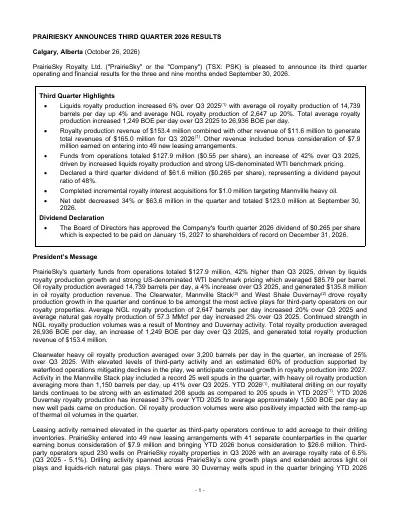
Organic growth continues in our business. Over Q3 2025, natural gas is up 2%, oil is up 4%, and NGLs are up 20% as high-liquids gas replaces drier gas.
Net debt decreased 34% over the prior quarter. Strong leasing activity continues as PSK entered into 39 lease arrangements with 41 oil companies.
New leasing was pervasive across our entire land base and includes numerous modular SAGD leases to qualified operators. $7.9 million of lease issuance bonus was brought in over the quarter.
230 wells were spud in Q3 at a 6%, 6.5% average royalty rate. This included 30 Duvernay wells in the quarter versus 46 in all of 2025.
Our team continues to execute well and is focused on continued active leasing of our large mineral title position. With the capital cycle returning and a number of teams restarting, grass-roots exploration in the basin has returned for the first time since 2013-2014.
We are uniquely positioned to capitalize on this trend with our mineral title land base. I will now turn the call over to Mike to further discuss activity on our lands.
Mike Murphy
Thanks, Andrew. Drilling activity was strong in Q3, with new well spuds up 14% over 2025 at a higher average royalty rate of 6.5% compared to 5.1% last year.
We had a record 30 Duvernay spuds in the quarter, bringing the total for the year to 81, including 65 in the prolific West Shale Basin. As of the end of this quarter, only 22 of these West Shale wells were on production, upcoming completions are expected to continue to support Duvernay light oil growth through Q4 and early 2027.
Notably, we've seen a resurgence in other light oil plays in the basin, including short cycle time plays like the Viking, where our spud count is up 49% year-to-date. Moving to heavy oil, Mannville stack multilateral drilling activity is up 57% through the first 9 months of the year relative to the same period in 2025.
This has translated into 26% year-over-year production growth in the Mannville stack, which has averaged over 1,100 barrels per day year-to-date. The Clearwater has maintained its 20% growth rate and exceeded 3,200 barrels per day of oil royalty production in the quarter.
Waterflood operations continue to expand in the Clearwater, with an estimated 60% of our production in the play under waterflood support, supporting low declines and a highly sustainable production base. I'll now turn it over to Pam to discuss the financials.
Pam Kazeil
Thank you, Mike. Good morning, everyone.
PrairieSky's total royalty production averaged 26,936 BOE per day in the quarter, an increase of 5% over Q3 2025. This growth was driven by the over 1,000 barrel per day increase in liquids royalty production, with oil royalty volumes increasing 4% to 14,739 barrels per day and NGL royalty production increasing 20% to 2,647 barrels per day.
The Clearwater, Mannville Stack, and Duvernay plays were the biggest contributors to these volume increases. Royalty production revenue totaled $153.4 million in the quarter, compared to $107.7 million in Q3 2025, with PrairieSky's realized oil price averaging just over $100 per barrel during the quarter.
Other revenue totaled $11.6 million, including $7.9 million of bonus consideration, bringing total revenues for the quarter to $165 million. Strong quarterly revenue generated funds from operations of $127.9 million or 55 cents per share, an increase of 42% over Q3 2025.
During the quarter, PrairieSky declared dividends of $61.6 million, representing a payout ratio of 48%, and completed $1 million of acquisitions targeting incremental Mannville heavy oil royalty interests. After dividends and acquisitions, excess funds from operations were directed towards debt repayment.
Net debt decreased by $63.6 million during the quarter to $123 million at September 30th. Year-to-date, PrairieSky has reduced net debt by $153.5 million or 56%.
The board has approved a fourth quarter dividend of 26.5 cents per share, payable on January 15th, 2027 to shareholders of record on December 31st, 2026. I will now turn the call over to the moderator to proceed with the Q&A.
Operator
Thank you. As a reminder, to ask a question, please press star 1 1 on your telephone and wait for your name to be announced.
To withdraw your question, please press star 1 1 again. One moment while we compile our Q&A roster.
Our first question will come from the line of Patrick O'Rourke with ATB Cormark Capital Markets. Your line is open.
Please go ahead.
Patrick O'Rourke
Hey, guys. Good morning, and thank you for taking my question.
I guess, just first question, in terms of the outlook for production growth, I think it's pretty well understood rateable growth in the Clearwater, high-impact Duvernay that's coming online here. In the medium and longer term, sort of what does the outlook for the small-scale SAGD?
What's sort of the timing in and around those things? Then just on a comment that you made on other light oil plays, maybe a little bit more color in terms of the trends that you're seeing there specifically?
Andrew Phillips
You bet. Thanks for the question, Patrick.
Firstly on the thermal volumes, the one thing that we have that's kind of in the queue right now is the Lindbergh expansion with Strathcona, which by 2031 should get to 45,000 to 47,000 barrels. That should effectively double our net royalty oil production coming from thermal from a current 1,200 barrels per day to just around 2,500 barrels per day of total royalty production.
With all of the leasing we've done in western Saskatchewan, we expect over the longer term, kind of starting in 2030 out to 2040, we should add another incremental 4,000 to 5,000 new royalty barrels from those plays as they're developed, using about 50% of them effectively being developed over time, but we think the chance of success is higher for that because a lot of them have been substantially de-risked. Then on the conventional side, we've been very actively leasing a lot of conventional plays that have been quite quiet over the last 5 years, and even some new technological advancements, multilateral drilling, etc., coming towards some of these plays and new waterflood opportunities on some of the older plays.
I think you should start to potentially see that conventional portfolio flatten out to potentially grow sometime in the next 3 years, assuming oil price hangs in there.
Patrick O'Rourke
Thanks. Maybe just shifting gears, I think you guys have been fairly clear about the counter-cyclicality of your acquisition strategy, and so debt came down in excess of $60 million in the quarter.
I think myself and my peers across the street would see you guys being debt-free in the first half of 2027. How do you think about allocation of capital, whether it be returns to shareholders or M&A, acquisitions in the context of the current market, and releasing some of that cash you're going to build on the shareholders either through acquisitions or direct returns in '27?
Andrew Phillips
When you look into 2027, we'll review the dividend in February as a board. We're looking to show dividend increases every year.
I think we definitely have the ability to do higher ones, but I think we'll keep it very pragmatic and kind of smaller dividend increases because we see a lot of value in share repurchases over time, potentially acquisitions as well. Even in 2025, which was a pretty frothy market, we were able to do $100 million of M&A with high teens returns.
Whatever provides a better return, we're willing to execute on, and I think it's been nice over the last 5 years. We've seen the share count come down 3%, paid $1 billion in dividends, and our royalty oil production's roughly doubled.
We're in a good position now. We expect more organic growth over the next 5 years, and it's hard to find acquisitions that look as good as our current business with kind of mid-plus single-digit growth rates, a mid-single-digit free cash flow yield, and then some of this higher-return M&A taking you to almost a mid-teens returns on an unlevered basis.
Again, we see a lot of value in the buyback, but we'll try and do it counter-cyclically.
Patrick O'Rourke
Thanks, guys.
Andrew Phillips
Appreciate the questions.
Operator
Thank you. One moment for our next question.
Our next question comes from the line of Aaron Bilkoski with TD Cowen. Your line is open.
Please go ahead.
Aaron Bilkoski
Thanks. Morning, guys.
My question's on the potential royalty concessions from the province. There's obviously an expectation that we're going to see some royalty concessions.
It's a bit ambiguous whether that's just going to be on heavy oil or conventional's going to be included, but to any extent that you can share, I'd be curious how you think this might impact PrairieSky.
Andrew Phillips
When you think about the royalty concessions, I know Saskatchewan's been very aggressive with the royalty concessions, and you did see capital flows into the province. I think for us, one of the bigger impacts would be if they loosen some of the regulations on water recycling for modular SAGD.
We have a number of opportunities in the Cold Lake region that we think would be excellent SAGD opportunities with low SORs, but because they're smaller projects, 6,000 to 12,000-barrel projects, they would require some type of relaxation on water recycling regulation similar to what they have in Saskatchewan. We think that would be the bigger incentive, but I think overall, already what the federal government's put in, the tax incentives and depreciation incentives, that just puts more cash flow into the system and there's more capital to deploy into the field, which ends up impacting us positively.
Aaron Bilkoski
That's helpful. Thank you.
Andrew Phillips
Thanks for your question.
Operator
Thank you. I would now like to hand the conference back over to Andrew Phillips for his closing remarks.
Andrew Phillips
Thank you very much for dialing into the PrairieSky Q3 2026 conference call, and please feel free to call Pam, Mike, or myself if you have any questions, and have a great rest of your day.
Operator
This concludes today's conference call. Thank you for participating, and you may now disconnect.
Everyone, have a great day.