Proto Labs, Inc.
Q3 FY2026 · Earnings Call TranscriptOctober 29, 2026
Operator
Greetings. Welcome to the Protolabs Q3 fiscal year 2026 earnings conference call.
At this time, all participants are in a listen-only mode. A question and answer session will follow the formal presentation.
If anyone should require operator assistance during the conference, please press *0 on your telephone keypad. Please note this conference is being recorded.
I will now turn the conference over to Ryan Johnsrud, Investor Relations. Thank you, Ryan.
You may begin.
Ryan Johnsrud
Thank you. Good morning, everyone, and welcome to Protolabs' third quarter 2026 earnings conference call.
I'm joined today by Suresh Krishna, President and Chief Executive Officer, and Dan Schumacher, Chief Financial Officer. This morning, Protolabs issued a press release announcing its financial results for the third quarter ended September 30th, 2026.
The release is available on the company's website. In addition, a prepared slide presentation is available online at the web address provided in our press release.
Our discussion today will include statements relating to future performance and expectations that are or may be considered forward-looking statements and subject to many risks and uncertainties that could cause actual results to differ materially from expectations. Please refer to our earnings press release and recent SEC filings, including our annual report on Form 10-K, for information on certain risks that could cause actual outcomes to differ materially and adversely from any forward-looking statements made today.
The results and guidance we will discuss include non-GAAP financial measures consistent with our past practice. Please refer to our press release and the accompanying slide presentation at the Investor Relations section of our company website for a complete reconciliation of GAAP to non-GAAP results.
Now, I will turn the call over to Suresh Krishna. Suresh?
Suresh Krishna
Thank you, Ryan. Good morning, everyone, and thank you for joining our earnings call.
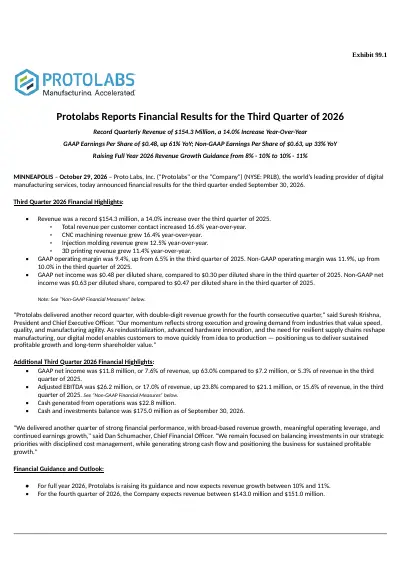
I am very pleased with our third quarter performance, which provides further evidence that the execution of our strategy is translating into strong and consistent financial results. Third quarter revenue grew 14%, resulting in another record revenue quarter.
This is the fourth consecutive quarter of double-digit growth. We also delivered double-digit non-GAAP EPS growth for the fourth consecutive quarter, with EPS growth outpacing revenue growth in each of these quarters.
In the first nine months of 2026, year-over-year revenue grew 12%, adjusted operating margin expanded 300 basis points, and adjusted EPS grew 46%, underscoring the consistency of our execution and the strength of our momentum. These results are driven by the tremendous work of our Protolabs team and their continued commitment to serving our customers.
I want to thank them all for everything they do every day. The trends that drove strong performance in the first half of the year continued in the third quarter.
Larger, strategic customers continued to broaden their relationships with Protolabs and turn to us for more of their manufacturing needs across the entire product lifecycle. This is reflected in a 17% year-over-year increase in revenue per customer.
In addition, we served almost 21,000 customers in the quarter, up sequentially for the third straight quarter. We continue to see strong demand in high-growth industries, including aerospace, defense, drones, robotics, and data centers.
We work with most innovative companies in these markets, including Blue Origin, Relativity Space, Raytheon, AeroVironment, Shield AI, Agility Robotics, and many others. These customers need to rapidly move from ideas to prototypes and into production, making Protolabs' speed, quality, and reliability increasingly critical.
We saw broad-based strength across our business in the third quarter, with each of our three largest service lines growing double digits year-over-year. Factory CNC machining was particularly strong, growing 22%, as our world-class speed continues to resonate with customers.
Global 3D printing revenues grew 12%, led by strong demand from metals and HP's Multi Jet Fusion technology, or MJF. Year-to-date, MJF revenue in our US factory operation is up more than 40%, and we are investing in additional capacity to support that growth.
Protolabs is at the center of a major shift taking place in manufacturing, driven by four powerful macro trends. First, reindustrialization: companies are bringing manufacturing closer to their customers and building more resilient, regional, and sovereign supply chains.
Second, a wave of hardware innovation moving at the speed of software: investment is accelerating across critical and emerging industries like space, drones, robotics, data centers, and other highly engineered hardware that ultimately needs to be designed, tested, and manufactured from prototype to production at faster speeds than ever before. Third, physical AI: AI is moving beyond software and into the physical world, driving a new generation of robotics, autonomous systems, intelligent machines, and other advanced products that require manufacturing to leverage physical AI.
Fourth, supply chain agility and scalability: as innovation accelerates, companies need manufacturing partners that can invest and scale with them without the manpower and capital constraints of traditional supply chains. This is exactly the environment Protolabs is built for.
We help customers move quickly from idea to prototype to production, while delivering the quality, reliability, and scalable capacity they need. We have an important structural advantage: our true digital thread.
Protolabs' software-native digital manufacturing model enables speed and automation today, while creating a foundation to leverage AI and scale efficiently over time. With millions of CAD files and decades of manufacturing data in our library, we have a powerful foundation to apply AI, advance our manufacturing capabilities, and create more valuable solutions for our customers.
We're already seeing the benefits of these trends in our business, and we believe they create a significant opportunity for Protolabs over the next several years. We continue to invest in capabilities to capture the opportunity ahead.
We are advancing our four strategic pillars: elevating the customer experience, accelerating innovation, expanding into production, and driving operational efficiency. I'd like to share several important business and product updates with you now.
On ProDesk, we launched new metal 3D printing heat treatments, FDM printing capabilities, and additional CNC machining surface finishes, giving customers more control over part performance, surface quality, and finishing requirements. Next, we continue to enhance the Protolabs Network with improvements designed to accelerate order acceptance, improve partner communication, and strengthen quality.
We're also developing AI-assisted order checks to identify specification discrepancies earlier and further automate the customer and partner experience. With respect to improving efficiency across the organization, last week we announced an enterprise implementation of Amazon Q as part of our broader AI roadmap.
Our initial focus is on go-to-market workflows, where we believe AI can improve productivity, reduce response times, and streamline order-to-quote processing. To accelerate implementation, we created forward-deployed AI engineer roles to identify high-impact use cases and design AI-enabled workflows across the organization.
Enterprise-wide implementation will continue into 2027, led by Mark Kermisch, our Chief Technology and AI Officer. Technology is an important enabler of our strategy, and operational execution is the other.
In August, Sam Rahmati was named Chief Operations Officer. Sam brings over 25 years of executive operational leadership across global companies like nVent, Eaton, Honeywell, and more.
Sam will help advance our strategic pillars, while focusing on driving operational excellence across safety, quality, delivery, and cost. We are also expanding the talent and capabilities needed to execute our strategy.
We have officially inaugurated our new Global Capability Center in India. Engineers are on site and are working directly on our manufacturing and AI roadmap.
The talent and capabilities we are building in India will help accelerate progress across all four strategic pillars. The center strengthens our investments in technologies that will meaningfully improve productivity, including AI, automation, and advanced manufacturing capabilities that support our broader digital manufacturing strategy.
Turning to Europe, revenue grew double digits in the third quarter, in part due to the go-to-market changes we initiated late last year. We are very pleased with this performance, and I want to thank our team in Europe, led by Piotr Horowits, for their continued execution and commitment.
We continue to advance the initiatives needed to return Europe to profitability, addressing the drivers of underperformance while putting the right organizational structure, operating model, talent, and capabilities in place to execute more effectively. These efforts are designed to complement the go-to-market changes already underway and support further operational improvements.
As I shared last quarter, the transformation in Europe remains a work in progress, and it's a longer-term effort. While we are encouraged by double-digit revenue growth, our objective remains unchanged: transform Europe into a contributor to both future growth and profitability.
Before I turn the call over to Dan, I want to highlight two recent recognitions of our commitment to manufacturing innovation. In August, we announced a partnership with MIT and a grant supporting US manufacturing innovation research at MIT Industrial Performance Center.
In September, Protolabs was one of the only 500 US companies named to Business Insider's America's Most Innovative Businesses 2027 list. We are proud of both recognitions and believe they reinforce Protolabs' position at the center of manufacturing innovation.
In closing, I am very pleased with our results through the first nine months of the year and the progress we are making on our transformation. At the same time, I believe we are still in the early innings of what this business can achieve.
We are executing our strategy at a time when some of the world's most innovative industries are moving faster, manufacturing supply chains are being reconfigured, and speed and digital manufacturing capabilities have never been more important. We believe Protolabs is uniquely positioned for this environment and the opportunity ahead.
We remain focused on building on recent momentum and delivering sustained profitable growth and long-term value for our customers and shareholders. With that, I'll turn the call over to Dan to walk through the financials and outlook.
Dan Schumacher
Thanks, Suresh, and good morning. I'll start with an overview of our third quarter results, followed by our outlook for the fourth quarter.
Third quarter revenue was a company record $154.3 million, up 14.2% year-over-year in constant currencies. US revenue grew 14.7%, while Europe grew 12.2% in constant currencies.
Third quarter CNC machining revenue grew 16.7% year-over-year in constant currencies. Our largest service continues to see very strong demand in aerospace and defense, most notably space exploration, satellites, and drones, as well as in robotics.
Injection molding grew 12.6% in constant currencies, driven by strength in electronics, aerospace and defense, and telecommunications. 3D printing revenue increased 11.5% year-over-year in constant currencies.
As we saw in the first half of 2026, demand in DMLS and MJF remained very strong in the US. We continue to invest capital to expand capacity in those areas.
Sheet metal revenue declined 4.6% year-over-year in constant currencies, with broad weakness across end markets, partially offset by strength in aerospace and defense. On to profitability: non-GAAP gross margin was 44.5% in the third quarter, down 230 basis points sequentially and 140 basis points year-over-year.
Lower gross margin was driven by our factory operations, primarily reflecting higher raw material costs, machine upgrades, and targeted near-term investments in labor and contractor support. These were made to accommodate the significant increase in volume over the course of the year, while maintaining our standards for speed, quality, and reliability.
Third quarter non-GAAP operating expenses were $50.3 million, up $1.7 million compared to the prior year, primarily reflecting increased investment in demand generation, along with higher contractor, professional services, and software license costs as we continue to fund our strategic priorities. Importantly, we continue to generate significant operating leverage.
Adjusted operating expenses were 32.6% of revenue, down from 34.8% of revenue in the second quarter and 35.9% in the third quarter of 2025. This operating leverage reflects both strong revenue growth and the targeted actions we have taken to improve our cost structure and reallocate resources towards our highest priority growth initiatives.
We continue to invest and add resources behind our strategic initiatives, while identifying additional efficiencies that can help fund future growth. Adjusted EBITDA was $26.2 million, or 17% of revenue, up from $21.1 million, or 15.6% of revenue, in the third quarter of 2025.
Year-to-date, adjusted EBITDA is up 27.2% year-over-year. Third quarter non-GAAP earnings per share were 63 cents, up 33.4% year-over-year, driven by revenue growth, mix shift, and significant leverage on our SG&A expenses.
63 cents is the highest adjusted EPS figure we've reported since the third quarter of 2020. Adjusted EPS is up 45.5% year-to- year-over-year, year-to-date.
We generated $22.8 million in cash from operations during the third quarter, and we repurchased $5 million of common stock. On September 30th, we had $175 million of cash and investments on our balance sheet and zero debt.
Our outlook for the fourth quarter of 2026 is outlined on slide 14. For the fourth quarter, we expect revenue between $143 and $151 million.
At the midpoint, this implies 8% revenue growth year-over-year. As a result, we are raising our full year 2026 revenue growth outlook from a prior range of 8 to 10% to a new range of 10 to 11%.
We anticipate 2026 will be our first year of double-digit organic revenue growth since 2018. We expect foreign currency to have a negligible impact on revenue compared to the fourth quarter of 2025.
Our fourth quarter earnings guidance incorporates the following assumptions: non-GAAP add-backs will include stock-based compensation expense of approximately $4.1 million and amortization expense of $900,000, a non-GAAP effective tax rate between 19 and 21%. In summary, we expect fourth quarter 2026 non-GAAP earnings per share between 46 and 54 cents.
That conclude- concludes our prepared remarks. Nicole, please open the line for questions.
Operator
Thank you. We will now be conducting a question and answer session.
If you would like to ask a question, please press *1 on your telephone keypad. A confirmation tone will indicate that your line is in the question queue.
You may press *2 if you would like to remove your question from the queue. For participants using speaker equipment, it may be necessary to pick up your handset before pressing the star keys.
One moment please while we poll for questions. Our first question comes from Brian Drab with William Blair.
Please go ahead.
Brian Drab
Morning. Thanks for taking my questions, and congrats on a great quarter.
Dan Schumacher
Thanks, Brian. Hey,
Brian Drab
could you just start by talking about it looks like revenue per customer is up about 17% and maybe add some granularity to that in terms of is it driven by volume, or is it also the breadth of services now that you're increasingly offering, that's allowing for that? That's just a very impressive result.
Where were you seeing the most success?
Suresh Krishna
Hey, Brian. This is Suresh.
Thanks for your question. As we've talked before, we are absolutely focused on our four key strategic pillars: the first of them, which is elevating customer experience, and the second of them, which is accelerating innovation on behalf of the customers, and the third, which is expanding into production, are all contributing to this particular growth that we are seeing in wallet share with our core customer base.
Some of the changes we've made to be able to do this well beyond the strategy is the way we are executing. We have an enterprise sales team.
We are focused on a handful of industries that are high value for us, and those sales teams are building deep customer relationships and listening and turning it around to provide innovation that is specific to these customers. In the past, we may have innovated for the general customer base, which for us is tens of thousands of customers, to now being very focused on the customers where we see high value.
That is where we are able to drive wallet share and increase revenue per customer.
Brian Drab
Thanks. Then, I'm surprised a little bit to see that the stock's indicating slightly down before the open here.
I guess it could be just midpoint of guidance is 50 cents for fourth quarter after you just put up 63 cents. What is there beyond just typical seasonality for the fourth quarter that you're looking at as you guide for that fourth quarter?
Dan Schumacher
Yeah. One, it is typical I assume the seasonality that we've seen for the prior seven years
Brian Drab
or
Dan Schumacher
last quarter. It is built in there that we expect to see some softness around the holiday time, which, as impacts that EPS number.
Second, gross margin I'm assuming to be flat to slightly down quarter-over-quarter. We talked about machine upgrade costs and so forth.
We don't expect to see it at that high of a level. We have lower revenue, and we have some of inefficiency in our factories around the holiday time as we bring in contractors and overtime as employees are taking time off.
Then, I would expect SG&A expenses as a percent of revenue to look more like the first and second quarter of the year, rather than what we saw in the third quarter. There's a pick-up in SG&A expenses as well.
Brian Drab
Got it. Okay.
All right. I'll get back in line.
I might have a couple more. Thanks.
Dan Schumacher
Sounds good.
Operator
Once again, if you would like to ask a question, please press *1 on your telephone keypad. Our next question comes from Austin Bohlig with Needham.
Please proceed with your question.
Austin Bohlig
Hey, guys. Thanks for taking my question, and congrats on the great results.
Was just hoping to get a little bit more color on kind of the growth you're seeing in the factory versus network. I didn't see what the revenue for the network was, if you could provide that.
Dan Schumacher
Yeah. Network revenue was up 3% year-over-year.
That meant that factory growth was up 17.5%. Again, we had higher growth in the factory than we had in the network.
From a network side, we are seeing really strong momentum in the network in Europe, but things are a bit softer in the US. Our customers, as we come to them, they have a choice at this time in terms of do they need the speed that we're offering through the factory, or do they need the breadth of services and maybe longer lead time of the network.
We are just seeing more of our customers in the US take advantage of that speed, and you're seeing that in the tremendous growth.
Austin Bohlig
Got it. Then just one follow-up.
With all the defense, or A&D success more broadly, what's your conversations with your customers? How are you guys feeling just with some uncertainty around the fiscal '27 budget, continuing resolution continuing through 2027?
Do you guys think that this momentum can continue even with some kind of lingering uncertainty around future budgets?
Suresh Krishna
Yeah. Austin, thanks for bringing that up.
We are very, very broad-based in terms of the industries served, and A&D for us is very broad as well. While there might be some uncertainty around defense budget, we see tremendous opportunity in space exploration, in satellites, in drones, neo-primes along with the primes.
Then beyond that, we absolutely see non-A&D sectors like robotics and data centers also growing. We are very confident that when we look out into the future that we would continue to be able to drive our goal of double-digit growth for the foreseeable future.
Austin Bohlig
All right. Keep up the great work, guys.
Thanks for taking my questions.
Suresh Krishna
Thank you.
Operator
Our next question is from Brian Drab with William Blair. Please go ahead.
Brian Drab
Oh, thanks. I was just wondering if you could talk maybe for Dan, a little bit further out in terms of how you're thinking about the trajectory of gross margin and expense dollars as we think about 2027, maybe just directionally or high level, like different projects and different expenses to think about it as we're modeling.
Dan Schumacher
Yeah. We're in the middle of establishing our 2027 budget and plans as we speak, but what I would tell you is we're going to continue to accelerate our investment in several areas.
One is expanding our capacity, and the second is investing in our strategic pillars, so that's elevating our customer experience, accelerating innovation, expanding into production, and driving operational efficiency. With the last one, our objective from a spending perspective is really to focus on how do we continue to increase our efficiencies as we invest.
I would expect next year from an operating expense perspective that the growth in operating expenses would be much closer to the revenue growth next year than what we saw this year, as we start to make these investments. From a gross margin perspective, it really is going to depend on the mix that we're seeing and the different types of products that we have and how that plays out as we go through the year, but I would expect that we would be able to hold our gross margin percentage as we go into 2027.
Brian Drab
Okay. I got it.
I think I'll follow up more later on that, but that's really clear. Thanks, Dan.
Dan Schumacher
Yep.
Operator
Our next question comes from Greg Palm with Craig-Hallum. Please proceed with your question.
Greg Palm
Thanks. Sorry if this got I guess maybe explained or specified.
I've been juggling a handful of calls this morning. In terms of maybe the sequential gross margin bridge from Q3 to Q2, a couple hundred basis points give or take.
Dan, I know you listed a bunch of reasons, but just can you break that out between them and then just in terms of sustainability or confidence in getting that gross margin level back up from here? Maybe just a little bit more color on that, please.
Dan Schumacher
Just to be clear, Greg, you're talking about Q2 to Q3 gross margin?
Greg Palm
Correct.
Dan Schumacher
All right.
Suresh Krishna
Yeah. Greg, as you noted in our prepared remarks, demand has been exceptionally strong in our US factory CNC.
Revenues have grown over 20% for six quarters in a row. While our automated model is designed to scale efficiently with these kind of volume increase, we in this particular quarter had to do some machine upgrades.
We found opportunistically a window where we could do that, and some of our older machines were upgraded so that they could start to perform at the same rate as some of the newer machines that we have acquired more recently. We've acquired over 40 new machines this past year.
Those expenses were incurred within the quarter and not capitalized. Then there was some contract labor we had to bring in for our support services because we were chasing this growth and make sure that we could deliver everything we needed for our customers within the timeframes that we provide them.
Beyond that, there was raw material increases that we saw. Those were the pressures that we got in Q3 versus our Q2 performance.
Dan Schumacher
Greg, just to provide more specifics, I would say there's about 100 basis points in those machine upgrades, there's probably about 90 basis points in that contract labor, and the remaining in the material cost. I just want to reemphasize that the contract upgrades and obviously the contract labor, those are all variable costs that we can choose to move over time, and it's really focused on making sure that we have speed, the quality and reliability for our customers.
Greg Palm
Okay. Just to be clear though, you incur that completely in Q3 and then it goes away completely for sort of Q4 or going forward, or?
Dan Schumacher
One thing I would say is we're always using contract labor, right, to vary depending on the volume that's coming in. There is some assumption in the guide that cost comes down as we're in fourth quarter.
What is kind of counteracting that, right, is the lower volume that is in the middle of the guide as well as seasonality. We may have to use some of that contract labor and some of that overtime as our employees take off for the holidays.
Greg Palm
Yep, understood. Okay.
Appreciate the color.
Operator
Once again, if you would like to ask a question, please press *1 on your telephone keypad. It looks like we have no more questions in the queue.
This now concludes our question and answer session. Ladies and gentlemen, thank you for your participation.
This concludes today's teleconference. Please disconnect your lines and have a wonderful day.