Perella Weinberg Partners
NNASDAQ:PWPQ3 FY2026 · Earnings Call TranscriptOctober 29, 2026
Operator
Good morning, and welcome to the Perella Weinberg Third Quarter 2026 Earnings Conference Call. Currently, all callers have been placed in a listen-only mode, and following management's prepared remarks, the call will be open for your questions.
If you would like to ask a question at that time, please press star one on your telephone keypad. If you need to remove yourself from the queue, press star two.
At any time if you should need operator assistance, please press star zero. Please be advised that today's call is being recorded.
I will now turn the call over to Kendyl Corber, Head of Investor Relations. You may begin.
Kendyl Corber
Thank you, operator, and welcome all. Joining me today are Andrew Bednar, Chief Executive Officer and Chairman, and Alex Gottschalk, Chief Financial Officer and Chief Operating Officer.
Before we begin, I'd like to note that this call may contain forward-looking statements, including Perella Weinberg's expectations of future financial and business performance and conditions and industry outlook. Forward-looking statements are inherently subject to risks, uncertainties, and assumptions that could cause actual results to differ materially from those discussed in the forward-looking statements and are not guarantees of future events or performance.
Please refer to Perella Weinberg's most recent SEC filings for a discussion of certain of these risks and uncertainties. The forward-looking statements are based on our current beliefs and expectations, and the firm undertakes no obligation to update any forward-looking statements.
During the call, there will also be a discussion of some metrics which are non-GAAP financial measures, which management believes are relevant in assessing the financial performance of the business. Perella Weinberg has reconciled these items to the most comparable GAAP measures in the press release included within today's Form 8-K, which can be found on the company's website.
I will now turn the call over to Andrew Bednar to discuss our results.
Andrew Bednar
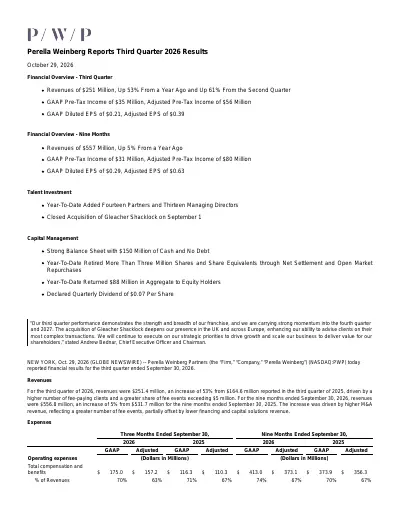
Thank you, Kendyl, and good morning. Today we reported third quarter revenues of $251 million, up 53% from a year ago and up 61% from the second quarter, bringing our year-to-date revenues to $557 million, up 5% from last year.
As we discussed last quarter, we anticipated that our revenue would be back-half weighted, and that is exactly what we're seeing. The momentum in our business has moved from pipeline into announcements and is steadily converting into revenue.
Our third quarter revenues were our highest since the third quarter of 2024, led by our M&A business, which nearly doubled from the third quarter of last year and is up over 40% year-to-date. We saw particular strength in our consumer, industrials, energy, and financial institutions businesses.
In restructuring and liability management, revenues are down against a record 2025, but we remain engaged on large and complex situations and that pipeline continues to build. The two metrics we previously highlighted as the strongest leading indicators of our business also continue to strengthen.
Our announced and pending backlog at quarter end was up nearly three times from a year ago. Our total booked plus announced and pending backlog as of today is up about 30% year-over-year.
Finally, the number of announcements year-to-date is up compared to last year, and our current gross backlog under engagement letters is up 40% versus this time last year. Importantly, our strong performance is broad-based.
In the third quarter, our fee-paying client count was up 50% from a year ago, and the number of fee events exceeding $5 million was up nearly 80%. This reflects our investments in internal talent development and our relentless focus on expanding client coverage.
On September 1, we closed our acquisition of Gleacher Shacklock. Our combined UK business has experienced strong momentum out of the gate with six announced transactions since September, and we see accelerating client dialogue, both demonstrating early validation of our combination thesis.
Taken together, the strength of our backlog, the breadth of our client base, and the level of activity across our business give us confidence heading into year-end and into 2027. Developing and attracting top talent remains central to how we grow the firm.
This year we have added 14 partners and 13 managing directors, including the Gleacher Shacklock team, and we intend to continue adding talent that broadens our client coverage and expands our product capabilities, consistent with our strategy and our brand. We remain very excited about our path, and we recognize our duty to you, our shareholders, a responsibility that we take very seriously.
Although we regularly evaluate ways to improve our position, we have never made a decision to sell the firm, nor have we ever initiated any sale process. We have been building this firm for the long term.
We are only 20 years in, and we continue to see tremendous opportunities in front of us. With that, I'll now turn the call over to Alex to review our financial results and capital management in more detail.
Alex Gottschalk
Thank you, Andrew. Our third quarter revenues of $251 million included $55 million related to closings that occurred within the first few days of the fourth quarter, which in accordance with relevant accounting principles, were recorded in the third quarter.
Our adjusted compensation margin for the first nine months was 67%, in line with last year and with our full year target. The third quarter margin of 62.5% reflects bringing our year-to-date accrual in line with that target.
Our adjusted non-compensation expense of $37 million for the quarter was roughly flat with last year. The $6 million increase from last quarter largely reflects the insurance recovery that benefited the second quarter.
For the nine-month period, adjusted non-compensation expenses totaled $106 million, down 14% from last year, driven primarily by lower professional fees. We remain on track for a single-digit percent decrease in full year adjusted non-compensation expense versus 2025.
Our third quarter adjusted tax rate was 29.5% on an if-converted basis. Excluding the benefit from RSU vesting, we continue to expect our underlying adjusted tax rate to be in the low-to-mid 30% range for the remainder of 2026.
Turning to capital management, year-to-date, we have returned $88 million to equity holders through the net settlement of RSUs, dividends, and distributions, and open market repurchases. Share repurchase activity has been temporarily limited as we have prioritized deploying capital towards strategic investments, including the acquisition of Gleacher Shacklock.
At the end of the third quarter, we had 79.5 million shares of Class A common stock and 18 million partnership units outstanding. Finally, we closed the quarter with $150 million in cash and no debt.
This morning, we announced a quarterly dividend of 7 cents per share. With that, operator, please open the line for questions.
Operator
Thank you. At this time, if you wish to ask a question, please press star one on your telephone keypad.
You may remove yourself from the queue by pressing star two. Our first question today comes from Devin Ryan with Citizens Bank.
Your line is now open.
Devin Ryan
Good morning, Andrew and Alex. How are you?
Andrew Bednar
Very good. Good morning.
Alex Gottschalk
Morning.
Devin Ryan
Good. Quick question, you gave some good stats on kind of the backlog and just trying to think about after obviously a good quarter here and I think playing out as you guys had framed kind of back-half weighted.
The announced and pending backlog, I think you said is nearly three times last year's level, and total booked plus announced and pending backlogs up 30%. Just trying to understand kind of the expected conversion of those two backlog measures.
What is typical in terms of length? Is it over two quarters, three quarters, four quarters?
Then what gives you kind of the greater visibility into 2027 compared to this time last year? Thanks.
Andrew Bednar
Sure. Thanks, Devin.
Not all of that announced and pending will hit in 2026, some of that will move into '27. There's not a whole lot in there that has any closing risk, it just has timing differences deal by deal.
We expect to take all of that into revenue over time. I don't think there's much in there that will take three or four quarters, but there's certainly one to two quarters out for sure, which is why we have conviction going into '27 because some of that build in A&P for sure will close in the early part of '27.
Devin Ryan
Got it. If you could just elaborate, Andrew, what has been driving that build?
Is it just a function of the specific corporate clients or sponsor clients you're working with, or is it partners that have been on the platform that are becoming more productive, or just the environment maybe getting better over the last six months? What would you attribute some of that build to?
Andrew Bednar
I don't think it's much on the macro backdrop. That's been quite positive outside of, I would say, energy, which is obviously for most of us has been a bit of a choppy year given things going on in the Middle East, and I think we're starting to see clearly now through the next couple of quarters look good in terms of the engagement and the pipeline, we feel good about energy going into '27.
It's more just clients that are taking advantage of opportunities. I think we tend to be a little more strategic-weighted, and although we've built up a very nice private equity business with a number of more recent hires we've made, it is more about getting our bankers on the platform.
It does take time to ramp. We still have more than 30% of our partnership that's here less than three years, and that just takes time to hit the stride and get into a rhythm and get into a transaction cadence with their group of clients.
I think that's just something we continue to see as a natural evolution of the business when you're in the state that we're in where we're hiring, but also where we've made obviously two acquisitions in the last two years, and then we've got strong internal development. All of that comes online over time, Devin.
Devin Ryan
Got it. That's great.
Then this is kind of interconnected to that, but you reiterated that you're building Perella Weinberg for the long term and also regularly evaluate ways to improve the firm's position. I think most people on the call here were following the press over the last month or so.
Sounds like from your comments, without being explicit, that it wasn't initiated on your side. Maybe to just think about the standalone platform over the next three to five years, how do you think about the current scale of the business, where you want to add additional scale or capability that you think could make the biggest difference, and whether that's by product, geography, or client channel?
You just hit on a little bit of it, but just love to hear a little more about that. I appreciate you probably can't say too much more.
Thanks.
Andrew Bednar
Sure. We're still in our scaling operation here, the first 10 years of the firm was really about starting a company and the second 10 years was about refining the business model, and in this decade, we're really focused on scaling what we know works and works well.
It will be a combination of hiring and brick-by-brick development. We'll have internal development into partners from managing director, and we'll tend to look at some acquisitions from time to time as we have with both the Devon Park transaction and more recently with Gleacher, both of which are working very well for us.
In terms of the specific areas of growth and where we see opportunity, part of the attraction of our firm is the scale. We are small, we have a brand that is much, much larger than our business, and that has always represented the unique opportunity to be part of our building effort.
It will come in the form of more client coverage, that's the primary goal we have is to expand our client coverage, but also we have found that adding product capabilities selectively is very attractive and that our clients have embraced that. I think geographically is probably where we'll be a bit more cautious, and that would have to be very compelling to meet our bar to do something geographically, because our clients don't really ask us to be present in local markets, they ask us to travel with them, more likely we'll be including investments to, again, add client coverage and to add some product capability.
Devin Ryan
Got it. Can you just double click a little bit into the recruiting conversations and kind of expectations for partner additions, and everybody's focused on that, and kind of where you are right now, what do you expect over the next 12, 18 months, and I'll pass it on after this.
Thanks.
Andrew Bednar
Yeah. Two years ago we hired 12 partners, last year was five, this year we're at 14, it's a combination of promotion and single hires as well as acquisition.
We will continue to look for opportunities, again, to expand our client coverage and expand our product capabilities. The hiring cycle, I think, is in a good place.
I feel very good about the conversations we're having, and I would expect us to continue to add talent, again, where we think the bankers operating in a way that's consistent with our brand and our values and covering markets and clients that we don't currently cover. It has to be additive for us, not something that's going to be duplicative with other efforts that we have.
Devin Ryan
Great. Thanks so much for the color, guys.
Appreciate it.
Andrew Bednar
Thanks, Devin.
Operator
Thank you. We'll go next to Alex Bond with KBW.
Your line is now open.
Alex Bond
Hey, good morning, everyone. Thanks for taking the questions.
Wanted to start on the comp side. Positive to see that the leverage there in the quarter and you're now at the 67% target for the year-to-date accrual.
Curious how sensitive that 67% target is for the full year if you were to see some deal slippage into the first half of '27. Earlier this week, I think one of the larger deals in your pipeline that the expected close on that moved to early '27 from what was previously later this year.
Just wanted to double click there and get some commentary on that. Thank you.
Andrew Bednar
Sure. Based on all the modeling we're doing and our expectation about where we're going to land at year-end, we're still committed and very focused on 67% as our full year comp ratio.
Alex Bond
Great. Very clear.
Then, Andrew, just would be great to get your expectations around large cap strategic activity in 2027. Obviously, the pipeline statistics that you gave very helpful and suggest some broadening momentum for the platform.
Just curious if you're still seeing a very healthy level of dialogue in that area specifically, and then maybe just taking it a step further, do you think that the current or year-to-date activity levels in this area are sustainable as you start to think about 2027? Thanks.
Andrew Bednar
Look, in the megacap, above $10 billion level, there's going to be 70 transactions probably this year. While it's a large market in terms of dollar volume and it takes up a lot of press time, in terms of number of transactions, there just isn't that many, and so that market's quite narrow.
We do like participating in that market, but the bigger market for us is really $1 to $5 billion, where you're going to have probably close to 1,000 transactions and where we get very significant fees and where we often have sell-side transactions where we have good alignment and incentives with our clients, where we can earn additional fees for outcome-based projects. Those are the areas of the market I think are most exciting, and I think that has a lot of legs.
I think we're sort of a natural hedge to asset inflation, so as you look at markets moving up and valuations moving up, we're still seeing very healthy fee levels in that $1 to $5 billion segment, where percentages are up pretty significantly in terms of sell-side fees versus where the market was in 2020, 2021. We're feeling very good about that particular market segment with respect to volume, but also with respect to fee realization.
Alex Bond
Great. Appreciate the color there.
Thank you.
Andrew Bednar
Thanks, Alex.
Operator
Thank you. Once again, if you'd like to ask a question, please press star and one on your keypad now.
We'll go next to James Yaro with Goldman Sachs. Your line is now open.
James Yaro
Good morning, and thanks for taking the question. I was hoping you might be able to dig in on two different macro topics.
I'll ask them the first one and then we can come back to the second one on the other. The first one is just on the impact of higher rates on your business and in which parts of the franchise might those impacts be felt and in which ways?
Andrew Bednar
Sure. I think it depends on how we get to higher rates.
I think that path is a very clear one that we will likely be in a higher-rate environment in the next 12 months. Right now we're sitting at a 3.75% to 4% Fed funds target.
You look back at a market like in 2007, which was a very robust M&A market, Fed funds were 4.5%. I think you have still a lot of room to absorb higher rates, but what markets don't like and what will impact valuations more violently is if we have a gap step-up in rates.
I think as long as we're on a trajectory versus something that's more of a violent move up, I think the markets will absorb another 50 to 75 basis points of Fed funds increase, and that'll mostly impact more highly levered transactions. In some cases it'll be private equity, and not all cases, there's some corporates that also have more levered balance sheets.
It's really though the combination of rates and the impact on valuation, it's not the availability of capital. There's a surfeit of capital in the marketplace, that's not really the issue, it's more of a valuation issue and there's still gaps in valuation I think that need to be reduced in order for transactions to increase in a meaningful way within the private equity community.
Strategics are less sensitive. Most of our clients have very healthy balance sheets, they see a moment of market opportunity here, they have synergies, there's an ability to pay that usually will outstrip what a financial sponsor might be willing to pay.
For our business, again a bit more weighted to corporates, we feel good. We have an increasing amount of our bankers that are very focused on target-rich areas for private equity, we have some exposure there, again if rates really gap up, but I don't see that as the path.
I see a pretty healthy flow of activity within the PE world, both buy-side and sell-side, as well as some amount of liquidity, structuring transactions, including continuation vehicles in that arena.
James Yaro
That's helpful. On a separate, bigger-picture topic, how much are the midterms coming up in boardrooms or with sponsors, and what in your view could the results of these elections mean for deal activity?
Andrew Bednar
I'm not heard really much at all other than personal conversations about midterms and impact and what could happen. We haven't seen any evidence of companies either accelerating or delaying because of midterms.
I think there's a base case out there and most people are following that base case. Again, it's like what I mentioned earlier about rates, if there's a surprise, then we'll have an adjustment that all of us will need to make if there's a surprise to the base case, but I haven't seen and we haven't seen as a firm our clients spending a lot of time on discussing midterms and the impact on their strategy.
James Yaro
Excellent. Thank you.
Andrew Bednar
Thanks, James.
Operator
Thank you. This concludes the Q&A portion of today's call.
I would now like to turn the call back over to Andrew Bednar for any additional or closing remarks.
Andrew Bednar
Okay. Thank you, operator.
Thank you, everyone, for joining today. I want to also extend my appreciation to my teammates around the world who've been working tirelessly with our clients and I think producing terrific results here this quarter.
We will look forward to speaking to you on our fourth quarter call in 2027. Thank you.
Operator
Thank you. This concludes the Perella Weinberg Third Quarter 2026 Earnings Call and Webcast.
You may disconnect your line at this time, and have a wonderful day.