Quanterix Corporation
NNASDAQ:QTRXQ4 FY2025 · Earnings Call TranscriptMarch 2, 2026
Operator
Ladies and gentlemen, thank you for standing by. My name is Colby, and I'll be your conference operator today.
At this time, I'd like to welcome you to the Quanterix Corporation Q4 2025 earnings call. All lines have been placed on mute to prevent any background noise, and after the speakers' remarks, there will be a question and answer session.
If you would like to ask a question at that time, please press * then the number 1 on your telephone keypad to raise your hand and enter the queue. If you would like to withdraw your question at any time, simply press *1 again.
I will now turn the call over to Joshua Young. You may begin.
Joshua Young
Thank you, Colby, and good afternoon, everybody. With me on today's call are Everett Cunningham, Quanterix President and CEO, and Vandana Sriram, Quanterix Chief Financial Officer.
Today's call is being recorded, and a replay of the call will be available on the Investor Relations section of our website. During the course of today's presentation, we will make forward-looking statements within the meaning of the US Private Securities Litigation Reform Act.
These forward-looking statements are based on management's beliefs and assumptions as of today, March 2nd, 2026. We may not actually achieve the plans, intentions, or expectations disclosed in our forward-looking statements.
Forward-looking statements involve known and unknown risks, uncertainties, assumptions, and other factors that may cause our actual results, performance, or achievements to be materially different from any future results, performance, or achievements expressed or implied by forward-looking statements. To supplement our financial results presented on a GAAP basis, we have provided certain non-GAAP financial measures.
These non-GAAP measures are used to evaluate our operating performance in a manner that allows for meaningful period-to-period comparison and analysis of trends in our business and our competitors. We believe that such measures are important in comparing current results with other periods' results and assessing our operating performance within our industry.
Non-GAAP financial information presented herein should be considered in conjunction with, and not as a substitute for, the financial information presented in accordance with GAAP. Investors are encouraged to review the reconciliation of these non-GAAP measures to the most directly comparable GAAP financial measures set forth in the presentation posted to our website and in our earnings release issued earlier today.
Finally, any percentage changes we discuss will be on a year-over-year basis unless otherwise noted. Now, I'd like to turn the call over to Everett Cunningham.
Everett?
Everett Cunningham
Hey, thanks, Josh, and I'm so excited to be with you this afternoon. I'm looking forward to meeting many of you over the coming weeks and months.
Now, for those of you that have not met, I want to share some information about my background and what brought me here to Quanterix. I've spent my entire three decade-plus career in healthcare with a diverse background in pharma, tools, and diagnostics from a variety of commercial and enterprise operational roles, which is very relevant for where Quanterix is and as we scale our business.
Now, in my last role as the Chief Commercial Officer at Illumina, I led the commercial strategy and execution for this $20 billion market cap company as we dove deeper into sequencing and array-based solutions. During my tenure at Illumina, I worked with the team that delivered one of the most transformational technologies in the analytical instruments market.
Now, my work there built on my experience as the Chief Commercial Officer at Exact Sciences, where my team encompassed sales, marketing, and customer service in precision oncology diagnostics and screening. Now, my prior roles at Quest, GE Healthcare, and Pfizer effectively round out my commercial and my operational portfolio, and combined, provide me with the insights needed to accelerate Quanterix's overall growth.
Now, I believe that Quanterix is well-positioned to achieve a leadership position in the diagnostics industry, and I'm just very excited to work with my colleagues to achieve our commercial and our financial goals. Now, there are several reasons why I'm very excited to be leading Quanterix at this time.
First, Quanterix has developed differentiated technologies in disease states that need healthcare breakthroughs and also need solid business partnerships in neurology, oncology, and immunology. Second, we have a compelling base business in the research tool space that exceeded our expectations in the fourth quarter and will drive us to break-even profitability this year.
Now, this continued operational rigor will also provide a steady, normalized growth path. Third, there's a massive opportunity for growth in the diagnostics market, starting with Alzheimer's disease, and Quanterix's ultrasensitive platforms are uniquely positioned here.
Next, we have a strong foundation here at Quanterix, including a talented and dedicated team and a solid balance sheet with more than $100 million of cash and no debt. Lastly, I'm just thrilled to be joining Quanterix at this inflection point.
I'm also looking forward to leading this company this year and beyond. Now, my immediate focus area will be to spend as much time as possible with my leadership team and the employee base to fully understand Quanterix's potential from an insider's perspective and to ensure that our culture supports our priorities.
I also fully need to understand the business and technology from a customer and strategic partner vantage point, I'll be spending a lot of time with customers and partners, too. Now, my objective is to continue to focus on what's working well and to evolve Quanterix into a stronger, more agile, and scalable company.
Now, that entails fully understanding where we are the strongest and have the best opportunities to win, working together with our team and drawing on my years of experience in this field to guide our direction forward. I also want to establish an open and transparent communication process with our analysts and investors.
I'm sure that many of you have a range of ideas and insights about our path forward, and I welcome your ideas. We will, of course, keep you updated as we move forward.
Now let me turn it over to our Chief Financial Officer, Vandana Sriram. Vandana?
Vandana Sriram
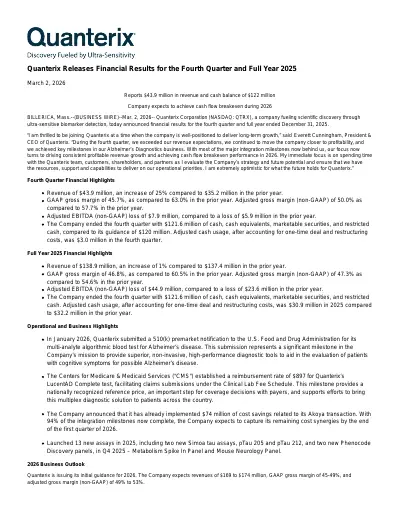
Thank you, Everett, and good afternoon. Total revenue for the fourth quarter was $43.9 million, an increase of 25% from the previous year and up 7% sequentially.
Organic revenue was a decline of 22%. Revenue from our diagnostics partners was $3.1 million in the quarter.
During the quarter, we saw better-than-expected revenues from the release of pent-up demand for from our academic customer base. From a product perspective, Simoa contributed $27 million, a 22% organic revenue decline, and spatial reported $17 million, down 23% year-over-year.
Spatial revenues include $2.5 million from a diagnostics development agreement that is now terminated. Excluding this agreement, spatial revenues were down 16% year-over-year.
The terminated agreement was dilutive to the company's financial results and will have a minimal impact on our core business in 2026. Instrument revenue was $6.1 million, comprised of $3.2 million of Simoa and $2.9 million spatial instruments.
We placed 21 Simoa and 17 spatial instruments in the quarter, as compared to 18 Simoa instruments in the fourth quarter of 2024. Consumables revenue was $23 million, up $3.8 million sequentially.
This consisted of $15.4 million in Simoa and $7.6 million in spatial consumables. Accelerator lab revenue was $8.3 million, $5.3 million in Simoa and $3 million in spatial.
Our customer mix was slightly skewed to academia, which represented approximately 55% of the business in Q4. On a pro forma basis, assuming Quanterix and Akoya were combined for the full year, academic revenue for the fourth quarter declined approximately 24%.
Pharma revenue declined 21% year-over-year, primarily due to lower large accelerator projects versus the prior year. From a diagnostics perspective, we now have 25 partnerships that generated $9.6 million in revenue during 2025, up from $6 million in the prior year.
This includes our recently announced partnership with Life Line Screening, a national health screening group focused on identifying asymptomatic risks for chronic conditions in a community health setting. We continue to deliver key milestones in our diagnostics business as we execute our long-term strategy.
Our LucentAD Complete test, which is a multi-analyte algorithm algorithmic blood test for Alzheimer's disease, remains a highly differentiated test in the market. We recently achieved two significant milestones for LucentAD Complete.
Firstly, in Q4, the Centers for Medicare & Medicaid Services approved a reimbursement rate of $897 for the test. This milestone provides a nationally recognized reference price for the test.
We are now focused on generating clinical utility data in support of LucentAD Complete in various payer conversations. Secondly, in January 2026, we submitted a 510(k) pre-market notification to the US Food and Drug Administration for this test.
Both these milestones further our mission to provide superior, non-invasive, high-performance diagnostics tools to aid in the evaluation of patients with cognitive symptoms for possible Alzheimer's disease. During 2025, we also launched 13 new assays, including two new Simoa tau assays, p-Tau 205 and p-Tau 212.
We have seen strong interest in both products during the initial launch period. In the coming year, we expect tau biomarkers to remain of high interest and plan to launch additional products addressing this growing field.
On the spatial side of the business, we launched two new PhenoCode discovery panels in Q4 '25, a metabolism spike-in panel and a mouse neurology panel. The mouse neurology panel expands our spatial biology neurology offerings into mouse models and compliments our previously launched human neurology panel.
Moving on to the P&L, gross profit and margin for the fourth quarter was $20 million or 45.7%. Non-GAAP gross profit was $21.9 million and non-GAAP gross margin was 50%.
Operating expenses for the quarter were $44.8 million. Included in operating expenses are approximately $6.4 million of costs related to acquisition, integration, restructuring, and purchase accounting, and $1.4 million of shipping and handling costs.
Non-GAAP operating expenses were $37 million, a decrease of roughly $1.5 million sequentially as a result of synergies. As Everett mentioned, we've completed major integration activities and are turning our attention to profitable growth and delivering on our commitment to be cash flow break-even in 2026.
We have already implemented $74 million of our $85 million cost synergy target and are on track to meet our target by the end of Q1. Additionally, we remediated our material weaknesses related to revenue and inventory.
By putting these material weaknesses behind us, we have established a stronger foundation for future growth. Our adjusted EBITDA was a loss of $7.9 million, a sequential improvement of $4 million as compared to a loss of $11.9 million in the third quarter.
We ended the quarter with $122 million of cash, cash equivalents, marketable securities, and restricted cash. During the quarter, we made a $10 million milestone payment for the EMISSION acquisition and spent $3.5 million related to severance and other non-recurring expenses.
Adjusted cash usage during the quarter was $3 million compared to $16.1 million in Q3, a marked sequential improvement as a result of synergies and improved working capital. I will now turn to our guidance for 2026.
We expect to report approximately $169 to $174 million of revenue, which assumes no underlying improvement in the academic or pharmaceutical end markets. In 2026, we expect a minimal impact to our core business from the terminated diagnostics development agreement, which yielded $5.6 million of revenue for the full year of 2025.
Excluding this agreement, we expect pro forma revenue for 2026 to increase by approximately 2% at the midpoint of the guide. We expect GAAP gross margin to be in a range of 45% to 49% and non-GAAP gross margin to be in a range of 49% to 53%.
We anticipate achieving cash flow break-even in the second half of the year and expect to end the year with approximately $100 million of cash and no debt. Finally, in terms of our quarterly cadence, we expect similar seasonal spacing to revenue as in prior years.
I will now turn it back over to Everett for closing remarks.
Everett Cunningham
Thanks, Vandana. I'm confident in our base business.
I'm also confident in our plan for break-even profitability this year. Lastly, I'm confident in scaling our business into areas of profitable growth.
Now I want to turn it back over to Josh.
Joshua Young
Thank you, Everett. Colby, please assemble the Q&A roster.
Operator
Thank you. We will now begin the question and answer session.
Again, if you would like to ask a question, please press * then the number 1 on your telephone keypad to raise your hand and enter the queue. If you would like to withdraw your question at any time, simply press *1 again.
We'll pause just for a moment to compile the roster. Your first question comes from Kyle Mixon with Canaccord Genuity.
Your line is open.
Alex Vukasin
Hi, this is Alex Vukasin?] on the line for Kyle Mixon.
Thank you for taking our questions, and congratulations Everett on the new role. We look forward to working with you.
This one's for Everett. In your assessment of Quanterix's core high-sensitivity proteomics as well as spatial biology businesses, what do you feel the company has been executing on effectively?
Additionally, what are some aspects of the current strategy that you would like to adjust or change with these two businesses in the near term? Thank you.
Everett Cunningham
No, thanks for that question. Looking forward to working with you also.
As I come on, I've been now with the company for 35-plus days and, I'm taking this opportunity to really assess our our diversified strategy, which I love. I'll mention a couple of stats about what Akoya's done in our spatial business.
Before Akoya, we were what, 90% neurology, 10% oncology, immunology. Now with Akoya and the spatial technology and expertise, we're now more diversified.
We're now, 60% neurology and plus 40 40% spatial and oncology and immunology. I like that diversification.
What I like is I I like the fact that they have a broad footprint. I like the talent that the business has brought onto Quanterix.
I also like the fact that there's been a lot of work around synergy targets and making sure that we can take advantage of that, as you heard from Vandana. We will hit our $85 million target at the end of Q1.
Now, what that's going to allow us to do, it's going to allow us to really focus on how do we now execute our growth plan in the Simoa space, but also in the Akoya spatial space. The footprint, the technology that they bring on, the customer relationships that they have, I think really poised, makes us really appropriate to to drive our growth strategy this year and beyond.
Alex Vukasin
Got it. Just one more for me.
You noted earlier on the call that you launched about 13 new assays in 2025 alone. On the pipeline, any any new assay or new product launches planned for 2026?
More specifically, what is the timing for the more general availability of your higher-plex Simoa 1 platform and any feedback from the early access program that gives you confidence this new platform and its capabilities could drive greater proteomics performance in the near term? Thank you.
Everett Cunningham
I'll have Vandana to take the first, and I'll take the Simoa 1 question second. Hey,
Vandana Sriram
Alex. You're right.
We we did 13 assays in 2025. We did about 20 assays in 2024 before that.
This is really an indicator of the fact that our innovation engine is now moving, and we expect to have a regular cadence of assay launches every quarter. We have a couple that are already in the pipeline for Q1 that will be coming out shortly, but the intent really is that this is a continuous stream throughout 2026.
Everett Cunningham
As far as Simoa 1, we rolled out our early access program for Simoa 1 at the end of last quarter, and right now what we're doing is we're currently, executing the test plans with our customers. We're going to continue to gather feedback, and that feedback will will actually steer our decision-making.
Now, the benefit of me taking over recently is I'm also in the process of doing a holistic review of all of our product development and launch initiatives here at Quanterix. I will say this, we have attractive segments on both sides, the Simoa and the spatial side.
The one thing that we will have to do because of that attractive, segments, we'll have to make some decisions, and our decisions will will be based on, return on investment and bringing growth back to to Quanterix as quickly as possible.
Alex Vukasin
Got it. Thank you very much.
Operator
Your next question comes from a line of Puneet Souda with Leerink Partners. Your line is open.
Puneet Souda
Yeah. Hi, Everett, Vandana.
Thanks for the questions here. First one, Everett, for you.
You emphasized Alzheimer's diagnostics. Obviously, you are coming with significant experience in sales and commercial side.
Wanted to get a view from you going forward as you talked about the diagnostics opportunity, how should we think about the overall prioritization or, when you look at the diagnostics versus the Simoa proteomics versus the spatial business that you have, and how are you thinking about those three segments? Also, if you can provide an expectation for the investments needed to drive growth on the Alzheimer's diagnostic side, can you still reach the cash flow break-even expectation by the year-end after the addition of those sales and commercial investments that you are potentially planning here?
Everett Cunningham
Puneet, thanks for the question. Appreciate that.
I'll touch on a few things and maybe have Vandana talk about the break-even piece. I'm excited about the diagnostics opportunity.
I've spoken about it in my initial remarks. We're well really set up to make an impact in the Alzheimer's diagnostics opportunity.
As Vandana said, we had a good price cross-walk from CMS. We had our CMS approved pricing, like I said, of $897 for LucentAD.
We now have several ongoing clinical utility studies for LucentAD, and we look to work with three organizations, two in academia, and then as we track the results, we're looking for releasing those results in the second half of this year. What that's going to do is that will really guide us with our payer engagement and reimbursement strategies.
From my past, I've learned that you really need to get the payers on board, get good reimbursement scalable strategies that will allow for our customers to pull this amazing opportunity through. Now, that's our Alzheimer's diagnostics opportunity.
I also feel that we have an oncology diagnostics opportunity, but again, 35 days into this, give me time to really look into this, focus on it, and really invest in how we bring that to market. Now, the impact for that will probably be starting in '27, but I'll let Vandana talk about that.
Vandana Sriram
Yeah. Hey, Puneet.
In terms of our framework for investment in diagnostics, as over the last couple of years, we've been somewhat pacing the market, but we've been putting in additional investments where needed. We already have a double-digit sales force that's out there that right now has been focused on partnerships, but very quickly is shifting their focus to really bringing LucentAD Complete to the market.
In our cash plan for 2026, we have contemplated all of the work that will go into the reimbursement pathway, as well as into building the infrastructure required from an order-to-cash perspective, etc., to be able to support volume when that comes in. Our plan for now contains all of those relevant investments and still gets us to break-even in that second half of the year.
Now, if the market were to move faster or things were to develop faster, those would be good problems to have in a way, and, we would welcome speed of adoption in this area.
Puneet Souda
Got it. That's helpful.
Then on the FDA submission side, can you just update us on any dialogue with FDA, what they are looking for? You have a breakthrough designation earlier on, just wanted to get a sense of, potential timeline and approval of the product.
It's good to see that you already have reimbursement, but just wanted to get a sense on feedback that you have received. Thank you.
Everett Cunningham
Thanks, Puneet. We're working very well with the FDA.
Again, we submitted the 510(k) in January. We expect the approval to take anywhere between six to nine months, and then we anticipate securing that same thing by Q4 of this year.
Again, six to nine months is what we're looking for. I think the most important thing around that Vandana said is working sequentially with, waiting for the FDA approval, making sure that we have good order-to-cash within our own lab, and then, I'd tell you, that making sure that we have a good payer strategy around when we develop that clinical evidence.
We're excited about our surround sound strategy.
Puneet Souda
Got it. Thank you, guys.
Operator
Again, if you would like to ask a question, please press * then the number 1 on your telephone keypad. Your next question comes from Tom DeBourcy with Nephron Research.
Your line is open. Tom, your line is open.
Tom DeBourcy
Hi, sorry about that. Could you hear me now?
Everett Cunningham
Yep, we got you, Tom.
Tom DeBourcy
All right, Thanks for taking the questions. I just wanted to understand your accelerator lab and lab services.
Seems like Q4 was stronger than expected, maybe even particularly in Simoa. Just in terms of the level of demand from pharma customers, and then as you look out at least for the next first half of the year, have you seen the rebounded activity and demand for lab services, I guess the pipeline that previously I guess, maybe went down a little bit there?
Vandana Sriram
Let me take the Q4 question and then Everett and I will tag team on what we're seeing for Q1. Q4, again, strong finish to the year.
We were generally very pleased with all of our sectors, consumables and lab services in particular. On the Simoa accelerator side, as we've mentioned before in 2025, the interest for the offerings continue to remain strong.
In Q4, we saw a handful of projects come to an end, and we also saw, again, a good diversity of projects that basically helped on the revenue side.
Everett Cunningham
I like our accelerator business. I think my first week here they were talking about how profitable our accelerator business is, and we have a lot of good partnerships that are out there.
Right now, my goal is to really understand our accelerator business. Our projects are about $50,000 on average.
My goal is I want to get bigger projects with pharma. I think there's an opportunity to do that with how important, solving this Alzheimer's dilemma is.
We'll continue to invest in our accelerator business. We'll establish broader partnerships with pharma, and it will be an opportunity for us to continue to grow that segment.
Tom DeBourcy
Great, thank you.
Operator
Thank you. With no further questions in queue, that concludes our question and answer session.
Thank you all for joining. You may now disconnect.