Radian Group Inc.
Q3 FY2026 · Earnings Call TranscriptNovember 5, 2026
Operator
Good day, and thank you for standing by. Welcome to the third quarter 2026 Radian Group earnings conference call.
At this time, all participants are in a listen-only mode. After the speakers' presentation, there will be a question-and-answer session.
To ask a question during the session, you will need to press *11 on your telephone. You will then hear an automated message advising your hand is raised.
To withdraw your question, please press *11 again. Please be advised that today's conference is being recorded.
I would now like to hand the conference over to your first speaker today, Bob Lawler, VP Finance. Please go ahead.
Bob Lawler
Thank you, and welcome to Radian's third quarter 2026 conference call. Our press release, which contains Radian's financial results for the quarter, was issued yesterday evening and is posted to the Investors section of our website at radian.com.
This press release includes certain non-GAAP measures that may be discussed during today's call, including adjusted pretax operating income, adjusted diluted net operating income per share, and adjusted net operating return on equity. A complete description of all our non-GAAP measures may be found in press release Exhibit F, and reconciliations of these measures to the most comparable GAAP measures may be found in press release Exhibit G.
These exhibits are on the Investors section of our website. Today, you will hear from Mike Weinbach, Radian's Chief Executive Officer, and Dan Kobell, Senior Executive Vice President and Chief Financial Officer.
Before we begin, I would like to remind you that comments made during this call will include forward-looking statements. These statements are based on current expectations, estimates, projections, and assumptions that are subject to risks and uncertainties, which may cause actual results to differ materially.
For more information regarding these risks and uncertainties, as well as certain additional risks that Radian faces, you should refer to the risk factors included in our 2025 Form 10-K, as well as to subsequent reports filed with the SEC. Now, I would like to turn the call over to Mike.
Mike Weinbach
Thanks, Bob, and thank you, everyone, for joining us today. We're speaking to you from London, where we've been spending time with our talented Inigo team.
Several of the Inigo leaders are with us today, and you'll have an opportunity to hear from them during Q&A, feel free to get your questions ready. This is my first earnings call as CEO, and I'm proud of the strong performance this quarter, with solid contributions from both our mortgage and specialty businesses, and the progress our teams are making across the company.
Before discussing our results, I'd like to congratulate Dan on his appointment as Chief Financial Officer, which we announced last week. Many of you have worked with Dan over his career at Radian, and know him as a trusted leader with deep knowledge of our businesses.
He's provided stability and sound judgment throughout this transition, and I'm confident he's going to be a great partner as we work closely together to build on our momentum and execute our strategy. Turning to the results, Radian reported an excellent quarter.
Specialty benefited from relatively benign cat activity, but the broader takeaway is a growing contribution to enterprise earnings and continued underwriting discipline in a more competitive market. Mortgage continued to generate attractive earnings and capital, supported by strong portfolio fundamentals.
As credit normalizes, performance remains in line with our expectations. Turning to the slides, as you can see on slide 1, our results demonstrate the strength of the combined company we've built, two complementary insurance businesses that share a disciplined approach to underwriting, risk selection, and capital management.
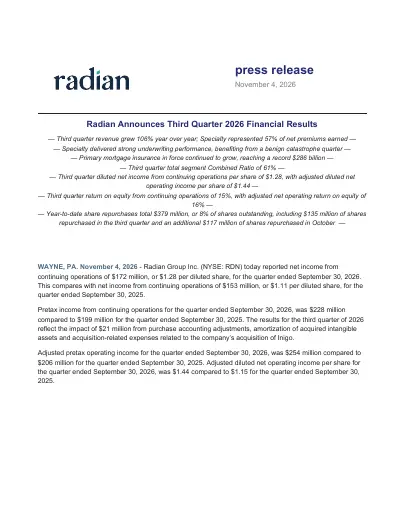
Total revenue for the quarter more than doubled year-over-year with the addition of Inigo, growing to $624 million, while adjusted pretax operating income grew to $254 million. Our specialty segment contributed 57% of net premiums earned and 34% of adjusted pretax operating income this quarter, tangible evidence of our strategy in action.
Over my first few months as CEO, I've spent considerable time with our leaders, teams, and customers in both the US and the UK, looking closely at our businesses, our markets, and where we have the greatest opportunity to create long-term value. I've come away with even greater confidence in our direction and several clear observations, which are summarized on slide 3.
First, we have two strong insurance businesses with significant opportunity ahead. In mortgage, that means continuing to improve efficiency and simplify the customer experience.
In specialty, it means continuing to build the business with the same approach to underwriting and risk that's driven its success since its founding. Second, the strategic rationale for acquiring Inigo is beginning to show up in our results.
We said the transaction would diversify our earnings, expand our ability to deploy capital, and add a scaled specialty platform without changing the disciplined way we approach risk. Those building blocks are now in place, and we're seeing them translate into results.
Third, the two businesses share capabilities that differentiate Radian. Both use data and analytics to inform risk selection, pricing, and portfolio management.
Both emphasize underwriting and risk management discipline, and benefit from strong customer insight. These are the critical capabilities that drive our performance across market cycles.
Fourth, we have a strong capital position and meaningful flexibility. That allows us to support growth and opportunity in our businesses, manage risk prudently, invest where we have expertise and a clear right to win, and return excess capital when that creates the greatest long-term value.
Finally, we have the leadership and focus to execute. In addition to Dan's appointment as CFO, we've made several changes to our leadership team to better align responsibilities with our strategic priorities.
Russell Merrett will lead group P&C strategy, Craig Knightley will become Inigo's Chief Underwriting Officer, and Stuart Bridges will take on a broader role as a Radian Group Advisor, strengthening relationships with P&C-focused investors and business partners. They join an already strong group of leaders on our executive team, which you can see on slide 11.
Together, the team brings deep experience across mortgage and specialty, the enterprise capabilities to support the businesses, and continued discipline around capital allocation and financial performance. I have great confidence in this team's ability to turn our strategic priorities into results.
Before turning over to Dan, I want to make a few points on our approach to strategic capital allocation. The capital we generate is a significant source of strength and is essential to how we create long-term value for our shareholders.
As you can see on slides 8 and 9, we have a strong track record of disciplined and opportunistic capital allocation. Our approach is straightforward.
We will put each dollar where we believe it can create the greatest long-term value while maintaining our financial strength. We're proud that adjusted book value per share has more than tripled since 2017, representing a compound annual growth of approximately 15%.
Our focus is to build on that track record by continuing to underwrite risk well, carefully allocate capital, and invest where we see the greatest opportunity. As we look ahead, I'm confident in where we are and clear about where we're going.
The building blocks are in place. Our focus now is execution, strengthening both businesses, operating more simply, and turning our strengths into long-term value for our shareholders.
With that, let me turn it over to Dan.
Dan Kobell
Thank you, Mike. Radian delivered a strong third quarter, and I'm pleased to provide additional details about our results.
On a GAAP basis, we generated net income from continuing operations of $1.28 per diluted share, with a return on equity of 15%. Adjusted net operating income was $1.44 per diluted share, an increase of 25% from the third quarter of last year, and adjusted net operating return on equity was 16% this quarter, an increase of approximately 250 basis points from the third quarter of 2025.
With three quarters of results now reported for 2026, we are also pleased to see the immediate financial benefits we expected from the Inigo acquisition. Year-to-date, Radian has generated operating earnings per share of $3.84, an increase of 17% compared to the prior year.
Our operating return on equity year-to-date has increased to 15%. Approximately one year after announcing this transaction, along with the divestitures of our non-core businesses, Radian is a simpler company, with a more balanced earnings profile, higher returns, and access to broader insurance markets to support disciplined, profitable growth.
Our book value per share grew year-over-year to $35.78. As a reminder, our book value includes the impact of the accumulated other comprehensive income or loss associated with our investment portfolio, which reduced book value by $1.33 per share this quarter due to an increase in interest rates.
We view the impact of this increase in rates as a net positive for Radian, as we have the ability to hold these high-quality investments to maturity and benefit from the pull to par, and we are able to now invest current cash flows into this higher interest rate environment. Excluding AOCI, our book value per share grew 9% year-over-year, or 12% when including the dividends paid to our shareholders during this time.
Turning to the key drivers of our performance, as shown on slide 4, we generated net earned premiums of $548 million this quarter, an increase of 131% from a year ago. Our net premiums earned are well-balanced across our segments, with specialty accounting for 57% of third-quarter net premiums earned.
Net investment income was $77 million this quarter, up 22% year-over-year due to a growing portfolio, including the impact of the Inigo acquisition, as well as higher yields. Our $7.1 billion investment portfolio remains well-diversified across highly-rated securities, and the portfolio continues to be an important contributor to our earnings.
Turning now to our segment results, our mortgage insurance business continued to generate strong, consistent earnings, supported by healthy portfolio fundamentals. Primary insurance in force continued to grow, reaching a record $286 billion.
We wrote $15 million of new insurance this quarter, while quarterly persistency remained favorable at 83%, supported by limited refinancing activity. As expected, the default rate increased to 2.68% this quarter, following typical seasonal trends.
As the portfolio matures, credit performance across all vintages continues to be in line with or favorable to our initial expectations, and the underlying portfolio fundamentals remain strong. For the quarter, the mortgage segment generated $206 million of adjusted pretax operating income, with a combined ratio of 37%.
Slide 7 shows results for our specialty insurance business, which delivered excellent third quarter results due to continued sound underwriting along with a benign natural catastrophe quarter. Net premiums earned were $311 million, a decline of 3% year-over-year.
In our specialty business, we continue to target opportunities to write attractive business across our range of insurance and reinsurance lines. As the environment has become more competitive, particularly in property insurance and reinsurance, we remain thoughtful and disciplined in our underwriting approach, focusing on maintaining sound margins to drive profitability.
This small decline in premiums year-over-year reflects this approach to prioritize profitable underwriting over top-line growth. Total loss provision within the specialty segment was $148 million, which included $43 million of favorable net development for prior period reserves, which was seen broadly across most of our property and casualty lines of business.
Our specialty segment net combined ratio was 80%, reflecting a benign natural catastrophe quarter. Setting aside the benefit of lower cat losses, our combined ratio in the third quarter would have been in line with our prior guidance in the low 90s.
For the quarter, the specialty segment generated $86 million of adjusted pretax operating income, up significantly from the prior quarter. Additional details regarding our segments are available in press release Exhibit E.
Moving to our capital, available liquidity, and related strategic actions, as shown on slide 8, our strong capital position remains a significant advantage and provides us the flexibility to support both insurance businesses, manage risk, maintain appropriate liquidity, and return excess capital to shareholders. During the quarter, we repurchased $135 million of our shares.
In October, we repurchased an additional $117 million of our shares, bringing our total 2026 repurchase activity to $379 million, or 8% of our beginning shares outstanding. Our repurchase activity this year has significantly exceeded our previously-guided range of $200 to $250 million, which did not anticipate the recent opportunity to buy shares at increasingly attractive prices.
Over the last three months, we leaned into this opportunity, purchasing over $200 million of our shares at an average price below our current book value, which we view as a highly accretive use of our excess capital. We are pleased that our financial strength and flexibility allowed us to opportunistically purchase these shares during the same year as a transformative $1.7 billion acquisition, and will continue to pursue opportunities to use our excess capital to drive attractive returns for shareholders.
During the third quarter, we also fully repaid the remaining balance on our revolving credit facility, reducing our holding company leverage below 19%. Our available liquidity at Radian Group was $376 million at quarter-end.
In August, we announced the sale of our real estate services and title businesses, which will complete our divestiture process announced late last year. We are pleased with the outcome of this process, which we expect to complete within our expected timeline, and has returned significant liquidity to our holding company.
As we move forward and continue to execute on our strategy, the earnings power of our complementary insurance businesses, along with our balance sheet strength, continue to provide us with significant financial flexibility. Our actions in the third quarter reflect our thoughtful approach to capital management, as we continue to return significant capital to shareholders while reducing our debt and maintaining our liquidity position.
I will now turn the call back over to Mike.
Mike Weinbach
Thank you, Dan. Before we open it up for questions, I'll leave you with three things.
First, we had a strong quarter, with solid contributions from both mortgage and specialty. The strategy we put in place is working, and we're seeing the benefits of a more diversified Radian.
Second, we see meaningful opportunity in both businesses, and our focus is on serving our customers well and growing with discipline. Finally, we have the financial strength and flexibility to invest in our businesses, allocate capital, and create long-term value for our shareholders.
Now, we look forward to your questions. Operator?
Operator
Thank you. As a reminder, to ask a question, please press *11 on your telephone and wait for your name to be announced.
To withdraw your question, please press *11 again. Please stand by while we compile the Q&A roster.
Our first question comes from Roland Mayer of RBC Capital Markets, your line is open.
Roland Mayer
Hi, and I guess it's good afternoon over where you are. Would love to just start on the specialty business.
I was hoping you can maybe discuss how Inigo establishes combined ratio targets, and whether you consider investment income potential particularly in long-tail lines.
Dan Kobell
Thanks, Roland, for the question. This is Dan.
In terms of combined ratio targets, I think certainly the investment income is part of the overall picture when you look at the longer-tail lines. That's a meaningful component of the total return.
When we look at the combined ratio guidance that we provided as an example, the low 90s, I think that's inclusive of a full portfolio with varying targets around that in terms of different lines of business, knowing that the investment income will be a different contributor for different lines as based on kind of short-tail versus long-tail, and in those, kind of how that varies across the portfolio.
Russell Merrett
Yes. Thank you, Dan.
Russell Merrett speaking. I think significant points I'd echo there are that our expectations for net combined ratio do vary quite considerably class to class, and are subject to variation year-on-year.
We are pretty comfortable with where we're operating at the moment in terms of being able to meet our target net combined ratios, in that we continue to enjoy adequately rated business throughout the lines that we underwrite today.
Richard Watson
Right, and I would say, it's Richard Watson here. It's clearly an important part of the consideration when we look at those risks, but I always fear that when underwriters think they can price risks to near 100 combined and then survive off the investment income, they're probably fooling themselves.
I don't know that we lean on that aspect as much as others do. I think I'm sort of still looking for something that is an attractive proposition net of that investment income, and it's an added benefit when we get it.
Stuart Bridges
I'd sort of add, Stuart Bridges here. We would, class by class, aim to make an underwriting profit in each class rather than just an underwriting profit from a portfolio.
I think that also differentiates our attitude towards underwriting.
Roland Mayer
Thank you. That's helpful.
Then maybe as I look at the reserve releases in specialty, is it being driven by any particular accident year, line of business, and then is there any FX impact in there, as I assume most of the reserves are in pounds?
Russell Merrett
Russell Merrett coming back to you on that, Roland. No, I think, as Dan observed, the reserve releases actually came from a whole variety of classes, both short-tail and long-tail.
Cat prior year, prior period development releases were a little bit less than half of the total. The non-cat releases related to both short-tail and the liability classes.
Fortunately, we're small enough and our number of large losses is actually small enough that each large claim gets reviewed each quarter. It just so happened that this quarter, there were a couple of large items, and I'm thinking in the $2 million to $4 million range, of specific reserves that developed favorably and went away, as well as a sort of broad-based observation that our incurred claims were actually trending favorably, and had been for a couple of quarters.
I I feel there was a bit of a a catch-up in the quarter, recognizing some good news that had been been coming.
Stuart Bridges
Stuart Bridges here. On the FX, we trade in dollars, the vast majority of our business is in dollars, there will be some foreign exchange effect, but I think it's easier just to regard us as people who think and trade in dollars.
Roland Mayer
Thank you. I believe this one's probably more for the Radian team.
When the Inigo deal was announced about a year ago, I think there was some belief that there would be capital synergies from the diversification. Now that you're a year in, is there any updated view on potential synergies, or anything tangible there?
Dan Kobell
Thanks, Roland, for the question. As you recall, when we announced the transaction, there was some financial guidance as far as the earnings accretion and the return expansion that we would expect to see.
When you look at our results through the first three quarters of this year, definitely you can see the earnings growth coming through, 17% year-over-year increase in terms of operating earnings. The return on equity, when you look at our operating ROE, kind of before the Inigo transaction, before the divestitures were announced, the first three quarters of last year, in the 13% range, and we're now at about 15% year-to-date.
You're seeing significant financial accretion there. That's really before some of those capital synergies that you kind of referred to really have been able to take effect.
The first of those that I'd point to would be the letter of credit facility. That's one that we talked about also at our Investor Day in June, and it's one of the flexible options for funding the specialty business, the capital requirement under Lloyd's that is available, and Inigo has been utilizing that, but it's available now given Radian's financial strength as a parent company in larger size and generally at favorable pricing.
The announcement that we had this week related to the letter of credit, we've increased that, we've secured favorable pricing on that, and that's really set up for the 2027 underwriting year, Stuart did an excellent job putting that in place. That's one piece of the puzzle.
We'd expect as we go forward and we put the specialty business capital stack together for next year, we'll have more to share as far as what that means. We're starting to see those capital benefits develop, and it's one of those cases where, again, the financial strength of Radian as a parent company and the flexibility that Inigo has, 1 + 1 equals something more than two.
Roland Mayer
Thank you, that's very helpful.
Operator
Thank you. Our next question comes from Bose George of KBW, your line is open.
Bose George
Hey, guys, good morning. On the buybacks, you noted that they were opportunistic based on where stock was trading.
Just going forward, what's a good way to think about the cadence of total capital return, including buybacks?
Mike Weinbach
Hey, Bose, it's Mike. How are you?
Good, are you? I'm doing well.
Top of the morning to you. Appropriate turn of phrase here.
As Dan shared with you, we ended up significantly exceeding the top end of the share buyback range we shared with you last quarter. As we discussed, we aim to allocate capital strategically to the benefit of shareholders.
Now, the top of our capital allocation waterfall is always going to be to invest in our businesses in a way that will create long-term value for the enterprise. When we last provided guidance, we had purchased a little bit over 175 million of shares year-to-date, and our shares were trading a little bit north of $39 per share.
Quite frankly, we didn't anticipate the opportunity to buy back shares at near book value and then even more below book value. As we look ahead to softening markets, we leaned into the opportunity and maybe a little bit ahead of our anticipated pace.
Depending on where we trade through year-end, we may or may not be done for the year, but our message remains the same, that we aim to be good stewards of capital on behalf of our shareholders, and we have two very strong businesses that generate capital back to the group, and we will be thoughtful in allocating it in a way to create long-term value for the company.
Bose George
Great. That's helpful.
Thanks. Then one on the FICO VantageScore stuff that's going on.
Now that they're both on the same grid, how does that impact your pricing, because clearly the credit didn't improve because the grid got sort of combined. Just, yeah, how does that kind of play into how you think about it?
Mike Weinbach
Bose, that's a great question. Mike again.
We're supportive of all the different credit models, and we're supportive of competition in the credit scoring market. We've studied them all, we've done the modeling, and we're operationally ready to handle all scores.
That said, we are watching to ensure that we can price accurately if we continue to be in a best execution environment for lenders. The same score under one model might mean a different level of credit risk than it does under another model, pricing them the same could potentially be concerning, because obviously, other things being equal, if lenders are best exing the execution and we price the same, we could find ourselves inadvertently taking more risk for the same pricing, or the same risk for lesser pricing.
We're watching it carefully, we're early, we're going to be thoughtful and careful in terms of the way we proceed, but at the same time, we're going to be there for our customers and prepared to support the market whatever way it develops.
Bose George
Great. Thanks.
Operator
Thank you. Our next question comes from Mihir Bhatia of Bank of America, your line is open.
Mihir Bhatia
Hi, morning. Thank you for taking my questions.
I wanted to maybe start with Inigo since you're in London. Maybe just talk a little bit more about Inigo's edge, if you will, right?
As competition increases in the specialty market, what differentiates your underwriting model, how is that and why is that sustainable in such a competitive market?
Richard Watson
Thanks. That's a great question, and thank you for that.
It's Richard Watson here. When we first set the business up, we took a very conscious choice to go narrow, go deep, to really focus on being experts in the lines of business we did, and to try and avoid being the kind of general player on multiple classes of business.
I'm delighted, six years later, that that strategy still seems like a very worthwhile one to pursue. When we hold our high bar against ourselves to prove that we do that, the idea that you can bring expertise, you can bring capacity, and you can back that up with one of the other advantages we recognized early on, particularly as a new player, was the ability to record and analyze data in a way that had not been possible before, and for a lot of incumbents, was very difficult because of the complexity and legacy systems they had.
If you combine expertise with an ability to record and analyze data in a really market-leading way, that's a pretty attractive combination. Then on top of that, the thing that we've really focused on is the connection with a customer, and really bringing the customer, figuratively and literally, into our office so that we can get to understand them, their risks, and partner with them in the way that we trade.
This week, we had 33 risk managers and partners in the office. We took them through a three-day program led by Craig Knightley and his team.
It was what I can only describe as an extraordinary event, and the feedback from customers has been really humbling and just extraordinary. I do think those are levels of focus and a way of operating that is differentiated in the marketplace, the amount of time and effort and the capability that we bring to all of those three things, the expertise, the data, the customer connectivity, I really do feel is market-leading.
From our point of view, we've only just begun that journey. We're looking at this improving every year that we do it.
This year's event was way better, more detailed than last year's. The work we're doing on AI and analyzing risk is just growing every day.
From my point of view, it seems I'm excited by where we can take those core ingredients. I'm not sitting here thinking we've reached a limit or we're just becoming part of the mass market.
It still feels like the strategy we had is a sustainable and competitive advantage.
Mike Weinbach
It's Mike. I'll just add, Mihir, for you and any of the other investors or analysts on the call, part of the reason that Dan and I are here is because we like to see it in action.
Richard mentioned the horizon event where our clients were here, when we're here, we spend time with the broker community, we spend time with the team. Richard, I think you used the word extraordinary twice, that's the word I was going to use as well, it really is beyond the ordinary, and we think it's something different, but also recognize that sometimes you have to see it to really appreciate it.
Just wanted to extend that offer to anyone on the call that wants to see it, reach out to our IR team and we'll help you get out and experience the magic.
Mihir Bhatia
Great. We're planning definitely a trip to London.
Okay. Maybe on switching gears a little bit to the housing era, first, on the MI business, obviously, the pilot talks about it being for new business and using AVMs and things like that, to the extent it's even, I guess, implemented.
Can you help us with just thinking through some of the implications of that? How much would that shorten expected life if you were to use that on new policies written last year or something?
I'm sure you started doing some testing and thinking through that. What are the implications of that?
Do you start needing to reprice new business for a shorter duration? Have you had any discussions with the FHFA on what their AVM standards would be and things like that?
Just any color you can provide us, and how to think about the implications of such a policy going in place. Thank you.
Mike Weinbach
It's Mike. I'll start with some general comments and then see if Dan wants to add anything more specific.
Maybe the most meaningful general comment is we're very, very early days here. We're supportive of the executive order.
It aimed at reducing the cost of homeownership, and that includes piloting simpler ways to provide for cancellation of mortgage insurance in the future where home price appreciation reasonably supports it. For the record, we're also supportive of aligning the GSE servicing guides.
I can't remember if that happened before the last quarter or not, and we support the actions FHFA and Fannie Mae have taken to do so. I'll maybe even take a step back and share, prior to Radian, I had responsibility for leading three mortgage originators, and I'll confess that, despite that, I didn't fully appreciate the important impact that private mortgage insurance plays in supporting affordable homeownership.
A few stats I just want to share with you and everybody: PMI helps homebuyers on average save nearly $50,000 on their down payments. Over 60% of buyers with PMI are first-time homebuyers.
Maybe most significantly, while there's been large increases in pricing in the cost of just about every aspect of homeownership, the rates for private mortgage insurance are down by over 25% over the last 10 years. As an industry, we're more than doing our part.
Of course, we bring private capital to the market, absorbing the first loss, protecting lenders, the GSEs, taxpayers. Back to your question, we look forward to working with Fannie and Freddie to help simplify mortgage insurance going forward in a way that produces the best outcome for homeowners, lenders, the GSEs, and the private capital that supports affordability.
It's way too early to have any specifics on what that looks like. I'll turn it over to Dan to see if there's anything you want to share in terms of numbers.
Dan Kobell
As far as our persistency, Mihir, I think you saw an increase this quarter a bit to 83% in terms of the annualized persistency metric. That really was a function of the increase in interest rates, seeing lower refi activity even off of a fairly low base of what we saw in the second quarter.
When you look at persistency trends over time for our business, there's cancellations related to kind of interest rate movement, rates go down, you'll tend to see more refi activity and cancellation for those reasons. You'll see automatic cancellations, and then you'll also see cancellations that are driven by home equity growth and kind of those borrower requested cancellations.
We typically see the volatility in persistency is going to be much more connected to the interest-rate-driven piece. The other ones are tend to be fairly stable quarter to quarter, and that's what we've seen over time.
I think, as we look forward for our business, I'd still continue to expect persistency to be relatively correlated with kind of what we see from a refi activity perspective and generally where we see interest rates going.
Mihir Bhatia
Got it. Thank you for taking my questions.
Operator
Thank you. Our next question comes from Jeffrey Dunn of Dowling & Partners, your line is open.
Jeffrey Dunn
Thanks, good morning. Just had a question on capital.
Should we consider Inigo as a potential excess capital generator for the holding company, or will that capital be retained for cycle management?
Dan Kobell
Thanks, Jeff, for the question. I think, over time, what you'll see, certainly Inigo's been a growing business in the first six years or so, and so typically the capital requirements under the Lloyd's framework will grow along with that, as kind of they're connected to the expected premiums that you're writing in any given year.
As we've entered into a little bit of a softening market, those capital requirements are probably going to be a little bit more stable from year to year. As the business continues to generate profits, to your point, you might see that Inigo, like our MI business, might find itself in a position where it's generating more capital than it needs to put back to work.
I think that's something that we'll see develop over time. Can't really speak to timing and amounts at this point, but certainly a good observation that that's where we could be headed overall.
Jeffrey Dunn
Dan, forgive my ignorance on this. Is there anything similar to a stat filing that we could look at to see any given quarter if there's upflows?
Dan Kobell
If there's upflows from Inigo to Radian Group?
Jeffrey Dunn
Yes.
Dan Kobell
We would certainly announce those if they happen. I don't believe there'd be anywhere else that you'd see it from a reporting perspective.
Stuart Bridges
Stuart Bridges here. What I'd say is, to date, we've retained the capital, as Dan said, to allow the business to grow.
It's aided premium growth. Obviously, as we are a fairly young company, and our reserves grow, so that creates additional capital.
I do think Dan's right that if you had excess capital, you would not keep it in the specialty subsidiary.
Jeffrey Dunn
Thank you.
Operator
Thank you. Our next question comes from Terry Ma of Barclays, your line is open.
Terry Ma
Hey, thank you. Good morning.
I think most of my questions have been asked and answered. Maybe just to follow up on policy, just given the midterm results a few days ago, any early thoughts on any potential shift in housing policy over the next two years, or anything you're watching out for to come out of Washington?
Mike Weinbach
Hey, Terry, it's Mike. Thanks for the question.
I don't think there's more to say other than we're committed to responsibly supporting housing affordability, which we believe is a bipartisan concern. We're not anticipating any significant impacts.
Terry Ma
Got it. Then maybe just last one for me, on MI credit, default rate was up about mid-20 basis points this quarter year-over-year.
As you kind of look out, as your vintages season, anything that would make that default rate on a year-over-year basis accelerate, decelerate over the next few quarters? Is that a good jumping-off point to think about 2027?
Dan Kobell
Thanks, Terry, for the question. This is Dan.
The default rate did increase, as you noted, to 2.68% as expected this quarter. We would typically expect to see that in the second half of the year, I would also expect in the fourth quarter to see an increase as well.
It's important to note that the portfolio default rate is really a weighted average of the underlying vintages, and so as the book has seasoned and extended, as we've seen fairly low level of cancellation activity, some of the older vintages, which typically tend to carry higher default rates just naturally, are now making up a larger and larger percentage of the book. I think that's really what's driving a lot of what you're seeing at the total portfolio level, where it's really just a skew upwards in terms of those older vintages driving a higher overall default rate, more so that dynamic than any deterioration that we see in terms of credit performance.
I think that extends also when you look at it at a credit cohort level or any specific geographies, not seeing any signs of concern or any kind of deterioration in the portfolio. I'd also note that the defaults that we have seen emerge over time continue to cure at very high levels, typically we've seen cumulative cures trending towards 96% or 97% of the defaults that have emerged.
Our reserving assumption effectively embeds a 92.5% cumulative cure assumption, we continue to see that outperform expectations as well. Overall, I'd say no areas where we're seeing concerns from a credit perspective, it continues to season very well.
Terry Ma
Got it. Thank you.
Operator
Thank you. Our next question comes from Doug Harter of BTIG, your line is open.
Doug Harter
Thank you. Can you talk about what your kind of expectations are for holding company liquidity, the ability to kind of dividend up from the MI, just as we think about your ability to continue to return capital to shareholders, especially if the stock continues to trade at a discount?
Dan Kobell
Sure. Thanks, Doug, for the questions.
This is Dan. I'll start with the dividend piece and then get to liquidity.
We did announce that we're expecting a dividend in the fourth quarter of $145 million, so that'll take the total 2026 amount from Radian Guaranty up to $660 million. If you remember back to the start of the year, initial guidance was $600, we're about 10% better than that.
That's really just driven by favorable earnings in the mortgage insurance business. Effectively, the dividend capacity from Radian Guaranty is really the primary driver of that is going to be the ongoing statutory earnings of the business.
As that has outperformed expectations, that's become available to dividend up to the holding company. As far as liquidity at the group level, I think the range that you see us in over the last couple quarters is a pretty good estimate for us, kind of in the $300 to $400 million range.
That's a comfortable level. Keep in mind, we do have a $500 million revolving credit facility that's now undrawn.
We just paid off the draw that we took earlier this year at the end of the third quarter. Feel very comfortable where we are from a liquidity perspective.
I'd also note, we have a senior debt maturity coming up in the first quarter of next year. Our expectation is we're going to refinance that, and certainly comfortable with where we stand in terms of total holding company leverage at this point.
I'd say overall, no guidance at this point in terms of the Radian Guaranty dividends for next year, it'll continue to be driven by the ongoing earnings. We can provide probably an update there as we go forward.
Hopefully that's helpful in terms of the overall picture from a group perspective.
Mike Weinbach
It's Mike. The only thing I'd add is we're blessed to have two profitable, cash-generative businesses that generate mid-teen returns through the cycle.
As I talked about earlier, our best use of capital is always going to be to invest back in the businesses we have, in ways where we can find good returns. Even in a softening specialty insurance market, we're finding places where we can deploy capital for adequate returns.
The mortgage market, in a high-rate environment, is growing slowly, we'll see what happens with rates, but should something change, we're ready and able to deploy more capital to that business when the opportunities present themselves. Then beyond that, we'll look at buybacks, dividends, what we do in terms of leverage levels, and/or evaluate the opportunity to hang onto capital to wait for a fat pitch in the future.
Going back to where I started, what underpins it all is having two really strong, profitable, cash-generative businesses. We should have a lot of opportunities in the future.
Doug Harter
Thank you, Mike. Thank you, Dan.
Operator
Thank you. We have a follow-up from Roland Mayer of RBC Capital Markets, your line is open.
Mike Weinbach
Hey, Roland, are you there?
Operator
Your line is open. Please unmute.
He may have stepped away. I show no further questions at this time.
I'd like to turn it back to Mike Weinbach for closing remarks.
Mike Weinbach
All right, thank you, Didi, and thank you, everyone, for joining us today. It's been great to be here in London with the Inigo team, and we're excited about what we're building together.
We appreciate your interest in Radian, and look forward to speaking with you next quarter. Thank you.
Operator
This concludes today's conference call. Thank you for participating, and you may now disconnect.