Reformation Inc.
Q3 FY2026 · Earnings Call TranscriptNovember 5, 2026
Operator
Please note this event is being recorded. I would now like to turn the conference over to Jean Fontana, Investor Relations.
Please go ahead.
Jean Fontana
Good afternoon, everyone. Thank you for joining us to discuss Reformation's third quarter 2026 results.
Joining me on the call today are Hali Borenstein, Chief Executive Officer, and Joshua Moore, Chief Financial Officer. Before we begin, I'd like to remind you that this conference call will include forward-looking statements, including statements regarding our future financial and operating performance, such as our outlook and guidance for the full year of 2026.
These statements are subject to various risks, uncertainties, and assumptions that could cause actual results to differ materially from these statements, including the risks mentioned in this afternoon's press release and in our SEC filings, all of which can be found on our website at investors.thereformation.com. We undertake no obligation to revise or update any forward-looking statements or information, except as required by law.
During our call today, we'll also reference certain non-GAAP financial information, including adjusted EBITDA and adjusted EBITDA margin. The presentation of this non-GAAP financial information is not intended to be considered in isolation or as a substitute for or superior to the financial information presented and prepared in accordance with GAAP.
Reconciliations of non-GAAP measures to the most directly comparable GAAP measures, as well as the definitions of each measure, their limitations, and our rationale for using them, can be found in this afternoon's press release and our SEC filings. With that, I'll turn the call over to Hali.
Hali Borenstein
Thank you for joining us. Our third quarter results demonstrate the continued strength of our brand, the relevance of our product, and our deep connection with our customers.
We delivered strong performance across channels and geographies while advancing our strategic growth priorities. What's particularly encouraging is that our growth isn't driven by any single initiative.
It's the result of years of investment in the capabilities that differentiate Reformation, all working together to strengthen our business and fuel sustainable long-term growth. Our performance this quarter reinforces our confidence in the significant opportunity ahead and our ambition to build Reformation into a truly generational brand.
We have a bold ambition to bring sustainable fashion to everyone, and we're making meaningful progress, now servicing 1.25 million active customers, representing growth of 23% year-over-year. Turning to a brief overview of key results.
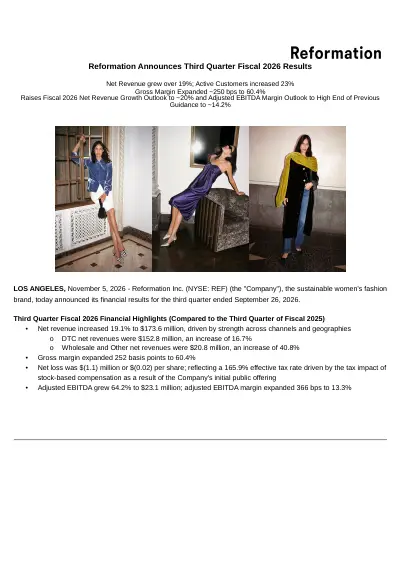
In the third quarter, net revenue grew 19% to nearly $174 million, driven by continued product diversification, increased distribution, and international expansion. This is our 22nd consecutive quarter of double-digit growth.
Our strong top-line performance translated into continued profitability. Adjusted EBITDA grew 64% year-over-year to $23 million, representing a 13.3% margin.
Based on the third quarter performance and the continued momentum into the fourth quarter, we now expect to deliver full year growth in excess of 20%, above our long-term algorithm of mid to high-teens growth. Underpinning our momentum is our unique combination of competitive advantages, which include: first, our strong, culturally resonant brand.
Reformation's distinctive identity engenders deep brand love, loyalty, and multigenerational appeal. With approximately 1% penetration of our core US addressable market captured, we have significant runway to bring Reformation to a broader audience.
Secondly, our agile merchandising model. We make beautiful products across categories and occasions, supported by data-driven merchandising and a fast and responsive supply chain.
This agility allows us to quickly respond to consumer demand and maintain high levels of full-price selling. Lastly, our digitally native omnichannel platform.
We leverage proprietary technology to bring our brand to life and deliver a seamless, differentiated customer experience across e-commerce and our technology-enabled stores. Looking at our channel performance, DTC remains a key driver of our results.
DTC revenue increased 17% to $153 million. Wholesale also delivered robust growth of 41% to $21 million.
Our 23% growth in active customers reflects strong new customer acquisition and retention, continuing a healthy trend and reinforcing our confidence in the significant brand awareness opportunity ahead. New customer growth was driven by the strength and breadth of our product assortment, as well as our growing omnichannel presence, which has increased the number of ways customers can discover and engage with the brand.
DTC net revenue per customer was $419, down half of 1% from last year, reflecting the higher mix of new customers. As a reminder, new customers spend roughly half of what existing customers spend on an annual basis.
Importantly, underlying cohort trends remain strong, with customer spend accelerating each year as cohorts mature, contributing to quarter-over-quarter improvement in DTC net revenue per customer. Our ability to attract new customers while retaining our existing base, which makes up approximately 70% of revenue, speaks in part to the power of the brand and our ability to consistently deliver amazing product.
Reformation sits at the intersection of cultural relevance and fashion authority, and we're highly intentional about how and where we show up. Through cultural moments, partnerships, and fashion collaborations, we create authentic opportunities to engage customers, build brand heat, and reinforce our relevance.
Our September campaign, Good Sport, featuring Olivia Jade, brought Reformation's distinct sense of humor to life. We playfully leaned into Olivia's story through a campus-inspired fall collection, including a limited edition college crewneck sweatshirt benefiting Yes Scholars, a non-profit expanding college access for students from under-resourced communities.
The combination of cheeky copy, beautiful imagery, and timely product created a stand-out campaign that captured attention and drove engagement. We followed this up in October with an elevated collection designed in partnership with Alexa Chung, a style icon and designer.
This partnership reinforced our fashion credibility and resonated with customers across geographies and generations. The strong customer response also demonstrated our ability to command premium price points for differentiated products, with the collection's AUR at more than 25% above the rest of the assortment.
Our Q3 results underscore the momentum within our core growth strategies, which include diversifying our product offering, expanding our omnichannel distribution, and scaling our international footprint. I'll walk you through a few highlights within each.
First, product diversification. Our growth in the quarter was broad-based, spanning both apparel and accessories.
Ahead of Q3, we identified a shift in customer preferences away from minimalism and towards novelty, texture, and color. Our agile merchandising model and fast supply chain enabled us to move quickly, testing new styles in small quantities and scaling those that resonated most with customers.
This enabled us to capitalize on emerging trends while maintaining a disciplined approach to inventory. The Olina crop pant is a great example of this approach in action.
In May, we identified the Olina as a top-performing style, thanks to its beautiful taffeta fabric and vibrant chartreuse color. We moved quickly and re-cut this high-demand SKU in just 21 days.
We then expanded this winning fabric in seven additional silhouettes, including skirts and shorts. In tandem, we introduced new colorways of the original pant, based on insights from other parts of the assortment.
In the third quarter, we also introduced a new AI-based planning engine that improves our ability to evaluate product performance and forecast demand for re-cut orders, bolstering in-stock rates and full-price selling. This is the power of our agile and data-enabled merchandising model: the ability to identify what customers love, respond quickly, and turn a single winning style into a multi-million dollar product franchise.
Our broad-based performance demonstrates our ability to grow alongside our customer and capture a greater share of her wardrobe. In the third quarter, tops, bottoms, and outerwear were among our strongest performing categories, attracting new customers and giving existing customers more reasons to shop Reformation.
Turning to our second growth strategy, channel expansion. During the third quarter, we continued to benefit from our omnichannel approach, spanning retail, e-commerce, and wholesale.
We opened seven new stores, including the reopening of our location in the Pacific Palisades, ending the quarter with 77 stores. We currently operate in just about half of the top 50 US MSAs and have a strong pipeline of new locations with a clear path to more than double our store count in the next five years.
Our stores not only deliver strong four-wall economics, but also serve as powerful drivers for customer acquisition and brand awareness, accelerating omnichannel growth across their surrounding markets. In Q3, we continued to expand our footprint, entering new markets and adding stores in existing ones.
We opened stores in Boulder, Princeton, and Southlake, right outside of Dallas, further extending our reach and bringing Reformation to more customers across the country. Santana Row in San Jose, which opened in September, is another new market for Reformation and has delivered standout performance in both sales and customer acquisition.
In the San Jose market, we saw our DTC net revenue growth rate increase by approximately 30% and our new customer growth rate lifted by 90% in the six weeks after opening versus the six weeks before. This performance further demonstrates the strength of our brand and the opportunities for continued geographic expansion.
We also reopened our Palisades location in Los Angeles, reinforcing our commitment to the market. This was a long-awaited moment of celebration for our broader community following the 2025 Palisades wildfire.
In the fourth quarter, we opened stores in Marin and Birmingham, Alabama, and plan to open one more in Kansas City, bringing our total store count to 80 by year-end. These openings reflect our strategy of balancing new market entry while expanding our presence in existing ones.
We continue to see significant runway to grow our store footprint with a disciplined approach designed to maintain attractive store economics with strong returns. Wholesale delivered 41% growth this quarter, supported by continued consumer demand and strong sell-through across our key partners.
Our speed to market and access to DTC and partner data allow us to identify emerging demand trends early and react in-season, driving impressive performance and reorders for our wholesale partners, just as we did in Q3 with late orders that we fulfilled to our strategic partners. Looking ahead, we intend to continue our disciplined approach to wholesale growth, primarily through category expansion, productivity increases, and replenishment with our limited number of existing high-quality partners.
Wholesale remains a complementary part of our growth strategy, with DTC continuing to be the primary engine of our business. Turning now to our third and final growth strategy, international expansion.
Our international business grew 25% this quarter, led by strong performance in our key markets: the UK, Canada, and France. Over the past five years, we've refined our approach to international expansion, creating localized digital and in-store experiences that resonate with customers.
The success of this strategy is reflected in many of our international stores, which rank amongst the most productive in our fleet. We're continuing to build on that momentum with the opening of our third Toronto location at Eaton Centre, further expanding our presence in a market where we've seen meaningful demand.
Looking ahead, our brand affinity, proven omnichannel model, and attractive store economics give us clear runway to scale internationally. Our performance this quarter reinforces our confidence in the significant opportunity ahead.
We are off to a strong start with continued momentum in October. As we approach the end of the year, our team is hard at work to ensure we continue to show up with enduring brand heat and strong winter and holiday product offerings.
We're proud of what we've accomplished year to date, but we're even more excited about what we're building. We are just getting started.
Now, I'll turn the call over to Joshua to discuss our financial performance and outlook.
Joshua Moore
Thank you, Hali, and thank you, everyone, for joining us today. We are very pleased with our third quarter results and the ongoing momentum in our business.
Our performance speaks to the durability of our business model, disciplined execution, and the hard work of our team. I will begin my discussion with a review of our third quarter results, followed by our full year 2026 outlook.
Our third quarter performance reflected continued top-line momentum. Net revenue increased 19.1% to $173.6 million, marking our 22nd consecutive quarter of double-digit growth, with strength across all channels, categories, and geographies.
Looking at revenue by channel, our direct-to-consumer net revenue increased 16.7% to $152.8 million, driven by strong customer trends, compelling product launches, and continued omnichannel expansion. LTM active customers grew approximately 23.4% to 1.25 million, reflecting the strength of our brand and product offerings.
We were particularly pleased with the growth in new customer additions alongside continued strength in customer retention. We attribute this to the power of the Reformation brand and our differentiated merchandising model.
Our DTC channel combines a highly productive e-commerce platform with a strategic retail expansion strategy, making it easier for customers to discover, shop, and engage with our brand. Over the past 12 months, we opened 17 stores, with seven in the third quarter, including the reopening of our Palisades location, bringing our total store count to 77.
Our DTC net revenue per customer was $419, a slight decrease of 0.5% versus last year and a sequential improvement from the second quarter. The decline reflects accelerated growth in new customers, who typically enter the brand at lower initial spend levels and increase their spend over time.
Customer spend grew consistently across our cohorts, driven in part by increased AUR from new and elevated styles and selective price increases. Together, these trends reflect the quality of the customers we're attracting and our opportunity to grow our customer value over time.
Wholesale and other net revenue increased 40.8% to $20.8 million, driven by growth from existing partners. As we transitioned into the fall season, we continued to see strong response at the point of sale across our partners.
Our results benefited from the stronger and earlier than anticipated demand in our wholesale business ahead of the holiday season. Turning to our performance by geographic region.
US revenue increased 17.7% to $137.2 million, reflecting strength across channels, product categories, and growth in our active customer base. International revenue increased 24.7% to $36.4 million, driven by widespread growth across our focus markets and the continued expansion of our retail footprint.
We ended the quarter with 12 international stores across the UK, Canada, and France. This performance further reinforces our confidence in the significant long-term growth opportunity we see internationally.
Now moving to gross margin, which increased 250 basis points to 60.4%, compared to 57.9% in the prior year period. The increase was driven primarily by lower average tariff rates and higher average unit retail.
Gross margin also benefited from approximately $800,000 in net refunds from vendors of previously paid IEEPA tariffs, which contributed 50 basis points to margin expansion. Excluding this benefit, gross margin expanded 200 basis points.
These benefits were partially offset by accelerated growth in the wholesale and other channel and allocated stock-based compensation expense in connection with our initial public offering. Turning to operating expenses.
Total operating expenses increased 31.3% to $97.5 million compared to last year. As a percent of net revenue, operating expenses were 56.1% compared to 50.9% last year.
Marketing expense in the third quarter was $14.6 million, compared to $12.2 million last year. As a percent of net revenue, marketing expense was flat to last year at 8.4%.
We remain disciplined in how we deploy our marketing dollars, with the majority of new customers coming from unpaid sources. SG&A was $82.8 million or 47.7% of net revenue, compared to $62 million or 42.6% of net revenue over the same period last year.
The dollar increase was primarily due to higher IPO-related stock-based compensation of $10.5 million, as well as increased shipping costs and other variable expenses related to higher sales volume, and additional costs associated with new stores and public company expenses. Excluding IPO-related stock-based compensation, which drove approximately 590 basis points in SG&A deleverage, we continue to realize leverage in our fixed cost base.
Our net loss was $1.1 million or 2 cents per share, compared with net income of $5 million or 10 cents per diluted share in the third quarter of last year. Our net loss reflects an effective tax rate of 165.9%.
The higher rate was primarily driven by discrete tax items related to the limitations on the deductibility of executive compensation and associated stock-based compensation. Adjusted EBITDA increased 64.2% to $23.1 million, compared to $14.1 million during the same period last year.
Our adjusted EBITDA margin increased 366 basis points to 13.3%, compared to 9.6% in the same period last year. Turning to the balance sheet.
Our strong financial position provides us with the flexibility to continue investing in our long-term growth priorities. We ended the quarter with cash and cash equivalents of $98 million and $23 million in available borrowing capacity.
Inventory at quarter end was $83.8 million, a 36% increase compared to $61.6 million at the end of the third quarter last year. The increase reflects both the normalization of inventory from last year's supply chain disruption and deliberate investments to support growth.
Approximately one-third of the year-over-year increase reflects our proactive investments in raw materials, positioning us to capture strong demand and deliver products to market faster. The balance reflects finished goods inventory to support our new store openings, broader business growth, and a more typical seasonal inventory build.
Excluding new stores, finished goods inventory grew in line with sales, positioning us well to meet strong demand and support our 80% full-price sell-through. Consistent with our typical seasonal cycle, we expect finished goods inventory growth to moderate in the fourth quarter due to holiday sell-through.
Total debt was $134 million and net debt was $36 million at the end of the third quarter. Our net leverage ratio was approximately 0.5 times at the end of the quarter, compared to approximately 0.9 times following our IPO.
Capital expenditures totaled $6.7 million in the third quarter, primarily supporting new store openings. Now turning to our full year outlook.
Based on our strong year-to-date results and continued momentum in the business, we are raising our full year net revenue guidance. For 2026, we now expect net revenue to be in the range of $610 to $612 million, representing approximately 20% to 21% growth as compared to last year.
We expect growth to be broad-based across product categories, channels, and geographies. This assumes our growth will continue to be driven by strong increases in active customer count, and for the change in LTM DTC net revenue per active customer to be similar to the third quarter, with continued strength in new customer growth and consistent cohort spending trends.
Looking at the implied fourth quarter outlook, we are anticipating accelerated growth on a two-year stacked basis. We are lapping a strong holiday selling season and a normalization of tariff-related supply chain disruptions last year.
Additionally, Q4 sales are weighted towards the back half of the quarter, with more than two-thirds of the selling period still ahead of us. Considering these factors and the dynamic macroeconomic environment, we remain prudent in regard to our outlook.
With respect to gross margin, we expect to see continued and meaningful expansion resulting from a lower tariff environment, as well as AUR increases driven by our pricing actions, elevated offerings, and continued strength in our full-price sell-through. Our current outlook does not reflect any anticipated tariff refunds that we expect to receive.
From an SG&A perspective, our full year outlook assumes higher stock-based compensation and public company-related costs in the fourth quarter, totaling close to $2.5 million of incremental costs, partially offset by fixed cost leverage on higher sales. Breaking this down, approximately 40% of this is expected to come from increased stock-based compensation costs.
The remainder reflects public company costs, primarily SOX compliance readiness ahead of 2027 and higher D&O insurance. From a profitability perspective, we expect the previously mentioned increases in SG&A costs, as well as higher variable costs related to shipping expense, to be partially offset by stronger gross margin and leverage on higher sales growth in the fourth quarter.
Taken together, we now expect adjusted EBITDA margin to be approximately 14.2% for fiscal year 2026, which is at the high end of our previous guidance range. With respect to capital allocation, our focus remains on investing in high-return opportunities.
We expect 2026 capital expenditures of approximately $26 million to $27 million, or roughly 4% of sales, primarily due to new store openings. We opened two new stores in the fourth quarter and expect to open one more for a total of 16 new stores in 2026, ending the year with 80 stores.
Overall, we remain very pleased with the strong momentum in the business and our ability to deliver against our long-term growth algorithm. With that, operator, we are ready to turn the line over for questions.
Operator
Thank you. We will now begin the question-and-answer session.
To ask a question, you may press star then one on your touch-tone phone. If you are using a speakerphone, please pick up your handset before pressing the keys.
To withdraw your question, please press star then two. At this time, we will pause momentarily to assemble our roster.
Your first question today comes from Simeon Siegel from Guggenheim. Please go ahead.
Simeon Siegel
Thanks. Hey, everyone.
Great job on nice broad-based growth, and congrats on the reopening of the Palisades store, that was really nice to see. Hali, to your point about identifying shifting trends ahead of Q3, can you just remind us how you think overall about lead times and how then you scale up into the trends when you see them working?
Then, just really impressive job on the active customer growth. Any new findings in the latest cohort, anything you can speak to regarding ongoing retention would be really helpful.
Thanks, guys.
Hali Borenstein
Hey, thanks so much, Simeon. Starting with your first question on lead times, one of the key advantages of our model is the speed and flexibility of our supply chain.
We've built an agile merchandising model that allows us to respond quickly to what our customers want, rather than making inventory decisions months and months in advance like a conventional brand. What we're doing is we are testing a lot of new ideas every week.
We're using data to tell us what is working, what is the customer really looking for, and we're getting into it a lot heavier with more inventory commitments once we have real confidence in that product. We've shared before, 90% of our apparel revenue comes from product where we have proven performance behind it.
We're able to do this really quickly. 50% of our product on average comes in 60 days or less, and as little as 15 to 45 days for a re-cut.
You heard me just talk about it with the Olina pant, and it's part of the reason we've been able to be so successful with this product. What we're able to do is take the trend that we identify, we can re-cut a specific style quickly, and then we can also take whatever this new idea is and translate it to broader silhouettes, such as we did with the taffeta fabric across so many different styles this year.
This really does enable our full-price selling and our disciplined approach to inventory, which is particularly valuable in an environment where consumers are moving very rapidly. On your second question on active customers, we're really proud of our active customer growth, plus 23% year to date.
We continue to see strong momentum in active customers. Similar to Q2, we are seeing that active customer growth is coming both from new customers and returning customers.
On the new customer side, the customers are behaving very similarly to years of the past. We have a ton of data on our customers, and what we're seeing is that this is a high-quality cohort of customers coming, even though it is much larger than any cohort we've seen in the past.
On the existing customer side, we continue to see that every cohort we have is staying with us and spending more year after year. This composition of growth of both being able to attract new high-quality customers, then to retain them, and to engage them further with the longevity of the relationship gives us a lot of confidence in where we're headed and how we're going to grow this business.
Simeon Siegel
That's great. Thanks, guys.
Nice job again. Happy holidays to you and your families.
Hali Borenstein
Thanks.
Operator
Thank you. Your next question comes from Matthew Boss from JP Morgan.
Please go ahead.
Matthew Boss
Thanks, and congrats on a nice quarter. Hali, on that active customer growth, which, to your point, has exceeded 20% now for two straight quarters, what do you think is driving the step-up in the new customer acquisition?
Then, can you just elaborate on that historical build, what you see in terms of spend per customer in year one versus years two or three with the brand?
Hali Borenstein
We continue to see our new customer cohorts grow really well, and I think it's a reflection of all of the hard work on our key growth pillars that we've had over the last couple of years. When I pull back and think about our customer strategy, the most important thing we can do is bring in high-quality new customers to Reformation, and we are doing that well through product diversification, increased channel expansion, particularly with new stores, and in our international markets.
The success we've seen, the capabilities we've built in each of these areas have enabled us to welcome brand new customers to this brand, and I think that's really driving the step-up that we've seen and that we are benefiting from. In terms of the spend levels, as we've shared in the past, new customers spend around half of what returning customers do purely because they are early into the brand, getting to know the brand, and there's just less time for them to spend.
We see them almost double their spend in year two, and then subsequently every year, we see mid-single-digit increases as well. It's a really nice story in terms of deeper engagement as our customers get to know us and explore the brand further across channels and across categories.
Then,
Matthew Boss
Hali, near-term, could you just elaborate on the momentum that you cited to kick off the fourth quarter, and how you see your product and marketing engine positioned in the holiday today versus a year ago?
Hali Borenstein
Similar to Q3, October is off to a good start. We're feeling great about the brand heat and the product reception from the customer, which is a great place to be.
We are confident heading into Q4 based on all of the data we've seen so far and the response, and I think in particular, what I shared earlier to Simeon's question about our agile and fast merchandising model, it's a particular advantage in a dynamic environment right now, particularly in holiday, because we are able to so quickly identify trends and respond in a period that is so important. We're feeling really good.
The team is hard at work to make sure that we continue to activate our brand and show up in the most compelling way possible with both winter product as well as holiday assortment.
Matthew Boss
Best of luck.
Operator
Thank you. Your next question comes from Dana Telsey from Telsey Advisory Group.
Please go ahead.
Dana Telsey
Hi, good afternoon, and nice to see the progress. The increase in wholesale is very impressive.
What are you seeing there? Is it coming from expansion of existing accounts, new accounts, and what do you see the opportunity going forward?
How do you think about the AUR increase given the gross margin improvement and the outlook? Thank you.
Hali Borenstein
Great. I'll start off with wholesale, and Joshua will jump in on AUR and gross margin.
Similar to our direct-to-consumer growth, we continue to see really strong performance with our high-quality wholesale partners, who they're demonstrating high productivity, high sell-throughs, and full-price selling with our product. Over the last two quarters, we saw particularly strong sell-throughs with our wholesale partners, and we're really pleased with how our product is showing up at these selling points.
It's important when thinking about wholesale just to think broadly, not just on a quarterly basis, but on an annual basis, and so we're anticipating that we continue to grow this business over the coming quarter and 2027 in a measured way, really focused on these core high-quality accounts that we already have. That will be the majority of our growth.
Wholesale is a great tool for us for brand awareness, for testing new geos, and it's really complementary to what we're doing in our DTC business, we'll continue to grow with these accounts through category expansion, productivity increases, as well as replenishment businesses that we've started offering as well.
Joshua Moore
Dana, and with respect to AUR and margin, I think one of the things that's a very bright spot for us is that the customer's overall response to the overall product assortment and the value proposition that we've had. As you recall, that we've historically had AUR increases right around the 3% or 4% level.
We've seen that here thus far this year. We've taken price actions, and the consumer response to that has been great.
Not only that, but we also have elevated styles that Hali had mentioned, which also helps the overall AUR. Then we had strength during the quarter on full-price selling, which was an improvement year-over-year.
All those things in combination has really helped overall gross margin. Very happy with our gross margin expanding 250 basis points, excluding the tariff refunds that we had during the quarter, which is about 50 basis points.
Then the absorption of share-based compensation that's allocated to cost of sales, our gross margin expanded by 230 basis points, and AUR was a good driver of that. Then also just recall we have a lower tariff rate environment this year versus last year, which significantly lowers our product acquisition costs, which was really the main driver of overall gross margin expansion.
Then one last thing I'll just mention, we talked about the wholesale business and the accelerated performance that we had in wholesale, and as a result of that, that did have a mixed impact on our gross margin for the quarter, but still very good around how all the levers are playing in unison together and really strengthening the overall business.
Dana Telsey
Thank you.
Operator
Thank you. Your next question comes from Mark Altschwager from Baird.
Please go ahead.
Mark Altschwager
Thanks for taking the question. Good afternoon.
Maybe sticking with the AUR theme for a moment, could you speak to how the customer has responded to some of the higher price points you've introduced, and how you think about pricing power from here versus protecting the accessibility that's been important to bringing in the new customers? Then separately, Joshua, just on the outlook, you raised the top line nicely, you're keeping the margin at the high end of the prior range.
Maybe just talk about how you're balancing the flow-through against reinvestment in the fourth quarter, and as we look into next year, just key puts and takes on the margins as then tariff benefit moderates and you keep investing behind the brand and the stores. Thank you.
Hali Borenstein
I'll start off with price, and then we'll hand off to Joshua. When we think about pricing at Reformation, we think about it from a value perspective, always trying to offer strong, compelling value to our customer across categories and different price points.
If you go to our site, you can see us selling $48 items, and then we have a $2,500 leather jacket on our site right now that is selling quite well. What we're trying to do is make sure that we can offer different types of customers different products for all the uses of their life, be it work or special occasion.
We're constantly testing what the elasticity is of these different price points and where we have a right to win. This last fall, we have been introducing some more elevated products in each of our categories to better understand if there are consumers who would be interested in purchasing higher price items with more make in them.
A good example was the Alexa Chung collaboration, which we told you about, where the AUR was on average 25% higher. This certainly isn't the bulk of our assortment, but it's a nice way for us to continue to round out the assortment and make sure we have a broad audience that we can include and stay with us over a long period of time.
Pricing is just one of the many ways that we're able to enable this brand to attract a broad audience. This higher price point strategy that we've introduced this fall has been successful in doing so.
Joshua Moore
Mark, thanks for question two. With respect to the outlook, our outlook of 14.2%, we feel very comfortable with that.
That's the high end of our previous range. That's going to be driven by: one, we've seen accelerated performance in our third quarter, and also a very strong start, as Hali mentioned, to the fourth quarter.
We've raised not only the beat that we had in the third quarter, but also have raised the fourth quarter as well, the implied fourth quarter. From a gross margin standpoint, we continue to expect to have margin expansion year-over-year.
We will benefit from a lower tariff environment, but as we also talked about AUR, we continue to expect AUR to improve, full-price selling, having a strong foundation with full-price selling, but also again still expecting strong engagement with our overall elevated product offering and styles. Then when we look at the SG&A, we will have a couple of components that I do call out is: one, we do think, first and foremost, we will have leverage on our base fixed cost base.
We are anticipating some incremental investments. Number one is we are going to have higher public company costs related to SOX.
We're actually accelerating our SOX work, pulling it forward from 2027, and we're going to begin that here in the fourth quarter. Then also we have higher just overall public company costs related to D&O insurance, that's reflected in that 14.2% outlook.
When you look at the SG&A, it won't impact our adjusted EBITDA, but when you look at our SG&A, we also will be experiencing higher share-based compensation, when you look at our print, there will be higher costs related to that. We do continue to expect to have nice flow-through in the business.
We will have some of those incremental costs as just mentioned around public company that will impact us, but overall feel very good about the 14.2% range. Then when we look at next year, we haven't really guided yet, and we'll talk more specifically in our fourth quarter call around next year, but I do want to remind everybody, as we look to the first part of next year, we will be lapping a first quarter that really didn't have any impact on overall tariff rates, as those were deemed to be illegal during the first quarter last year, and so we will be having a slight headwind as a result of that.
Then we will be lapping the tariff refunds that we saw in the first quarter. Then we'll start to see normalization once we get into the third and fourth quarter from a tariff rate standpoint, but we still expect to have gross margin expansion, a long-term growth algorithm.
We said we'd be at 62% plus long-term. We feel very good with that overarching range, and we'll continue to focus on our full-price selling and our speed to market.
Then, right now with our overall long-term growth algorithm of mid to high-teens, we still again feel comfortable within that range. I think this year is a reflection of our ability to actually get into that range in a relatively quick period of time, just making sure that we're leveraging the top line from a fixed cost standpoint and then continue to expand gross margins.
Mark Altschwager
Thank you. Congrats on the strong results.
Joshua Moore
Thank you.
Operator
Thank you. Your next question comes from Alex Johnson from Morgan Stanley.
Please go ahead.
Alex Johnson
Hey, thanks for taking the question. Maybe just as we look ahead and as comparisons get a little bit more difficult in the fourth quarter and the first half, can you just talk about what gives you confidence in sustaining such strong growth, and what level of visibility you have into wholesale orders versus DTC trends?
Thanks so much.
Hali Borenstein
Thanks for the question, Alex. We're entering the fourth quarter with a lot of confidence.
We've had a great year to date. We're feeling very positive about all of the work we've done.
First, when I look at our active customer performance, I think it's a real indication of the strength of this brand and what we are doing right. It's important to note, we are growing through both new and existing customers.
We have the right recipe to bring customers in and keep them and engage them, and that's going to fuel our growth and benefit us for a long period of time in the future. Just purely on the active customer tailwinds, we are feeling really positive about that story.
On top of it, our growth isn't really driven by just one thing going well. We've had years of us investing in our growth pillars, and these capabilities will translate to significant growth for us over the long run.
We have big aspirations here at Ref, and so when we think about our growth pillars of product diversification and channel expansion and now international growth, we know we have proof points along each of these levers that will translate to real value. It's these areas, it's these capabilities, as well as the momentum we have on our customer front that give us a lot of confidence in where we're headed in 2027 and our ability to continue to achieve or exceed our long-term algorithm of mid to high-teens growth.
Alex Johnson
Perfect. Congrats again.
Good luck.
Operator
Thank you. Your next question comes from Irene Nattel from RBC.
Please go ahead.
Irene Nattel
Thanks, and good afternoon, everyone. Congratulations on a great quarter.
Most of my questions have been asked and answered, but wanted to come back to something that you said in your opening results about rolling out an AI-based planning engine. Really curious about, given how effective you are and efficient you are already, what we can expect to see as a result of that new planning engine.
Thank you.
Hali Borenstein
Irene, thanks for that fun question. I love talking about some of the new innovation we have in the organization.
In Q3, we did introduce some new AI-enabled tools to help us better predict demand on re-cut orders, and we're also using a similar tool to help us allocate different orders across factories in our global supply chain. AI is really helping us manage what we have so many POs going through our business at any given time, that something can often get missed or demand can change at any given point.
What these tools are doing are helping us to every day monitor demand signals, and not just sales signals. We're looking at all different types of data points throughout the entire customer experience.
If you recall, our stores are tech-enabled, we also have very rich data coming from our stores, as well as through our e-commerce funnel and digital touch points. We can aggregate all of this data and then get even more informed projections for re-cut orders.
We then will use AI to also determine the best place for us to manufacture our product to ensure we hit our sustainability, our cost, and our speed guidelines across our really diverse and broad supply chain. It's been incredible, and we're in the early evenings.
We have an entire team focused on it, and this will continue to really benefit us as we scale.
Irene Nattel
That's great. Thank you.
Thank you.
Operator
Your next question comes from Dylan Carden from William Blair. Please go ahead.
Dylan Carden
Thanks. I guess I was curious, as you think about getting into the balance of the 50 largest MSAs, any kind of learnings on infill opportunities and receptivity, you have a pretty unique retail concept.
Receptivity of that concept in newer markets, even sort of smaller markets? Yeah.
Hali Borenstein
We've had a a great year for new excuse me, for new store expansion. When I look at 2025, that cohort was exceptionally strong, and that included both new markets as well as existing markets.
2026, it's early on, we're still getting data, but we are ahead of our budgets and pro formas for the 2026 new store new store cohort as well, which gives us a ton of confidence in our plan to more than double store counts. In terms of how we enter a market, we're constantly learning the best way based on the local dynamics.
Our stores are great stand-alone businesses, but they're even more important as catalysts for broader DTC growth. How we are able to engage with the local community, increase brand awareness, and welcome more store customers to our stores is something we're working on constantly to help accelerate the ramp of our stores.
Currently, our stores ramp pretty quickly in about two to three years, but we believe we have an opportunity to continue to invest in those first 12 months, particularly for new markets, so that we can accelerate that ramp forward, bring more new customers into our ecosystem, and help them understand and try the product IRL. We're really excited about this opportunity.
We're seeing strength all across the fleet in in local markets. Give you an example, Birmingham, Alabama is open, and it's been a really great success story so far, and that's a market that is really new for us.
We're continuing to take all of these new learnings and integrate them into our future plans over the next several years of expansion.
Dylan Carden
Is that something maybe falling on from the last question where you have this capacity to sort of micro-assort or assort specific to a market, is that in your skillset at this point?
Hali Borenstein
Sorry, will you repeat the question one more time?
Dylan Carden
Just as you think about entering new markets, and particularly a market like Birmingham, which might arguably have a different customer base relative to your core, just your capacity to micro-assort, merchandise those stores more relative to localized demand, if that's within your skillset at this point?
Hali Borenstein
It's like you're at the company, Dylan, and you're hearing some of the things that we're working on. We currently do segment our product by different store types in several different ways, mostly through a customer profile lens, as well as volume and weather.
We are actually constantly doing analysis to figure out what are the right attributes, what are the right ways to make sure that we have the best product in all of our stores, but we are tailoring to the local demographics as well. Weather surely is the most obvious way to segment, but we're also seeing some AUR changes in category mix is also a variable that we will be leaning further into as we think about store segmentation.
We definitely do it today, and we will continue to refine this in 2027 and beyond. This is also a place where AI and technology will only make it a lot easier for us to really localize this experience for our customer.
We're excited about what's to come here.
Dylan Carden
Awesome. Thank you, Hali.
Appreciate it.
Operator
Thank you. Your next question comes from Janine Stichter from BTIG.
Please go ahead.
Janine Stichter
Hi, congrats on momentum. Hali, wanted to get your thoughts on the shift that you mentioned away from minimalism towards more fashion and color, and you've done a great job chasing into it.
I'm just curious, kind of a higher, more macro level, how you think about that shift impacting your business? I'm wondering, based on what you've seen historically, if you see this as something that can support accelerated growth.
It would seem to me that as our trends shift, you could see a potential for a restocking cycle. Then also just your customer spans a broad set of age ranges.
Wondering if you're seeing any difference in purchasing behavior between the younger and older cohorts. Thank you.
Hali Borenstein
It's certainly been a fun trend cycle, Janine. We were just joking earlier that the team, we were all wearing purple, and that was the first time in my career at Ref where purple was such a big moment.
I think what is so interesting about Reformation is the way in which we can use this particular advantage in a market just like this, where things are moving really quickly, trends are moving really quickly. Reformation is able to identify these trends, showcase them, have the right product, and then move out of them at the right time as well.
We don't really get stuck into inventory because our buys are limited, and we have this approach of inventory discipline. What we're seeing is trends are continuing to move forward.
Right now, it's color and texture. It's the Olina pant, as we talked about, but that will shift, and we'll be ready for it given all of the work we've done on the supply chain side.
Then in terms of purchasing behavior between younger and older customers, we're still seeing that Reformation's a brand that is attracting a really wide audience, there's been no change to the broad demographic. Both mom and daughter continue to engage with Reformation consistently.
The one thing I can call to your attention that is a change, it's not really product, because a best seller is a best seller across age very often, they just tend to get styled differently, but we are seeing our stores are becoming a vehicle to really meet more customers under the age of 25, as they are coming to stores much more frequently looking for IRL experiences, whereas our older customers tend to lean a little bit more into our digital channels. That's actually the biggest difference we're seeing versus any product-specific change.
Janine Stichter
That's helpful. Thanks so much.
Operator
Thank you. This concludes our question-and-answer session.
I would like to turn the conference back over to Hali for any closing remarks.
Hali Borenstein
Thank you all. We are really proud of what we've accomplished this quarter, and we're even more excited about what lies ahead.
With our differentiated brand, a growing customer base, and significant opportunities across our business, we believe we're building something with lasting relevance and tremendous potential. Thank you to all of our teams for their incredible work, and to all of you for your continued interest in Reformation.
Have a great holiday season, and we will see you in the new year.