Transocean Ltd (Switzerland)
Q3 FY2026 · Earnings Call TranscriptNovember 3, 2026
Operator
It is now my pleasure to turn the meeting over to David Keddington, Vice President, Treasurer. Please go ahead.
David Keddington
Thank you, Brittany, and welcome everyone to Transocean's third quarter earnings call. Today's call will be led by Transocean's President and Chief Executive Officer, Keelan Adamson.
Keelan will be joined by Chief Financial Officer Thad Vayda and Chief Commercial Officer Roddie Mackenzie. In addition to the comments that will be shared on today's call, we'd like to direct you to our earnings release, fleet status report, and 8-Ks that contain additional information, all of which is available on Transocean's website at www.deepwater.com.
After our prepared remarks, we will open the conference line for questions. I'd like to remind everyone that today's call will include forward-looking statements, which are subject to risks and uncertainties that could cause actual results to differ materially.
With that, I'll hand it over to Keelan Adamson.
Keelan Adamson
Good morning everyone and thanks for joining us. Today we will address four key topics.
I will begin with an update on the Valaris acquisition. Next, I'll share some perspectives on the deepwater and harsh environment drilling markets, after which I will review recent contracts and incremental opportunities around the world.
Lastly, we'll summarize our third quarter operational and financial performance, provide updated guidance for the remainder of 2026, and some preliminary 2027 guidance, albeit for Transocean standalone. Starting with the Valaris acquisition.
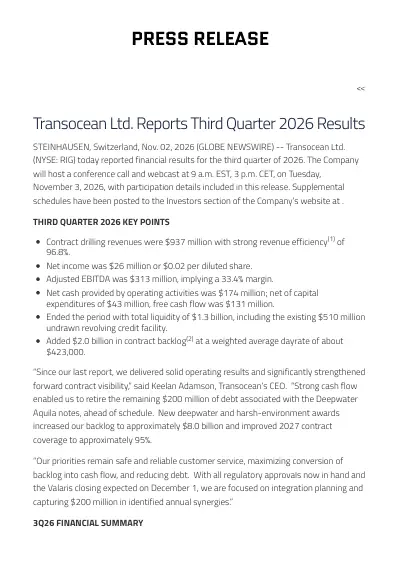
We have now received all necessary regulatory approvals required for closing. Most recently, the US Department of Justice and CADE, the Brazilian competition authority, each approved the deal with no conditions.
I wish to thank the amazing team, internal and external, that successfully supported us through the various governmental reviews over the last several months. Transocean and Valaris filed the definitive proxy statement on October 14th, and shareholder votes for both companies are scheduled for November 24th.
We encourage shareholders to approve the transaction and associated resolutions for this exceptional value-creating combination. After successful shareholder votes, we expect the Bermuda court to approve the deal on November 26th, and closing will occur on December the 1st.
We are now in the final stages of integration planning. Upon closing, we will quickly commence the process of delivering the estimated $200 million in annual synergies.
We intend to provide 2027 guidance for the combined company in February next year, along with our year-end results. Now on to some market observations.
Consistent with third-party reports, we believe that global market conditions and energy supply and demand trends are very constructive for our business. Even though the outlook for oil prices remains supportive, due to the long-lead-time nature of this business, all our customers remain disciplined in allocating investment capital to exploration and development opportunities.
Even so, while our discussions with customers and industry observers suggest that this budget season will result in increases in deepwater and harsh environment spending, IOCs particularly still seem most likely to contract rigs for durations that align with their specific drilling programs. As the market continues to tighten, however, we expect these customers to make longer-term commitments as needed to ensure access to preferred assets.
While national oil companies are also financially disciplined, their long-term interest in the exploration and development of domestic hydrocarbon resources reflects their governments' economic growth or energy security agendas, the latter being emphasized by recent supply chain challenges. Indeed, the significant year-over-year increase in contracting activity has been led primarily by NOCs and skewed to longer-term contracts as they secure rig capacity to pursue their broader agendas, which is reflected in the appreciable percentage of the total backlog year-to-date that has been awarded to us, at roughly 60%.
In contrast, we have observed certain independent operators act opportunistically in securing drilling capacity, taking advantage of favorable economic conditions to perform additional work. According to Fearnley Offshore, active fleet utilization now stands at or above 90% for drillships, with demand for sixth- and seventh-generation drillships still expected to exceed 95% by the end of 2027.
Drillship backlog is now 237 rig years, an average of roughly two and a half years per unit, the highest in over a decade. In the near term, we expect rig utilization to tighten further with incremental investments in exploration and development projects.
We also expect contracting lead times to lengthen as longer-duration contracts reduce fleet white space and build forward-looking backlog visibility. In the context of tighter utilization and improving visibility, drillers should carefully consider the many and various strategic, tactical, and economic trade-offs associated with these opportunities.
Moving to recent contracts and prospects. We continue to carefully manage our rig portfolio to ensure that we maximize cash flow.
You should expect us to seek an optimal deployment of assets through a continued, disciplined, centralized management of our fleet once the transaction closes. While all of our contract awards are covered in our Fleet Status Report, let me share a few recent highlights that support our very constructive outlook.
The Deepwater Proteus was awarded a 10-well contract in direct continuation with our current customer in the US Gulf, adding about $325 million of backlog. The Deepwater Conqueror was awarded two new contracts in direct continuation with her current customer for a total award of $305 million.
The Dhirubhai Deepwater KG2 was fixed with ONGC in India on a $300 million commitment. In Norway, the Transocean Norge was awarded work with Shell worth approximately $62 million.
In Australia, a single-well option was exercised for the Transocean Equinox for about $24 million. In total, we added nearly $2 billion of backlog, including $1 billion associated with the formal approval of an award for the placement of three Cat-D rigs with Equinor announced in late June, namely the Enabler, Encourage, and Endurance.
These recent commitments have effectively sold out our active fleet for the remainder of 2026. Our 2027 contract coverage has improved from 81% to nearly 95%, and 2028 coverage is already around 65%.
In fact, the Deepwater Mykonos is the only drillship we have available to commence a term contract in the next 12 months. Even though we have already experienced a substantial amount of contracting activity this year, there is still a very healthy pipeline of outstanding opportunities around the world.
According to S&P Petrodata, approximately 124 rig years have been awarded year-to-date, while operators are currently evaluating roughly 35 open tenders representing a further 45 rig years of potential demand. In the US Gulf, our recent contract awards reinforce our view that long-term demand fundamentals remain compelling in this key region.
However, as we have noted on previous calls, we are also observing growing international demand for capable assets, particularly from West Africa. We expect several rigs in the US Gulf that are not on long-term contracts to leave and satisfy this demand.
This likely temporary migration will keep the Gulf's fit-for-purpose asset base in a healthy supply-demand balance. Brazil will remain one of the world's most attractive deepwater markets, supporting a relatively stable fleet of approximately 30 to 33 rigs over the next 5 years.
Recent discoveries from BP and Petrobras underscore Brazil's significant resource potential and our expectation for additional exploration activity. We continue to believe that African demand across multiple basins will grow the regional rig count from approximately 15 units today to over 20 units in the next 18 months, with opportunities in the Ivory Coast, Mozambique, Namibia, and Nigeria.
In the Mediterranean, several new discoveries requiring appraisal and development drilling should drive an expansion in that regional fleet of approximately two to three units over the coming years. In Southeast Asia and India, recent rewards represent encouraging signs of what will become a broader regional growth cycle.
In Southeast Asia alone, we see potential for seven to nine rig years of demand from four to five opportunities in a market that currently has only one active deepwater rig. In India, as a result of the government's pursuit of their Samudra Manthan mission to find and grow offshore production, a multi-rig, multi-year program could commence with a near-term activity increase of as many as four drillships in the next 2 years with Indian NOCs.
Turning to Norway. Utilization of high-specification, harsh-environment semisubmersibles remains exceptionally strong through 2028, supported by recent awards from Equinor, Harbour, Vår Energi, Shell, and Aker BP.
The Spitsbergen and Equinox are Transocean's only harsh-environment semisubmersibles available before 2029. We are encouraged by the many inquiries on these rigs and are confident that they will secure work soon.
Additionally, potential programs in Canada for Equinor and Cenovus could further tighten harsh-environment supply from 2028 onward. In summary, while the timing and scope of individual opportunities will inevitably evolve, the broader market trends driven by new sanction developments, increasing exploration investment, and a growing inventory of recent discoveries remain highly constructive.
Against a backdrop of limited fleet growth, more forward contracting visibility, and a steadily tightening supply-demand balance, we continue to see favorable conditions for strong fleet utilization and improving business economics. Finally, before I pass the call to Thad, a brief comment on third quarter results.
During the quarter and year-to-date, our fleet uptime was an exceptional 98%, in line with the best performance ever delivered by the company, with average daily revenue approximating $463,000 per day. Both revenues and operating and maintenance costs were in line with our guidance range.
Adjusted EBITDA of $313 million and the associated margin of 33% was consistent with the prior quarter. We continue to improve our capital structure by fully redeeming the Deepwater Aquila secured notes in October, and also finalizing an amendment to our revolving credit facility that will become effective at the closing of the Valaris acquisition.
Over the past 2 years, we have focused on debt reduction and the simplification of our balance sheet. In the last 24 months, we have retired over $2 billion of debt, and you should expect us to continue to pursue this objective.
I'll now hand the call over to Thad for additional comments on Q3 financial results and to provide guidance. Thad?
Thad Vayda
Thank you, Keelan, and good day everyone. As Keelan highlighted, our third quarter financial results were consistent with our expectations and, importantly, the guidance we provided to you in August.
Now just a couple of comments on our results. At $590 million, O&M expense continued to trend a bit below our forecast.
This is due in part to success in reducing costs for both in-service and out-of-service projects, and reflects the continued scrutiny of our spending requirements, which will continue. At $62 million, G&A exceeded the upper end of our guidance range due to $10 million of costs associated with the pending Valaris acquisition.
Adjusting for these costs, we spent about $52 million for G&A expense, generally in line with our quarterly run rate over the past year. Free cash flow of $131 million with a margin of about 14% was lower versus last quarter due primarily to the timing of collections as well as an annual fleet insurance premium payment of approximately $20 million.
Our trailing 12-month net debt-to-EBITDA ratio, inclusive of restricted cash reserved primarily for debt repayment, is now 2.9 times, generally consistent with where we ended the second quarter and one full turn lower than a year ago. We finished the quarter with about $500 million in unrestricted cash, roughly in line with the prior quarter.
Our total liquidity, inclusive of the undrawn revolving credit facility, was approximately $1.3 billion. We expect that we will end the year in about the same place.
On October 1st, including a nearly concurrent $35 million amortization payment, we retired the full principal balance of about $200 million of the 8% Deepwater Aquila senior notes. The payment, which included a call premium and accrued interest, was settled using cash on hand and a $48 million of restricted cash from the associated debt service reserve account.
This debt retirement saves approximately $22 million in interest expense through maturity. Subsequent to this retirement, the reserve account, which makes up the bulk of our restricted cash, contains about $230 million, almost all of which is associated with our remaining $763 million of 8.75% secured tailwinds notes, which we expect to address in 2027.
These actions reflect continued execution of our strategic objective to reduce leverage and simplify the balance sheet. On October 15th, we completed an amendment to our revolving credit facility to expand its total capacity to $750 million, improve terms, and extend its scheduled maturity date by 3 years to late 2031.
The amended facility was substantially oversubscribed during syndication, with several new banks joining. The facility will become effective when the acquisition of Valaris closes, expected on December 1st.
Now for a few thoughts on our outlook for the balance of the year and into 2027. Our 2026 revenue guidance has been narrowed by $25 million, reflecting the diminishing likelihood of additional gap-filler work materializing for the next couple of months.
Indeed, our remaining contract coverage for already approximates 100%. We have also increased the lower end of our full-year cost guidance by $25 million, moving the midpoint slightly higher to reflect incremental activity.
Our G&A guidance range is $185 to $190 million for the full year, including increased employee benefit costs. This range excludes transaction-related expenses, which would typically be excluded from adjusted EBITDA.
I will also note that our full-year interest expense guidance of approximately $500 million consists of results through Q3 that include the effect of the bifurcated exchange feature in our 2029 exchangeable bonds, plus our forecast for Q4 interest expense approximating $107 million. This figure excludes any potential derivative effects of these bonds.
On a standalone basis, we expect to end 2026 with less than $4.8 billion of gross debt and, as previously mentioned, forecast our total liquidity to be around $1.3 billion. This liquidity estimate includes our existing, undrawn $510 million revolving credit facility.
Our latest earnings release provides preliminary guidance for full year 2027 for Transocean on a standalone basis. As Keelan mentioned, our fleet is already 95% committed in 2027.
This is about 10 percentage points better than where we were for 2026 at a similar point in 2025. Year-over-year O&M costs are expected to increase by approximately $60 million.
A large portion of this cost relates to the repositioning of rigs for new contracts, periodic surveys and recertifications for our fleet, and includes required overhauls of spare equipment. Finally, we're observing some inflationary pressure, mainly in logistics and fuel, but also some increases in the cost of manufactured goods, the result of increased input costs, including raw materials, energy, and logistics.
Notwithstanding, we expect cost inflation to remain in the low single digits in 2027 and have considered this friction in our guidance range. This concludes my prepared remarks.
Keelan?
Keelan Adamson
Thank you, Thad. Year-to-date, we have added over $4 billion of contract awards, bringing our standalone backlog to approximately $8 billion.
We remain focused on converting as much of every backlog dollar to cash flow as possible. We look forward to closing the Valaris transaction in early December, combining two great companies committed to operating best-in-class assets, delivering exceptional performance that surpasses customer expectations, and utilizing an industry-leading pro forma backlog of approximately $12.7 billion to drive shareholder value.
We'll now open the line for questions.
Operator
Thank you. If you'd like to ask a question, press star one on your keypad.
To leave the queue at any time, press star two. Once again, that is star and one to ask a question.
We'll take our first question from Joe Laetsch with Morgan Stanley. Please go ahead, your line is open.
Joe Laetsch
Hey, good morning team, and thanks for taking our questions. I just wanted to ask on the preliminary 2027 guide.
Could you just talk to how you're thinking about the upside and downside scenarios here? With contract coverage at 95% next year, what could push you to the upper or lower end of the guidance range?
If you could talk about both revenue and O&M, that would be helpful as well. Thank you.
Thad Vayda
Thanks for the question. As you've observed, it's a pretty good situation we're in from a contract coverage perspective.
If you noticed from our performance this year, our initial guidance reflected our best guess of how the year was going to go. Our operational performance was very good.
There is a very limited amount of opportunity here for sort of fill-in work. I think that there is enough variability in that that we have some upside potential.
When it comes to the costs, we're going to continue with our scrutiny of every expenditure as we've done. In that context, we feel that the guidance that we've given you is pretty much straight down the fairway, but, again, in the context of the acquisition, plus the standalone efforts that we're making to reduce costs, we think that there is some room for improvement there.
Joe Laetsch
Great. Thank you, that's helpful.
Then maybe just on the macro. Can you talk a little bit about where you see the progression of dayrates?
You've announced several sizable awards over the last couple of months, and it seems like dayrates are in the $450 to $500,000 per day type of range. Could you just talk to where you're seeing leading-edge dayrates today and maybe how much additional pricing opportunity there could be as utilization tightens?
Thank you.
Roddie Mackenzie
Hey, this is Roddie. Look, far for it from us to speculate where that's going to go.
You've seen a few of the announcements that we've made recently. As Thad and Keelan have pointed out, we're really in a great position backlog-wise and with limited availability in '27.
Everyone is now focusing on '28, '29, and '30. What's interesting about that is we're observing at the moment 100% utilization, but there's still time available as time goes out.
The visibility on that is going to change, and I think that's going to be the inflection point. When the operators are now beginning to see that they don't have the visibility to rigs in the timeframe they need, that's probably the trigger that's going to help change that dynamic.
Keelan Adamson
Maybe, Joe, I'll just jump in on the back of Roddie's comments. I think the point that we need to remember is that we talk about a prompt utilization typically at 95%, or rates will move at a certain point in that utilization, but clearly we always need to make sure that there's a good backlog of utilization in the out-years.
What Roddie's speaking to is the fact that the opportunities that we're looking at now are in the out-years of '29, '30, '31. As that develops and as we see more of those opportunities coming through, we're going to see the lead time for contracting awards is going to have to come forward.
As that takes place, the visibility improves, the utilization stacks, and at that point, we should be seeing better economics on these deals as we go forward.
Joe Laetsch
Great. Thank you, that's helpful.
Keelan Adamson
Thanks, Joe.
Operator
Thank you. We'll take our next question from Keith Beckmann with Pickering Energy Partners.
Please go ahead, your line is open.
Keith Beckmann
Hey, good morning, thanks for taking my question. I just wanted to hit on the Gulf seems like it's going to be down a little bit next year, right, with several rigs heading over to West Africa.
Maybe looking forward a little bit further, do you expect that to be somewhat of a new normal where the Gulf is, or do you think we're going to see more of a return potentially in 2028 within the region, and either way, what do you think is driving that? Thanks.
Roddie Mackenzie
I'll take that one. There are a couple of rigs that are already booked to leave, right?
It's interesting, the utilization in the Gulf for us certainly was at 100% this year. We had a few opportunistic fill-in wells, which was great.
That helped top up the rig that had a little bit of availability on it. Yes, we've announced that there's two of ours that are going to be leaving.
We know that there's at least one of our competitor rigs going to be leaving. This is because places like West Africa and the Mediterranean and potentially Asia are really heating up.
They're a significant draw on these rigs. If there is any idle time on these rigs going forward, I think it gets snapped up real quick.
I think basically what happens is these mobile units move where the work is, and at the moment the urgency for the work is perhaps not in the Gulf of Mexico or Gulf of America right now, but we do think that the fundamentals of the basin are solid. There's been a number of kind of developments kicked off, and we do expect that a lot of the big guys especially are looking for longer-term development work in the Gulf.
It's just a question of does that transpire into a contract in a timeline that keeps the rigs here, or do they go elsewhere first and then perhaps come back a bit later as the availability tightens up?
Keelan Adamson
Keith, I also think to Roddie's point, the long term for the US Gulf is strong. When we look at the prospects our customers are focusing on for the next decade, 2030 and beyond, it's clearly the Paleogene.
The assets that are required to drill those prospects are clearly the high-spec end of what we own. While you might see some of these high-spec units leave for the work that Roddie is talking about, as our customers start increasing their exploration spend, and there's a lot of conversations happening about that today, where our majors are looking at near prospects, looking to see if they can tie back into existing production hubs, and then obviously addressing future potential, we see the basin being very strong for many years to come.
Keith Beckmann
Awesome. That's really helpful.
Then my follow-up, I just kind of wanted to check back in on energy security and how you guys are thinking about that now with customers. Following kind of the KG2 contract that you guys had, right?
Are you guys seeing NOCs start to try to move faster towards FID given energy security risk right now, or maybe any urgency within those projects given everything going on, just any thoughts around that? Southeast Asia, but also more broadly anywhere else that we should think about as well.
Roddie Mackenzie
Very much so. Look, last year and beginning of this year, you saw the Petrobrases of the world moving quickly, really awarding a tremendous volume of work, deciding on their long-term plans and getting after it.
This year we're seeing the same thing in other places. A good example is India, for example.
There's $9 billion has been earmarked for funding for basically large-scale exploration and development of their resources. Again, it is all linked to domestic production and the issues that we've seen in the Strait of Hormuz, the other places around the world, particularly Ukraine conflict, is really bringing into focus the concept of domestic production and being self-reliant.
With that said, we definitely are observing the NOCs getting after it. We actually would say that, in India, ONGC moved very quickly from when they got the bids finalized for that tender to actually making the award, recognizing the scarcity of the rigs available.
We think there's going to be a lot more of that. We think basically those that move quickest are the ones that are going to secure the assets, and those that don't are going to be disappointed.
Keelan Adamson
I think we're also seeing some NOCs learning how to scale up, right? The Petrobrases of the world, the Equinors of the world, they are used to building volume, pursuing long-term objectives in a steady fashion.
I think some of the other NOCs around the world are governed by their procurement processes, and of course that in itself needs to be addressed to accelerate their ability to be able to acquire the assets and start this work. I think they're looking at all possibilities to ramp up as soon as they can, and they are absolutely committed to these energy security initiatives that they are now executing.
Keith Beckmann
Awesome. I'll turn it back.
Thanks, guys.
Operator
Thank you. We'll take our next question from Eddie Kim with Barclays.
Please go ahead, your line is open.
Eddie Kim
Hi, good morning. One of your peers recently indicated that the deepwater market is firming up despite very limited demand uplift so far this year from higher commodity prices.
Would you agree with that? If so, when would you expect operators to really start stepping up their rig contracting activities given the elevated commodity price environment?
Roddie Mackenzie
Look, the elevated commodity prices are either based on a macro trend or movement or temporary global issues. I think what we've observed and I think if you talk to any of our customers, they are very focused on being disciplined in terms of matching their contracting activity to their approved development activities.
That's important because they are not using the current commodity price to justify projects. They are grounded in a very realistic long-term outlook, which is actually great for our business.
It would be interesting that our business would uptick heavily because of recent oil prices, but it's not particularly useful in the long term. What we're looking for, especially in this market, is long-term stable contracts at attractive economics that just make sense.
That's basically where the operators are today. They are not kind of doing the knee-jerk reaction.
There are one or two that have taken some opportunistic wells to increase near-term production, which is commendable. For the most part, everybody is viewing their big commitments on a long-term outlook, not on something that's happening in the near term.
We think that's extremely encouraging for our business because it means that the uptick in contracting that you've seen now, which is actually a banner year, best year for us in 10 years, is going to be the way going forward. This is the normal that they're working to, and they're justifying this on breakevens that are $50 and below.
They're not talking about justifying things at $80 or $90 a barrel. We actually think that's extremely positive.
Keelan Adamson
I think Eddie, it's a lot about reserve replacement conversations right now. It's about energy security, it's about how are we able to supply the energy to the world's demand as opposed to the spot market pricing, right?
Our business is very long lead, and our customers have been very, very disciplined in allocating that capital, and they will continue to do so, albeit that probably upstream, and particularly deepwater, is going to attract more of that investment as we move forward.
Eddie Kim
Got it. Understood.
My follow-up is just on your cold-stacked assets. I think you had previously talked about a reactivation of one of your cold-stacked assets probably not being a '27 event, but more likely a '28 or '29 event.
Just curious if your thoughts there have changed at all. Just with your recent fleet update, it doesn't look like you have much availability really at all in 2027 besides the Mykonos.
Just curious if thoughts on timing has changed even in the past 3 months or so.
Keelan Adamson
Eddie, I would say that first and foremost, we're not going to reactivate one of those cold-stacked ships speculatively. If the demand in the market requires more capacity, then clearly we will see utilization building in the out-years, like we've talked about, where we see really tightened visibility in the out-years of '29 and beyond.
As we think about cold-stack reactivations, we think about the lead time to get them restarted and available to work, that's 12 to 15 months. I think we're still in the same mindset: one, it's not going to happen unless there's a contract and we're going to recover that investment, and two, it's probably not happening in the next 12 months anyhow.
Roddie Mackenzie
I'll just add to that, we are not in the habit and we will not be creating the habit of plundering hundreds of millions of dollars into reactivations on questionable economics. As Keelan points out, we are going to be very disciplined in this approach.
We are only going to do it when it makes sense and the returns are guaranteed. Don't expect to see us do it just yet.
We will wait for the right moment.
Eddie Kim
Understood. Great to hear.
Thanks for that color, I'll turn it back.
Operator
Thank you. We'll take our next question from Greg Lewis with BTIG.
Please go ahead, your line is open.
Greg Lewis
Thank you, and good morning and good afternoon everybody. Roddie, Keelan, I was hoping you could talk a little bit more about what you're seeing in the North Sea.
You mentioned you have a couple rigs that are rolling off contract in a year. It just seems like the other day you were moving rigs to Australia because the North Sea was kind of softening.
I guess just kind of curious is we're hearing that the North Sea is selling out, what type of durability or duration are we seeing in the North Sea in terms of longer-term opportunities to put work to rigs, and even, I know we don't want to talk too much about pricing, but in a market that's sold out, it's probably higher there. Thanks.
Roddie Mackenzie
North Sea, I'll do with Norway first. We're basically operating at near full capacity for the high-spec rigs, and what we're seeing is there's basically an increasing number of kind of direct negotiations and long-term partnership deals being struck.
You have seen several announcements from ourselves and our competitors over the last 6 months that all point to long-term stuff. That just kind of tells you that in Norway, we're experiencing the high utilization, but now we're getting to see the really strong visibility.
That's again very positive for those dynamics. As you point out, we do have a little bit of availability left, but we've already announced that two of our rigs that had previously left Norway to go overseas are coming back.
That's kind of the beauty of this class of fleet that we have, and the mobile nature of our units, is that when it isn't working out, they can go elsewhere, and when it is, then they'll come back. We're excited to bring them back.
We're excited to expand our footprint in Norway again, and we're excited at what other opportunities are there. Real quickly on the UK side of the North Sea, there is a glimmer of hope.
The government has not been particularly helpful over the last several years, but the Jackdaw sanctioning and then of course the confidence that people are building in the Rosebank decision means that the UK has a pretty good chance of adding some capacity there. It's just going to be a question of whether there's rigs for it.
That market is in good shape as we switch from the concept of utilization to forward availability.
Greg Lewis
Great. I realize the Valaris transaction is not yet closed.
Are you guys entertaining questions on jackups or should I ask something else?
Keelan Adamson
Obviously we're operating as individual companies until we close, Greg, but happy to take any questions on the jackup fleet at a future point.
Greg Lewis
Sure. Okay.
Then, Roddie, maybe this question's for you. Clearly we're hearing a lot more about the opportunity for exploration drilling as we look out into '27 and '28.
I guess I'm kind of curious what your views are, and I know this is hard to pinpoint because rigs go back and forth. As we think about the global fleet, do we have any sense for how much of the fleet is kind of operating in exploration, and then realizing that, hey, drilling a well in West Africa is different than drilling a well in the US Gulf of Mexico, is there any kind of way to think about how much longer an exploration well takes than say a development well?
Is it a 20%, is it 30%? Any kind of color around that, because it does seem like we're going to see a lot more exploration here over the next couple years.
Thanks.
Roddie Mackenzie
That's very true. We are seeing that, right?
There are several of the rigs are moving to that kind of mode, and a lot of the new things that have been sanctioned are going to be about exploration. For example, the work in India, a lot of the stuff that's happening in West Africa is additional exploration work.
Yes, a new location and you're exploring the nature of it, has a chance of running longer, has a chance of being more difficult, but when you go into development mode, you're also completing wells. There's an element of that that kind of balances it out.
Very, very difficult to say if there's a difference in duration, but it really depends on locations and also what well programs look like in terms of development stuff. Now, of course, development stuff you do over and over again, you get better at it typically, you understand the conditions more, you maybe perhaps a bit more efficient.
I think that's a hard one to
Keelan Adamson
It's a great question, Greg. It's basin by basin, as you rightly point out.
Obviously, exploration well designs are more conservative as opposed to development wells, which obviously the operators have the ability to drive a lot more efficiency as they understand more about the reservoir. On conservative wells, they typically will take a little bit longer, depending on the basin, but of course, on the successful exploration wells, then there's logging programs and potentially testing programs, and so that obviously extends the duration as well.
It's why it's difficult to really talk about how long an exploration well can go, because it really depends on the success and whether the geological targets are what they expected to see. I think it's fair to say they typically go longer.
Greg Lewis
Super helpful. Thank you very much.
Keelan Adamson
Thanks, Greg.
Operator
Thank you. We'll take our next question from Fredrik Stene with Clarksons Securities.
Please go ahead, your line is open.
Fredrik Stene
Hey, Keelan, Thad, Roddie. First, congratulations on getting all the I guess paperwork done in relation to all the different antitrust processes.
I'm sure you're looking forward to some actual integration instead, I'll be eagerly watching the votes and completion towards the end of the month. For my questions, I wanted to be a bit specific on rigs.
As you pointed out in your prepared remarks, you have very good coverage on '27 already. There is, I would say, a gap on the Deepwater Atlas between the '27 program and '28, and you also mentioned the Mykonos as the only rig of being available over the next 12 months that is potentially set for a term program or have the opportunity to do a term program.
Any color that you could give on those rigs in terms of the chance of filling that Atlas gap, or for the Mykonos, should we expect a gap before a new contract on that as well, or do you feel like you have line of sight to opportunist that would be close to direct continuation? Thanks.
Roddie Mackenzie
Yep. Hey, there are no shortage of opportunities for both rigs, the likelihood of gaps is very low.
It's just a question of what the right opportunities are. The Atlas specifically, the gap is real small.
We've got plenty of interest to fill that gap. It's really just a timing thing, it's on a well-based contract just now, and it moves to a term-based contract a little bit later on, but there's possibilities for all of those things to move.
That's dynamic, but likelihood of a gap's pretty small. Thinking about the Mykonos, she actually has options on her, those have not been struck yet, we wait to see what happens there.
Again, we think as one of the few rigs active and working well and available, there's pretty low risk of gaps on her. If they were, it would perhaps be just for changing operator type gap rather than a significant idle period.
Feeling pretty good about that.
Keelan Adamson
Fredrik, I would say, look, you're talking about Atlas being the high-spec rig in the world, right? Any time that she might have available, I think we've demonstrated this year that the high-spec rigs in the US Gulf, we can get them busy.
In opportunities in particularly the US Gulf, and if you think about Brazil, and the conversations we're having with activity in both of those areas, we're not concerned about any significant gaps that could develop on those rigs.
Fredrik Stene
Very happy to hear that. As a follow-up to the rig-specific, and maybe I'm just trying to be too clever in a way here, but I think you said over the next 12 months Mykonos was the only one with availability for a term program, as I mentioned.
I guess technically the Pontus will end in October next year. Should we interpret that as a new program already being in line for her, or again am I just trying to read too much into the details here?
Roddie Mackenzie
I think you're trying to read too much into the details. She's actually more likely to be right towards the end of the year, but yeah, that's just semantics.
Fredrik Stene
All right. Thanks.
If I may, just one for Thad as well. You are targeting around $200 million of synergies from the integration with Valaris, but are you able to give some specifics on potential integration costs?
I'm sure there will be some costs there one-off in nature as you do the integration work. If you have scoped that, would be very interested to hear, and also if that is in any way reflected in the standalone guidance of some sort that you've given
Thad Vayda
for '27? Thanks.
Yep. Last question first, it's not reflected in our guidance.
If you've noticed over the past three quarters, we've called it out discretely. As we approach an opportunity here to provide more fulsome guidance on the combination, we'll consider advising what the integration costs are going to comprise.
Fredrik Stene
All right, appreciate all the color on everything. Thank you very much, have a good day.
Keelan Adamson
Thanks, Fredrik.
Operator
Thank you. We'll take our next question from Noel Parks with Touhy Brothers.
Please go ahead, your line is now open.
Noel Parks
Hi, good morning. Thinking back over what has been a very eventful years in the oil markets geopolitically, and yet sort of the strip behavior has been a little bit unexpected it is for me.
I'm just wondering, it's kind of with the benefit of hindsight, in terms of sort of the energy security motivation with the NOCs, do you have a sense of when maybe they sort of really got religion on that? I'm kind of looking at the say back end of the 24 month strip, where it's looking finally more solid than it had been for much of the year kind of with the war going on.
I just wondered now with some time behind us, do you have a sense people caught on, okay, this is definitely something we're going to have to address, who's not going to be, a short-term phenomenon in terms of the wars effects?
Roddie Mackenzie
Look, things have been trending back towards oil and gas for a couple of years now, right? If we're brutally honest, a lot of the other energy ventures have not panned out, initially with very heavy government subsidies and not able to turn a decent margin at that point, and then of course when some of those subsidies dry up, then the economics look even worse.
I think there's just been a gradual movement back towards oil and gas and in particular domestic production, and the recent events, certainly the last 12 months, have brought that into a much sharper focus. We've commented on it a lot, our customers have commented on it a lot.
I would say probably about 18 months ago, there was really a big shift back towards hydrocarbons, and that has only accelerated in the recent round of energy capital days and budget updates from the majors. Very welcome, very overdue, but it's logical, and it's based in reality now, whereas before it was perhaps a little bit aspirational, if you would, rather than realistic.
Keelan Adamson
I think the conflict served to amplify the situation, Noel, that I think we've all seen coming with reserve replacement percentages being at all-time lows for a very long period of time. I think as the demand started to increase, it really became a concern on supply, and then the conflicts amplified the situation, to be honest.
We see it as a much more longer-term kind of pivot in the last few years.
Noel Parks
Great. Thanks, it's helpful because there are just enough really moving parts in how the equation of how the fundamentals play out that it's helpful to sort of get that perspective on the earlier roots of that trend.
In term to Valaris again, I'm just wondering, beyond sort of the market dynamics you've discussed already, I just wondered are there sort of any metrics you're keeping an eye on that sort of help validate to you, yeah, Valaris is going to prove ultimately to definitely be a bargain? In other words, just anything that you've seen as you've had more and more time to look at the assets that you're particularly excited about with the combination?
Roddie Mackenzie
Valaris have recently announced a few very strong contracts, which are great, particularly in the jackup market, somebody had asked about that earlier. We're not really in a position to comment on the details of that, but we're excited about the combination for a number of reasons on the floater side, but also on the jackup side.
That market appears to basically have bottomed out kind of last year, earlier this year, and we're very encouraged by the contracts that they signed. Kudos to the team, they've done great there, but we don't really have all the details on that.
Keelan Adamson
I think the fundamentals for our decision to want to move ahead with this combination were based on our constructive view of the market and what we felt it was going to be in the coming years. When we looked at Valaris and the assets that they own and operate and their ability to work across very different geographies and customers, we knew we were putting together a top-tier asset-based company that was going to be focused on delivering outstanding performance for our customers and finding solutions for what they needed in the go-forward, which we felt was a very productive time.
If you think about the metrics that we'll be looking at, obviously we're looking at utilization and the visibility of the utilization stacking over time, and Valaris's fleet is largely contracted next year, and they've done a very good job of preparing to get their full fleet in operation from early '27. In fact, I think most of their rigs now and their floater fleet is working now at the end of this year.
We believe that we've positioned the transaction timing at an ideal point where they're going to have some contract backlog through '27, as are we, and then we'll be rolling rigs going forward into a very constructive cycle. That's probably as I think about the transaction, I think it's playing out exactly the way we expected it to.
Noel Parks
Terrific. Thanks a lot.
Operator
Thank you. We'll take our next question from Jeff LeBlanc with TPH Research.
Please go ahead, your line is open.
Jeff LeBlanc
Good morning, Keelan and team, thank you for taking my question.
Keelan Adamson
Morning.
Jeff LeBlanc
I wanted to see if you could provide some more color on the sequential rise in non-allocated O&M costs, and how should we expect this bucket to trend in the subsequent quarters given the commentary on inflation?
Thad Vayda
Most of that cost is associated with the increased activity we're seeing next year. Roughly two-thirds of it is associated with fleet spares, and then the balance is associated with some BOP recertifications and maintenance.
It's all associated with the activity levels. As I mentioned, we've been pretty good about keeping our costs in check.
We'll continue to scrutinize all of the expenditures. As I mentioned, this is sort of straight down the middle of the fairway.
There's really nothing untoward about the increase given the assets that are going back to work.
Jeff LeBlanc
Thank you very much. I'll hand the call back to the operator.
Operator
Thank you. We'll take our next question from Doug Becker with Capital One.
Please go ahead, your line is now open.
Doug Becker
Thank you. Keelan, Roddie, I really wanted to circle back to your expectations for longer-duration contracts.
When we take a look at contracts this year, the average duration for drillships is still even through below 2024 and certainly 2014, if we go back that far. Really wanted to get a better sense, are you seeing these longer durations in formal tenders?
Is it more based on conversations today, or is it just anticipatory right now given the logical extension of the tight market we see today?
Roddie Mackenzie
Year-on-year, we're basically last year we were 245, I think was the average duration, this year we're already 380 is the number of days on the average duration of contracts, so that's a meaningful increase for sure. Your comparison to the previous upcycle, the previous upcycle is very different because at the tail end of that upcycle, the durations had to be very, very long because it was a newbuild cycle.
Nobody was building rigs to bring them out speculatively initially, and then once few of the speculative builds did come into the market, they were still always talking about 3-, 4-, 5-year terms. The comparison to 2014, we're definitely a long way from a newbuild cycle, so that's not what we expect to see.
If you just go year-on-year, we're already up 50-plus percent than we were last year. We do see a pipeline that has several very long contracts in them, by that we're talking 2, 3 years, some even more than that.
In our current dynamic, we consider 2, 3 years to be solid long-term contracts. The dynamic to 2014 is not really of comparison in this environment.
Keelan Adamson
It's a very different cycle we're in, and obviously the capital discipline being employed by our customers is poles apart from when it was in 2014. What we're seeing and why we're constructive is obviously the activity is growing, the demand for assets for developments and exploration is driving utilization, the utilization is starting to get booked now for out-years in 2028, '29, '30.
As we start to see that, then the lead time, I think, is an important metric to look at and how that will increase as opposed to the number of years associated with the contract. I think you're going to see longer-term contracts come through, and I think you're going to see us contract them earlier for longer in this particular growth cycle.
Doug Becker
That's really helpful context. Reasonable to be thinking about 2-, 3-year contracts becoming more normal, but don't hold out hope for 5-year-plus contracts at this stage?
Keelan Adamson
I'd probably go to the former rather than the latter. I think the discipline that we're seeing from our customers is that they're contracting for their drilling programs, for their FIDs, and I don't think they're ready to make any sort of commitment on that sort of scale at this time.
Doug Becker
No, makes sense. Maybe just a little more color on the outlook for the 20K completions market going forward?
Roddie Mackenzie
Solid. There's more and more demand for that certainly with the increased exploration wells in certain basins, we expect that to continue up.
The Gulf of America has got plenty of opportunities there. There's not very many assets that can do it.
Then we are seeing an interest from some overseas locations depending on what the anticipated pressures are going to be, there's a few of them hanging in the balance, but that's a relatively healthy position to be in.
Keelan Adamson
I think when you think about 20K completions, obviously a lot of our customers that are in that arena are talking about the 2030s in the US Gulf as the major source of production from those deep reservoirs. Building the exploration programs and commencing the development programs for those prospects will start in the latter part of this decade and obviously into the 2030s, so that's probably where the main 20K completion activity will really fire off.
Doug Becker
Got it. Thank you.
Keelan Adamson
Thanks.
Operator
Thank you. This brings us to the end of today's meeting.
We appreciate your time and participation. You may now disconnect.