Rank One Computing Corporation
NNASDAQ:ROCQ2 FY2026 · Earnings Call TranscriptAugust 13, 2026
Operator
As a reminder, this conference is being recorded. I would now like to turn the conference over to Jules Abraham with Core IR.
Please go ahead.
Jules Abraham
Thank you, Betsy, and good afternoon, everyone. We thank you for joining ROC's second quarter 2026 financial results call.
Presenting on today's call are Scott Swann, ROC's CEO, and Cody Barnes, ROC's CFO. Brandon Clare, ROC's co-founder and Chairman of the Board of Directors, and David Gray, ROC's Head of Capital Markets and General Counsel, will also be available during the question-and-answer portion of the call.
Before we begin, I remind everyone that this call may contain certain statements that constitute forward-looking statements within the meaning of the Private Securities Litigation Reform Act of 1995. These include remarks about management's future expectations, beliefs, estimates, plans, and prospects.
Such statements are subject to a variety of risks, uncertainties, and other factors that could cause actual results to differ materially from those indicated or implied by such statements. Such risks and other factors are set forth in the company's quarterly report on Form 10-Q filed with the Securities and Exchange Commission, and it does not undertake any duty to update such forward-looking statements.
Additionally, during today's call, certain non-GAAP measures will be discussed. The presentation of this additional information should not be considered in isolation or as a substitute for results prepared in accordance with U.S.
GAAP. Now my pleasure to turn the call over to ROC's CEO, Scott Swann.
Scott?
Scott Swann
Thank you, Jules. Good afternoon, and thank you for joining ROC's second quarter 2026 earnings call.
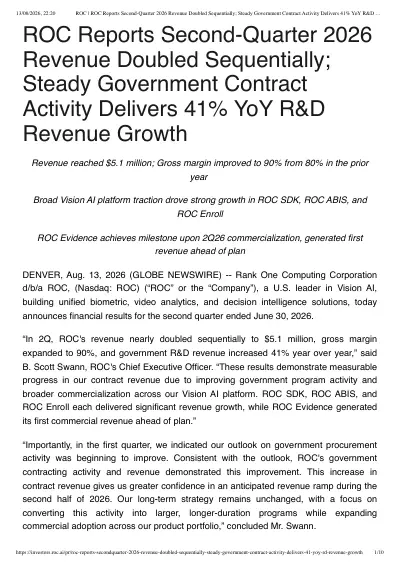
The second quarter marked ROC's first full quarter operating as a public company, and it was reflected measurable progress in two areas we outlined on our first quarter call. We've seen improving government contracting activity and broad commercial adoption across the ROC product portfolio.
We're pleased to report sequential growth nearly doubling our revenue compared to the first quarter. We've also successfully monetized the entire ROC Vision AI platform ahead of our plan.
Second quarter revenue was $5.1 million. This is up 2% year over year, as I mentioned, nearly double first quarter revenue, primarily driven by a 41% increase in R&D contract revenue, which more than offset the decline in product revenue attributed to the completion of a ROC Watch deployment recognized in prior year periods.
In May, we said government procurement activity was appearing to be improving with awards and revenue to follow incrementally through the remainder of 2026. The second quarter provided initial evidence that funding and program activity are actually beginning to return to normal and develop.
Additionally, we advanced our newer ROC products across the Vision AI platform. ROC SDK, ROC ABIS, and ROC and Roll each generated strong year-over-year revenue growth, and ROC Evidence produced its first commercial revenue.
Combined, these developments indicate early progress on the path to growth we've outlined. However, that does not mean growth for the business will follow strictly a linear trajectory.
Government awards and deployment schedules are unpredictable, and it creates quarterly variability. However, we believe the second quarter performance demonstrates that the underlying government procurement activity level has increased, the contract awards that we target are beginning to be executed, and our go-to-market strategy is advancing.
Taking a closer review of ROC's government-driven activity, R&D contract revenue increased to approximately $3 million from $2.1 million in the prior year quarter. This initial contract revenue growth is encouraging, but activity has still not returned to a normalized rate.
Government program timing remains variable, and business activity is informed by appropriations, procurement schedules, and the timing of individual awards. That being said, we believe ROC is well-positioned to capture growth opportunities through the second half of this year.
Importantly, the value of these programs extends beyond initial contract revenue. Government-funded work allows ROC to demonstrate its technology in demanding operating environments that deepen our customer relationships and position us to pursue expanded programs with our Vision AI solutions.
Our overall strategic growth objective for our R&D contract business is straightforward: converting research into successful mission deployments or proof of concepts that lead to larger, longer-duration recurring revenue, and ultimately establishing ROC's American-built technology as the identity infrastructure of government customers. Turning to our product segment, overall product revenue declined year over year due to the completion of a significant ROC Watch deployment, which was recognized in prior year quarterly revenue.
To be clear, this was a profoundly successful project for ROC. Under the contract, the ROC Watch solution was selected for an initial short-term contract period with a strict timeline and a tailored to really highly sensitive mission for a government agency.
Based on rigorous intelligence results, it validated that mission and that critical utility. ROC Watch outperformed customer expectations, and that deployment was subsequently expanded and ultimately completed successfully with high customer satisfaction.
This ROC Watch mission is an important example of contract economics because certain ROC product programs are phased and finite. Revenue may be concentrated in particular periods depending on program and deployment milestones.
Excluding the ROC Watch year-over-year comparison, the broader product portfolio showed strong progress. ROC SDK revenue increased 84% to approximately $1.6 million, supported by growth in new customers.
ROC ABIS revenue increased 723% off a marginal base in the prior year quarter. The current ABIS revenue contribution was a result of our early go-to-market process to advance these initial customer programs to commercial deployment, and we are continuing discussions with a consequential potential beachhead customers.
Our newest product brought to market, ROC Evidence, generated its first commercial revenue following an early deployment completed ahead of original commercialization timelines. ROC and Roll revenue increased 125%, also from a small base, reflecting continued adoption by our key enterprise customer, MTN in South Africa, as it activates an expanded rollout plan for identity enrollment and verification.
Our commercial growth model remains consistent across our Vision AI platform. We introduce ROC products with a defined use case, prove our performance, and successfully expand across additional users, workflows, locations, and products.
The ultimate objective is to secure beachhead customers that require capacity to deliver multi-year identity intelligence programs with ROC's technology and support for a recurring, repeatable revenue stream. Before shifting away from our product performance, I'd like to touch on our digital evidence growth strategy.
During the quarter, we pursued a strategic initiative designed to enhance our ROC Evidence product. As announced in June, we entered into an agreement to acquire VTC, a legacy strategic partner of ROC.
Consolidating VTC into ROC's business and operations was a natural next step in our collaboration with this uniquely skilled engineering team. We see this as a strategic acquisition intended to build a robust version of ROC Evidence with VTC's additional digital forensics capabilities, their domain expertise, and government customer relationships.
We've already made a lot of progress on aligning our companies in advance of closing the transaction. Integration across our engineering, product, and business development is well underway and showing promising results, with the business operation integration to be completed quickly upon closing.
We will provide further details once the transaction is complete, with greater visibility into the financial profile and full scale of the integrated company. We anticipate closing the transaction by the end of the third quarter.
I'd like to spend a moment to revisit ROC's differentiator. It's not simply that we are American-built.
It's that we combine this U.S. ownership and development with technical performance validated by top-tier performance in independent industry benchmarks.
We believe that combination is increasingly relevant to national security, public safety, and critical identity infrastructure. Our commercialization efforts are also supported by this independent validation as a key consideration in both government and commercial procurement processes.
During the quarter, ROC achieved NIST results, including the fastest latent fingerprint search speed in the Evaluation of Latent Fingerprint Technologies benchmark and leading identification accuracy results across multiple friction ridge image and features friction fingerprint technology evaluations. Now these results matter because our customers require this objective evidence of accuracy, speed, and scalability, and they frequently support their acquisition decisions.
We also continue to strengthen the platform and organization as we deepen our public market heritage. We've appointed Dr.
Kathleen Kiernan, former Assistant Director for the ATF's Office of Strategic Intelligence and Information, to our Board of Directors. We also added Stephen McQueen, former Director of the FBI's Threat Screening Center, as a senior advisor establishing our Homeland Security and Intelligence market strategy.
Additionally, ROC's suite of solutions received its Development, Testing, and Evaluation designation under the Department of Homeland Security's SAFETY Act and were named Facial Recognition System of the Year in the 2026 AI Breakthrough Awards. As a newly public company, our mandate is to deliver on the objectives within our control to our shareholders.
We acknowledge that our credibility we build as we demonstrate execution against our expressed strategic priorities. In the first quarter, we said government activity was beginning to improve.
In the second quarter, R&D contract revenue increased materially. We indicated that we were advancing ROC ABIS and ROC Evidence toward commercial use.
In the second quarter, ROC ABIS revenue expanded, we covered multiple new customers, and ROC Evidence generated its first commercial revenue ahead of our internal plan. We invested in talent across product development, business development, and deployment capacity, as well as investing in our AI/ML algorithm development engine, our technology hardware, and processing infrastructure to drive durable growth and scale.
Our responsibility now is to convert those investments into larger customer programs for a more durable revenue profile and scale. With that, I'll turn the call over to Cody Barnes, our Chief Financial Officer.
Cody Barnes
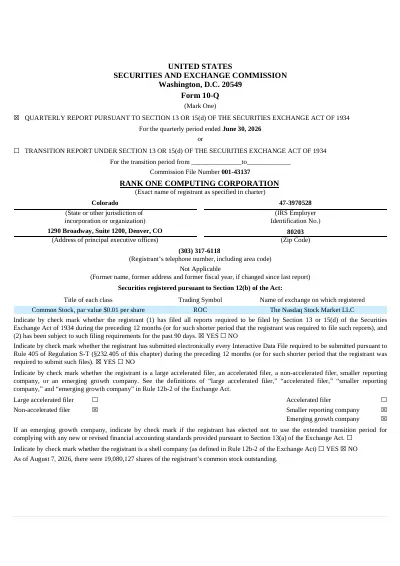
Thank you, Scott, and good afternoon, everyone. I will now provide a brief overview of our financial results for the second quarter ended June 30th, 2026.
Total revenue for the second quarter 2026 was $5.1 million compared to $5 million in the second quarter of 2025, an increase of approximately $0.1 million or 2%. Product revenue was $2.1 million compared to $2.8 million in the prior year quarter, a decrease of $0.7 million or 26%.
As Scott said, the decrease in product revenue was due to the completion of a significant ROC Watch deployment recognized in the prior year quarter. ROC Watch revenue in the second quarter decreased 87% year over year.
This was partially offset by higher revenues for ROC SDK, ROC ABIS, ROC and Roll, and ROC Evidence. ROC SDK revenue was approximately $1.6 million, up 84% year over year, reflecting continued customer adoption of our foundational software platform.
ROC ABIS revenue increased 723% year over year to approximately $0.2 million, driven by multiple new customer deployments. ROC and Roll revenue grew 125% to approximately $0.1 million, reflecting the planned expansion of our MTN deployment.
ROC Evidence generated its first commercial revenue during the quarter. ROC R&D contract revenue was $3 million compared to $2.1 million in the second quarter of 2025, an increase of $0.9 million or 41%.
The increase reflected revenue recognized from an exercise of an option to significantly expand an existing government R&D contract. Importantly, this award reflects improving government contracting activity following the slower award environment experienced in late 2025 and early 2026.
Gross profit increased to $4.6 million in the second quarter of 2026 from $4 million in the second quarter of 2025. Gross margin expanded to 90% from 80% in the prior year quarter.
The improvement reflected the quarter's shift to higher-margin revenue mix with lower cost of sales. We believe this reflects the strength of our software-driven revenue model and the efficiency of our Vision AI platform.
Notably, margin will fluctuate depending on the revenue mix of software licenses, services, hardware, and R&D contract revenue. Operating expenses were $5.3 million in the second quarter of 2026 compared to $3.2 million in the second quarter of 2025.
Selling, general, and administrative expenses increased to $3.3 million, primarily driven by our continued investment in growth, reflected in higher personnel-related costs across engineering and product development, business development, and operations. Research and development expenses increased to approximately $2 million.
The increase from the prior year reflects continued investment in engineering, product development, and platform enhancement. Net loss for the second quarter of 2026 was $0.8 million compared to net income of $0.6 million in the second quarter of 2025.
Basic and diluted loss per share was 4 cents compared to basic and diluted earnings per share of 4 cents in the prior year period. As of June 30th, 2026, we had $11.9 million in cash, approximately $14.8 million in working capital, and no outstanding debt.
We believe the post-IPO balance sheet provides the flexibility to continue executing our current strategic growth plan against product development, deployment capacity, customer acquisition, and the infrastructure required to support larger, longer-duration programs. With that, I'll turn the call back to Scott.
Scott Swann
Thank you, Cody. In closing, our second quarter results showed progress, but they also clearly indicate there is work to do in executing against our stated plan.
Our goal remains establishing beachhead contracts for all of our products and expanding those relationships both within the product line and across the Vision AI platform. Our priorities are to convert government-funded activity into larger production programs, advance ROC ABIS and ROC Evidence customers into expanded deployments, and grow existing customer relationships across additional ROC products.
Completing the VTC transaction will further accelerate product development capabilities and our ability to serve new and existing customers. The core opportunity for ROC is market recognition as the leading American-built identity technology infrastructure for national security and law enforcement customers, which generates long-duration customer relationships and high-margin revenue.
We are encouraged by the progress made during this quarter. We also understand that credibility will be established as we demonstrate sustained execution with contracts secured, deployments completed, customers expanded, and financial performance delivered.
That is the long-term value proposition of ROC. We appreciate the continued support of our dedicated shareholders, customers, our partners, and our employees.
We look forward to providing updates on our developments. I'd like to now hand the call to the operator to begin the questions-and-answers session.
Operator
We will now begin the question-and-answer session. To ask a question, please press star then one to join the question queue.
If you are using a speakerphone, please pick up your handset before pressing the keys. If at any time your question has been addressed and you would like to withdraw your question, please press star then two.
Once again, to ask a question, please press star then one. At this time, we will pause momentarily to assemble our roster.
The first question today comes from Yifu Lee with Benchmark. Please go ahead.
Yifu Lee
Hello, Scott, and direct welcome to you and team. Thank you for taking my questions.
Congrats on the strong 2Q on nearly doubling revenue quarter over quarter while boosting gross margin to 90%. Scott, I just want to start with the macro environment, especially as it relates to the government recovery.
Obviously, R&D revenue grew 41% year on year. I think you clocked in at $4.9 million, which is pretty much nearly the entire balance of 2025, right, in R&D revenue.
Can you describe what you are seeing, Scott, in terms of the government side, the recovery? I know you mentioned that it's not linear, the recovery, but as we all know, September is the fiscal government year-end.
I just want to get your thoughts on how you characterize the funding environment. I know in your prepared remarks you say it's a little bit slower in terms of approval.
Just want to get your thoughts on that just to start off the conversation, Scott.
Scott Swann
Thank you, Lee. As we're coming off of a fiscal year in 2025 that was operated the entire year in a continuing resolution and then a record government shutdown, it did set the stage for a slow half of the year in large part because the monies for government agencies hadn't made it to where they needed to get to these particular agencies that would execute against that money.
The revenue is a good indicator. The award of the R&D contract is a good indicator that the government is back in more of a normal operation, but there are several other indicators that we really pay a lot of attention to.
Those are increases in interaction, additional quotes and pricing and solicitations, and we're seeing all those signals from the government right now that they are moving toward their milestones of having to obligate their FY '26 monies by September 30th of this year.
Yifu Lee
Got it, Scott. Thanks for that.
Would you characterize any possibility of a budget flush that we are accustomed to? I know three years ago in the SaaS software space, the government needs to spend that money before fiscal year-end.
Would you anticipate any sort of that coming just because there's still a lot of money left?
Scott Swann
There's certainly a lot of money left within the government. I think those that are doing business with government agencies will see stronger performance in the second half of the year.
It takes time for them to move that money to a contract and get that awarded to particular vendors. The key for a government agency is that they have to obligate that money by September 30th, and that sometimes can go to third parties like integrators that can subsequently award that money to technology providers like us.
I think that will trickle into Q4 in some respects for some government contractors. All that said, the government is sitting on some very large budgets that they need to execute before September 30th and or to obligate before September 30th.
I think that there is a lot of energy toward that within the government agencies right now, and we're seeing all those signals with our customers.
Yifu Lee
Got it, Scott. The next topic is really the pipeline conversion.
I'm sure a lot of investors are wanting an update, and you provided a great update. Let us start off with the ABIS contract first, right?
You did two two pilots program in the quarter. Can you help us understand from these pilot programs to long-term deployment, we just want to understand the journey to get from initial pilot to full commercialization deployment.
How long does it take for these projects to scale up? Because I remember during the IPO process, research process, you mentioned these are large-scale projects, could be seven, eight figures.
You have two two pilots going on. Can you give us a sense of the ramp-up on those?
Scott Swann
Yes. Early in the deployment of your new product capabilities, a few things happen.
The first adopters get the best deals. We work very closely with them to make sure the products are truly ready for market.
That helps us to really ensure that we have that scalability moving forward. We've successfully worked with two of our ABIS customers this year to provide them with deployments.
As we move forward into our next set of deployments, we would be looking at larger opportunities depending on the agencies. Some of the agencies are smaller in size and could be smaller opportunities, but as we start approaching larger federal agencies and having ABIS opportunities in that particular space, we'll have those credentials under our win column of already have proven out the technology.
That's what I believe where we'll see our longer-term durable revenue with repeating year-after-year revenue to ROC.
Yifu Lee
Any timeline, Scott? I know two of them in pilot program.
Should we think the cadence is 12, 18 months to fully ramp these ABIS projects out?
Scott Swann
That is about the cadence. Do note that we're not starting from zero.
We've been working several of these, we have already been working specifically for capture in many, many different AFIS and ABIS market spaces now. As I set out at the beginning of our IPO, our key priorities for this year is to establish our beachhead wins in each one of our product lines.
Those two early ABIS wins this year, they don't constitute what we consider beachhead wins. Beachhead wins to us are multimillion-dollar contracts, multimillion dollars per year contracts that have multi-years associated with them.
We're looking to establish that not just in the AFIS/ABIS market, but across a few of our product lines this year.
Yifu Lee
Got it. Then just to balance it out off of that so I know you mentioned that Watch, there's a completion of the large deployment.
We've seen some headwinds this quarter. Just want to get your help that's to understand about the cadence of ROC Watch deployment going forward.
Whether the expanding customer base will create opportunities for more recurring revenue? Is that some lumpiness on the Watch side?
Can you give us a little bit more color on how to think about Watch?
Scott Swann
I think this is just timing. I think as you look at the particular project that gave us a spike last year, that was a very set mission-related project that we were very successful in delivering that particular project.
As I mentioned in the government budget cycles, it takes time for the evaluations, the money to get to the agencies, and the actual obligation and execution of those funds to a contractor. We've been very active in various pilots and opportunities and quotes and activities within the ROC Watch portfolio.
Our focus this year is scaling ROC Watch, as well as establishing a major beachhead customer in ROC Watch as well.
Yifu Lee
Would you anticipate, let's just say, the second half, will there be any headwinds on year-over-year comparisons, I guess, because of this roll-off of the contract?
Scott Swann
I won't provide any formal guidance moving forward, but I will say that we are fostering several opportunities moving forward, and I believe that we're really focused on the growth of our various product lines. I anticipate that the Q2 of 2025 was a bit of a spike in ROC Watch performance in comparison to what we'll see as we move forward within 2026.
Yifu Lee
Got it. Thanks for that.
Then, Scott, on the ROC Evidence, right? I'll love these two questions together.
VTC, you talked about how the strategic impetus to buy VTC to accelerate ingesting the data for the Evidence product, and we've seen some wins at the US Drug Enforcement Administration, it started last quarter, but I think you guys made good headway into that. How would you characterize VTC will help you accelerate, let's just say, the Evidence side of your portfolio?
Scott Swann
They're a key partner in this. We would have been working with them even had we not moved forward toward an acquisition.
They have decades of experience in working in the digital evidence space, and our ability to help them focus more toward a product mindset and working toward a ROC product in the digital evidence space is already paying dividends. As I mentioned, we have already made great strides in the integration of VTC into ROC on the engineering and product space.
Those strides have already been presenting to customers and giving us good signals of the demand signals that we're seeing from those that need forensic digital evidence capabilities. Really combining their decades of engineering experience building these products with our product-minded mindset of building out applications is already well underway and something that I think that we'll see a lot of benefits from in the near term.
Yifu Lee
Got it. Makes sense.
Then for the technology enhancements, I know ROC won some awards on fingerprinting search, whether be search or accuracy. How should investors think about these award accolades when it seems like the ROC platform is earning more and more.
Does this open the door to certain avenues that wasn't able to go into in terms of the awards?
Scott Swann
It's very important. We've often times talk about being one of the only American companies in this space.
We're really the only American company that's providing identity technologies across all the various biometric modalities. We don't win on just being American alone.
We really have to prove out our performance and that we are best in industry when it comes to our algorithms. The recognition that we get from winning these benchmarks and awards is important from the business development perspective, but even more so, some of the government procurement activities are structured to help support acquisition decisions based on how well we perform in these evaluations.
We take them very seriously. We're performing extremely well across the board in all those biometric modalities thanks to our research team.
Yifu Lee
Got it. Then I'll finish off with the financials, Scott, and I'll ask both of them at the same time is go-to-market.
In terms of the go-to-market investments, can you give us a status on that, how should we think about the team? Are you ramping up?
Is there sufficient resource? Then lastly on the financial is, I think you have $11 million, a little bit more than that, on your balance sheet.
Your timing on fundings, how much runway you have, and also give us some color. I know you gave us some qualitative guidance, but we've seen some good outperformance, right, in terms of revenue growth this quarter, almost 100%, as well as gross margin 90%.
How should we think of it as we head into the second quarter of this year? That's it for me.
Thank you, Scott and team.
Scott Swann
That's right. I'll answer the first part of this question, and then I'll hand it over to Cody to answer the second part.
What I would say, Yi, we deployed capital early. We were prepared to launch that capital to support our growth.
We kind of intelligently deployed to make sure that we got people in place quickly and also invested in the hardware resources that we need to accelerate the abilities of our research team. The majority of that allocation has been already put in place and deployed.
To this point, now we'll really be focused in converting those investments into capital. Given the software nature of our business, as we look forward and we are optimistic about the second half of the year with the margins that we create, we essentially are able to start converting our business into cash also as we move forward.
Cody, I'll allow you to have some a little more color on the balance sheet.
Cody Barnes
Thanks, Scott. I think on the liquidity side, we ended the quarter with $11.9 million in cash, $14.8 million in working capital, and no borrowings outstanding on our facility.
The use of cash reflects the investments that we've discussed and been discussing, mainly personnel-related, into product development, into our infrastructure and deployment capacity. Just overall, we're very comfortable with our current liquidity profile and balance sheet, and we'll continue to be disciplined with how we allocate operating capital.
I think in terms of just kind of forward-looking, we won't provide formal guidance, but I'll just kind of emphasize again that we've been very deliberate with the investments we've made in the first half of the year. We're obviously encouraged by Q2 results.
We're seeing good engagement in the opportunity funnel, and again, the balance sheet's very, very healthy. I think collectively, that sets us up really, really well for the second half.
Then just to touch on the gross margin, I wouldn't think about it as a quarterly run rate, Yi. Gross margin is going to move around based on contract mix.
This quarter in particular, we benefited from a higher mix of software license revenue relatively and a relatively lower cost of sales associated with our R&D contract revenue. By comparison, the prior year quarter included a large ROC Watch deployment, which carried some marginal delivery costs that were very unique to that project.
I think we should generally expect some quarter-to-quarter variability in gross margin, and we should definitely look at this over a longer trailing period. Thank you.
Yifu Lee
Got it. Thank you, Cody and Scott, for patiently taking all my questions.
Congrats again on the strong 2Q. Talk soon.
Cody Barnes
Thank you.
Scott Swann
Thank you, Yi.
Operator
As a reminder, if you would like to ask a question, please press star then one to join the question queue. This concludes our question-and-answer session.
I would like to turn the conference back over for any closing remarks. The call has now concluded.
Thank you for attending today's presentation. You may now [disconnect].