Roivant Sciences Ltd.
Q1 FY2027 · Earnings Call TranscriptAugust 6, 2026
Operator
Good day, and thank you for standing by. Welcome to Roivant first quarter 2026 earnings conference call.
At this time, all participants are in a listen-only mode. After the speakers' presentation, there will be a question-and-answer session.
To ask a question during the session, you need to press *11 on your telephone. Please be advised that today's call is being recorded.
I will now like to hand the conference over to your first speaker today, Stephanie Lee. Thank you.
Please go ahead.
Stephanie Lee
Good morning, and thanks for joining today's call to review Roivant's financial results for the first quarter ended June 30th, 2026. I'm Stephanie Lee with Roivant.
Presenting today, we have Matt Gline, CEO of Roivant. For those dialing in via conference call, you can find the slides being presented today, as well as the press release announcing these updates, on our IR website at www.investor.roivant.com.
We'll also be providing the current slide numbers as we present to help you follow along. I'd like to remind you that we'll be making certain forward- looking statements during today's presentation.
We strongly encourage you to review the information that we have filed with the SEC for more information regarding these forward-looking statements and related risks and uncertainties. With that, I'll turn it over to Matt.
Matt Gline
Thank you, Steph. Good morning, everybody, and thank you for joining.
This is a little bit of a calm-before-the-storm moment for us. A pretty quiet quarter, and maybe not the most interesting of our earnings calls in recent memory, but nonetheless, a lot of great progress in the business.
Certainly, we're expecting a jam-packed second half, as I'll get to in a moment. I'll be relatively brief in my remarks, and then we'll we'll go to Q&A.
I just want to start on slide 4. This is a slide we we took from our own our own prior deck.
This is from the Investor Day that we did in December of last year, and this was a list of our priorities for the year. We're sitting here a little bit more than halfway through the year, just wanted to highlight that it it's gone well for us, that we feel really good about the setup.
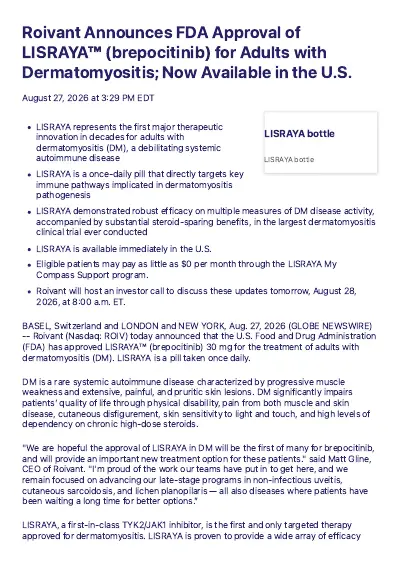
On slide 5, looking across the list here, we've got brepocitinib expected to launch by the end of September. Obviously, we got priority review, and our PDUFA date, as we said, is is this quarter.
We had great data from 1402 in the D2TRA study that we presented on our last quarterly call. Probably the most notable update for today on the top center of this slide is that we've now enrolled patients in the Phase 3 study in cutaneous sarcoidosis for brepocitinib, which follows on the positive results that we had in our Phase 2 data, which I think we announced on our first quarterly call this year, earlier in the calendar year.
We've now received the initial payment from Moderna in the settlement, and that the sort of second part of that, the 14 the 1498 part of that case is progressing. We filed international proceedings against Pfizer and BioNTech in that case.
Finally, earlier this year, we added LPP as a fourth brepocitinib indication. As I'll remind people later today, that study is continuing to enroll really well.
As I mentioned at the top of the call here on slide 6, I'll just say this is a quiet quarter, and this is a quiet day. I don't know exactly how the following statement could be true, but I think it is.
The next 6 to 12 months are in any in many ways busier than the prior 6 to 12 months for us. We just have an enormous amount coming up, starting, as I mentioned, with the upcoming potential brepocitinib launch in DM, which should happen imminently assuming everything goes as we as we hope and expect it will with FDA.
We've got top-line data in brepo from the NIU study in an indication that could easily be as large as dermatomyositis. That data is coming in the second half of this year.
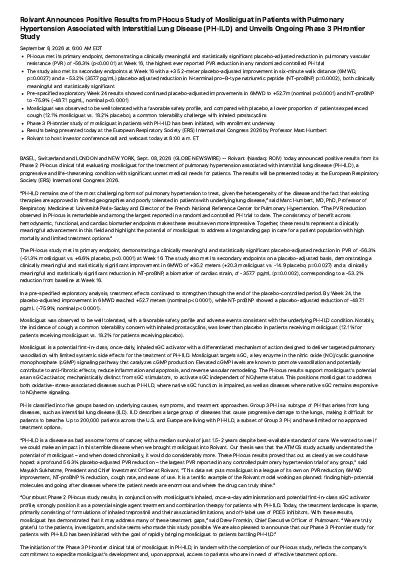
We also have top-line data coming shortly in the second half from mosliciguat, the Phase 2 study in PH-ILD. I know that's being closely watched, and we're looking forward to to getting that data and presenting it.
We will provide updates further updates on the D2TRA program at Immunovant in the second half of this year, including hopefully a download on a conversation we hope to have with FDA about that program, as well as the results from the second part of the study, and a little bit more about our our plans going forward. Then finally, probably the smallest of these, we're expecting top-line data from the POC study in CLE, also in the second half this year, and looking forward to finding out what we've got there when that comes in as well.
Just a jam-packed second half, and even more coming in 2027 with the Graves' data and beyond. Just just a lot, a lot in the in the in the coming months here.
I'll just hit a couple of highlights in terms of the pipeline updates in a little more detail here before, again, before going to Q&A. Starting on slide 8 with a reminder because it's been a few months since we've talked about it.
The the initiation of this cutaneous sarcoidosis Phase 3 study is is a pretty exciting event. It's a little bit ahead of schedule in terms of what we've been able to do here.
This is a disease that we're just privileged to be able to work in here. It's a it's a it's a high-morbidity, very difficult disease with a high urgency to treat.
You can see on slide 8 some of the photos we've shared before, but these are patients who are really sick and have very few treatment options. On slide 9, as a reminder of the data that we generated in our Phase 2 study, we had set for ourselves a goal of a sort of 5-point benefit on the CSAMI scale for clinical meaningfulness.
In the study on the top left of this chart, we showed a greater than 20-point benefit compared to roughly roughly nothing on placebo. Just a a huge benefit to those patients in the Phase 2 study, and really excited to carry that forward into the into the pivotal program.
As a reminder on on slide 10, we think this is a a pretty decent-sized indication, again with high unmet need, probably about 40,000 patients in the US, and reasonable overlap with some other organ systems, including optical sarcoidosis or eye sarcoidosis, where that overlaps with NIU, that is that is one of the one of the types of NIU that we're studying, as well as pulmonary sarcoidosis, which is a big a big potential indication as well, and where we hope to be able to treat some of those patients via either their ocular sarcoidosis or or CS. The Phase 3 study that we've now begun, the design is laid out on slide 11.
I know there were some questions after the Phase 2 about what exactly this study would look like. It is designed to take all of the learnings from the Phase 2 study that was successful.
It is a 16-week study with a primary endpoint of CSAMI greater than or equal to 50% response rate. It's 140-patient study across about 70 sites, 3 to 2 randomized, with patients either on 45 milligrams of brepocitinib or placebo, and with a mandatory taper sorry, a mandatory steroid taper going from week 2 to week 8 down to zero, which is consistent with roughly consistent with what we did in the Phase 2, and generally consistent with what we think is appropriate for patients in this indication.
That study, as I said, has already begun rolling patients, and we expect top-line data in 2028, which just adds to the list of registrational, potential registrational indications for brepocitinib coming up. I'll I'll reiterate on slide 12, the other ongoing registrational program is the brepocitinib study in lichen planopilaris, LPP, that we announced earlier this year.
That study is enrolling, I would say, extremely well. There's a lot of enthusiasm from physicians and patients for that.
Speaks to the high unmet need in the indication. Speaks to the quality of the work being done by Ben and the Priovant team, and looking forward to sharing more about that as soon as we've got it.
That that that's also moving along nicely. Look, finally, and and I'm sure there will be questions about this in Q&A and lots of opportunity to talk about it, hopefully with a potential approval and beyond.
Obviously, one of the major events in the near term here is the launch, potential launch of brepocitinib in dermatomyositis. I'll just say I think we're in a phenomenal position here in terms of what we've got and in terms of what we hope to be able to do, starting with the quality of our clinical data, which, as you know from the multiple times we've talked about it, from the publications including in the New England Journal and so on, just phenomenal data, stat sig across all 10 endpoints, big clinical benefit, a lot of enthusiasm from the doc community.
This is a really tough disease, a large addressable population, most of them on sort of polypharmacy, trying a lot of different things, and frankly, most of them still dissatisfied with the available treatments. We feel like we have an opportunity to do something big and different for this patient population.
Our team's been out spending a lot of time with the physician and the patient communities on overall education, and I think the enthusiasm for a new therapy is is coming out loud and clear, including with all the academic presentations that have been done and so on. Commercial launches, there's not much to say today other than that it's on track.
We're we're ready to launch on time, having received priority review. The sort of commercial and patient support teams are built out, trained, ready to deploy.
We feel really great about the hires we've made there, really great about the organization we've built there. We think we're doing this in a way that is both capitalizing on all the learnings from successful launches at other companies in recent years, and doing it in a in a Roivant-Priovant way.
There's there's nobody in the world I'd be more excited to see oversee this than the team we've got at Priovant with Ben and Daniel and others, and I think we're going to we're going to be fully ready. Everything's everything's on schedule.
We'll have much more to say about that with a potential approval and after, but but looking forward to it. I'll say one more thing about the commercial franchise overall of brepocitinib on slide 14.
We we get a lot of enthusiastic questions from investors around pace of launch. We've been pretty consistent that our answer to that question is sort of slow and steady is is what we're looking to build there.
I think there's a bunch of reasons for that. Obviously, some of them are DM is a new indication, and no one's launched a novel therapy basically ever, or at least a targeted therapy basically ever, and so it's just hard to know exactly what what what work will need to be done to get everyone comfortable and excited and on drug, although I think we're fully prepared.
Also, to me, it's it's because brepocitinib is a lot more than just dermatomyositis. To me, what we're really doing here is not just trying to make that launch as fast as possible, we're trying to lay the groundwork for the overall opportunity, which goes beyond DM into, first NIU and then CS and LPP with with the data coming thereafter.
I think as you think about that layering, to me, it's much less about what week 1 or month 1 or quarter 1 look like, and much more about making sure that the foundation on access, the foundation on patient support, the foundation around the institutional activities, the foundation around our communication with the scientific and physician community and our our communication with patients are all set up to deliver the maximum opportunity for brepocitinib across all of these indications. I think, I think slow and steady isn't just about sort of guidance.
Slow and steady is about the approach that we're taking with the program to make sure we have maximum reach across everything that we're doing there, including indications that we're excited about beyond the ones we've already announced. A lot to come.
As I said, on track for that launch. You all hear the same thing we do, which is a ton of enthusiasm from the patient and physician community for for new options in all of these indications, and looking forward to sharing more when we know about it.
Our guidance is going to continue to be slow and steady, because that's what we think we're we're building. Final business update here is we we got the upfront payment in the settlement with Moderna.
That $950 million has come in, $770-ish of it to to Genevant, and the rest to Arbutus. That's done.
There will be progress in terms of, return of capital, etc., of that by Arbutus and so on. The 1498 sort of appellate ruling is that that process is ongoing at the Federal Circuit.
That'd be another $1.3 billion if we got a favorable outcome there. Then we continue to advance our litigation against Pfizer and BioNTech.
We filed three international lawsuits, notably in Canada and the UPC, in July, just last month, and continue to progress that case as fast as we can. Obviously, not all of it in our control, but equally enthusiastic about the potential there in terms of what we could get.
I'll wrap up just with our usual financial update on slide 17. Look, I think, overall, most importantly, we are spending in areas that we're excited to be spending.
We're excited about all of our R&D programs, about $200 million of of R&D expense for the quarter, of of just under $100 million of non-GAAP adjusted G&A, or $166 million of of GAAP G&A expense, and cash just under $4 billion, and that's before the receipt of the $772 million. Notably, pretty significant share repurchase activity, about $200 million in the quarter, a bit more than that when you include March.
Obviously, what we did there was we accelerated our share repurchase program upon the announcement of the Moderna settlement so that we could get those shares in. The shares that as a reminder, the shares that we bought back kind of the first round of this, the billion and a half that we had bought back sort of up up through mid-last year, we bought back at around $10 a share.
I think the the average price at which we've been able to buy back stock since we kicked off the second round of this in earnest in March has been in the high 20s. Feeling good overall about retiring those shares and getting that capital back to shareholders.
Going to continue doing that according to our authorizations for now. All of it ahead of, on slide 19, a really rich catalyst calendar ahead with a lot coming.
Looking forward to all of that with with a just just an incredibly busy incredibly busy stretch ahead. On slide 20, again, a little bit incredulous for the people around Roivant who are doing all of this work, or incredible for the people around Roivant who have to do this work, but but by the end of calendar 2028, we'll have had hopefully three or more commercial launches, nine or more pivotal study readouts, four-plus NDA or BLA filings, a number of proof-of-concept studies, just a ton a ton coming up in the near term.
With that, I'm going to wrap up my prepared remarks for the day, and I will hand it back over to the operator for Q&A in just a moment. Thank you again for listening this morning, and looking forward to taking your questions.
Operator, over to you. Thank you.
Operator
Certainly. We will now begin the question-and-answer session.
As a reminder, to ask a question, please press *11 on your telephone. If you would like to cancel your request, you can also press *11 again.
Our first questions comes from the line of Brian Cheng of J.P. Morgan.
Your line is open, please go ahead.
Brian Cheng
Hey, guys. Good morning.
Thanks for taking our questions. Maybe just thinking through the DM launch, Matt, can you give us a quick sense of what metrics we could be receiving right out of the gate to help us better track the initial launch?
Then secondly, on PH-ILD, as we think about the baseline characteristics here in FOCUS, it seems that more patients are on treprostinil. We're curious if there's any implication in terms of the fibrosis versus emphysema ratio in the populations, and then further down the line, whether there's any implication towards the bar for success for both 6-minute walk and also PVR?
Thank you.
Matt Gline
Perfect. Thanks.
Appreciate both questions. Look, on DM, a thing I've gotten fond of saying, as I've watched other companies with commercial launches, is that you all don't deserve our guidance, which isn't quite fair.
Look, I think other than sort of a slow and steady launch, and obviously the sort of top-line metrics will be plainly visible in our financials each quarter, I don't know that we're going to provide a ton of detail in the early days. I think it's important for us mostly to spend our time focused on understanding those dynamics ourselves, getting out, talking to patients, talking to physicians, doing the work we need to do.
We'll give a little more color on what that's going to look like on a call with potential approval, and then we'll start to flesh out the package that we share with each successive quarter. I don't have a lot to say right now about metrics.
I'll say, I think typical with these launches, I'm not sure a ton is going to be visible in the early days just given how the commercial apparatus is set up for actual purposes, but we'll provide more guidance on that as it gets closer and is clearer. On PH-ILD, I guess first of all, we've obviously been watching, for example, the treprostinil data in IPF, and trying to understand a little bit better what's been going on with these PH-ILD patients in treatment of PH-ILD for fibrosis and for lung disease.
It's been a view of ours for a while that one of the things to look out for in treatment of PH-ILD with vasodilators is emphysema. The study was designed with care around the amount of emphysema allowed in the study overall, and that was an important part of the guiding philosophy of the study to make sure that we could serve the patient population broadly, but also were maximizing the potential benefit of the therapy.
That was considered from the beginning. Those are, I think, things we're keeping an eye on.
I know there is a vocal cohort that believes that treprostinil has antifibrotic benefit. Look, I think our view is if you treat PH-ILD patients well for their pulmonary hypertension, you may well deliver a benefit overall on their lung disease.
I think our view is probably that vasodilation is driving a lot of the activity there, but we also have some evidence from nonclinical models of antifibrotic activity for mosli. Overall, on 6-minute walk and PVR, and I'm sure I'll get versions of this question more today, look, I think it's consistent with what we said before.
We're hoping to see a clear signal on PVR. We expect if the drug is at all active, we will.
We don't expect to see very much with clarity on 6-minute walk. The study is not powered for 6-minute walk.
It would be nice to see some separation, but I don't think that's essential for our sort of go/no-go decision from here. We'll know what we've got once we get a closer look at it, including the full balance of that data.
Thanks, Brian.
Brian Cheng
Thank you, Matt.
Operator
Thank you for the questions. Our next questions comes from the line of Dave Risinger from Leerink Partners.
Your line is open, please go ahead.
Dave Risinger
Thanks very much, and thanks for all the updates, Matt. I have three questions, but rather than rattling them all off right now, maybe if it's okay, I'll go one by one.
First, on mosli, you commented just now on 6-minute walk distance, but if you were to run a large trial, what type of 6-minute walk distance would you be hoping for, i.e., what would be relevant to the clinicians and to the patients? That's my first question.
Matt Gline
Thanks, Dave. Look, I think, obviously, we'll have a slightly better answer to these questions overall once we have a sense of what we saw in Phase 2.
The truth is that PH-ILD patients are really sick. There are not a lot of options for these patients.
As we saw in Group 1 in PAH, when you have more treatment options, first of all, patients go on multiple options, multiple lines of therapy, and second of all, most importantly, not from a clinical trial perspective, but from a real-world evidence perspective, survival and mortality rates go down as new classes of drugs are introduced in PAH over time. I think it's less about a number on 6-minute walk, and more about having an approvable therapy.
Remember, these are patients they're trying to walk to the car, they're trying to walk to the bathroom, they're trying to live their daily lives. I don't know that I think it's correct scientifically to describe a specific numerical bar that matters versus just being able to get a new therapy.
Some of that's frankly because 6-minute walk in clinical settings is an artifact that is complicated and noisy and a little bit difficult to translate into daily lives, whereas if these drugs really effectively vasodilate and improve lung function and improve PVR, I think you wind up seeing a lot of benefit for these patients. I don't know that we're going to articulate or have a specific numerical bar versus a successful study.
Obviously, we will be judged, especially by the investor community, based on competitor data, but I don't think we even need to be per se better than any other mechanism in order to have a big benefit to patients. Thanks, Dave.
Dave Risinger
Great, that's very helpful. Then regarding the forthcoming brepo DM launch, could you discuss the cadence of formulary reviews for rare disease drugs?
I ask because for mass-market drugs, P&T committees often wait until 6 months after launch before putting drugs on formulary.
Matt Gline
Thanks. Look, I don't have a ton to say about that right now other than we're having all of the normal engagement with the payer community that you'd expect us to have at this stage, and also, and I think this is a critical point about all of these launches, we are super focused on making sure that the physicians who want to write this drug and patients who want to get on this drug are going to have access.
I think that's going to be really important for our engagement with the community for access generally. I think in terms of literal formulary, it's probably not so different.
It's not like there's a separate committee for different kinds of diseases, but there's lots of medical exception procedures and other things that you can do to get patients covered. We have a whole team of people built out at Priovant dedicated to making sure whether the formulary work has happened yet, whether the P&T committee has happened yet is not something that our patients and physicians have to spend a lot of time thinking about as they're deciding how to use the drug.
Dave Risinger
Excellent, that's really helpful context. Then finally, beyond the list of programs on slide 19, could you remind us about pipeline-in-a-product opportunities for your portfolio, including specific products that you could announce initiation of new studies for over the next year or so?
Matt Gline
I think every single one of the programs that the world is aware of in our pipeline, as well as potentially ones that the world is not yet aware of in our pipeline, in all of those cases, we could announce new trials, new indications in the next year. I think it's every one of those are eligible, and all of our molecules could be put into indications beyond the ones we've talked about, and I think it's fair to say in each case, we have specific ideas of indications we're excited about.
We've done active work, and are in fact preparing to initiate programs to varying degrees depending on how busy those teams are today versus next month or the month after, but real progress. I think the answer is we are actively working on that, that all of our products are, as you've called them, pipeline-in-a-product products, and that we're excited to share more indications as we start those studies.
Dave Risinger
Excellent, thanks so much.
Matt Gline
Thanks.
Dave Risinger
Thank you.
Operator
Thank you for the questions. The next questions comes from the line of Samantha Semenkow from Citi.
Please go ahead.
Samantha Semenkow
Hi, good morning. Thanks very much for taking the questions.
I also have two, one on mosli, one on brepo. For mosli, I'm wondering if you could just talk about the translatability of PVR reductions in patients with PAH to those with the PH-ILD population that you've enrolled in FOCUS.
Are there any aspects of either disease that could influence the magnitude of PVR that you could see in the mosli data? I have a follow-up.
Matt Gline
Look, I think thanks for the question, I appreciate it. I think the translation from PAH to PH-ILD is the fundamental question being answered by our study.
The first unfortunate answer to that question is we're just going to have to see what we see. It is the risk of the program at some level that we find something again, the Phase 1 data, including in PAH patients, looked very good on a PVR basis.
One of the main quote-unquote risks of this program is that there's something, I would call it unexpected, in the PH-ILD translation. Obviously, I use the word unexpected because I think, scientifically, it seems relatively straightforward that inhaled vasodilation is an effective mechanism in PH-ILD, but we'll find out.
Obviously, the lungs of PH-ILD patients are different than the lungs of PAH patients, and so you might expect some difference in sort of the pharmacodynamics of the drug in those patients, but overall, it seems pretty clear that when you take an inhaled vasodilator in PH-ILD patient, you get drug to the healthy lung tissue, and it matters. That's what I'd say.
Samantha Semenkow
Got it. Thank you, that's very helpful.
Then just on brepo in DM, in your conversations that you've been having with physicians for education, I'm wondering if you could just talk about their reception to brepo given the JAK class safety concerns. Obviously, the safety profile in VALOR was quite favorable, but from a class perspective, it would just be helpful to hear how the physicians are thinking about safety, particularly since DM patients already tend to have a higher underlying risk for cancer.
Thanks very much. We've said a few times that
Matt Gline
when we first in-licensed brepocitinib, we didn't exactly know what the reception to JAK inhibitors was going to be following the addition of black box warnings, and our whole view was to choose indications where the safety profile of JAKs was going to be much less of a focus. I think dermatomyositis is a poster child for this in that while JAK inhibitors are at this point extremely widely used in diseases with much less morbidity, many more alternative therapies, in dermatomyositis, there's really no other options available, and I don't think physicians therefore are going to be particularly focused on this question.
Remember, first of all, and I think you sort of alluded to the profile in the trial, dermatomyositis patients are inherently at risk of many of these concerns, malignancies, cardio metabolic events, and treating them well makes them healthier and reduces those risks. Then on top of that, the therapies that they are currently on for dermatomyositis are things like high-dose steroids, which themselves add meaningfully, in fact in many cases much worse than JAK inhibitors, to those very same risks.
I think, in general, physicians are not going to spend a lot of time worrying about this, especially when reminded of the inherent risks of steroids and immunosuppressants that they're on anyway. It's clear from our conversations with docs across different prescriber bases that they're just very comfortable using these agents, including across different prescriber bases, as we said, for patients with significantly less severe disease.
As a reminder, we fully expect that our label is going to look like the labels for other JAK inhibitors, that it's going to have the black box warnings, it's going to talk about experience with JAK inhibitors in other indications, and like I said, I think docs expect that, and I think are not going to be too concerned about it because these patients are, A, very sick, and B, on other drugs with in many cases significantly worse safety concerns.
Samantha Semenkow
Thanks, Matt. Very helpful.
Operator
Thank you for the questions. Our next questions will come from the line of Prakhar Agrawal from Cantor Fitzgerald.
Your line is now open.
Prakhar Agrawal
Hi, thank you so much for taking my questions, and congrats on the continued execution. Maybe a couple of questions from my side as well.
Firstly, on brepo in DM, could you remind us what percentage of DM patients are on off-label JAKs based on your latest primary or secondary research? Would you expect rapid switches from these patients who are on off-label JAKs to brepo?
If not, why is that the case? Secondly, for brepo in NIU trial, what do you see as the biggest risk for Phase 3 given the Phase 2 was really strong?
Is geographic variation, which has been a key risk for this trial, which could drive some of the baseline variability, this has been flagged as one of the risk factors by some of the KOL checks that we have done. Thank you.
Really appreciate it.
Matt Gline
Great, thank you. In terms of your first question on brepo in DM around who's on off-label JAKs and what does that look like, look, I think, first of all, there's just variability in physician practice, and some physicians use more JAKs and some physicians use less JAKs.
That has more to do, I think, with the docs in many cases than with any specific subcategory of patient. I think what we've said publicly is a low single-digit percentage or mid single-digit percentage of dermatomyositis patients have experience with these things.
Some docs don't use off-label drugs, full stop. I think some of the docs who use off-label JAKs have said they expect to switch patients over, and I hope they do, and obviously we'll be working to help them, where that's appropriate, facilitate those switches.
I think it's just going to be down to the preference and practice of each individual doc. I think one of the things that our team is finding in talking to physicians is that different docs have different sort of ideals in mind for who their sort of first patients might be, and I think it just varies based on the patient's experience with the physician.
Obviously we'll be able to have much more of these conversations pending a potential approval, but I think, medically, we'll see a wide variety of different phenotypes. On NIU, what is the biggest risk in Phase 3?
It feels funny to call placebo a risk in these trials, and that's not quite exactly what but I think the variability in placebo response rates in immunology trials is significant. If you're asking me what keeps me up at night, it's that we don't know exactly what placebo response rates will be in that study, and that just makes it hard to know exactly what the trial is going to look like on outcome.
Obviously, the Phase 2 data was quite compelling, and the level of drug activity seems good, and so, I'm pretty optimistic about the study, but this is biotech, you can lose sleep over anything. Is geography a risk?
I think there may be geographic variation just as there is in many other indications, and some of that's literally driven by geography, and some of it's driven by physician practice, and some of it's just noise. I don't know that it's a risk in the sense that it's unanticipated or whatever, it's just a feature of running immunology studies.
Overall, I think the team is doing a great job with the study, and I hope it's going to come out well. Thank you.
Prakhar Agrawal
Thank you.
Operator
Thank you for the questions. Our next question comes from the line of Andy Chen of Wolfe Research.
Your line is now open.
Andy Chen
Hey, thank you for taking the question. I don't think this has been talked about yet, but for the brepo launch, can you maybe talk about a few launch analogs that you are assessing right now, either patient curve or market share curve?
What are the historical products with the most resemblance to brepo in DM? Thank you.
Matt Gline
Thanks, it's a good question. The truth is there has never been a launch of a targeted therapy in dermatomyositis before, and so there is no good quote-unquote analog in the sense that you can point to lots of other launches of lots of other kinds, and some have been faster and some have been slower and some have been slow and steady and some have been just different versions of different things.
I think it's hard to say, and there have been successful products with all kinds of different launch paces. I think the short answer is I don't have a specific analog for another drug that we're watching as evidence of our own penetration.
I think what we're really focused on here is the dermatomyositis opportunity itself, these docs and these patients. The benefit and the cost of being a pioneer in an indication is that you don't get to look at others, you have to chart your own course.
I don't have an analog to point to. Thanks, Andy.
Operator
Thank you for the questions. One moment for our next question.
Our next questions comes from Yatin Suneja from Guggenheim. Please go ahead.
Yatin Suneja
Hey, guys. Thank you for taking my questions.
Just a quick one on difficult-to-treat RA. Could you maybe talk about the strategy there?
Would you need one more study, two more studies? How are you thinking about that?
What should be our expectations for the randomized withdrawal phase that we're going to get data on? Thank you.
Matt Gline
Thanks. Great question.
Look, on study design, so, we're going to come back later this year with a full update on that program, and we don't yet have the randomized withdrawal period data yet, I can't speak to what's in it or how it will or will not inform strategy from here. I think, at some level, the results of that study may inform whether it is usable or not as one of our pivotal studies, etc.
I think we designed it to serve potentially as one of two, but obviously it's got to hit for that to work. As we said when we announced the data, the quality of the response rates in the open-label period have set a somewhat higher bar for hitting a p-value on the randomized withdrawal section.
I think we've got to sort of see all that, take it in aggregate, look at the patient-level data, understand what's going on, and we are planning for an FDA conversation this fall that will inform both the exact design of that study, as well as help us answer those questions. I don't have a specific guidance to give on exactly what those studies are going to look like now because we don't know, but I'll say the team's working on it hard.
The data was obviously exciting, it has gotten noticed, we've got a lot of enthusiastic reception, including from the doc community on it, and we're excited to finalize those plans and bring them back to you later this year. Thank you.
Operator
Thank you for the questions. Our next questions comes from Yaron Werber from TD Cowen.
Your line is now open.
Yaron Werber
Great, thanks so much. I have a couple of questions.
The first one with mosli, once you release the data this year, would you release both the mono and the combo data at the same time? Then secondly, for CS, the trial design is super interesting and makes obviously a lot of sense.
That the primary endpoint is CSAMI more than a 50% response, can you maybe translate the Phase 2 data into the same context, because I think the Phase 2 looked at CSAMI over 10 points and the change from baseline? I'm just trying to get a sense of apples-to-apples, kind of what to expect.
Thank you.
Matt Gline
Great. On mosli, I think the short answer to your question is we will not release the monotherapy data and the combo data at the same time because the combo study started much later and is enrolling now, whereas the monotherapy study obviously will read out pretty soon in the second half.
I think the answer is they won't come out at the same time, and we'll put out the combo data when we've got it. The combo study, remember, it's an open-label study.
The truth is, I think a lot of the information that we could want will come out of the monotherapy study anyway, such that the combo study won't provide that much incremental. I think it was designed in part to give us really good safety experience in the combination, as well as a little bit of information about incremental efficacy, just so that we could get a sense for inclusion criteria and management in the Phase 3.
I'm not sure it's going to be a super, super informative outcome. That's what I'll say on mosli.
I think data's going to come at separate times. On CS, I don't have to give right now the exact delta, but I'll say we saw meaningfully higher rates of greater than 50% CSAMI in the treatment arm than in placebo.
The delta was wide. I think in the press release that may have gone out around the initiation of the CS study, it'll have said well north of 50% of the patients in the treatment arm of the Phase 2 had a CSAMI response rate greater than 50% compared to, I think it was zero on placebo.
It should be a good bar to set for us in terms of the endpoint. I don't know that we're going to replicate exactly what we saw in the Phase 2, but I think the point is it's well-powered for probability of success given what we saw in the Phase 2.
Yaron Werber
Great. If I can maybe just sneak in the Phase 3 NIU, do you have a sense, is the percent Humira experience going to be the same as the Phase 2 given that the data looked pretty good overall, it must have been pretty good in that segment, too?
Thank you.
Matt Gline
I don't think we've said thank you what the percentage of patients in the Phase 3 have Humira experience. I don't have that number on the top of my head, I'll have to check into it.
I think the answer is there's no reason to expect it to be very different than what we've seen. There are a meaningful number of Humira-experienced patients in the Phase 3, which matters in terms of ability to go into all of those patients, but I think the short answer to your question is I wouldn't expect it to be a major driver, and I wouldn't expect anything markedly different about the patient population from the Phase 2.
Thanks, Yaron. Thank you for the questions.
Operator
Our next questions comes from Thomas Smith from Leerink Partners. Your line is now open.
Thomas Smith
Hey, good morning. Thanks so much for the updates and for taking our questions.
On the 1402 difficult-to-treat RA program, I just wanted to clarify how you're approaching the disclosure in the second half of the year. Should we expect to see the part two randomized withdrawal data prior to your meeting with FDA, or are you planning to share the data and the regulatory feedback and next steps simultaneously?
Then on Graves', just wanted to get your thoughts on the competitive landscape. Obviously, you're the first advanced therapy there with really stellar Phase 2 data, and you'll have the first pivotal readout next year with 1402, but there are a number of different approaches targeting various segments of the Graves' patient population.
Just wondering if you could comment on the competitive landscape, and as you see some of the approaches some of these competitors are taking with respect to the patient population, wondering how you're thinking about potential future studies for 1402 in Graves'. Thanks so much.
Matt Gline
Perfect. Those are both really great questions.
On the first one, I think what we said when we put the data out still holds. I think our dream for the second half of this year is that we can come back with everything tied as nicely into a bow as possible, which is to say the period two data, the FDA conversation, maybe some further analysis of patient experience through both periods in the RA study, all shared at the same time.
Obviously, until we have the part two data in hand, we can't sort of specifically know whether there's anything in there that requires earlier disclosure, but in general, I think the answer is our hope and expectation would be to give a full, some update later this year on everything all at once for D2TRA. On Graves', look, I think, first of all, I cannot say enough times that discussion of competition in Graves' disease among therapeutic categories is just misplaced in the sense that you've got so many patients with unmet need.
The last time a novel therapy was developed in Graves' disease was the 1950s or 1960s. There's so many patients who have need of novel therapy that it's not about outrunning the bear, it's not about beating some specific competitor, it's about changing doc behavior in an indication that badly needs new options.
1402 will have been studied in lots of patients as a safe and well-tolerated drug. Graves' is going to have room for lots of mechanisms and lots of products.
Among the other mechanisms, some will have specific either safety liabilities or they'll mimic a thyroidectomy and they'll require treatment with Synthroid, or there's just lots of different approaches, and those drugs may be appropriate for later-line patients or a different subset of the patient population. Over time, I'm sure that segmenting will occur, but first of all, we're going to be first out in the marketplace there long before anybody else, and so we're going to get to have some influence over the treatment paradigms and also just get an option out to patients and physicians before some of those other choices are available.
Second of all, I think it's mostly about building the market, not about any specific alternative and so on. Look, we're tremendously excited to be in our position in Graves', to be first, to be able to offer hopefully a new option here.
The only other thing I will say is you learn a lot running these studies, you learn a lot engaging with this physician community, and I do think there is nuance to the patient population, and I think there is nuance to the prescriber behavior. I think there's a lot of heterogeneity in terms of how these patients are managed around the world and around the US, and I think one of things that we're going to be able to do is to take advantage of those learnings in future studies, in these studies, in commercial prep, and I think that will be of a big benefit to us in being in the first place here.
Thank you. Thank you for the
Operator
questions. Our next questions comes from Yasmine Rahimi of Piper Sandler.
The line is now open.
Shannon Duffy
Hi, this is Shannon on for Yas Rahimi. Congrats on a great quarter.
Maybe just one more from us about clarity with the readout in second half '26. Could you give us just maybe what you might be thinking about narrowing guidance, if you expect to do that, and then sort of how you're thinking about the bar for success?
Then timing post-data, would you expect to file an sNDA, and sort of what would be the cadence on that? Thanks.
Matt Gline
Thanks. Look, I think I doubt that we're going to provide more specific timing guidance at this point than we have.
We announced I think when the study was fully enrolled, and I think we're just going to read the study out when it's done and we have the data clean. The truth is NIU is another one of these diseases where there's a lot of unmet need.
Humira leaves a lot of room on the table, and frankly, a lot of patients aren't even getting it. I think the truth is that the bar for success is successful studies that would support registration.
I think if we get that, we will have a big opportunity to help lots of patients who need it. I don't think there's a numerical bar.
Obviously, better data is better, and the more we look like our Phase 2, the happier I'll be about that. Our Phase 2 was really, really great data.
Overall, I think as long as we have a successful clinical trial, a successful outcome, we're going to get what we need and there will be a lot of patients we can reach. I don't want to put Ben on the spot right now on exactly when that sNDA goes in, but we got the DM one in nice and quickly, and I know the team is enthusiastic.
Frankly, it's an indication that that study is positive. You got to believe that team's going to be working really quickly to get that sNDA in as fast as possible.
Operator
Thank you. Thank you for the questions.
Our next questions comes from Douglas Tsao from H.C. Wainwright.
Please go ahead. Douglas, your line is open, you can unmute locally.
In that case, we'll move on to our next questions, one moment please. The next questions comes from Sam Slutsky from LifeSci Capital.
Please go ahead.
Sam Slutsky
Hey, thanks for taking the questions. Two quick ones for me.
I guess for the proof-of-concept readout in CLE, there's a few parts to that study, just remind me what we'll be getting in that initial release this year. Then for the initial launch in dermatomyositis, remind me how many clinics you're targeting and the concentration of patients at those clinics?
Thanks.
Matt Gline
Thanks. On CLE, and again, I think we've said this before in other settings, but it bears mentioning, I think CLE is an interesting indication.
This is a small study, it's really a fact-finding, proof-of-concept study. We've been watching the competitive landscape in CLE closely.
There's a lot of other exciting therapies in development as well. Early data from a couple of patients that we have dosed was encouraging.
We're really sort of overall just looking to understand what our treatment benefit looks like, how we could conceptually stack up in the future treatment landscape, and I think that will all be super informative to what we do from here and whether we go forward. I think the primary, as a reminder, is 12 weeks, 600 versus placebo, and then in period two, all patients go on 600 at 52 weeks.
The thing that we'll be reporting first is that 12 weeks for 600 versus placebo. That's what we'll see.
Then, obviously a bunch of other data beyond just the specific primary endpoint. On the DM launch, I'm not going to share today exactly what our sort of targeting strategy is, but as a reminder, there's about 200 myositis referral centers that treat approximately half of the US patient population.
Obviously those centers are an important part of the overall picture, but there are other important physicians as well. I think Ben and the team have done a really great job overall engaging with the physician community, I'm excited about what we've done there, excited about the sort of medical publication strategy.
Obviously, the New England Journal publication was a great outcome. Feeling good overall about that plan, and we're going to talk to as many docs and get out there as much as we can pending a potential approval.
Thank you. Great questions.
Thank you
Operator
for the questions. We will now take the last questions from Alex Thompson of Stifel.
Please go ahead.
Alex Thompson
Hey, great. Thanks for taking our question.
Maybe two more on 1402. Going back to the questions around placebo responses, how are you thinking about managing placebo response in the Graves' studies, particularly in the backdrop of ATD downtitration, and the potential for waxing and waning of disease in that context over longer periods of time?
Then secondly, what's your current thinking on sort of where 1402 could fit within MG and CIDP as that landscape continues to evolve? Thanks.
Matt Gline
Thank you, great questions, appreciate it. Look, on Graves', well, I think the short answer to this question is if you set the bar high enough on the endpoints, these are just not patients who are spontaneously remitting, and so if you're looking at patients who are getting to proper thyroid hormone levels and off ATDs, I think the simple truth is placebo should be pretty manageable here without saying much more about exactly how the ATD titration works and so on, and different of the studies being run by different companies are taking slightly different approaches there, I'm not going to say too much about exactly what we're up to.
Overall, I think this is something that is likely manageable. Then, I think as far as MG and CIDP are concerned, and I'll say first of all, it's pretty rare that you have a great drug where you can run a clinical trial and be just very confident that the trial is going to work.
FcRns have been studied many times in MG at this point. 1402 really should work in MG.
The data that we generated in batoclimab, although I know there was plenty of debate over the deeper is better question, we think showed a real treatment benefit, especially on things like MGC and sort of clinical remission that other FcRns, in our view, have not been quite as compelling on. I think we have an opportunity to deliver really great data, and I think that data will translate to adoption.
I'll say two other things. One is that the MG market has just shown itself to be extremely large.
There's room for lots of different classes, there's room for multiple FcRns, there's a little bit of cycling going on, there's differences in dosing paradigm and so on. I think no matter what share we take, even a relatively modest share of a market that size is a big opportunity.
I think argenx has done a really great job establishing that market, establishing themselves in that market, becoming the drug of choice that people reach to for next-generation therapy. I think they may very well remain the class leader there, and I think we will find lots of operating room around them with hopefully incremental, meaningful benefit to patients beyond what they can deliver, and just with another option with different route of administration and so on.
I think in MG, we'll be out there. I think we'll have a big opportunity just given the size of the overall market, and then exactly what our share is and where we fit in will depend on the clinical data that we generate in the study.
I think in CIDP, class leadership has been less concretely established. At this point, it's a more recent launch, and I think there's probably a little bit more room for improvement on treatment paradigm.
I think what we showed with bato in the CIDP study was pretty encouraging, and I hope we're able to do something similar with 1402, and I think there will be a lot of enthusiasm if we can for our role there. I think we have an opportunity to be a major driver in that market.
Overall, I think the level of success that argenx has had with things like MG and CIDP make me tremendously excited about Graves' and about D2TRA and the other indications where we are first, in that the first-mover advantage that argenx has been able to develop in their indications are significant, and I expect to build a similar moat for ourselves. Look, I think, ultimately, these docs are going to be sensitive to clinical data, focused on clinical data, and I think if our data is phenomenal, we'll be able to lead in every indication where we have that kind of data.
Big docs are going to follow the quality of the evidence.
Alex Thompson
Thank you.
Matt Gline
Appreciate the question. Great, thanks, Matt.
Operator
Thank you for the questions. With that, I'll like to hand the call back to management for closing.
Matt Gline
Great. Look, thank you, everybody, again.
Thank you for the thoughtful questions. I appreciate how much work it is to come up with good questions in a quiet quarter.
I promise there'll be lots coming in the coming weeks and months to give you more substantive stuff straight in the future. In the meantime, we appreciate it.
We appreciate everyone for listening. As always, I'm super appreciative of everybody who works for Roivant and our Vants, who are working just super hard on all of these programs to move them forward.
I've been very proud of our execution and pleased with the quality of progress we've made. Then I want to thank the physicians and investigators and patients in our studies who trust us with their care, and couldn't be more excited for the 12 months ahead.
One way or another, this is the last boring quarter we're going to have for a while. Looking forward to the more exciting ones ahead, and losing sleep over them until we get there.
Thank you, everybody. Have a good day.
Operator
That does conclude today's conference call. Thank you for your participation.
You may now disconnect your line.