Root, Inc.
NNASDAQ:ROOTQ3 FY2026 · Earnings Call TranscriptNovember 4, 2026
Operator
Welcome to the Root, Inc. 3Q 2026 earnings conference call.
At this time, all participants are in a listen-only mode. A question-and-answer session will follow the formal presentation.
If anyone should require operator assistance during the conference, please press star zero on your telephone keypad. Please note, this conference is being recorded.
I will now turn the conference over to Matt Lamalva, Head of IR and Corporate Development. Thank you, Matt.
You may begin.
Matt LaMalva
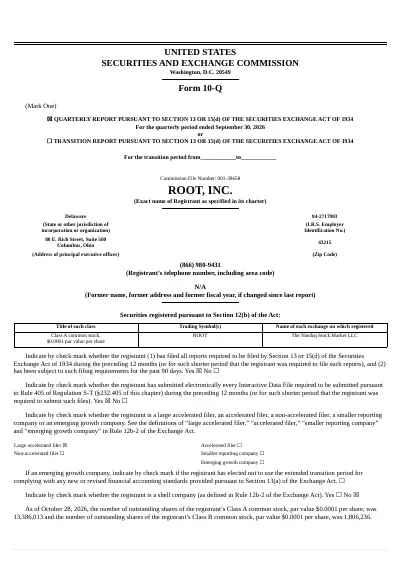
Good afternoon and thank you for joining us. Root is hosting this call to discuss its third quarter 2026 earnings results.
Participating on today's call are Alex Timm, Founder and Chief Executive Officer, and Megan Binkley, Chief Financial Officer. Earlier today, Root issued a shareholder letter announcing its financial results.
We will focus today on how we are executing against our model and the progress we are delivering across the business. After prepared remarks, we will address a few questions that we received from individual investors through our live retail investor Q&A.
While today's discussion will reflect the shareholder letter, for more complete information about our financial performance, we also encourage you to read our third quarter 2026 Form 10-Q, which was filed with the Securities and Exchange Commission today. Before we begin, I want to remind you that matters discussed on today's call will include forward-looking statements related to our operating performance, financial goals, and business outlook, which are based on management's current beliefs and assumptions.
Please note that these forward-looking statements reflect our opinions as of the date of this call, and we are not obligated to revise this information as a result of new developments that may occur. Forward-looking statements are subject to various risks, uncertainties, and other factors that could cause our actual results to differ materially from those expected and described today.
For a more detailed description of our risk factors, please review our most recent Form 10-K, 10-Q, and shareholder letter. A replay of this conference call will be available on our website under the Investor Relations section.
I would also like to remind you that during the call, we will discuss certain non-GAAP measures while talking about Root's performance. You can find reconciliations of these historical measures to the nearest comparable GAAP measures in our financial disclosures, all of which are posted on our website at ir.joinroot.com.
I will now turn the call over to Alex.
Alex Timm
Thanks, Matt. Good afternoon and thank you, everyone, for joining us.
Root delivered another strong, profitable quarter. Most importantly, we meaningfully progressed across virtually all elements of our strategy.
We expanded geographically, launched new partnerships, and developed what we believe to be our most predictive algorithm to date. We generated $381 million of revenue, $14 million of net income, and $34 million of adjusted EBITDA, producing approximately 18% annualized ROE.
Personal auto competition intensified during the quarter as large carriers increased marketing, lowered prices, and competed aggressively for growth. We remained disciplined in direct and deployed capital only where expected returns met our thresholds.
This is a core operating principle we believe is essential for compounding shareholder value. In the quarter, this meant intentionally trading off incremental policy growth in direct when expected returns fell below our threshold.
This discipline builds the financial strength to invest in products and capabilities that we believe will create durable long-term growth. Those investments are already driving how customers find and experience Root today.
New writings across our partnership channel grew 19% year-over-year and represented 52% of total new writings, up 44% from the prior year's period. Pricing is the main reason a customer chooses an insurance company, and we got markedly better at it in the quarter.
We completed development of our latest pricing algorithm and began deploying it in the fourth quarter. We expect it to deliver our largest improvement in predictive power to date.
This model helps us identify customers that deserve a better price. This is evidenced by significant rate decreases in Florida, Kentucky, South Carolina, and Ohio, all while remaining disciplined on returns.
On our quest to become national, we entered Wyoming after launching New Jersey in July, bringing Root to 38 states. A larger footprint expands our direct addressable market and is critical for scaling partnerships nationally.
On partnerships, we continued to expand our platform in the quarter. Carvana Insurance Built with Root, which makes insurance part of the vehicle purchase, renewed after selling well over 250,000 policies.
In addition, we launched the Hyundai Secure Plus Powered by Root pilot, which creates a powerful new way to make cars more affordable for drivers. Consumers have never liked shopping for car insurance, no matter how many billions of ad dollars are spent trying to convince them otherwise.
Over the last six months, AI technology has developed to a point where we're seeing signs that some customers are bypassing the traditional shopping experience altogether. AI agents are making it easier to compare prices and coverage, and even complete a purchase or cancel a policy.
That change plays directly to Root's strengths. Our API-based architecture lets us integrate quickly into digital shopping environments, while our pricing and underwriting systems use real-time data to evaluate customers against target returns, and we are already acquiring customers where price and speed win.
While agentic commerce remains early, as it scales, we believe the carriers with the strongest pricing and integration capabilities will be advantaged. That opportunity reflects a broader truth about Root: we are a technology company built to automate insurance end-to-end.
We own the integrated system across acquisition, pricing, underwriting, policy, servicing, and claims. Our vision is to turn this integrated architecture into a self-improving insurance system.
Pricing, claims, and distribution are part of the same learning loop. The system gets smarter with every quote, every policy, and every claim it observes.
We are innovating from a position of financial strength and laying the foundation for the next phase of expected profitable growth. We are building the pricing, products, and distribution that we believe can compound value over time, and we are already seeing the fruits of these labors.
With that, I will turn the call over to Megan.
Megan Binkley
Thanks, Alex. We delivered another profitable quarter while continuing to invest in the capabilities that support long-term growth.
Third quarter revenue was $381 million compared with $388 million in the prior year period. Gross written premium was $358 million, down 8% year-over-year, and gross earned premium was $356 million, down 5% year-over-year.
We ended the quarter with 484,000 policies in force, up 4% year-over-year and broadly stable with the second quarter. We continued to diversify our mix of business with new writings generated through our partnership and independent agent channel representing more than half of our new writings in the third quarter.
We're still early in scaling this channel, and we expect it to continue to increase as a percentage of our overall book over the long term. We delivered net income of $14 million in the quarter compared with a net loss of $5 million a year ago.
Adjusted EBITDA was $34 million, broadly consistent with the prior year. Our underwriting performance remained strong.
Net combined ratio improved 4.9 points year-over-year to 97.2%. Our gross accident period loss ratio was 61.1%, which is within our long-term target range of 60% to 65%.
We achieved these results while continuing to invest in pricing, technology, and diversified distribution. Our capital position remains strong.
Under our $75 million repurchase authorization, we have bought back $36 million of shares through the third quarter. Our approach to capital allocation remains unchanged.
We evaluate organic growth, technology and pricing investments, strategic distribution opportunities, and share repurchases against a long-term return framework. Looking ahead, we expect year-end 2026 policies in force to be broadly in line with the third quarter.
As we expect the current competitive environment to persist, we will continue to exercise discipline in deploying direct acquisition capital. We plan to invest approximately $5 million in marketing R&D initiatives as we test and expand into new acquisition channels.
We believe these investments are foundational to driving long-term growth and scale in the direct channel. In the fourth quarter, we anticipate the loss ratio will increase in line with typical seasonality driven by elevated animal collisions and bad weather.
We expect the impact of the seasonality to result in an accident period loss ratio toward the top end of our long-term loss ratio target of 60% to 65%. As we close out 2026, we remain focused on balancing disciplined underwriting, thoughtful capital allocation, and targeted investments.
While we can't control when the market shifts, we can control how prepared we are. We're doing this through innovation and a continued commitment to our strategy, which, as Alex shared, made meaningful progress this quarter.
With that, I'll turn it back over to Matt and Alex to answer a few investor questions before we open up the line for Q&A.
Matt LaMalva
Thanks, Megan. Alex, I want to close with a few questions we received from individual investors.
First, several investors asked about embedded insurance, recent programs, and the broader opportunity. What does it take to win in embedded?
Why do Root's technology, pricing, and integration capabilities position us to scale across partners and applications?
Alex Timm
Thanks. I think it's a great question.
First, I think what I'd like to hit on is why embedded is such a strong and great product for customers and partners. Customers, there isn't a customer that we've seen out there that says they enjoy shopping for car insurance, getting multiple quotes, going through screen by screen to do that.
Oftentimes when they purchase a vehicle, it's like batteries aren't included. You purchase the vehicle, you drive it home, and then now you've got to go through this cumbersome insurance process.
It's going to be expensive. You don't know what it means.
This product, however, and embedding that in the vehicle purchase, actually just creates a very seamless, easy customer experience. It's great for the customer.
They understand the total cost of ownership when they purchase the car. It's great for the partner because it's also a point of friction in their sales funnel, it's a win-win.
Importantly, it's not just a great product, but it works. We have meaningfully increased our attach rates in our embedded program, and we have meaningfully scaled that program to a sizable business.
How we've done that is really how we've won. Those capabilities include flexible and easy integrations, it's very easy for a partner's engineering team to quickly get set up through APIs and begin selling.
It can take a very, very short period of time to actually embed this versus having to put it on some long product roadmap. The second is, yeah, flexible pricing and underwriting applications so that you can actually use your partner's data to generate prices that are adequate and also have the same amount of predictive value as if you were to generate that data.
Then the third, and this is really interesting that we're continuing to build interesting products here, is customizing the product and creating a system that's highly customizable based on that partner's experience, that partner's data, so that they have their own unique bespoke product experience.
Matt LaMalva
Second, investors asked how AI is changing insurance, from pricing and claims to how customers shop. How is Root applying AI today?
How could agentic shopping change for the role of traditional bundling?
Alex Timm
First, I'd say, when we founded Root, the founding thesis was that insurance was really primed for disruption based on modern quantitative methods. That was 10 years ago.
We didn't plan on this massive sea shift and this unbelievable advancement of AI, but we did happen to be perfectly situated and positioned for it. We think that that's great.
In terms of where and how this is going to change the industry, of course, there's agentic commerce, which we believe is going to grow. It used to be that customers had to go and figure out, "Oh, should I shop for insurance in six months, every six months, every month?
When should I?" Now you can just shop for insurance every day.
You don't have to do anything. It can buy a policy for you.
It can cancel a policy for you. It can be very, very easy for customers.
Through our embedded platforms and API integrations, as well as through our really advanced pricing, we're perfectly situated for that. You can see that today on price comparison websites.
We take a much larger market share than we do everywhere else. Insofar as these agentic experiences take off, we stand to gain quite a bit, and it'll level the playing field on brand, which is great.
Also, we believe that there's something more fundamental here happening, which is the application of AI and predictive sciences to the very core of what we do as an industry and what we do as a business, which is pricing and claims. Pricing is fundamentally a prediction problem, and AI is fundamentally, especially the mathematics underneath it, a advancement in how do we predict in predictive sciences.
That's really where we are focused. We think that just makes our company and our product fundamentally better for customers.
Matt LaMalva
Lastly, investors asked whether Root's goal remains to build the largest and most profitable personal lines insurer. With growth muted in the current market, how do direct, embedded, and independent agents fit together in pursuing that ambition while maintaining target returns?
Alex Timm
One, absolutely. That's our goal, continues to be our goal, it's always been our goal.
It is unchanged. We had a very strong profitable quarter, and this goal is supported importantly by discipline: the ability to understand when to pull back and when to push in and to responsibly grow a business we think is required to achieve that goal because that is what creates a durable business and an enduring business over the long term.
Although you may see the market shift and we can't control that and we can't time that in certain elements of our business, in our direct channel, for example, what we can do and what we are doing is we can continue to innovate and set the framework and the foundation for growth that is really orthogonal to whatever the market happens to be doing. You saw us do that in this quarter, right?
We launched multiple states. We just launched our most predictive pricing algorithm we've ever launched that also had the most improvement in predictive power of a model over its predecessor.
Third, we launched new partners, and that, by the way, were also totally new customer experiences that did not exist before. You've continued to see us grow our independent agent footprint and continue to add new top-of-funnel direct marketing channels.
All of those things will pay off regardless of what happens in the environment. It's important that culturally, financially, we have the discipline to not chase growth for growth's sake because that's what builds an enduring business that allows us to innovate and continue to win towards that long-term goal.
Matt LaMalva
Thanks, Alex. Operator, please open the line for analyst questions.
Operator
Thank you. We will now be conducting a question-and-answer session.
We ask that you please limit yourself to one question and one follow-up. If you would like to ask a question, please press star one on your telephone keypad.
A confirmation tone will indicate your line is in the question queue. You may press star two if you would like to remove your question from the queue.
For participants using speaker equipment, it may be necessary to pick up your handset before pressing the star keys. One moment, please, while we poll for questions.
Our first question is from Tommy McJoynt with KBW. Please proceed with your question.
Tommy McJoynt
Hey, good evening, guys. Thanks for taking our questions.
There was a lot of commentary in those remarks on the current market conditions making growth somewhat difficult right now. Your return on equity was 18% this quarter, and I think around 25% over the last 12 months during a period in which the level of competition has been continuously intensifying.
To the extent that market conditions do stay competitive for an elongated period and that keeps a cap or a lid on your growth potential, and you're able to continue to generate strong ROEs, what do you think about your plans and priorities to do with that capital when we look at the ROE relative to the growth opportunity?
Alex Timm
Thanks, Tommy. First, what excites us the most is continuing to invest in the business and the technology that has been driving growth and that you saw us make so much progress on this quarter in our strategy.
We think that's the highest return of our capital. That's where we're continuing to invest.
You're seeing real results from that. We launched New Jersey in July.
It's actually our most successful state launch in terms of new writings per capita. We followed that with Wyoming, and we plan to follow that with more states in our quest to become national.
You saw us, again, expand our partnership platform, by the way, not just with new partners that are of significant size, but with brand new products. You saw us add more independent agents.
Regardless of what the market does in terms of how many billions of dollars of advertising spend happens in any given quarter, those are just fundamental advancements in the strategic position of the company that we believe long-term certainly offset whatever may be happening with advertising spend.
Tommy McJoynt
Got it. As you guys start to look out to 2027 and plan for budgets, is there anything you guys are thinking about communicating with us in terms of what you would target for, whether it be premium growth or policy growth or state expansion or ROEs, any sort of metrics on into next year that you guys are starting to think about?
Thanks.
Alex Timm
I think we're certainly targeting the continued expansion of the partner platform, and so you should expect that from us. You should also expect, and we've said this multiple times, that we are really targeting to be near national by the end of 2027.
We expect also to continue to roll out our pricing segmentation model, the newest model that we just launched actually early in Q4 through the first half of '27. We think that those will impact growth materially, be very favorable for us.
We don't predict what the market's going to do or what competitors are going to do, so that's one caveat to that as well. Megan, I'll pass it to you, though, for some 2027.
Megan Binkley
I think, at the risk of maybe repeating some of what we've said in our opening remarks and what you've heard from us over the last few quarters, I think we're incredibly proud of the progress that we've made, and we've continued to advance the strategy in 2026 against a rather difficult competitive backdrop. And 2026 really been a year of meaningful execution across the strategy.
We really intend to keep that momentum going in 2027. Like Alex said, we can't control the competitive environment, but we're certainly not standing still.
We've delivered over $75 million of net income on a year-to-date basis, and I think that really reflects both the strength of our underwriting and our ability to just dynamically manage the business. As we look to 2027, we do see several opportunities to continue broadening our reach through partnership, independent agent distribution, new states, and the continued rollout of our latest pricing and segmentation models.
We do expect that some of the larger states that we plan to enter in 2027 will come towards the end of 2027, which, of course, is subject to regulatory approval. Our focus is definitely on expanding into new markets, new channels, and then continuing to expand the states and the channels that we're in today.
We're expecting increasing contribution of our growth initiatives next year as the year progresses.
Tommy McJoynt
Thank you.
Operator
Our next question is from Andrew Andersen with Jefferies. Please proceed with your question.
Andrew Andersen
Hey, good afternoon. You had mentioned just AI agents and potentially insurance kind of shopping every day here.
Why doesn't that ultimately become a retention headwind for the industry? As you think about Root specifically, what gives you confidence that lower shopping friction kind of benefits customer acquisition more than it would impact persistency?
Alex Timm
I think that you very well may see churn go up quickly, but then you have to look at, well, who's most dependent on churn staying low? There's massive customer segments that shop through exclusive agents or otherwise that are bundle customers, and carriers are reliant on it being very difficult to switch and selling many policies.
If that goes away, that's certainly not Root's position. If that goes away, those folks actually become shoppers up for grabs.
Then you think about where we've actually been positioned, and most of our customers on the direct channel have actually been from vertical search or price comparison websites, where we already have a high-churn base in some of those customer segments. We've grown up with that customer segment, and we're very good at pricing that customer segment.
We've also invested very heavily in our LTV analytics to understand when dynamics change. You saw that when the loss trend changed last time.
We were able to almost double the size of our direct business at one point over a 12-month period because we caught trends earlier than anyone else in the industry. Insofar as it happens again here, we are certainly well-positioned to take meaningful share.
We would love it if the price comparison-type websites grew meaningfully because our market share in those is so much larger than our market share everywhere else. We also don't have a large brand presence where we just get a bunch of traffic directly to our website that subsidizes paid channels.
If that playing field is leveled, that's a massive change in the industry, and it's very, very good for us.
Andrew Andersen
Thanks. On the new pricing model, I think you called this the largest improvement in predictive power you've achieved to date.
From the outside, how should we think about where that benefit shows up? Is it better conversion, broader appetite, better loss ratios?
What's the way to think about that improvement in the pricing model?
Alex Timm
For our pricing models, when we iterate on our pricing models and we're at roughly our target loss ratios, which we are today, we've got a fairly benign indication and it's roughly rate-adequate everywhere, then segmentation actually goes to growing the business faster. Where you should expect to see that is really slightly lower average premiums, usually with segmentation improvements, but it's not going to be material, maybe a couple of points, and also meaningfully increasing conversion, and so making the product much more competitive, and that's really big.
The other thing I'd note is that this particular improvement, as we've now launched an independent agents and had more of our exposure data actually observing independent agents, as well as we've consistently been getting more and more competitive with a preferred customer segment, we're seeing meaningful rate decreases in those segments from this model. We also believe it will mix-shift us more towards a preferred customer segment.
You may also see that then show up in our retention numbers strictly as a matter of mix shift. Also broadly, as we get more competitive, you see retention improve because it's less likely someone will find a better price elsewhere.
Andrew Andersen
Thank you.
Operator
Our next question is from Elyse Greenspan with Wells Fargo. Please proceed with your question.
Elyse Greenspan
Hi, thanks. Good evening.
I know you guys, right, guided to just how to think about PIF trending for the rest of the year, but when we think about beyond, I guess, the fourth quarter into '27, just how are you thinking of the underlying policy growth environment trending in '27?
Alex Timm
I think, as we think about longer term, we have many meaningful levers to continue to grow the business. State expansion is a big one.
We're in, I think just north of 80% or so of the US population, so as we go national, that's a natural growth driver in the business. It's almost a mechanical growth driver in the business.
We still are in a minority of independent agents, and so we're adding new agents to our platform every single week. We're seeing that increasingly grow our business.
We're very excited about some of the new products we launched, particularly on our embedded platform this quarter. We think that those can be meaningful as well.
We think that, again, as we've improved pricing, that's going to be a tailwind for growth. We think we have a really strong growth strategy that will certainly execute over the long term.
That being said, again, we cannot predict what's going to happen to the competitive environment next year. Usually these things reset a little bit from a year-to-year basis, but we can't predict that, and so we will be managing the company prudently and appropriately according to that, particularly in our direct channel.
Elyse Greenspan
Thanks. Then my second question is, I know you guys alluded to, right, just loss trends seasonally being higher in the fourth quarter.
Can you just give us a sense just how you guys are seeing severity as well as frequency trending, and just anything away from just normal seasonality as you're thinking about just underlying loss trend within the business?
Alex Timm
I'd say it's really, I would say, more of the same. I think our frequency and severity trends are fairly benign, they're low.
It's nothing outside of the bounds of statistical noise when we look at how it's changed quarter-over-quarter. I'd say our current trend is fairly benign outside of seasonal pressures that you may see in Q4.
Megan Binkley
Then, Elyse, on the Q4 loss ratio, as you've seen historically, the loss ratio in Q4 is typically the highest for us from an annual basis perspective, and that's generally driven by increased animal collisions, bad weather in the November and December months. You can expect the loss ratio will be closer to the high end of our long-term target range.
Elyse Greenspan
Thank you.
Operator
We have reached the end of the question-and-answer session. This concludes today's teleconference.
You may disconnect your lines at this time. Thank you for your participation.