Royalty Pharma plc
Q3 FY2026 · Earnings Call TranscriptNovember 4, 2026
Operator
Ladies and gentlemen, thank you for standing by. Welcome to the Royalty Pharma third quarter 2026 earnings conference call.
I would now like to turn the call over to George Grofik, Senior Vice President, Head of Investor Relations and Communications. Please go ahead, sir.
George Grofik
Good morning and good afternoon to everyone on the call. Thank you for joining us to review Royalty Pharma's third quarter results.
You can find the press release with our earnings results and slides to this call on the Investors page of our website at royaltypharma.com. On slide 2, I'd like to remind you that information presented in this call contains forward-looking statements that involve known and unknown risks, uncertainties, and other factors that may cause actual results to differ materially from these statements.
We refer you to our most recent 10-K on file with the SEC for a description of these risks. All forward-looking statements are based on information currently available to Royalty Pharma, and we assume no obligation to update any such forward-looking statements.
Non-GAAP liquidity measures will be used to help you understand our financial results, and the reconciliation of these measures to our GAAP financials is provided in the earnings press release available on our website. With that, please advance to slide 3.
Our speakers on the call today are Pablo Legorreta, Chief Executive Officer and Chairman of the Board; Marshall Urist, EVP, Head of Research and Investments; and Terry Coyne, EVP, Chief Financial Officer. Pablo will discuss the key highlights, after which Marshall will provide a portfolio update and Terry will review the financials.
Following concluding remarks from Pablo, we will hold a Q&A session when we'll be joined by Chris Hite, Vice Chairman, Partnering and Investments. With that, I'd like to turn the call over to Pablo.
Pablo Legorreta
Thank you, George, and welcome to everyone on the call. It gives me great pleasure to report another strong quarter in 2026 as we execute towards our goal to be the premier capital allocator in life sciences with consistent, compounding growth.
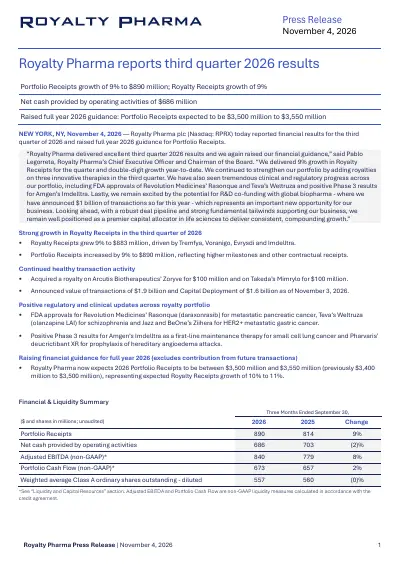
Slide 5 summarizes our strong business momentum in the third quarter. Starting with the financials, we delivered 9% growth in portfolio receipts, our top line, and also in royalty receipts, which are our recurring cash flows.
On a year-to-date basis, royalty receipts have grown by 12%, reflecting the strength of our diversified portfolio of high-quality royalties. We also maintained attractive returns in our business with return on invested capital of 14.3% and return on invested equity of 20.2%.
By combining strong growth and superior returns, we're confident we have a clear path to drive shareholder value creation. Turning to capital allocation, we have deployed $1.6 billion of capital so far this year with an announced value of $1.9 billion.
Most recently, we acquired a royalty on Arcutis' Zoryve, an approved therapy for immune diseases of the skin. We also acquired a royalty on Takeda's mivobrevart, a potential blockbuster therapy for rare blood disorders, polycythemia vera.
As we look ahead, our deal pipeline remains robust, supported by continued, powerful fundamental tailwinds. Under our value-driven capital allocation framework, we also returned close to $590 million to shareholders in dividends and share repurchases in the first nine months of the year.
Moving to our portfolio, we're excited to see a number of positive clinical and regulatory updates, which we expect to support our growth over the medium to long term. Our partner Revolution Medicines received FDA approval and a positive regulatory opinion in Europe for rasoconquek in pancreatic cancer.
Teva also received FDA approval for its schizophrenia therapy, Uzedy. While we were, of course, disappointed by the Phase 3 results for Novartis' pelacarsen, the overwhelming weight of news across our portfolio was positive, with successful Phase 3 results for Amgen's Imdelltra in first-line small cell lung cancer and Pharvaris' deucrictibant XR in hereditary angioedema.
We also structured the pelacarsen investment in a protective way where we will still make our money back plus a small return. As Marshall will explain later, our track record of success in development-stage investing remains outstanding.
Looking ahead, we're increasing our 2026 full-year guidance for the third consecutive quarter based on the excellent business momentum I just highlighted. Slide 6 is a slide we show every quarter.
It demonstrates our consistent double-digit growth on average since our IPO. We have delivered this impressive record year in, year out, regardless of the market backdrop.
This reflects the quality of our asset selection and our unique business model. It's a track record that I believe very few companies in the healthcare space can match.
With that, I will hand it over to Marshall.
Marshall Urist
Thanks, Pablo. I want to focus today on our recent royalty deals for mivobrevart and Zoryve and to give a broader update on our development-stage portfolio.
Beginning on slide 8, we recently acquired Zealand Pharma's royalty interest in Takeda's mivobrevart for a total of $100 million. In return, Royalty Pharma is entitled to receive a 1% royalty on annual worldwide sales of up to $1.5 billion, tiering down to 0.75% above this sales threshold.
We are also eligible to receive up to $23 million in milestones. Mivobrevart is an exciting first-in-class therapy for polycythemia vera, or PV, a rare chronic blood disorder.
In PV, there is excessive red blood cell production, which thickens the blood, resulting in increased risk of clotting and major cardiovascular events. There's a high unmet need for new treatment options, as many patients are still reliant on frequent phlebotomy, or blood draws.
Mivobrevart reduces the excessive red blood cell production, and in Phase 3, it demonstrated significant clinical benefit across a range of parameters, including phlebotomy burden and fatigue. Based on the compelling results, the FDA approved mivobrevart in August 2026.
Takeda has provided peak annual sales for mivobrevart of between $1 and $2 billion, and we see clear blockbuster potential. Polycythemia vera is a potentially large market, with a prevalence of around 155,000 patients in the US alone.
Based on this, we would expect to generate an unlevered IRR in the low double-digit percentage range, consistent with our target for approved products. Moving to slide 9, in our latest transaction, in September, we agreed to pay AstraZeneca $100 million upfront for a 3% royalty on worldwide sales of Zoryve.
This is an approved, once-daily topical, which is marketed by Arcutis Biotherapeutics for three skin disorders: plaque psoriasis, seborrheic dermatitis, and atopic dermatitis. Zoryve offers an effective and safer alternative to widely used topical steroids.
This represents a significant commercial opportunity for Zoryve based on growing physician recognition of the local and long-term side effects of chronic steroid use. The scale of this opportunity is underscored by the modest penetration to date of branded non-steroidal topicals, which only represent 7% of the market.
Arcutis' commercial execution has been impressive, and their message is resonating with physicians. Zoryve is expected to grow by more than 40% in 2026 to over half a billion dollars, and we see clear blockbuster potential.
Consensus currently predicts Zoryve sales will reach $1.6 billion in the early part of the next decade, while Arcutis has supplied a peak sales estimate of $2.3 to $3 billion across Zoryve's current indications. We expect the transaction to generate an unlevered IRR consistent with our target range for approved products.
I want to move on now to our development-stage pipeline. Slide 10 shows our scorecard for 2026 for key clinical and regulatory events.
As Pablo noted, while the outcomes trial for pelacarsen was not successful, the transaction to acquire this royalty was structured in a protective manner. As a reminder, our $500 million funding agreement with Ionis included stable and predictable royalties in Spinraza, with upside from the pelacarsen royalty.
Based on the pelacarsen results, our royalty interest in Spinraza will revert to Ionis after we receive royalty payments of $550 million, or a 1.1x return on the total amount funded. Overall, we remain pleased with the progress of our development-stage portfolio in its entirety.
Far in 2026, we are proud to have five successful pivotal Phase 3 trials from our development-stage therapies and nine positive regulatory events, including six FDA approvals and three FDA filings. Our overall track record for development-stage investing continues to be well ahead of industry averages, with a success rate of approximately 90%.
Importantly, many of the therapies shown on this slide have the potential to be truly transformative for patients, as well as highly commercially successful. Revolution Medicines' RMC-6236 for pancreatic cancer and Cytokinetics' aficamten for non-obstructive hypertrophic cardiomyopathy are the two most obvious examples.
The year is not over yet, with the upcoming FDA regulatory decision expected later this year on GSK's linerixibat for non-small cell lung cancer and Phase 3 results expected for Biogen's litifilimab in systemic lupus. Consequently, we feel really good about both the progress of our development-stage pipeline this year, as well as the potential of the therapies we added this year to be very significant royalty contributors over the long term.
Slide 11 details our development-stage pipeline by year of potential launch. Here's a list of a dozen potential blockbuster launches over the coming years that can power our growth through 2030 and beyond.
Importantly, all are either first-in-class or best-in-class, and all have been through our rigorous diligence process. As a result, we expect a significant proportion to reach the market successfully and deliver transformative benefits to patients.
To wrap up, we're extremely excited about our pipeline that in aggregate has the potential to add peak royalties of more than $1.7 billion to our top line in the future, and we expect to continue to add new and exciting therapies to our development-stage pipeline in the years to come. With that, let me hand it over to Terry.
Terry Coyne
Thanks, Marshall. Let's move to slide 13.
This slide shows how our efficient business model generates substantial cash flow to be reinvested. Royalty receipts grew by 9% in the third quarter, reflecting the strength of our diversified portfolio.
As Pablo noted earlier, this takes our growth in the first nine months to 12%. Milestones and other contractual receipts, which are more variable, were relatively modest in the quarter, but increased year-over-year.
Taken together, portfolio receipts, our top line, grew 9% in the quarter to $890 million. As we move down the column, operating and professional costs equated to 5.6% of portfolio receipts in the third quarter.
This line continues to demonstrate the benefit of the cash savings we are delivering from the internalisation transaction, which we completed in May of 2025. Net interest paid was $167 million in the quarter.
This reflects the semi-annual timing of our interest payment schedule, with payments primarily in the first and third quarters, together with the interest we receive from the cash on our balance sheet. Moving further down the column, we have consistently stated that when we think of the cash generated by the business to then be redeployed into value-enhancing royalties, we look to portfolio cash flow, which is adjusted EBITDA less net interest paid.
This amounted to $673 million for the quarter. Our margin of around 76% in the quarter and 82% year-to-date underscores the high underlying level of cash conversion and efficiency in the business.
Capital deployment in the quarter of $362 million mainly reflected R&D funding for JNJ-4804 and upfront payments for clazakizumab, Zoryve, and mivobrevart. Lastly, our weighted average share count declined by approximately 3 million shares in the quarter versus the prior-year period, reflecting the impact of our share buyback program.
Slide 14 provides more detail on the evolution of our top line year-to-date. Royalty receipts, which we consider our recurring cash inflows, grew by 12%.
Key drivers were the strong performances of Tremfya, Voranigo, Evrysdi, and Imdelltra. Importantly, we have been able to absorb significant declines from Promacta and Imbruvica, amounting to an approximately 5% combined headwind, and still delivered double-digit growth in royalty receipts.
Moving to portfolio receipts, these grew by 9% in the first nine months, reflecting lower milestones and other contractual receipts, which is consistent with our full-year 2026 guidance. Slide 15 updates our portfolio return metrics for the quarter.
Return on invested capital was 14.3% for the last 12 months ending in the third quarter of 2026, and return on invested equity, which shows the impact of conservative leverage on our equity returns, was 20.2% for the last 12 months. This is the fifth straight quarter we've reported these metrics, and their remarkable stability demonstrates that we are continuing to invest at attractive returns that will drive long-term value for our shareholders.
Slide 16 shows that we continue to maintain the financial flexibility to execute our strategy and return capital to shareholders. At the end of September 2026, we had cash and equivalents of $514 million.
In terms of borrowings, we have investment-grade debt outstanding of $8.8 billion with a weighted average duration of around 12 years. Our leverage now stands at 2.7 times total debt to adjusted EBITDA, or 2.5 times on a net basis.
We also have access to our $1.8 billion revolver, which was undrawn as of the end of the third quarter. All considered, we have access to approximately $4.8 billion of financial flexibility through cash on our balance sheet, the cash our business generates, and access to the debt markets.
Turning to our capital allocation framework, we deployed just over $1.2 billion of capital on attractive royalty deals in the first nine months of 2026. At the same time, we returned approximately $590 million to our shareholders through share repurchases of over $180 million and our growing dividend.
In total, we have returned about 28% of our portfolio cash flow this year to shareholders. On slide 17, we are again raising our full-year 2026 financial guidance.
We now expect portfolio receipts to be in the range of $3.5 billion to $3.55 billion, up from $3.4 billion to $3.5 billion previously. This assumes growth in royalty receipts of around 10% to 11%, compared with 7% to 10% previously, which reflects the strong underlying momentum of our diversified portfolio.
It also reflects an expected decrease in milestones and other contractual receipts from $128 million in 2025 to approximately $65 million in 2026. Importantly, and consistent with our standard practice, this guidance is based on our portfolio as of today and does not take into account the benefit of any future royalty acquisitions.
Turning to expenses, payments for operating and professional costs are expected to be in the range of 5.5% to 6% of portfolio receipts in 2026, reflecting cost savings from the internalisation of the manager. We continue to expect interest paid to be around $350 million to $360 million in 2026.
Based on our semi-annual payment cycle, we anticipate interest paid to be a de minimis amount in Q4. This guidance reflects repayment of the $380 million term loan in July, but does not take into account interest received on our cash balance, which was $18 million in the first nine months.
To close, we've had an excellent first nine months. We've raised our guidance for the third consecutive quarter, and we expect to deliver another full year of strong financial performance in 2026.
With that, I would like to hand the call back to Pablo.
Pablo Legorreta
Thanks, Terry. To conclude, I'm very pleased with our continued execution against our strategy in the first nine months of 2026.
We have consistently delivered strong growth and returns. We've again deployed significant capital on exciting new biopharma royalties.
We've tirelessly innovated to open up major new opportunities, such as pharma R&D co-funding. Last, but not least, we have enhanced our leadership team and capabilities to ensure we remain at the forefront of our highly attractive industry.
On slide 19, I also wanted to draw your attention to something we're very proud of that we don't often highlight. As a leading funder of innovation, we recognize the importance of integrating sustainability-related principles into our strategies and investments.
We were therefore delighted to have recently been awarded a AAA ESG rating by MSCI, indicating that we are an industry leader in managing the most significant sustainability risks and opportunities. This adds to our already strong ESG ratings from ISS.
For Royalty Pharma and our investors, we believe this is important as it supports our belief that we're conducting our business in the right way, based on the core pillars of strong corporate governance, talent management, and a business model that is aligned with patients' needs. I want to close on slide 20 with a recap on why we believe we're well positioned to drive continued strong value creation.
First, we're the long-standing leader in the rapidly expanding biopharma royalty market with powerful, fundamental tailwinds, reflecting the huge demand for funding life sciences innovation. Second, we have a best-in-class platform for investing in the most transformative and innovative products marketed by premier biopharma companies.
By expanding our global platform and capabilities, we expect to remain the undisputed leader in our industry. Third, we expect to deliver strong, low-volatility top- and bottom-line growth through 2030 and beyond.
Lastly, we have an incredible track record of delivering consistent and attractive returns, including an IRR and return on invested capital in the mid-teens and return on invested equity in the 20%-plus range. I have never been more excited about our future and the opportunities ahead.
With that, we would be happy to take your questions.
George Grofik
We will now open up the call to your questions. Operator, please take the first question.
Operator
Thank you. As a reminder, to ask a question, you will need to press *11 on your telephone and wait for your name to be announced.
To withdraw your question, please press *11 again. Please stand by while we compile the Q&A roster.
Our first question comes from the line of Asad Haider with Goldman Sachs. Your line is now open.
Asad Haider
Great. Terrific.
Thanks for taking the questions, and congrats on the continued strong execution, guys. Really great to see.
A couple on pipeline economics. First, on Amgen's Imdelltra, just in the context of the strong data in first-line small cell lung cancer seen at ESMO, which is really a standout.
Just maybe talk about how this shifts your view of the overall opportunity versus what was reflected when you did the deal with them. Then, second, in the context of the pelacarsen failure where you took a $150 million non-cash impairment charge, can you just provide any context on economics on Amgen's olpasiran and the impact of royalty if that trial also fails?
Thank you.
Pablo Legorreta
Sure. Marshall, that's a question for you.
Marshall Urist
Sure. Hi, Asad.
Good morning, and thanks for the question on Imdelltra. Thanks for pointing out the recent positive first-line small cell lung cancer maintenance data.
It was spectacular and is a real advance for patients. We are certainly excited to have it in our portfolio.
It is a significant expansion in the marketplace. I would say, when we make these investments, we always think about a lot of scenarios and have to think through how the product could evolve in the future with major label expansions like this.
The data was ahead of our expectations, and so we are really excited about what this means, obviously, for patients, and then also for the downstream commercial benefits of that and the royalties to us. Certainly, a really nice royalty that we have.
I think just taking a step back, it's a good example of our team's ability to identify really exciting therapies wherever those opportunities lie. This time, we were really happy to work with BeiGene to acquire this royalty.
Really, I think a great product and a great example of how we build our portfolio. Your second question was on olpasiran.
We're a few days away from seeing all the detailed data, I think at AHA this weekend. Let's see what comes out of that.
In the future, what it might mean for olpasiran and this class going forward, and then we can have a more informed discussion about specifically what it means for us and our remaining investment in olpasiran.
Pablo Legorreta
I think you also asking about the economics, and I think what's interesting for us there is that the royalty on Amgen's drug is bigger, and we made a bigger investment, potentially if it works, we could end up having a really positive driver of growth and cash flow.
George Grofik
Thanks. Operator, next question, please.
Operator
Great. Thank you.
Our next question comes from the line of Chris Schott with JPMorgan. Your line is now open.
Chris Schott
Great. Thanks so much for the question.
I had two here. Maybe first on just competition within therapeutic areas.
It seems like the window between when we see a therapeutic breakthrough and when competition arrives continues to shrink, and I think that seems particularly true with the rise of the Chinese biotech industry. I guess, do you agree with that view, and how does that impact your approach towards deals?
Does that lead you to focus on areas with less competition? Is it multiple deals per therapeutic area?
Are some of these fast followers in some cases better companies to bet on? Just any perspective there would be great.
Then the second questions, you called out the pharma co-funding deals. You've had a billion dollars year-to-date.
I guess just with rising R&D budgets across the large cap space and a patent cycle approaching, just can you help frame out how meaningful an opportunity this could be for Royalty as we think through the direction some of these large biopharma companies are going with their R&D budgets? Thanks so much.
Pablo Legorreta
Thanks for the question. I think Marshall will take the first one and Chris the second one.
Marshall Urist
Hi, Chris. Good morning, and great question.
Specifically in terms of how we think about competition in therapeutic areas, and it is something that we think a lot about, and certainly the dynamic of China as a new source of products definitely puts a finer point on it. There isn't one answer, as you alluded to.
We definitely still think about how do we prioritize a lot of different factors, which is, we've always said, being first can be a major competitive advantage; who is our partner; whose hands is it in, and do we believe in their ability to execute. Then, also, we have the unique ability, as you pointed out, to make multiple investments in the same therapeutic area.
We don't see it as a zero-sum game that we have to choose one, and I think it's a very unique aspect of our business. If anything, as we've talked about, the increase in new programs has two tailwinds for our business.
We don't just see it as competition, it's an opportunity for us. I think, number one, it gives us more opportunities to support companies, and it will, certainly from the China perspective, as we talked about, will create more licenses, and that means more royalties, and a lot of those royalties are in the hands of some of the biggest, most capable companies in the world.
As we've talked about in the past, we've expanded our team to make sure that we have the team on the ground in Asia to maximize those opportunities, and that team is off to a great start.
Chris Hite
On your second question, Chris, thanks for the question around R&D co-funding. We see this as a tremendous growth opportunity for us.
As you've seen, this year alone, we announced $1 billion of R&D co-funding deals: $500 million with J&J and $500 million with Teva. Those conversations and opportunities continue to accelerate in our deal funnel.
It's obvious the reasons why. The amount of R&D spend happening at pharma over the next five years is expected to exceed a trillion dollars.
The capital need is there. The accounting framework is there, especially under US GAAP, and we've seen some companies take advantage outside of the United States under IFRS as well, so that's a positive tailwind for us.
As the companies see the deals announced, it's opening up even more opportunities because they're seeing their competitors use R&D co-funding to expand their pipelines and accelerate their pipelines, and so they themselves would like to do it as well. It's a confluence of tailwinds really pushing that opportunity forward, and we're just super excited about it.
Operator
Thank you. One moment for our next question.
The next question comes from the line of Mike Nedelcovych with TD Cowen. Please go ahead.
Your line is open.
Mike Nedelcovych
Hi, thanks for the questions. I have two questions and a follow-up.
My follow-up is on olpasiran. As you noted, we're going to get the Phase 3 Ocean(a) data this weekend.
I'm curious, Marshall, what specifically will you be looking for in the presentation to help you understand whether olpasiran still has potential? That's one.
My other question relates to RMC-6236. Revolution Medicines declined to take tranche 3 of funding from Royalty Pharma, it seems like a reasonable base case to assume the royalty rate will stay where it is now.
I'm curious to what extent that's a swing factor relative to your $4.7 billion top line target in 2030, if at all. Then my last question relates to capital deployment.
It looks like you're on track to deploy less capital this year relative to each of the last couple years. Correct me if I'm wrong on that.
I know that annual fluctuations are to be expected, but I'm wondering if there is any specific reason for this, or if maybe we should look for a rebound in the near future. Thanks.
Pablo Legorreta
Thanks for the question. Marshall will take the first one, and then Terry will take the second one.
Marshall Urist
Yes, thanks, Mike, and and good morning. We are looking forward to seeing the pelacarsen Horizon data this weekend and to understand, really our first glimpse at at understanding this target.
I think there's going to be a lot of questions that that that that we're looking that we are looking to looking to understand better is, most basically, baseline baseline factors, like baseline Lp(a) or baseline LDL, how how much did that impact it? How did Was there any evidence that pelacarsen itself played played any role?
Then, are there are there are there other other subgroups in there to to to really understand and give us a sense of get give us a sense of who may or may not benefit from this target? I think there's going to be a lot of detail, a lot of discussion this weekend, and we're certainly and we're certainly looking forward to looking forward to learning more.
Then,
Terry Coyne
Mike, on your second and third questions, on RMC-6236, no impacts on 2030. We're still very confident in that meeting or exceeding that guidance, feel really good there.
Then on your question on capital deployment, I think, first of all, we're at $1.6 billion through today, versus historical years, maybe it's a little bit lower, but it's kind of in the range. I think we all feel internally like we're extremely busy, and we can't always predict the timing of when transactions are going to close.
That's why we've said, since dating back to the IPO, that the capital deployment was going to be kind of uneven from a year-to-year basis, and you really needed to look at it on a multi-year basis. We feel like there are a lot of great tailwinds.
There's still a couple months left in the year as well, so, we'll see how things shake out for the end of the year. We're very busy.
The pipeline's really strong. We feel like we're getting a lot of momentum in sort of the core areas we're focused on, synthetic royalties, pharma R&D co-funding, and feel like over the long term, we're going to be very comfortable with the guidance that we've given, and then see a clear path to doing well ahead of that, around $2.5 billion per year.
Feel really good about it, and stay tuned.
Mike Nedelcovych
Thank you.
Operator
Thank you. One moment for our next question.
The next question comes from the line of Geoff Meacham with Citi. Your line is now open.
Geoff Meacham
Morning, guys. Thanks for the question.
Just have a couple. The first is on deal structuring.
On deals where you have a novel mechanism or a disruptive class, like, let's say the Lp(a) category, going forward, are you guys biased to more contingent considerations or have some protection to preserve your returns, maybe as a boilerplate type of structure? Then the second one is that when you look at some of the categories, you guys have done some great deals the past few years, but there are still some big categories across pharma that are high-growth or high-opportunity, like GLP-1s or neuro, for example.
Is there still an interest in looking at opportunities like that? Maybe it's more competitive, but co-funding would be one solution for that.
I just want to get your perspective on some of the bigger opportunities, and maybe do you guys have FOMO looking at some of those when you look at the range of deals? Thanks.
Pablo Legorreta
Thanks for the question. I'll take the first one on structuring, and then Marshall can take the second one.
Regarding structuring, I think what we've done for three decades is been very open-minded about everything, and the approach we take when we meet with companies is that we want to understand their needs, their constraints, and understand the asset really well. What I tell the team often is, we need to approach everything with a sort of open mind and sort of blank piece of paper.
Obviously, the experience and structures we've used in the past are helpful, but it's better to approach things in a fresh way because each asset is different, each opportunity is different, the companies. We're very open-minded.
What I would tell you is that, when we're looking at investments and deploying capital, we tend to favor transactions that are driven more by royalties versus things like milestone payments because, obviously, that is what drives more long-term value creation. That's an important thing for us.
In terms of downside protection, yes, often interesting, useful, but we actually are really focused on understanding the risk-reward profile really well, and because downside protection, it's not a good way of thinking about a business when you're deploying capital. It's more, we get that kind of protection by diversifying, right, and having great assets in the portfolio.
I'll stop there and let Marshall take the second question.
Marshall Urist
Yeah. Hi, Geoff.
Thanks for the question. I think our core approach hasn't changed.
We are absolutely open to every therapeutic area, every modality, and it's really about what it has always been over those same three decades, which is identifying great products in the hands of great partners and structuring a win-win transaction, and we show a lot of discipline. We don't really think of it as FOMO, it's more a matter of when we find the right thing in a given therapeutic area, we will go after it aggressively, and I think our track record proves out our ability to do that.
We are, though, focused on expanding the number of ways that we can work with partners so that we are the best-positioned player in our industry. That's why, as you mentioned, R&D co-funding and that growth broadens the aperture of the number of companies and products that we can work with.
We mentioned China as another way that we continue to make sure that our platform and our team is positioned to work with as broad a spectrum of companies and partners and products and therapeutic areas as possible. We again have a very full and active pipeline that's highly diverse across many therapeutic areas, and that underscores the optimism that Terry just talked about.
Great.
Geoff Meacham
Thanks, guys.
Operator
Thank you. One moment for our next question.
The next question comes from the line of Terence Flynn with Morgan Stanley. Your line is now open.
Terence Flynn
Great. Thanks for taking the questions.
I guess, first, on litifilimab, we're expecting some upcoming Phase 3 data in SLE this year and then CLE next year. I know Biogen has talked about lupus being an $8 billion commercial opportunity.
I saw you had highlighted some of the sales potential on your slides, but maybe, Marshall, you could just talk through how you guys are thinking about the commercial opportunity both in SLE and CLE. Then the second question is just on China.
I know you guys have people on the ground now over there, just any update in terms of how that ramp is going and when we might expect to see some capital deployment on the China side. Thank you.
Pablo Legorreta
Sure. Marshall, why don't you take the litifilimab question, and then maybe Chris can take the China question.
Marshall Urist
Hi, Terence. Good morning, and thanks for the question on litifilimab.
We are getting excited to see the Biogen SLE data coming up. Just as a reminder for everyone, we did a $250 million R&D co-funding agreement with Biogen to fund the Phase 3 trials for litifilimab in two indications, SLE and CLE.
I think we are excited about both of them, and, this the this deal was structured in in a way that makes a lot of sense for our shareholders. I think if either one of them proves to be successful, this is going to be a great investment, and if both are successful, it will be it will be even better.
Our view on lupus has been that, this is a area of significant unmet need, and there are there's a need for for for new products. I think, one of the things we've seen in other spaces in, in autoimmune and I&I more broadly is that the categories grow, and the market grows significantly as you have more products and more companies and doctors and patients have options.
I think what Biogen is doing here, they have a great program, they've executed really nicely against litifilimab, and I think having another product here is going to, is is going to grow the market, and then also, interestingly, starting to subset the market with with CLE and being able to really focus and offer and offer a new option for for for those patients as well. We think this can we think this can be a a big product, and excited to see the data, and it'll be a nice addition to our portfolio and a great example of how R&D co-funding, allows us to allows us to access a a broader spectrum of products.
Chris Hite
On your second question, Terence, on China, thanks for the question. It's obviously a very exciting and strong strategic longer-term market opportunity for us.
You've seen the rapid and large and growing out-licensing that has occurred out of China into Western multinationals. I think in 2020, there was only around two out-licensing deals and therefore royalties created versus over 50 last year.
The growth is exponential. We feel we've already deployed capital last year when we bought BeiGene's royalty on Amgen's Imdelltra for over $900 million.
That certainly caught the attention of a lot of the Chinese pharmaceutical companies when they saw that. That was a great example of how we can work and deploy capital in China.
We obviously hired Ken Sun, who ran Morgan Stanley's healthcare Asian business. He's on the ground and up and running.
We've spent a lot of time in-country with him, and continue to develop those relationships. As those out-licensing deals mature, we're obviously tracking all of those products and programs that were out-licensed to Western multinational companies.
As they mature through the pipelines at the big pharma companies that in-licensed those programs, that's where we can strike and really hope to obtain those royalty streams from the Chinese companies. It's a really exciting opportunity for us.
We're excited to hire Ken, and we're excited to see what the future holds on acquiring those royalties.
Operator
Thank you. One moment for our next question.
Our next question comes from the line of Ash Verma with UBS. Go ahead.
Your line is open.
Ash Verma
Hi. Thanks for taking my question.
Maybe just I wanted to understand your thought process and pursuing royalty transactions with private companies. Obviously, most of the deals have been with the public, but a few you've done with private.
Is that something that could become a bigger piece of the pie, and what potentially is holding it back? Then, secondly, a lot of focus on AI in general and everything, but I guess one question that I had was around how are you using AI in your day-to-day investment process?
Either to process the ideas at a much faster pace, or any other way, like getting up to speed on the opportunities or driving the partnership discussions? Thanks.
Pablo Legorreta
Ash, thanks for the question. I'll take a first crack at it, but then maybe Marshall can get in some of the specifics of AI and in the investment process.
Regarding private companies, there's absolutely no restriction or issue. Our business model is totally open-ended, and we can do transactions with private companies, public companies.
I think there are interesting opportunities for us in the case of private companies to actually be there and provide capital because, for some of these private companies, funding is more complicated, right? They don't have access to the capital markets where sometimes capital is more readily available at bigger scale, lower cost.
We can in those cases be incredibly effective and add a lot of value to those companies. Also, we have situations where in M&A, where these private companies can be acquired by bigger companies, and we can come in and help fund the pipeline so that it's not dilutive to the bigger companies.
We have done transactions with private companies over and over again, and that really shows how the reach of our business. Two of them are actually what we did with Servier and with Voranigo, obviously the transaction we acquired from a public company, but then also Ferring.
We have a track record doing things with these companies. AI is something that is really important for us.
As we hired a great person that is leading our efforts there, Lucas Glass, that was the head of AI for IQVIA. I can tell you that in the six months since he has joined us here, he's starting to have a real impact in how we approach things, and the depth and breadth of our analytical capabilities.
Marshall, why don't you maybe take that question also?
Marshall Urist
Absolutely. Hi, Ash.
As Pablo mentioned, we have been really aggressively pursuing integrating AI into multiple aspects of our business. Certainly, the research and investments process is just one of them.
Lucas has been an incredible addition to the team. Specifically to your question how we've been using it, I think it's really kind of multiple ways to rethink, reinvigorate our research process and make sure that we are at the absolute forefront of how this is done in our industry.
Yes, it is about identifying more things, looking more broadly, helping us do that. It is about helping us move faster.
I think the other really powerful thing that we're seeing is it's really allowing us greater and greater analytical depth over time. We are being able to look at more data, certainly do it more broadly, more quickly, and it's been and it is really really exciting.
I think the entire team is engaged in this. We are off to a super strong start, and are really excited about where this will lead us.
Ash Verma
Great. Thank you.
Operator
Thank you. One moment for our next question.
The next question comes from the line of Umer Raffat with Evercore. Your line is now open.
Umer Raffat
Morning, guys. Thanks for squeezing us in.
Wanted to touch up on a couple of products. Perhaps first, congrats again on ESMO data with the tarlatamab.
I guess what I was trying to understand is, it's a 7% royalty on worldwide sales, but my understanding is there's some royalty sharing with BeiGene above $1.5 billion, which is really where the maintenance data starts to take effect. Is your royalty above $1.5 billion half of that 7%, or just wanted to put some parameters on that?
Secondly, on litifilimab, obviously, important Phase 3 is coming up. I'm just trying to think about how you see the commercial opportunity between systemic versus cutaneous, the sales breakdown, but also how it ties together with some of the breakthrough designations we're seeing on oral TLR7/8s.
Then, finally, a quick clarification, if I may. I think on the IL-15 collaboration with Teva, you guys mentioned a $500 million commitment, of which I think $75 million co-funding was for vitiligo in particular.
I guess I just wanted to confirm the scope of your arrangement is on the molecule, meaning any progress on celiac would also be part of that. Thank you.
Pablo Legorreta
Thanks for the question, Umer, and it's good to hear you. Marshall can take the question on litifilimab and the IL-15 deal with Teva, and then Terry can address the other question about Imdelltra and the economics there.
Marshall Urist
Perfect. We'll we'll we'll we'll answer you in a slightly different order.
The So first, on the, the the commercial opportunity for for SLE and CLE, we we are honestly excited about both of them. The the CLE is obviously a kind of a newer indication and market that is going to take time that will take some time to develop, but I think certainly, having a product there and, importantly, as we've seen, having multiple products in the space is really what is really what grows is really what grows a category over time.
We think that having multiple products is a positive, and actually makes the opportunity bigger. We we haven't said specifically what we think the the the relative contribution is, but we think they are both significant significant opportunities.
On your second question on IL-15, yes, just to be just to be crystal clear about this, it's a $500 million commitment. Of that, it's structured, it's $75 million to help fund the Phase 2b in vitiligo, and then the balance, $425 million, would go to fund the Phase 3 the the the Phase 3 trial in vitiligo.
That but the royalty is on all indications for the IL-15 program. Wherever that wherever it goes in the future, there's been a lot of focus on on celiac, and that's certainly exciting to see, are we we will get a royalty on all sales.
It was structured based on It was structured to vitiligo as a trigger for funding simply because that was the more sort of concrete development program at the time, it was much easier to bring capital in through that when and and so we we could structure that and and move forward, whereas the celiac program still still developing, and so we and so it was triggered to triggered to vitiligo, but it is a royalty on all sales in all indications. Then,
Terry Coyne
Umer, on your question on Imdelltra, we haven't given really a lot of specifics there, but what I can say is you're right, we share above $1.5 billion with BeiGene. I think the way to think about it is that, and there's different tiers, but, as we get above $1.5 billion up until about $2.5 billion, we really have the vast majority.
Then above that, we still have a significant majority, maybe not quite as much as that point between $1.5 and two $2.5 billion.
Umer Raffat
That's really helpful, actually. Thank you.
Operator
Thank you. One moment for our next question.
Our last question comes from the line of Jason Gerberry with Bank of America. Go ahead.
Your line is open.
Jason Gerberry
Hey, guys. Thanks for taking our question.
One on ecopipam. Just curious, what do you see as sort of the key determinants of pricing power for this asset?
In the labeling outcomes here, I'm just curious, do you think there's a lot of pricing power here given the availability of some generic alternatives? Just love to get your high-level perspectives there.
Then one for Pablo, just, as you wake up this morning to the midterm results, I'm just wondering if you have any unique perspectives as to what things look like in the next few years on the drug price policy side of the equation. I think the consensus view is just gridlock and maybe some congressional hearings, but wondering if you have any unique perspectives here.
Longer term, I guess, risks to the existing US government agreements and potentially Democratic champions of Medicare for all, just wondering how high on the radar that is for you. Thank you.
Pablo Legorreta
Sure, thanks for the question. I'll take the one about the political situation, and then Marshall can take the other one.
I think it's early days, early to see how this going to evolve. We're going to, obviously, pay a lot of attention to what happens in the next weeks, months.
Maybe, just stepping back, I want to provide a perspective that I think investors underappreciate. It's something that I think maybe now is better understood because, obviously, investors have paid more attention, and our stock has done well.
What is unique about Royalty Pharma, when I look at three decades of running it, building it, is that the business can do well in good markets, bad markets, and we've lived through so many cycles in the financial markets, and the business has done remarkably well. We can do good or well in different political environments, different kinds of administrations.
That is something very unique that has allowed us to really deliver incredible performance, returns, growth over three decades. I think the one thing that is important is for the US to maintain its lead in funding of innovation, and continue to invest in basic science, continue to invest through NIH in academic research.
I think that will continue in my mind. I think maybe the chances now of the US supporting research have increased, which is what the public wants, what the US population wants.
They've always been supportive of that. I think I'm excited about the performance of our business long-term, and really don't see any negatives in what's happened politically.
Marshall, I'll turn it back to you on the other question.
Marshall Urist
Sure. Then on ecopipam, thanks for the question.
Before getting to the specifics of your question, I think this is a good opportunity just to remind everyone of our investment in ecopipam and how it came to be, and brings together some of the themes from prior questions, which is this was a royalty that our team identified on a product in development for what is really a new indication where there's been essentially no innovation that was being developed by a private company, and we got excited about it and bought the royalty. It was subsequently acquired by Teva, and now is in the hands of a company that can really maximize its value.
I think a great example of our ability to identify novel opportunities and in being open to new therapeutic areas where there might not be a lot of focus elsewhere in our space. Specifically on pricing, probably a better question for Teva.
I think we certainly think that Teva, given what they've done, commercializing branded products, everyone has seen how well they've executed, and so we certainly have all the confidence in the world that they will be able to execute at the same level for ecopipam. The fact that this is a first-in-class molecule in a condition that has not seen innovation in decades suggests that Teva will have some flexibility in how they price and how they position the product, and we're excited to see that happen.
Jason Gerberry
Great. Thanks, guys.
Operator
Thank you. This concludes the question and answer session.
I will now turn it back to Pablo for closing remarks.
Pablo Legorreta
Thank you, operator, and thanks to everyone on the call for your continued interest in Royalty Pharma. If you have any follow-up questions, please feel free to reach out to George Grofik and his team.
Thanks.
Operator
Thank you for your participation in today's conference. You may now disconnect.