Rational Aktiengesellschaft
Q3 FY2026 · Earnings Call TranscriptNovember 5, 2026
Operator
Hello, good afternoon. A warm welcome to Rational's earnings call for the third quarter of the current fiscal year 2026.
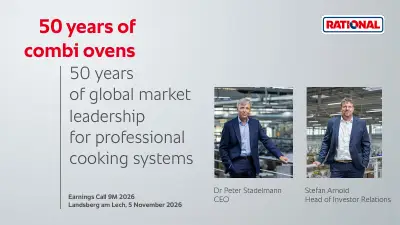
The results will be presented by the CEO, Dr. Peter Stadelmann, and the Head of Investor Relations, Stefan Arnold.
Thanks a lot to everybody who submitted their questions in writing in advance, and they will be answered briefly after the presentation. To avoid duplications of questions and for your convenience, I will post a list of all questions that have already been submitted to Rational ahead of this call in the chat box on the lower right-hand corner.
You will find them there in a few moments. Should there be any additional questions coming up, feel free to also add them into the chat box on the lower right-hand corner.
Please note that in order to ensure a smooth and uninterrupted presentation, Rational has chosen to use a static image instead of a live camera feed for today's presentation. Also be aware that we will record this event, and you will be able to review it later today on Research Hub.
We're looking forward to the insights that we will now hear from Dr. Peter Stadelmann and Stefan Arnold, and I hand it over to you.
Peter, it's all yours.
Peter Stadelmann
Thank you very much. Dear ladies and gentlemen, welcome.
Thanks a lot for dialing in today. Apologies, Jörg Walter, he's currently traveling through Asia for our budgeting 2027 and sends his best regards.
As always, please let me start with a very impressive reference story on a highly satisfied Rational customer. This time, this will lead us to Argentina first.
Cerro Castor is a ski resort located in the province of Tierra del Fuego near Ushuaia, Argentina. This is the southernmost ski resort in the world.
They run eight dining areas: four at the base and four at various elevations up the mountain. In total, they are operating 22 Rational units: 14 iCombi Pros and eight iVarios.
The capacity is between 1,800 and 4,000 people at once. Let them speak for themselves.
La montaña no es fácil. Brindar un servicio de excelencia es aún más difícil.
Estamos en Ushuaia, provincia de Tierra del Fuego, República Argentina, en Cerro Castor. Estamos en el fin del mundo.
Yo siempre digo y me gusta empezar a contar esto es que Cerro Castor, o no solo para la familia sino un poco para mi papá, siempre digo que es su sueño hecho realidad. Rational vino para cambiarnos el concepto de propuesta.
Tras el asesoramiento de la empresa, logramos llegar a poder tener 22 equipos. Estos 22 equipos compuestos: 8 iVarios y el resto con iCombi Pro sin dudas.
Nos permite estandarizar procesos. Te permite también trabajar con anticipación a la temporada.
Creo que eso es reimportante para nosotros. Empieza la temporada ya teniendo un montón de gente.
En un lugar donde necesitamos respuesta como para dar en los horarios picos entre 1,800 y casi 4,000 personas, Rational vino a cambiarlo todo. Hay cosas que cambian y hay cosas que no cambian tanto.
Entonces, yo siempre digo porque para nosotros la temporada fuerte hay 3 meses. Entonces, si un día equivale a una semana en tiempos normales, entonces cuando se hunde es una tormenta.
La decisión fue que una operación como esta, en el lugar geográfico que estábamos en el fin del mundo, no la podíamos hacer si no fuera porque Rational nos da todo el apoyo técnico y logístico. Mi papá es de esos de que no les mande un mensaje, sino como [tuc-tuc-tuc?]
, levanta el teléfono y llama, ya. Me está pasando esto, ¿no?
Como, bueno, es de la vieja escuela y... El servicio de posventa de Rational fue decisivo a la hora de tomar la decisión final.
Tenemos ocho puntos distintos en distintos lugares geográficos de la montaña. La única manera era generando producción previa, era teniendo más respuesta tecnológica, por ejemplo, a la logística de la montaña.
Al generar producción, no tener que pisar tanto las pistas. La transformación que hemos vivido en los últimos 2 años no la habíamos vivido en los 25 años anteriores de la inauguración del cerro.
Nosotros en la montaña tenemos los cuatro elementos: aire, tierra, agua, fuego. Y ahora, incorporamos el quinto elemento: Rational.
Peter Stadelmann
How wonderful, the fifth element. That's a nice story.
The second reference story is the famous Oktoberfest. With more than 7 million visitors, it's the world's largest party.
At the Oktoberfest 2026, a total of 259 Rational cooking systems were in use and supported the kitchens in preparing large quantities in consistently high quality. The first preparations begin at the beginning of the year, including the creation and testing of recipes as well as extensive test cooking.
The actual construction of the so-called tents will start in June and will be carried out in close coordination with the operators. In the week before the Oktoberfest, four Rational chefs were directly on site in the tents, conducting briefings, uploading cooking programs, and answering last questions from the kitchen teams.
Technical support during the Oktoberfest will be provided by several service partners. Some are present on the festival grounds with their own containers, engineers, and service parts.
We are happy to share with you today the results of our latest customer satisfaction survey 2026. With a Net Promoter Score of 65, we were able to improve the value compared to our former surveys and to stay in the best-in-class segment.
We are proud to achieve much better results than industry benchmarks. This confirms that we live up to the expectations of our customers in a very good way.
Of course, we will continue to work on improvement potentials mentioned in the survey in the different markets. What are our customers satisfied with?
Here, you see the most important reasons if it's about buying professional kitchen equipment. It is important to know that across all countries, customer expectations might be expressed differently.
What customers value the most is remarkably consistent: reliable products, cooking results, high product quality, ease of use, and an effective technical service. By strengthening these factors, we will continue to build customer loyalty worldwide.
A very special highlight for us in Q3 was the 100,000th iVario Pro that was produced and will be donated to Yale New Haven Hospital in Connecticut, USA. The official handover will take place this weekend and will be accompanied by a live cooking session with a Rational chef together with the local Sodexo team that is operating that kitchen.
We combine celebrating this milestone and contributing to the community. Behind every unit installation are dedicated teams, satisfied customers, and a shared passion for making professional kitchens more efficient.
We are all proud to be part of this success story. Many thanks to everyone involved.
If we look at the installed base of VarioCookingCenter and iVario, it shows a clear dominance of Europe. Number of installed units in overseas markets grow step-by-step.
We started the overseas launch in 2020. That is the main reason for the actual allocation.
Let me also give you an update on the development of iHexagon. We do not publish detailed sales figures.
There is a very encouraging development in terms of the customer feedbacks and identified potentials for the iHexagon. Since October 2026, the iHexagon is now available in almost all countries of the world after a phased global market launch.
It is our goal to have it available worldwide by April 2027 with just a few exceptions. At the end of my part, let me give you some impressions on the development of our new service parts center here in Landsberg.
The steel construction for the pallet high-bay warehouse and the container warehouse has been completed. The storage and retrieval machines of the high-bay warehouse have been brought into the building via the roof.
The construction of the conveyor technology is proceeding according to plan. The building is scheduled to be used in March 2027.
For the financial details, I hand over to Stefan now.
Stefan Arnold
Thank you, Peter. Let us turn now to the financial performance of the first nine months.
After nine months, we achieved €974 million in sales revenues, which means we grew by 6%. Adjusted for negative FX effects that we were facing mostly in Q1, sales revenues increased by 7%.
With that, we saw an incrementally higher growth rate compared to 2025 and 2024. This is in line with the expansion of our sales force and the increase of our sales activities at approximately the same growth rate.
Important as well, as far as we can see, we outperformed all competitors publishing nine-month figures with that performance. Looking at the quarterly results, we see sales revenues increased by 6% to €332 million in the third quarter.
This corresponds approximately to the average growth rates we saw in Q1 and in Q2, where we saw 8% and 4%, and so on average also 6%. The price increases we announced for Q4 did not have any material impact on sales revenue growth in Q3.
There were rather some short-term order shifts from October to September, as in the majority of the markets, the price increases went effective as of 1st October. Important to know as well, the big majority of these orders was not yet shipped by the end of September.
For Q4, we are rather expecting growth in the lower single-digit percentage range due to a strong comparison of Q4 2025. I want to clear up one thing to avoid misunderstandings: with single-digit percentage range, we rather talk about the range between 1% to 5%.
More on this later when it comes to our adjusted guidance. Let me now dive into our sales revenues by region for the nine months of 2026.
Overall, the sales revenue growth continued to be driven primarily by Europe, while the development in other regions were most mixed. Let us start with Germany.
Sales revenues here increased by 9%, reflecting a healthy demand in our home market. We are particularly pleased to see again that the growth remains strong also in the third quarter.
What is indeed a positive thing for us is that there is no one-off factor driving the growth, but it is a broad positive development. Looking at Europe excluding Germany, revenues increased by 8%.
Growth was broad-based across the regions, and there was no country below previous year after nine months. Particularly strong developments we saw in Spain, in Scandinavia, in Italy, and in Eastern Europe, and to mention also in Austria and in Switzerland, which was driven also by some key account projects that were supporting growth here.
Overall, Europe continues to demonstrate the resilience, and it remains a highly reliable growth contributor for our group. Turning to North America now, revenues increased here by 5% in the first nine months.
However, before exchange rate effects, we were able to grow in the first nine months by 9%. In Q3, there were fewer one-off effects compared to the Q1, Q2, but one that is really worth mentioning was the lower level of school business in summer this year compared to the high level of last year due to way lower public funding for kitchens in the education system.
That's the major reason why organic growth in Q3 was slightly lower at 7%. FX effects turned from significantly negative in Q1 to neutral in Q2 to now slightly positive in Q3, and we are also expecting positive effects from the US dollar in Q4.
In Asia, revenues were around 6% below previous year in Q3, and they decreased by 3% after nine months. The major reason was the continued weakness in China, where revenues were down by around 19%.
Here, we are still heavily affected by Yum China's decision to source combi ovens locally. This was partly offset by stable business or solid growth in other Asian markets like Japan, India, or some ASEAN markets.
For Q3, there is an additional factor, which is the volatile business with a Japanese key account. After strong development in Q1 and in Q2, the level was lower here, which is quite usual for such kind of customers.
The smaller regions of Latin America and rest of the world, I do not want to comment in detail, as we usually see higher volatility here on a quarterly basis. Maybe only one word to the Middle East again: so, the conflict with Iran is still affecting our sales in this region, which is part of the rest of the world region you see here, and this is one major reason why we are showing a decrease in sales here.
Let's take a short glance at the development of our product groups, and we start with the iCombi product group. Here, sales revenues increased by 5%, and as our largest product group, iCombi continued to benefit from the solid demand across most regions, and it remains the backbone of our business.
In the iVario product group, sales revenues increased by 10% to €120 million. As we generally expect the iVario to grow faster than the iCombi product group due to its lower market penetration and its high growth potential in many markets, especially in the overseas markets, as Peter showed before.
The nine-month numbers once again underline these expectations. Especially positive was that we grew significantly in all the major regions, and just in the rest of the world regions, we did not reach previous year's levels, mainly due to the mentioned weak development in the Middle East markets.
Looking at the EBIT, we see in the first nine months of 2026, this increased by 12% year-over-year to €261 million, while the EBIT margin reached the highest number since years. This very high level was mainly possible due to the positive impact from the tariff refunds related to our US business from Q2.
Excluding these tariff refunds, the EBIT margin would also have been at a very nice level at 25.4%, which is fully in line with our guidance for this year, and just slightly below the two previous years' figures, but as expected. Let me walk you through the profitability development for the first nine months of 2026 in somewhat detail.
Cost of goods sold increased by 4%, this means significantly less than the sales revenue growth. Gross margin remained affected by slightly higher material costs, increased freight and logistics expenses, and tariff-related effects.
These headwinds were more than offset by the tariff refunds received during the second quarter mentioned before. As a consequence, gross profit increased by 7% with an improved margin of 59.5%.
Again, adjusted for the tariff refunds, the margin is at 58.1%, and with that, slightly below previous year due to the mentioned cost effects. Operating expenses increased by 5%.
As announced, we continued to invest selectively in our strategic priorities. R&D expenses grew by 7%, reflecting our ongoing commitment to innovation and future product development.
Sales and service costs increased by 5%, mainly driven by customer-oriented functions and activities and the targeted initiatives to further strengthen our market position. At the same time, administrative expenses were slightly below prior-year level, again demonstrating our continued cost discipline.
As a result, EBIT increased by 12% to €260 million, outpacing revenue growth and with that resulting in higher EBIT margin. Let us keep the balance sheet again quite short, as it remains very strong and it is more or less unchanged to H1.
Total assets increased by around 7% year-on-year, reflecting the continued growth of our business. Despite the high dividend payout in May of 90% of our net earnings, we increased the equity position by €44 million against September last year.
The other balance sheet items also increased slightly, but without being worth mentioning in detail. Let me now conclude with our revenue and earnings outlook for 2026.
We confirm for 2026 to continue to grow in the mid to high single-digit percentage range. Looking at the growth we saw so far, and against the background of a strong Q4 2025, we are now making this guidance more concrete and expect to rather come out at the lower end of this range.
Looking at the gross margin, there are two major drivers. On the one hand, this is the input costs, and after having stabilized in the recent years, we saw now raw material, electronics, chemical, and logistics costs have started to trend upward again.
In addition, we face a full-year impact from the foreign exchange and the tariff situation for our exports to the United States. On the other hand, price increases introduced in 2026 and the reimbursement of the tariffs we paid mainly in 2025, they will fully compensate for these effects or even slightly more.
As a result, this means that the gross margin will be on or slightly above the prior-year level. Looking at the operating expenses in 2026, we are investing especially in direct sales and in R&D, while costs not related to sales are kept stable or as stable as possible.
In total, this means the operating expenses will grow approximately proportionally with sales revenues or slightly slower. Overall, this means that due to the positive effects of the tariff refunds and price increases, we now increase our EBIT margin guidance to a corridor between 26% and 27%.
However, due to the more concrete sales revenue guidance at the lower end of the guided range, we confirm the EBIT to be in a range between €340 and €360 million. This means the expected EBIT level in euro terms is unchanged to the guidance given at the very beginning of this year.
Important, it also matches the average consensus estimates, which are on the same level. This means that we are confirming our EBIT guidance for fiscal year 2026.
With this, I want to conclude the presentation, and we are now happy to take your questions.
Operator
Thank you so much, Peter and Stefan, for the insights that you provided. Congratulations on a very solid quarter.
We do have a lot of questions, and I want to start out with one that is focused on the big picture, on the outlook for the gastronomy industry as a whole in your markets.
Peter Stadelmann
Yes. Overall, we could describe the outlook for the gastronomy industry as stable.
While the market environment remains mixed and customer sentiment varies by region, we continue to see healthy investment activity in many of our markets. Europe remains solid, as demonstrated.
Germany, for example, shows sales growth in hospitality in '26 after several years of decreasing sales. In North America and parts of Asia, demand is somewhat more cautious.
At the same time, ongoing labor shortages, the need for greater efficiency, and increasing digitalization continue to support demand for professional cooking solutions. Overall, we do not see any major deterioration in market conditions at this stage.
Operator
Thank you so much for the big picture. Let's dive into an individual market, China.
Can you provide an update on China, including the current market conditions, the development of the KFC Yum China business, the performance of the street business, and the progress of the iCombi One launch?
Peter Stadelmann
Yes. Since mid of last year, we have been strengthening our local sales structures, particularly our dealer network and the sales organization.
We are making good progress and believe we are on the right track, but these investments will take time to be fully reflected in our business performance. The main headwind continues to be the KFC Yum China business.
Yum China runs more than 10,000 Rational units. They placed a large additional order in 2023, which was delivered across 2023 and 2024, and therefore contributed significantly to sales in both years.
Historically, KFC accounted for around 30% to 40% of our total China sales. Following the normalization of order volumes in 2025 and a further decline in 2026, KFC shares has fallen to around 10% of China sales, creating a significant headwind compared to previous years.
Against this backdrop, it is encouraging that the underlying street business is developing positively and continues to grow, also from a relatively low level. The launch of the iCombi One is also progressing well.
We have won our first key account and are reaching customer segments that previously viewed the iCombi Pro as outside their budget. Expanding our addressable market was one of the key objectives of the launch, and we believe we are making good progress.
However, we are not disclosing detailed figures at this stage. Looking ahead, year-on-year comparisons should become easier as the reduction in Yum China volumes began in early 2026 and will therefore have a much smaller impact going forward in 2027.
In addition, other Asian market continue to develop well, while we remain focused on investing in our sales organizations to capture the long-term growth potential in the region.
Operator
Thank you so much. We talked about regions.
Let's dive into products and services. Peter, can you give us an update on iHexagon, please?
Peter Stadelmann
Yes. We also here remain very pleased with the development of the iHexagon.
While we are not disclosing specific figures, customer feedback continues to be very positive. Initial activities were driven mainly by larger chain customers, but we are increasingly seeing demand from independent customers as well through all our customer segments.
As highlighted in the presentation, the iHexagon will be available in almost all of our markets by year-end, and we continue to see significant long-term potential for the product.
Stefan Arnold
The strong performance in Germany, Europe is not driven by the launch of iHexagon. Again, we would like to stress that completely new kind of equipment in our industry penetrates in decades, not in years.
Operator
Thank you. Let's continue with products and move on to the iVario.
The iVario installed base remains very concentrated in Europe with about 87,000 units installed here compared with around 4,000 units installed in North America. What are the main barriers to faster adoptions outside of Europe, you think, and which regions offer the greatest growth potential over the next 3 to 5 years in your eyes?
Stefan Arnold
I think we already touched this a little bit in the call, but let's go a little bit deeper maybe here. As Peter said, the main reason for that gap is timing.
While the iVario, or the VarioCookingCenter before, has been established in Europe for many, many years now for more than 20 years, we only started rolling out it in the most overseas market around 2020. As a result, we are still in an very early stage of market penetration outside Europe.
Just in a few overseas markets, we provided the iVario to bigger partners even before, for example, in Japan, in Australia, or in Korea. Looking ahead, we see significant growth potential across all overseas markets, but particularly in North America.
Operator
Thank you. Let's continue with a look at the order book.
How much of the order book was at the old price point at the end of September?
Stefan Arnold
We had an order book at end of September that was maybe €20 to €30 million higher compared to average of the previous quarters. As said before in the presentation, the majority of this was not shipped, of course, until the end of September, there was a bigger part with the old price point in the order book.
We do not exactly know this.
Operator
Great. Thank you.
Looking at the service part, after-sales business, what percent percentage of sales in the third quarter stems from the non-equipment business?
Stefan Arnold
The share of non-equipment revenue remained stable at 31% in Q3, in line with the previous quarters.
Operator
Great. Looking at the iVario, which was slower in the third quarter, especially in North America, what's the key reason behind this?
How should we expect the growth development of iVario going forward?
Peter Stadelmann
iVario growth in Q3 was mainly affected by a very strong comparable quarter last year, particularly in North America. At the same time, iVario has started very well this year, some quarterly volatility should be expected.
Looking ahead, we continue to expect iVario to grow significantly faster than iCombi. As a rule of thumb, we believe iVario can achieve growth rates roughly twice as high as those of iCombi.
Operator
Thank you, Peter. We talked about price increases in the order book.
How much of the recent growth do you think was driven by pre-buying effects ahead of the September price increase? How have customers reacted to the pricing measures that you have installed?
What is your current view on prompt pricing going into 2027?
Stefan Arnold
As mentioned, we did see some customers bring forward orders ahead of the approximately 3% price increase effective September 1st, resulting in a pre-order effect in Q3. However, the impact on reported sales was relatively limited, as most of the effect reflected a timing shift in orders rather than a meaningful contribution to revenue growth.
Customer reaction has been largely in line with our expectations. Apart from the order pull-forward, we have not seen any significant negative feedback.
Historically, we have taken a cautious approach to pricing and have typically focused on efficiency improvements before passing on higher costs, which has supported good customer acceptance. Looking ahead to 2027, pricing decisions will depend on the development of cost inflation and our ability to offset these increases through efficiency measures.
Given the current environment of elevated cost inflation and volatility, we cannot rule out further pricing actions, but no decision has been made at this stage.
Operator
Looking back at the regions, can you comment on recent regional developments in Europe, Latin America, Germany, the Middle East, and the outlook for demand trends?
Stefan Arnold
Demand trends remain broadly healthy across our key regions. To start with Europe, here growth continues to be well-balanced across the countries and the customer segments.
While the growth rates, of course, can fluctuate from market to market depending on the prior-year comparisons, we do not currently see tougher comparison as a major risk for the European market as a whole. Q4 comparables on the other hand are not easy as well, with Europe having grown by 8% in Q4 last year.
Apart from the HoReCa roll-out in Austria and in Switzerland, we are not aware of any major projects that would materially influence growth. In Latin America, growth is broad-based as well and not driven by individual key accounts or one-off projects.
Brazil continues to perform well, Mexico is growing strongly from a low base following a weak 2025, and several other South American markets are also contributing positively. Germany's strong growth, as said in the presentation, likewise was broad-based across all customer segments.
There was no large project or special effect, although the increased density of our sales organization may have provided some support here. Regarding the Middle East, there is no significant new update, as you can imagine.
Sales remain slightly below prior-year level and currently account for around 2% of group revenues after nine months, limiting the impact on the group overall.
Operator
Thank you, Stefan. We have seen a lot of revolts and demonstrations all across Europe during October.
Have you seen any impact on your business stemming from that?
Stefan Arnold
We would say that at this stage, we have not seen any material impact from these protests in Europe. Our business continued to operate normally, and we have not experienced any meaningful disruptions to customer demand or to deliveries or the operations related to these events.
Operator
Thank you. Unit sales, can you give us an update on unit sales and sales development for both the iCombi and the iVario in 2026, and what do you expect for the full year?
Stefan Arnold
After the first nine months, we sold approximately 75,000 units, representing a growth of around 5%, in numbers, in unit numbers year-over-year. The volume growth was driven by both product categories, with the iCombi units up around 4% and the iVario up around 8% after nine months, slightly below the sales revenue growth.
For the full year, we would currently expect growth rates to be maybe slightly lower than the year-to-year the year-to-date figures, reflecting the more demanding comparison in Q4. However, we continue to expect, as Peter already said, the iVario to grow faster than the iCombi, approximately twice as much.
Operator
Great. Looking at Q4, you were just referring to that, could you remind us how strong the currency-adjusted sales growth in Q4 last year 2025 was, and how we should think about the comparison base for Q4 2026?
Stefan Arnold
Q4 was the strongest quarter in both 2024 and 2025. In Q4 2025, currency-adjusted sales growth was approximately 11%, creating a demanding comparison base for Q4 2026.
Operator
Can you give us a better understanding of what the driver behind the softer performance in the US in the third quarter was, and do you lose any market share in that region currently?
Stefan Arnold
We don't think so. If we see the published figures of American-based companies, we outperformed them.
That would mean that we could gain market shares. On the other hand, as addressed earlier, the education business, the school business was lower this summer due to less financial resources available for schools.
Operator
How should we think about the normalized gross margin going forward into 2027? There are two things basically moving it: on the one hand, your recent price increases, and on the other hand, emerging input cost pressures.
Can you give us a better insight into how you view that?
Stefan Arnold
While our planning for 2027 is still ongoing, of course, we cannot go in detail here. What we can say is our mid-term EBIT margin assumption of 25% to 26% would also correspond to a gross margin level of around 58%.
The roughly 3% price increase outside the US should provide a low single-digit million euro benefit in Q4 now, as it was announced in September and only became effective during this quarter, or will become effective during this quarter. The full-year effect will therefore mainly support 2027, helping to offset expected increasing in material and component costs at least partly.
Operator
Great. Thank you.
Let's stay with that issue for a little while longer. How do you expect input costs, and particularly materials, components, and energy, to develop in the remainder of this year in Q4, into 2027, and to what extent can pricing offset these pressures?
Stefan Arnold
We indeed continue to see cost pressure across the most input cost categories, particularly materials and components. While only part of the announced supplier increases materialized so far, we expect these pressures to become more visible in 2027.
Energy is not a major direct cost factor for us, but higher energy prices, of course, can indirectly affect us through supplier costs. At the same time, our recent price increases will provide a full-year benefit in 2027, helping to offset some of these headwinds.
The ambition we are having is always to safeguard a margin level of 25% to 26% by efficiency measures at first, and as a measure of last resort by pricing actions. As said, as our planning process is still ongoing, it is too early to quantify the overall cost impact for 2027.
Operator
Thank you. Staying with the cost side and looking at the price increases that we've seen in oil and other things, how do you see the development of your logistics costs going forward?
Stefan Arnold
Logistics costs have risen compared to the same quarter of the previous year also in the nine-month period. In particular, overseas freight has risen due to additional surcharges we are facing.
On the other hand, cost savings have been achieved by, for example, changing freight forwarders. Costs are increasing, but we were counteracting here quite successfully.
Operator
Thank you. We've seen a lot of shifts in the tariff situation in the USA.
Can you give us an update on where we currently stand and what you would expect for 2027?
Stefan Arnold
Tariffs on our cooking equipment currently stands at 15%, while tariffs on other products such as service parts and accessories are somewhat lower in the 10% plus some surcharge level. The tariff environment has stabilized now in the recent months, and assuming no further regulatory changes, as far as this is possible, we would expect these rates to remain broadly unchanged in 2027.
This would mean the average rate for 2027 would be lower than in 2026, and with that, our total tariff expenses will be presumably slightly below 2026, of course depending also on the volume.
Operator
Thank you. Given that we have tougher comparison base and expected low mid to single-digit growth in the fourth quarter, how do you assess the underlying growth momentum going into 2027, and do you still consider high single-digit growth achievable in the medium term?
Peter Stadelmann
We continue to see healthy underlying demand and no structural slowdowns, except for the ongoing challenges in China. For Q4, we expect 1% to 5% revenue growth, primarily reflecting the strong comparison base.
North America, which grew 15% in Q4 last year, is likely to show only limited growth therefore, or could be flat. We currently do not expect the US midterm elections to have a significant impact.
Looking into '27, as you all know, that's too early to do some guidance, but we see a good starting position. Growth should benefit from the full-year impact of pricing, our expanded sales organization, further iVario penetration outside Europe, particularly in North America, and the continued rollout of iHexagon, which is now available in almost all markets.
China is likely to remain challenging while we rebuild the dealer network and sales organization. Overall, we continue to believe that high single-digit growth of around 8% is achievable in the medium term, supported by significant untapped market potential and continued investments in sales, innovation, and customer support.
Operator
You increased your 2026 EBIT margin guidance to 26% to 27% and had a very strong performance in the third quarter. How should we think about the underlying sustainable margin level, the impact of tariffs and other one-offs, and the key drivers for the remaining quarter and for 2027?
Peter Stadelmann
Excluding tariff-related effects, we continue to see an EBIT margin of around 25% to 26% as a sustainable mid-term level, and currently do not expect operating leverage to structurally lift margins above this range. The higher 2026 guidance reflects a €4 to €5 million release of tariff provisions in Q3 with no further releases expected in Q4, as well as material cost increases coming through more gradually than initially anticipated and some recent easing of currency headwinds.
Looking into Q4 and 2027, the key variables are the timing of pricing versus cost inflation. Pricing should support margins, while higher material and wage costs, including a potential wage increase of around 3% from July, will create headwinds.
At the same time, we will continue targeted investments in sales, service, and R&D, while maintaining discipline in administrative functions. The current guidance range primarily reflects uncertainty around the timing of these effects rather than a change in underlying business momentum.
Operator
Thank you. Looking at working capital and the change in the quarter, which was less positive than last year's Q3, was there any impact from the announced price increases in your presales here?
Peter Stadelmann
Working capital analysis quarter-on-quarter in our eyes is not really sensible. For end of September, the working capital as a percentage of sales was at around 23%, and with that, in the normal range between some 20% to 24% that we had in the last years.
We would not assume a significant impact here.
Operator
Thank you. Let's look at the CapEx.
What do you think CapEx is going to look like and develop through the end of 2027?
Peter Stadelmann
We will start building a new customer experience center in 2027 after then having finished the service parts center. With these new training center, we will create additional training centers and spaces and office space here in Landsberg.
As a ballpark number for the future, we are expecting CapEx to be in the range between 2% and 3% of sales revenues.
Operator
Thank you. Let's talk about the dividend.
What are your thoughts on the special dividend that over the last 2 years to be converted into a regular dividend?
Peter Stadelmann
No, that is rather not the case. The 7% dividend plus X% special dividend gives us some more flexibility.
Operator
Thank you. Let's look at the mix of new kitchen sales versus replacement cycle in different regions.
Can you shed some insight on that for us, please?
Peter Stadelmann
The mix between replacement and new business varies by region. In Germany, we estimate around 80% of sales come from replacement demand, since it's a very old and mature market.
Across Europe, the share is closer to 50% or less. In regions such as North America and Asia, replacement demand is significantly lower at around 10% to 20%, with the majority of sales driven by new customers acquisition and first-time installations.
Operator
Thank you. I have a follow-up question to your earlier statement when you said, "Here, we are still heavily affected by Yum's China decision to source combi ovens locally."
Does that mean that Yum China is now buying machines from local competitors? Is this what you mean, and if so, why are they doing this?
Peter Stadelmann
Yes, that is essentially what we mean and said in earlier calls. Following Yum China's decision to increase local sourcing, a larger share of demand has been awarded to a local supplier called Justa.
The main driver behind the decision appears to be pricing. As a result, Yum China's purchases from us have gradually declined significantly over the past few years, creating a challenging comparison base for our China business.
Operator
Thank you very much. From what I can see, I think we are done with the Q&A pretty much right on time.
It's almost 4:00. Thanks to everybody for handing in the questions beforehand, and of course thanks for asking questions during the live call.
Peter Arnold Peter, Stefan, thank you so much for your insights that you shared with us. Before we close the call, I would like to hand it over to Stefan for some final remarks.
Stefan, please, go ahead.
Stefan Arnold
Thank you very much, Holger. My dear ladies and gentlemen, to close the call, please let me again thank you for actively participating in our earnings call.
We are looking forward to staying in contact with you, in case of any questions, please do not hesitate to contact us. Our next IR event will be our IR follow-up talk next week, Wednesday, 11 November, at 2:00 p.m.
CET. The week after, we will have our online Capital Markets Day on Thursday, 19th November, also at 2:00 p.m.
CET. Here, we will have an online webinar focusing on the virtual world of connected cooking.
For both events, you can find the subscription link in the financial calendar on our homepage. Our next announcements will be on the one hand the preliminary figures on fiscal year 2026 on 3 February 2027, and of course the disclosure of our annual report with an earnings call on the 25th of March 2027.
With that, I want to wish you a good time, and we are looking forward to welcoming you to one of these events. Thank you very much.
Goodbye, and take care.
Operator
Thank you so much. In case you missed part of this event, you can review it on Research Hub a little later once we post this video for your consideration.
Thank you so much. Have a great afternoon.