Redwood Trust, Inc.
Q3 FY2026 · Earnings Call TranscriptNovember 3, 2026
Operator
Greetings, and welcome to the Redwood Trust third quarter 2026 financial results conference call. Today's conference is being recorded.
I will now turn the call over to Ahn Huynh, Head of Investor Relations. Please go ahead, ma'am.
Anh Nguyen
Thank you for joining us today for Redwood's third quarter 2026 earnings conference call. With me on today's call are Chris Abate, Chief Executive Officer, Dash Robinson, President, and Brooke Carillo, Chief Financial Officer.
Before we begin today, I want to remind you that certain statements made during management's presentation with respect to future financial and business performance may constitute forward-looking statements. Forward-looking statements are based on current expectations, forecasts, and assumptions, which includes risks and uncertainties that can cause actual results to differ materially.
We encourage you to read the company's annual report on Form 10-K and quarterly report on Form 10-Q, which provides the description of some of the factors that could have a material impact on the company's performance and can cause actual results to differ from those that may be expressed in forward-looking statements. On this call, we may also refer to both GAAP and non-GAAP financial measures.
The non-GAAP financial measures provided should not be utilized in isolation or considered as a substitute for measures of financial performance prepared in accordance with GAAP. Reconciliation between GAAP and non-GAAP financial measures are provided in our third quarter Redwood Review, which is available on our website, redwoodtrust.com.
Also note that the contents of today's conference call may contain time-sensitive information that are accurate only as of today. We do not intend and undertake no obligation to update this information to reflect subsequent events or circumstances.
Finally, today's call is being recorded. It will be available on our website later today.
With that, I'll turn the call over to Chris for opening remarks.
Chris Abate
Good afternoon, everyone. Today, we announced several important developments for Redwood.
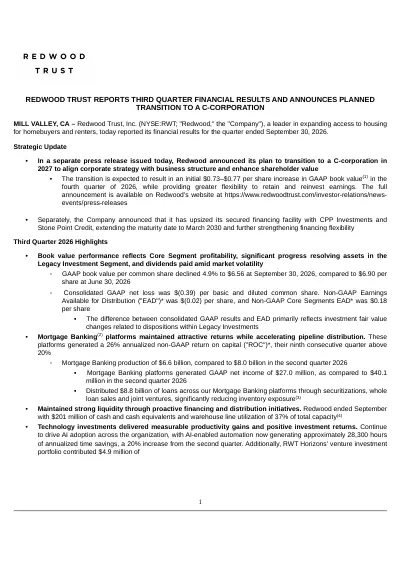
I'll cover the key points before Dash and Brooke share their prepared remarks, and then we'll take your questions. After 32 years as a real estate investment trust, Redwood plans to transition to a taxable C corporation beginning in 2027.
We believe the structure better aligns with our operating business today and will strengthen our ability to build long-term shareholder value. We expect the transition to generate an initial GAAP book value benefit of approximately 73 cents to 77 cents per share in the fourth quarter of 2026, which translates to an increase of approximately 11% over our September 30 book value per share of $6.56.
We realize that this transition has been anticipated for some time by many of our shareholders. Redwood has evolved considerably since its founding in 1994, with our transformation into an operating platform accelerating in recent years.
Today, we serve as an embedded partner to hundreds of loan originators and real estate investors, including 70 of the top 100 US banks. We support these institutions with deep underwriting and asset management expertise and leading securitization and whole loan distribution programs.
Our recent market share gains in mortgage banking indicate that we have only begun to monetize the full potential of these relationships. However, the earnings strength of our franchise has not translated into sustained book value growth.
One reason is that we've distributed substantial capital through dividends, limiting our ability to allocate capital and compete effectively with our mortgage banking peers. By de-REITing beginning with the 2027 tax year, we want to share three near-term benefits.
First, we expect to unlock significant tangible value from our existing tax assets through previously unusable federal and state NOL carryforwards. In this regard, we are unique.
As all REITs that come to mind, which stand to lose their tax shelters by not complying with the REIT rules, our shareholders will immediately realize the opposite. Second, we will have greater flexibility to retain earnings and allocate capital.
As we disclosed earlier, we expect the board to reset the quarterly common dividend to 2 cents per share beginning in the fourth quarter. This would bring our payout ratio in line with banks, asset managers, and other C-corp mortgage businesses with comparable operating models.
We recognize that the de-REIT transition, while in the long-term interests of the company, entails a lower common dividend to fully leverage the compounding effect of earnings and associated benefits. For our shareholders who value Redwood's historically high dividend yield, particularly our retail investors, today we announce plans for a preferred-for-common exchange offer that we expect to come at a significant premium.
This new series of preferred stock will carry a high dividend yield aligned with income-oriented objectives. I would strongly encourage interested shareholders to fully explore it ahead of the upcoming launch.
For common shareholders, this exchange can be thought of akin to a share buyback and will further enhance the contribution from our newly minted tax assets. Based on our projected size for this exchange, we would expect any remaining potential dilution associated with our September convertible debt issuance to be neutralized, especially when factoring in our third quarter common share buybacks.
Third and finally, the C-corp transition creates a path towards a structurally lower cost of capital. Our corporate debt costs reflect constraints associated with mortgage REITs, particularly the requirement to pay out substantially all earnings rather than allocate that capital for other uses.
As a consequence, non-REIT mortgage peers enjoy broader access to the debt markets, including rated debt, with covenants better suited for operating businesses. With more than 80% of our unsecured debt callable by the end of 2028, the C-corp transition will allow us to not only pursue more attractive debt, but also opportunistically replace higher-cost obligations with lower-cost financing.
In step with that unlock, today we announced the upsize of our corporate secured financing facility with CPP Investments and extended its maturity to March of 2030, adding valuable funding flexibility. As we head towards year-end, we are working very hard to resolve as much of the legacy book as possible in the fourth quarter.
While Dash and Brooke will cover legacy, I want to be sure our shareholders understand that the legacy book remains very much a melting ice cube. Charges went up this quarter because liquidations went up and the outstanding balance went down.
I'd also note that our legacy book is marked dramatically lower than many who utilize CECL reserving for similar assets. This distinction is a big reason why we can pursue liquidations at this time rather than traditional loan modifications.
In closing, through all of today's announcements, our mission remains the same: to make quality housing, whether rented or owned, accessible to all American households. As we discuss in this quarter's shareholder letter, that mission is taking on new significance as we transition towards becoming an agentic enterprise.
With our expectation that markets begin to normalize after the midterm elections, we're excited to challenge the boundaries between agency and non-agency mortgage lending in the quarters ahead. With that, I'll turn the call over to Dash.
Dash Robinson
Thank you, Chris. Our third quarter operating results reflected proactive risk management and the depth of distribution and product offerings that make our platform resilient even in times of market volatility.
We substantially increased activity with our joint venture partners, increased loan purchase and sale activity with banks, and made important strides in the wind-down of our legacy portfolio. The result was our ninth consecutive quarter of mortgage banking returns north of 20%, despite sharply higher benchmark rates and spread widening that has persisted into the fourth quarter.
Across our platforms, we produced $6.6 billion of loans, down from $8 billion in the second quarter, while distributing $8.8 billion through securitizations, whole loan sales, and joint ventures. We meaningfully reduced net inventory, freeing up liquidity for fresh working capital and accretive deployment into our corporate capital structure.
At Sequoia, lock volume was down modestly on the quarter to $5.1 billion from $5.6 billion in Q2. Gain-on-sale margins rose to 113 basis points, up from 92 basis points in the second quarter, resilience that reflected a proactive distribution posture, appropriate conservatism with our rate sheet, and continued accretive hedging activities, particularly as 10-year Treasury yields moved sharply higher into quarter-end and the mortgage basis widened.
Sequoia distributed over $7.1 billion of loans during the quarter, including $5.8 billion across 10 securitizations and the first out of the Castlelake joint venture. Whole loan sales totaled $700 million, including transactions with two new bank partners.
The majority of Sequoia's dispositions on the quarter occurred prior to the uptick in rates in September, helping to support gross margins. Just one quarter after coming online, the Castlelake partnership is reinforcing how joint ventures can expand our production capacity while more efficiently deploying our shareholders' capital and increasing mortgage banking returns.
Through these partnerships, Redwood earns upfront economics on loan sales, recurring management fees, and a share of gain-on-sale profits, providing growing revenue streams without the added working capital requirements. Amidst a more cautious operating approach, Sequoia continued to expand its product development and bringing a deeper suite of solutions to our seller base.
Traditional 30-year fixed-rate production represented less than 70% of locks on the quarter, a nod to strategic progress with our medical professional loan offering, for which we issued our second securitization during the third quarter, as well as HELOCs, which we formally rolled out in May. When rates and spreads are volatile, these products support margins both through our unique sourcing capabilities and increased market demand for non-fixed-rate product when convexity becomes more challenging to manage.
Transaction activity with our bank network also continued to trend higher, with over 30% of our Q3 locks coming from depositories. While rates have rallied close to 40 basis points off their recent highs, spreads remain at or near recent wides, an opportunity for the business heading into year-end, a period of time during which many competitors have historically retrenched.
Market conditions more acutely impacted Aspire's third quarter performance. Spread widening across the capital structure and rate volatility, particularly at the short end of the yield curve, led to roughly flat gross margins, down from 101 basis points in the second quarter.
Lock volume on the quarter totaled $1.1 billion of loans, down from $2.1 billion in the second quarter, and the result of deliberate calibration of activity as distribution timelines extended, with both originators and aggregators challenged to efficiently move inventory. Flow purchases represented roughly 88% of Aspire's volume, and our active seller network grew to over 165 sellers.
Aspire distributed $1.3 billion of loans, including $904 million across two Aspire securitizations and $386 million of whole loan sales. The non-QM market remains in growth mode, and Aspire's addressable market remains significant.
With a net undistributed pipeline of below $400 million, the business is well positioned to capitalize as demand from insurance capital ramps back up and we prepare for initial fundings under Aspire's newly formed joint venture, which at scale has overall purchasing power of approximately $8 billion. CoreVest funded $406 million of loans in the third quarter, roughly flat with the second quarter.
Higher rates once again weighed on the term loan pipeline, but combined bridge and RTL fundings increased roughly 35% and accounted for nearly three quarters of volume. CoreVest distributed $427 million of loans through joint venture transfers, securitization, and whole loan sales, including $244 million to our joint venture with CPP Investments.
We also launched a new pricing engine and redesigned website to support lead generation and began transitioning servicing of certain bridge loans to our new servicing partner, an effort we expect to reduce on-the-run servicing costs through time. As production activity has increased across our platforms, credit performance has remained stable and delinquencies remain low.
60-day-plus delinquencies in Sequoia and Aspire are each below 20 basis points, reflective of continued strong underwriting discipline as those businesses continued to expand. Importantly, credit performance in recent CoreVest production vintages has also remained healthy, with combined serious delinquency and REO below 5% in our securitized bridge portfolios, affirmation of the significant changes in our approach beginning in late 2022 that have delivered several consecutive years of strong credit cohorts.
Total payoffs across all bridge portfolios have totaled $475 million in unpaid principal balance since June 30th, a level of turnover in line with expectations. This included $160 million of payoffs and dispositions of legacy and other seasoned bridge loans, with another $70 million in UPB expected to be resolved by mid-Q4 or already under contract.
As credit from core production activities remains resilient, the legacy investments segment, which continues to shrink, remains the primary area of focus for loss mitigation and disposition. Since the third quarter of 2025, we have reduced exposure in that segment by close to 40%, prioritizing proactive measures including note sales, refinances, and REO sales.
As such, modification activity in the legacy portfolio has decreased sharply in recent quarters as we prioritize expedient recovery, capital reallocation, and reduction in interest expense. As we evaluate offers on close to 70% of the remaining loans in the segment, we maintain our posture of expeditiously reducing this position.
While we may encounter additional transaction costs in doing so, the dual economic benefits are powerful: reallocation of capital to our profitable mortgage banking activities and reduction in carrying costs that have averaged 12 cents to 14 cents per share per quarter thus far in 2026. I'll now turn the call over to Brooke to discuss our financial results.
Brooke Carillo
Thank you, Dash. We reported a GAAP net loss related to common stockholders of $47 million, or 39 cents per share, compared to $3 million, or 3 cents per share, in the second quarter.
Book value ended the quarter at $6.56, down 4.9% from $6.90 at June 30th. The decline reflected losses associated with resolutions of legacy assets and our 18 cents per share dividend, partially offset by approximately 25 cents per share of accretion from common stock repurchases we completed during the quarter.
Our economic return on book value was -2.3%. Excluding the 39 cent GAAP loss from legacy investments, which included a 7 cent per share charge to position certain legacy HEI assets for liquidation, book value per share would have been up modestly from the second quarter.
Consolidated non-GAAP EAD was -2 cents per share, compared to positive 15 cents per share in the second quarter. Core segments generated $23 million of EAD, or 18 cents per share, representing a 12.7% annualized return on equity, compared to 25 cents per share last quarter.
Legacy investments reduced consolidated EAD by 20 cents per share, compared to 11 cents per share in the second quarter, reflecting carrying and resolution costs. Importantly, the underlying non-performing loan population continues to shrink, with non-accrual loans declining to $205 million at September 30th, down from $291 million at year-end.
Throughout the year, we have not accrued on the majority of our legacy loans, irrespective of payment status. We completed no complex modifications or rate concessions during the quarter, focusing instead on sales, foreclosures, and other dispositions.
As this portfolio continues to wind down, we expect the associated earnings drag to decline. Our goal remains to resolve as many legacy loans as possible throughout the remainder of the year.
Mortgage banking generated $27 million of GAAP net income, compared to $40 million in the second quarter, and a 26% annualized non-GAAP return on capital. Sequoia generated $32 million of GAAP net income, essentially unchanged from the second quarter, and a 41% annualized return on capital.
Margins benefited from our interest-only and servicing hedges, as well as joint venture distributions offsetting the impact of lower volume. Aspire reported a $5 million GAAP loss, compared to $7 million of net income in the second quarter.
Volume declined 45%, reducing operating leverage, as we deliberately moderated acquisitions early in the quarter when loan spreads did not adequately compensate for emerging market risks, a decision which was reinforced by subsequent market volatility. CoreVest was approximately break-even on a GAAP basis.
Excluding acquisition-related expenses and the related tax effects, EAD was $1.6 million, representing a 20% annualized EAD return on capital, and compared to $2.8 million in the second quarter. Fundings remained relatively stable, with increased bridge activity offsetting weaker term loan demand.
Redwood Investments generated a $4 million GAAP loss versus $1 million of income in Q2, as higher rates and wider spreads pressured retained investment valuations. This was partially offset by $4.9 million of positive RWT Horizon fair value changes.
Net interest income rose to $19 million from $10 million, primarily reflecting seasoned IO and servicing investments transferred from mortgage banking as their pipeline hedging benefit diminished. Segment EAD before allocated corporate costs increased to $13.6 million from $10 million.
G&A was essentially unchanged at $38.5 million. Year-to-date, total expenses represented 69 basis points of production versus 88 basis points for the full year 2025, a 22% improvement.
Turning to liquidity and capital, we ended September with $201 million of unrestricted cash, up from $192 million in June. We raised $205 million through our 7% convertible offering, retired approximately $125 million of 2027 converts, repurchased $34 million of common stock, deployed $67 million into retained investments, and paid $23 million in dividends.
Cash generated through loan distributions and ongoing balance sheet management allowed us to fund these capital actions while increasing our cash balance, a trend that has continued into the fourth quarter. Recourse debt declined approximately $310 million to $4.2 billion as distributions outpaced production.
Recourse leverage rose to 5.2 times from 5.0 times, reflecting lower equity from repurchases, the net loss, and dividends. Turning to the financial implications of today's corporate actions, our planned C-corp conversion will allow us to use approximately $304 million of federal and over $1 billion of state net operating loss carryforwards from our REIT-qualified businesses to offset future taxable income generated by our operating businesses, where our effective tax rate at the TRS increased to approximately 29% this quarter, up from 21% in the second quarter.
We expect to recognize an initial deferred tax asset of $85 million to $90 million in the fourth quarter of 2026, increasing GAAP book value by approximately 73 cents to 77 cents per share, based on September 30th shares outstanding, and subject to final tax and accounting determinations. Beyond this initial benefit, at an illustrative $30 million of quarterly taxable income, NOL utilization could reduce quarterly taxes by approximately 5 to 6 cents per share per quarter over the next several years, subject to applicable limitations.
As Chris mentioned, the board is realigning our quarterly common dividend policy to 2 cents per share, expected to take effect with the declaration of our fourth quarter dividend in December. Compared to the current 18 cent quarterly dividend, that would reduce our annual common dividend payments by approximately $75 million at the September 30th share count and before the effects of the planned exchange offer.
Finally, the board approved a 1-for-5 reverse split planned for January 4th, 2027 to improve share marketability. It proportionally reduces shares outstanding and increases per-share amounts without changing total equity.
All per-share figures discussed today are pre-split, as the split will be reflected in our fourth quarter metrics. With that, I'll turn the call back over to the operator for questions.
Operator
Thank you. We will now be conducting a question and answer session.
If you would like to ask a question, please press *1 on your telephone keypad. A confirmation tone will indicate your line is in the question queue.
You may press *2 if you would like to remove your question from the queue. For participants using speaker equipment, it may be necessary to pick up your handset before pressing the star keys.
One moment please while we poll for questions. Thank you.
Our first question comes from the line of Doug Harter with BTIG. Please proceed.
Doug Harter
Thanks, and good evening. With the combination of the cash savings from the dividends, cash tax savings, can you talk about kind of your priorities for capital deployment, whether that be repurchasing debt at a discount in the market, continuing to invest in mortgage banking or share repurchase, kind of how you're thinking about those options?
Chris Abate
Sure. Hey, Doug, I'll start.
With respect to the common stock, we've announced an exchange offering that we think really addresses the portion of the shareholder base that prefers a high dividend going forward. I'll let the press release do the talking at this point.
We expect to launch a tender next week. I think that exchange has the potential to be very accretive to the common.
We expect to take shares out of the market. That's going to be our next step with respect to common.
I think with the new dividend policy, it allows us to be much more opportunistic with debt repurchases across the stack. We also noted that the type of debt that we're able to raise and the rates become more attractive.
We'll be focused on our entire capital structure. Of course, mortgage banking, we're running a mortgage operation here.
It needs capital to grow, pushing $6, $8 billion a quarter through the pipes, retaining investments, managing the pipelines. All of those things take capital, but the earnings that we're generating at our core operating subsidiaries remain substantial.
We're very excited about having the opportunity to allocate capital in a more optimized fashion. We'll have more to discuss in the weeks ahead, but I think for now, we've given the market a lot today to digest.
Doug Harter
Great. Thank you, Chris.
Operator
Thank you. Our next question comes from the line of Crispin Love with Piper Sandler.
Please proceed.
Crispin Love
Thank you. Good afternoon.
Just following up on that last question. I think it addresses it somewhat, but just with the transition to a C-corp, just how do you expect the shareholder base to change?
What have you learned from other companies taking similar steps? Just what that could look like over the next few months.
I assume that the exchange offering is meant to address that, but what if that offering isn't as successful as intended?
Chris Abate
We certainly hope it's successful. I think it's well thought out, and it's a great opportunity for those shareholders who value a high dividend to step into what we currently expect to be an 11% coupon.
There's a tender, a modified Dutch auction component, the actual yield to the investor could certainly be higher. Again, we'll have more to say about that at the launch next week.
I think for us, we've studied our mortgage banking peers. We were thoughtful in how to reset the dividend, looking at our true competitors based on the business that we're running, not based on the tax [structure?]
. We also have historically had a very high institutional ownership percentage within the common stock.
Our retail ownership is not typically been nearly as high as we've seen in other more passive-income-oriented REITs. We're optimistic that hopefully many or most of our long-term shareholders understand these changes or even anticipated these changes.
We're going to work hard to make sure that those investors who value a high dividend have a great option to exchange into a preferred.
Brooke Carillo
Can I add one thing too, Crispin? Just I think for all the common shareholders, too, this is an atypical C-corp conversion in that we actually think it's very ROE accretive for us.
It's actually really unlocking these tax assets that will provide a significant financial benefit for us. In addition to the retained capital that has a significant compounding effect to be able to reinvest that both in our businesses and potentially delever.
That $75 million alone could bring our leverage multiple down by a half a turn over the next year and provide significant working capital for our 20%-plus mortgage banking entities. The saved cash taxes is significant, too.
Every $20 to $25 million is about a 20% ROE accretion for us. Taken together, we think that this is really exciting for a prospective shareholder base that will get to enjoy and book value growth and ROE accretion from this change, too.
Crispin Love
Great. Thank you.
Brooke, just on that point, when you think about, 'cause you've had ROE targets out in the past, but when you think about the conversion or the transition, the ROE uplift, the earnings outlook, can you just discuss kind of what do you think normalized ROEs could be?
Brooke Carillo
I think it's very similar to what we've been generating on the mortgage banking side. We have nine-plus quarters of 20%-plus ROEs.
We will recognize this upfront benefit through book value and over time see that through kind of the cash savings. That again is really compounding from an ROE effect.
I think we continue to have the same kind of target returns for our capital that's redeployed back into our core segments, which, despite the market volatility, on a consolidated margin basis, we really saw Aspire, Sequoia, and CoreVest collectively over kind of a 1% margin. Really looking forward to continuing to really target those same returns in our on-the-run business.
Crispin Love
All right. Great.
Thank you, and appreciate taking my questions.
Operator
Thank you. Our next question comes from the line of Marissa Lobo with UBS.
Please proceed.
Marissa Lobo
Hi. Thank you.
I just wanted to talk about mortgage banking with 30-year rates stubbornly above 7%. How are you thinking about the strategy in banking across the different platforms, and where you see the best risk-adjusted returns?
Chris Abate
Yes. Marissa, we'll tag-team this one.
At a high level, we've been, I'd say, extremely conservative and cautious up to this point in the fourth quarter. While we have seen benchmarks start to stabilize, spreads have continued to widen, I'd say across the board.
We want to make sure that when we lean back in to mortgage banking, that we can confidently generate the margins that we've consistently generated for a number of quarters now. I think at a high level, we're excited to get the midterms today behind us.
We have started to see things stabilize, and the really good news about the platform is, just given our market penetration and our access to our seller base, we're able to lean in extremely quickly. I think we've demonstrated this through past cycles, and this one I think will be no exception.
We sort of have the luxury of thinking about timing, thinking about when the right re-entry point is to really step on the gas. For us, I think we've been very conservative, I'd say, from early September through today, candidly.
We're definitely starting to see the market stabilize. We're starting to see mortgage rates stabilize and come down a bit.
The signs are there. We're looking forward to leaning in.
Dash Robinson
One subtext I would add there, Marissa, is just how light our position is, which is the function of two things: the conservatism that Chris articulated in terms of just the locks we've taken in the latter part of Q3 and to date in Q4, but also, we were reasonably ahead of the curve, particularly in Sequoia, about distributing a lot of the risk in the position prior to Labor Day, after which, as there was a significant amount of upward pressure on rates, and there's been fairly consistent upward pressure on spreads since then through today. We're currently sitting at about $800 million of undistributed pipeline across Sequoia and Aspire, which is as light as we've been as we can remember.
One of the reasons that's important is when rates move a lot very quickly and spreads widen, current coupon moves very significantly as well. We saw situations earlier this or in October and September where a high 6, low 7% current coupon was quickly 7.5% and 7.75%.
For a variety of reasons, including convexity, those portfolios or those inventories become more challenging to manage. We were largely ahead of that, which is helpful.
As Chris articulated, the overall size of our position that's undistributed right now is as light as we've been in some time and does position us well when we feel like we can lean back in.
Brooke Carillo
The other thing it's done, too, is really helped us build a nice cash position, I would say, with all of the distribution activity. We've seen $20 to $25 million of cash inflow here that we can also use.
We've made some comments around opportunistic debt repurchases for certain of our debt that's higher yielding and looks attractive to us today. That's certainly on our radar as well.
Marissa Lobo
Great. Appreciate that detail.
Just on legacy, as you mentioned, you're evaluating offers on about 70% of the remaining loans. How should we think about potential for additional markdowns or transaction costs required to exit those positions?
Dash Robinson
We're obviously very focused on that. Maybe just to look at what we just have accomplished over the past three or four months.
We talked about the majority of the fair value changes in legacy being linked to actual realized dispositions. That was about 22 cents.
That was linked to about $230, $240 million of resolutions, realized or expected to be realized here in the coming couple of weeks. A lot of those loans are the loans we disclosed and talked about when we issued our convert a few months back as part of that sales process, and there were others.
We'll certainly evaluate everything. It will depend upon the specific assets, but we feel like that's a reasonable proxy, potentially.
The reality of these assets is often times there is a bid-ask, depending on the particular situation with the sponsor. Obviously, we're evaluating everything, also in the context of timing.
We talked about the 12 to 14 cent carry cost per quarter. That is definitely to the extent we take additional fair value hits on where we have the position marked, that earnback period and that quarterly savings is very important in terms of the interest expense and the carrying costs, etc.
The big thing, just to underscore sort of the prepared remarks, is that the position continues to shrink. We reduced it by over 20% last quarter alone.
We're very engaged to reduce it even more significantly than that in the fourth quarter. Our recent credit cohorts have been very, very strong.
To use Brooke and Chris's terms, this really is a melting ice cube, and we're optimistic that we will continue to move the majority the rest of this year, the rest of the quarter, and into early next year.
Marissa Lobo
Thank you very much.
Operator
Thank you. Our next question comes from the line of Rick Shane with J.P.
Morgan. Please proceed.
Rick Shane
Hey, guys. Thanks for taking my questions this morning, or this afternoon, I guess.
A couple of things. Look, tactically the decision to hold back on volumes in hindsight looks like a very good decision.
Strategically, the conversion to de-REIT is interesting. I'm curious about a couple of different things.
One is, and I think this all sort of ties together 'cause we've talked about the financing in the corporate structure, but if we look at the expense structure, it's about $150 million on a run-rate basis over the last 12 months. That makes it fairly challenging at current volumes to generate profits.
I am curious when you guys look forward and get credit for sort of that 75 cent deferred tax asset, what are the underlying assumptions to actually realize that value? Is there going to be operational change along with sort of the corporate and financial structure change?
Chris Abate
Thanks. Maybe Brooke and I can team up on this one, Rick.
At the highest level, we should continue to underscore that a huge amount of our costs associated with mortgage banking are variable. It's a unit issue.
If you're pushing through fewer units because, in our case, we've decided to be more conservative as spreads have widened, there's going to be a direct reduction in expenses associated with that throughput. Obviously there's fixed costs associated with the operation.
I think that's where the retention of capital comes into play to continue to leverage the platform. We also, a few other things.
I'll let Brooke talk about our joint venture partners and how we're scaling on that front. We continue to point to an efficiency ratio based on operating expenses and revenue versus equity.
This is a big reason why we've decided to move forward with the de-REIT. When we think about our business and our operating expenses divided by revenues, we actually look better than most of the money center banks.
The operation itself is efficient, and we can dig into those numbers with investors. The corporate structure has not been.
We're trying to strike that balance. Certainly, we definitely want to preserve margin.
Margin requires, obviously, net revenues that make sense and are consistent. I personally think we're definitively seeing signs of the mortgage market stabilizing here.
We're hoping that, as we exit the midterms and some of the vol that we've experienced over the last six or eight weeks, it's going to be a great opportunity to lean back in. Certainly if the market remains challenging and we don't see the volume opportunities that we expect, we're going to remain efficient.
We're going to make sure that our expenses and our efficiency is in line.
Brooke Carillo
Hey,
Rick Shane
Brooke, before you answer, do you mind helping me with what percentage of the expense you see as fixed versus variable? I think that'll be really helpful as we sort of think through this.
Brooke Carillo
Yeah. About 56% of our costs are variable today, Rick.
Some of that noise was muted in a quarter like this, where we had a pick-up in predominantly legacy portfolio management costs while G&A was flat. We had some workout costs associated with loans that increased overall OpEx.
I would also note that while our lock volume was down this quarter, our purchase volume was actually up. This is really just because purchase volume lags by 30 to 45 days, you will actually see our loan acquisition costs, some of those variable costs, decrease in the fourth quarter on our 18% lower lock volume.
A couple of other comments there. Chris mentioned our joint ventures.
We had over a billion and a half or so of volume that ran through our JVs. Capital really has been the biggest constraint to our model, not our addressable market.
It is really both these joint ventures and the retained capital that we're freeing up through our both retained earnings and these cash savings that we're talking about via taxes. This is why it's so meaningful to our ability to continue to grow volume.
As Chris noted, we have intentionally slowed over the past months, but as we look out over a more stable market, then we really have an ability through our joint ventures and this retained capital to continue to meet the right operating leverage of our model. I would lastly note, just consolidated EAD would have been a mid-teens return if not for kind of two main factors.
One, Aspire's net margin was really the primary driver of the decrease. That was due to fairly extraordinary spread widening and rate volatility in the market, which is not something specific to us.
Then secondly, I would say the mark-to-market on the HEI intended resolutions actually does run through EAD. Those are just a couple of notes on the quarter as it relates to forward profitability.
Rick Shane
Got it. Very helpful.
I'm going to follow up with one thing. Can you walk through the Section 382 risk?
The reason I ask is obviously by reducing the dividend, there is risk that you're going to have pretty significant shareholder turnover. I know one of the strategies to mitigate that is to offer prefs to equity holders.
Do folks who tender and take prefs count for or against the 382 test?
Brooke Carillo
The exchange offer we don't expect to meaningfully mitigate the 382 analysis because our board has been very thoughtful, together with tax advisors, as to how to structure the preferred instrument so that we are very mindful of any 382 impact, which we don't expect a significant one at the time of the exchange. The plan that was put in place is detailed in one of our press releases that the board put out with respect to ownership thresholds is exactly to your point, to be mindful of this very significant tax asset that we have.
This preservation plan is really very similar that's been adopted by other companies with significant net operating losses. A lot of time has been put into making sure that this structure is very cautious with respect to any forward implications in our 382 analysis.
Rick Shane
Got it. Thank you.
I'm sitting here thinking I had a lot more hair the last time I wrote a de-REIT note, but looking forward to dusting off that knowledge base. Thank you, guys.
Brooke Carillo
I think you spent a lot of time on the follow. No problem.
Rick Shane
Thanks.
Operator
Thank you. Our next question comes from the line of Jason Weaver with JonesTrading.
Please proceed.
Jason Weaver
Hey, guys. Lots of news today, obviously.
Maybe to the point of the last exchange, just thinking about the preferred exchange offer, what were your assumptions around sizing that transaction? Do you have an idea of is there a hard limit on oversubscription or upside to preserve a given level of common that you want to retain?
Chris Abate
Good question. We disclosed $50 million with the potential to upsize based on demand and subscription.
We want to be thoughtful, candidly. We are going to have all the details when this actually launches, which we expect next week.
I think what we wanted to be mindful of, things like the 382 issue, covenants, other things. However, we think this is an excellent option for investors, common investors that value a high dividend.
We expect it to come at a premium to the share price at the time. I think once we have all the details ready to go, we will have more to say.
Brooke Carillo
One other point just around sizing is we anticipate at a $50 per in a $50 million level that this really would, together with the repurchases that we've already commenced since our September offering of our convertible instrument, that would really care for any potential dilution of that instrument as well, depending on the ultimate premium there.
Jason Weaver
Got it. That's helpful.
Thank you. Then maybe more broadly, without the REIT asset test restrictions, what, if any, changes do you anticipate for the investment or retained portfolio strategy going forward?
As Brooke spoke to in I think one of Rick's questions, would that incorporate possibly increasing the amount of retention going forward?
Dash Robinson
Hey, Jason, it's Dash. I can take that.
Probably not. We have continued to lean into our originate-to-distribute model, either full distribution or having these joint ventures be a bigger part of the story in terms of how we grow our mortgage banking platforms.
Certainly the ability to retain more capital does give us the ability to continue to invest in and add to that portfolio, but I would expect us to continue to do more of what we've been doing, which is bringing outside capital partners, either through whole loan sales or joint ventures or sort of similar structures to continue to scale in tandem with the ability to continue to grow our capital base.
Chris Abate
We also, while we have joint venture partners, we're an investing partner. For our business to scale, and this gets back to the essence of the mortgage business that we're running, we need to retain investments in securitizations, we own MSR, to run more volume, we need more working capital to fund warehouse haircuts and for hedging.
Really to meet our business objectives, we need that form of growth capital, and if we're successful, the capital piece needs to follow. As Brooke mentioned, the real constraint to unlocking the true value of the franchise has been capital.
We're focused on the amount of capital, our cost of capital, and certainly open to more joint ventures and partners.
Jason Weaver
Got it. Thanks for that color.
Operator
Thank you. Our next question comes from the line of Mikhail Goberman with Citizens JMP.
Please proceed.
Mikhail Goberman
Hey, good afternoon. Lots to unpack here, obviously, and we've been over quite a lot of ground already.
Maybe if I could ask you guys to maybe walk through the mechanics of the C-corp conversion, the expected timeline of it, if you guys need a shareholder vote on that, stuff like that. Thanks.
Chris Abate
I'll start, Mikhail, and the team can add comments. The first thing is, by way of the announcement today, we've announced the NOL plan and the board's intention to transition to a C-corp.
Once that intention has been made, those tax assets become realizable. That's why we announced we expect an 11% increase from our September 30th book value, which is pretty substantial.
A reminder, these are NOLs that our operating businesses should be able to use more or less immediately. We've been paying for some time mid to high-20s effective tax rates on substantially all of our earnings, which is very counterintuitive for a REIT.
We've had the NOLs. We've not been able to use them based on the structure.
For some extended period of time, we expect to not have to pay taxes out of cash. Tax obligations will be absorbed by the NOLs.
It will become very tangible to us. I think we have an example in the review on what a average quarter could look like in the per-share P&L increase from tax savings alone.
We think that the benefits will become immediate. We mentioned that it becomes effective in the 2027 tax year.
The technical requirements from a federal income tax perspective would presumably be met in the first quarter. I think that our next step is to kind of get through the next few weeks.
We've got this exchange plan. We're quite excited about it.
I think what we're trying to do in the fourth quarter through all of the initiatives that we mentioned, is really put the business in a position to be growing on a stable basis in 2027. Hopefully more simple, more straightforward, with a business structure that is consistent with our operating model.
Our results will become a lot more intuitive.
Mikhail Goberman
There's no shareholder vote that's needed?
Chris Abate
No.
Mikhail Goberman
Gotcha. If I could just make a quick little hard pivot to an operational segment, just your thoughts on credit quality going forward.
Some data's been popping up about delinquencies sort of rising in the non-QM space and a few other pockets of the mortgage industry. Maybe just talk a little bit about that, and if there was any effect of that on your Aspire volumes in the third quarter.
Thanks.
Dash Robinson
Thanks, Mikhail. It's Dash.
I can take that. No, in terms of the credit philosophy within Aspire, non-QM [clears throat] can be a broad term.
I think since we launched Aspire close to 2 years ago, we've had the thesis of sticking to our knitting and being on sort of the middle lanes of the highway in terms of credit. I think we have market standard guidelines, but the judgmental underwriting that our underwriters do, how we price our rate sheet, etc., I think has generally guided us to, on balance, probably a higher credit quality net book, [clears throat] than maybe the industry in total, which I think shines through with our delinquencies being at 20 basis points, which is probably in the best quartile of the market.
We've taken a very conservative approach to higher LTVs, to aggressive debt service coverage ratios, extremely mindful for some of the issues in valuation that the sector overall has had over the past few years. I think that's shining through, frankly, in delinquencies and performance.
Obviously that's a day-to-day discipline, but so far we feel like we're performing that effectively. The volume pull-back for Aspire was really largely market driven.
As we saw spreads widen, [clears throat] and rates move higher, non-QM in particular did widen pretty significantly in the second half of the third quarter, and it actually has continued to widen in the fourth quarter. If you go back to the summer, maybe in August, AAA's were probably at 120, 125.
Now prints are probably at 165 or so. There's definitely significant widening in both whole loan and AAA spreads.
One thing I would reinforce, which we didn't mention on this call, but have on prior calls, is that with Aspire, we move all of our risk. We sell the subordinate securities.
We sell the risk retention securities to third parties. While that execution did impact our margins in the third quarter, that risk is sold.
We're not sitting on bonds that maybe have had some negative price action thus far this quarter as spreads have continued to widen. I think sticking to our knitting on credit and continuing to focus on running that business capital efficiently.
We have our JV. We expect to set up here shortly in the fourth quarter.
That will continue to be the story in Aspire.
Mikhail Goberman
All right. Thank you all.
Looking forward to the updates going forward over the next couple weeks and beyond. Thanks.
Operator
Thank you. Our last question comes from the line of Bose George with KBW.
Please proceed.
Bose George
Hey, everyone. First, just one follow-up on the legacy.
Your capital there is the $116 million, it's less than a dollar a share. On each position, can you walk away if the potential loss exceeds that equity allocation?
Just confirming your loss is now ring-fenced at this pretty small number.
Dash Robinson
Some of the debt allocated against that position is non-recourse and some is recourse, Bose, so that is a consideration. We have some detail on that.
[clears throat] So, that is part of the capital allocation there is some modicum of recourse debt. Again, we're going to do everything we can to move the position expeditiously, but obviously protect value.
We recognize that it is an overall challenging environment. Each of these assets is bespoke and takes its own considerations, but we feel very good with the progress we made.
Again, close to a quarter billion of resolutions since June 30th, and the opportunities we have in front of us to continue to de-risk between now and the end of the year and into early Q1, we're optimistic that the bulk of this can get behind us pretty quickly.
Bose George
Okay. Great.
Then actually, you noted that 12 to 14 cents a quarter of the carrying costs relative on this. Has that declined as the legacy has declined, and was that number for 3Q as well, or was that a lower number?
Dash Robinson
It's been fairly consistent, Bose, and some of that is just the ongoing costs, but also in some cases just the costs to resolve and get to the real estate and move it. Those have been reasonably consistent.
We should start to see those trend down in the fourth quarter and into Q1, as some of the associated secured debt is paid down, and obviously the ongoing property management and just overall protective costs come down as the position continues to shrink.
Bose George
Okay. Great.
Then actually one on the deferred tax asset. Just given the size of your NOL, is there sort of incremental deferred tax assets that are going to have a valuation allowance initially and can be reversed, or is the amount you noted kind of the max on the DTA?
Brooke Carillo
No, a part of our DTA will have a valuation allowance up. We see some of our NOLs expiring before they're fully utilized.
There's potential based on our profitability for that to be recognized over time. We're not taking 100% of the value today.
Bose George
Okay. Is that something you can quantify now?
Could that be a pretty meaningful number just given the size of your NOL? It seemed like there should be more DTA eventually.
Brooke Carillo
Yeah. We have a billion-one of NOLs at the California state level, and so we're expecting to use roughly kind of half of that state NOL today, to the extent, again, our projections change around our ability to utilize that, we would de-recognize that VA over time.
Chris Abate
Bose, we can follow up with the amount, but I think the big takeaway is the big jump in book value is been heavily vetted with our tax accountants and tax attorneys, and that is what we expect to be realizable. Certainly, there's more upside if more of that allowance can be released.
Some of these DTAs date back to the financial crisis. It's been just a very long time coming, we're excited to have that unlock.
Bose George
Okay. Great.
Thanks a lot.
Operator
Thank you. This concludes today's teleconference.
You may disconnect your lines at this time. Thank you for your participation.