Saia, Inc.
Q3 FY2026 · Earnings Call TranscriptOctober 29, 2026
Operator
Good morning, and welcome to the Saia, Inc. third quarter 2026 earnings conference call.
All participants will be in listen-only mode. Should you need assistance, please signal a conference specialist by pressing the star key followed by zero.
After today's presentation, there will be an opportunity to ask questions. To ask a question, you may press star then one on your telephone keypad.
To withdraw your question, please press star then two. Please note, this event is being recorded.
I would now like to turn the conference over to Bill Kain, Senior Director of Investor Relations. Please go ahead.
Bill Kain
Thank you, Gary. Good morning, everyone.
Welcome to Saia's third quarter 2026 conference call. With me for today's call is Saia's President and Chief Executive Officer, Fritz Holzgrefe, and Saia's Executive Vice President and Chief Financial Officer, Matt Batteh.
Before we begin, you should know that during this call, we may make some forward-looking statements within the meaning of the Private Securities Litigation Reform Act of 1995. These forward-looking statements and all other statements that might be made on this call that are not historical facts are subject to a number of risks and uncertainties, and actual results may differ materially.
We refer you to our press release and our SEC filings for more information on the exact risk factors that could cause actual results to differ. Also, in the third quarter of 2025, we recorded $14.5 million in net operating expense reduction from a gain on real estate disposal and impairment of real estate.
When we discuss adjusted operating expenses, adjusted operating income, adjusted operating ratio, or adjusted diluted earnings per share for the third quarter of 2025 in our comments, we're referring to our adjusted results that exclude the gain from that real estate sale and impairment on that property. See our press release announcing third quarter results for a reconciliation of these and other non-GAAP financial measures.
That press release is available on the Financial Releases page of Saia's Investor Relations website. I will turn the call over to Fritz for some opening comments.
Fritz Holzgrefe
Thanks, Bill. Good morning, and everyone, thank you for joining us.
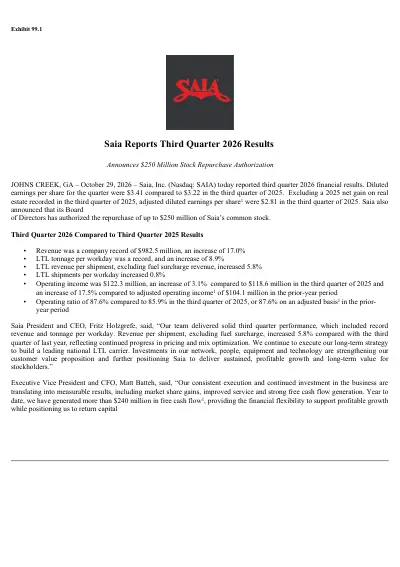
We're pleased with our solid third quarter performance, which included record top line revenue and tonnage. Our results demonstrate that prudent investments in our network, people, equipment, and technology are strengthening our customer value proposition and further positioning Saia to deliver sustained profitable growth and long-term value for stockholders.
Third quarter revenue increased 17% to a record of approximately $982 million, supported by 8.9% tonnage growth, 0.8% shipment growth, and a 5.8% increase in revenue per shipment, excluding fuel surcharge. These results reflect broad-based business momentum and the continued execution of our pricing and mix optimization strategy.
Operating income increased to $122.3 million, or 17.5%, from Q3 2025 adjusted operating income. From a profitability perspective, we've delivered strong operating discipline through execution in both our legacy and ramping terminals.
Our operating ratio was 87.6%, consistent with the prior-year adjusted result and significantly better than the typical seasonal trends. Notably, we maintained a sequential operating ratio within 70 basis points of the second quarter, despite the historical pattern of approximately 150 to 200 basis points of deterioration from the second quarter to the third quarter, reflecting our continued focus on pricing, productivity, cost management, and operational execution.
These results reflect continued execution of our long-term strategy to build a leading national LTL carrier by expanding network reach and density, scaling the fleet, and increasing our addressable market, leveraging technology, and optimizing efficiency, all while delivering superior service and converting scale and customer value into profitable growth and higher returns. As part of that strategy, we've made continuous investments across our network to strengthen the business.
Since the beginning of 2022, we've added 45 terminals and relocated or expanded more than 25 others. Those investments have increased our operational door count by approximately 32% and tractor and trailer capacity by more than 35%.
As our network continues to mature and density builds, we are better positioned to create more solutions for existing customers, attract new customers, and further improve network efficiency. Today, Saia is serving customers with a national solution.
Our expanded footprint, combined with technology investments and network optimization, has improved efficiency, reduced freight handling, and enhanced service levels across the network. In June, we introduced our REV initiative, which marked another step toward improving the customer experience through faster transit times, expanded capabilities, and greater shipment visibility.
Among other improvements, REV improved transit times in more than 2,000 lanes across our network. While implementation remains in an early stage, the results of the initial phase of the REV initiative are encouraging, with lanes benefiting from improved transit times experiencing outsized volume growth.
As we continue to gain traction with both new and existing customers, density continues to build across our national network. In Q3, handling or touches improved 1.3% compared to the second quarter and improved over 2% compared to the third quarter last year.
Our operational improvements continue to be supported by our investments in optimization technology, which help drive efficiencies as our network scales. Our pricing and mix management efforts continue to gain traction as our broader network strengthens the value we provide to customers.
In a changing freight environment, shippers value reliable service, and our expanded network allows us to serve more of their needs. We continue to see improvements across several key service metrics.
Our cargo claims ratio was a company record 0.3% in the quarter, improving more than 40% from the third quarter last year. Consistent execution on service and claims supported a 10.8% contractual renewal rate in the third quarter.
Our network investments have continued to move us closer to the customer, with over 60% of zip codes now within a 50-mile radius of a Saia terminal, which compares to about 35% in 2017. Our proximity to the customer supports our ability to exceed their expectations, which is represented by our internal Net Promoter Score improving 15% compared to the third quarter of 2025.
Those improvements reflect better scheduling, pick up reliability, delivery quality, and effective problem resolution. Our network investments are translating into tangible results, helping us meet customers' evolving needs while supporting market share gains and improved service.
The operating benefits of these investments, together with the scale of our network, are contributing to strong free cash flow generation. We believe we are just beginning to see the benefits of our investments as the network matures and density builds.
Year to date, we've generated more than $240 million in free cash flow and ended the quarter with over $200 million of cash on hand. With a stronger network and operating platform in place, we are well positioned to continue strengthening Saia's position as a leading national LTL carrier while improving profitability and delivering returns on our investments.
As part of our ongoing capital allocation strategy, we are pleased to announce that our board has authorized the repurchase of up to $250 million of Saia common stock. This new authorization provides an additional means of returning capital to stockholders when repurchases represent an attractive use of capital, subject to market conditions and our other investment priorities.
With the majority of the foundational network build-out behind us, capital expenditures are beginning to moderate relative to the recent investment cycle. That transition, together with stronger free cash flow and low leverage, provides flexibility to continue funding high-return growth investments while repurchasing shares when valuation and market conditions makes doing so attractive.
Reinvesting in the business to support long-term growth and maintaining a strong balance sheet remain our priorities. Through disciplined execution through the past several years, we've created significant financial flexibility.
That flexibility allows us to continue to invest in the opportunities ahead while returning excess capital to stockholders when appropriate. As part of our long-term strategy to support sustained performance for stockholders, we continue to strengthen the board's composition and oversight.
Earlier today, we announced the appointment of Todd Fowler as an independent director. Todd brings extensive expertise in transportation, logistics, supply chain, technology, and capital markets, and we are pleased to welcome him to our board.
Before I hand it over to Matt for more details on the quarter, I'd like to highlight that we remain focused on disciplined execution while navigating a mixed freight environment. We are improving service, deepening customer relationships, and converting the scale of our network into greater density, utilization, and profitability.
These actions position us to deliver profitable growth and stronger returns over time while preserving additional operating leverage as freight conditions improve. Matt?
Matt Batteh
Thanks, Fritz. Third quarter revenue increased 17% to $982.5 million.
Shipments per workday increased 0.8%, tonnage per workday increased 8.9%, and average length of haul decreased 1% to 885 miles, all compared to the third quarter of 2025. Revenue per shipment, excluding fuel surcharge, increased 5.8% year over year and 2.7% sequentially from the second quarter.
Fuel surcharge revenue represented 22.5% of total revenue compared with 15.2% a year ago. Including fuel surcharge, revenue per shipment increased 16.1%.
Weight per shipment increased 8.1% year over year and 1.2% sequentially from the second quarter, reflecting our continued efforts around mix optimization. As a reminder, higher weight per shipment typically reduces yield.
As a result, yield, excluding fuel surcharge, declined 2.2% compared with the third quarter of 2025, while yield, including fuel surcharge, increased 7.4%. Importantly, yield, excluding fuel surcharge, increased 1.5% sequentially from the second quarter, despite the increase in weight per shipment.
We continue to see progress across recently opened terminals. Compared to the third quarter of 2025, the operating ratio in terminals opened in 2023 and 2024 improved by 40 basis points, while operating income from these terminals improved 22%.
Notably, these terminals' revenue per shipment, excluding fuel surcharge, improved year over year at a higher pace than our legacy terminals. We are pleased with the continued improvement across these facilities.
While they remain early in their ramp towards greater scale and density, they're already delivering tangible results, including enhancing our ability to provide better service to customers. Turning to expenses.
Salaries, wages, and benefits increased $46.7 million, or 11.6%, compared to the third quarter of 2025. The increase primarily reflected wage increases and higher compensation associated with improved company performance.
Total headcount increased 0.4% year over year, while headcount, excluding linehaul drivers, decreased 0.6%. Removing the impacts from the five terminals opened in the second quarter, headcount is down 0.5% compared to the third quarter last year.
Group health insurance costs also increased $2.3 million from the third quarter last year, reflecting the continued impact of the inflationary cost of claims. Truck and rail purchase transportation miles represented 15.7% of total linehaul miles compared to 12% a year ago.
Compared to 2025, our usage of rail as a percent of purchase transportation increased, now representing nearly 39% of our total purchase transportation miles. Our usage of rail remains cost-advantaged on a per-mile basis, and we will continue to leverage our growing scale and technology investments to optimize our network.
Across the entire purchase transportation spend, the underlying rate per mile, excluding fuel surcharge, increased about 4% compared to the third quarter of 2025. Fuel expense increased 55.2% compared to the prior-year period, reflecting a 48.1% year-over-year increase in the national average diesel price.
Company linehaul miles increased 2.4%. Claims and insurance expense decreased 10% year over year, reflecting a decline in preventable accidents and favorable claims experience.
Depreciation expense was $64.1 million, essentially flat with the prior year. Higher depreciation from ongoing investments in revenue equipment, real estate, and technology was offset by owned assets becoming fully depreciated during the year.
Total operating expenses increased 16.9% compared with the adjusted operating expenses in the third quarter last year. With revenue growth of 17%, our operating ratio was 87.6%, unchanged from the adjusted operating ratio in the third quarter of 2025.
Quarter tax rate was 24.7% compared to 24.8% in the third quarter last year. Diluted earnings per share were $3.41, up 21.4% from adjusted diluted earnings per share of $2.81 in the third quarter of 2025.
We ended the quarter with $203 million of cash on hand and $100 million of total debt outstanding. I will now turn the call back to Fritz for some closing comments.
Fritz Holzgrefe
Thanks, Matt. As we begin the fourth quarter, the momentum of exiting September gives us confidence in the business, while we remain focused on navigating the broader freight environment.
I'm proud of our team's continued focus on service to our customers through daily execution and pleased with the progress we're seeing across the business. We're seeing stronger service performance, including a company record low cargo claims ratio, improved on-time delivery, and continued progress in customer satisfaction.
The early results from the REV initiative also reinforce the opportunity to use faster transit time and greater visibility to serve more customers and build density across the network. Broader network is [unclear] our ability to existing customers, attract new customers, and compete nationally.
As the network matures, we remain focused on pricing and mix optimization, productivity, [unclear] utilization, and cost discipline. These priorities are helping us convert network scale into stronger operating [unclear] while preserving additional opportunity as freight conditions improve.
We also remain committed to executing our disciplined capital allocation approach. There are significant opportunities ahead, and
Operator
Pardon me, this is the conference operator. We seem to have lost the connection with the speakers.
Please stand by as we get them reconnected. Pardon me, this is the conference operator.
We've rejoined the speakers from Saia. Please go ahead.
Fritz Holzgrefe
All right, I will try to pick up where we were leaving off. We were talking about our broader network is improving our ability to support existing customers, attract new customers, and compete nationally.
As the network matures, we remain focused on pricing and mix optimization, productivity, utilization, and cost discipline. These priorities are helping us convert national scale to strong operating performance while preserving additional opportunities as freight conditions improve.
We also remain committed to executing our disciplined capital allocation approach. There are significant opportunities ahead, and reinvesting in the business and maintaining a strong balance sheet remain at our top priorities.
The newly authorized share repurchase program provides additional flexibility to return excess capital to stockholders. We have strengthened the business, improved our operating platform, and created a clear path for further growth.
While there's still work ahead, we continue to focus on the factors within our control and executing consistently for our customers, employees, and stockholders. With that said, we're now ready to open the line for questions, operator.
Operator
We will now begin the question-and-answer session. To ask a question, you may press star then one on your telephone keypad.
If you are using a speakerphone, please pick up your handset before pressing the keys. To withdraw your question, please press star then two.
Our first question today is from Scott Group with Wolfe Research. Please go ahead.
Scott Group
Hey, thanks. Good morning, guys.
Can we just start with the tonnage update and then maybe, I know you always give the color on Q4 OR?
Matt Batteh
Sure. Hey, Scott.
Just to kick off, apologize for getting disconnected. If anyone has any items that need clarification, certainly just let us know.
Scott, to your question, I'll go ahead and give the full slate of the months. I know the mid-quarter update was out there, but just to recap: for July, shipments per day were up 0.8%, tonnage per day was up 7.8%; August, shipments per day were up 1.1%, tonnage per day was up 8.7%; and September, shipments per day were up 0.4%, and tonnage per day up 10.3%.
If I look at where we are month to date of October, still a few days left obviously, but shipments are up about 2% year over year, tonnage is up about 10% year over year, which is in line with seasonal expectations. When I think about the OR, typically what you'd see in history from Q2 to excuse me, Q3 to Q4 sequentially is an increase of about 250 to 300 basis points.
Based on what we're seeing so far with October trending seasonally, we feel like we can keep that in the 200 basis points or so range, which would represent OR improvement year over year of over 200 basis points. We feel good about where that's tracking right now, but obviously a long way to go, but we feel pretty good about being able to outperform what we typically see on the Q3 to Q4 sequential.
Scott Group
That's helpful. Then, I know you don't tend to give lots of mid-quarter update color on sort of yields and pricing, but maybe I think pricing trajectory is pretty important right now, I don't know, maybe some color you can give on what you're seeing and what you're expecting on yield trends for Q4?
Matt Batteh
Sure. We put a GRI in place in July, as and we continue to see great results from that.
Obviously, there's always a lot of business that moves around in the early stages of that, but when I look at our take on the rate on that over the past couple years and even this year, that's gotten even better, which in our view is directly correlated to the ability to service more customers and do things for them in different lanes. The REV initiative that Fritz talked about is certainly part of that.
We implemented the GRI last year in October, you lapped that at this point, but we've been working hard on pricing, mix optimization. I think you see that in our weight per shipment trends.
We're very focused on driving rate, finding the customers that value the service that we provide. We're pleased with the progress, but we've got to keep pushing on that.
Fritz Holzgrefe
We were pleased what we've seen in Q3, and I should point out that kind of that LA region, which historically has been in a really important region for us, really is kind of bouncing around kind of we haven't seen that recover yet. That 5.8% revenue per shipment improvement includes kind of headwind from that region not being where we'd like it to be.
We're particularly pleased with what we saw in the third quarter. Right.
Scott Group
I guess what I'm trying to figure out is revenue per shipment is up 5.8% in Q3, yield's down 2.2%. Do you think that we see sequential improvement on those metrics in Q4?
Do we stay static, take a step back, any just sort of directional thought?
Matt Batteh
Sequential increase certainly our approach. We've got to keep driving that forward.
The year-over-year number, Scott, that you're talking through on the yield side certainly has the impact from that heavier weighted shipment. Even with heavier weighted shipments Q2 to Q3, yield was still up.
That gives a view of the core pricing approach, the metrics in there. No, we expect to continue to drive that improvement sequentially.
We're critically focused on it.
Scott Group
All right, thank you, guys.
Operator
The next question is from Jordan Alliger with Goldman Sachs. Please go ahead.
Jordan Alliger
Hi. Good morning.
It was good color on the new terminals. I'm just curious, can you maybe talk a little bit more color around sort of the density fill that you're experiencing on those new terminals?
I'm assuming it's probably accelerating, given you're seeing that year-over-year OR improvement and good EBIT lift off. Can you maybe talk a little bit about maybe some key metrics or so that to ascertain perhaps how that excess capacity has been diminishing, how much versus, let's say, last year or even at the start of this year?
Thanks.
Fritz Holzgrefe
Jordan, that's something that we pay particularly close attention to the performance of the new facilities. To date, we've been pleased with it.
I think based on our historical experience with openings, frankly, the environment that we open these facilities in has been a little bit softer than it was historically in terms of the performance we've seen at. Now, although they improved year over year, they're still below the company average in total, but we continue to make progress there.
I think that that is part of what you're going to see, frankly, into Q4 and into next year is the continued improvement in those markets as we develop maturity, develop those customer relationships, customers experience the kind of service level we're able to provide out of those newer facilities. I think that from here we'd continue to expect that to accelerate.
We're pleased with the growing profitability in those terminals, for sure. There's still runway there for us, though, they're not where they need to be.
Matt Batteh
The other thing we track with that, Jordan, is on the REV initiative, the way that we're able to improve those 2,000 transit lanes, and that's just the first batch, we're going to continue to do that. That's density build in the network.
At the beginning when you open these facilities, you often don't have enough freight to move direct and to a destination, it's got to go back to a break, get offloaded, and aggregated with more freight. When you've got density and that starts to build, you're able to run that more directly.
You see that in the handling and the touches, you see that in the revenue per shipment, where we're able to charge more because part of it is being applicable or faster on the transit time. It's all-encompassing, and like Fritz said, those aren't where they need to be yet.
They're not where our legacy markets are, but that's part of the journey. We're pleased to see it.
Jordan Alliger
Great, thank you.
Operator
The next question is from Stephanie Moore with Jefferies. Please go ahead.
Stephanie Moore
Great, thank you. Good morning, everybody.
Maybe just turning to the pricing question here. I'd love to get your update here on how we should think about the opportunity for you guys to further just narrow the pricing gap versus peers.
Then, obviously, with contractual renewals accelerating here that you call that, I think you said double-digit renewals, how much of that is being driven by your own specific actions, and if so, what are you guys doing behind the scenes, and then also how much of this is just being driven by just a more supportive pricing environment? Thanks.
Fritz Holzgrefe
Our internal organization focus is strictly around the customer, right? It's all about service.
Service is about improving. If you look at our claims number that we highlighted, 40% improvement year over year, you see the new terminals, the introduction of the improved transit times in 2,000 lanes, all of those give us an opportunity to provide better service and a better experience to our customers.
Those things all lead to supportive pricing opportunities. Certainly the environment that's out there I think is positive, but customers are also more demanding than ever because they're dealing with inflationary costs, they're dealing with their own supply chain challenges and those sorts of things.
They need somebody that's got higher levels of reliability, and I think we can deliver that to them, and that puts us in a position that, when our team gets in front of the customer, they've got something that they can sell. They can sell a network that is much closer to the customer than it's ever been, performing at a very high level, record low claims, all those things add up to supporting the pricing thesis.
If I look across the landscape and you can see kind of where the national market is for all the national players, and you can see that Saia is doing a great job, but there's an opportunity for us to continue to push the pricing, and, frankly, the service levels that we've been providing I think support that.
Stephanie Moore
All right, thank you, guys. Appreciate it.
Operator
The next question is from Chris Wetherbee with Wells Fargo. Please go ahead.
Chris Wetherbee
Hey, guys. Good morning.
I guess maybe wanted to talk a little bit about optimizing sort of the mix, and as we think about it, the weight per shipment. You guys obviously have been bringing that up quite a bit.
It looks like it's also trending up well in the fourth quarter, or at least in October so far. Can you talk about where you are, and I don't know if that maybe is sort of talking about the new terminals versus the old terminals, and just get a sense of kind of bringing that mix to where it needs to be, just wanting a sense of how much more you might need to see weight per shipment move up before you guys feel like you got the right balance?
Fritz Holzgrefe
That's a good question, Chris. When we think about it, our focus is really on, there isn't the ideal shipment.
Certainly, a higher weight per shipment, as we all know, delivers greater demands on our network in terms of greater space utilization, filling up trailers, greater difficulty around handling it, it's really critical that we find the customers, we know there're increased costs that comes along with all those things, but it's critically important that we find customers that say, look, we need to have a LTL partner that is going to be able to deliver on time with damage-free, and those customers are the ones that are really going to support our value proposition. Now, certainly that can be a higher weight per shipment customer, it can also be customers that have very, very high demands and have low weight per shipment, maybe one- and two-day service, but it's critically important in those businesses that they have a partner that delivers on time, damage-free, right?
In that scenario, that customer values that. I don't know that there is a perfect mix of business in the sense of what's the length of haul or what the weight per shipment is, it's the customer that says Saia is doing a great job, that's the partner we need to have, and that's the customer that is willing to pay for that service.
It can come from a range of customers. I point that out because I think that's critically important.
As we have been able to shift and evolve this network, and we're adding the improving transit times for 2,000 lanes, certainly that benefits the higher weight per shipment customer, but that also benefits the one- and two-day service customer who absolutely needs to have something done on time, and maybe their weight per shipment's only 500 or 700 pounds weight per shipment, but they say, I value that investment in network because we can provide performance for them, and that is a customer that's willing to pay for that service. There isn't a perfect mix sort of case study around what it's got to look like, it's more about what's the customers say, hey, I need to partner with somebody that's providing a very high level of service.
Chris Wetherbee
Okay. That's super helpful color, appreciate that.
Maybe big picture, if we just zoom out a little bit, now that you feel like you're making some progress on the yield front, as we look at '27 or maybe just bigger picture, longer term, what do you think the incremental margins of this business will be, assuming we're in a positive tonnage environment like you guys are putting up? What can we expect the sort of incremental profitability to look like?
Fritz Holzgrefe
Our expectation is it continues to improve. If you think about even just the guide we just gave for the fourth quarter, we think there's an opportunity to grow OR year over year by over 200 basis points, and I think that continues, and I think that opportunity for us to drive profitability in the business is pretty compelling, right?
As we have the opportunity to scale the network, the incremental margins in the facilities that are what we call ramping, the incrementals there should continue to improve. Those are all beneficial.
I think this is all the path to that sort of sub-80 OR. Timing, the external markets, all those things, those are some things that we can't control, but I do know that as I look at close in, our execution is pretty high, the service is very high, and we're getting some traction around pricing, so that leads to what looks like a pretty good fourth quarter for us and into next year.
Chris Wetherbee
Appreciate the color. Thank you very much.
Operator
The next question is from Ken Hoexter with Bank of America. Please go ahead.
Ken Hoexter
Hey, great. Good morning.
Fritz, sorry about the BYU loss, and good luck in Miami. I know you're looking to fill out density.
Is this like the phase post the Northeast expansion where you've made upfront commitments and now we should look for CapEx to fill in density on a nationwide basis? I'm just wondering how we should think about CapEx, is it going to be lumpy, what your needs are going forward?
Thanks.
Fritz Holzgrefe
Thanks for the support, Ken. Keep in mind, Miami's got to go to South Bend, and it's going to be cold.
With respect to our total network, I think what you think about from here is that if you go back to the days of the Northeast expansion, we built out, put terminal leadership, regional leadership in place, and as we developed those markets, we were able to drive some really strong, robust returns. I think the environment that we've been operating in with the facilities we've opened, we haven't had the sort of stronger backdrop to drive those returns, but nonetheless, we had to put in leadership in these new facilities, the appropriate driver and support teams in place to take care of the customer, because that's part of it.
Now I think what you're seeing, and Matt pointed it out in his remarks, about the improvements in those facilities, and I think we see the incrementals on the facilities start to approach what we saw in the Northeast. Then I think, frankly, over time that the rate of improvement in those should accelerate.
We like the performance in there, we think the customer experience has been good and continues to improve. I think all those things portend to improved incremental performance out of those facilities.
Ken Hoexter
Right. I was talking just maybe a little adjustment, but I was talking more about the thoughts on CapEx needs, right, given you're driving free cash flow for buyback, but I'll throw in my follow-up too.
Oh.
Fritz Holzgrefe
Yeah. No problem, Ken.
I left that part out. Listen, at this stage, as we continue to drive profitability in the business, we're going to generate cash flow.
I think anybody's run the model around where Saia is understands that the ability for us to generate cash flow is really positive. I think that we've done a good job managing the balance sheet.
There are investments that we're going to have to make in the business, but we're in a position now where the appropriate utilization of the shareholders' capital here is we got to make decisions around, all right, it's an attractive market, those are ones that get us incremental returns that help us filling the network from here. Certainly, we're going to make those investments, but as we drive profitability, we're generating cash, and there's an opportunity where appropriate that we can make the necessary returns to shareholders.
We think that's part of the sort of developing profitability of the business, and I think that is something that we knew that was a big potential of the business for a while now, and we just feel like at this point we're in a position we can make the announcement we did. That's not to say we don't have investment opportunities, but I think we've got the opportunity now where we're better positioned to make all the choices to allocate the capital appropriately.
Then,
Ken Hoexter
Fritz, just a follow-up on kind of you had some mix questions before on pricing and impacts and talked about weight per shipment, but how about the customer type, whether, from your peers, we hear a lot about going after SMBs or local customers, maybe different end markets? Can you talk about that and if that's having an impact on your pricing or if that's part of the process at this point or just still focus on national accounts as you enter new markets?
Fritz Holzgrefe
Ken, I think we're focusing broadly across the national network now, and I think that's important. That can be a regional account, that can be a national account, could be a partner in a 3PL.
Most importantly, these are all customers that understand the value of that 219-terminal network. That's really important.
They understand the value of service that they're getting, what we can provide for them. That can sort of agnostic industry.
Certainly they're industries that we have benefited from. You see the data center business, I think we're exposed there a bit, that's helped drive some profitability.
Frankly, the one consistency when you go across all industries is the people that really value an LTL partner that can provide a high level of service. That can be any number of industries, but we're pleased to see that it's been kind of a national sort of success.
Matt Batteh
Being in the market is critical. I think it might have been Chris's question earlier where we talked about that.
At 219 facilities today, we get more seats at the table with customers. We get the opportunity to solve more problems, and the conversation around, well, you can't do this for me, well, that's less now than it's ever been.
Every day at Saia is an opportunity to have a better discussion with the customer about what problems we can solve for them. That's why Fritz gave the stats in his comments about the door capacity and the terminals that we've opened, not just opened, but relocated and expanded over the past number of years.
That's capacity for a customer. That's our ability to service them.
Being in the market really matters, and we're getting the chance to be on equal footing with everybody else, which we're really excited about.
Ken Hoexter
Great, guys. Appreciate the thoughts and insight.
Operator
The next question is from Richa Harnain with Deutsche Bank. Please go ahead.
Richa Harnain
Hey, good morning, Fritz and Matt. Thanks for the opportunity.
First, I just wanted to get some clarifications on the OR outlook. I'm just curious what you've assumed for kind of November, December, is it normal seasonality?
From a year-over-year perspective, would that mean something similar to the 10% in October, or maybe lower, I know your comp gets tougher. Then would love to understand kind of what's also assumed for fuel and that sort of thing.
Matt Batteh
Sure. From a seasonality standpoint on the shipment side, from here we're expecting normal seasonality.
Typically, what you'd see is, obviously, as you get into the holiday months, things slow into November and then again into December, but the guide implies and expects normal seasonality. On a fuel side, the guide embeds fuel that's sort of on a October average, is how I'd frame that.
Fuel hanging in an October average, shipment levels at seasonality. You're right on the comps, they move around a little bit into November and December, but broadly from a sequential basis, what we're expecting in the guide is seasonality, normal seasonality.
Richa Harnain
Okay. On headcount, I wanted to clarify.
I think you said it was down, tonnage is up a lot, very impressive. I guess, how are you doing that?
How much excess capacity do you have? How long does that kind of algo work that way, and before you probably need to start adding more headcount?
Then longer term, I guess, this plays into, Fritz, I think you said over 200 basis points of margin expansion, I know that's the guide for Q4, but it was also implied that this could be something that occurs for 2027. Is that a preliminary view or what were you trying to say there?
Matt Batteh
I'll start with the headcount part. That's right, we've made a lot of investments in our network and linehaul drivers.
If you exclude that, the headcount number is down a little bit. Same thing if you exclude the impact from the five new terminals that we opened in Q2.
Part of building a network and density is scale opportunity. You have the people in the new markets before the volume comes, you have to be in the market, you have to provide great service, but a new market is not as dense on the pickup side as a legacy facility would be.
Over time, you get the opportunity to scale and leverage those investments that you always have to make when you open a facility. You can't open them without people, you have to provide service for a customer.
We're making strategic investments, depending on what the volume environment looks like as we get into next year. There's probably going to be some adds, we've got more opportunities to continue to optimize our network, but we are very diligent on what that looks like.
We've been pretty restrictive on that for a number of quarters, but service is important, and we're going to continue to make those investments. We'll see what the environment deals us in the early part of next year to see where headcount goes.
Fritz Holzgrefe
I would just add just on the comments about next year, I think we're going to see a continued improved performance in the Q4. I think the incrementals will be good year over year.
I'm expecting that to continue into next year. Can we hit that sort of to our long-held goal of 200 OR improvement, or point OR point improvement on an annual basis?
Depending on what the environment deals us, I think we could, frankly. I think we could do better than that.
At the same time, I think there's a fair amount, let's see how it develops. I know close in, I like what we're seeing from a core execution perspective for the customer, I like the trends that we're seeing around kind of our revenue per shipment, that's important, and yeah, you put those things together, and I look at these facilities that we've invested in, we're able to generate returns, and we're seeing growing operating income and improving OR there, those all portend to next year kind of OR expansion.
I think I like the trends that we're on right now. I think that those are all positive.
Operator
The next question is from Tom Wadewitz with UBS. Please go ahead.
Tom Wadewitz
Good morning. I wanted to ask you a little bit on the cost side.
I know you've got obviously with capacity expansion, you're going to add costs and add capacity, but I guess if you look at a kind of like-for-like basis, what does inflation look like in terms of, I guess you got probably some wage inflation, some group health, that type of thing, but maybe some incentive comp that's stepping up as well. Just if you have some thoughts on that, and then would you expect that level of inflation to decrease when you go to next year?
Then I think the second question, another important element would be you talked a little bit about purchased transportation and outsourced linehaul miles. That's something where seems like that's been reasonably well-controlled, but obviously truckload rates are going up a lot or have gone up a lot, and I'm just wondering timing of your reprice of that or your contracts, is that something we should contemplate in terms of there might be a step change for you in the future or is that different?
A couple things there, but also just kind of like rail versus truck in PT, it sounded like there was some nuance there. Kind of overall inflation, how we ought to look at it, and then just kind of more unpacking on PT.
Thank you.
Matt Batteh
Sure. I'll start with the inflation aspect of it.
Look, every line in this business is expensive. If you have to provide great service, you've got to have a best-in-class team, you've got to have equipment, facilities, have best-in-class benefits, all of those are expensive.
We're going to continue to work hard on efficiency, productivity, optimization, every single piece of that in the hopes that we can mitigate the cost inflation, but the nature of this business is inflationary. It's a high-asset-intensive business that requires investment.
I'd expect cost inflation to continue. I don't see a reprieve on things like health insurance and benefits, those are part of our strategic investments in our people to provide great service.
We're going to continue to work hard on that, but I'd expect cost inflation, wage increases, those are just part of the ongoing nature of the LTL business. From a purchased transportation side, the underlying rate per mile increase, ex-fuel, if I just look across the entire base, was about 4%.
Obviously that's really well-controlled compared to what you're hearing out in the environment. The way that we use PT is strategically.
We are not in the spot market, the way that we use it as an extension of our network. We won't use it if it doesn't make service, that's the number one gating factor for us.
We do use rail. Rail is very cost-advantaged, and over the years, if you look, we've had the opportunity to use more of that with a wider network.
As a percentage of the PT miles, that's approaching 40% of miles. As the network builds density and we get the opportunity, if you look at our map, we have double-digit market share in our Houston markets and Texas, where we've been the longest.
As that expands and we build more density, we'll have opportunities to insource some of that, but we believe that we use it effectively, and PT is part of how we operate our network. I like to use rail where we can, and had been able to use that more over the past several years, and you saw that in this quarter as well.
Fritz Holzgrefe
I would just add on top of that, Tom, is the optimization model you're running, and Matt walked through exactly kind of how we think about this, but in our prepared remarks, we noted that we actually increased the number of headcount in our linehaul team, and the reality what that is is the optimization model said that basis external, using truck PT or rail, we found that it was cost-optimal in some lanes to actually hire more people internally to insource that. That equation around, all right, is the service match and then what's the optimal cost structure, that'll continue to evolve over time, and that's an important part of how we manage the cost structure.
When we look at our cost structure, and I think we're pleased with how we performed on managing cost in the quarter, if you look at our weight per shipment's up, handling, complexity of the freight that we're handling has increased, all those things would lead to higher levels of cost, and I think we've managed it pretty well, in part because we know how to use PT and run the optimization models around that.
Tom Wadewitz
Just, I guess, just to make sure I understand that, there's not an intention really to vary meaningfully the outsourced linehaul miles from where you are, you're kind of comfortable with that? Then I guess on the contractual piece, if your truckload is contractual and well-controlled at 4%, would also imply contracts would expire at some point, I don't know if they're just kind of mixed through the year so you don't really see a bigger impact, or if there is kind of a timeframe that they tend to expire that you might see a little greater step-up?
They're
Fritz Holzgrefe
mixed through the year, Tom, but I would tell you that our focus, and it always has been, is that we need to get the OR in this business below 80, we're going to take the cost-optimal way to get us there, and that's going to require us to figure out ways to best manage our network costs, moving freight between the 219 facilities. If we find that the contractual environment for PT partners is increasing at a rate that doesn't make sense for us, our solution to that or the way we would manage that is we probably insource with more of our own drivers in certain markets, maybe tap rail in certain markets we can, and that's all part of the equation.
If I look at the opportunity around what Saia has, is it's continued to leverage that cost structure to do a great job servicing customers, but the real value driver in the business is really getting the pricing and mix where it needs to be, and I think that's what gets us to the low-80s OR and beyond.
Tom Wadewitz
Okay. Great.
Nice to see the share buyback program, too, and the capital discipline. Thanks for the time.
Thanks, Tom. Thanks, Tom.
Operator
The next question is from Brian Ossenbeck with J.P. Morgan.
Please go ahead.
Brian Ossenbeck
Hey, good morning, guys. Thanks for taking the question.
Maybe you can put a little finer point on the difference in the performance of the legacy and the ramping terminals, how that gap has changed throughout the year, where you expect it to be in the fourth quarter. It still seems like there's quite a bit of improvement there, and I don't know if that's going to be something that improves gradually, and I guess, frankly, how big that gap is right now between the two?
Matt Batteh
We're certainly pleased to see the progress. Year over year, those newer or ramping facilities, they improved 40 basis points year over year.
They're operating in the low 90s, and they're making progress. Importantly, they're starting to build density.
A uplift helps those a lot. Like I mentioned before, you've got the natural cost and that's part of opening a facility.
You have to have a terminal manager, you have to have sales staff, you have to have people that can service the customer, and those facilities are generally not as dense, they're generally not as efficient in their pickups early on because they're in newer markets. There's still a bit of a gap, to be expected, but they're going to continue to march themselves forward.
I would point to a few things that are extremely important for us. Those are going to continue to march their way.
Those facilities also benefit the legacy facilities. We've seen countless examples.
Number one, we're getting more seats at the table, but we've seen countless examples of a customer being willing to give us business in a legacy market, areas that we've covered for years, because we can also cover a new market. That's ease to the customer, that's the ability to say, you know what, Saia, you can handle all these locations for me, I'm going to give you a shot at this business.
We look at them and we measure them independently, and they're going to continue to drive strong incrementals, but the opportunity is in the remainder of the business as well. I think you're seeing that in the outsized revenue per shipment growth, the volume growth in the lanes that we improved transit times, the more that we get like-for-like and have the ability to compete on a real basis, that's critical.
They're going to continue to march their way, but they also impact the legacy facilities as well.
Brian Ossenbeck
Would that be more of a step change when you hit, I don't know, a critical mass or critical density, just trying to figure out how that could look in the future? Then maybe just to follow up on Fritz, you mentioned I guess kind of relatedly, there's still some mixed shift bouncing around in the West Coast area, just want to understand what that was because it feels like it's been out there for quite some time, and still seems like it's a headwind.
Fritz Holzgrefe
What I would just point out with Brian, with the West Coast, it was just still down. LA region was still down a bit year over year, kind of low single digits.
That's a higher revenue per shipment for us, that's a bit of a mixed headwind. I think it's just kind of the nature of that market right now, at least as it relates to what freight that we think makes sense in our network and the customers that might be interested in working with us, so that's probably part of it there.
I think that over time what I'm excited about is that the rest of the business is doing pretty well, so that's a continued opportunity for us.
Matt Batteh
That's right. On the other piece, Brian, on a step change, a stronger backdrop certainly helps those, right, where you've got a driver in a new market that may be going out and getting seven or eight shipments every time he goes out on a route, a legacy facility may be 12 to 15, and very market-dependent.
An uplift certainly helps that, but we're going to continue to push our way there. It's just work, right?
It's execution, it's the opportunity to get in front of a customer and get the opportunity to do a great job, handle their freight, and get a second shipment the next day. It's execution that's really going to drive that.
Brian Ossenbeck
Guys. Thanks for the time.
Appreciate it.
Operator
The next question is from David Vernon with Bernstein. Please go ahead.
David Vernon
Hey, good morning, guys, and thanks for having me on. I wanted to ask about the rev per bill focus.
Obviously, I think I understand, the more revenue you get per stop, then the cost of kind of the same to make a stop, you should be getting some leverage out of that. I'm just wondering, whether the heavier freight is priced for the extra work it's adding, the lack of sort of margin leverage, I guess, to the tonnage number is really what I'm trying to get at, and whether there were any sort of temporary or transitory things getting in between the tonnage growth and actual margins in the quarter, or how we should think about that relationship maybe for 2027?
Matt Batteh
Like Fritz talked about earlier, we're interested in finding the customers that are willing to pay for the service that we provide. The tonnage shift and the heavier weighted shipments, they often come with more handling units and having to do different things to service that for a customer.
Over time, we feel like finding the right mix of business in our network is going to drive the incremental margin opportunity, the OR opportunity for us. All else equal, on a heavier weighted shipment, you get paid more for it.
Keep in mind that a heavier weighted shipment that's in a one- and two-day market is different than one that may have been coming out of an LA market that Fritz just talked about that's still down a little bit. There is extra cost associated with handling them, but it's also an opportunity for us to be more embedded with a customer and have the message of we're willing to continue to do this for you, but we also want an opportunity to handle your heavier weighted shipments as well.
There's increased costs associated with it, but we're finding the right mix of business that works best in our network.
Fritz Holzgrefe
I think there is opportunity to continue to drive sort of the incrementals even on the heavier weighted shipments, part of that is getting additional density with the customer, that's part of it's there. I think in the third quarter, we count the cost headwinds that we highlighted in there in that sort of discrete period, those were all headwinds to us into the incrementals there.
If you look at what we're thinking about or what we've guided to in the fourth quarter, we're expecting kind of the mix of business that we have presently to kind of continue on a sort of seasonal basis, and with the sort of OR improvements that we're expecting in Q4, those are reflective of incrementals there. I think you're going to see some better sort of leverage performance out of that in the fourth quarter and into next year.
That's something we're very closely monitoring and closely attuned to because that, certainly heavier weighted shipments, although a lot of things you like about that, that also adds network complexity, and you got to make sure that you've got that priced accordingly. We like how it lays out for us into Q4 and beyond.
David Vernon
All right, thanks for that. Then, I guess, with hiring, the labor market is obviously very tight right now.
Is that maybe adding to incremental cost pressure? I'm sure it is in purchased trans, but just wondering as far as kind of the expansion that you're having, the marginal cost you're adding, is that coming in at a higher rate that's also maybe kind of contributing in the short term here?
Fritz Holzgrefe
I think that's pretty minor in the whole scheme of things, where we are having added hiring costs. I think that the one nice thing about some of these newer markets, we are scaling in those markets as we're adding volume, but we got to continue to drive the incrementals in those and in the newer facilities.
I think that's probably going to really help us address with the incrementals over time as we continue to leverage those facilities.
David Vernon
All right. Thank you for the time.
Operator
The next question is from Eric Morgan with Barclays. Please go ahead.
Eric Morgan
Hey, good morning. Thanks for taking the question.
I just had one on service, great to see the tangible improvements in claims ratio the last couple quarters, and I think you saw lower claims and insurance expense in the P&L as well. I was just wondering with the Mastio results coming out recently, if you have any new insights into where you have further opportunities to make progress, or just where you think it should be focused, to kind of take that next leg up on service outcomes?
Fritz Holzgrefe
I think all the investments that we're focused on right now, whether it be the REV initiative that we talked about, the REV initiative is an interesting opportunity for us because improving transit times and predictability are all things that customers really value. As you build density, you're able to do that, which also has a cost benefit as well, a little bit highlighting some of that leverage opportunity from the last question.
As we continue to develop those, it does two things, right? It certainly provides great value to the customer because they've got a more predictable service that they like to see.
On the cost side, that's a benefit. We track very, very closely our internal service performance.
Our Net Promoter Score is up 15%, and those are with customers that we do a lot of business with, right? I feel like that's great feedback, and I also think we look at kind of the markets where we've been able to grow, and grow both volume and our shipments and tonnage, and that's reflective of customer acceptance, which I think is also an important measure of what customers think about what they're getting for us.
Now, with all that said, we're very, very intentional about how do we continue to drive our claims performance, drive that lower. I think there are certainly opportunities to continue to improve in those areas.
We want to make sure we're easy to do business with. Part of that is getting the appropriate pricing in place.
You do that, and then that becomes less of a conversation with customers, they kind of understand where we are. Those are kind of all part of the experience.
Any sort of interaction with the customers, make that a positive experience. In the last year alone, we've redeployed all of our customer service sort of functions to our field organization, and the chief benefit of that are the people that may tap in and want to understand what's going on with their freight, well, now they can talk to people actually in the field.
We've made those investments over time, and it just takes time for us to kind of develop that, continue to develop that with the customer, and they understand the value in all that. It's an ongoing opportunity, but really pleased with the success that we've had not only this quarter, but this year.
Eric Morgan
Appreciate that. Just a quick follow-up on the buyback program.
I know you mentioned still needing to make investments, I was just wondering if you had any early thoughts on where CapEx could shake out for '27, and also just how you're thinking about any debt on the balance sheet? Thanks.
Matt Batteh
Obviously, a great opportunity for us to announce that, and really driven by all the work and execution of the past number of years. On a CapEx side, we're still working through the final pieces of our plan in the next month or so, but probably a 13% to 14.5% of revenue type number is fair.
Like Fritz said in the comments, the big investment years from a real estate standpoint are behind us. There's obviously still some strategic investments that we need to make, and the flexibility and the opportunities ahead of us are still there.
That's probably a fair number. Longer term in the business, we feel like it's a 12% to 15% of revenue type number.
Obviously, very little debt on the balance sheet right now. We want to make sure that we have flexibility to take advantage of strategic investments that may come our way, but we're feel like we're in a really good spot to be able to execute on both, and that's the main driver of the announcement, or one of the main drivers of the announcement, but we feel like we're in a great spot.
Eric Morgan
Thank you.
Operator
The next question is from Bascome Majors with Stephens. Please go ahead.
Bascome Majors
Thanks for taking my questions. Fritz, two big board-level announcements with the buyback and adding Todd Fowler to the board.
Can you talk a little bit about how long you've been deep in discussions about both those moves, and what brought them over the finish line today? Thank you.
Fritz Holzgrefe
Sure. The capital allocation conversation is one that a good fiduciary sort of view of that, that's something it's an ongoing conversation.
If you go all the way back to 2017 when we decided to do the organic expansions in the Northeast, that was a capital allocation decision. Do you look for an opportunity to buy a business and bolt it on or do you do it organically?
Then we got into that, felt like that was a pretty efficient use of capital to develop our skills around organic expansion, and we've done that. We think leading into the sort of generational real estate opportunity that the industry bankruptcy presented with us, at that point in time, certainly we were looking at how do we allocate capital, because if you look at the balance sheet at that point in time, we were performing very well, had ample liquidity, and we had a position that probably a shareholder return made sense then.
The industry bankruptcy got there, and that was a generational opportunity, the appropriate deployment of capital clearly was there. Since then, it's been about how do we get our balance sheet back to where it has plenty of flexibility, high-quality balance sheet, and then we look at our performance right now, and you've assessed that, and now's a good time for a buyback, introduce the buyback program as we look at kind of what the capital deployment opportunities are and kind of where the profitability of the business is.
I think that this is a long been a Saia sort of kind of how we approach our deployment of capital. With respect to the board, listen, I think part of any good business, over time you're going to look for opportunities to continue to refresh the board, or refresh the leadership of the company, either developing people internally or whatever it might be.
We all operate in a very dynamic environment, having the opportunity to bring somebody of Todd's skill and background and kind of add that to a strong board, that only seemed to make sense for us, and over time, you're always looking for opportunities, as you think about where the board needs to be and kind of how you refresh the board, and people aren't going to be on the board forever, right, you want to be in a position that you have a good transition. For us, these are things that don't come up in a matter of days, these are things that you look at over a period of time as part of your planning.
Bascome Majors
Thank you for that. Matt, if you could maybe add we've talked about funding the buyback and how you have capacity to do that and meet your capital needs, but do you look at this as opportunistic, valuation-based, or excess cash flow-based?
Would there be a matrix? Just any thoughts on how you deploy that tactically would be helpful.
Thank you.
Matt Batteh
Sure. Yeah.
It's a combination of both. We're going to be opportunistic with this and do it where it makes sense.
Number one, I think it's a signal of the long-term potential that we see in the business, that we've long discussed, and the execution over a number of years, but it certainly is our view of what the long-term potential in the business is. We're going to be disciplined, we're going to be opportunistic around this.
We've still got strategic investments to make in the business, and we want to have flexibility to do that. We're going to be disciplined around this and do it where it makes sense, and provide ourselves the opportunity to where there's good real estate investments to make, we want to be able to take advantage of those to build out our network, and keep the balance sheet in a good spot to be able to do that.
It's really a combination of all those that you mentioned.
Bascome Majors
Thank you.
Operator
The next question is from Ravi Shanker with Morgan Stanley. Please go ahead.
Ravi Shanker
Great, thanks. Just a quick one here.
Obviously we are now lapping the cycle inflection and kind of going into the second year of big rate increase in the TL side. I'm just trying to get a sense of do you have a better idea of how much that correlates to LTL pricing as well, and given that some TLs are talking about double digits on top of double digits, kind of do you feel like you should see a little more traction with LTL yields here just given the rising tide?
Fritz Holzgrefe
I think if you look at the overall structure of the TL market and kind of what's going on there, those industries are focused on TL, I think the downstream impact of the significantly smaller LTL space is that the players in the business that are handling freight in this mode of distribution are all LTL players. I think that that makes this a competitive LTL environment, focused LTL players in the space, you don't see the truckload sort of carrier participation, I think that that's one factor that's out there.
The underlying business in LTL is inflationary. Put fuel aside just for a second, we all know that's inflationary, but everything else that we touch is inflationary.
Asset capital deployment is significant in this business, I think that that bodes well for this sector of the transportation business, I think that that structurally is sound. I still think it's over time we're going to see it develop as the freight market continues to improve broadly.
We like where Saia's positioned, and we like kind of what our opportunity and runway is.
Ravi Shanker
Understood. Thank you.
Operator
The next question is from Ari Rosa with Citigroup. Please go ahead.
Ari Rosa
Hi, good morning. Continuing on that line of questioning, I think the last time we spoke, Matt, you mentioned that customers have been a little bit more receptive to pricing actions.
Correct me if I'm mistaken on that, but I believe that was kind of what you said. Just wanted to get confirmation on that and understand how much of that you think is kind of unique to Saia and some of the better service levels that you're providing, and how much of that is just a reflection of the broader industry environment, and maybe capacity being hard to find, and especially high service levels being difficult to find?
Thanks.
Matt Batteh
Sure. I don't know that any customer ever loves a price increase, certainly, but as we look at the investments that we've made in our business and our ability to provide service to customers, we are able to have better discussions with them about the value that we're providing, and we're able to cover every market, part of that REV initiative is a automated guaranteed 10:00 a.m.
delivery, the first in the industry. We're able to provide solutions for them to meet their needs.
The discussions, while always challenging and back and forth, is all about the value that we're providing, the ability to provide service to them like-for-like with everyone else that's national. Customers want service reliability, they want consistency, and the more that we're able to do that, it puts us on equal footing.
Now, truckload markets tighten, certainly, there's probably some modal switch where things are going into rail as the overall driver capacity tightens, that has an impact in the ability to move LTL. No one's typically moving something LTL because the most cost-effective way to move freight, obviously, but it provides a very important role in the supply chain, and we're able to provide more solutions for customers in markets that we haven't always been in.
Customers I would say are more receptive because we're able to provide more problem-solving aspects to it, but we've got to continue to drive that. Part of the growth strategy and having more terminals is that we're able to build density with customers, and there's a power of incumbency there.
When you're handling a bigger portion of a customer's business, a larger share of their wallet, you're harder to change out if you're doing a great job, and we've got that opportunity ahead of us with the more customers that we can be in front of, the more problems we can solve, that's just more value, and it gives us a better chance to be able to drive rates. The good news is everyone's focused on that, and that bar continues to climb, and we feel like we've got a lot of runway to continue to do that.
Ari Rosa
Do you feel like customers have become more receptive kind of at an industry-wide level, though, you mentioned several times the inflationary cost pressures that everyone is experiencing. Do you think customers have understood that better, and as a consequence, it's maybe perhaps a bit easier to kind of have those conversations?
Fritz Holzgrefe
I think the conversations go a lot better when you can come in and say, our claims ratio is down 40% year over year, we've added improved transit times in 2,000 lanes, we have invested in customer service in the field to support the customer's initiatives and their programs. I think all those things make for a more palatable conversation.
As Matt pointed out, no one's really excited about a rate increase, but if you're delivering a very high level of service, you have an opportunity to be in that conversation. Listen, if you can be reliable and a customer can count on you in their supply chain to really make money in their business, to drive the returns in their business, you have a shot to participate in that, right?
The customer that comes to you and says, look, the only way we're going to be profitable is we have cheap LTL, that's probably not a customer that's going to make a lot of sense for Saia. Somebody that's going to be very demanding, last week we had a big national account that awarded us carrier of the year.
When they came in and they talked to us and they explained why we won that, they didn't talk about low rates, they talked about, we know that we're incredibly demanding, and you achieved and exceeded our expectations. That is an opportunity for us to make sure we're compensated for that significant investment we made to support that customer's success.
That conversation is stronger when you've got a national footprint, high level of service, those all help that conversation.
Ari Rosa
Very helpful. Thank you.
Operator
This concludes our question-and-answer session. I would like to turn the conference back over to Fritz Holzgrefe for any closing remarks.
Fritz Holzgrefe
Thank you, operator, and thanks to all that have called in. At Saia, we believe that our value proposition to the customer continues to be significant, and we look forward to talking about the success we will achieve in the quarters and years to come.
Thank you for your interest.
Operator
The conference is now concluded. Thank you for attending today's presentation.
You may now disconnect.