Safe Bulkers, Inc
Q3 FY2026 · Earnings Call TranscriptNovember 10, 2026
Operator
Thank you for standing by, ladies and gentlemen, and welcome to the Safe Bulkers conference call on the third quarter 2026 financial results. We have with us Mr.
Polys Hajioannou, Chairman and Chief Executive Officer; Dr. Loukas Barmparis, President; and Mr.
Konstantinos Adamopoulos, Chief Financial Officer of the company. At this time, all participants are in a listen-only mode.
There will be a presentation followed by a question-and-answer session, at which time, if you would like to ask a question, please press star one on your telephone keypad and wait for your name to be announced. Following this conference call, if you need any further information on the conference call or on the presentation, please contact Capital Link at (212) 661-7566.
I must advise you that this conference is being recorded today. The archived webcast of the conference call will soon be made available on the Safe Bulkers website, www.safebulkers.com.
Many of the remarks today contain forward-looking statements based on current expectations. Actual results may differ materially from those results projected from those forward-looking statements.
Additional information concerning factors that can cause their actual results to differ materially from those in the forward-looking statements is contained in the third quarter 2026 earnings release, which is available on the Safe Bulkers website, again, www.safebulkers.com. I would now like to turn the conference call over to one of your speakers today, the Chairman and CEO of the company, Mr.
Polys Hajioannou. Please go ahead, sir.
Loukas Barmparis
Hello, it's me Loukas Barmparis, President of Safe Bulkers, and I will do this presentation at the beginning and I am welcoming you all this quarterly and nine-month period results. We had a strong financial performance based on improved charter market conditions.
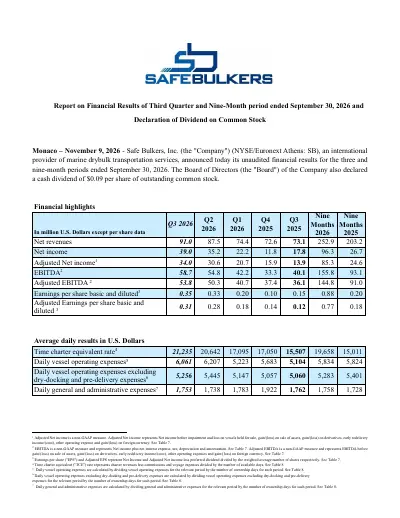
Our adjusted EPS reached 31 cents in the third quarter of 2026, more than doubled compared to the same period of 2025. Our board has declared an increased dividend to 9 cents per common share, following our private placement of about €80.4 million to institutional investors in Euronext Athens in September to increase the liquidity of our stock in Europe.
We have diversified our investor base and further strengthened our balance sheet, liquidity, and capital resources. Please be reminded that the total number of shares today is about 114 million, substantially lower compared to about 122 million shares prior to our buyback program.
Following a comprehensive review of the forward-looking statements presented in slide two, let's start our presentation with the company section in slide four, where we always make a reference to our track record. Safe Bulkers draws an extensive experience gained through multiple market cycles with uninterrupted presence in the dry bulk shipping sector the last seven decades, with presence in four countries: Athens, Limassol, Monaco, and Geneva.
Our interests are closely aligned with those of our public shareholders through significant management ownership of about 44%. As a pure-play dry bulk shipping company, we provide worldwide seaborne transportation of major bulks, including iron ore, coal, and grain, as well as minor bulks, serving some of the world's largest charterers.
We have consistent fleet growth since our IPO. As shown in slide five, for the last five years, we have taken delivery of 16 Phase 3 newbuilds, bringing our fleet size to 46 vessels.
Key points are the extensive fleet growth plan of eight more newbuilds on order until 2029, and a young modern fleet of 9.8 years average age, while maintaining age stability through the fleet renewal program. Our net debt per vessel stands comfortably at $5.3 million per vessel.
A successful course in the dry bulk sector is relied on two elements: the operational excellence and the successful asset play. Let's focus on our operational advantage as shown in slide six.
On the top graph, we present our improving daily time charter equivalent rate together with our relatively steady daily operating expenses. The improved TCE, due to the prevailing market conditions, is enhanced by the reduced fuel consumption of the fleet, as is reflected by the 22% reduced carbon intensity index since 2021.
This is because our 16 newbuild vessels are by about 30% more efficient, and the environmental upgrades of 26 existing vessels improved their efficiency by about 10%. All these vessels are traded in premium to the Baltic Exchange indices.
19 heavy consuming vessels are equipped with scrubbers, as they are able to burn the less expensive HFO compared to the very low sulfur fuel oil imposed by IMO since 2020, benefiting of the price differential of the two fuels, which is about 150 USD today. Improved managerial procedures with implementation of DryBMS, giving us commercial and financial advantage with selected large operators.
Safe Bulkers was among the very few companies worldwide to achieve this level of operational standard of excellence, being the first in Greece and the sixth globally. Key points is our CII rating, [zero?]
vessels on the rating of [E?] category, which would require additional capex.
In relation to asset play, as reflected in slide seven, we point out the timing of newbuild ordering in relation to market conditions. Today, two new orders can be delivered only after 2030 or 2031 at very high prices.
We have already taken delivery of 16 newbuilds, which have provided us with ability to renew our fleet by selling 19 older vessels, whilst still our order book is eight additional until 2029. We have built a resilient company, as seen in slide eight, with a comfortable leverage standing below 30% as of quarter end, backed by $319 million in total cash and cash equivalents, bank time deposits, and restricted cash, and $196 million available under revolving credit facilities, totaling a significant firepower of about $515 million.
We also present our balance sheet analysis, noting that assets are presented in their book values. We maintain a healthy, resilient balance sheet supported by a robust equity base.
Moving on to our debt profile and financial health, as presented in slide nine, we stand strong with a total of liquidity, capital resources, and revenue backlog just shy of $700 million, for $567 million debt, including our unsecured €100 million eurobond. Let's move to slide 10.
We have declared our 20th consecutive quarterly dividend and increased it to 9 cents, supported by our operational cash flows. At the same time, our free cash flow continues to finance our newbuild programs.
We do have an active 10 million share repurchase program. The returns to shareholders include $109 million paid in common dividends and $78 million paid in common shares repurchases since 2022, reflecting our consistency in delivering sustainable returns across market fluctuations.
Concluding the company's update in slide 11, we present the historic development of our dividend versus earnings, noting that the improved market conditions the last quarters provide us with the opportunity to increase once more the quarterly dividend. It is important to highlight that while enhancing shareholder returns through a more rewarding distribution policy, Safe Bulkers remains committed to allocating a substantial portion of its cash flows to its newbuilding program.
I now pass the floor to our co-CFO Thanasis Antonakis for the dry bulk market review. Thanasis, the floor is yours.
Thanasis Antonakis
Let's proceed to examine the supply side dynamics in slide 13. We present two scenarios of fleet supply growth, with Strait of Hormuz closed and Strait of Hormuz open.
The orderbook now stands at about 15.4% of the fleet, almost half of which is comprised of Capes. The forecast for dry bulk supply as per BIMCO is to grow 3% to 4% in 2026 in closed strait scenario versus 4% to 5% growth in open.
For reference, about 0.5% of dry bulk capacity is currently within the Gulf. BIMCO expects sailing speed to fall up to 1% in 2027 if the Strait of Hormuz remains closed.
Asset prices remain elevated, in line with the current freight market. Currently, only 10% of fleet capacity in the dry bulk orderbook will be able to use alternative fuels upon delivery.
Thus, the dual-fuel orderbook remains small in the dry bulk segment. It is important to note that 10% of the dry bulk fleet is above 15 years old, which means these vessels will face increased repairs, maintenance expenses, additional inspections, restrictions, and certain associated costs.
Let me point out here that in our total orderbook of 24 Phase 3 vessels placed in 2021, we had two dual-fuel newbuilds on order, one of which we took delivery of just a few days ago, and the second one is due for the first quarter of 2027. These vessels are able to operate with fossil fuels until alternative fuels become available and economically viable, hedging for the carbon intensity-related regulations.
Safe Bulkers' fleet now counts 16 Phase 3 vessels on the water, all delivered from 2022 onwards. Our average fleet age of 9.8 years is more than two years younger than the global fleet average age of 12.5 years, strengthening our competitive position in terms of operational performance and fuel consumption.
Moving on to slide 14, we present an overview of the demand in basic dry bulk commodities trade. The global GDP growth expectations for 2026 and 2027, as reflected in IMF's October forecast, call for a growth around 3.5% in the coming years, accompanied by persistent inflationary pressures.
BIMCO forecasts a global dry bulk demand growth of about 1.5% in 2027 on the closed strait scenario. Iron ore demand is expected to grow up to 2.5% in 2027 in open Hormuz scenario.
However, Chinese inventories may soften import demand in 2027. Coal demand is projected to decline 1% to 2% in 2027.
Grains remain a strong performing major bulk. However, the Black Sea trade disruption and China's policies pushing toward greater self-sufficiency and reduced soybean usage present a downside risk.
Minor bulks growth in an open Hormuz scenario is expected to be quite strong. Energy transition-related ores remain supportive.
Fertilizer demand continues to be a key factor affecting the Hormuz closure. Now, China remains a central swing factor for the dry bulk market.
Strong export performance continues to provide a counterbalance to subdued domestic demand, which remains constrained by the ongoing property sector crisis and manufacturing overcapacity. China's GDP is forecasted to grow by 4.5% in 2026 and 4% in 2027, with higher global oil prices, persistent trade uncertainty, and structural headwinds expected to weigh on economic activity.
Although a truce has been reached in the US-China trade tensions, tariffs remain a key source of global economic uncertainty. On the energy front, the Chinese government has issued directives to accelerate the resumption of idle coal mines and increase domestic coal production, reflecting its continued focus on energy security.
In the longer term, however, China's gradual transition away from fossil fuels in electricity generation, alongside the expansion of renewable energy capacity, is expected to reduce its dependence on import energy and reshape its energy-related dry bulk trade flows. India, with a forecasted 7% GDP increase in 2026 and for 2027, is projected to experience the fastest growth among major economies.
Its expanding domestic market, with infrastructure investments playing a vital role, and manufacturing sector, continue to contribute positively to the dry bulk demand. Japan's transition from prolonged deflation to sustainable growth includes targeted fiscal stimulus and public investment to boost demand and sustain economic momentum.
Japan is projected at 0.7% GDP growth in 2027, with fiscal support measures partly cushioning the impact from higher energy prices, and to stabilize as the energy shock dissipates and monetary policy gradually normalizes. Summing up the supply-demand equilibrium on slide 15, in the closed Hormuz scenario, the supply growth is expected to be 3% to 4% versus demand growth of about 1.5% for 2027.
The freight market has shown strength during the first nine months of 2026 and continues to be healthy to date, with Capes spots at about $34,000 and Kamsarmax spots at about $17,000. In relation to our Capesize class vessels, all seven were chartered under period time charters with an average remaining charter duration of 1.4 years and an average daily charter hire of $24,700, accretive to our contracted revenue backlog.
I now pass the floor to our CFO Konstantinos Adamopoulos for our quarterly and nine-month financial health.
Konstantinos Adamopoulos
Thank you, Thanasis, and good morning to everyone. During the third quarter of 2026, we operated in an improved charter market environment compared to the same period in 2025, with increased revenues due to higher charter hires and increased earnings from scrubber-fitted vessels.
Our revenue generation, as we see in slide 17, is reflected in our robust $264 million in revenues for the nine months of 2026, being a foundation for our strategic fleet growth plans and fleet modernization initiatives. Moving on to slide 18, which shows our quarterly financial highlights for the third quarter of 2026 compared to the same period of 2025.
Our adjusted EBITDA for the third quarter this year stood at $53.8 million, compared to $36.1 million for the same period last year. Our adjusted earnings per share for the third quarter of 2026 was 31 cents, calculated on a weighted average number of 104.4 million shares, compared to 12 cents during the same period in 2025, calculated on a weighted average number of 102.3 million shares.
On the graph on the top, during the third quarter of 2026, we operated 45.3 vessels on average, earning an average time charter equivalent of $21,235, in comparison to 46.51 vessels and on average time charter equivalent of $15,507 during the same period in 2025. Our daily vessel running expenses increased to $6,061 for the third quarter of 2026, compared to $5,104 for the same period last year.
Daily vessel operating expenses excluding drydocking and pre-delivery expenses increased by 4% to $5,256 for the third quarter of 2026, compared to $5,060 for the same period in 2025. Moving on to slide 19 with our nine-month financial highlights compared to the same period of 2025.
Our adjusted EBITDA for the nine-month period of 2026 stood at $144.8 million, compared to $91 million for the same period in 2025. Our adjusted EPS for Konstantinos Adamopoulos (CFO): the nine months of 2026 was 77 cents, calculated on a weighted average number of 102.8 million shares, compared to 18 cents during the same period in 2025, calculated on a weighted average number of 103.3 million shares.
On the graph on the top, during the nine months of 2026, we operated 45.15 vessels on average, earning an average TCE of $19,658, compared to 46.42 vessels on average, earning a TCE of $15,011 during the same period in 2025. Our daily vessel running expenses remained stable to $5,834 for the nine months of 2026, compared to $5,824 for the same period in 2025.
Daily vessel running expenses excluding drydocking and pre-delivery expenses actually decreased by 2% to $5,283 for the first nine months of this year, compared to $5,401 for the same period in 2025. Moving now to slide 18, we see a quick overview of our operational highlights for the third quarter and nine months 2026, compared to the same periods of 2025.
Let us focus now on our liquidity, our cash flows, and our capital structure, which are presented in slide 21. We are maintaining a comfortable leverage below 30%.
Our debt remains comparable to our fleet scrap value, although our fleet is on average below 10 years old. Our weighted average interest rate of our debt stood at 5.10%, with a portion of €100 million being fixed at 2.95% coupon in an unsecured five-year bond.
We have paid a considerable part of our capex in relation to our outstanding orderbook. Our liquidity and capital resources stand strong at approximately $515 million, which together with the contracted revenue of about $183 million totals a bit shy of $700 million.
This is more than adequate for our outstanding capex and provide flexibility to our management in capital allocation. Furthermore, we have additional borrowing capacity in relation to two existing debt-free vessels and our seven newbuilds upon their delivery.
We ensure that our capital expenditures is adequately covered by our contracted future revenues, fortifying our balance sheet towards a trajectory of sustainable growth. This underscores our capacity to support debt service, reinvestment, and shareholder returns at the same time.
All of this enabled us to expand the fleet, build a resilient company, and create long-term prosperity for our shareholders. Thank you for your attention, and we are now ready for your questions.
Operator
Thank you. We will now be conducting a question-and-answer session.
If you would like to ask a question, please press star one on your telephone keypad. A confirmation tone will indicate your line is in the question queue.
You may press star two if you would like to remove your question from the queue. For participants using speaker equipment, it may be necessary to pick up your handset before pressing the star keys.
One moment please while we poll for questions. Thank you.
Our first question is from Elias Papazacharia with Piraeus Securities.
Elias Papazacharia
Thank you, and congrats on the quarter. I wanted to ask you, as of the end of the quarter, the company held a sizable cash balance of $319 million.
Could you please elaborate on your capital allocation priorities right now? Would you focus more on dividends, buybacks, newbuild installments, or would you wait for the right time to purchase vessels in the secondary market?
Polys Hajioannou
Yes, hello. Look, the liquidity is there also for newbuilding installments that they are coming.
As we said, we have eight more ships to take delivery of in the next two years. We are keeping a good part of that for the newbuildings, as we don't wish in a rising interest rate environment to add more debt on the company.
Now, part of it also would be used for acquisitions as and when the availability of second-hand ships of meaningful price become available in the market. The company is monitoring this.
Sometimes you may pay a little bit more expensive for a second-hand ship provided the charter rate environment can support it. It's a matter of balancing between newbuildings and second-hand acquisitions should the freight market can provide support.
This is the main area of use for our liquidity. The dividend this year has been improving with the improved freight rates.
If the spot market continues to perform, it's obvious that the company will be returning money to shareholders.
Elias Papazacharia
Thank you. We're also going through your updated fleet employment list, and we saw that your charters were extended either at higher rates or at the same rate, probably because of extension options or.
Could you give us an update on charterers' appetite for time charters into 2027, and if there has been any change on your current chartering strategy?
Polys Hajioannou
Yes. Look, from time to time, there are opportunities appearing up, and the chartering market in dry bulk is working differently each quarter, depending on the views of the wider market.
For example, in September, when we had the Capesize spot market improving to $50,000, we fixed early one of our ships opening in February 2027 at $37,500 for 12 to 15 months time charter. On Capesize, you could have opportunities like that much more easy than on the Kamsarmax market.
On the Kamsarmax market, it's a little bit controlled the forward periods by lower FFA values. On the other hand, the spot market is very healthy.
Ship like ours, modern Phase 3 vessel with low consumption, could be fixing today $25,000, $26,000 per day, whilst their period market is only in the low 20s. For the time being, the company prefers to work the attractive spot market, and from time to time, whenever we can secure period charters a little bit higher, we will be doing that.
It's a combination of both at the moment: trading spot or employing ships for six months or up to a year. This is a scenario that is workable for us, and we will continue to work this.
As you have seen, it has given the good results in the last two or three quarters.
Elias Papazacharia
Right. All right.
On another topic, with respect to bauxite, could you please tell us what kind of impact you have seen from export restrictions in Guinea in the third quarter? Has there been any major impact?
Have they been successfully enforced, those restrictions, or?
Polys Hajioannou
We don't have so many Capes in the fleet. We own seven Capes at the moment, and from time to time, we are lifting some cargoes of bauxite from West Africa.
Is not our usual trade. Our ships are more in demand for the West Australian trade because not every ship is going to West Australia.
The regulations there are tougher, and the AMSA requirements are tougher than in other loading areas. Our charters elect most of the time to load our ships either from Brazil or from West Australia.
Bauxite trade from West Africa is mainly for older ships that they don't trade a lot in Australia and places like that. Indeed, the volumes from those areas are meaningful, and it's helping keeping all those ships employed for longer.
Hence, you have the good freight market on the Capesize. The same is predicted for 2027.
Ships are fixing well over $30,000 for 2027 and near to 20 to $30,000 for 2028. As I told before, we fixed one Capesize six months ahead at $37,500 plus scrubber premium on top of that rate.
I think that right now we are optimistic for the next two or three quarters of having a healthy market. Thereafter will depend on a lot of factors how the market will be performing, what will happen on the geopolitical situations, if new routes will open up.
It remains to be seen. It's a little bit unclear what will happen six months from now.
Elias Papazacharia
Right. There's a lot of moving parts.
Lastly, would like your outlook on scrapping, as the dry bulk fleet ages and environmental rules tighten. Should we expect a pickup in scrapping next year, or would that be too early?
Polys Hajioannou
Look, from my experience over the years, scrapping is picking up after you have a 6 or 12 months of bad market. To be honest, especially after a good period of freight rates, they keep their ships for a little bit longer or as much as they can afford to, especially if they have passed the special survey and the drydockings.
They tend to keep the vessels for a bit longer. It's not immediately when the market drops, owners will start scrapping ships.
It needs a time lag of 6 to 12 months, and then the ships that they are due for expensive drydocks, which is usually at 20 years or at 22.5 years, the expensive drydocks, the owner may decide at that time. You may be seen the paradox scheme that if the market drops after I don't know when, 6 or 12 months later, you may see ships approaching 20 years old getting scrap, whilst you may see other ships 22 years old keep trading, simply because the owner has done the 20-year survey, and he can keep going fixing the ship for another 2.5 years.
Whatever is the situation, because after 20 years the drydock periods is every 2.5 years, time passes very quickly and either you will scrap at 20 years or at 22.5 or at 25. The best case scenario is at 25, but usually in a bad market, it's more likely at 20 or 22.5 years that you scrap.
It needs some time to happen. It will not happen overnight.
Elias Papazacharia
Got it. Okay.
Thank you very much.
Polys Hajioannou
You're welcome. Now
Operator
our next question is from Climent Molins with Value Investor's Edge.
Climent Molins
Hi, good afternoon, and thank you for taking my questions. I wanted to ask about the unsecured bond maturing next year.
What's the plan to tackle the maturity? Would you figure a refinancing over a full repayment?
Polys Hajioannou
You mean about the bond, you mean in the Euronext Athens?
Climent Molins
Yeah. The Greek bond.
Polys Hajioannou
The Greek bond, yes. Look, the Greek bond was a very attractive tool back in 2022 when we did it, with the interest rate or blended in rate of 2.95%.
This time around, the company will consider what is the market in a rising interest rate environment, and we will examine if this is worth renewing or if it's worth to continue with ordinary financing of the fleet. As Mr.
Adamopoulos said before, the all-in blended in average of the company is around 5%, including the bank margin, and you have to remember that bank margins are coming down because of healthy liquidity by owners, especially in the tanker market, in container market, they are paying their loans early. The bank margins are coming down for good company, which Safe Bulkers is in that category as well.
It remains to be seen when the time comes if it's worth renewing or not. We will know in a few months' time.
Climent Molins
Makes sense. Thanks for the color.
You mentioned having some cash ready to selectively expand the fleet. I'm guessing whether you'll totally pull the trigger will depend on the opportunity you come across.
As you think about your fleet positioning, is there a specific subsegment you would like to expand on? Secondly, would it be fair to expect any acquisitions to be on the eco side?
Polys Hajioannou
Look, we are primarily a company trading successfully in the Kamsarmax and Post-Panamax sectors, and we have also a presence in the Capesize sectors. Now, as our Capesizes are getting a bit older, and they are over 10 years old or approaching some of them 15 years old and some others approaching 17 or 18 years old, we would be looking to order at the right time the right ships from the right yards.
Right now, we have only one Capesize on order from a Japanese yard in 2029. Definitely will be one sector that we will be focusing there on the next opportunity that may appear.
We're not in a hurry to go in and compete with everyone else at the moment and pay the sort of prices we are hearing at the moment. We will be there.
We are in the market. We are visiting shipyards regularly, they visit us regularly.
I think the opportunity will come. Now, when is that opportunity, remains to be seen.
It could be in six months, in one year, or a bit later. There is no hurry that we have to do it in a rush.
As I said, we have eight newbuildings still to take delivery of, which all of them have been ordered at much lower prices than the current prices that the shipyards require. We could be a little bit patient.
We're in a good position that, sometimes, in shipping, to wait is not the worst option you have. For the time being, we will be waiting.
Climent Molins
Sounds good. That's everything from me.
I'll turn it over. Thank you for taking my questions, and congratulations for the quarter.
Polys Hajioannou
Thank you very much.
Operator
Thank you. There are no further questions at this time.
I would like to hand the floor back over to management for any closing remarks.
Polys Hajioannou
Thank you. Thank you again for attending this quarterly results, and we're looking forward to see you again and discuss with you next quarter.
Thank you.
Operator
This concludes today's conference. You may disconnect your lines at this time.
Thank you again for your participation.