SBI Holdings Incorporated
Q2 FY2027 · Earnings Call TranscriptNovember 2, 2026
Yoshitaka Kitao
This is the announcement of the 6-month period financial results, and so it's my turn to talk to you. Actually, for the interim period, I think this is probably going to be the last time for me to present results.
Going forward, once a year I will meet you to present our financial results. That's my plan.
Of course, the materials presentation will be checked rigorously by myself based on my own idea, please feel reassured. Without further ado, for about 2 hours from now, or it could be longer than 2 hours, let me present our results.
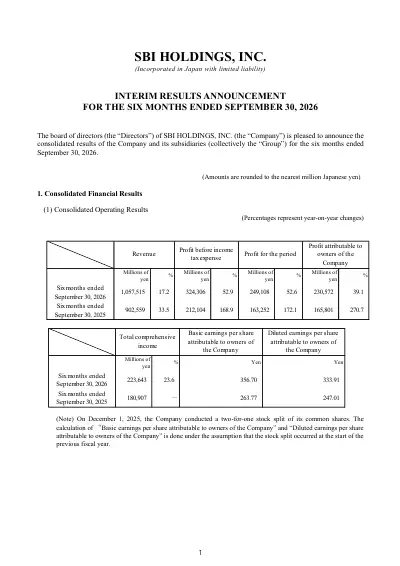
The first, the outline of the results: as you can see, the revenue 1,057.5 billion yen, or up 17.2% year-on-year; pretax profit 324.3 billion, up 52.9%; profit for the period 249.1 billion, up 52.6%; profit attributable to owners of parent 230.6 billion yen, up 39.1%. The annualized ROE for the first half, 23.2%.
This is the comparison of consolidated performance with major securities groups. According to some press report, so that we have banking and also, but all the other groups also have those other business, the other categories.
The press write, if you like, that the audience would understand that all the other businesses are included here. As you can see, between ourselves and Nomura, the pretax the profit, or the profit for the period attributable to owners of parent, are not so different.
The Nomura has more than 100 years of history, and ourself has only about 26 years of history. Daiwa Securities Group is lagging behind the performance of SBI Holdings.
By segment, this is the first half results: financial services business is the main driver of the performance. The pretax profit, for the very first time, exceeded 200 billion yen mark, the revenue 129.7 billion yen.
Each segment, in most of the cases, the numbers hit record highs. As to crypto asset business, [Cladilog?]
is approved or not and there are some issues, and because of that, the pretax profit is in negative, but a very small negative number. Under such circumstances, the financial services business is doing very well.
As to dividend, basically, this financial services the business is the basis for the calculation of dividends. The current situation will not the change so much, toward the end of the year, we did not the present a forecast for the other year-end dividend, but here I am the presenting 80 yen as year-end dividend.
The annual dividend is 110 yen per share. This is IFRS-based, the financial services business performance development.
Here alone, the excluding gain on sale of former SBI Sumishin Net Bank the shares, and here the for second half of FY2025 included gain on sale of former SBI Sumishin Net Bank shares of 141.6 billion yen, it jumped the number to 306.9 billion yen. As to dividend, basically, especially for the dividend, we are going to make more efforts to increase shareholders' return.
That's a very strong demand from the other shareholders. We would like to take this policy to increase our dividend.
As to SBI Shinsei Bank, the from FY2026 introduced interim dividends, paying an interim dividend of 10 yen per share. SBI Leasing Services, interim dividend of 30 yen per share, up 5 yen.
SBI Global Asset Management, year-on-year, it is increasing the dividend. As to the year-end dividend, the continue increasing year-end dividend for 18 consecutive years.
SBI Insurance Group, at up 12.5 yen, forecast of 59 yen per share. As to segment-wise performance, financial services business, as I mentioned earlier, the revenue up 17.3% at 829.7 billion yen; pretax profit 200 billion yen, more than 200 billion yen, up 69.7%.
Both of them are record highs. The banking business, up 45.8%, exceeding 100 billion yen in the first half.
The securities business with the 64.8 billion yen, or up 90%. Those are the pretax the profit breakdown.
Insurance business, the huge growth rate, while the size is still small, 18.6 billion yen and up 227.1%. As to banking business, more detailed explanation: the gross operating profit, net operating profit before credit costs, the pretax profit on each line numbers hit record highs for SBI Shinsei Bank.
The gross, as you can see here, as to profit attributable to owners of the parent, because of tax issue, this are the results, but there is no problem that we observe here. As to SBI Shinsei Bank's retail accounts and total deposits, as of the end of March comparison of each year, for 2026, that is for the first half, first half alone, the total amount of deposits and the number of retail accounts exceeded the annual results of the previous years.
It's a very strong results. In December 2021, they joined SBI Group, and they continued to grow year after year.
SBI Shinsei Bank's SBI Hyper Deposit, the which is offered with SBI Securities, and both the deposit and the account number are increasing, with 1.5 trillion yen. In September 8th, the deposit exceeded 1.5 trillion yen mark, and as to the number of deposit accounts, the 710,000 accounts.
As to the operating asset of SBI Shinsei Bank, after December 2021, when they joined the group, the growth has been significant. At the end of September with the 19.5 trillion yen, exceeding annual results of the previous year at 18 trillion yen.
Now, securities business: on this occasion, I did not plan to talk about this page, but please look at this page. The online SBI Thai Online Securities in Thailand, SBI Royal Securities, VNISecuritas, FPT Securities, we have those the securities entities in Southeast Asia.
The in the banking business, we are operating in various the areas, and that applies also to securities business. This is SBI Securities' first half results: from April to September, on all of these lines, numbers hit the record highs.
In all levels, we achieved record highs. The growth is a very strong growth.
SBI Securities' the consolidated expense ratio is 58.1%, and much lower than other entities compared to Nomura or Daiwa. If the market goes down, then the expense ratio, the smaller the expense ratio is, more resilient you would find yourself to be.
The diversification of the revenue sources and the strengthening of the earnings capability paid off, and the revenue of SBI Securities increased significantly. Please look at those details.
In each category, we saw big growth. This is the quarter-on-quarter comparison.
In most of the cases, compared to the first quarter second quarter, the second quarter was down. In our case, 8.5% plus quarter-on-quarter basis.
Then, number of securities accounts at the SBI Group, for the very first time in Japan, the number exceeded 17 million on October the 15th. The Zero Revolution led us to the current situation.
As to compound annual growth rate as of the end of September, 13.4%. The from end of March 2009 to end of March 2026, the CAGR 13.4%, and while Nomura only 1.9%.
A change going forward is the customer basis. Nomura had a senior people as customers, while SBI has much younger the customers, but nowadays the we are receiving more and more senior people as customers.
Everyone passes away somewhere or the other, and that brings about the issue of inheritance. That is the connected to younger generation, namely their children.
In many cases, those young people will be or are our customers already, which is another additional benefit for us. Also neo-media strategy was, I think, very good.
Neo-media strategy, with that strategy, people criticized me, why the financial the group the to be involved in neo-media? When you don't understand, you don't understand.
You need to look at the results. In terms of the SBI Securities business, in terms of the assets under custody, it was increased by 39% to 79 trillion yen.
Since the start of the Zero Revolution, that was back in September 2023, it has accelerated in terms of the growth. We're actually aiming towards 100 trillion yen.
We are diversifying the revenue sources, and we're definitely seeing the results. These are the in order of the revenue contribution.
In terms of the financial the revenues, as you can tell from these bar graphs, it has actually turned it at a high level, a trend in open interest credit balance that is definitely supporting the overall the financial revenue. Of course, that is exceeding 3 trillion yen mark just for the interest in the credit balance, so that is quite strong.
Also, in terms of the financial revenues, of which revenue from margin trading is a 43.8 billion yen year-on-year, that is increased by 36.4%. It has been a steady growth.
Next is on the trading revenues. FX revenue was especially a strong driver.
Both for the spot, as well as for the swap revenue, the spot revenue and the swap revenue. Unless you have a system such as ours, we will not be able to generate a profit as successfully as we have.
Of course, if you have an automated system, actually quite often you would actually face issues. Actually, we do have some manual operation.
The experts are actually engaging in the FX revenue, we are not facing any issues. Also, in terms of the fixed income and so forth, of course, we're not at the state to strongly grow that.
In terms of the foreign the bonds, it's actually trending flat. Of course, we are watching carefully the interest rate situation as well as FX, but it is definitely become a steady base of our financial revenue.
This shows the investment trust balance as well as the investment trust fees. They have been record high.
This is quite incredible in terms of the investment trust. If you actually look at the balance here, increased by 49.5% year-on-year.
Also in terms of the balance, 32.3 trillion yen, quite an incredible level. Likewise, for the investment trust fees on the right-hand side, again 7 billion yen, record high, year-on-year 48.9% increase.
Next is on the revenue from foreign stocks at SBI Securities. It has grown quite substantially.
Especially the US stocks. The trading value has been a record high to 7.3 trillion yen.
Also in terms of the margin trading is 2.5 billion. This 7.3 trillion, this is for the actual equity, the spot, that is.
Also in terms of the revenue, the first half of this year, last year that was 4 billion, now we're actually seeing at 10 billion to 2.5 times. Actually, this is quite surprising, the SpaceX, perhaps I shouldn't say it is surprising, but it has actually contributed to the revenue.
So 550 million yen, that is the sales commission, trading commission, and foreign exchange fees combined together. At the time of the IPO of US-based SpaceX, we've actually partially underwrote that, and we've been able to generate 550 million.
SBI Securities, the retail JGB sales. JGB, of course, it's been really having the slogan to grow the sales of the JGB, and there's been an incredible growth.
Also on the right-hand side, the top institutions by retail JGB sales, we are definitely top in the rank, more than 300 billion or yen or so. Timing is important.
You really have to really focus on certain timing, and you really have to promote it at that specific timing. I've been involved in this business for a long time, I can see it, what is the best timing and what should be conducted.
So 50 years I have been doing my business, I have honed my this capability, intuition, shall we say, to assess that timing. Next is a primary and secondary underwriting business, that is for the equity and fixed income.
In terms of the IPO underwriting, since April 2026 to September 2026, 25 companies have IPO'd. Within that, 24 cases SBI has been involved.
Underlying the percentage is close to 96% or so. Within that, SBI Securities been the main the manager, we have eight cases.
We have the corporate bonds, as well as the public bonds. Actually, recently they have been coming to us, rather than us trying to sell.
That really shows our strong capability to sell. SoftBank, the retail bonds, of course, it's quite a large unit.
We as the leading the manager, unless we are the lead manager, they will not be able to sell that. Given the current environment, the SoftBank, this sector, the area they're trying to engage in, it might be challenging.
Next on the expansion of the customer base and further strengthening of the revenue, and some of the initiatives. It's really boils down to Kodomo NISA and capturing the minor accounts.
This is anticipation of the future. We would like to really focus on this initiative.
Our commercials, I'm pretty sure you have seen those in various places. This is definitely a focus area for us.
This will be starting January 2027. We are expanding our minor accounts.
In Japan, the population age 0 to 17 is 17 million. It's actually easy to remember, isn't it?
0 to 17-year-olds currently 17 million in terms of the number. Junior NISA, that was the predecessor, it had only 1.04 million accounts.
In terms of the penetration, it's mere 6%. That is why, this time around, we hope that this will come to its success.
Also, hopefully, would actually go to the full-fledged NISA, which is for 18 years or above. We are hoping that this will be successful.
That is why we're collaborating with SBI Shinsei Bank. We have quite a lot of the interest been provided, and has been expansion of tools.
We can actually combine the assets of the parents and the child's together. Those are some of the functionalities.
Collaboration with the media business, as part of our sales promotion. The role that media business is going to play definitely is going to be larger.
Also, the financial education, that is important. As far as Kodomo NISA is concerned, we have this 0% trust fee, a so-called Zero-kan.
This has drawn much attention from the market. From Zero-kan, and of course after age 18, it will be All Country, All-kan.
It will be Zero-kan to All-kan. We'd like to facilitate that flow from Zero-kan to the All-kan.
This is the fourth round of the Zero Revolution, and this is an appeal to the parent and child asset building households. Up until 17, you can use the Kodomo NISA, and beyond 18, it will be All Country.
That is the flow that we would like to generate. On the left-hand side, once you join, you can't really change the securities company.
That is why we have to focus on that to lock those customers in. Next is the open alliance strategy.
We are collaborating with SMBC Group. For instance, Olive Consulting, it has been launched already.
It was back in May 26 of 2026, that was the launch date. Already, as of the 29th of October of this year, we have 281,000 accounts.
Also, the asset under custody is a 2.54 trillion yen. It is quite incredible the SMBC Group's capability in terms of the number of customers, and also their really quality the consulting channel.
That is definitely giving force to the Olive Consulting, and it has earned the trust of the customers, leading to these incredible numbers. Moving on to the digital, the affluent customers: we're seeing the increase in the number, our securities the customers, we have plenty of these digital affluent customers.
Through Olive Consulting, we could have a referral service for partner companies, including SBI Group companies. At the launch of the service, we have various connections, and we've been engaging in a fairly highly specialized the dialogue and extending consulting to the customers.
Next is on JR Kyushu. We have announced strategic business alliance.
This is the first pass in the railway industry. Of course, it's a financial super app that has securities and other functions.
That is the intention of this business alliance. We have a comprehensive financial platform, JQ Bank, of course, this is a tentative name, but we would like to introduce this platform.
The financial the functionalities at SBI Group, that is the banking, securities, insurance, and combine that with JR Kyushu's railway, real estate, points, and so forth, those could be converged together. That is a kind of app we intend to develop.
JR Kyushu, the customer base that they have, it's near 5 million in terms of the customer base. Moving on to insurance business: so we have various constituent companies, as you can tell.
Kyobo Life Insurance, that is from Korea, and Ly Hour, SBI Insurance, is from Cambodia. Already we have been launching our insurance businesses in various countries, and this is the consolidated performance.
Across the board, it has been record high. Moving on to in-force, the total: so as of March end 2016, that is for 10 years, 12.1% annualized growth that we have seen, or a CAGR growth, rather.
It has been quite steady. As of April end of 2025, we topped 3 million in terms and in the in-force, we have 3.31 million in terms of the in-force policies.
Now moving on to the asset management business. Here we have many new companies joining our group, including Rheos Capital Works and SBI Okasan Asset Management, and under the circumstances, we have been achieving record high results.
The SBI Global Asset Management the consolidated results, it's J-GAAP, and this has been growing steadily well, as you see here. Then the AUM of SBI Global Asset Management Group: the assets under management reached approximately 14 trillion yen, and we are targeting 20 trillion yen during FY2026, and with Asakura-san, we are working on this.
By 209 FY2029, we'd like to achieve 50 trillion yen AUM. As for the PE investment business, this has also been involving a lot of new technical evolutions, and when we find these, we are very keen about capturing the momentum and opportunities, and they are blossoming nowadays, and they are really contributing to the profit increase of this investment business.
They are the investees of IPOs and M&As, and throughout FY2026, March 2027, we have 29 companies in prospect, and it's becoming much bigger than the initial prospect and the previous year. In the first half, there's been six companies, and in the seven companies in the first half, and in the six second half, six companies.
We have such great prospects. I have great expectations in this area.
As for Ripple, it goes up and down over time, but in terms of the development of the ecosystem, it's been making good progress, I think. It's the most promising business.
The Bitcoin as an asset, we have been holding, but as for XRP, it's being used in various different forms. They would actually invite actual demand.
There is still the current Ripple's holdings that are not in circulation, which is about 7.6 trillion yen. As regards to the listing, according to my idea, which I do not speak about much, well, maybe next year sometime we might do the listing.
Maybe it's about time. Then again, there's a tricky part about this, which is relating to the presidential election, who is going to be elected.
I think President Trump's Republican Party would be winning in both the upper house and lower house, but not many people are predicting that as I do. I don't know, but in fact during the previous election, many people thought Kamala would be winning, but I was thinking Trump would be winning overwhelming victory.
The reason why I thought so, I've been watching X all the time, and I've been checking Trump's speech, and I've been especially noting the number of gatherings. It was completely different from that of the Democrats.
The Democrats are not really visible. It's like maybe there are some leaders, regional leaders, but when it comes to the next candidate for the president, some people are still talking about Kamala Harris, and I don't think that would be the case.
How that outcome will be is the question, and whether the Clarity Act would pass or not. The administration, whether it's SEC or CFTC, they are administratively making sure that this cryptocurrency world is authorized, it does not matter anymore.
Around the world, this area is making progress, and for the US, which is most important, as fiat as the key currency, in order for the US to keep the dollars as the key currency, they need the cryptocurrency and the stablecoin. The US would have to be making focus on this, whether it's Republicans or Democrats.
Now about the XRP Treasury, there's Evernorth, that's been listed, and the market cap is now about 140 billion yen. Our voting rights is now 6 36.1%, and we are the largest shareholder and equity method associate, and economic interest is 20.5%.
Aside from this, there's XRP issuing entity, Ripple Lab equity, we have about 9% stake in the Ripple Lab. Outstandingly, we have a great influence on the company, and the value upgrading would also lead to the value upgrade for our company as well.
Moving on to the assets under management of the SBI Group, the private equity, the so-called unlisted equity: that investment is now 1.332 trillion yen. As I see here, there is a great percentage of the US, which is about 496 497 billion yen, and I'm being shifting to the US nowadays, too.
A lot of technology is coming out from the US, and in Japan, first is the Shinsei Bank, how are we going to change it? We are getting a lot of implications from these technologies coming out from the US.
We are putting our capital in such areas. The US is large.
Naturally, Japan is another big one, 20 283.4 billion yen, is another big weight holder. Now, crypto assets business: like I said earlier, the Clarity Act and all, there was instability throughout the first half.
There were up and downs, especially at the end of September, at the end of the fiscal year. There was a big drawdown that could impact us just with such one day's drawdown.
Such influence could be coming from the market with this crypto assets. As for the number of accounts for crypto assets, as Bitbank joined us from October 1st this year.
It became our subsidiary, fully owned subsidiary. With that, now 1.116 trillion yen would be the balance.
Some investors may say we should consolidate all these, and we are discussing such possibilities, too. There are of course good aspects of having separate companies, for one, and there are also inefficiencies on the other, or partially, maybe the back office, maybe they should be consolidated into one, that's one another one idea we're having.
In any case, from various different angles, we are discussing, and we'd like to come up with some kind of conclusion. As for the assets under management, we think we are the top holder in the market.
As for the number of accounts, Mercari has been having a lot of small-sized customers, maybe they are top in the number of accounts, maybe. Now, Next Gen business: this is including bio, health, neo-media, Web3-related businesses, and Mynavi.
Mynavi should not be staying here forever, either, at some point in time, we may have to move to a different place. In any case, in the wide range of areas, we are doing various different businesses.
Basically, we are engaged in the human resources company. This is similar to Recruit, that is Mynavi, that's the general understanding.
There's also the media business that they're doing as well, Mynavi is engaged in various different business areas, and its profitability is high as well. It's generating good profit.
Now, from here on, I'd like to go into the main topic for today. Here are the strategic initiatives being focused on in the current fiscal year.
Like I said earlier, if I talk about these things too much, some other companies may imitate us immediately. Maybe I feel like I should refrain from talking about this too much, maybe just once a year.
In any case, the challenge is that WebX webinar requests or, oh, there are so many requests coming to me for keynote speeches, and when I speak too much, when I try to refrain on the other hand, it's not going to be good. That's an issue.
In any case, as much as possible, I'd like to talk about the strategy because it really is the strategy. Some would have to be to discreet to a certain extent.
If I speak too much, I could be revealing too much, I should control myself. There are five points here, and in short, I'd like to briefly talk about these.
Especially we have three TV cameras facing me, I'd like to be distinct and precise here. First, regarding the intensively strengthening security measures toward making the SBI Group fully AI-driven: so now the security is very, very important.
In other words, the system, when the system is down and when our credibility is gone, our business will not be viable. We have been doing this business for 26, 27 years, and I truly think so.
We consider security to be very, very important. Security in many ways has been in place to be prepared against the cyber attacks.
We are utilizing AI, and we have multilayered defense. We are thinking about a lot of different things, and I'd like to explain these one by one.
First, regarding the multilayered defense using AI: so Claude Mythos of Anthropic is something that I consider to be very effective. The high-performance AI, we need to enhance the level of AI, otherwise we cannot cope with the coming era.
Claude Mythos, embedded Claude security, that's been introduced across the SBI Group, that's been decided already. Now, furthermore, AI would be checking the source code weakness without taking any time.
If any issues were found, it would be fixed immediately. I'm always saying this behind the scenes, too, but don't spare any of the expenses here.
If we try to save money there, we could lose our trust, lose our business, and so don't think about cost when it comes to security. That's my strong message to the whole group.
We are authorized by Anthropic to use this certain functions, and we are going to utilize those functions as well. Fortunately, in such areas, we were one of the first companies to be acknowledged by Anthropic.
It's not 100% just yet, but we are acknowledged to a lot of areas. Using Mythos, I'd like to use this.
There are both defense side and offense side. As for the offense side, we don't need that.
We don't need to offend or attack anyone. On the other hand, when it comes to our system, when there's attacker, the white hacker would be doing the imitation of the attacking and draw out what is the vulnerability, and with that, as soon as possible fix those bugs or issues that were found.
That's what we are doing. Furthermore, 24/7 AI-powered security operation center is also available.
Nowadays, AI shall be utilized to the fullest, otherwise you cannot do even such simple things, either. In our three biggest strategy, we are talking about AI-driven.
Fully AI-driven company is what we'd like to become. Also we're going into the on-chain transition.
That's what we've been talking about from before. The company that does not do such things would be left behind in the new era.
If you cannot catch up with a new era, you would be losing out in the market. You have to leave the market.
SBI Securities is using several AIs to address vulnerabilities, utilizing the AI, prioritizing critical vulnerabilities. For everything, you need to do the prioritization.
Priority is very important, in other words. You need to do this.
Of course, every single detection of the issues would have to be fixed. With AI, in a few days identify weakness, maybe it should be much faster than a few days.
We should identify those weaknesses much more quickly. Anything that may be a single tool cannot find would have to be detected and fixed.
Various different AIs are having various different uniqueness, and combining these various different AIs would draw out great effect. In July 2026, we began to use Claude Security for vulnerability diagnosis, and from October 2026, we are also using Claude Mythos for vulnerability diagnosis.
We are utilizing all those functions that's been authorized by Anthropic. Mega 3 called by JFSA, and to Mega 3 banks, Katayama Minister was talking about Mega 3, but I don't know what happened.
I don't know how these megabanks are actually utilizing AI now to counteract against the cybersecurity. I don't get much news.
Maybe I am speaking too much, maybe it's better not to speak too much. I don't know which is better.
Now the preparing for high-frequency AI-driven attacks with EverSafe dynamic defense: we have created a joint venture in Japan with this company, and we came to introduce those products into Japan. The other day, NHK went to Korea to cover the story and visited Heo-san, the representative of the company.
Korea has been damaged very much by the cyber attacks, but the companies that were introduced EverSpin was saved, they were safe. That's the actual outcome they enjoyed.
We need to introduce more EverSpin, EverSafe. EverSafe is preventing the attacks at various different phases, like analytical prevention.
It's making difficult to analyze the structure and behavior of apps and web services, because once it's analyzed by the attacker, it's over. Then the dynamic defense: this, well, we have already hold relevant patents in 11 different countries, 33 patents.
We're making sure constant changes and therefore defense that and make the analysis results unusable. There's server-side verification: determines whether access is from legitimate use and blocks automated attacks.
We are always changing the defense style and making the attacker to do the analysis over and over again. As a result, it becomes not economically viable for the attackers.
I was talking about this at the board meeting earlier, too. There's Trend Micro, which I've been close with, and I'm asking Trend Micro to be introduced Trend Micro would not have been listed without me.
It was only a small, tiny lab in Taiwan, but I brought this to Japan, and I came to serve as CEO, I supported the company, and it was listed in Japan. Now in the US, NASDAQ, it's been listed.
Their engineers, the Eva Chen, she's the CEO, Taiwanese CEO, she's a very smart, excellent person. There's McAfee and various others, but they were all ousted from the market.
Trend Micro became the outstanding market player. With the founder, I've been very close, who is Steve Chen.
He sometimes come over to Japan, and I meet him whenever he does. The development of AI infrastructure and AX toward becoming fully AI-driven: so in the cyber attacks, we can all see how AI could be functioning in preventing the cyber attacks.
The AI promotion level is very important. Ever since April 2026, in the whole group, we have been promoting the structure of AI transformation, but we could not have done this alone, I judged.
Therefore, with Ridge-i, we had their support, and with Yanagihara-san, he became our outside director, and with that, with the whole group, we are trying to promote this AX now. There's the top-down decision-making process, and there's community and weekly reports, and I'm always attending these meetings.
The group's common AI structure that's introduced everywhere, all the 71 group companies are having this as a common AI platform, 71 companies and 10 companies with API integration. With Microsoft 365, it's been also connected, too.
We are on the way toward the full AI-driven transformation. As we do such things, the cost can be reduced very much.
Within 3 years, the total of 48.2 billion yen cost reduction is expected, as shown here, from these areas. Especially Shinsei Bank is large; Securities is also large.
With such plans, we are working on cost reductions. This AX project, AI transformation is AX, and not just in AX, but there's going to be digital transformation and some other work process improvements.
We are accelerating these activities all across the company and the groups. I'm endeavoring to do this, I've been leading this movement so that the whole group would be moving.
Our company group is relatively good and agile in doing such things. We are such a company.
As focusing on building on-chain financial infrastructure toward realizing SBI APAC digital economic zone, on-chain companies are spreading, and when we started to work on on-chain the initiative, nobody knew about it, and now it is widespread and this term also is widespread, especially in the financial sector it is becoming a more important concept. Tokenization, and this word also is the word that I might be the first person to start talking about it and spreading it in the society, and the writing books and explain about the concept, and also in English there was publication and the book is read in many countries as well.
SBI APAC digital economic zone, as to this APAC region, I think is a very important region. In terms population, it is increasing, and economic growth is very strong.
In Vietnam, for example, almost 10%, like 9.9% economic growth was announced by the government. I feel very attracted to that market.
It is complete opposite of the Japanese situation. Developing on-chain enabled exchanges, because the the venue is ness is needed for digital asset.
We are going to develop on-chain enabled exchanges both at home and abroad. For example, the example of overseas Robinhood, the the 24-hour trading of tokenized stocks on its own chain from June 2025, and for EU, more than 200 US stock and ETF token have been offered.
Now it has exceeded 2,000, more than 2,000 issues. At a very high speed, globally we are seeing such development.
Real world asset chain, focused AI-native Arbitrum, based on Arbitrum. This is the Robinhood chain, AI-native Ethereum L2, Robinhood chain is enabling trading 24/7 in over 120 countries, and with DeFi protocols such as Morpho, and the tokens can also be used for collateral and yield generation.
Morpho is one of the investee company of ours. We have covered everything.
A securities company with its own chain provides trading, collateral, and yield generation for tokenized stocks on an integrated basis, that this is the example. For me, I'd like to be dominant in this area.
That is the tokenized trading of real stocks, like equity, that is one thing. The the voting right, and the the dividend, and shareholder's the right remain intact, and traded with the same order book price and ticker as conventional shares, the trading will be the possible in my idea.
The other day, with Nasdaq people came to see me, CEO, and we had meal together, and discussion was very successful. I we will have the people from the New York Stock Exchange as well to discuss this.
In our case, we have Osaka Exchange and the PTS in Tokyo, we can separate we can operate separately, or integrate, the we have not come to conclusion yet. As to Robinhood-style linked tokens, that's one thing, but unlike that, the stocks themselves are brought on-chain within the existing market framework.
This is the the example. That's what Nasdaq is trying to do, or the New York Stock Exchange is also trying to do it.
As to PTS, the we have to the develop it into exchange, because 10%, more than 10% of total listed securities, or 20% in any individual issue, these are the rules. With this criteria, you have to be exchange according to the FSA.
That if that's the case, then we are going to the establish an exchange, on-chain exchange, that is. We need to get an approval about UTP, unlisted trading privileges.
Once you get listed there, like the TSE, then the it will be also used for the this, and that is what UTP, and UTP exists in the US, not yet in Japan. The TSE the wants the government to say no, but the we will behind the the trend if that happens.
Looking back, under the the Hashimoto administration from 1996, the Japanese Big Bang started, and in 1999, finally, the the trading fees was this the the regulated, deregulated, and so now the 17 million the customers of the other securities have been highly appreciating our services. To the the administrative or the the political moves to try to block it is really impossible.
I will always fight such trend or moves. Once it becomes an exchange, then it can only handle stocks listed on its own market.
That means that if you are not get listed, and without a UTP, then it would not be the the treated. Even if on-chain and exchange the exists, if that's the case, what is the meaning?
On-chain, the next generation exchange, it means that 24/7 trading and instant settlement should be possible, and micro trading as well, tokenization, and stablecoin support should be perfectly there. That's what we need to achieve.
Building a global network of regulatory compliant digital asset exchanges centered on APAC: as we have invested the SBI Coinhako, the with 51.69%, and the changed the name to SBI Coinhako Group. It's a very compliant the crypto asset platform to be built.
If it's not Japan, then we will go global. That is my message, which remains intact.
The global financial institutions are in this the trend. The MAS the operates through SBI Coinhako Technology, which holds a major payment institution license from MAS, and Alpha Hako, registered with the BVI FSC.
Based in Singapore, where digital asset regulation is most advanced, building on-chain finance functions through partnerships with local companies like Startale, and of course of JPYSC, DigiFT, which tokenizes Japanese equity funds, SBI Digital Markets, and AsiaNext, and the services, the exchange that delivers JPYSC and other products to investors in global markets. Also, important thing is we are combining JPYSC with USD-denominated USDC and Ripple USD, we endeavor to realize yen-dollar cross-border settlement through SBI Coinhako.
No matter how somebody wants to stop it, you can't. UAE, Dubai, temporarily the regulation was became tougher in Singapore, and there was a flow of the new companies to Dubai, because in Dubai it is more deregulated, but because of the current war, the those companies are now back again in Singapore.
Fasset is headquartered in Dubai, but using stablecoin, they provide investment service for remittance, payment, and also using stablecoin in Asia, Middle East, and Africa, and in this company we have 20% stake. Its proprietary payment infrastructure, own network, connect 16 blockchains and over 100 banking corridors in 125 countries and regions, over 3 million wallets.
I had many dinners and discussions with the the top person of this company, very smart guy, and I think these people the will lead the trend of the globe. I'm 75 years old, and still I'm trying so hard to catch up with them at full speed.
Basic agreement with SBI Remit to build next generation international remittance infrastructure, plans to jointly operate a digital bank in Malaysia and to jointly distribute tokens issued by Fasset. These relationships should be win-win relationships.
If not, the relationship will not be sustainable. Therefore, joint venture, for example, all for the the investment stake investment, the both sides should get benefits, profits, and I always make it sure that will happen.
On August 24th, we made additional investment. Valuation USD 1 billion, more than $1 billion actually.
That is about Fasset. Ajaib from Indonesia, the online the comprehensive investment platform.
The CEO is still young, but the very smart guy. For online company, he started the business, and in addition to conventional financing, stablecoin, the tokenized deposit, he expanded the his business one after another.
Very similar to our business model. The number of customers is more than 7 million, retail individual investors.
It's very interesting company. Focusing on the Southeast Asia, the they are expanding digital asset in the the the region.
That is our aim to go with this company. Vietnam, the other day the I have visitors, I had visitors from Vietnam, and in November, the Secretary General will come from Vietnam, and we are going to have signing ceremony with a certain company in front of him.
That it is about the the giving license to five companies, and we are going to the make investment in one of those five for the crypto asset the trading exchanges, but the more than 50% should be held by the Vietnamese company, the with which the we came to an agreement. It's already very expensive.
There's nothing there, but the it's very expensive. As you can see in this the box, the annual crypto asset trading involving Vietnamese traders is over 200 billion USD, and adoption ranks number four in the world.
Currently, much of the trading takes place on overseas exchanges. Reuters, it dated March 17th, 2026.
I thought that this is it, and I wanted to get it, but it's very expensive. Ultimately, well, it's a decision by the government, I we have to go with it.
If it is a company, then I can I could have negotiated, but it's a decision by the government. This is the only option, they say, we have to live with it, and cover out certain percentage to the the other the partner as well to win the game.
Those once we So there is a law in Vietnam that the if you do trade outside the the approved exchange, you there's a penalty. There's some other violent the problems.
For example, you can see that on X. The economic But economic growth and the population exceeding 100 million a long time ago, and also diligence, diligent people, and the the excellent people.
They fought with the US, and they won, and they fought with China, actually many several times, and they won those wars as well, and the France, and partly owing to Japan, they got rid of these the invasions by other countries. When there's a fight, they're very strong.
When we have when we dine with Vietnamese people, like karaoke, for example, at the very end, they always sing Vietnamese national anthem. Very interesting.
Developing and distributing tokenized financial products in Japan and overseas in collaboration with overseas partners: as I mentioned earlier, DigiFT, it's a Singaporean company approved by MAS, launched GoldX, Southeast Asia's first tokenized gold fund, and in Japan in October 2025, as a JV, the SBI On-Chain was established with SBI, and also DigiFT tokenized the SBI Japan High Dividend Equity Fund, managed by SBI Asset Management, a subsidiary of SBI Global Asset Management, as JX on Solana. DigiFT CEO is rather old, but very smart.
It's actually genius. To Ondo, the number one market share in the US tokenized stock market, holding about 50%.
This entity the is another entity that the we should the cover. Utilizing JPYSC for settlement and as collateral on Ondo, we have reached basic agreement already.
As to Solana Foundation, it's a foundation, but in the real world asset market, they are dominant, very fast moving, and very cheap in gas price. Compared to Ethereum, this is even much more the the effective, efficient, and the the used more than Ethereum.
Joint venture, in July we announced about SBI Solana Global, services for institutional investors, and next generation payment infrastructure in the picture. More recently, the Nikkei newspaper had an article about this, partnership with BlackRock.
That is to promote initiatives related to tokenized MMFs tradeable using JPYSC. It's actually a big news.
We have the technological infrastructure and regulatory issues and so on, and the we are talking about BlackRock, the largest the asset management company, and we are going to strengthen the the partnership with them. The promoting the distribution of JPYSC both at home and abroad.
It's not public distribution yet, which it should be which should happen sooner than later. The we've requested the government for early application of tax measures for JPY-denominated trust-type stablecoins for public distribution.
Currently, when there is a change in beneficiary, the trustee submits the statements, and as the stablecoins circulate among an unspecified large number of users, the trustee cannot identify beneficiary's names or changes in beneficiaries. The request is about measures such as eliminating the requirement to submit the above statement to enable public distribution.
If it is delayed, because in the US the GENIUS Act the was enacted already, and it will be it will take effect in January 2027. In Singapore, we need to do more.
For Japan, I want to do something. The but the Japanese government administration are dragging my legs.
In many cases, for about 26 years, I have been fighting the with the establishment. The they are saying maybe in August, no way.
For the public distribution, that should happen on January 1st, and I made a very strong request to the government about it. SBI Startale Marketing, the SMFG is going to, who actually has 5% in SBI Startale Marketing, we sold 5% of SBI Startale Marketing to them.
The this is rather an old story, and SMFG was saying that the they are going to do something with the the other two the major megabanks. Maybe SMFG didn't want to tie up with something other than the megabanks.
It took so much time for them to make a decision, I made a telephone call to Nakashima-san saying that the valuation is going up, what are you doing? They decided to take 5%.
Nakashima-san said, 'Is that the situation? Sorry!'
because he understands very quickly. It happens that in our group that the the the managers do not do what the the subordinates want them to do, that leads to the making big mistakes.
It happens often. The message is that you have to act quickly, that's the most important thing.
If you can't move quickly, you will be loser, especially in this world. Sometimes things are delayed or not pinpointed.
I always look ahead, ahead, and then the make the the instructions, and but the people do not move, and then there should be some changes in the personnel the deployment. Now, the participating in OpenStandard, which promotes the USD-denominated stablecoin, or USD OpenUSD, considering interoperability connecting the yen and the dollar, this is a must.
Visa, Mastercard, BlackRock, Coinbase, more than 140 companies participate, you need to be on board, and we have decided to participate in OpenStandard. Domestically, the Ripple USD, and both USD-denominated and JPY-denominated, and now once interoperability globally, that's what the we would like to do next.
With Korea, our neighbor, and the Kyobo Life Insurance, I am the the the director, and we have 20% stake in the entity, and we have we need to have partnerships with Korean entities, with EverSpin, SBI EverSpin, which will go public, and it's another the element for partnership. The Shinhan, the we have a very close relationship in this area, we need to the expand relationship.
Striving to make JPYSC a JPY-denominated stablecoin also recognized in the US. The other day, I saw with a chairman who was engaged in lobbying activities in the US.
When we want to achieve something in the US, the the most reasonable approach is to do lobbying. That's what we are going to do.
A path is also open for foreign issuers to circulate stablecoins in the US if they meet the following three conditions. One of them is regulatory equivalence, equivalent to the GENIUS Act.
The determination call is made by US Department of the Treasury determines. With Mr.
Bessent, I the met who him many times, and maybe this is a time that we go ask the to him, and for that the we need to hire lobbyist, which could be very expensive, and we decided to hire this lobbyist, though. As to registration with OCC, you should register with OCC and become subject to reporting and examinations.
It's kind of troublesome, because everything will be the subject to reporting and examinations, it could take a lot of time. We need to the give due consideration to these issues.
As to reserve assets in the US, you should hold reserve assets at the US financial institutions sufficient for redemptions to US users. It is, but of course, but how to what extent the market the grows, depending on that prospect, you need to have a quite considerable amount of money dormant for some time.
From different aspects, we need to look at this issue. From Japan, internationalization of the yen will be except accelerated, and for that this is going to be a very important step.
The Fourth Megabank concept led by SBI Shinsei Bank as a platform provider is making steady progress. Building robust collaboration framework with regional banks with SBI Shinsei Bank at the core.
Promoting SBI Shinsei Bank's transformation into digital bank in anticipation of the on-chain shift of finance. As you can see here, Fourth Megabank concept.
Perhaps it's easier to share with you concrete example. We have SBI Shinsei Bank, and of course we have the Shimane Bank and the Fukushima Bank.
Those two banks will be umbrellaed under NISA Shinsei Bank, it will be an equity method affiliate. For Shimane Bank, we'd have the third the party allotment, 10 billion yen that is the total amount of the investment.
Also, it doesn't have the voting rights. It's a preferred shares with no voting rights.
Our objective here is really not to dominate or control some banks. That is not our intention.
Right from the start, as we've been engaging in the redevelopment and regeneration of the regional the parts of Japan, without the revitalization of the regional parts of Japan, the growth of Japan would not be realized. Where there is a system, weak system, we can provide the core banking system.
We like the system to make sure every bank could grow and all could be changed to a cloud system, or perhaps regional economy is getting weaker and there will be no potential borrowers and the deposit will not grow. There are some issues facing the regional financial institutions.
We have been engaging and addressing this issue from quite an early phase. The regional banks, they should change from being a regional bank to nationwide bank.
We started from scratch. We actually divested already, but so it's part of Docomo's banks, the entity that we have divested.
After 7 years, it has developed into a fairly highly profitable the company. That is possible.
We are giving a various guidance. Also in terms of structured products, these are shows the track record of the structured products.
Shinsei Bank, they structure various products, and they would sell those or they give those to the regional banks and they can generate the yield using these new products. Or the regional syndicate the loan, so as we engage in large-scale projects, the regional banks could participate.
They are 58 regional financial the companies, and about 60 or so we've been able to have a syndicated loan or structured finance. These are the opportunities we continue to give to the regional financial institutions.
The various collaboration that we've been able to realize in various forms, we talked about the next generation banking system already that's been introduced to six financial institutions, also Fukushima Bank. It has become much more sophisticated, and so various the person in charge of the system, IT system, they have been visiting the heads of banks and they've been conducting a thorough explanation at Fukushima and Shimane.
Seeing is believing. Basically seeing how rational the system is, that would actually create the belief.
Also collaborative lending, we are actually conducting those with banks. Also personnel exchanges that has been conducted since 2022, started with 32 entities, and now we have accepted 64 trainees.
In various areas, of course there's a lot of requests related to the virtual currency, or so-called next generation financial products. There has been a lot of requests from the financial institutions requesting our assistance.
Next is the promoting SBI Shinsei Bank's transformation into digital bank in anticipation of the on-chain shift of finance. SBI the Shinsei Bank just by acquiring, just happy with acquisition, they will not be able to grow.
We have to change those into digital bank. That is the focus point going forward.
In order to realize that, the SBI Shinsei Trust and Banking will be the core of the SBI Group's digital finance domain, we like to enhance their functionality. The SBI Group's overseas alliance and investees' insights could be utilized to further evolve.
In the US, for instance, in the moves, the company Moves example, they're able to provide its customers, small financial institutions, with functions such as acceptance and settlement of stablecoin payments and real-time funding. These next generation functionalities should be provided.
Up until now, sort of the old-school the tradified the functionalities, that is the old-school, the online functionalities. We need to change the bank into a new digital bank that can provide various new functionalities.
That is the SBI Shinsei Bank, as well as the Trust and Banking bank. Digitalization is essential, we need to expedite our effort.
SBI Shinsei Bank would evolve as a digital bank, and by providing the on-chain financial function to the regional financial institutions, the Fourth Megabank concept would advance to the next stage. In the next phase, as somewhat we anticipate, the year-end financial results, you can only hear from me only at the year-end the financial results.
In terms of the SBI Shinsei Trust and Banking, so as the core of the digital finance domain, we will continue to expand. That is why we will merge with SBI Clearing Trust.
The stablecoin will be issued here, so that is yen-denominated, of course. We have a diverse financial infrastructure functionalities, custody that is included.
Also, we like to utilize SBI Group's overseas alliance and insights for further evolution. As mentioned, there's been increase in the investment towards the US.
Why? This is one of the example that is embedded finance type of example.
So-called embedded finance, and the company is called US-based Cross River Bank. We have agreed in principle on a partnership with them.
CRB Group, we have a partnership with the parent company, they're based in New Jersey. They have the settlement function that is stemming from AI agents, they call the agentic commerce.
That is a new concept. I'd like to promote this more to SBI the Trust and Banking, as well as SBI Shinsei.
We need to collaborate with AI and the APAC the companies. I have been stressing the importance within the APAC companies as well.
In terms of JPYSC on-chain function, we talked about CRB, they would use the Cross River Bank's platform to provide the service. The cross-border, that is actually related to Mr.
Elon Musk. This is another bank, Erebor Bank.
Palmer, Mr. Palmer Luckey, he's a founder, he's one of the founder.
He's a founder of Anduril. For instance, missiles, the design of the missiles are provided, also various defense-related equipments have been developed.
Again, another genius. It just so happens that when President Trump visited, I had the honor to sit at the main table.
The same table as Mr. Trump, and I had the opportunity to speak to a lot of people, and also actually Mr.
Luckey was seated right next to me, and I felt that he was a very interesting gentleman. I received an email recently, and he invited me to invest in this bank.
February 2026, they have acquired approval of the banks. It's only been after 8 months since the establishment, they've been able to collect a deposit amount of $7 billion, but of course there's a shortage of capital, so that is why they've asked us for the investment.
That was quite a referral that we received. They have AI, defense, aerospace, the vessel, quite very advanced manufacturing, and that is linked to the crypto assets.
They have major customers as part of this bank. We can really for some sort of a partnership, collaboration, that would be very important.
In the US, actually I intend to pick a couple of our very talented individuals, we can dispatch them to the US, or perhaps we can convey them from outside. Otherwise, we will not be able to catch up to all the different insights that's available.
Next is the integration of the asset management business and insurance business. Zero Revolution and the securities business, I think this is as valuable, there is quite a grand revolution that we intend to conduct.
I'd like to make an explanation one by one. The SBI Insurance Group will be under the umbrella of SBI Global Asset Management.
They're both public companies. SBI Global Asset Management will be the surviving company, it will be dissolved the merger.
That is the ratio. They will continue to be listed on the Prime Market.
Disclosing of the loading premiums, we like to change the conventional wisdom of the insurance industry. The premiums, you may wonder what exactly was the cost structure, what sort of premiums actually was all hidden in terms of the loading premiums and the general structure.
This particular person working for a foreign capital firm, they've been pressure from the US that Japan should also disclose the cost structure, because in the US, if we do not disclose those, we could be sued. That is how serious this is.
However, in Japan, nobody sees that as an issue. What would happen, what would arise from there?
All the insurance premiums are extremely expensive. Also, the life insurance the companies, they should engage in asset management.
They are not able to strengthen that because they're relying so much on the premiums. I think that is a possibility.
Quite from an early phase, since I established an life insurance company, I have been voicing this as a necessity. However, back then, well, we were late in the game in terms of the insurance business, we were small-scale.
I deemed that we cannot actually compete in this quote-unquote war, we wanted to wait until we have build up our strength. Change the customs in the insurance industry.
Since we announced this, it's been a lot of complaints and ever after from the FSAs as well. Asakura-san, he made an explanation to the FSA.
Also, I know he is addressing the industry as well, or maybe they're doing that at the Insurance Group. It's been a lot of hellacious, shall we say, a lot of impacts that we're seeing.
In terms of the cost, the personal expenses, and the maybe the commissions, maybe are passed on to the premium, that is a big big question. We're not quite sure if it is the case, but in any case, the premiums are extremely expensive.
Also, what has been really problematic reason is the face-to-face agency-based sales channel. The sales network itself, that may be driving up the cost.
If we can do that online, that would significantly lower the price. If you were to change to direct sales, we can actually make into an industry's lowest level of premiums.
Also, we have the income from the asset management, and also with making the operation more efficient, we can drive down the premiums. That is a kind of competitive climate we can generate.
Transparency is important. We are always putting the customer in the center, and also valuing the investors, or to the beneficiaries as well.
We have been pursuing this customer-centric principle all along. We like to implement in this particular field.
We conducted a zero commissions for the securities. Some of the large-scale securities firm, they may have lowered the commission, but they haven't made those into zero.
I'm not quite sure whether they're able to provide valuable advice, but in the end, that is bringing high revenue for those large-scale brokerage firms. If you really do value the investors, you should make the commissions as zero.
They would say, 'No, no, we have to pay the salesmen. We need to give them high salaries.'
That is exactly the same argument as conducting the face-to-face agency network. Because you continue with a face-to-face agency channel, that is why they're facing various issues.
That is true for Sony Life. The foreign capital the insurers, that is definitely happening.
What would you do? Our investment trust is overwhelmingly low-priced, because Zero-kan, as we talked about, start with Zero-kan, and once you're over the age of 18, it will be All-kan, All Country.
Again, very low price. We continue to be close and be of value to the customers, and that the outcome of that is shown as that.
Disclosing the loading premiums so we can change the common practice. Of course, from the consumer's point of view, now they can appreciate, understand the cost structures of the premiums and they can choose accordingly.
Also, we could have a healthy, competitive climate within the industry. For SBI Group, we would like to rebuild the operation with AI, and the fruits, the returns could be return the benefits to the policyholders.
Who is right here? Which side?
If it's just making money on one side, maybe they will not really focus on the other side. Basically, their asset management capability would become poor.
We need to change that. It is very essential for insurance companies to enhance their asset management capabilities.
We need to realize in Japan the investment multiplied by insurance model, investment times insurance model. Making the commissions as zero, because we have engaged in this initiative, if you look at the household financial assets as of March end of 2023, 54.2% was a cash and deposits.
Now this move from savings to investment, that percentage has come down to 44.9%. Now in terms of the investment trusts and equities and so forth, it's the conversely is actually increased from 16.7% to 28.5%.
Finally, for the insurance and pensions, rather than complaining, you still have 44.9% in the cash and deposits. We need to have more variable annuities, for instance.
You could have various new types of insurance products. We can further drive from deposits and savings movement.
There's nothing to complain about. You can just change your investment management the structure.
That is the argument here. Buffett model, the of course, Berkshire the Berkshire Hathaway, they've been basically using the premiums into investment.
Likewise, Brookfield, and so that is May 2022 multiplied by American National. Basically, they acquired American insurance company.
KKR, a private equity fund, they made Global Atlantic, a US life and annuity insurer, a wholly-owned subsidiary. Apollo Global Management, again, this is a major alternative asset manager, they made Athene Holding, a US annuity insurer, as a subsidiary.
That is a global trend. We should not lag behind.
That is what the Japanese insurance company should engage in. With the integrated operation of the investment and insurance, we can return the fruits to the policyholders or beneficiaries.
We need to drive this. We need to start with our own selves.
We change our organizational structure, and we intend to continuously do so. Investment times insurance as the growth engine.
By 2030, the AUM of 50 trillion yen would be pursued. That is SBI Global Asset Management Group's AUM.
As of end of March 2027, it would be from 14 trillion to 20 trillion, and it will further grow to 50 trillion, and the drivers are managing the group's insurance assets, M&A of insurance companies, and joint venture with major overseas firms. Through these various initiatives, we intend to realize these big target.
Now, toward the realization of neo-media concept, we are strongly promoting the building of a business foundation. I started to do this, and I completely understood something.
In this industry, you have to acquire IPs, intellectual properties. The IPs, intellectual properties, they are really the most important thing in this industry.
You need to acquire IP, create IPs, and develop IPs. Such diverse initiatives would have to be promoted.
That's what we need to do. That's what I felt.
The IP investment, IP creation, development functions would be expanded, and would also expand the IP creation development platform. There would be IP creation support model to be built in Japan.
I'd like to start from here. There are issues, challenges faced by the Japanese IP industry, but they would be addressed by this model, I think.
First, the mechanism to continually create the IPs would have to be in place. This Mr.
Akimoto, Yasushi Akimoto, is like the savior. I think he's really the genius in this world.
For 50 years, I've been in this financial industry for 50 years, but Akimoto-san, he's been this entertainment industry for 50 years. He's been surviving and winning.
He's really the a great warrior, a great fighter. In that regard, I truly respect him.
To this person, I have would like to ask to lead this content innovation to continue to discover and develop IPs that can prove succeed globally. First, in various different IP areas, the professionals, the experts would would be selected and appointed.
There would be auditions and competitions. We think we should invite a lot of general people to come to the auditions, because everything starts from such operations.
We should start from there. We should come up with various plans and discover creators.
If we let Akimoto-san do his job, I'm sure he will do a good job. Then the overseas extension.
What I found out later was that in Jakarta, Akimoto-san made something like the localized version of AKB48, something like JKT48, and there's one in Bangkok as well. I'm thinking about compiling all these to be listed at Nasdaq.
All those rights were and IPs were researched. We should not just be limit ourselves to Japan and list ourselves in the small market.
Our group would be bringing everything to the US, US market. If we drag along, the US movement pace is really fast, we would be behind.
That's one thing. With Akimoto-san and the team, I'd like them to get listed and pass over before stock stock option.
Then everything came out of Akimoto-san. I would have Akimoto-san to be in charge of all those things.
Just and the stock options will be held by other directors, too. All those directors at our company that are coming from SBI will not be getting anything.
They have already been paid well enough. At SBI Holdings, we have they have already been get gaining enough value from the stock option.
Rather than that, they should themselves do more, think more, as I've been doing. Take an initiative by themselves.
Otherwise, everything that's been built so far can be collapsing instantly like a sandcastle. The brain, what Mr.
Son was often saying was that you need to think and think and think until your brain would bleed. I think it's correct.
I'm doing that every day with only 4 hours sleep. You need to be as passionate as that, and doing the business for the people, for the society.
If you are not passionate enough like that, they should leave our group. Even the young people, I'm going to take them in to commission them as the presidents of each I'm increasing the young leaders very much.
Whether that person has the passion or not is the most important thing here. Mr.
Konosuke Matsushita said in the book called The Conditions for Leaders as such, I think there were 112 conditions for the leaders, and every single one of them would have to be there. None of them could be zero, but the leader would have to have much more than anyone else is the passion, he said.
That's what Mr. Matsushita said, and I think he's completely right.
Now the neo-media ecosystem, we have about 40 companies in collaboration. Neo Contents Fund, we have about 100 billion yen gathered, and now we have 12.5 billion yen governmental money in there, too.
There's our alliances, too. With FMH, Fuji Media Holdings, and Yoshimoto Kogyo, we are formulating joint ventures as such, and it's increasing.
Overseas, too, where was that? I need to check.
We formulated alliance, we were hoping to formulate an alliance, and there was some French person coming to approach me, but anyway, including all those things, we'd like to extend that alliance globally, much more than what we have now. The IP investment and IP creation development functions expansions, now we have 40 companies in movies, games, music, books, artists, we are have various different functionality that's been enriched with more IP creation capabilities.
Neo Contents Fund, now it's 100 billion yen, plus that there is Cool Japan SBI Content Investment of 12.5 billion. With the total of those this money, 400 companies were listed out, and we already interviewed about 150 companies, and out of which over 10 promising candidates were decided to be invested in.
I'm meeting every single one of them. I need to check with my own eyes.
If someone else aside from Akimoto-san, I don't trust anyone else in this investment world, that is. The neo-media ecosystem has already built an IP creation and development platform through investments.
Some of the examples are shown here. All of these are very good companies, I think.
Then expanding the IP creation and development platform through partnerships with leading companies. One example of Yoshimoto Kogyo alliance, I think this is going to become very interesting.
The joint venture will be created, and the Neo Contents Fund is utilized so that our network in and out of Japan can be utilized so as to maximize the IP value. We are also going to do the regional revitalization.
Yoshimoto-san, Yoshimoto Kogyo is doing a lot of business in those regional areas as well, I think there will be a lot of interesting initiatives there. As for Fuji Media Holdings alliance, there were various different things, but now we have settled to formulate a joint venture, and we'd like to be mutually having good results, win-win for both.
As a first step in the real media area, we've decided to formulate a joint venture. As a holding company, in each one of the business areas, there will be subsidiaries to be set up.
The first one is the idol-related business. Akimoto-san is really good at this area, of course.
He's an expert. By introducing such expert's insights, we'd like to make this joint venture the best thing in the world.
Thinking to the global expansion, the large-sized visual contents creation, co-creation, and the co-study of the contents finance and others. This is the first example, the first attempt.
Fan platform to be created. I have great expectations on this.
In fact, Fuji Television has a great network in entertainment, and and those programs, the their production capability and the slot securing capability, I think they are very good at this, we can do well here, too. Then with Culture Entertainment Group, we are going to do this joint film project, competition for the future of Japanese movies.
I think they have a very good tagline to create this together. We are going to develop the contents from starting from Japan together with them.
Then, as I've been saying from before, I really needed to do this to build a fair, impartial, and global information platform. We took livedoor and to make this a wholly-owned subsidiary of ours.
We'd like to I'd like to change a lot of the conventional ways, and so Livedoor News is the Japan's largest general news site, and they all also have the livedoor Blog. They have about 100 million monthly users, and the social media followers are over 30 million.
Because there's already such a platform, how can we expand this further, or grow this? By putting in more personnel, I think we can do more.
We can grow more. More than anything else, I'm pushing this, this AI-utilizing information guarantee to make it fair and just.
We are going to do the fact-check, and everything utilizing AI. The global information platform is what I'm striving to make this into.
There will be a real physical events to be conducted, and we'd like to create new touchpoints with the customers, clients. This SBI Music Circus and the fireworks event, Kondo-san, who is the vice chairman, is really eager to work on these things.
This Music Circus, we did this Mihanabi first, and we introduced drones, and we did a show. It's completely different from the conventional fireworks event with all those drones flying around.
You draw such picture, the future starts from SBI all the time, with 4 4,000 drones. It was tremendous drone show.
At Expo, there was 3,000 drones used, but this is even bigger than that Expo level. Everyone was really surprised by this, and I'd also like to introduce robots, too.
If someone dances and sings, robots would also be performing as the back dancers, like with 10 robots, I think it would be impactful. Maybe not as big as 100 robots, but maybe 10.
The Tokyo Girls Collection, TGC, so-called TGC, this is also impactful event, especially in the regional cities. There are a lot of cities who are inviting this show.
Some say, 'Kitao-san, you are related to this, right?' Some of the regional bank heads or presidents are asking me to come over to do this show.
The other day, there was event held in Ehime city, and it was really popular. It's the Japan's largest fashion event.
The cumulative number of participants, including virtual participants, it was 8 million plus people. I need to go this really soon, but and I'm going, but in November, this month, this is going to be held: the Formula 1 World Championship Las Vegas Grand Prix.
We are going to sponsor this. As with a certain American financial institution that I'm close to, with about 20 inviting those 20 heads of the banks, this F1 race is going to be held in Las Vegas.
At the time of boxer Naoya Inoue, I'd never heard of boxing or never went to see boxing, but ever since Inoue match, I'm taking interest in boxing matches. If there were to be anyone who is going to do the sponsorship, who should be the best?
I'm wondering that, and I'm now watching the boxing, too. Now there would be two more matches by Inoue, and I think he's going to win both.
Now there's Las Vegas Grand Prix. It's the city-integrated entertainment.
I've mentioned this at the presentation once before, but I think it's really going to be a great city entertainment. There's going to be global enthusiasm and global business touchpoints both to be gained, and there would be a lot of exposure in various different old media as well.
Sphere, I mean sphere, there would be sphere. It's about 2 hours.
TV crews, you can go home, and now after that I would be receiving questions from the audience. Then and the yeah, please erase that at the Q&A.