Sabra Health Care REIT, Inc.
Q3 FY2026 · Earnings Call TranscriptNovember 3, 2026
Operator
Good day, everyone. My name is Piercy, and I will be your conference operator today.
At this time, I would like to welcome everyone to the Sabra Health Care REIT third quarter 2026 earnings call. All lines have been placed on mute to prevent any background noise.
After the speakers' remarks, there will be a question-and-answer session. If you would like to ask a question during this time, simply press * followed by the number 1 on your telephone keypad.
If you would like to withdraw your question, press *1 again. I would now like to turn the call over to Lukas Hartwich, EVP, Finance.
Please go ahead, Mr. Hartwich.
Lukas Hartwich
Thank you, and good morning. Before we begin, I want to remind you that we will be making forward-looking statements in our comments and in response to your questions concerning our expectations regarding our future financial position and results of operations, including our earnings guidance for 2026, and our expectations regarding our tenants and operators, and our expectations regarding our acquisition, disposition, and investment plans.
These forward-looking statements are based on management's current expectations and are subject to risks and uncertainties that could cause actual results to differ materially, including the risks listed in our Form 10-K for the year ended December 31st, 2025, as well as in our earnings press release included as Exhibit 99.1 to the Form 8-K we furnished to the SEC yesterday. We undertake no obligation to update our forward-looking statements to reflect subsequent events or circumstances, and you should not assume later in the quarter that the comments we make today are still valid.
In addition, references will be made during this call to non-GAAP financial results. Investors are encouraged to review these non-GAAP financial measures, as well as the explanation and reconciliation of these measures to the comparable GAAP results, included on the Financials page of the Investors section of our website at sabrahealth.com.
Our Form 10-Q, earnings release, and supplement can also be accessed in the Investors section of our website. With that, let me turn the call over to Rick Matros, CEO, President, and Chair of Sabra Health Care REIT.
Rick Matros
Thanks, Lukas, and thanks, everybody, for joining us this morning. Our same-store SHOP cash NOI margin is at 34.9%, which is best-in-class.
Our RevPOR growth was stellar again for the quarter, along with solid cash NOI growth and occupancy increases. We've closed on $750 million in investments to date, all of which is SHOP, except for $100 million, which was skilled nursing.
We have $425 million awarded and expect more to come before year-end. All of that, but $24 million, is SHOP.
Our skilled nursing and senior housing triple-net rent coverage continues to get better as we continue to move forward towards 40% SHOP exposure. Going to 50% by year-end 2027, our senior housing portfolio will outweigh our skilled portfolio for the first time as that exposure drifts closer to 40%.
We see no barriers that would prevent this momentum from continuing. That said, we believe it's important to have that diversity in the portfolio.
As we have demonstrated, our skilled portfolio offers more earnings growth than the 2.5% escalators that we have seen historically. Our focus on optimizing rents was evident in our July announcement, and we are currently assessing other opportunities.
Additionally, as you look to our lease expirations, we expect to see rent increases in those portfolios as rents get reset to fair market, given how much higher than fair market rent coverages currently are. This strategic focus that we've had will result in 7% to 8% year-over-year earnings growth at the midpoint of guidance this year, certainly a mark we feel good about and bodes well for that portfolio's contribution to future earnings.
With that, I'll turn it over to Darrin.
Darrin Smith
Thank you, Rick. Sabra's senior housing operating portfolio had another great quarter with continued growth.
The total senior housing operating portfolio, including non-stabilized communities and joint venture assets at share, had sequential revenue growth of 10.3% and an NOI growth of 8.5%. These statistics demonstrate sequential improvement in operating results that reflect our SHOP's continued growth and strong performance.
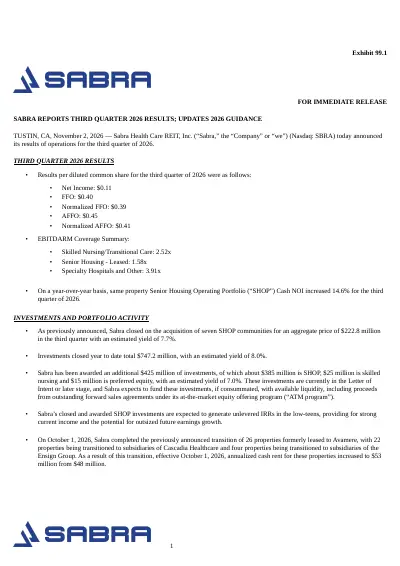
During the third quarter, Sabra invested $222.8 million, adding seven SHOP communities to Sabra's portfolio. Subsequent to quarter-end, Sabra invested an additional $140.7 million, adding four SHOP communities, bringing total year-to-date investments to over $747 million with an estimated yield of 8%.
Additionally, Sabra has another $425 million of additional awarded investments, nearly all SHOP, which should close in the near future. In addition to the over $1.17 billion in closed and awarded investments, Sabra has an additional $260 million of SHOP investments that we are actively pursuing.
On a year-over-year basis, Sabra added 18 SHOP communities, an 18% increase by number of assets, and over 60% increase in total SHOP NOI. Deal flow shows no signs of slowing, and Sabra remains competitive on new investments.
Moving on to the same-store portfolio. Sabra's same-store SHOP portfolio, including joint venture assets at share, continued its strong performance in the third quarter.
The key numbers are: revenue for the quarter grew 9.3% year-over-year, with our Canadian communities growing revenue by 7% in the same period. Third quarter occupancy in our same-store portfolio was up 160 basis points to 89.2% year-over-year.
Notably, our domestic portfolio occupancy increased 211 basis points to 86.9% during that period, while our Canadian portfolio grew 77 basis points to 93.9% in the same period, marking the 10th consecutive quarter where occupancy was over 90%. RevPOR for the third quarter continued to rise, with an increase of 7.3% year-over-year, with our Canadian portfolio increasing 6.0% in the same period.
While RevPOR and occupancy continued to grow, ExPOR increased 4.7% for the same period, providing for cash NOI growth of 14.6% on a year-over-year basis. The increase in ExPOR was driven primarily by repairs and maintenance, sales and marketing, and incentive management fees, while labor continues to grow less than 3%.
With over $1.17 billion in closed and awarded investments to date, a very robust pipeline, and industry tailwinds at our backs, we should continue to see solid growth in our portfolio. With that, I will turn the call over to Michael Costa, Sabra's Chief Financial Officer.
Michael Costa
Thanks, Darrin. For the third quarter of 2026, we recognized normalized FFO per share of 39 cents and normalized AFFO per share of 41 cents, compared to 38 cents and 40 cents, respectively, in the second quarter.
Year-over-year, our third quarter normalized FFO per share and normalized AFFO per share each posted an increase of 8%. Cash rental income from our triple-net portfolio increased $1.2 million on a normalized basis compared to the second quarter.
Cash rental income was $93.5 million for the quarter, excluding a $10.2 million payment of deferred rent received in the quarter. On a normalized basis, our second quarter cash rental income was $92.3 million, after adjusting for $1.8 million of out-of-period revenues primarily related to the Avamere rent reset.
SHOP cash NOI was $48.4 million this quarter, compared to $44.6 million last quarter. This increase reflects both the contribution from recent investment activity, including seven communities added during the quarter, and continued same-store occupancy gains and rate growth.
Interest and other income was $3.2 million for the quarter, compared to $5.8 million in the second quarter. The decrease was primarily due to repayments of loans in the second and third quarters.
Cash interest expense was $26.8 million for the quarter, compared to $27.4 million in the second quarter. The decrease reflects lower borrowings under our credit facility during the period.
Normalized cash G&A was $10.6 million for the quarter, compared to $10.7 million last quarter. During the quarter, we wrote off $6.2 million of straight-line rent receivables and lease intangibles, primarily due to the transitioning of the former Avamere portfolio.
This amount was normalized in our quarterly results. We have updated our 2026 earnings guidance and increased the midpoint of our per share normalized FFO and normalized AFFO by half a penny.
At the midpoint, this represents year-over-year per share growth of 7% for normalized FFO and 8% for normalized AFFO. Now briefly turning to the balance sheet.
Our net debt to adjusted EBITDA ratio was 4.54 times as of September 30th, 2026, compared to 4.61 times as of June 30th, 2026. As we have stated previously, our strategy is to naturally lower our leverage over time without sacrificing earnings growth.
This quarter's results reflect that strategy in action, and it is a strategy we will continue to employ. As of September 30th, 2026, we had approximately $1.2 billion of liquidity and were in compliance with all of our debt covenants.
In addition to $36.2 million of unrestricted cash and cash equivalents and $873.5 million of available borrowings under our revolving credit facility, we had $292.5 million related to shares outstanding under forward sales agreements under our ATM program, which consisted of 15 million shares at an initial weighted average price of $19.53 per share, net of commissions. Additionally, we have $332.7 million of availability remaining under the ATM program.
During the quarter, we issued 6.5 million shares in settlement of certain outstanding forward sales agreements under our ATM program at a weighted average price of $17.89 per share, net of commissions, resulting in net proceeds of $116.2 million. These proceeds, together with cash on hand, were used to fund our investment activity during the quarter.
Finally, on November 2nd, 2026, Sabra's Board of Directors declared a quarterly cash dividend of 30 cents per share of common stock. The dividend will be paid on November 30th, 2026, to common stockholders of record as of the close of business on November 13th, 2026.
The dividend is well-covered and represents a payout of 73% of our third quarter normalized AFFO per share. With that, we'll open up the lines for Q&A.
Operator
We will now begin the question-and-answer session. If you would like to ask a question, please press *1 to raise your hand.
To withdraw your question, press *1 again. We ask that you pick up your handset when asking a question to allow for optimum sound quality.
If you are muted locally, please remember to unmute your device. Please stand by while we compile the Q&A roster.
Your first question comes from the line of Juan Sanabria with BMO Capital Markets. Your line is now open.
Juan Sanabria
Hi. Good morning out there.
Just curious if you could, Rick or Darrin, elaborate on the optimization in skilled nursing, and maybe that includes the behavioral hospitals. Is that just rent increases upon expiration, which you touched on in the prepared remarks, or does that include further potential sales or monetizations of the assets to accelerate this transition towards SHOP NOI?
Rick Matros
Hey, Juan, thanks. It's just skilled nursing, and there are a couple that we're currently working on.
One is another transition, similar to the ones that we talked about in July. The other is a lease that's coming up in the not-too-distant future, and the operators involved are interested in negotiating an extension sooner or later, and that extension would carry with it an increase in rents simply given where rent coverages for that portfolio today, and what we would normally put a new lease at for a skilled nursing operator, somewhere around 1.5.
That's really where the upside is. If you look at our lease expiration schedule, we've got, between 2027 and 2020 2031, we have a big chunk of leases coming up, you should expect us to take advantage of that in the same way that we've been taking advantage of to date, and again, for the same reasons.
Does that answer your question, Juan?
Juan Sanabria
It does. Thank you.
Then just as a follow-up, if I may, just curious if you can give a little bit more color on the fourth quarter-to-date transactions and the 40- 400-plus million that's in process, that has been agreed to, and pricing, and how that may be changing kind of in the short and longer-term yield expectations on those acquisitions.
Rick Matros
What was the first part of the question, Juan? Say again.
Juan Sanabria
The recent deals, what's closed fourth quarter-to-date, and what's kind of pending to close--
Rick Matros
Okay.
Juan Sanabria
--and how cap rates have trended.
Darrin Smith
Sure. This is Darrin.
Economics in the current pipeline for the 425 are similar to those completed in 2026. It's a mix of stabilized assets and some modest value-add or upside opportunities.
Unlevered IRRs continue to range in the low double digits to mid-teens. I would say that the previously closed assets had more SNF and pref equity, higher yielding investments.
That being said, there's definitely been cap rate pressure on the senior housing side that we've seen in the industry throughout the year. However, with the rising interest rates, that pressure appears to have moderated for now.
Juan Sanabria
Thank you.
Operator
Your next question comes from the line of Jamie Feldman with Wells Fargo. Your line is now open.
Jamie Feldman
Hey, thanks for taking the question. I guess along the same lines, how have you changed your underwriting assumptions with higher rates and then just with operating conditions in the business in terms of your willingness to underwrite better NOI growth or maybe weaker NOI growth and then exit cap rates, as you're thinking about your own IRR outlooks?
Darrin Smith
Sure. The underwriting of each investment opportunity is very asset and market-specific, number one.
Occupancy, we're still keeping occupancy or stabilized occupancy probably up to the 92%, maybe 93.5% range, once again depending upon the local market. As far as rate growth is concerned, you do end up with a little bit more visibility into near-term rate growth that typically takes place January 1st as these plans are kind of implemented here later in the year.
Those tend to be, at least they have tended to be, kind of in the mid single digits for now. As far as exit cap rates, we are basically using what we see as a market cap rate today, there's no sort of cap rate compression or inflation.
Rick Matros
As we had mentioned earlier or last call or whatever, we are looking at doing more value-add, and we did do a sizable value-add. When we say value-add, we're not talking about distressed operations that are destablized.
We're looking at 80% occupancy in the case of the deal that we did. That obviously brings down the overall yield, but it provides a lot more upside for us going forward.
Given the volume of deal flow that we have and that we anticipate having next year, we can do those kinds of things here and there and still make it work for us with our cost of capital.
Jamie Feldman
Thanks for that. Then turning to Avamere, can you just remind us how much rent remains to commence and the incremental '27 contribution that's not yet reflected in the current cap rate or current run rate?
Michael Costa
Sure. When we did that transition effective October 1st, that took the annualized rents from $48 million to $53 million.
We're only seeing the impact of that on 2026 numbers just for three months. That full impact is going to be seen in 2027, obviously.
Actually, the increase year-over-year will be slightly higher than that, because as you recall, we did the rent reset earlier in the year. You should expect to see year-over-year the NOI generated from that lease to be, call it $5 million or a little bit higher than $5 million on a year-over-year basis.
Jamie Feldman
It sounds like it's in the full 4Q run rate?
Michael Costa
It is in the full 4Q run rate. It's in our guidance.
Jamie Feldman
All right, great.
Michael Costa
Thank
Jamie Feldman
you for-- Mhm. Thank you.
Operator
Your next question comes from the line of Farrell Granath with Bank of America. Your line is now open.
Andrew Reale
Hi, this is Adhiraj on with Farrell. Thanks for taking our questions.
I guess first just with respect to the SHOP same-store NOI guide, what sort of improved in the fourth quarter outlook to support moving the guide up to the mid-teens? Is that mainly stronger occupancy and rate trends, or are you expecting some expense growth to moderate as well?
Rick Matros
It's just overall strength in the performance of the SHOP portfolio.
Michael Costa
I think more visibility, right? Because we're talking about two months of forecasting here versus nine months earlier in the year.
Andrew Reale
Thanks. Maybe one on the supplement.
Looks like it now shows an estimated yield figure instead of an initial cash yield in the investments. Also looks like 1Q SHOP deals moved from 7.9% yield to about 9.2%.
Just curious what's behind the change and what is the new yield measuring?
Michael Costa
In terms of what the new yield is measuring, I think the simplest way to put it is it's a year-one yield other than the limited situations like Rick articulated, where we're doing some value-add opportunities, in which case we're using a stabilized yield on that. When we say stabilized, we're talking about, call it year two, once the operators able to go in and put their strategy in place.
It's by and large a year-one yield except for those select opportunities. The one thing I would say is when you kind of take a step back and you look at our total closed and awarded pipeline, the going-in yield, the year-one yield that we're expecting is in the low 7s.
Even with those value-add opportunities, the going-in yield that we're expecting in year one is still competitive with our cost of capital.
Rick Matros
What about the other--
Michael Costa
Your second part of the question, can you repeat that?
Andrew Reale
No, I think you answered it. Just wondering what's behind the change, what is it measured, but I think you answered the question.
Michael Costa
Yeah.
Operator
Your next question comes from the line of Austin Wurschmidt with KeyBanc Capital Markets. Your line is now open.
Austin Wurschmidt
Great, thanks. Just going back to the earlier question about the optimization of skilled nursing, you highlighted those two opportunities.
Can you give us a sense of, just to quantify what that upside opportunity looks like from an NOI perspective and really the timing of those taking place, and how much they could contribute to '27, I guess? Thanks.
Rick Matros
We can't, because we're still in the process of negotiating that, but I would expect that they'll be if not a full '27 year full 2027 year impact, or pretty close to it. We're still in the process of negotiating those.
Michael Costa
To the extent those are completed by the time we release our fourth quarter earnings and our 2027 guidance, those will obviously be reflected in there as well.
Rick Matros
If there's a reason to do an update then-- Say again?
Austin Wurschmidt
No, I was just going to say, could you give us a sense where the coverage ratios are for those specific leases today?
Rick Matros
They're well over 2 times.
Austin Wurschmidt
Got it. Then you mentioned some SNF and preferred equity deals that you did subsequent to the third quarter.
Are you seeing a larger number of skilled nursing investment opportunities, and is that something that's of interest to you to mix in with some of the SHOP investments in the awarded pipeline?
Rick Matros
No, not at all. These are off-market deals.
We're not seeing any uptick in sort of traditional down-the-fairway triple-net skilled deals. Then the prep all relates to development that we're doing on the senior housing side with existing operating partners.
One of the reasons it works for us, whereas in almost every development deal that we look at that they don't pencil, in the instances that we're doing deals, one, they're with operators that have their own in-house capabilities. Very often they've owned the land for a while so the basis is low.
They're really distinct opportunities as opposed to kind of the beginnings of any trend on the development side.
Austin Wurschmidt
That's helpful detail. Thanks for the time.
Rick Matros
Also, we may not wait until fourth quarter earnings on the optimization stuff if we have something that we can just do a business update on before then.
Operator
Your next question comes from the line of Michael Stroyeck with Green Street. Your line is now open.
Michael Stroyeck
Thanks, and good morning. Can you just talk a bit about the behavioral health business, where is coverage for that portfolio, how did that change this quarter, and maybe any color on the kind of the near-term outlook for that business would be helpful?
Rick Matros
All we really have left, we're pretty much out of the substance abuse disorder business. We have Signature left, which is five psych hospitals, it's actually quite a different business.
They've been a tenant since 2017. Without the substance abuse disorder business, that business fits much more aligned with our other category, which includes rehab hospitals and acute hospitals and a couple of other things that are more specialized in nature.
The coverage, it's much more dynamic business as is the acute hospital business, you're going to see occupancy and coverages go up and down a little bit. The coverage is really strong in that other category, and total is closer to 4 times than 3 times, we feel like we're in pretty good shape there.
In terms of the future of our relationship with Signature, as we've said in the past, it's not RCA. They've been a reliable tenant for a long time.
They'd like to own the real estate, but it's got to be compelling for us. We're not willing to take dilution to earnings in order to get a deal done there.
For right now, I'd say they'll continue to be our tenant. That other category is now down to 10% of the total portfolio and will continue to shrink as we grow the rest of the business, it becomes less and less impactful.
Michael Stroyeck
Got it. That's helpful.
Then maybe can you provide some color on the coverage stratification you guys started disclosing this quarter? What segments or operators make up that 1 to 1.5 times bucket, and are there any concerns that rent cuts could be needed on any of those assets?
Michael Costa
No, there's no concerns that any rent cuts are needed, and I would say that those buckets, it's a mix of skilled nursing and senior housing that's in there.
Michael Stroyeck
Great. Thanks for the time.
Michael Costa
Yep.
Operator
Your next question comes from the line of Wes Golladay with Baird. Your line is now open.
Wes Golladay
Hello, everyone. I just wanted to get a little bit more color on the deferred cash rent payment of over $10 million this quarter.
Is that a sign of a tenant getting healthy and going back to accrual accounting?
Michael Costa
That's actually a sign of, yes, getting healthier, but then also a transition that happened with that particular operator. As part of us agreeing to that transition, combined with their stronger financial position today, we required that they repay that deferred rent, and they gladly did to make that transaction happen.
Wes Golladay
Okay. Going to the senior housing, is the RevPOR growth broad-based?
It's pretty strong, over 7%. What is driving that?
Is it just pricing power, through concession burn-offs? Is it mix at all?
Just trying to get a little bit more details on that.
Michael Costa
It's interesting because we get the question, others get the question as well regarding pricing power. Are you going to be able to increase rates above market when you're above 90% occupancy?
While that intuitively makes sense, we're not seeing any evidence of that within our portfolio, at least not yet. There are some facilities that are over 90% occupancy that are being able to push higher rates, but we have some that are in the 80s that are being able to push higher rates as well.
I think probably the one thing that we would probably chalk up the strong RevPOR growth to most significantly is acuity and the ability of a lot of our operators to take on higher acuity residents and provide the care that they need and be able to charge those levels of care accordingly. That's having a positive contribution on the RevPOR side.
Wes Golladay
Thank you for the time.
Michael Costa
Yep.
Operator
Your next question comes from the line of Vikram Malhotra with Mizuho. Your line is now open.
Vikram Malhotra
Thanks for taking the questions. I guess just maybe, first one, Rick, you talked about the trajectory of SHOP.
You went from 20 to 40, now pro forma, I guess, 50. I'm just wondering where do you see this ultimately shaking out, meaning at what point do you say we've had enough SHOP growth?
Now you just referenced cap rates coming in, perhaps taking more value-add. You have a good balance.
You have these rent resets all adding to growth next year. By just my math, you should be at least 6%, 7% FFO growth with everything you've done.
I'm just wondering bigger picture, how big do you grow the SHOP platform and just how much more risk do you take in terms of value-add?
Rick Matros
I think we don't view ourselves taking risk on value-add. It's funny how everything changes.
Now that people are thinking about occupancy in the 90s, all of a sudden 80%, which is actually quite stabilized, is viewed as not stabilized. If you're at 80%, you've got a good operator in there and a good asset, there's not much risk there.
We'd like to do more of that. In terms of our SHOP exposure overall, our focus is on growing earnings and we're going to follow where the opportunities are.
Right now, the predominant opportunities are in SHOP and that's why we're anticipating 12 months out we'll be closer to 50% SHOP and closer to 40% skilled nursing. We're happy to do more skilled nursing, and we can do both.
If the SHOP opportunities remain what they are and there are more skilled nursing opportunities, we're just going to do both. We're not sort of putting any parameters on how much SHOP we want to have or how much skilled nursing we want to have.
We want to have a very well-balanced portfolio. We like the idea of having more SHOP than skilled.
As we all know, for those of us that have been around for pretty long time, the outlook is great for both SHOP and skilled, but life happens and stuff happens, and we don't want to make a bet just on one asset class only, particularly with the contributions that we're getting out of the skilled portfolio now. As I mentioned earlier, you look at our lease expiration schedule, we're going to have outsized contributions from our skilled portfolio through the end of the lease expiration schedule in 2031.
That's a good place, I think, for us to be. Does that answer your question, Vikram?
Vikram Malhotra
No, that's helpful. I guess just, bigger picture question.
We'll see what the midterm outcome is today, but I'm wondering are there any specific states you're watching, is there any Medicaid growth implications, or even bigger picture, if there's a blue wave versus not, any thoughts on what that may mean for skilled and the reimbursement landscape?
Rick Matros
Sure, if the chambers are split, with the Republicans holding the Senate and the Dems getting the House, I don't think there'll be much change, or much of a fight over anything. If the Dems win both the Senate and the House, they've already put this paper together.
It's 81 pages on health care overall, and there's some stuff in there that we like with workforce investments, and it's not just about long-term care, by the way. It's about the entire health care space.
We would expect that there may be things coming up like staffing again, or private investment in health care facilities. That kind of stuff will bubble up again.
When we beat those things down in the past, we did it with bipartisan support. Not everybody sees it that way on the Dem side.
We feel pretty comfortable with it. There'll be probably a little bit more noise about it if the Dems win the Senate as well, I think is probably the best way to put it.
The other thing I'd point out is to remind everybody, every state that we're in has staffing band-aids currently, and that the staffing mandate that was originally recommended at the federal level was one that Sabra in the aggregate already met. It's just not a concern.
I think it's going to be more noise in headlines than an actual impact on the day-to-day business.
Vikram Malhotra
Great. Then, sorry, just maybe if I can clarify one thing.
Assuming this trajectory continues and you're headed to then pro forma let's say 60% SHOP, meaning in terms of acquisitions next year, just remind us capital available to fund incremental deals into 1Q '27, and then what your order of preference would be. Would you be doing more dispositions?
Would you use leverage? Just remind us sort of the preference for funding all of this.
Michael Costa
In terms of financing, I think between our cash on hand, the availability on our line of credit, and what we've raised on the ATM, we have enough capital to close everything we need to close through early '27, call it Q1 or even early Q2 of '27. Then going forward, I think when you look at investment opportunities that come our way, we would look to fund them similarly, use our credit facility to fund the debt portion of it, call it 35 30% to 35%, and the rest would come from either retained earnings or from raising equity in the ATM or even the traditional ways if there's enough volume to do so.
From the disposition side, look, you're always going to have some level of dispositions. I think that's something every company should be doing and looking at their portfolio and pruning it off periodically.
I wouldn't expect it to be of a meaningful volume. It's not going to be of a volume that's going to allow us to fund our entire pipeline or anything like that, but it'll be part of the equation, albeit a small part of it.
Operator
Your next question comes from the line of Seth Bergey with Citi. Your line is now open.
Seth Bergey
Hey, thanks for taking my question. I guess I just wanted to go back to kind of the pipeline.
How much of kind of the awarded pipeline is either off-market or from existing operators that are kind of already with you?
Darrin Smith
Sure. The off-market transactions we've been doing through the beginning of the year, we've been averaging about 30% off-market.
Then as far as existing operators, we're only changing operators in about 35% of the total closed and awarded opportunities, 65% the incumbent operator will be staying in place.
Rick Matros
By the way, last year Last year, last year we had almost no off-market deals and and we've intentionally developed relationships where we can do more off-market. We've jumped from about 0 to 30% just in the last year.
Seth Bergey
Great. Then maybe going back to some of your earlier comments around occupancy and 90%, how should we kind of think about kind of the operating leverage and the incremental margin flow-through as you kind of achieve higher occupancy within some of the more stabilized assets?
Rick Matros
Where occupancy currently is, you're going to see a minimum 50% pull-through to the margin. As you get to 92%, 93%, that's going to grow probably to 70-plus percent.
There's just not that much more costs associated with bringing in just a few extra residents. Those are probably good numbers.
To be clear, we've already surpassed the operating leverage mark, so that pull-through has already started to happen, which is really one of the reasons that we've got sector-high cash NOI margins.
Seth Bergey
Great. Thank you.
Operator
Your next question comes from the line of Dave Rodgers with Raymond James. Your line is now open.
David Rodgers
Hey, Rick, good morning out there. I think you addressed this maybe a couple of questions ago, but maybe ask it in a different way.
40-some-odd percent of your skilled expirations are kind of after 2035, and I think Ensign's been out there desiring to buy some assets out of their REIT partner portfolios. I don't know if they've approached you or not, but how do you think about some of the long-dated SNF assets and maybe offloading some of those, continue to accelerate the growth in the company overall, but keep some of the near-term opportunities that you mentioned earlier in the call?
Rick Matros
At this point, we feel like we've pretty much cleansed the portfolio of anything that we didn't want to retain on the skilled side. We'll see what the environment looks like, but as we sit here today, I wouldn't anticipate any material dispositions with our skilled operators.
The space has such a nice runway ahead of it. The environment may change over the next couple of years.
We've got time, obviously, to make those judgments. We're not having those conversations with anybody right now, kind of to answer your question about that with Ensign.
We'll see, but we'll be open-minded about it.
David Rodgers
Then just a quick follow-up on the leased senior housing portfolio. Any opportunities there as well for rent resets, transitions to managed, anything like that that would benefit you as well?
Rick Matros
We've pretty much done as much as can be done there. If there's any other opportunity, it's going to be incremental.
Basically that piece of the portfolio, which is down to about 7% of our NOI right now, are legacy operators that like everybody else kind of went through hell during the pandemic. They're doing really well now.
They're good operators, and so they're content with where things are. We're happy to have them as operators.
We're not going to force them out of the portfolio just because they're triple-net, you're just going to see that number continue to shrink as a percent.
David Rodgers
Thank you.
Operator
Your next question comes from the line of Juan Sanabria with BMO Capital Markets. Your line is now open.
Juan Sanabria
Thanks for the extra time. Just curious on the SHOP side of the business, how are you thinking about costs as a result of your tech and data initiatives, and how you think about ExPOR trending from here?
Michael Costa
In terms of the costs that we're incurring at the corporate side, I think it's really incremental in the grand scheme of things. We're making investments today.
We have a lot of the infrastructure already in place, adding to it incrementally, as I mentioned. I don't see that as being anything that's going to meaningfully move the needle from a cost perspective.
Obviously, from an efficiency perspective, we fully believe that to be the case on the corporate side as we continue to take on more operators, as we continue to expand that portfolio. The initiatives that are happening at the facility level, I think speaks more to your question in terms of ExPOR.
Look, I think all those initiatives are done with an eye towards making operations more efficient, whether that's on the housekeeping side, whether that is on the caretaker side, whatever it may be. It's all with an eye towards improving the efficiency and the ultimate delivery of care there.
Juan Sanabria
Thanks. One last one for me.
There was a mention of kind of value-add investment opportunities. Just curious on how you guys think about CapEx for the SHOP business on a per-unit, per-year basis, presumably those may be having some deferred CapEx.
Any thoughts about why you guys don't include SHOP CapEx now that SHOP is 40% of the business in your FAD calc? I think most of the peers do that.
Michael Costa
In terms of the FAD calc, years ago we decided we didn't want to put FAD in our supplement or anywhere else just because the SEC prohibits you from showing it on a per-share basis. Now, with that said, as we've talked about before, the numbers are all there, right?
We do disclose what our recurring CapEx is. We disclose what our non-recurring CapEx.
The math is all there if somebody really wants to calculate what FAD is on an apples-to-apples basis with a competitor, or a peer of ours I should say. We just don't want to disclose it because we can't show it on a per-share basis.
That simply it.
Rick Matros
In terms of CapEx spending, right now everything that we've been buying is less than 10 years old, including the value-add stuff, there's not much in the way of meaningful CapEx spend. I think it's reasonable to assume as time goes by and the amount of newer assets kind of dwindles a little bit, you'll pick up some older assets and they will require more CapEx spend going forward.
Juan Sanabria
Rule of thumb, I guess, on how much you guys think is your proper amount to spend on a per-unit, per-year basis?
Michael Costa
It depends. It depends on the age of the property, but I guess rule of thumb is around $1,200 to $1,500.
Juan Sanabria
Thank you.
Operator
Your next question comes from the line of Michael Goldsmith with UBS. Your line is now open.
Michael Goldsmith
Good afternoon. Thanks a lot for taking my question.
In regards to the value-add SHOP investments that you've already closed, can you give us an update on how those assets are actually tracking relative to the original underwriting? Are you still comfortable with that one to two-year stabilization timeline and roughly 9% stabilized yield?
Thanks.
Darrin Smith
Yes to all of this. They are actually performing ahead of underwriting projections, both from an occupancy perspective and an NOI.
It's still early days, but so far so good.
Michael Goldsmith
Got it. Then just to clarify the comment made earlier, I think around when you get to 90% occupancy, you get pricing power and you're not seeing it.
Was the purpose of that comment to suggest that you're seeing pricing power before you hit 90% occupancy? Just wanted to clarify that.
Michael Costa
The comment was more directly around the 7-plus percent RevPOR growth we saw this quarter wasn't because our portfolio is over 90%. We're seeing facilities that have occupancy in the 80s being able to drive higher than average rate growth, right?
It's not directly correlated today. It's not directly correlated with being over some occupancy threshold.
That's it.
Rick Matros
Right. Once you get into the lower 90s, I think there's an intuitive assumption it seems that everybody's part that there will be pricing power, and there may be.
We're not saying there won't be. We're just not there yet on occupancy.
The fact that our RevPOR has been as strong as it's been, and it's not just this quarter by the way, without that bodes really well going forward.
Michael Goldsmith
Thank you very much.
Operator
Your next question comes from the line of Austin Wurschmidt with KeyBanc Capital Markets. Your line is now open.
Austin Wurschmidt
Hi. Thanks for taking the follow-up.
I just wanted to go back to something discussed on the first quarter call around the Landmark assets that were intended to be sold. Where does that stand?
Has anything been completed on that front? I'm just looking for a general update.
Thanks.
Rick Matros
A bunch of that stuff has gone. There's a couple left that are dwindling out, and that's kind of it.
It's not even rounding.
Operator
There are no further questions at this time. I would now turn the call back to Rick Matros for closing remarks.
Rick Matros
Thanks for your time today. Appreciate your continued support, and we look forward to seeing a lot of you at NAREIT in two weeks.
Take care.
Operator
This concludes today's call. Thank you for attending.
You may now disconnect.