Stepan Company
Q3 FY2026 · Earnings Call TranscriptOctober 28, 2026
Operator
Good morning, and welcome to the Stepan Company Third Quarter 2026 Earnings Conference Call. During the presentation, all participants will be in a listen-only mode.
Afterward, we will conduct a question-and-answer session. To ask a question during the session, you will need to press star one one on your telephone.
You will then hear an automated message advising your hand is raised. To withdraw your question, press star one one again.
As a reminder, this call is being recorded on Wednesday, October 28th, 2026. It is now my pleasure to turn the call over to Mr.
Ruben Velasquez, Senior Vice President and Chief Financial Officer of Stepan Company. Mr.
Velasquez, please go ahead.
Ruben Velasquez
Thanks, Cherie. Good morning, and thank you for joining Stepan Company's third quarter 2026 financial review.
Before we begin, please note that information in this conference call contains forward-looking statements, which are not historical facts. These statements involve risks and uncertainties that could cause actual results to differ materially, including, but not limited to, prospects for our foreign operations, global and regional economic conditions, and factors detailed in our Securities and Exchange Commission filings.
In addition, this conference call will include discussions of adjusted net income, adjusted EBITDA, free cash flow, net debt, and leverage-related metrics, which are non-GAAP measures. We provide reconciliations to the comparable GAAP measures in the earnings presentation and press release, which we have made available at www.stepan.com under the Investor Relations sections of our website.
Whether you are joining us online or over the phone, we encourage you to review the investor slide presentation. We make these slides available at approximately the same time as when the earnings release is issued, and we hope that you find the information and perspectives helpful.
With that, I would like to turn the call over to Mr. Luis Rojo, our President and Chief Executive Officer.
Luis Rojo
Thank you, Ruben. Good morning, and thank you all for joining us today to discuss our third quarter 2026 results.
I will share the highlights of the quarter and an update on our key strategic priorities, while Ruben will take you through the financial details. Before reviewing the quarter, I want to recognize our teams around the world for their commitment to safety.
Safety remains our top priority and the foundation of everything we do at Stepan. Our safety performance over the last 12 months remains strong.
The third quarter was another quarter of earnings growth for Stepan. The three segments delivered organic volume growth and increased earnings versus the prior year.
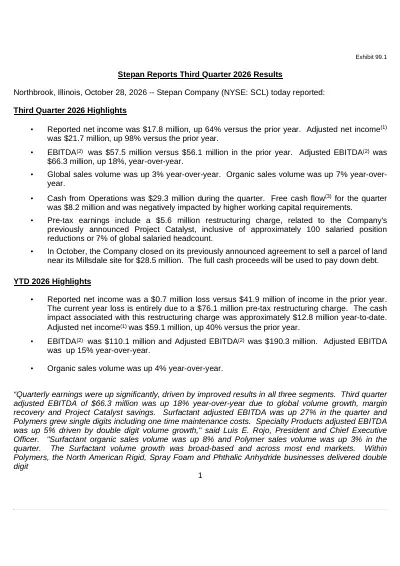
Adjusted EBITDA was $66 million, up 18% versus the prior year, driven by global volume growth, margin recovery, and Project Catalyst savings. Surfactant adjusted EBITDA was up 27%.
Polymers grew single digits, including one-time maintenance turnaround costs at our Germany site. Specialty Products grew EBITDA single digits, driven by double-digit volume growth.
On a consolidated basis, adjusted earnings per diluted share were 94 cents, nearly double the prior year. Now, I want to highlight a few elements of our third quarter performance.
First, volume growth: organic volume grew 7%, with growth in all three segments. Surfactant organic volume was up 8%, and the growth was broad-based across most of the end markets.
Polymers volume was up 3%, with North America growing a strong double digits. Specialty Products delivered 20% volume growth behind a strong innovation plan in our MCT product line.
We are pleased with the growth we achieved in several of our key strategic end markets despite ongoing global economic uncertainties and supply chain disruptions. Second, margin recovery and pricing discipline: raw material costs continue to increase in a volatile environment, including the disruption related to the Middle East conflict.
Our pricing actions, together with our disciplined execution of our contractual pass-through mechanism, offset those higher costs. Third, productivity and cost-out: Project Catalyst continues to deliver savings, and we are now projecting to exceed the 60% target for 2026.
Finally, we remain focused on cash generation and balance sheet deleveraging. Our net leverage improved to 2.4 times.
Free cash flow was positive at $8 million despite a further investment in working capital. In October, we closed the sale of a parcel of land near our Millsdale site for $28.5 million.
The full cash proceeds will be used to pay down debt and continue to deleverage the balance sheet in November. Through the first nine months of the year, adjusted EBITDA is up 15%, and adjusted earnings per share are up 40% versus the prior year.
We remain committed to a balanced approach to capital allocation. During the quarter, we continued to invest in working capital, we executed our capital plan across our sites, and we paid $9 million in dividends.
Finally, we increased our quarterly dividend by 1 cent per share, or 2.5%, marking the 59th consecutive year that Stepan has increased its dividend. With that, I will turn the call back to Ruben to walk you through the financial details for the quarter.
Ruben Velasquez
Thank you, Luis. As shared in our third quarter 2026 earnings release, reported net income was $17.8 million, or 78 cents per diluted share, up 64% versus $10.8 million, or 47 cents per diluted share, in the prior year.
Reported results include a $5.6 million pre-tax restructuring charge, largely related to the previously announced close of our Fieldsboro, New Jersey site, the decommissioning of select assets at our Millsdale, Illinois and the Stalybridge, United Kingdom facilities, and the global salaried workforce reduction we announced in July. Let's move to slide six, which shows the adjusted net income bridge for the third quarter of 2026 versus the third quarter of last year.
Adjusted net income was $21.7 million, or 94 cents per diluted share, up 98% versus $10.9 million, or 48 cents per diluted share, in the prior year. The increase in adjusted net income was primarily due to higher Surfactant earnings, with additional contributions from Polymers and Specialty Products, partially offset by higher corporate expenses and a higher tax provision on the stronger earnings.
Adjusted corporate expenses increased by $1 million, or 6%, primarily due to higher incentive-based compensation associated with the improved operating performance. Slide seven shows the total company adjusted EBITDA bridge.
Adjusted EBITDA was $66.3 million, up $10.1 million, or 18%, versus the prior year. This increase was primarily due to higher Surfactant earnings, driven by sales volume growth and margin recovery, with Polymers and Specialty Products also up, partially offset by $1.6 million of higher corporate expenses reflecting higher incentive-based compensation.
I will now cover each segment in more detail. Turning to Surfactants on slide eight, net sales were $487 million, up 15% versus the prior year.
Selling prices were up 10%, primarily due to the pass-through of higher raw material costs and targeted pricing actions. Reported volume grew 3%, and organic volume increased 8%.
Foreign currency translation positively impacted net sales by 2%. The organic growth was led by double-digit increases in consumer products, including laundry, construction and industrial, and oilfield end markets, partially offset by lower crop productivity demand.
Surfactant adjusted EBITDA was $48 million, up $10 million, or 27%, versus the prior year. North America and Asia earnings improved on organic volume growth in consumer products, oilfield, and construction and industrial, together with margin recovery.
Latin America earnings increased on double-digit organic volume growth, pricing execution, and margin recovery. Europe was modestly lower as reduced crop productivity demand more than offset growth in our consumer end markets.
Moving to Polymers on slide nine, net sales were $179 million, a 24% increase versus the prior year. Selling prices were up 22%, primarily due to the pass-through of higher raw material costs.
Sales volume increased 3% in the quarter. North American volume was up double digits, driven by rigid polyols and phthalic anhydride, including continued significant growth in our spray foam product line.
This growth was partially offset by softer demand in Europe and Asia. Foreign currency translation negatively impacted net sales by 1%.
Polymer adjusted EBITDA was $23 million, up 4% versus the prior year, as North America's strong volume growth in rigid polyol, spray foam, and phthalic anhydride more than offset the five-year regulatory-mandated maintenance turnaround costs at the company's Germany site, lower rigid polyol volume in Europe, and softer demand in China. North America EBITDA was up $3 million on volume growth and margin improvement.
Europe was down $2 million, primarily due to the maintenance turnaround at our Germany site. Asia was slightly lower on softer demand for specialty polyols in China, partially offset by improved rigid polyol margins.
Specialty Product net sales were $27 million, a 12% increase versus the prior year, and volume increased 20%. Adjusted EBITDA was $11.7 million, up 5% versus the prior year, primarily due to higher volume in the MCT product line, partially offset by less favorable product mix.
Now turning to cash flow and the balance sheet on slide 10: cash flow from operations before working capital was $49 million in the third quarter, while free cash flow was $8 million after $21 million of capital expenditures. Free cash flow reflected a $32 million working capital build from accounts receivable, accounts payable, and inventories, driven by stronger sales and higher raw material costs.
Free cash flow included $6 million of restructuring-related cash payments. We ended the quarter with net debt of $536 million.
Our net leverage ratio improved to 2.4 times from 2.7 times a year ago, reflecting continued progress in deleveraging. Improving cash flow and further strengthening the balance sheet remain key priorities across the organization.
Moving to slide 15 and Project Catalyst: through September, we have recognized $76 million of pre-tax restructuring charges. The year-to-date cash impact of restructuring is $13 million.
Project Catalyst continues to deliver savings in line with our plan. The savings run rate increased to approximately $23 million in the third quarter.
These savings were partially offset by inflationary pressures on operating expenses. For 2026, we expect to exceed the 60% two-year, $100 million pre-tax savings target.
With that, I will turn the call back to Luis for an update on our strategic priorities and Project Catalyst.
Luis Rojo
Thanks, Ruben. Our strategy continues to be anchored in four pillars: first, customer-centric innovation to drive top-line growth; second, diversification of our markets and customers, with a focus on higher-growth end markets and Tier 2 and Tier 3 accounts; third, operational excellence, including the reliability and resiliency of our manufacturing network and supply chain; and fourth, financial strength through free cash flow generation, deleveraging the balance sheet, and disciplined capital allocation.
We continue to make progress against these priorities during the quarter. Surfactants showed consistent and broad-based growth in the third quarter.
Year-to-date, we have more than 300 new customers, and we have delivered nearly 900 new customer and product combinations in this business, with our global Tier 2 and Tier 3 customer base growing double digits. Additionally, we delivered strong double-digit growth in North America Polymers and our MCT product line.
We delivered this growth while continuing to recover margin in an inflationary raw material environment, which reflects disciplined commercial execution. The Middle East conflict has added volatility to feedstocks and supply chains, and we believe we are well-positioned to manage that disruption.
Our regional manufacturing footprint keeps production close to our customers, with a particular advantage in the United States. Our dual petrochemical and oleochemical raw material streams give us flexibility on feedstock management and maximize customer supply.
Finally, we continue to improve the reliability and resiliency of our manufacturing network. Our flagship Millsdale site had a great quarter in terms of production volumes and improving all key operating metrics.
Our Pasadena, Texas site continues to ramp up production and delivered the expected supply chain savings embedded in Project Catalyst. Pasadena remains a critical enabler for strategic future growth in specialty alkoxylates.
Let's move to slide 12 for an update on Project Catalyst. As a reminder, Project Catalyst is our comprehensive plan to further optimize our asset base and create a more productive and agile organization to enable balanced growth.
We are executing the program safely and in line with expectations. Per-quarter run rate savings was approximately $23 million, and we have identified actions that we believe will enable us to exceed the $25 million per quarter goal on average during 2027.
We executed the organizational redesign phase of Project Catalyst during the third quarter. This new organization design is a key enabler for us to deliver our balanced growth strategy, which is focused on top-line growth, margin recovery, and disciplined cost-out initiatives.
To conclude, we believe we are positioned to continue delivering growth in our businesses. Despite the ongoing and significant market uncertainties and challenges, the organization continues to be focused on executing our growth opportunities, productivity plans, and cash interventions.
With these actions and our strong results through the first nine months of the year, we believe we will deliver full-year adjusted EBITDA growth, positive free cash flow, and continued deleveraging of the balance sheet in 2026. This concludes our prepared remarks.
At this time, we would like to turn the call over for questions. Cherie, please review the instructions for the question portion of today's call.
Operator
Thank you. As a reminder to ask a question, please press star one one on your telephone and wait for your name to be announced.
To withdraw your question, press star one one again. One moment while we compile the Q&A roster.
Our first question will come from the line of Mike Harrison with Seaport Research Partners. Your line is open.
Mike Harrison
Hi, good morning. Good morning, Mike.
Luis Rojo
Good morning, Mike.
Mike Harrison
Really good to see all the pricing that you guys are getting across the three segments. I think we're trying to understand a little bit better the margin impact that you're seeing from raw material inflation and how much pricing is offsetting you across the three segments.
Maybe help us understand where the margin pressure is still a factor from inflation, and should we see further pricing catch up in Q4, or maybe when do you neutralize the impact of some of the higher raw material costs that you're seeing?
Luis Rojo
Great question, Mike. What I will say is this continues to be a very volatile environment when you think about oil prices and raw materials.
I think we did a pretty good job in Q2 and Q3. I don't want to focus too much in quarterly numbers, but when you think about on a year-to-date basis, and you look at our margins, and you see Surfactants double-digit margins—I mean EBITDA margins—you see Polymers in the 13% to 15% EBITDA margins, those are healthy margins.
We will continue to work on productivity to make sure that we have the best value for our customers, right? Right now, with the current oil prices, we believe we are in a good position in several places.
There are a few places where we are still making some price adjustments, but in general terms, I think the majority have been done. Again, this assumes the oil prices of Q3.
We will see what happens in the next few weeks with the raw material environment. Far, I think the margins for the year are going in the right direction, and we're pleased with the work that our commercial team has done not only to have a decent margins, but to be able to grow our volumes 4%.
4% organic volume growth in the first nine months is almost a record, all right? This is a significant amount of volume growth, and I have talked a lot about balanced growth, and again, I want to continue balancing volumes, margins, and of course cash, but we need to keep our reactors full, and that's what we are after.
Mike Harrison
All right, and then in terms of Project Catalyst, it sounds like the savings there are running ahead of plan for both 2026 and maybe the longer-term run rate into '27. I guess the way we were thinking about it is you'd get about $60 million worth of savings this year and then the incremental $40 million coming next year, but how should we think about Project Catalyst's contribution to further earnings growth in '27 versus '26?
Is $40 million still a good number, or could it be higher or lower than that?
Luis Rojo
No, look, good question, Mike. As we said today, we are ahead of the 60% target for 2026.
We are, instead of the 60, we are more in the $66 million to $70 million range. We already are delivering $23 million run rate in the savings in Q3.
We believe we can be ahead of the $25 million on average for 2027, right? That means $2 million to $3 million more versus where we are today.
Now, that's going to be, again, on average for 2027, which means ahead of the 25 in the second half, slightly below the 25 in the first half, as we continue ramping up production in Pasadena, as we continue implementing other projects that we have in the pipeline. That's the main component of the gradual savings increases in the next four to five quarters.
Remember that we have been very clear that these are the savings from Project Catalyst. We also have the normal inflation in our P&L.
That our fixed cost base is roughly $800 million. That's public information.
You can factor the normal 2% to 3% on the inflation piece on that base, and we will continue working on productivity, as I said before, to provide the best value that we can to our customers.
Mike Harrison
All right, thanks. Just a couple more for me.
Apologies if I missed this earlier, but what was the impact of the maintenance costs in Germany in the Polymers business in Q3, and is that cost completely isolated to Q3 or is there some carryover into Q4 or next year?
Luis Rojo
Yes, Mike. As you mentioned, we have that turnaround in Europe, in our Germany site.
That's a turnaround that happens every four years. It's regulated, it's mandated, and the impact on the Polymers business for Q3 was $2 million-plus driven by that maintenance.
Remember, Mike, that we talked last quarter that we had $4 million to $5 million of headwinds in turnaround maintenance costs, both Germany and the U.S. Germany was more Q3.
You will see the impact in Q4 in U.S. with all the maintenance and turnaround costs that we need to do in our PA facility.
It's coming in line, as expected and as planned.
Mike Harrison
All right. Then last quarter, you had talked a little bit about some volume that you felt like was being pulled forward or some pre-buying that might be happening.
I think at the time you expected that that maybe was as much as a $10 million impact to EBITDA. Now that we're sitting here in October and maybe you have the numbers to fully understand how much impact you saw, is there any way to help understand how much stronger Q2 was than what might have been normal and how much weaker, I guess, that made Q3?
Any color on that would be helpful. Thanks.
Luis Rojo
No, yeah, I agree, Mike, that we talked about the $5 million to $10 million impact from Q3 to Q2 last call. I would say that some of that was expected on the volume side, but a lot of that was expected on the margin side as well, right?
We grew in Q2, 6% volume, but the reality is that we grew with lower-cost inventory in our tanks. Now we are accelerating the growth actually to 7% with a different mix, with a different mix than that we had in Q2 as well, and with a normalized cost position in our tanks and our inventory.
What I would say is that I think the best way to look at Q2, Q3 will be, averaging both, when you think about the 75 and the 66. There was some swing, for sure, but delivering, $140 million in those two quarters shows the discipline of our execution plan, shows, a strong volume growth, which—let's be clear, when you think about 6% volume in Q2 and 7% volume in Q3, we are expecting a lower growth in Q4, for sure.
When you think about the year, when you include also Q1, we're growing volumes 4% on an organic basis. That's still a very strong performance when these markets are basically not growing, right?
These markets are, 0% to 1% growth. That 4% growth on volume is coming from a lot of new customers and share growth in the different end markets.
We're happy with a 4% volume growth. If we can continue that throughout the year, that will be an outstanding year of volume growth for Stepan Company.
Mike Harrison
All right, thanks very much. I'll turn it back.
Operator
Thank you. One moment for our next question.
That will come from the line of Dave Storms with Stonegate. Your line is open.
Dave Storms
Morning, and thank you for taking my questions. Luis, I actually wanted to go back to kind of what you just mentioned around margin growth coming from both new customers and share growth.
I was hoping, giving you mentioned approximately 340 new customers, 900 new combinations, can you help us understand how much the margin growth came from new customers versus share growth?
Luis Rojo
No, look, when you're growing volume 7%, of course you have the benefit of reducing all the fixed cost and improving the margins this way. Again, we're seeing very strong performance in the Surfactants business when you think about especially the Americas.
You can do the math, right? On a year-to-date basis, our Surfactant business grew EBITDA in all the regions.
Grew EBITDA in North America, grew EBITDA in Latin America, actually even grew EBITDA very slightly, but grew EBITDA in Europe. The Surfactant business continues to be strong based on share growth, Tier 2, Tier 3 strength, and actually, a few very good quarters on the crop productivity business.
Q3 was a little bit softer, but when you think about the year, crop productivity is still okay and still positive. We feel good about the Surfactant business.
When you think about Polymers, again, very strong performance in North America with strong double-digit growth. The rigid business is strong, and we're growing a lot of share in spray foam and in PA.
We have talked the PA business in the past. It's not secret.
We are growing significantly in the PA business. We feel good about how the margin profile is going vis-à-vis the leverage that you have when you're growing volumes, 4% or 6% or 7%.
Again, this is not related to one side of one customer or the others. This is across the board.
Dave Storms
Understood. Appreciate that.
You also—in that answer, you mentioned North America Polymers growing strong, but Europe and Asia still remain weak on the Polymer side. Any green shoots there?
Any signs of improvements? Is that just a macro story?
Anything we should keep an eye out for there?
Luis Rojo
No, totally right. This is a macro story for Europe and China.
It's not a secret how the chemical industry is doing and a lot of the end market demand are doing in Europe and in China. When you think about China, the car industry and a lot of our Polymers products goes there as well, and that's not robust.
Then, of course, all the challenges that we see in Europe with the overall demand and with the overall construction environment there. Now, there is a lot of pent-up demand in Europe that we believe and our customers believe we can capture in the next three to five years.
There is plenty of work to be done to continue reducing energy consumption in Europe, which is the biggest issue there, and the building envelope can make a significant impact in reducing the energy consumption. That's where we play, and we're happy to play in that industry, and we're happy to play and help the Europe region to reduce the energy consumption in the building.
We are all hopeful that the next, three to five years, we will realize that pent-up demand.
Dave Storms
That's really great color. Thank you.
If I could ask one more, and it might be a quarter too early to ask this, but because you brought up crop productivity volumes decline in the quarter, when we're looking into the next couple quarters with a developing El Niño, do you see any changes in customer purchase expectations as we start to get ready for the next six to nine months on the ag side?
Luis Rojo
Great question, Dave. Because we're seeing—I mean, and you guys are seeing a lot of struggle from some of the, big ag companies.
It's not a secret. Now, what I will tell you is that our teams continue to do a great job in developing new products, new formulations, to continue growing share with all our key multinational accounts in the ag business and also growing with the middle Tier 2, Tier 3 ag companies.
We still have plenty of opportunities, right? When you think about tank mix adjuvants, this is a $1 billion market in the U.S.
This is a $700 million market in Brazil. We are still—we are still in the infant phase of developing our tank mix adjuvants and growing in that space.
Agree with you that the macros are not there for the overall ag industry and fertilizer prices and all of that. On the other hand, we will continue working on our innovation plan to continue growing in this space because it's a key strategic priority for Stepan Company to grow in crop productivity.
We have the products, we have the team, we have the know-how, and we will continue executing.
Dave Storms
Understood. Thank you for taking my questions, and good luck in the next quarter.
Luis Rojo
Thank you, Dave.
Operator
Thank you. One moment for our next question.
That will come from the line of Gaushik Sri with Singular Research. Your line is open.
Gowshihan Sriharan
Good morning, gentlemen. Congratulations on a strong quarter.
It's my first call covering Stepan, thank you for taking my questions.
Luis Rojo
Thank you so much. Welcome, Gaushik.
Welcome to the team, and happy to have you here.
Ruben Velasquez
Hello, Gaushik.
Gowshihan Sriharan
Thank you, Ruben. Thank you, gentlemen.
On my first question is the double-digit growth in the consumer products, I know you've alluded that there's some share gains, and I just want to make sure, are these share gains that you can hold to? Because I think in a previous call, you alluded to the fact that some of the competitors were short on raw materials.
Any comment or color on that?
Luis Rojo
Look, we continue executing our Tier 2, Tier 3 strategy, Gaushik. That works in the consumer space, that works in many of our end markets, but it's working.
It's working especially in the Americas. We will continue growing with our Tier 1 multinational companies.
We have a strong plan there. We have been doing extremely good with our Tier 1 accounts.
On top of that, Tier 2, Tier 3 is coming up incremental. That's the good news about how the strategy is playing out.
Tier 1s represents a very important business for Stepan Company. We are doing extremely well with Tier 1s, and Tier 2s and Tier 3s are coming on top, and we're happy to support them as they need formulation services and help on their products.
It's an "and" strategy. We're working on both.
Gowshihan Sriharan
Awesome. On the specialty products in the MCT, how sustainable do you see this MCT volume growth heading into next year?
Was there any kind of order timing benefit in the segment this quarter?
Luis Rojo
Yeah. Remember that we have a pharma business that is very seasonal, and that's why you see the EBITDA or the operating income on Specialty Products this quarter, because we ship a lot of the pharma business in Q3, and that was very similar to last year, right?
That's why last year was also in the same level of $11 million of operating income in Q3. When I think about the MCT business, Jamil and the team in Maywood has done an extremely good job of expanding our offerings in MCT, and we have developed a new innovation program to go into different segments and different price tiers within the MCT business, not only on the top tier, but also on the mid-tier.
That's why the mix effect and the margin is a little bit different, but that is showing up on the results, and that is also filling up our reactors. The reality is that this year we had a lot of, a lot of headwinds on the fatty acid pricing.
When you think about raw materials for fatty acids, we had a lot of challenges there. That's why we're not growing even faster, which we could, which we could in this MCT business.
That's our plan for next year, and we will continue to filling up the reactors. We have extra capacity, and we want to deliver all the capacity that we have at margins that make sense.
Awesome. Then
Gowshihan Sriharan
a little bit of color on the Pasadena utilization: where is it running today in terms of utilization, and what does getting into full utilization add to next year?
Luis Rojo
Good point. Look, we are in the—we have talked this in the past.
We are in the, 75%, 80% range on utilization. As we plan next year, that's why I mentioned before that probably we will see more savings on tolling savings and things like that in the second half than the first half, as we continue ramping up production in Pasadena.
Now, when I say the 75%, 80%, of course, is very focused on the volume piece. We are very focused on maximizing Pasadena on the dollar front, because at the end, every product is different.
There are products that require, 30 hours in a reactor, and there are products that require way more or way less. What we need to maximize is the dollar return from our Pasadena site, and that's what the team is working.
We are delivering more savings than we thought on the tolling piece in 2026 from our Pasadena site. We're happy with the development, even at, 75%, 80% capacity utilization.
Awesome.
Gowshihan Sriharan
Just sneaking in one last question: Latin America, I think you mentioned there was a competition that left, and so how exposed is Latin America to the Asian imports coming back, and how much of this year's recovery do you see it as structural?
Luis Rojo
Great point, Gaushik. Really great point, because for sure, Asia imports, especially in Mexico—you know, Brazil is more protected.
Brazil has a lot more restrictions, but in Mexico is where we see a lot of the imports from Asia. You're rightly so that having local production in the environment where we were in 2026 is a significant advantage for companies like Stepan.
We need to continue making sure that we provide the right value for our customers in 2027, we continue growing that business. We have an excellent footprint in Mexico, in Colombia, in Brazil.
I want to give kudos to the other Jamil—we have two Jamils in the company, but the other Jamil in Brazil and the whole Brazil team for what they are delivering this year has been an outstanding performance from them, and we believe a lot of that is sustainable. We will continue our plan to grow share, to fill up our reactors at the right margins, and continue to provide the right value to our customers in the Latin America region.
Gowshihan Sriharan
Thank you again for taking my questions. Congratulations, and I'll talk to you later.
Luis Rojo
Thank you, Gaushik, for joining.
Operator
Thank you. I'm showing no further questions in the queue at this time.
I would now like to turn the call back over to Mr. Rojo for any closing remarks.
Luis Rojo
Thank you very much for joining us on today's call. We appreciate your interest and ownership in Stepan Company.
Have a great and safe day.
Operator
This concludes today's program. Thank you all for participating.
You may now disconnect.