Stellus Capital Investment Corporation
Q3 FY2026 · Earnings Call TranscriptNovember 10, 2026
Operator
Good morning, ladies and gentlemen, and thank you for standing by. At this time, I would like to welcome everyone to Stellus Capital Investment Corporation's conference call to report financial results for its third fiscal quarter ended September 30th, 2026.
At this time, all participants are in a listen-only mode. We will open the floor for your questions after the presentation.
If you wish to join the queue to ask a question at any time, please press * followed by 1. To remove yourself from the queue, please press * followed by 2.
This conference is being recorded today, November 10th, 2026. It is now my pleasure to turn the call over to Mr.
Robert Ladd, Chief Executive Officer of Stellus Capital Investment Corporation. Mr.
Ladd, you may begin your conference.
Robert Ladd
Okay. Thank you, Sylvie.
Good morning, everyone, and thank you for joining the call. Welcome to our conference call covering the quarter ended September 30th, 2026.
We have six topics to cover this morning: First, our financial results for the third quarter; second, portfolio and asset quality; third, a history of our Stellus investing and life-to-date performance; fourth, an outlook for Q4 and beyond; fifth, our $20 million share buyback program; and sixth, our opportunities for growth. Joining me as usual this morning is Todd Huskinson, our Chief Financial Officer, who will cover important information about forward-looking statements.
Todd Huskinson
Thank you, Rob. I'd like to remind everyone that today's call is being recorded.
Please note that this call is the property of Stellus Capital Investment Corporation, and that any unauthorized broadcast of this call in any form is strictly prohibited. Audio replay of the call will be available by using the telephone number and PIN provided in our press release announcing this call.
I'd also like to call your attention to the customary safe harbor disclosure in our press release regarding forward-looking information. Today's conference call may also include forward-looking statements and projections, and we ask that you refer to our most recent filing with the SEC for important factors that could cause actual results to differ materially from these projections.
We will not update any forward-looking statements unless required by law. To obtain copies of our latest SEC filings, please visit our website at www.stelluscapital.com under the Public Investors link, or call us at 713-292-5400.
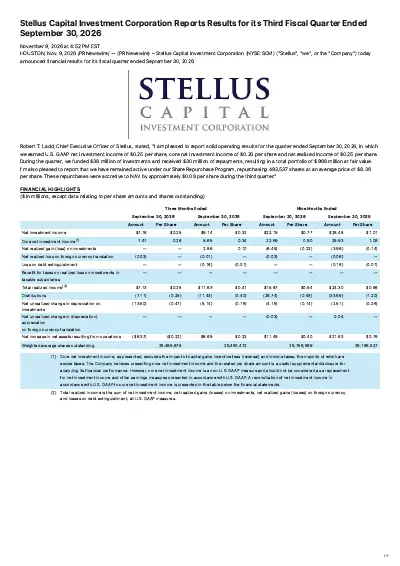
I'll start by covering our operating results for the quarter. In the third quarter, we generated 25 cents per share of GAAP net investment income, and core net investment income of 26 cents per share, which excludes estimated excise taxes.
Overall for the quarter, net asset value decreased by 40 cents per share, or 3%, driven by two primary factors: First, net realized and unrealized losses contributed 48 cents per share, primarily driven by write-downs related to company-specific performance. Second, our share repurchase program was accretive to NAV, adding approximately 8 cents per share.
Turning to portfolio activity and composition: We ended the quarter with an investment portfolio at fair value of $966 million across 119 portfolio companies, a slight decrease from $968 million across 116 portfolio companies as of June 30th, 2026. During the third quarter, we invested a total of $37.8 million, of which $29.7 million was in four new portfolio companies and $8.1 million was add-ons to existing portfolio companies.
We also received three full repayments totaling $18.8 million, and received $11.5 million of other repayments at par. The average loan per company is $8.8 million, and the largest overall investment is $24.3 million, both at fair value.
For the 99 companies that comprise our loan portfolio, the weighted average EBITDA level was $15.9 million at quarter end, and the weighted average normalized leverage was 4.2 times for the performing loans in the portfolio. As a reminder, SCIC co-invests alongside the other Stellus investment vehicles, SCIC's exposure is only a portion of the total exposure.
While we invest in lower middle-market companies, these are still substantial businesses with meaningful earnings and private equity capital on their balance sheets. As an example, in general, our portfolio companies have an enterprise value in excess of $100 million, with loan-to-value ratios of less than 50%.
At September 30th, 100% of our loans were secured, 93% were priced at floating rates, and substantially all of our portfolio companies are backed by a private equity firm. From an asset quality perspective, our weighted average risk grade is slightly below plan.
At fair value, 78% of our portfolio is rated a 1 or 2, or on or ahead of plan, and 22% of the portfolio is marked in an investment category of 3 or below, meaning not meeting plan or expectations. We added one loan to non-accrual status during the quarter.
Currently, we have loans to six portfolio companies on non-accrual, which comprise 9.6% of the total cost and 5.4% of the fair value of the total investment portfolio, respectively, which represents a slight increase from the prior quarter at cost and no change at fair value. To be clear, the level of non-accruals remains higher than historical averages, and reducing both the number of these investments and our exposure to them remains a key priority and one that we have a track record and expertise in solving through many credit cycles.
We continue to give great focus to these positions and are bringing to bear our years of investing and restructuring experience to obtain the best resolution possible for our investors. Our experience would tell us that over time, our non-accruals will return to a more moderate level, in line with our historical experience.
Now I'd like to turn the call back over to Rob to discuss our history and life-to-date performance, the outlook for Q4 and beyond, our share repurchase program, and opportunities for growth.
Robert Ladd
Thank you, Todd. For the benefit of our new and prospective shareholders who are listening, and as a reminder for our long-time shareholders, I thought I would share some background about our history and life-to-date results.
First, we are one of the longest-tenured active private credit managers, with a history of investing that is 22 years across 400 companies and $10 billion of deployment. The Stellus management team has an investing history that has been resilient across multiple macroeconomic cycles, including the Global Financial Crisis of 2008-2009, COVID-19—the global pandemic, and periods of other market volatility, such as the international tariff disruption of 2025.
Second, we are the lead lender in approximately 65% of our loan investments, and all of our loans have financial covenants. Effectively all of our portfolio companies are backed by a private equity sponsor and have substantial equity below us at the time the loans are made, typically at least 50%.
I'd also like to point out this is different than the broadly syndicated loan market, in which many of the larger public and private BDCs invest, where there are light to no covenants, leverage levels are typically higher, and the lenders may be participating in a loan with no ability to control outcomes. Third, we have a long history of equity co-investments alongside our debt investments.
This is where we buy a small piece of equity in the companies we lend money to, usually 5% of the total portfolio at cost. The equity co-investments have resulted in substantial equity gains.
For SCIC, this has generated $98 million of realized gains life-to-date, which has largely offset loan losses, thereby protecting the net asset value of our shareholders. Regarding SCIC, since our IPO in November of 2012, we have invested approximately $2.9 billion in more than 230 portfolio companies while navigating multiple market and credit cycles, as I mentioned before.
Over this time, we have received approximately $1.9 billion of repayments while maintaining disciplined credit. Over our 14-year track record, we have generated a life-to-date return on equity for our investors of 9.2%, which includes all realized and unrealized gains and losses across the portfolio.
We've also paid $356 million of dividends to our investors since our IPO, representing $19.08 per share over this period. Now turning to outlook: As of today, our portfolio is approximately $951 million across 120 portfolio companies.
For the balance of the quarter, we expect new fundings, which will likely replace repayments, thus ending the quarter of roughly where we are today. However, we have seen an improvement in the origination pipeline across the Stellus platform since the beginning of the quarter.
As mentioned on previous calls, we have reduced the amount of spillover income, such that now our dividend is covered by net investment income. To that point, based on the current trajectory of net investment income, as well as the recent increase in SOFR and our outlook for short-term rates and spreads in general, we expect to be well-positioned to earn our 25-cent quarterly dividend moving forward.
Now turning to the share repurchase program, which you've heard about before, where we approved in the spring a $20 million program for repurchasing. We think this is certainly an attractive use of capital today, and so to date in 2026, we have repurchased 767,880 shares for a total cost of $6.6 million.
Going forward, we'll continue to analyze liquidity and leverage levels as we consider additional repurchases. Finally, opportunities for growth from here: As we mentioned last quarter, we began investing in our third SBIC license and have grown the portfolio to $23 million.
Near term, we expect to fund three additional deals, which will increase the portfolio by approximately $25 million, that should come by year-end. This third license allows us to contribute up to $125 million of equity and access up to $250 million of long-term low-cost SBIC SBA-guaranteed debentures.
In addition, the SBA recently increased the maximum amount of debentures that a family of funds may have outstanding from $350 million to $475 million, providing us with additional long-term financing capacity as we continue to grow the platform. We believe these developments and changes will ultimately result in the ability to expand the investment portfolio by up to $100 million—excuse me, by $100 million over time, or approximately 10% of the current portfolio today at fair value.
With that, Sylvie, let's open for questions and answers.
Operator
Thank you, sir. Ladies and gentlemen, the floor is now open for questions.
If you wish to join the queue to ask a question at this time, please press *1. We do ask if listening on speakerphone today to please pick up your handset while asking your question to provide optimal sound quality.
Once again, please press *1 on your phone at this time to join the queue to ask a question. Thank you.
Your first question will be from Erik Zwick at Lucid Capital. Please go ahead.
Todd Huskinson
Good morning, Erik.
Erik Zwick
Good morning, guys. Morning.
Wanted to start, I guess, just a bit of a follow-up on the commentary about share repurchases and also mentioned that the pipeline still looks attractive today. Just given the discount of where the stock is trading in the market today relative to NAV, it's pretty compelling from a math standpoint to repurchase shares.
How do you guys think about that, where to allocate those funds between share repurchases and new potential loans or add-on opportunities?
Robert Ladd
Erik, very, very good question. As I indicated earlier, we purchased about $6.6 million of shares so far against the $20 million authority from the board.
I think at this point, there's no question that it's an attractive investment for the company to make, and that meaning repurchasing shares at such a discount. I think we just want to balance overall liquidity and leverage levels in doing so.
More to come on that, but that's the balancing that we're doing. I think you'll find us continue to invest in new opportunities on the balance sheet, but we'll be certainly looking to share repurchases as they make sense.
Erik Zwick
Great. Appreciate the color there.
Then just looking at the fair value of the equity portfolio, I guess up to just under maybe 10% of the fair value of the total portfolio today, and you've historically had the opportunity to realize some gains. Is there any near-term outlook—I know it's hard to have a view out past maybe 3 to 6 months—but any near-term opportunities where you expect you might realize some gains there from the equity portfolio?
Robert Ladd
Yes. One of the repayments that we may receive over the next 2 to 3 months would include a nice equity gain.
Beyond that, no near-term visibility, but we're certainly optimistic in 2027 that we'll see more. That portfolio has a nice mark-up, but it's relatively modest based on our experience, which has been about three times our investment.
In any event, we nothing more than one in the sight line, but I would expect in 2027 we will see more. Which is a nice recycling of capital on the equity gains in that there's currently no income coming from them, and there's no borrowing base associated with them, it's really free capital that we can turn around and lever again, as an example, in the SBIC vehicle, 2 to 1.
It'll be a great recycling of capital when they occur. Then
Erik Zwick
last question for me, I think in talking about the unrealized depreciation in the quarter, mentioned company-specific performance. Just curious if you could give us a little color there in terms of what you saw at that company or companies that drove that mark, and if it's multiple, is it kind of common trends that you're noticing?
Todd Huskinson
Erik, it's Todd. I would say that there were several names.
Most of them were on our non-accrual list as we continue to work those positions and over time just kind of dealing with the current facts and circumstances that are occurring there. Those were further write-downs on four of those names, or five of those names.
Then we also had another position that was a 3 that was realized after quarter end, but we wrote it down by $4.5 million. You'll see that at the beginning of the quarter, it's in a subsequent events, where we were paid off and recognized a loss in Q4, but it was an unrealized loss in Q3.
That's a position that won't be there next quarter.
Robert Ladd
I might just add on that last position, this was a company that was being marketed for sale by the sponsor, and turned out there were not attractive offers that came in, and ultimately sold to another party at a discount, and that, as Todd said, realized in October, but written down to that level at 9/30.
Erik Zwick
That's very helpful. Thank you.
Robert Ladd
Thank you, Erik.
Operator
Next question comes from Christopher Nolan at Ladenburg Thalmann. Please go ahead, Christopher.
Christopher Nolan
Hey, guys. Rob, on your comments—and I apologize for missing this—you said expand portfolio by $100 million over time.
Am I correct that's mostly from SBA investing, or did I miss something?
Robert Ladd
No, Chris. That's right.
That's expressing the potential that is there by now, in another way of recycling capital, more to SBIC 3 because of the 2 to 1 leverage and lower cost of borrowing. That's right, that would be the mechanism to get up as much as 10% of size from here.
Christopher Nolan
Got it. Then J.R.
Watkins, as I recall, is mostly in the SBIC. Does that affect the recovery at all?
Is that government-guaranteed or anything like that?
Robert Ladd
No. If something's in the SBIC, it would just be that it had certain financial attributes that qualified for it to be there, but otherwise doesn't affect the company, how it's managed, or recovery.
Christopher Nolan
Understood. Then I guess, given where the stock price is right now and your current dividend is over 20%, which is unbelievably high, and your comments, if I understood them correctly, that you expect to be able to sustain the current dividend, I would imagine being really aggressive on the share repurchases makes a lot of sense just from preserving capital down the road.
Is that how management's looking at it, or because it sounds like you guys are being a little bit more cautious on that?
Robert Ladd
We definitely agree with you, Chris. It's an outstanding opportunity.
I think we just want to balance maintaining our equity base and our leverage level. I think we're just going to be looking at it over time, but would expect that it's very attractive and we would continue to execute on that program.
Christopher Nolan
Okay. Thank you.
Robert Ladd
Thank you, Chris.
Operator
Next question will be from Robert Dodd at Raymond James. Please go ahead, Robert.
Robert Dodd
Hi, guys. I just want to get a handle.
Obviously, that there are some underperforming assets, and as you point out, Rob, you've got a good track record at turning those around. That requires fundamentally that the end market still be good and it's a stumble by the borrower.
How much of that depreciation that's currently in the portfolio do you think is actually ultimately recoverable? Or as you said, right, you just had an asset sell after the end of the quarter for a loss.
They don't always come back, but sometimes they do. I'm just trying to get a handle on how much you think is recoverable, how much of it is a work in progress because obviously you mark it down during the process, but just trying to get a picture there on what you think the ultimate recoveries on some of these assets could actually be, particularly relative to where you've got them marked.
Robert Ladd
Yeah. It's a really good question.
I think that of course our best estimate is the current valuation. I think that's what we would expect.
I think where we could see perhaps movement upward would be in the equity portfolio overall. That's one that I think would be more likely to see appreciation.
We feel like the debt portfolio, those are properly marked for the information we have today.
Robert Dodd
Got it. Got it.
Thank you. Then one on the NAV, it's been particularly relatively volatile over the last year.
A year ago roughly it was $12.80, $12.50, $12.80, $12.40. It's just hopping around quite a lot.
I know you're making your best efforts on realizing or estimating the fair values. At the same time, that tends to imply that there's quite a lot of volatility in the portfolio itself.
Could you give us any color on when do you think you might see more stability broadly across the portfolio, which obviously if that happened, you might see more stability in NAV, and investors would have a little bit more maybe relaxed approach to the NAV if it wasn't bouncing around quite as much quarter-to-quarter? Yeah.
Robert Ladd
Another good question. In a relative sense, if it's helpful, it's a 3% movement.
I know that may seem large, but that's a small movement. I think we call and value things as we see the information each quarter.
As an example, in the second quarter, we had some movement up on positions, they came down. I think we're just trying to be as precise as we can in the valuation process.
I couldn't predict a time when it would be not move at all. In the meantime, we're generating a 10% return on capital, and what appear a dividend at 20%.
Again, I think remember we're also generating income off that portfolio.
Robert Dodd
Yep. Understood.
Thank you.
Robert Ladd
Thank you. At
Operator
this time, we have no other questions registered. I will turn the conference over to Mr.
Ladd.
Robert Ladd
Okay. Thank you, everyone, for being on the call, for being supportive, and we sure look forward to speaking with you in the new year about the performance for the fourth quarter.
Happy holidays to everyone.
Operator
Thank you, sir. This does conclude today's conference call.
You may disconnect your phone lines at this time, and have a wonderful day. Thank you for your participation.