Scinai Immunotherapeutics Ltd.
NNASDAQ:SCNIQ2 FY2026 · Earnings Call TranscriptAugust 26, 2026
Moderator
With that, let's kind of jump in. As we discussed, the first-half results got published yesterday.
I think there was a lot of positives coming out of that. Before we get into the individual numbers, can you put the first half of 2026 into perspective for investors, Amir, and what changed at Scinai, where does the company stand today versus the beginning of the year?
Amir Reichman
The day before yesterday. Time flies.
I think the most important way to look at the first half of 2026 is that Scinai today is materially different company than the one that entered the year. At the beginning of 2026, we had our innovative immunology R&D pipeline and an emerging CDMO business in Jerusalem.
During the first half, we significantly expanded the commercial side of the company through the acquisition of former Recipharm operations in Yavne, Israel. That transaction added much more than equipment and infrastructure.
It added an experienced operating team, established quality systems, technical know-how, customer relationships, and additional manufacturing capabilities. Today, Scinai has two complementary value-creating platforms: our immunology R&D activities, and a broader two-site CDMO business operating in Jerusalem and Yavne, Israel.
The first half was therefore largely about transforming the operating platform. The second half is increasingly about demonstrating what we can do with it: converting customer activity into revenue, increasing utilization of the infrastructure we now have, and advancing our R&D programs into capital-disciplined way.
Moderator
Perfect, thank you. Thanks for correcting me.
Sorry, the week moves fast just as this summer's been moving fast for us. Two days ago was the earnings.
Thanks for that kind of initial update. I think from what I observed at least from the report, there were several moving pieces in the first-half financials as a result of this Recipharm transaction that you just alluded to.
What are the real numbers that investors should be focusing on as they think about that report?
Amir Reichman
Thank you, Andrew. There are few numbers I think investors should focus on, but it is important to distinguish between the accounting effects of the Recipharm transaction and the underlying operating performance.
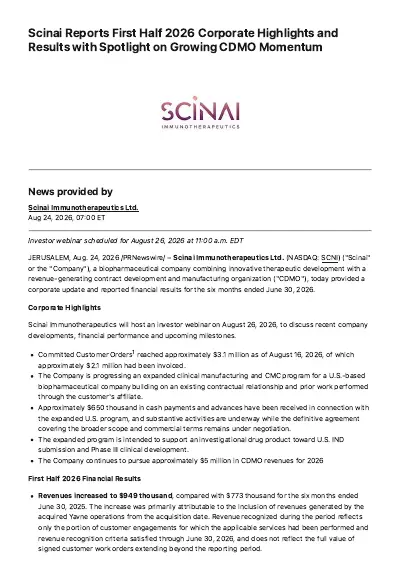
Revenue for the first half was approximately $949,000 compared to approximately $773,000 in the first half of 2025. At the same time, the expanded CDMO footprint brought a larger fixed, semi-fixed cost base into the company before utilization had fully ramped.
As a result, we reported a gross loss of approximately $2.37 million and an operating loss of approximately $4.6 million. The most significant accounting item was the approximately $6.4 million bargain purchase gain associated with the Recipharm transaction.
That is a non-cash, non-operating accounting gain based on the preliminary purchase price allocation, what's called PPA. Primarily because of that gain, we reported net income of approximately $1.50 million for the first half—$1.57 million, sorry.
I would not want investor to interpret the reported net income as an operating profitability. The underlying business still generated an operating loss during the period.
From liquidity perspective, however, as of June 30th, 2026, we had approximately $2.85 million of cash and restricted cash. The financial picture therefore reflects a company that has expanded its operating capabilities materially, while the revenues and utilization of that infrastructure are still in the process of scaling, and I believe you will see that in the coming quarter and the next half.
Moderator
Great. Thank you.
That's important nuance there with the accounting with this transaction and where that leaves us and how the Scinai business actually in a very good spot right now with how all that fleeces out. Great.
Moving on here into more of the fundamental business, can you talk a little bit about what capabilities Scinai has today that did not have entering 2026? Is management still integrating now at this stage from that transaction, or is it shifted to an execution focus?
Amir Reichman
Thank you, that's an excellent question. The transaction significantly broadens what Scinai can offer to customers.
In Jerusalem, our capabilities are focused primarily on biologics development, analytical services, aseptic processing, and clinical cGMP manufacturing. Yavne site adds complementary capabilities in early chemistry development and small-scale cGMP manufacturing of active pharmaceutical ingredients, API, for clinical programs.
I think it is important to emphasize that we did not simply acquire equipment. We acquired an experienced pharmaceutical team, established quality systems, operating procedures, customer relations, and know-how that would take considerable time and capital to build independently.
At this point, management's focus is increasingly on execution, utilization, and commercialization rather than simply integration. The relationship with Recipharm is also strategically important.
The commercial collaboration is intended to facilitate cooperation and potential customer referrals between our early and clinical-stage capabilities and Recipharm's broader manufacturing network as programs mature. Just to clarify, Recipharm AB was the international CDMO company that sold us Recipharm Israel facility and business.
The objective is to make the combined platform productive: bring in more customer work, execute well, increase utilization, and build longer-term customer relationships.
Moderator
Great, fantastic. No, and I think a key takeaway from what you just said, right, is the way that you were able to structure this transaction is you can hit the ground running and start executing sooner because you're not building this from scratch, right?
There was this fundamental business in place that you're essentially just integrating with your already outstanding business, which I think is an exciting aspect of this transaction. Moving back more to the financial side of this, I saw one of the items in the first-half report was, one of the more notable updates is the approximately I think it was $3.1 million of committed customer orders as of August 16th, which obviously happened post the end of the quarter.
Can you tell us a little bit about what that represents?
Amir Reichman
All right. Committed customer orders is a management KPI.
As of August 16, we had approximately $3.1 million of what we define as committed customer orders. These are signed customer purchase orders for specified CDMO services under existing contractual agreements.
Usually they are non-cancellable, and usually clients pay an upfront payment against them. Approximately $1.6 million of that relates to the Yavne and approximately $1.5 million to Jerusalem.
I want to be precise about what that number means. It is a measure of customer-authorized commercial activity.
It should not be interpreted as $3.1 million of future revenue or as a traditional backlog figure because portions may have already been invoiced or recognized as revenues. The timing of the remaining revenue recognition depends on execution on our side of the underlying projects and satisfaction of the applicable accounting criteria.
However, as of August 10th, I can tell you that approximately $2.1 million had been already invoiced to customers, while approximately $1 million of the $3.1 represents signed work orders that had not yet been invoiced. What I find encouraging is that the activity is distributed almost equally between Jerusalem and Yavne.
That indicates that we are seeing meaningful commercial activity across the broader CDMO platform rather than only within the business we acquired.
Moderator
Gotcha. That's helpful, thank you.
Speaking more on that kind of CDMO commercial traction and that expansion you allude to, what does the expanded U.S. clinical manufacturing engagement tell you about the platform as it stands today?
Amir Reichman
I think this is a very good example of the kind of customer progression we want to see. The relationship began with feasibility and cGMP readiness activities, subsequently expanded toward a broader CMC development and clinical manufacturing program intended to support the customer's planned U.S.
regulatory submission with the FDA and subsequent clinical development. We have already commenced substantive activities and receive approximately $650,000 in cash payments and advances after June 30th.
The expanded definitive agreement remains under negotiation, I do not want to imply a final contract value, scope, or development timeline that has not yet been agreed. Strategically, this is exactly the type of relationship we want to build, beginning with a defined technical need and expanding into a broader development and manufacturing engagement.
Moderator
Fantastic. No, it's great to see that that clientele and that customer base expanding out progressively.
That's fantastic. Another thing I wanted to go back to is that commercial execution and some targets you've previously announced.
I believe it was an objective of approximately $5 million in CDMO revenue for 2026, which was the initial objective. Is that still the objective today, and what would a successful execution look like by year end?
Amir Reichman
Yes, we continue to pursue approximately $5 million of CDMO revenue for 2026. Achievement of that objective of course will depend on the timing and execution of customer projects and, in addition, satisfaction of the applicable revenue recognition criteria, and our ability to continue converting additional commercial opportunities.
I would not want investors to derive that target mechanically from the $3.1 million of committed customer orders because these are different measures. For me, successful execution by year end would mean several things.
First, converting meaningful amount of customer work into recognized revenue. Second, continuing to expand the level of customer-authorized work across the sites.
Third, increasing utilization of the infrastructure and workforce that we already have in place. Fourth, generating repeat business.
Repeat business is particularly important in CDMO because winning the first project shows that a customer is willing to work with you, while winning the next project is a much stronger indication that you delivered. Success is not just increasing the commercial pipeline, it is turning customer commitments into executed work, revenue, and longer-term relationships.
To go back, yes, we are still supporting the $5 million in CDMO revenue for 2026.
Moderator
Fantastic. No, that's great, too.
Like you said, not only get new business, but keep building on that current business you have and expanding those relationships into those later-stage projects, which I think is a great sign of good work delivered. Beyond, now I want to shift a little bit from the CDMO to more of some of these R&D priorities, right?
Because as we talked about at the offset, Scinai is a platform that is not only developing this growing CDMO business, but there's this exciting early pre-clinical platform as well. Beyond the commercial business, what should investors watch for from the R&D pipeline during the remainder of 2026?
Amir Reichman
On the R&D side, our focus is increasingly on prioritization and capital discipline. We continue to believe that our NanoAb platform can support differentiated therapeutic formats, but we are being very deliberate about where we allocate capital.
For each program, we are looking not only at the science, but also at intended product profile, development feasibility, differentiation, technical risk, and the financing required to reach the next meaningful value inflection point. We therefore intend to use non-dilutive funding, collaborations, and strategic partnerships whenever possible, rather than asking shareholders to finance every stage of development internally.
PC111 remains an important program for us and is being advanced under our option agreement with Vincere. We believe it addresses serious dermatologia conditions with significant unmet medical need, but we are also maintaining a disciplined approach to how and when we deploy capital toward the program.
Moderator
Very smart. I think there's a lot of excitement with a few different assets within the pipeline.
I would definitely encourage folks to check those out. Great.
I think we hit on a lot of the core takeaways from the report. I'd encourage people to continue submitting questions.
As we're getting close to wrapping up here, I have one more question for Amir, but then we'll jump into the audience Q&A. Before we wrap up here, I think a good place to leave on is if we're having this conversation again at the beginning of 2027, looking several months down the road, what would you like to have accomplished between now and then, right?
What should investors be looking out for from an execution story?
Amir Reichman
Exactly tapping into the last words you just said, I would like investors to be able to look back at the second half of 2026 and see measurable execution. On the commercial side, I would like to see customer commitments translated into work and revenue, additional customers coming onto the platform, higher utilization of our capacity across Jerusalem and Yavne, and evidence of repeat business.
On the R&D side, I would like us to have advanced our highest priority programs through clearly defined milestones, while maintaining the capital discipline we have established. At the corporate level, I would like the market to have a much clearer understanding of what Scinai has become.
We are building a company that combines innovative immunology R&D with real pharmaceutical development and manufacturing capabilities. When we speak again in early '27, I want to be talking less about what we intend to build and much more about what we have demonstrated: revenue generated, customers added, utilization increased, R&D milestones achieved, and capital deployed intelligently.
Moderator
Fantastic. Thank you.
That was quite helpful. Perfect.
Now I'd like to take some time to jump into some audience questions. I see one or two coming in here.
I'll give everyone another kind of call 15, 20 seconds to submit some additional questions. What I'll just add at the end here is I think Scinai represents a really unique opportunity, right?
Not only as this growing CDMO platform that is clearly getting more customer accounts, but then there's the excitement behind this R&D pipeline, which on the earlier side, but still very exciting with some of the assets that you have acquired and are focused on developing and in spaces that we're seeing continued interest and support and just across the sector. I think it's a really exciting time for Scinai as a platform at this stage and excited to see what the rest of this year and kind of early 2027 looks like.
With that said, I see a couple questions coming in here on both platforms. Let me just pull those up and I think we have time for a couple.
This was the first one I saw, we'll start here. This one has to do with kind of the SEPA that your team has in place, Amir.
The question says, "I saw that Scinai is updating the F-1 registration statement covering the $15 million SEPA. Should shareholders expect $15 million of dilution in the near term?"
Amir Reichman
Absolutely not. The filing updates the registration statement that we already had underlying our existing SEPA to reflect our June 30th financial information.
This is a post-effective amendment. It's very normal.
It doesn't basically mean that we are going to raise $15 million tomorrow through this instrument. The August 21st and also we had to reflect in this post-effective amendment also the August 21st ADS ratio change.
It's not a new $15 million financing, and it does not mean that we have decided to draw the full amount. However, the SEPA gives us the right, but not the obligation, to access capital under the facility.
We as management control whether and when to use it, and the size of each draw, subject to terms of the agreement. I also want to be clear that any actual issuance of new equity is dilutive.
That's clear. The advantage of the SEPA is flexibility.
Advances through the SEPA are priced at 97% of the applicable VWAP pricing formula and do not carry warrants. The commitment fee is separate from the pricing of individual advances and have already been paid.
When deciding whether to use the facility, we can take into account the company's funding needs, prevailing share price, and the market liquidity, volume trade, etc., and size any draw responsibly in a responsible way. We therefore view the SEPA as one additional financing tool available to the company alongside cash generation from the CDMO business, customer advances, non-dilutive funding, and other financing alternatives.
Moderator
Gotcha, thank you. No, I'm glad you clarified that as it's a tool that can be used that doesn't have to be used.
Your last statement there actually transitions well into this next question that I saw come in also on the liquidity funding angle. It says your cash and restricted cash was approximately $2.85 million, and the filings say the company require additional capital.
How would investors think about funding from here? Obviously, SEPA is one vehicle, but would love to hear kind of what I think what this question is asking is kind of what are the ways you think about funding at this stage.
Amir Reichman
Yeah. We are very focused on improving the company's liquidity through a combination of operational execution, sales, and disciplined financing.
On the operating side, I would say the priority is to expand our customer base, increase the number and value of committed customer orders to generate more stability and ability to project how much we're going to generate, and execute those projects efficiently so that customer commitments convert into revenues in a reliable way and as quickly as possible, where customer agreements allow it, in a way that helps cash flow and help us fund the underlying project activity and reduces the working capital burden on Scinai. At the same time, I would say we continue to control discretionary spending and prioritize capital allocation carefully, particularly within R&D.
On the financing side, we continue to pursue non-dilutive funding, grants, for example, governmental grants and NGOs, and maintain access to capital market tools such as the SEPA, which we intend to use selectively rather than as an automatic source of funding. Our approach is not based on one financing source.
It is a combination of our growing CDMO cash generation, improving in working capital efficiency, disciplined spending, and non-dilutive funding, and of course, selective use of capital markets.
Moderator
Fantastic. No, that's I think helpful and answers the question.
The best companies in the market use a variety of different financing mechanisms, right, to get the cash they need. I think you're thinking about that the right way.
I think we got time for one more question before we enter kind of closing up here. This I'd like to go back to this one because this is something you touched upon about earlier in the call, and I think it's important kind of clarifying and verifying.
It says, "How much of the $3.1 million of committed customer orders is still future revenue, and are you still pursuing the approximately $5 million CDMO revenue objective for 2026?" which you I think you stated at the end of the call that you are, but maybe you can talk a little bit more on that $3.1 million number and what that relates to.
Amir Reichman
Absolutely. It is important to clarify, and it is industry standard and also across industries to use management KPIs to clarify the situation because not always accounting can capture exactly what's going on now and give the visibility to investors of the health of the business.
The first point I would like to emphasize is that committed customer orders, as I said before, should not be interpreted as forecast of future revenue or future cash. The $3.1 million represents signed customer purchase orders for the specified CDMO services that we provide.
As we disclosed, approximately $2.1 million has been already invoiced, it means that's going to be paid rather soon or has been paid already. That was as of August 10th.
We are already on the 25th, while approximately $1 million as of August 10th represented signed work orders that had not been yet invoiced. Okay?
That doesn't mean that the $2.1 million invoiced has all been recognized as revenue, because as according to accounting rules, sometimes you take an advance, it's not regarded as a revenue until you didn't finish the deliverable, for example, project end report and things like that. The more important thing is that it is really talking a lot about the cash we have and the ability to maintain our runway.
That's something for companies at our side that's quite important for investors. Again, revenue recognition depends on the performance of applicable services and satisfaction of the relevant accounting criteria, but yes, we continue to pursue the $5 million of CDMO revenue for '26.
That remains our objective, subject to of course timing and execution of customer projects, satisfaction of the applicable revenue recognition criteria, and our ability to continue converting additional commercial opportunities. The $3.1 million of committed customer orders and the $5 million revenue objective are related indicators of commercial progress, but they are not the same measure and should not be added or compared mechanically.
Moderator
Fantastic. No, I think that provides great clarity, appreciate that.
I do see one or two other questions here, but in the sense of time here, and just want to make sure we're cognizant, we will follow up separately with those who submitted those offline, to make sure you get answers to that, but want to just jump to kind of wrapping up with closing statements here. I think before we hop, I think, Amir, what would be helpful is what is the one takeaway you would like investors to leave with today after everything we discussed, right?
Because we did talk about a lot here.
Amir Reichman
I'm quite excited about where we are now, and I would want investors to leave with a clear understanding that Scinai is now in a completely different stage of its development. We have significantly expanded our commercial platform.
We are seeing increasing customer activity across both Jerusalem and Yavne, and our focus now is on execution: converting the activity into revenues, improving utilization, and strengthening the financial resilience of the company. At the same time, we are continuing to advance our R&D programs with greater discipline around prioritization, funding, and capital allocation.
We want to invest where we believe we can create the greatest value, while using non-dilutive funding, partnerships, and external capital efficiently. For the remainder of '26, the focus is very straightforward: execute commercially, strengthen the financial position of the company, and advance the R&D portfolio in a disciplined way.
I want to thank you and everybody who took the time to join us today and for your continued interest in Scinai.
Moderator
Fantastic. Thank you, Amir.
Thank you for your time and walking through everyone the core fundamental updates of the recent financial report and the excitement for the rest of 2026. We appreciate your time, and thank you to everyone who joined the call today, as Amir said, and the interest in the story.
We look forward to continuing to update you as we progress through the rest of the year. Thanks again, and we'll talk soon.
Amir Reichman
Thank you, Andrew. Thank you, everybody, for attending.