ScanSource, Inc.
Q1 FY2027 · Earnings Call TranscriptNovember 5, 2026
Operator
Welcome to the ScanSource quarterly earnings conference call. All lines have been placed in a listen-only mode until the question-and-answer session.
Today's call is being recorded. If anyone has any objections, you may disconnect at this time.
I would now like to turn the call over to Mary Gentry, Senior Vice President, Finance and Treasurer. Please go ahead.
Mary Gentry
Good morning, and thank you for joining us. Our call will include prepared remarks from Mike Baur, our Chair and CEO, and Steve Jones, our Chief Financial Officer.
We'll review our operating results for the quarter and then open the line for your questions. We posted an earnings infographic that accompanies our comments and webcast in the Investor Relations section of our website.
As certain statements in our press release, infographic, and on this call are forward-looking and subject to risks and uncertainties that could cause actual results to differ materially from expectations. These risks and uncertainties include the factors identified in our earnings release, in our Form 10-K for the year ended June 30, 2026, and in our subsequent report on Form 10-Q.
Forward-looking statements represent our views only as of today, and ScanSource disclaims any duty to update these statements except as required by law. During our call, we'll discuss both GAAP and non-GAAP results.
We've provided reconciliations on our website and in the press release included in our Form 8-K filed earlier today. I'll now turn the call over to Mike.
Mike Baur
Thanks, Mary, and good morning, everyone. We appreciate you joining us today.
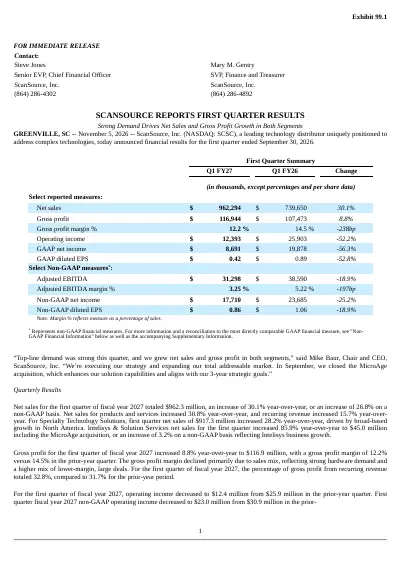
Demand was strong this quarter, led by large deals and market share gains. Our team delivered broad-based growth in North America, and both segments grew net sales and gross profit.
While profitability was impacted by a higher mix of lower-margin, large hardware deals as well as customer-specific bad debt reserves in Brazil, we view these factors as largely confined to Q1 and not reflective of the underlying profitability of our business. We are raising our FY 27 net sales and adjusted EBITDA ranges, which now include MicroAge.
We remain confident in our strategy, and we are making progress on our three-year strategic goals. For our Intelisys business, accelerating new order growth is the key to taking market share.
We are reallocating Intelisys investments toward the activities that drive new orders, including a targeted effort to recruit and onboard new partners this fiscal year. Our new Converged business unit is helping channel partners sell more communications hardware and more cloud recurring revenue.
In September, we closed the MicroAge acquisition, extending our reach in high-growth technologies like cloud, cybersecurity, data center, and AI. MicroAge brings solution provider relationships with top suppliers including CrowdStrike, Dell, HPE, Microsoft, NetApp, Sophos, and VMware.
Our near-term priority is to bring MicroAge managed services and AI solutions to market by co-selling with ScanSource specialty channel partners. This quarter, we are launching a pilot to test the go-to-market model.
Based on what we learn, we intend to finalize a services catalog of offerings that are repeatable and scalable. Looking ahead, we are confident in our direction.
Our team is executing our strategy. With our initiatives to accelerate growth and gain market share, we believe we are well positioned for the remainder of the fiscal year.
I'll now turn the call over to Steve to take you through our financial results and outlook for fiscal year 2027.
Steve Jones
Thanks, Mike. Our first quarter results reflect strong, broad-based demand in North America.
While that demand drove significant revenue growth, profitability was impacted by a mix of large hardware deals that carry lower margins along with customer-specific bad debt reserves in Brazil. Despite these factors in our Q1 results, we are confident in our organic business, and we are raising our full-year outlook, including the contribution of MicroAge.
Net sales grew 30% year-over-year, with reported net profits growing 9% year-over-year. Non-GAAP SG&A expense in the quarter, including acquisition, totaled $92 million, or 9.6% of net sales, compared to our prior year at $75 million, or 10.1% of net sales.
Non-GAAP net income was $17.7 million, and non-GAAP EPS was 86 cents per share. Free cash flow was a use of $44 million in Q1, primarily reflecting the higher working capital balances associated with strong revenue growth.
We expect positive free cash flow generation for our full fiscal year. We continue to believe the margin dynamics experienced in the first quarter were primarily driven by sales mix and specific bad debt reserves, and do not reflect a change in the underlying earnings power of our business.
Turning to our segments, I'll start with Specialty Technology Solutions. Net sales for the quarter increased 28% year-over-year, led by North America hardware sales growth across most of our technologies.
Gross profits increased 3% year-over-year to $87 million. The difference in growth rate between revenue and gross profit is mainly due to mix.
This quarter, we saw a significant increase in large hardware deals, which come at a lower gross profit margin. Included in this segment is our operations in Brazil, which represents about 5% of this quarter's segment net sales.
In Brazil, net sales declined more than 20% on a constant currency basis, and for the quarter, we had higher bad debt expense primarily related to customer-specific credit issues in Brazil. STS segment adjusted EBITDA for the quarter was $20 million and our adjusted EBITDA margin of 2.18%.
In Q1, recurring revenue in the segment grew 16.8% year-over-year, and gross profits from recurring revenues represent 14.3% of segment gross profits, an increase of 88 basis points from last year. Our Intelisys and Solutions Services segment was renamed to now include our acquisition of MicroAge that we closed on September 1st.
MicroAge contributes hardware, software, and services revenue to the segment. Quarterly net billings for Intelisys increased 3.8% year-over-year over the prior year's quarter to bring annualized net billings to approximately $2.9 billion.
Q1 reported net sales increased 86% year-over-year, or 3.2% on an organic basis. Reported gross profits increased 29% year-over-year to $30 million.
Adjusted EBITDA for the segment was $11.3 million, with an adjusted EBITDA margin of 25.1%. Going a bit deeper on our balance sheet and cash flow, we ended Q1 with $46 million in cash and a net debt leverage ratio of approximately 2 times trailing 12 months adjusted EBITDA.
Share repurchases totaled $5 million for the quarter. As of September 30, 2026, we had approximately $116 million remaining under our share repurchase authorization.
Adjusted ROIC for the quarter was 10.7%. Our leverage ratio and our continued share repurchases reflect our disciplined approach to both working capital and capital allocation priorities.
Our acquisition of MicroAge is an exciting opportunity to accelerate our three-year goals. It expands our total addressable market, technology stack, capabilities, and channel reach, with accretive margins and positive free cash flow generation.
It also aligns with our capital allocation priorities. Our capital allocation priorities remain the same: maintain a strong balance sheet with leverage of 1 to 2 times adjusted EBITDA, and be disciplined in capital deployment, including strategic acquisition and share repurchases.
In the near term, we will focus on reducing our leverage and plan to continue share repurchases. Our outlook for free cash flow reflects our belief that we will generate positive free cash flow in our fiscal year and be able to do both debt reduction and repurchases while also supporting continued strong demand.
Our working capital metrics reflect the operational improvements from our cash culture focus. Faster inventory turns are helping offset higher accounts receivable balances as we respond to robust demand from our customers and their end users.
While first quarter profitability was impacted by mix and customer-specific reserve adjustments, the strength of demand and contributions from MicroAge support our confidence in the remainder of the year. As a result, we are updating our annual outlook.
Including the contributions of MicroAge, we believe that reported net sales will range from $3.8 billion to $4 billion. We expect adjusted EBITDA between $175 million and $185 million.
For free cash flow, we are reaffirming our expectations that we will generate at least $85 million in free cash flow. To help with analyst models for FY 27, we expect interest expense to range from $18 million to $20 million, and our effective tax rate to range from 27.5% to 28.5%.
We'll now open it up for questions.
Operator
Thank you. As a reminder, to ask a question, please press star one one on your telephone and wait for your name to be announced.
To withdraw your question, please press star one one again. Please stand by while we compile our Q&A roster.
Our first question will be coming from the line of Greg Burns of Sidoti. Greg, your line is open.
Greg Burns
Morning. Could you maybe give us a little bit more color on the strong hardware demand you saw this quarter, which technology segments were showing the most growth, and the mix you saw with the large enterprise deals this quarter, do you expect that to continue for the rest of the year given the pipeline that you have?
Steve Jones
Greg, good morning. This is Steve.
As far as the technologies growth for Q1, we continue to see strong security growth as we've seen over the last year or so. We also saw Cisco grow year-over-year, networking, barcode mobility.
This time, for the quarter, we also saw growth in our communications hardware group. I would say when we say broad-based this quarter, we really mean broad-based, especially in North America.
When you ask about the mix of business and how much of our business do we think going forward are large deals, this was a unique quarter for us. We've been talking about large deals that have been pushed or also split up for a while now.
In Q1, what we saw was a lot of those deals delivered, and we also saw deals get booked and shipped in the quarter. We think a lot of this is timing.
We think we're going to modulate back to a better mix of large and run-rate deals as we look at the full year.
Greg Burns
Okay. The bad debt in Brazil, do you have any other risk around that going forward, or do you see that as more of a one-off for the first quarter?
Steve Jones
Let me add a little color to that. In Brazil, we took a significant reserve for a company called Oi SA, which was a Brazil telecommunication giant, once the largest fixed-line operator in South America, and a longtime customer of our Brazil business.
With our Q1 reserves that we took, basically all of our exposure to this customer is now reserved, and we'll work through the final judicial proceedings like many other creditors for this particular customer, that was declared on August 25th. As far as other exposures, this was the largest concentration of any customer we had in Brazil.
Greg Burns
Great. Thank you.
Operator
Our next question will be coming from the line of Keith Housum of Northcoast Research. Your line is open, Keith.
Keith Housum
Thank you. Good morning, guys.
Hey, I was a little bit confused on the performance of the quarter, understanding that the mix was weighted towards some large deals, but were the large deals done at the expense of some of the small deals? Because if I look at that history, even going back to a year, a year and a half ago, substantially less, $200 million less of revenue and you still did just about the same in gross profit.
I'm just really kind of confused on the mix here, and if SMBs suffered because of that.
Steve Jones
Keith, hi, this is Steve again. Thanks for the question.
I would say that it was just an unusual timing for the quarter. Again, I think when I try to peel back the impact in the quarter, I would say that probably 110 to 120 basis points of our margin decline or compression in the quarter was really related to these large deals that were both carried forward from last year and booked in this quarter.
Keith Housum
Okay. You feel like SMBs must not have done well then, anywhere near as well compared to the large deals.
Steve Jones
We certainly wouldn't have had as much top-line growth, and we would modulate back towards our normal margin profile.
Keith Housum
Okay. In terms of your full-year outlook, is the increase in both the revenue and adjusted EBITDA, is that all attributable to, or majority attributable to, the MicroAge acquisition?
Steve Jones
From a guide, what I would say, Keith, is that we have confidence in our Q2 through Q4 original guidance that we gave. We believe that the Q1 profit pressures related to the mix and the SG&A are pretty well contained in the quarter.
The balance of it would be related to the positive contributions from MicroAge. I would say on the top line, we were surprised.
We didn't expect a 30% year-over-year growth in Q1, so that's definitely helping push that top line up for the full year.
Keith Housum
Okay. If I say MicroAge will contribute about $20 million in EBITDA for the year, is that in the right ballpark?
Steve Jones
I would say that that's close. What I would say is we have bigger expectations for MicroAge.
Remember, we're only talking about 10 months of this, and we're early days in what we can do to accelerate growth in our core business with what Mike talked about in these tests that we're doing.
Keith Housum
Gotcha. Then during the quarter, obviously, what used to be probably your most significant competitor in the AIDC space and POS space, of course, I'm referring to BlueStar here, was bought by TD SYNNEX.
Any thoughts on how that might change the competitive dynamics going forward for you guys?
Mike Baur
Morning, Keith. It's Mike.
We've seen over the years consolidation happen in distribution, and typically early on, there's a lot of disruption, some turmoil. We believe there'll be some market share gains.
Over the years, whenever one of the broadline, lower-value distributors got into any part of our business, typically over time it appeared that those companies still maintained similar value propositions. That'll be what we're looking for is is there anything that's going to be expected differently from us by the suppliers based on this acquisition?
Typically, we watch that really close. We make sure the key suppliers know, well, if they're going to operate differently, meaning BlueStar was to be operating differently going forward, we would want to be very aware of is that in the suppliers' best interest.
For us, we do believe there's a market share opportunity here.
Keith Housum
Great. I guess last question for me, I know it's sometimes tough to tell who your end customers are, but obviously networking is an area you've had a lot of success lately, and networking's important to the AI infrastructure play out there now.
Any way to tell if some of your business here is being driven by the AI infrastructure that's going into place?
Mike Baur
Keith, in our MicroAge business, for sure. We definitely, as we did our due diligence, we looked at that very carefully.
We're wanting to understand how they were performing so well, frankly, in the market with their data center products and services, and that is one reason that they became a very attractive acquisition for us because it expands our TAM. In our core business, what we think is many of our traditional partners, whether they were barcode mobility partners, security partners, communication partners, many of them are looking to add some AI capabilities and more products.
We believe that's the idea behind our MicroAge pilots. We want to co-sell with our channel partners to get them into the AI side of the business that many of them are not prepared for, including some of our larger mobility partners.
We've talked to them about would you like us to co-sell with you with our expertise from MicroAge, and they've said yes. We're testing that this quarter.
Keith Housum
Okay. Appreciate it.
I'll turn it back over. Thanks.
Operator
Our next question will be coming from the line of Logan Katzman of Raymond James. Your line is open.
Logan Katzman
Hi, this is Logan on for Adam. Thanks for taking our question.
I guess first, I think last quarter quarter you mentioned supply constraints were limiting some of that Juniper's contribution in 1H 27. I guess, first, did you see that come into fruition?
Then I think you said the expectation was that to become fully operational in fiscal 2H. Have have you seen that come into fruition, or have expectations changed around that?
Mike Baur
This is Mike. Logan, thanks.
The Juniper plans are still similar, is that we're still working with them to try to establish a pipeline. Yes, there's some delays from where we originally thought, let's say nine months ago, but what we said last quarter is true: that we expect that we'll start seeing Juniper revenue in the second half.
Steve Jones
This is Steve. I'll just talk about our expectations on supply chain constraints and how we're thinking about that in our outlook.
We still believe that that's manageable, and we wouldn't expect a significant impact that would put pressure or anything on our current outlook.
Logan Katzman
Awesome. I appreciate that.
Then, growth here was really really strong, obviously. I think organic revenue accelerated 27% year-over-year.
How much of this was pricing versus units? Then, did you guys see any pull forward in demand?
I guess on the pricing, if you saw that, how sustainable is that?
Steve Jones
Logan, this is Steve again. Let me talk about the pricing impacts on our growth rate.
We know it had an impact and a fair amount. For us, it's really difficult to isolate how much is pricing because more than 80% of our deals are going out on a special pricing arrangement, and so how much of the street price actually gets through is kind of hard to isolate.
We know it was a fair amount of our 30% growth. What was your second question?
Logan Katzman
My second question was did you guys see any pull in demand, push out, any of those dynamics in the quarter?
Steve Jones
From what we see and what we believe, it's not apparent that we saw any pull-in or push-out. I would say given the results that we had, we feel like everything that was needed was booked and shipped in the quarter from our customers.
Logan Katzman
Understood. Thank you.
I guess last one from me. I think organic Intelisys and Solutions Services revenue grew about 3% year-over-year.
I know you guys have been making a lot of investments into this business over the last few quarters to accelerate growth. I was just kind of curious expectations around timing on when you guys think those investments will come to fruition and how you're thinking about the trajectory of that business.
Steve Jones
This is Steve again. Let me maybe talk about how that business operates.
It is a fairly long cycle from when we make an investment to when the revenues come in for us. If you think about what happens, we make the investment, we recruit new partners, we look at new orders, those orders get placed, then the rollouts have to happen and the commission streams have to happen.
If it's a small deal, that can be 6 to 9 months; if it's a larger deal, that can be 12 to 18 months. It is an invest-ahead business.
We've talked about this for a long time, that this is an invest-ahead business. We're seeing momentum in orders, and so we're seeing the fruits of those investments as we go along.
We definitely want to accelerate that growth because, as Mike talked about in his prepared remarks, we think that is key to growing that business is getting those new order growth and more of that market share.
Logan Katzman
Great. Thank you guys for taking our questions.
Operator
As a reminder, to ask a question, please press star one one on your telephone and wait for your name to be announced. I'm showing no further questions.
I would now like to turn the call back to Steve Jones for closing remarks.
Steve Jones
Thank you for joining us today. We expect to hold our next conference call to discuss our December 31st quarterly results on Thursday, February 4th, at approximately 10:30 a.m.
Eastern Time.
Operator
This concludes today's conference call. Thank you for participating.
You may now disconnect.