Smith Douglas Homes Corp.
NNYSE:SDHCQ1 FY2026 · Earnings Call TranscriptApril 29, 2026
Operator
Hello, everyone. Thank you for joining us, and welcome to Smith Douglas Homes first-quarter 2026 earnings call and webcast.
After today's prepared remarks, we will host a question-and-answer session. If you would like to ask a question, please press *1 on your keypad to raise your hand.
To withdraw your question, press *1 again. I will now hand the conference over to Joe Thomas, SVP of Accounting and Finance.
Joe, please go ahead.
Joe Thomas
Good morning, and welcome to the earnings conference call for Smith Douglas Homes. We issued a press release this morning outlining our results for the first quarter of 2026, which we will discuss on today's call and which can be found on our website at investors.smithdouglas.com or by selecting the Investor Relations link at the bottom of our homepage.
Please note this call will be simultaneously webcast on the Investor Relations section of our website. Before the call begins, I would like to remind everyone that certain statements made on this call, which are not historical facts, including statements concerning future financial and operating goals and performance, are forward-looking statements.
Actual results could differ materially from such statements due to known and unknown risks, uncertainties, and other important factors as detailed in the company's SEC filings. Except as required by law, the company undertakes no duty to update these forward-looking statements.
Additionally, reconciliations of non-GAAP financial measures discussed on this call to the most comparable GAAP measures can be found in our press release located on our website and our SEC filings. Hosting the call this morning are Greg Bennett, the company's CEO and Vice Chairman, and Russ Devendorf, our Executive Vice President and CFO.
I'd now like to turn the call over to Greg.
Greg Bennett
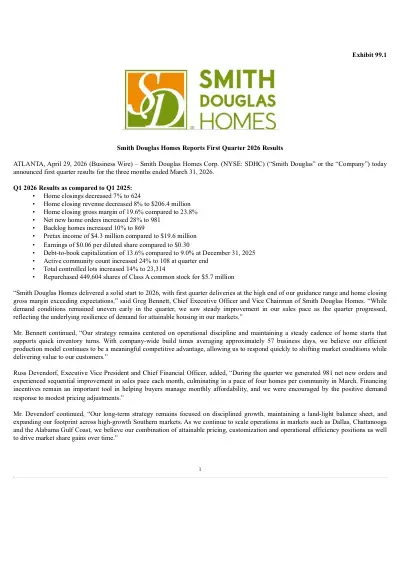
Good morning, and thank you for joining us today to review our results for first quarter of 2026 and provide an update on our operations. Smith Douglas Homes generated $4.3 million in pre-tax income for the quarter, net income of 6 cents per share.
We delivered 624 homes, which came in at the high end of our guidance range, while home closing gross margin exceeded expectations at 19.6% on a GAAP basis. For the quarter, we generated 981 net new orders, up 28% from a year ago and a new quarterly record for the company.
While order activity remained choppy throughout the quarter, we experienced a sequential improvement in our sales pace each month for the quarter, culminating in a sales pace of 4 homes per community in the month of March. Financing incentives continue to be a key selling tool as buyers remain motivated to own a home provided they can secure a monthly mortgage payment that fits their budget.
We're encouraged by the price elasticity we experienced during the quarter as incremental adjustments in pricing led to an uptick in demand. We view this as an indicator that underlying demand remains intact across our markets despite broader macroeconomic uncertainty.
From an operational standpoint, we remain focused on pace over price philosophy, which means maintaining a consistent cadence of starts, driving efficient inventory turns, and driving towards a more pre-sale-oriented backlog. Our average build time was 57 days during the quarter, consistent with prior periods, and we continue to view our ability to deliver homes quickly and reliably with an offering of home choice and personalization as a key competitive advantage.
Our land-light strategy also remains central to how we operate. Relying on third-party lot developers, we are able to allocate capital efficiently and maintain flexibility through varying market conditions.
We believe this approach positions us well to manage risk while continuing to scale the business. We also made progress on our growth initiatives during the quarter.
Community count expanded to 108 active communities across our markets, up 24% from a year ago, and we continue to ramp operations in our new markets such as Dallas, Chattanooga, Greenville, and Alabama Gulf Coast. Our experience in Houston continues to demonstrate that our operating model translates well beyond our legacy footprint, and we remain focused on executing a disciplined and opportunistic expansion strategy over time.
As we move through the spring selling season, we're encouraged by sales orders generated during the quarter, which helps rebuild backlog and provide momentum heading into the second quarter. We have continued to see encouraging traffic and order activity early in the second quarter, although demand remains variable week to week.
We will continue to evaluate pricing and incentives at community level and adjust as needed to maintain the pace required to support our operating model. While macro conditions remain dynamic, employment trends have been relatively resilient, and we continue to see motivated and engaged buyers in our markets.
We believe our focus on attainable pricing, personalization, and value put us in a good position to compete for these buyers and drive market share gains over time. Finally, I'd like to thank all our team members for the hard work during this quarter.
We challenged everyone to focus on getting off to a strong start this year, and our results this quarter showed they were up to the challenge. With that, I'd like to turn the call over to Russ, who will provide more color on our financial results this quarter and give an update on our outlook.
Russ Devendorf
Thanks, Greg, and good morning. I'll highlight our results for the first quarter and then conclude my remarks with an update on what we are seeing so far this year and our outlook for the second quarter.
We finished the first quarter with $206.4 million in revenue on 624 closings at the high end of our guidance range with an average sales price of $331,000. Our home closings gross margin was 19.6% on a GAAP basis, and adjusted home closing gross margin was 20.3%, which adds back impairments, interest in cost of sales, and purchase accounting adjustments.
During the quarter, gross margin benefited by 170 basis points from the reduction of land development accruals on the closeout of several communities. Our margins continue to reflect the use of incentives and targeted pricing adjustments to support affordability and maintain sales pace.
During the quarter, closing costs, price discounts, and the cost of forward commitments totaled 730 basis points, which compared to 430 basis points in the year-ago period and 680 basis points sequentially from the fourth quarter of 2025. Selling, general, and administrative expenses for the quarter were $35.9 million or approximately 17.4% of revenue, up $2.9 million compared to the same period last year, reflecting continued investment in our growth markets as well as the impact of lower average sales price.
Pre-tax income for the quarter was $4.3 million, resulting in net income of 6 cents per share. Given the nature of our Up-C organizational structure, our reported net income reflects the allocation of earnings between Smith Douglas Homes Corp.
and the non-controlling interests of Smith Douglas Holdings LLC. Because a significant portion of our earnings is attributable to LLC members and not taxed at the corporate level, the income tax impact reflected in our financial statements can differ from more traditional C-corporations.
For that reason, we also present adjusted net income, which assumes a blended federal and state effective tax rate of 26.6% as if we operated as a fully public C-corporation, which we believe provides a more meaningful comparison to peers. For the quarter, adjusted net income was $3.2 million compared to $14.7 million in the same period last year.
Turning to orders, we generated 981 net new home orders during the quarter, an increase of 28% versus the year-ago period. We ended the quarter with 869 homes in backlog with an average sales price of $332,000.
In addition to backlog, we also had 42 home reservations at the end of the quarter. These reservations allow our buyers to take advantage of buying a built-to-order home while also benefiting from a guaranteed mortgage rate when they close.
We expect most of these reservations to convert to new home orders in the second quarter. Turning to the balance sheet, we remain in a strong financial position.
We ended the quarter with $28 million of cash and $68.5 million of total debt with approximately $195 million available under our revolving credit facility. Our debt to book capitalization was 13.6%, and net debt to net book capitalization was 8.5%, reflecting our continued conservative approach to leverage.
Our land-light strategy remains a core component of our operating model with the majority of our lots controlled through option agreements, allowing us to maintain flexibility and deploy capital efficiently. As Greg previously mentioned and I explained on our fourth-quarter call, I want to reiterate that our pace over price philosophy continues to guide how we manage the business.
In the current environment, our focus remains on maintaining absorption and inventory turns, even if that requires some pressure on margins in the short term. We believe maintaining sales pace allows us to preserve market share, generate cash flow, and continue investing in our community pipeline, which ultimately drives scale and stronger returns over the full housing cycle.
From a broader macro perspective, the housing market continues to operate in a challenging environment driven primarily by affordability pressures and elevated mortgage rates. Recent economic data has been mixed, and geopolitical developments continue to contribute to uncertainty.
We are also monitoring labor market trends closely as employment remains a key driver of housing demand. Our capital allocation priorities remain unchanged.
We will continue to prioritize investing in our land pipeline and community growth while maintaining a conservative balance sheet, and we will also remain opportunistic with share repurchases. During the first quarter, we began executing on our share repurchase authorization and continued to repurchase shares into the second quarter.
Including repurchases completed in April, we have repurchased approximately $10 million of stock at an average price of $13.28 per share. We believe these repurchases represent an attractive and disciplined use of capital without limiting the financial flexibility to support our long-term growth strategy.
For the second quarter, we currently expect closings between 725 and 800 homes, average sales price between $325,000 and $330,000, and gross margin between 17% and 17.5%. Given the continued variability in demand conditions, we're not providing full-year guidance at this time.
We believe the primary risks to our outlook remain tied to macroeconomic conditions, including mortgage rates, consumer confidence, and employment trends. That said, we believe our affordable product offering, land-light strategy, and disciplined operating model position us well to continue gaining market share over time.
With that, I'll turn the call over to the operator for instructions on Q&A.
Operator
We will now begin the Q&A session. A reminder, if you would like to ask a question, please press *1 to raise your hand.
To withdraw your question, press *1 again. We ask that you pick up your handset when asking a question to allow for optimum sound quality.
If you are muted locally, please remember to unmute your device. Please stand by while we compile the Q&A roster.
Your first question comes from the line of Michael Rehaut with J.P. Morgan.
Michael, your line is open. Please go ahead.
Nick Cara
Hey guys, it's Nick Cara on for Michael. Good morning.
Thanks for taking questions. I wanted to start by asking on the gross margin piece.
You call out some moving pieces, but would really appreciate any extra color that you have on the incentive environment and pricing, considering ASPs for the first quarter toward the lower end of your guide, as well as on the cost side would be really helpful, any color you can provide on construction costs, labor, etc.
Russ Devendorf
Came in at the high end of guidance on a GAAP basis and we had 170 basis points, as I mentioned, in the way land development works, when we close out communities, we typically have a reserve in land development for anything that, over the next three to six months, may come in from a cost perspective. We have closed out some communities in the fourth quarter, towards the end of last year, and so those accruals that we had got reversed in the quarter.
That contributed to 170-basis-point positive impact to margin. If you back that out, we would have been right around I think 18.
18.1% which I think still was right in line with guidance or in the high end of our guidance range. Then just from additional costs, as we mentioned, there's 730 basis points that were impacted by, like I said, closing costs, the incentives for forward commitments, the costs there, and price discounts.
Just to remind everybody, the price discounts and the forward incentives, that's a reduction to revenue. ASP, that kind of drives ASP down a little bit, and then closing costs run through our cost of goods.
That was up sequentially as I mentioned and up year-over-year. Then, just from a cost perspective, we're actually getting some benefit on the direct cost side, so that's coming in a little bit better year-over-year.
The big driver still for us in kind of margin degradation is the lot cost. As a percentage of revenue it's up about 300 basis points versus last year.
That's just the impact of the higher basis for land deals that we entered into the last couple of years.
Nick Cara
Got it. Helpful.
Thank you. Then on anything you could provide, I think you mentioned in your prepared remarks that demand is still looking a little choppy week to week.
Any color you can provide on that, either on a sequential basis, just couple weeks in, but relative to March or anything you could provide on April to date, that'd be helpful from a demand perspective.
Greg Bennett
Thanks for the question. We're seeing seasonal traffic.
We had good, strong traffic through March. April has been a slight decline, but still seasonally good, as we've gone through all the spring breaks and all the disruptions there, it's held pretty steady, maybe down oh 6, 8% over what we were seeing earlier.
Nick Cara
Got it. Super helpful.
Appreciate it, guys. I'll pass it on.
Greg Bennett
Thanks.
Operator
Your next question comes from the line of Mike Dahl with RBC Capital. Mike, your line is open.
Please go ahead.
Stephen Mea
Hi, everyone. You've actually got Stephen Mea on for Mike Dahl today.
Thanks for taking my questions. I was hoping we could talk a little bit on the SG&A side of things.
I totally understand y'all are in a big kind of growth stage, and there's life cycle charters and you're opening up your new divisions and kind of getting all heads in place in there. I was just kind of wondering if you could give us a little more of an overview on where you are in those life cycles.
Is that going to keep ramping, or is that something that might start to moderate a little bit in the coming quarters? Just kind of a qualitative overview there.
Thanks.
Russ Devendorf
Sure. I think as a percentage of revenue, it should definitely start to moderate, cuz when you look at the the gross dollars, we were only up $2, $3 million in that in that range, it it's it's more a reflection of, our ASP is coming down, and again, part of that is, increased incentives.
Like I mentioned, forward rate forwards and price discounts are are pushing that ASP down, and so it's pushing that top-line revenue. Some of that percentage increase is is because of the top-line revenue, but, it is, the gross dollars the increase is is actually not that bad in in my, from from our perspective, because we did open, as you recall, Dallas was a new division last year, we divisionalized Chattanooga, we're opening up the Gulf Coast, which we hope to have some sales here in the next few months, and so we've got we've got a lot of new, fresh G&A that's hitting the books without any any volume, and so that that again just reflects our our continued, growth and scale, and so when when you start to see, some of that's revenue come through, I think it'll it'll moderate, right?
Again, even if you go back a couple years, Greenville's a fairly new division. We centralized or we divisionalized Central Georgia, and so we have expanded the footprint, again in in in the drive for additional scale, it's just, it's kind of a timing thing.
Stephen Mea
No, totally makes sense. Appreciate the response.
Secondly, understanding that you're not providing full-year guidance, but if there's anything y'all could share with us on areas where you might have a little more visibility, like your thoughts on your, perhaps, pace or cadence of community counts, and how you're looking at kind of hopping on the previous question, incentives kind of within the guidance, just kind of more broadly going forward, would be helpful. Thank you.
Russ Devendorf
Sure. We we we don't like to give full year now.
Maybe as we as we wrap up the second quarter and we're kind of halfway through the year, we will give some more clarity. It's not like we don't have, our internal targets.
It's just just given the environment, we just don't think it's prudent to to provide any, full-year guidance. Again, especially especially when it comes to margin or income.
That that's it's it's such a wild card. We're going to continue to push pace.
We feel pretty good, especially coming off of March and and the quarter. We had a a really good beat, exceeded our internal expectations on on sales.
That's a reflection of us doing, some additional price discovery in our communities, really driving our sales folks. Credit to them in the in the field for really pushing pushing on pace.
Turned out to be a good quarter in sales, which obviously the the increase in backlog, it's going to, set us up for hope hopefully it starts to set us up for a good back half of the year in terms of closings. I think I mentioned on the last call, we were we were expecting anywhere from, 10 to 10 to 20% in community count growth for the year.
You can kind of translate that into, what you might expect or as you you run your model what you might expect for for closings, but clearly we're we're we're focused on growing closings year-over-year, we've got some some pretty good internal targets, but you you can kind of back into the numbers based on what I just told you.
Stephen Mea
Makes a lot of sense. Thanks.
Thanks for all the color.
Russ Devendorf
Sure.
Operator
Your next question comes from the line of Trevor Allinson with Wolf Research. Trevor, your line is open.
Please go ahead.
Trevor Allinson
Hi, good morning. Thank you for taking my questions.
First one's on your expectations for vertical costs going forward. Obviously, we've had oil prices up quite a bit, steel prices up.
Some building product material have seen price increase announcements. What are you expecting for vertical costs going forward?
Then in terms of some of these price increase announcements from the manufacturers, are you currently taking on any of those price increases, or have you been able to successfully push back against those?
Greg Bennett
Thanks for the question. We've been pretty successful in pushing a lot of those increases off.
Our costs are down year-over-year. We know that if this fuel situation stays higher for longer, we're going to get hit with fuel surcharges and some of those things, but we show up diligent every day to work on our cost and our efficiency.
We'll continue to do that, and the market's not allowing us price, and that message is going through to our trade and our suppliers to say, "Look, we don't have ability to take price, and so we can't pass that through." We're holding a pretty tough line on that.
Trevor Allinson
Got it. Makes sense.
Appreciate that color. Then on your lot portfolio, clearly, the majority of your lots are held off-balance sheet.
Can you talk about what portion of those lots are held by land banks, and then shed any light on the structure of your land bank agreements, perhaps in terms of deposit rates, option maintenance fees, as well as your ability to potentially walk away from deals that no longer pencil? Thanks.
Russ Devendorf
Sure. Of the total portfolio, we have about 30% of our lots under option are with land bankers.
Then there's about 40% of our lots under option are with developers, and so there's 70%. Then the balance, the other 30% are still deals that are with the underlying land seller.
Where we have a contract that we may be in various stages of due diligence, but we control it with varying deposits. Usually those are pretty small.
Just from a land bank perspective and a structure perspective, on average, it's about a 10% deposit that we have with the land bankers, and then there's typically a walk-away fee that if you bust out of the option, then you pay another 10% walk-away fee, and we disclose that in our financials. On all of our new land bank deals, we do not cross-collateralize.
We have some finished lot bank where we'll stick some lots when we have some bulky takedowns on active communities that we'll put into a finished lot bank, and we may, within a division cross-collateralize, but honestly, we don't view that as any real issue. It's pretty simple the way we think about it.
Trevor Allinson
Yep. Makes sense, Russ, and appreciate all the color.
Good luck moving forward.
Russ Devendorf
Thank you.
Operator
Your next question comes from the line of Ryan Gilbert with BTIG. Ryan, your line is open.
Please go ahead.
Ryan Gilbert
Hi, thanks. Good morning, guys.
On the 2Q '26 margin guidance, can you talk about how much of the step-down is from higher incentives in the quarter versus higher lot costs or if there's anything else that we should call out?
Russ Devendorf
We're assuming the incentives are probably about flat sequentially, maybe up or down 10 10, 20 basis points. We're still seeing the same and it's been pretty consistent.
We're seeing the same percentage of forwards, the use of forwards, so that's probably pretty consistent. Then it's really, I think there's a little step-down in ASP.
That again is probably coming from the forwards. It's lot costs, again.
I think lot costs, you're going to continue to see that trend year-over-year where that's about 300 basis points up, it's lot costs is driving it. Then part of the variable in there is how much, to the earlier question and what Greg said, how much are we able to hold on vertical costs.
Right now, we've done a pretty good job year-over-year. The average sticks-and-bricks costs are down a bit, but there's some variability there.
Ryan Gilbert
Got it. Can you update us on what you're seeing in terms of, I guess, spot land prices for the deals that you're signing up today, and then if you're getting any relief on pricing, how long that would take to flow through into your income statement?
Russ Devendorf
It's starting to turn. I think we've been mentioning this for the last couple quarters.
We're definitely seeing land prices start to moderate. We're starting to feel like we have more negotiating power, right?
It's starting to flip from a seller's market to a buyer's market, and obviously any new deals that we put under contract in the typical fashion, excluding where we can pick up some finished lots from others that have walked, but it takes 18 months to flow through typically, right? Because you've got development for a year, and then you've got several months of vertical construction.
It takes some time. We don't expect the increase in lot cost to moderate for at least a couple years, right, at any material level.
When we went public, we knew. We were guiding everybody.
Lot costs were going up just because we knew what we were doing deals at. Now you're starting to see that reverse a little bit, but that's also as we talked about on our call, in our pace over price philosophy, that's why it's real important for us to continue to move inventory through the pipeline so that we don't get gummed up with these lots.
We can continue to move it through the pipeline so we can start taking advantage of a reset in land basis, land prices. That's kind of how we're thinking about it.
Ryan Gilbert
Got it. Makes sense.
Just one more for me.
Russ Devendorf
One last thing, yeah. One last thing there,
Ryan Gilbert
and
Russ Devendorf
Joe just pointed it out and he's right, this is part of the reason why we think it's a reasonable opportunity to enter some of these new markets because we're able to start fresh and take advantage of some of these reset basis. So
Ryan Gilbert
Got it. That makes sense.
Just one more for me. It seems like you and the other publics and I guess the industry overall based on the starts number earlier this morning, it seems like there's a reacceleration in starts.
I'm just wondering how inventory looks in your markets and if you're seeing any impact from, I guess, the recent increase in starts volume.
Russ Devendorf
There hasn't been anything that we've seen materially different or that we're hearing from our divisions. I know some of the builders, I think when you look year-over-year, a lot of the publics' spec counts are down.
They may be starting, and that could just be relative to maybe some better, slightly better sales. We had better sales than expected this first quarter.
We were up pretty good. Obviously our starts are going to be up, but no, from an overall pure inventory standpoint, not seeing any real impact there.
Ryan Gilbert
Great. Thanks so much.
Operator
Your next question comes from the line of Natalie Kulasekere from Zelman & Associates. Natalie, your line is open.
Please go ahead.
Natalie Kulasekere
Hey, good morning. Thank you for taking my question.
Could you talk a little bit about how your incentives trended as the quarter progressed? I know you said it was 730 basis points for the whole quarter on average, but I'm just wondering if March was higher than January and February and if you had to kind of push incentives to achieve that pace of 4 sales per community.
Russ Devendorf
I don't have the exact numbers in front of me, but keep in mind the 730 basis points, that's incentives and discounts that would have mostly come through in Q3, Q4 of last year that are hitting the books. Then from incentives on sales through the quarter, yeah, I would just generally say that as we ramped up our pace and pushed for a little bit more price discovery, we probably saw it up a little bit, but honestly, I think we were pleasantly surprised that it wasn't a huge hit, but it does show that there is some price elasticity.
It does, you can see it ties into increase in volume. So
Natalie Kulasekere
All right. Thank you.
What share of your closings this quarter were driven by spec sales, and where are you in terms of getting to a more pre-sale-heavy business?
Russ Devendorf
Pre-sale is a huge driver or a huge focus of ours because traditionally you're going to make more money on pre-sales. Because of our business model, we really focus on personalization and choice for our buyer, and we have a quick turn from a cycle time perspective.
Really for us, we're trying to drive that message to the divisions, and because we do think that ultimately that's going to help drive higher margins, but it also gives our buyers a different buying experience than when you go to some other entry-level builders that are more, "Hey, you get vanilla, chocolate, strawberry" type of choice. It's probably still 40/60 pre-sale versus spec every week.
More importantly, we're getting the contract. We saw an uptick in getting a sale on a spec home before it hits what we call line in the sand, kind of before it hits drywall stage.
That's really today very important because we're still using forward commitments, incentives, and to put an interest rate lock out there for more than 60 days is almost cost-prohibitive. The incentives are still a big driver for some of these buyers and in figuring out payment.
Even if we have those starts, as long as we're within kind of 60 days and they can get some choice before we hit drywall stage, getting that sale before drywall stage is important. We're doing a pretty good job there.
I'd say we're probably 70, 80% before drywall stage has got a sale, and our spec inventory has been coming down, it's still a battle, but that's our focus is driving more pre-sale going forward.
Natalie Kulasekere
All right. Thank you.
Russ Devendorf
Sure.
Operator
Your next question comes from the line of Rafe Jadrosich from Bank of America. Rafe, your line is open.
Please go ahead.
Rafe Jadrosich
Hi, good morning. Thanks for taking my question.
I know you walked through it a little bit, but just the gross margin sort of it's good to see the backlog sort of stabilizing and step up here. The gross margin sequentially flat quarter-over-quarter in 1Q, just can you help me just understand the accrual callout that you had there and bridge maybe on a like-for-like basis 1Q to 2Q?
Russ Devendorf
We had 170 basis points roughly of a benefit because we reversed some land development accruals on closeout communities. These were several communities that closed out in kind of Q3, Q4, and so our internal policy is we start to ratchet down accruals over three to six months just in case there's any stragglers or any calls out there once we close a community.
That was 170 basis points to margin. Basically, if you just look operationally, take our margin for the quarter, back out 170 basis points, and that's kind of where you would start with your gross margin to take out the noise.
We had a little bit of impairment in there, strip that out. I think that was 30 I don't know how many basis points that accounted for.
Joe Thomas
70.
Russ Devendorf
70 basis points. There was 70 basis points of impairment that was a negative impact to margin, again.
You want to strip that out. When you see our filing, you'll be able and I think it's in the notes, it's in the back half of the press release, but when you look at the adjusted margins, you'll be able to see some of that stuff.
That's why when you strip out all the noise, I think sequentially we're basically calling for about a 50-basis-point decline in margin from Q1 to Q2. Again, there was a lot there, but we can walk through any detail if once you see the numbers you have any confusion.
Rafe Jadrosich
That's very helpful. It makes sense.
That's the sequential from 1Q to 2Q, that's you still have land inflation, but incentives sort of flat, and that's getting to the
Greg Bennett
That's right. Yeah.
Rafe Jadrosich
Okay. All right.
Then on the SG&A side, you said something that was really interesting and obviously the dollars have stepped up here and continue to grow, but you're expanding communities, you're also moving into new markets. Of the markets that you operate in today, what would you consider to be at scale versus what you're still trying to get the scale up and are sort of below where you'd expect it to be longer term?
Greg Bennett
Thanks, Rafe. I'll take that.
We're in still infancy, I would say, in Greenville. We're the same in Dallas-Fort Worth, Gulf Coast.
We're kind of over that hump in Chattanooga. Made a lot of growth strides there in the last year.
Then Central Georgia would be another that we're still building scale in. It's just kind of spun off of Atlanta, but without any real community count as we spun that out.
Those are again, not to scale would be Central Georgia, Greenville, Dallas-Fort Worth, and Gulf Coast.
Russ Devendorf
What I'd add to that as well is while we have, we always are targeting a minimum of two what we call R-Teams, and that's roughly 208 starts per R-Team. We want to have a minimum two R-Teams in every division, and so we're not quite there in a couple of our legacy divisions like Charlotte, Nashville.
We're not there yet, at a minimum we want to get there. Then that's just the minimum, but we really feel like in some of those legacy divisions, we should be closer to three R-Teams, 600 closings, specifically Raleigh.
I do think Charlotte can get there, 600-plus. We're not there yet.
Nashville should be 400-plus. Then obviously, Atlanta and Houston right now are two big from a permit count, right, two of the largest markets that we're in.
Atlanta, because we peeled out Chattanooga, which was really kind of north Georgia, pulled back a little bit, but again, Atlanta proper should be close to 1,000 units on a run rate. Then Houston for us, we entered that.
We're making a lot of good strides in getting them what I would say is Smith Douglas-ized from a turns, and they've been great, but we're only doing 400, plus or minus closings there. That should be double, right?
Within 5 years, that's such a big market. We've had some headwinds, but that should be double.
Then what's really shining for us is our Alabama division. They're at pretty good scale between Birmingham and Huntsville, kind of plus or minus 600.
We've got some work to do in scaling up some of the legacy division, but like Greg said, a lot of these new ones are just getting going, but that's why you see the G&A, right? When you look at the G&A relative to the community count increase, right, our community count was up 24%, and our G&A was only up $2.9 million on gross dollar basis.
To me, that's pretty efficient.
Rafe Jadrosich
Great. That's really helpful.
Thank you.
Russ Devendorf
Yep.
Operator
Your next question comes from the line of Jay McCanless from Citizens Bank. Jay, your line is open.
Please go ahead.
Jay McCanless
Hey, good morning, guys. First question I had, we've seen some articles in the mainstream press about affordability being even worse in some of the larger cities now, which is forcing some migration out.
I guess my question is, are you guys seeing better demand in your smaller markets, whether it's absorption, traffic, however you want to measure it, versus maybe some of the larger markets like a Raleigh and Atlanta?
Russ Devendorf
Look. Alabama has done really well, and I would consider that relative obviously, Birmingham, Huntsville relative to a Houston, for instance.
We've seen some better demand trends. Again, Texas is its own animal.
I think it's also just we're so used to in the Alabama markets, they didn't have the kind of spike up, post-COVID. It was good, but it wasn't like you had some of these other markets.
I almost feel like we're just used to hand-to-hand combat there, and it's just the way we operate. We saw some better demand there.
Outside of that, there's nothing that I would say really sticks out with our footprint. I think we're in some pretty good markets, kind of in the Southeast and Central US, that's by design.
Nothing really that I can say sticks out. I don't know, Greg, if you
Greg Bennett
The only thing, Jay, I'll add to that is the in-migration in some of the bigger metro locations we're in is down. That's been reported a lot.
You feel that a little more. Some of those smaller markets are not as sensitive to that.
Jay McCanless
Got it. Thanks, guys.
Then the second question I had, ARMs, are you guys still trying to push on those? Is that still having good success with customers, and maybe what your ARM percentage was this quarter?
Russ Devendorf
We shifted really towards the end of the quarter and into April. We moved from a 4.99 incentive that we kind of marketing across the footprint, 30-year fixed.
Just to change it up a little bit, and the costs were kind of almost in line. We moved to a 3.99 5/1 ARM towards the end of the quarter and really into April.
If you go to our website, I think that's what you'll see at the top of the page. We're still offering both.
We're marketing the 3.99, and it's more a traffic driver, but it's also designed to give our salespeople as much flexibility, right, because with a 3.99 5/1 ARM, the buyers can qualify off of that payment that calculates off the 3.99, so, for our buyer, that's definitely helpful. We kind of give them some optionality there, but we're just seeing what the market's doing, trying to at least compete at that level and give buyers as much affordable options as possible.
Jay McCanless
We're seeing more usage of the 4.99 still.
Russ Devendorf
Yeah, 4.99, the 30-year fixed 4.99 is still probably taking the most of the incentive.
Jay McCanless
Got it. Great.
Thanks, guys. Appreciate it.
Russ Devendorf
Yep. Thanks, Jay.
Operator
We have reached the end of the Q&A session. I will now turn the call back to Greg Bennett for closing remarks.
Greg Bennett
Thank you for joining us on our Q1 results call. Hope everyone has a great day.
Operator
This concludes today's call. Thank you for attending.
You may now disconnect.