SolarEdge Technologies, Inc.
Q3 FY2026 · Earnings Call TranscriptNovember 4, 2026
Operator
Good morning and welcome, everyone, to the SolarEdge conference call for the third quarter ended September 30th, 2026. This call is being webcast live on the company's website at www.solaredge.com in the Investors section on the Events Calendar page.
The call is the sole property and copyright of SolarEdge with all rights reserved, and any recordings, reproduction, or transmission of this call without the expressed written consent of SolarEdge is prohibited. You may listen to a webcast replay of this call by visiting the Event Calendar page of the SolarEdge Investor website.
I would now like to turn the call over to Mr. Jeff Osborne, Head of Investor Relations.
Please go ahead, sir.
Jeff Osborne
Good morning, and thank you for joining us to discuss SolarEdge's operating results for the third quarter ended September 30th, 2026, as well as the company's outlook for the fourth quarter of 2026. With me today are Shuki Nir, Chief Executive Officer; Maoz Sigron, Chief Financial Officer; and Meir Adest, Co-Founder of SolarEdge.
Shuki will begin with a brief review of the results for the third quarter ended September 30th, 2026. Maoz will review the financial results for the third quarter, followed by the company's outlook for the fourth quarter of 2026.
We will then open the call for questions. Please note that this call will include forward-looking statements that involve risks and uncertainties that could cause actual results to differ materially from management's current expectations.
We encourage you to review the Safe Harbor statements contained in our earnings press release and our filings with the SEC for a more complete description of such risks and uncertainties. We disclaim any obligation to update our forward-looking statements.
Please note, during this earnings call, we may refer to certain non-GAAP measures, which are not measures prepared in accordance with U.S. GAAP.
The non-GAAP measures are being presented because we believe they provide investors with a means of evaluating and understanding how the company's management evaluates the company's operating performance. Reconciliation of these measures can be found in our earnings press release and SEC filings and are provided directly as part of this earnings call.
These non-GAAP measures should not be considered in isolation from, as substitutes for, or superior to financial measures prepared in accordance with U.S. GAAP.
Listeners who do not have a copy of the quarter ended September 30th, 2026 press release may obtain a copy by visiting the Investor Relations section of the company's website. With that, I will turn the call over to Shuki.
Shuki Nir
Thank you, Jeff. Good morning, everyone, and thank you for joining our call today.
As highlighted on previous calls, our turnaround continues to be guided by four priorities: driving profitable growth, expanding global market share, scaling the SolarEdge Nexus platform, and advancing our opportunity in SSTs for data centers. In the third quarter, we made further progress on each of them.
We met the midpoint of our revenue and gross margin guidance, even as the market presented a more challenging near-term backdrop, as we continue to pursue profitable growth. This was also our fifth consecutive quarter of positive free cash flow, reflecting the steady progress we have made over the past two years.
Before I get into the details of Q3, I would like to address the outlook. We expect Q4 revenue of $245 million to $275 million, below the expectations provided at our Investor Day.
This decline is a result of two main developments. First, our two main markets are expected to be soft in Q4 and Q1.
The U.S. residential market continues to be slow, mainly due to delays in additional guidance surrounding FEOC clarity and higher interest rates.
Germany is currently reforming its Renewable Policy Act called EEG. If the current draft is adopted, the reduction of feed-in tariff support could meaningfully weigh on demand for new installations.
When adjusting for the expected levels of installations in the U.S. and Germany, and in order not to overship products into the channel, we expect our revenue in Q4 to further decline.
We believe this inventory discipline is warranted as Q4 is typically followed by a seasonally weak Q1. Second, we are making deliberate decisions to exit select underperforming geographic markets and redirect resources toward our core markets and higher-growth opportunities.
In addition, given the lower revenue outlook, we are taking additional actions to reduce costs, simplify operations, and support profitability. These are difficult, but necessary decisions to build a more focused and competitive SolarEdge.
Maoz will walk you through the financial impact of the actions we're taking. While the near-term backdrop is soft, the underlying fundamentals and growth drivers we laid out at our Investor Day remain in place.
Even in this environment, our third quarter results provide solid evidence that the underpinnings of our growth initiatives are taking shape. Shifting to our second priority, market share gains.
Starting with the U.S. commercial and industrial market, we continue to build on our higher than 50% market share in rooftop C&I, and our pipeline remains healthy.
The outlook for the C&I market remains solid, supported by rising electricity prices, data center-driven demand, and the expectation that storage attach rates will increase over time. Within the U.S.
resi market, demand remains soft. It is consistent with the broader financing-driven headwinds and the higher interest rates.
Beyond the near term, we continue to believe the market's evolution towards higher battery attach rates and third-party ownership plays to our strengths. Namely, our longstanding position as a leading provider to TPOs and our fully integrated, DC-coupled battery architecture.
Our confidence is supported by the visibility provided by the Safe Harbor transactions in both resi and C&I. These agreements amount to $1.7 billion and may reach $3.3 billion when required optimizers are added.
Turning to Europe, in the third quarter, we witnessed the expected seasonal decline, but continued to ramp up Nexus three-phase, to deliver commercial storage solutions, and to accelerate our battery upsell activities. Speaking of battery upsell activities, we continue to leverage our installed base of over 1 million homes in the Netherlands and Germany.
In the quarter, we recognized more than $30 million in revenue from upselling to them, up from more than $20 million in Q2. Turning to our third priority, scaling the Nexus platform.
Nexus systems delivered strong sequential growth and contributed over $100 million in revenue this quarter. We see continued adoption of three-phase Nexus in European markets since we started shipping in the second quarter.
Nexus installations have shown higher average system size as it addresses the 10 to 30 kilowatt segment in Germany. They've also come with a higher attach rate of storage due to the built-in advantages the Nexus solution has in a PV-plus-storage environment.
In the U.S., Nexus has been added to the approved vendor list of every leading TPO and prepaid lease company we work with, and our meter collar solution was approved by California's top utility. It allowed us to start rolling out Nexus in July, and so far, we have received very positive feedback, which aligns with our value proposition.
With Nexus, homeowners get higher clipping, installers can complete more jobs faster, and TPOs can maximize fleet return on investment. It's important to note that the Nexus stackable battery has led to installations of systems ranging between 5 to 40 kilowatt-hour to address different market segments.
As VPPs gain market momentum, we're seeing average battery system sizes increase. We expect to begin rolling out single-phase Nexus in Europe in the first quarter of next year, completing the platform's launch globally.
As many of you are aware, Nexus is also a key enabler of the continued shift in our mix towards PV-plus-storage solutions. Storage revenue grew again this quarter, driven by both higher attach rates on new systems and rising retrofit volume.
Storage was our largest product category by revenue for the second quarter in a row. We view this as an important marker of the transition we've been describing towards a holistic energy solution, which we believe more than doubles SolarEdge's potential revenue.
Turning to our fourth priority in the data center market. In the third quarter, we continued to advance our DC-native, grid-to-rack power train from medium voltage to 800-volt DC.
It is important to note that our solution is designed to support medium voltage ranging between 13.8 kilovolts through 34.5 kilovolts. Building on the live lab demonstration we discussed last quarter, our three-phase conversion stage is now operating under load in our lab, with system-level validation of the full power path underway.
At the heart of the system is our SST cell. During the quarter, the cell completed high-voltage insulation testing in our lab at the level used for 34.5-kilovolt class equipment, and its transformer completed partial discharge testing well above its operating voltage.
This is a key step towards direct connection to 34.5-kilovolt grid. Our SST cell has continued demonstrating efficiency above 99% in all demonstrations.
In the ecosystem, we issued our 800-volt DC protection and grounding white paper, developed with NVIDIA, and offered as a technology-neutral framework. We have also extended our collaboration with Infineon on solid-state circuit protection.
At OCP, we showcased our SST cell on NVIDIA's AI factory MGX ecosystem wall. At the same time, we have continued live demonstrations to prospective customers and active engagement in several RFIs.
We remain on track for a working system in our lab by the end of 2026, pilot installations in 2027, and volume shipments in 2028, consistent with the timeline we discussed at the Investor Day. To summarize, in the third quarter, we continued to execute against a challenging near-term backdrop.
We delivered on our guidance, grew Nexus meaningfully, continued to shift our mix towards storage, advanced our data center opportunity with a high-visibility customer showcase, and took further action to streamline the business. The opportunity ahead remains strong and promising, and we remain focused on improving our execution and capitalizing on our advantages in the markets we participate in.
With that, I will turn the call over to Maoz.
Maoz Sigron
Thank you, Shuki, and good morning, everyone. Starting with our quarterly results.
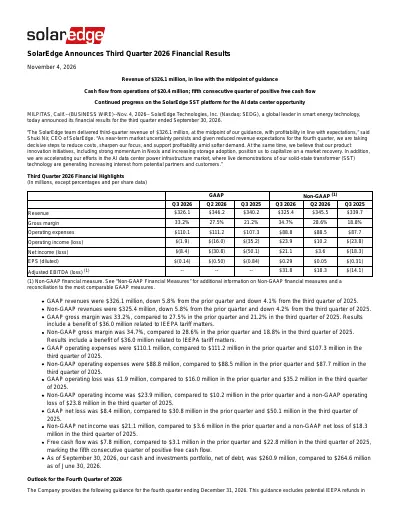
GAAP revenue for the third quarter was $326.1 million, down 5.8% quarter-over-quarter and 4.1% year-over-year. Non-GAAP revenue was $325.4 million, down 5.8% quarter-over-quarter and 4.2% year-over-year, in line with the midpoint of our $310 to $340 million guidance range.
GAAP revenue from the U.S. amounted to $145.9 million, down 5.8% quarter-over-quarter, representing 44.7% of revenue.
Revenue from Europe was $141.7 million, down 8.2% quarter-over-quarter, representing 43.5% of revenue. International market revenue was $38.5 million, up 4.3% quarter-over-quarter, representing 11.8% of revenue.
GAAP gross margin was 33.2% this quarter compared to 27.5% in the second quarter and 21.2% in the third quarter of last year. Non-GAAP gross margin was 34.7% this quarter compared to 28.6% in the second quarter and 18.8% in the third quarter of last year.
This quarter's results included the benefit of approximately $36 million related to EPA tariff matters. Excluding this item, we estimate non-GAAP gross margin was approximately 23.6%, near the midpoint of our previously guided range of 22% to 26%.
The year-over-year improvement was driven by the EPA refund, 45X benefit associated with the transition to U.S. manufacturing, and the continued cost discipline.
GAAP operating expenses for the third quarter were $110.1 million compared to $111.2 million in the second quarter and $107.3 million in the third quarter of last year. Non-GAAP operating expenses were $88.8 million compared to $88.5 million in the second quarter and $87.7 million in the third quarter of last year, essentially flat on a sequential and year-over-year basis and in line with the midpoint of our previous guidance range of $86 to $91 million.
As Shuki discussed, we recently took additional restructuring actions to streamline our cost structure, including deemphasizing select geographic markets while reallocating resources to more profitable regions and activities. Specifically, we have chosen to accelerate our investment in the data center opportunity relatively to our initial plan.
This action will create a more agile organization while supporting continuing innovation. From a modeling perspective, we are expected to deliver net saving in the mid-single-digit million each quarter, including approximately $3 million from COGS and $2 million from opex.
From a top-line perspective, the regions in which we are deemphasizing, giving the lower profitability profile, represent approximately $40 to $50 million of annual revenue. Giving the timing of implementation, we expect to see the top-line headwinds starting in the fourth quarter, while the full expense benefit will be realized in the first quarter of 2027.
GAAP operating loss was $1.9 million compared to $16.0 million in the second quarter and $35.2 million in the third quarter of last year. Non-GAAP operating income for the third quarter was $23.9 million compared to $10.2 million in the second quarter and a non-GAAP operating loss of $23.8 million in the third quarter of last year.
As for the gross margin, this result included the benefit of approximately $36 million related to EPA tariff matters. GAAP net loss was $8.4 million compared to $30.8 million in the second quarter and $50.1 million in the third quarter of last year.
Non-GAAP net income was $21.1 million in the third quarter compared to $3.6 million in the second quarter and a non-GAAP net loss of $18.3 million in the third quarter of last year. GAAP net loss per diluted share was 14 cents in the third quarter, and non-GAAP net income per diluted share was 29 cents.
Adjusted EBITDA was $31.8 million in the third quarter compared to $18.3 million in the second quarter and an adjusted EBITDA loss of $14.1 million in the third quarter of last year. The quarterly results included the benefit of approximately $36 million related to EPA tariff matters.
We generated $20.4 million of operating cash flow and $7.8 million of free cash flow in the third quarter compared to $3.1 million of free cash flow in the second quarter and $22.8 million in the third quarter of last year, marking the fifth consecutive quarter of positive free cash flow. Year to date, free cash flow was $31.7 million.
Our capital expenditure this quarter was $12.6 million, up from $8.3 million in the second quarter, including continued investment in our SST program, manufacturing capacity, and investment in our new headquarters in Israel, which consolidates several locations into one, including expanding our advanced R&D facilities. Year to date, capital expenditure was approximately $25 million, and we now expect full-year capital expenditure in the range of approximately $45 to $55 million.
We continue to expect positive free cash flow for the full year, reflecting our improving operating performance, continued discipline in managing expense and capital investment, and our ongoing ability to monetize 45X credits. Turning now to our balance sheet.
As of September 30, 2026, our cash, cash equivalents, restricted cash, and marketable securities, net of debt, were $260.9 million compared to $264.6 million as of June 30, 2026. Cash and cash equivalents were $555.1 million, up from approximately $527.3 million in the second quarter.
Trade receivables decreased to $209.6 million from $211.9 million in the second quarter, with DSO increasing to 60 days from 57 days in the second quarter this year. Inventory increased to $621.1 million from $599.8 million in the second quarter this year, reflecting higher finished goods and lower raw materials.
We are watching both closely and continue to manage our cash conversion cycle actively. Turning now to our outlook for the fourth quarter of 2026.
As Shuki mentioned, we expect overall market conditions to remain soft. We anticipate continued weakness in the U.S.
and further weakening in Germany ahead of the decision of feed-in tariff reform. We expect revenue to be within the range of $245 million to $275 million.
This revenue is below the $310 million we outlined as part of our full-year 2026 targets at the Investor Day. The net change at the midpoint is $50 million, and I will detail the three main contributions.
The first is $35 million for proactive channel inventory management in both the U.S. and Germany.
In the U.S., this is affected in part due to delays in additional guidance surrounding FEOC clarity and interest rates. In Germany, it is driven in part by the lack of clarity of potential regulatory changes.
We believe these proactive measures should reduce the risk of channel inventory challenges in 2027. Second, we expect our decision to deemphasize less profitable markets to reduce fourth quarter revenue by approximately $10 million.
Third is the euro exchange rate, which is anticipated to reduce revenue further $5 million. We expect non-GAAP gross margin to be within the range of 17% to 21%.
This range reflects the underabsorption of fixed costs in the fourth quarter and does not include any impact from a potential EPA refund. During the second quarter, we received $13.3 million EPA refund and $36 million in the third quarter.
We believe approximately $4 million remain to be returned during the fourth quarter. We expect non-GAAP operating expenses to be within the range of $87 to $91 million.
Looking ahead to Q1 2027, we believe normal winter seasonality, combined with continued regulatory uncertainty in the U.S. and Germany, will result in a 10% plus sequential decline in revenue.
Beyond the first quarter, our expectation is that the policy uncertainty in the U.S. and Germany will be behind us.
We believe that this will allow the growth drivers we have discussed, namely our Nexus solution, storage retrofit opportunity, and Safe Harbor backlog, to result in a flat year-over-year growth profile for our business, which following our recent restructuring actions is expected to result in an adjusted EBITDA breakeven profile for 2027. In addition, as we expect customer pilots of our SST to conclude during 2027, we anticipate further clarity on the growth trajectory of our SST business for 2028.
With these growth opportunities and our continued focus on operational discipline, we believe we will continue to drive profitable growth in the years ahead. I will now turn the call over to operator to open it up for questions.
Operator?
Operator
Thank you, gentlemen. Ladies and gentlemen, at this time, if you would like to ask a question, please press star one.
If you find your question has been addressed, you may remove yourself from the queue by pressing star two. Once again, that's star one for questions.
Additionally, we ask that you please try to limit yourself to one question and one follow-up. We will pause for one moment to allow everyone a chance to respond.
We'll go first this morning, gentlemen, to Brian Lee with Goldman Sachs.
Brian Lee
Thanks for having me on the call, guys. Good morning.
I guess a couple questions. Just appreciate all the additional color on the puts and takes around what happened here into year-end and how to think about it heading into '27.
The gross margin view here, I guess, should we anticipate that, given the lower volume in Q1, that gross margin is going to be even lower in Q1 off of the Q4 level? Then, kind of what's the pace of recovery on gross margins?
I know you said adjusted breakeven for the year, but how should we be thinking about how that translates to gross margins as well as free cash flow for 2027?
Maoz Sigron
Okay. Thank you for the question.
Hi, Brian. We shared a 19% midpoint gross margin.
It's actually takes the fixed cost that we have to more or less 17%. If you are looking on the improvement that we are keeping doing, this is about 2%.
This is how we're getting to the 19%. Of course, with the seasonality, and as we said, we're expecting more or less a 10% and plus reduction in Q1, of course, the gross margin will impact as well.
As we are not guiding more than the quarter for the full year. As we said about 2027, we are expecting a flattish year from revenue, and on adjusted EBITDA point of view, we're expecting more or less a breakeven.
More or less you can actually take a reasonable assumption based on the yearly margin that we're expecting for the full year 2026, kind of same start points for 2027 with some improvement that we already have in the numbers that I just shared, and the efforts that we shared also in the Investor Day. First is the Nexus, second is the 45X, we're expecting more revenue from U.S.
manufacturing next year, and operational excellence that's still running, and we're expecting to see more improvement next year.
Shuki Nir
Actually to add to that, Brian, scale, and as you mentioned, scale is actually driving the margin. Our expectation is that once the FEOC clarity hopefully is going to be finalized, we will see resumed growth in the U.S.
resi, where we are very, very well-positioned between our long-term engagement with the TPOs and the way that we have worked together with them for many, many years, coupled with the fact that Nexus, we've just started actually with Nexus, but it shows very, very positive feedback that we are receiving from installers and from the TPOs about the value that it brings, the ease of installation, and the round-trip efficiency that actually delivers better returns to the TPOs. We feel that when the market is coming back, we will be very well-positioned to benefit from that.
Hopefully, we will get some clarity in Germany as well by that time, and then, similar to cases that happened before in which there is a change in regulation, the initial drop is a little bit harder and then it recovers a little bit. We believe, or we hope, that scale is going to come back later in 2027, and that will allow us not only to gain share and to increase revenue, but also to expand our margin.
Brian Lee
That's super helpful color. Maybe just quickly on that, because you guys have a diversified business, geography as well as end market.
When you talk about a flat revenue growth outlook for next year, what are you embedding in there? Are you embedding share gains?
Are you embedding U.S. is flat, Europe is up, or vice versa?
Just kind of what are some of the underlying, sort of base-case assumptions between Europe growth, U.S. growth, and then what you're assuming for your own share gains in that environment?
Shuki Nir
Yes, it's a great question, and I'd like to remind everybody we are guiding only for the current quarter, we are not guiding beyond that, we are trying to give color here about Q1 '27 and then a little bit more about the rest of the year. What we currently know about the beginning of the year is Q1 both in the U.S.
and in Europe is expected to be soft for the reasons that we mentioned in our prepared remarks, the new expected regulation in Germany, and even if FEOC is clarified in Q1, it does take time for the financial system to actually go about it. Now, in terms of what is going to happen next in the year, as we mentioned, we are pleased with the feedback that we are receiving on Nexus in the U.S.
Nexus three-phase in Europe is actually getting more traction because we started that early in Q2, and what we're seeing over there is actually average size of each system is actually growing and the attach rate percentage is actually growing. That gives us early indications that we can gain share in Europe.
We believe that if Nexus is actually coming up as expected, and the market is trending more and more towards storage, which Nexus was designed to actually support, we will be in a position to gain some market share in Europe, and also to gain some storage share in the U.S. We mentioned the Safe Harbor, that gives us confidence for that.
That's on the resi side. On the C&I side in the U.S., we are coming from the very same place that we've discussed in our earnings day.
Our market share is supported by something that is structural, both the advantages of the technology, as well as FEOC, domestic content, and FCC listings, all are supporting our current market share, and hopefully will support additional market share in the future.
Brian Lee
All right. Thanks, guys.
I'll pass it on. Appreciate it.
Operator
Thank you. We'll go next now to Philip Shen with ROTH Capital Partners.
Philip Shen
Hey, guys. Thanks for taking the questions.
Want to ask a little bit more about the U.S. markets.
Specifically, the weakness is being driven by the delayed FEOC and PFE guidance, but wanted to check in with a bit of a nuanced topic. In California, which is a big market, it seems like there could be a new 1.1% annual property tax applied to new solar and storage systems, and so that exemption to not pay that tax is going away at the end of this year.
Do you see that as being a headwind for '27 as well, and is that fully factored into your outlook? Thanks.
Shuki Nir
Yes, thank you, Phil, and thank you for joining us today. Compared with the clarification that is required around FEOC and PFE, this change in regulation in California, it will have some impact, obviously, but it's one of these things that are gives and takes that are happening on an ongoing basis.
We wouldn't attach major impact for something like that. As and you know it very, very well, in different states, there are different incentives that are given for solar systems, now there are many other benefits that are given for storage, not only from VPPs, but actually some state funded or utility funded grants.
These are the ins and outs that are going on an ongoing basis. We believe that once FEOC and PFE are going to be clarified, it will allow the TPOs and the prepaid lease companies to raise more money and to raise it in a better terms, and that will actually increase the demand for solar and storage systems, and over there, Nexus is very well-positioned.
That's kind of how we look at it going into '27.
Philip Shen
Okay. Thanks, Shuki.
Shuki Nir
Then,
Philip Shen
on SST, I know you mentioned the timeline is the same as before, nothing's really changed that much, but was wondering if you might be able to give a little bit of color on the conversations that you're having. Do you have a sense for how much 800-volt could be coming online?
Is the share of 800-volt of data center build in 2028, 2029, has that changed and increased at all? Just was curious if you could just give us a little bit more color.
Thanks.
Shuki Nir
Yes, absolutely. We are excited with the progress that we've made on the SST, and we talked about the restructuring and the fact that we are reducing expenses and deemphasizing certain geographic markets.
We're actually increasing our investment on the SST because we are satisfied with the progress that we've made, and we believe that the opportunity is not only a big opportunity, but actually it's a real opportunity. In the conversations that we've had with different players in the ecosystem, whether these are prospects, the incumbents, and other horizontal players, I think that the message coming from everybody is very similar.
In order to move to the next-gen of the NVIDIA GPUs, the power architecture in the data center is going to change to 800-volt. Initially, people are going to do it with the sidecar because that's the easy way and call it there is less risk, but they're going to lose a ton of efficiency on the way.
As we described at our Investor Day, we believe that people will quickly move into DC-native type solutions, and definitely the SST. These conversations are now, I would say that almost every hyperscaler or neocloud is talking about testing one flavor or another of the SSTs in the coming year.
This is why we're excited about where we are. As we started early on the SST, we are in a leading position, and our intention is to continue to maintain the lead, and if possible, actually to extend it.
By the end of this year, we'll have a working system in our lab, and we are in discussions in order to see how we can actually have some pilot installations with customers in 2027. From that perspective, we're excited about where we are.
From what we are hearing, the intention of the ecosystem is actually to move to 800-volt. There has been some confusion around 13.8 versus 34.5.
Both of them are medium voltage. 13.8 is there, absolutely, but 34.5 is where the real large data centers are going to this is going to be the power source of the large data centers.
Our product and our solution is designed to work with 34.5. This is the way that we designed it, this is the way that we develop it, and this is the system that we are going to have available for customers.
The gap between 13.8 to 34.5, and you definitely know that, is big. It's not like a linear progress that somebody who's made 13.8 can move into 34.5.
Our products can definitely scale down to 13.8 if needed, but we feel that it's going in that direction, and there will be some POCs with 13.8, but later on, definitely the hyperscalers are going to go to the 34.5.
Philip Shen
Great. Thanks, Shuki.
I'll pass it on.
Operator
Thank you. Just a quick reminder, ladies and gentlemen, star one, please, for further questions this morning.
We'll go next now to Corinne Blanchard with Deutsche Bank.
Corinne Blanchard
Hey, good morning, guys. Thank you for taking my question.
Maybe I want to go back actually on the four priorities that you highlighted this morning, and maybe as well one that you mentioned exiting some of the underperforming market. Can you give us a little bit more color on that one?
Which market would it be, and what would be then the maybe the tradeoff, or where would you focus rather than those market or geography?
Shuki Nir
Yes, good morning, Corinne. How are you?
What we what we've been doing on an ongoing basis, I would say, is is continuously monitor different geographic markets that we operate in, as well as different different segments of of our of our business, and we we are analyzing to see what the contribution is today, what the potential is, and and how profitable they can be in the long term, because our our goal, and and we've said it from day one, is profitable growth and not just growth for the sake of growth. In in recent months, and obviously we have to to to analyze these things carefully and there are many moving parts, but in in recent months in recent weeks, actually, we've come to the conclusion that there are several geographic markets that are underperforming, and we don't see them coming in with the profitability that we would like to see, and because of that, we're deemphasizing these markets.
Actually, a year ago, we deemphasized some some markets already, and now we're doing we're repeating the same a similar process in in these other markets. It's important to note that at the end of the day, we we need, and we actually aimed at being able to meet the breakeven point EBITDA adjusted EBITDA breakeven point with a flattish year next year.
Then we we had to make some some choices, and and one of the choices, as I mentioned earlier, was due to our progress with the SST. We we have to to invest over there, and and we we've moved some some additional people to work on the SST, and and these markets are the ones that we had to deemphasize in order to actually meet our financial goals.
Corinne Blanchard
Right, thank you. Maybe on the Oh, sorry, go ahead.
Maoz Sigron
Just maybe to give some more color on the other process that we have shared, and you know that we shared the $50 million change, part of it is definitely related to the countries that Shuki just mentioned with the $10 million. We have additional $5 million from the exchange rate, and another $35 million from the channel inventory, which is the total $50 million compared to the implied number that we have from the Investor Day.
Corinne Blanchard
Thank you. Maybe on the same topic, as I think you mentioned in the prepared remark, cost-saving, reducing cost as well as part of the strategy, is it just a question of exiting some of those markets, or is it more a question of reducing your workforce?
I think you guys went through that a couple of years ago. Then maybe as well on the overall strategy, are you considering any price cuts in some of the markets to remain in line with competition?
Maoz Sigron
Okay. We did the process that is a combination between the countries that we have discussed before.
This is, of course, part of the restructuring, but there is additional part that is not related and related to across optimization globally, including the reallocation of resources towards the SST investment that we are increasing, and we're expecting to increase as part of the progress that we have. This is a combination, and as we said, this is all going to be implemented during the quarter, and we're expecting the full saving to start from Q1 next year.
Shuki Nir
As for pricing, Corinne, we've not seen price decreases or price declines that require us to change our price. With the introduction of Nexus, as we said, we introduced it in Europe in Q2, in the U.S.
in Q3, and the single-phase Nexus is expected in Europe in the first quarter of 2027. Nexus brings a lot of value to the entire chain, right, between homeowners, installers, and the TPOs, and at the moment, we don't see any reason to actually reduce our prices.
The value is there, and people are actually quite happy with the product and the solution that they are getting.
Corinne Blanchard
Great. Thank you so much.
Shuki Nir
Thank you.
Operator
Thank you. Gentlemen, it appears we'll have no further questions this morning.
Mr. Nir, I'd like to turn things back to you, sir, for any closing comments.
Shuki Nir
Thank you. Just before we end, I would like to express my appreciation to the outstanding team and our loyal partners whose hard work is actually driving our turnaround and positioning us very well to capture the exciting opportunities ahead of SolarEdge, and thank you for everyone who joined our call today.
Operator
Thank you very much, gentlemen. Again, ladies and gentlemen, this will bring us to the conclusion of SolarEdge's third quarter conference call.
We'd like to thank you all so much for joining us today and wish you all a great day. Goodbye.