Schaeffler AG
Q3 FY2026 · Earnings Call TranscriptNovember 3, 2026
Operator
Ladies and gentlemen, welcome to the Schaeffler Group Q3 2026 earnings conference call and live webcast. I'm Sergen, the chorus call operator.
I would like to remind you that all participants will be in a listen-only mode and the conference is being recorded. The presentation will be followed by a Q&A session.
You can register for questions at any time by pressing * and 1 on your telephone. For operator assistance, please press * 0.
The conference must not be recorded for publication or broadcast. At this time, it's my pleasure to turn it over to Heiko Eber, Head of Investor Relations.
Please go ahead, sir.
Heiko Eber
Thank you very much. Ladies and gentlemen, I'm very happy to welcome you to our today's call of Schaeffler's financial results Q3 2026.
As you all know, we have already pre-released the key KPIs a couple of weeks ago. The press release, the presentation, and our interim statement have been published today on our investor relations homepage.
I know that you have, as always, taken notice of our well-known disclaimer. As a reminder, we will for sure provide a recording and a transcript of this webcast after the call.
As always, Klaus Rosenfeld, our CEO, and Christophe Hannequin, our CFO, have joined the conference call to guide you through the key information in our presentation, and, of course, they are both available for a Q&A session afterwards. With this, let me hand over to our CEO.
Klaus Rosenfeld
Ladies and gentlemen, welcome to our Q3 conference call. Heiko, thank you very much for the introduction.
You have the presentation in front of you. The numbers from Q3, I will concentrate on the announcement this morning of our next performance improvement program.
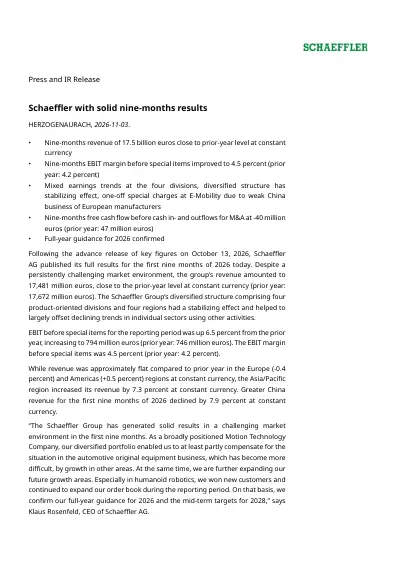
Please before I do so, quickly on page 3, the summary. I'm not going to go through the details here, but I think it's fair to say with the 4.2% Q3 EBIT margin and the 4.5% for the first nine months, a strong free cash flow contribution in Q3, the performance in Q3 was, despite the weaknesses in auto OEM markets in China, solid.
I can always say here, Heiko, we confirm the guidance for the year 2026. What is new today, and please go to the next page, is the performance improvement program that we announced this morning.
That fits very nicely into the three key priorities that we have shared with you in our Capital Markets Day more than a year ago. These priorities stay absolutely in place: delivering E-Mob recovery and achieving break-even, implementing the right self-help measures when needed, and certainly advancing new growth opportunities in humanoids and other areas.
The focus is on execution. With that, let me go to page number 5 on explain the automotive, sorry, the performance improvement program.
The automotive situation is, as it is a continued downturn here in Europe that we are facing. I don't think that this is something that will go away tomorrow.
It's more a structural change that we need to address, and that is why this performance improvement program, the next one, is a response to that situation. We have basically four issues that we need to address.
The first one is in a declining market, the demand for vehicles with combustion engines is declining as well, and that results in overcapacity in Europe that we need to address. One of the key problems is overcapacity in production, and the solution is consolidate capacity, reduce the number of plants, and consolidate also in the ancillary areas like special machinery and tool technology.
The second problem that we are facing is that the ramp-up of E-Mobility is happening slower than expected. While we are still making losses, as you all know, it is important that we also address here the cost side, and that means in particular adjusting R&D capacities that are not necessary.
A key problem in Germany is personnel costs, and it's a simple fact that they are too high. If you want to be able to produce in a competitive and cost-efficient manner in Germany, we need to address this issue of the personnel costs.
It's a very simple formula: it's number of employees times personnel cost per FTE. With this program, we are trying two things: we are trying to reduce the number of headcount, but beyond also trying to reduce the personnel cost per capita.
That you can do in several ways. You can, move things from Germany into other locations, but you can also think about what we call the solidarity contribution that, has impact immediately and is also, at least for the ones that are not tariff employees, easy to implement.
We have asked this morning our top leadership levels to reduce on a on a varying basis their salaries for two years in a in a row by 5%. The Vorstand has committed itself to reduce its salary by 10% over two years.
That is not just a signal to the works council and our employee representatives, but also something where we want to contribute immediately to a cost problem that needs to be addressed. The last point that is also on this slide is the organization has become, also through the merger with Vitesco, too complex.
We have too many management layers and too narrow spans of control, and that is also part of the program and part of the solution. If you go to the next page, you see what that means in details.
We're talking here about a net reduction of 3,460 employees, with 16 locations affected. The bulk of the 3,460 is in Germany with 2,660, and 800 in Europe.
You see the balance across the different areas: 50% production, 30% R&D, and 20% in other functions. Four of the 16 sites are sites that we will close in Germany.
Dortmund is a small location that manufactures parts for combustion engines; Wuppertal, the same; Berlin is an R&D area that we inherited from Vitesco; and Schwalbach in the same way. This is, a necessary step.
It's always difficult for people, but we have done this before, and I'm confident that this will also be successful this time. The implementation is intended to take place mainly by 2028.
For sure, as a family-owned company that is listed, we will do this in a responsible, socially responsible manner. Our relationships with works council, also the unions in Germany, is good.
That gives me hope that this will be a process that leads hopefully to a quick resolution of these issues, although the situation in Germany is, as is tense. With the solidarity contribution, with the clear commitment to Germany, I think we have at least two arguments on our side that will help us to achieve that in a, reduced friction way, let's put it this way.
Sustainable earnings improvement of €300 million per year from 2030 onwards, one-off restructuring costs in the area of €480 million. If you compare that to the last program, in the last program, we announced gross reduction of 4,700.
The gross reduction in the new program is around 4,300. We announced with forward, initially €290 million.
Here in Horizon, it's a little bit more. The restructuring cost in Horizon, as we call this program, is €480 million, and the last one was about €100 million more.
We didn't need everything, you see the size of these programs are similar, and that also gives me hope that we will be able to reduce this, to implement this properly with the experience we have from the past. Let's go to page 7 and again put this a little bit in perspective: what does this net reduction in Germany mean in a from a longer point of view?
When you take as the starting point the workforce after acquiring Vitesco in 2024, we had 35,000 employees in Germany. Today, end of September, we have about 32,000 employees.
Around 3,000 headcount cuts are going to come from the structural measures in 2024, including also the part-time reduction through ATZ measures in 2026 already agreed. That leads us to 29,000 people.
Another 2,660 on top gives you 26,300. That is, if you compare that for the next program, a around 9% reduction of workforce in Germany, and over the long term, a 25% reduction of what we have been doing.
You see there is a continuous approach here to streamline German operations and come to a situation where we can operate in a competitive and efficient manner here in our home country. The next page, page number 8, is simply what you know from the past, the the program and what we expect in terms of EBIT improvement.
The idea is that 100% of the impact will come through in the year 2030. The solidarity contribution will, if it comes true and if everyone agrees to this, will certainly help also to create an immediate impact in 2027.
As it's temporary, it will not impact 2030, but it will help us also to support 2027 and also 2028. That is on the program, more in the Q&A session.
I will now very quickly go through the next pages that you have read to allow enough time for Christophe. Sales growth you saw.
The weakness in China is well-known. We still printed a -2% overall.
I think that is not something that should be underestimated, and it shows that our hedge logic works. The next page shows you the outperform numbers for [BEV?]
as a whole. You all know that E-Mobility is not just [BEV?]
only. Both automotive divisions, PTC and Bearings, and E-Mob have exposure to all three different categories of powertrain solutions.
You see we continue to outperform in terms of sales growth the market. The order intake this year, this quarter was rather lower, to some extent on purpose.
We'll come back to that, but we're still at a book-to-bill ratio of 1.1 times. On E-Mobility next page, the most important number here is, from my point of view, the gross margin improvement.
You remember what we shared with you on Miami 2, and if you take that separate, then there is a two percentage points improvement, from my point of view, absolutely pointing in the right direction. Order intake rather low in the quarter, but that also shows that we are fully concentrating on delivering properly what we have in the books already.
Powertrain and Chassis, stronger order intake, for sure. This is a business that is not just going down, but that also acquires new activities.
There are some interesting new projects that have to do with the pickup market in the US and also with hybrid car business. You see that that business is active.
The order intake level signals commercial success in a challenging environment with Americas being the main contributor. For sure, the gross margin here is something to watch out for, and this reduction here is predominantly impacted by volume decline.
Vehicle and Lifetime Solutions, as we indicated already and answered your questions last time, good growth with 5.8%, clear outperformance of the market, some issues on the gross margin that come from higher product and logistic costs, that is hopefully now history, and Christophe will report on this. Bearings and Industrial Solutions, all green in that area, slight sales growth, strong gross margin level maintained with nearly 25%, and also a good book-to-bill ratio.
You see here that part of our business that includes, never forget that, also the automotive bearing parts, is on track. Last but not least, from my side, two pages left: humanoids, nothing new to report here since our last conversation.
The order book stands at €400 million, but significant number of conversations and customer engagement is deepening. We will come up as soon as we have new information here, also maybe before year-end, with some interesting news.
NVIDIA partnership is building. You all saw that Jensen Huang was here in Germany and gave a great speech, and also the Schaeffler Lighthouse family, sorry, factory opening in Taicang was another cornerstone that shows that we are on the right track.
We have been, page 16, very disciplined in terms of capital allocation and capital deployment. You see a reinvestment rate of 0.5 times, similar like in Q3.
The capex has been rather low, with €193 million this year, but you can be rest assured, we have the money available to spend what we need to spend. At the same time, we are very cautious with not overspending somewhere, reinvestment rates are rather at the lower end.
As you all know, capital allocation is important these days to manage the capital employed. With that, I hand over to Christophe for more information on the numbers.
Thank you very much.
Christophe Hannequin
Thank you very much, Klaus. Good morning, everyone.
As mentioned by Heiko, the numbers have been out for a while and as some of your comments pointed out, they have not changed since publication, you should be quite familiar with them. I'll take you through a couple of slides, starting with sales and gross profit.
Starts with sales, -2% burden or dragged down by the China part of our ecosystem, - slightly over -16%. Asia Pacific helps a little bit at +7.6%, but not enough to offset, especially given the fact that the Americas and Europe were hovering close or at 0% growth year-over-year.
One item to keep in mind, we're not exactly at the same perimeter in 2026. There is some divestiture of businesses that happened late last year that are still in the basis for Q3 2025.
If I look at the bridge on the right side, and if I focus not on the first column, I'll get back to it, but on the second one, the volume one, -€70 million, you have €39 million of that that is related to, let's say, the Chinese market and the phase-out. If I have to split it again, it's a 40/60% split, 40% for the phase-out, 60% attributable to market.
Quite an impact year-over-year. The price column is a little bit misleading on this one as we were actually able on the VLS side and the E-Mob side to put price into the market, VLS pushing price to offset inflation to its customers, and E-Mob mainly going through some repricing discussions with customers on existing programs.
That is not shown here due to some accounting reclassification linked with the US tariff flows, but the message is actually positive, and without the reclass, we would be around €30 million positive on that column. Mix, more or less a non-event this quarter at -€5 million.
Production cost at +€12 million, it demonstrates two things for me. The first one is that we are still harvesting the results from our structural measures and operational performance on one hand.
The second one is, on a short-term basis, our ability to flex cost is not 100%, we do have the impact from volume on the left side there, but the drop on the Chinese side was, I'm not going to say quite sudden, but still fairly short-term, the mitigation actions are underway, they are included in there, but we were not on the quarter itself 100% able to offset all of that. Luckily enough, on the comparison basis, the +€35 million that you see there in other cost of goods sold is actually a basis effect mainly, €21 million out of the 35 coming from last year where we took a rather heavy hit on inventory valuations, and the rest of the complement comes from stronger calibration sales and some other miscellaneous items, having to partially with insurance.
Maybe the takeaway from that page that I would recommend is you look at gross profit, 21% going to 20.7%. If you exclude the phase-out business, we would be dealing with a stable margin or stable gross profit margin year-over-year or actually slightly increasing, completely in line with the narratives.
If we move on to EBIT, again, -0.3 points, impacted by what I explained on the previous page, and then again to one more slightly misleading column, R&D expenses here does not fully show the progress that has been done over the last few quarters on R&D costs, including headcount reductions in the triple-digit numbers in quantities, we're slightly below 800 there, but a lower ratio of capitalization versus last year hides the good news on the P&L, but the structural improvement is there and the efficiency improvement on R&D is there. Same thing on the right side, you see the improvement on the rest of our SG&A expenses with a leaner organization processes that, again, one of the building blocks if we want to link it to what Klaus just announced in restructuring, this is one step out of many.
If I then go quickly through the different divisions: E-Mobility, almost two points worth of EBIT year-over-year, good solid news for us, it starts as early as the gross profit level, it's not a topic on R&D costs or related items, we see it already at gross profit level. Evolution, if you look at it by sector, Mechatronics and Modules, -21%, that is mainly the impact of the Chinese market.
The growth actually came from E-Drive with ramp-ups in Europe with several customers of new projects, as well as Asia Pacific, that would be for us mainly Korea and India. If we move on to PTC again, Powertrain and Chassis, drop year-over-year, the phase-out business accounts for 2.8 points out of the 6.9 that you have here, mainly located, as you can see on the right side, on the Powertrain Solutions side.
The good takeaway is the interesting increase in our Chassis business, which is mainly centered at this point in time in China, that's mainly to do with motion deactivation. Again, EBIT slightly lower, PTC was a significant impact from the short-term drop in China, still working on reacting and flexing cost.
Vehicle and Lifetime Solutions on the next slide, as Klaus mentioned, after two quarters of complicated execution, they are now on the way to delivering this year. The demand for the products is there, has been there since the start.
It's been mainly this year a topic of supply chain and execution, supply chain on the first part of the year, more recently impacted by the redeployment of our logistics footprint in Europe, which is burdening a little bit the EBIT generation there. We're still at 14.4%, almost 15% remains in very, very healthy territory, and as mentioned before, most of the topics are mostly behind us.
Quarter four should be quite clean in that sense. Bearings and Industrial, two stories in one: Automotive and the Chinese market weighing things down at -4.8%, offsetting what is happening in industrial bearings, which is a positive story there.
There we're focusing on industrial automation and the off-road segments, in which we have double-digit growth versus the comparison basis. The EBIT contribution there, solid 0.8 points, or almost €14 million additional EBIT, again, mixture of operating performance on the day-to-day and the continuous harvesting of the structural measures implemented by Bearings and Industrial Solutions for quite some time.
On the free cash flow side, as promised, but as indicated during the last few calls and the signals we sent to the market, a solid quarter three with €260 million generated, standing at -€40 million on a year-to-date basis. We will deliver the guidance on cash this year.
We were impacted and are still impacted by working capital and inventory topics on the first half of the year, part of it to protect our customer and our ability to deliver in a complicated supply chain environment, we had to push inventories a bit higher. We are now working on normalizing this without putting our supply at risk.
Capex was touched on by Klaus, moderate advance given the amount we were seeing in the past, but still close to €200 million coming out during the months. If we spend one second on the last slide on my side, the maturity profile, the key point that we would like to signal is bullet on the bottom right, we have exercised our options on our existing credit facilities, all participating bank have agreed, which we take as, again, a sign of confidence in the Schaeffler name, and the €3 billion RCFs are now extended until October 2031.
This, combined with the bond issuance earlier this year, puts us in a good position as we enter 2027 in terms of maturities. At this point, I hand back over to Klaus.
Klaus Rosenfeld
It's a very short finish. You have heard this before.
We confirm our guidance for '26. You see the details here both for the group and the divisions, and I think it's fair to say we are on track with our first nine months.
Let's see how the fourth quarter comes in, but we are confident that what we promised will be achieved. The next page and last page, stay on the financial calendar.
Heiko and his team will be quite active in the last couple of weeks of the year. For sure, we all look forward to seeing you then at the Consumer Electronics Show, where the new business will play an important role, at the Commerzbank and ODDO German Investment Seminar.
It will remain interesting, it will remain challenging, but you can be rest assured that we are very confident that with this new program, we will make a difference again and see that we get this whole company with its new strategy, Motion Technology, on track. Thank you very much, back to Heiko.
Heiko Eber
Thank you very much, Klaus. Thank you very much, Christophe.
Just as a quick reminder before we jump into our Q&A session, tomorrow, as you have already seen on the slide, we will hold our virtual Q3 roadshow together with Christophe and organized by Deutsche Bank. With this, I would say let's directly go into the Q&A session and give it back to the operator.
Operator
Ladies and gentlemen, we'll now begin the question and answer session. Anyone who wishes to ask a question may press * and 1 on their telephone.
You will hear a tone to confirm that you have entered the queue. If you wish to remove yourself from the question queue, you may press * and 2.
Anyone who has a question may press * and 1 at this time. The first question comes from Christoph Laskawi from Deutsche Bank.
Please go ahead.
Christoph Laskawi
Good morning. Thank you for taking my questions.
The first one would be on restructuring cash-outs. Is there any indication you could give us already on the program announced today and what we should expect in terms of cash-out for '27?
Related to that, will that in any way impact your dividend decision for this year? Do you consider limiting it to free cash generation, or will you largely independent of that take the decision on the dividend distribution?
Then second point on inflation, obviously a lot of companies and your peers point to accelerating inflation in Q3 and Q4 and into next year. Could you remind us between E-Mobility and PTC roughly the share of the indexed sourcing?
I would assume for PTC it's higher than for E-Mobility. Then given the usual time lag between negotiations of increased cost to pass through to the OEMs, should we prepare for, especially in E-Mobility, on top of the usual seasonality, a rather weak start to '27, or is it at this point far too early to comment?
Thank you.
Klaus Rosenfeld
Let me start with the first two questions, and Christophe will take the third one. Christoph, on the cash-outs, it's too early to say.
Typically, the cash-out is more geared towards the middle part of the program, so that's too early to give you a number. On the dividend decision, I can be more explicit.
That our dividend decision is driven by a formula that says X percent of net income before restructuring or one-off restructuring costs, we will determine this without this impact of the 480. You saw that in the first nine months, the net income was €11 million.
There was no real big one-off item that we could deduct here, but the 480 that you just mentioned will stand for the decision we make separated from this. Second element is free cash flow.
We normally like to align the dividend payment with the free cash flow we generate in the year before, and as it looks like, as Christophe said, there will be significant cash flow generation the fourth quarter. That gives us a solid basis to make a positive dividend decision.
Let's wait and see. We have not decided yet, but we have clearly a commitment out to say we want to pay continuous dividends to all our shareholders even in times where restructuring is necessary.
With that, I give the second part to Christophe.
Christophe Hannequin
On the index sourcing for PTC and E-Mob, the share, it depends. I know that's not a good answer.
Depends a lot on customers and regions, but overall at group level, we are slightly above 50% in terms of coverage. The rest is done through price negotiation to cover the part that is not explicitly covered.
As you mentioned, there is a time lag, three to six months ideally. On the indexed stuff, it's on a quarterly basis, three months.
When it is a one-off negotiation, it takes a little bit longer. Most of the time settles itself in the second part of the year, which explains some the seasonality of our numbers.
Now to go as far to say that there would be a weak start in 2027, that's a bridge I'm not willing to cross, as we are already discussing 2027 topics with our customers, especially as it relates to circuit boards and PCB, which is the, I'm going to say the burning topic, but the hot topic right now with significant inflation seen not just by Schaeffler, but by the entire market. That's already on the table with our customers.
As far as the question behind the question, which might be the guidance for 2027, let's have that discussion when we have the discussion, which is not something we would do today.
Christoph Laskawi
Thank you. One small follow-up, if I may, just in terms of constant currency growth of E-Mobility in Q3.
The way I understood it, obviously there was some end-market weakness, but there's also in E-Mobility some internal combustion related business, which is not broken out separately in terms of size. Would it be fair to assume that excluding that or eliminating the decline from that in E-Mobility, you would actually have shown positive constant currency growth in Q3 as well?
Christophe Hannequin
Again, directionally, I would disagree because the impact is coming mainly from the Chinese market and is not limited to just combustion or even the combustion piece that might be in E-Mobility. It's a wider impact on the market at least for a few months.
The question is what does it mean structurally, but again not, I would not fully agree with the statement there. The drop in China is too widespread.
It's also impacting by the pure players, the pure EV or battery electric vehicle manufacturers in China, again, wish I could agree, but probably would not.
Christoph Laskawi
Understood. Thank you very much.
Operator
The next question comes from José Asumendi from JP Morgan. Please go ahead.
José Asumendi
Thank you very much. Good morning.
A few questions, please. Can you, Klaus, can you comment a bit, please, on the labor cost reductions you're doing?
By the way, I find them very proactive and definitely driving the company in the right direction. In which division should we see this coming up as the biggest benefit?
Question two, please, with regards to humanoids, are you starting to see some of your customers moving from prototype a bit more into production series? If you're not in that phase yet, when do you forecast or foresee that happening towards '27, '28?
Then three, I'm trying to understand a little bit better if we can see margin improvement in '27. It might not be the time now to think about that, but if you could give us maybe a little bit sort of building blocks or high-level things we should think about for '27, if possible, that would be great.
Thank you.
Klaus Rosenfeld
Maybe I start with the first one. The restructuring program, again, is a response to the weakness in our automotive businesses per se.
Automotive businesses are in PTC, in E-Mob, and to some extent also in automotive bearing that sits with Sascha's subdivision. That's where it impacts.
We have so far not given numbers how much of the 2,660 in Germany and how much of the 3,460 in Europe is allocated to which division. I would, at the moment, for your modeling purposes say, about a fifth is with Sascha, and the other elements more or less go into both divisions equally with different impacts.
The one is more an overcapacity issue, and the other one is more an F&E issue, but let's see. We need to negotiate these numbers.
This is clearly targeted to maintain the profitability as good as we can in a shrinking market in PTC, and build the profitability as we grow in E-Mobility. Second one is one of the most interesting questions that you can ask: are moving from prototypes into production series already?
There are first signs, but this is not something where you can just have one KPI that says this is now happening on a broad scale. We have at the moment five serious contracts that are moving forward, but don't view these contracts as a typical automotive contract with a four-year development time and then three years start of production until peak level and then they disappear.
This is a new environment, we need to see how that works. What really makes me confident here is that this has become a much broader issue.
You see it in areas like German automotive where people are saying, 'Now we need to think about this, how to best apply this.' You heard this morning what happened in UAE, where new companies fork up and say, 'We will apply robots in a completely different environment when it comes to energy.'
You have signs here in Germany that some of the defense players start to work with this. The real question is when and where will be the broader application of this?
My view at the moment is everything I hear from the US, everything I hear from Europe makes me confident that while the Chinese are super interesting when they come to what their robots can do, the main application will, from my point of view, we will see in Germany, in Europe, and in the United States, together with a strong move into physical AI. When you heard what Jensen Huang said on stage in Berlin, then this is testimony of where the real potential is, and I think we have a very good chance here as a European-based supplier to play a role.
Margin improvement in '27, would you like to take it on the building blocks?
Christophe Hannequin
As you wish. Again, a bit early for guidance discussion, but if anything, we are consistent people, we're a consistent company.
You have our midterm targets. You see what drives the improvement of margin in 2026 and to some extent in 2025, expect some of the same trends to continue as we continue to leverage what has been done in terms of restructuring and working on our cost basis in the past.
The other point would come from, again, the scaling in E-Mobility, which will be what gets us ultimately to break-even.
Klaus Rosenfeld
Maybe just to make, Jose, for a little bit more color, we are committed to our midterm targets, no? That they say for 2028, what is around the corner, 6% to 8%.
I think you can draw your own conclusions from this, but if you have 3.5% to 5.5% in 2026 and want to get to 6% to 8%, yeah, there must be a step in between that is credible. We'll not talk about this more today, but you can be rest assured that we are fully committed on making our 6% to 8%.
José Asumendi
Super helpful. Thank you.
Klaus Rosenfeld
One last thought, this restructuring program is designed in the way it is proposed because we want to see, through the solidarity contribution, a more immediate impact than what you normally have, because at least for the management parts, we can design this in a way that it immediately impacts P&L. The
Operator
next question comes from Horst Schneider from Bank of America. Please go ahead.
Horst Schneider
Yes, good morning. Thanks for taking also my questions.
I have got a question on this potential disposal of your stake in Schaeffler India. Maybe you can tell us a little bit about background, when you intend to execute that, and what is the potential use of the liquidity?
If that could be maybe also used for dividends and if this disposal, I guess it's not yet part of your free cash flow guidance, but maybe you can clarify the aspects around this intention. Then the second one is, again, maybe more follow-ups to the questions before.
When I think about this material cost pass-through, is there any risk now on the fourth quarter that you wait for reimbursement and if you don't get that, there could still be a negative disappointment? Or is it all in the bag that you say your visibility for Q4 is now good enough that you have got great confidence that you can meet all your margin targets?
Maybe you can also say where maybe you have got the biggest headaches on that? Is it more on the chip side?
Does it affect more E-Mobility or some more color on that would be appreciated. The last one is, again, with more big picture question on E-Mobility, kind of follow-up to Jose's question, with regard to expectation for '27, but also then '28, when we think about forecasting E-Mobility.
Especially for '27, is it more than linear improvement or you would say it's more weighted towards 2028 that we see here the improvement? I guess it's all linked to revenue growth in E-Mobility.
Thank you.
Klaus Rosenfeld
Horst, on the first one, the announcement we made is an intention to sell that we had to make at the local stock market authorities, and it doesn't mean that we're doing anything tomorrow. It doesn't mean that we need the liquidity for our free cash flow guidance.
It's, I would call, a precautionary measure to be flexible when we would like to do something. We have not decided yet, and when we decide, you will hear from us because there will be a public announcement.
It's there to create flexibility and to hit the market when we think it's right. When you read the announcement correctly, it doesn't give you any time period where this has to happen.
It's an open announcement, and we just wanted to clear the market to an extent that people know that this is intended, but the when, the if, and the how is nothing that we can at the moment talk about. It's precautionary.
For sure, if there would be some liquidity flow from this, we would then see what we do with it, but you see that we still have not reached our leverage targets. I would assume that at least an liquidity inflow will help us to reduce that further, but again, it's more a precautionary, early day step to be flexible.
I take on the last one, and Christophe can continue on the material cost pass-through. The E-Mob development is the most important commitment that we have given.
You saw what we did with Miami 2. The way to a break-even is still a path that is, to some extent, dependent on what's happening in the market as well, but there is a significant element that we can drive ourselves.
I would like to see an improvement that is sustainable. Whether that is linear or not is a separate story, but the most important indicator to watch out for is gross profit.
The gross profit margin is the health indicator, and all what we're doing at the moment is to stabilize that margin. You saw what we did with Miami 2 to get rid of the bad parts or the things that will not perform, means at the same time that we concentrate on those parts that perform.
Let's wait and see for the fourth quarter this year. During the year, it's certainly something that is geared towards the fourth quarter because that's where the big compensation payments come in.
That's the logic that Vitesco has. PTC and VLS are a little bit more different, but the most important message from my point of view is it needs to be a consistent, continuous improvement in the gross profit margin that we want to see.
If then the business grows, even better, but margin improvement is the most important. You could also say earn your right to grow by improving the margin with the things that we have in our hands, and that is project delivery, cost improvement, and the things that we're now doing with this restructuring program.
Horst Schneider
All right. Thank you.
Klaus Rosenfeld
You're welcome.
Christophe Hannequin
On question two, the material cost pass-through, Q4 Q4 performance on that topic, I think we have it, we are comfortable with it. Does not mean we recover everything in in Q4 2026, as as mentioned before.
There is some lag, it take it takes it takes time, but where we are sitting, and given our guidance, and given our internal forecast, we feel comfortable with it. The biggest headaches would come not necessarily from chips, but from circuit boards, where we directly compete with the the data center sector and industry, and they have somewhat deeper pockets than the automotive industry, for sure, and are massively, massively impacting the the supply and generating a lot of inflation on that on that sector.
If there was any risk, it would not necessarily be raw material related, but, as as Klaus mentioned, the Q4 is a typical quarter where we finalize and settle claims related to volumes, quality, change in design, etc., etc., with our with our customers. Obviously, not everything has been 100% signed at this point in time, there there is always a risk that would come from that, but I would not target it necessarily through the material side.
It's it would be more through the claim side.
Operator
The next question comes from Harald Hendrikse from Citi. Please go ahead.
Harald Hendrikse
Morning. Thank you.
Can you hear me okay?
Klaus Rosenfeld
Yes, we can.
Harald Hendrikse
Good, good. Thank you so much.
I'm on for Ross, obviously, who does a much better job than I do, but thank you so much for the presentation. Sometimes it's nice to go back to the suppliers.
I thought your presentation on the restructuring was exceptional. Thank you for all the detail there.
I wish the OEMs would do that for us sometimes. Just on restructuring, can I just ask a slightly broader question, and I kind of have two or three slightly more broader questions given my background maybe, but one, just the background in Germany, to what degree do you get understanding from the unions, from the workforce when you announce these programs, right?
This has now been ongoing for some time. The situation in Germany is obviously getting pretty tense, like you say, extreme.
How much understanding is there that this is an ongoing process, right? ICE volume, as you say, is not going back up, and this is probably not the only restructuring we're going to have to take in the future, no?
I'd love to understand the feeling in Germany and how much pushback you're getting. Secondly, Mercedes recently, the CFO made a sort of rather strange comment regarding supplier compensation and maybe intimating that he wasn't maybe willing to discuss supplier compensation specifically with regard to volume as much as he had done in the past.
What do you see again in terms of behavior from the OEMs? How is that culture?
How set is that culture? I know that culture changed significantly with inflation back in 2022, 2023, the index clauses have changed and have been updated, but are there further changes there that maybe again the OEMs can push some risk back to the suppliers?
Those are really my two quick questions. Thank you.
Klaus Rosenfeld
Let me start on the first one. Thank you very much for the positive comment, that's appreciated.
For sure, unions are at the moment a bit unhappy about the announcement today because they are still in this negotiation of the next, how do you call this, Tarifvertrag. In Germany, negotiations about the next labor cost increases is now happening at the moment.
The end of October period is over, so that's not ideal for them, but I think it's necessary. If you are in this situation that we have with a continued downturn in the automotive industry, if you're asking for 5% labor cost increase, then at least the industry needs to speak up and say, 'How is that possible in such an environment?'
That's why I'm happy that we have the chance to do that, and I think that's appreciated. We have at Schaeffler, since many years, very good relationships with our unions and our works council.
I can tell you here that we have certainly discussed our program in our supervisory board where you have 10 members from the employee side. We have shared the views and the ideas with our works council representatives during the year.
For sure, it's now a negotiation. Your question here is, is there an understanding?
There is understanding if you are factual. If you just try to drive this with bold statements and create a social tension that is unnecessary, people are unhappy.
If you try to explain it like we try to do it today with, 'Here the facts, guys. This is happening, and we have to respond to this.
We cannot just sit here and do nothing and hope for the best or have some illusionary ideas of what could be done with labor cost increases. We need to tackle this problem together.'
That is why the solidarity contribution that we are also explained this morning and that we offered this morning is a very important part of this exercise. Typically, the pattern, and I've gone through at least five or six of these programs, is there's a little bit of noise at the beginning, but then it's our task to get the guys back to the table and discuss with them, also to listen to them what they have, because most of them are responsible in a sense that they understand a company can only perform on the long term if it's competitive.
We have a competitive issue in Germany that cannot be solved by companies themselves. To invite them to this discussion, we have given, Harald, a clear commitment to Germany.
We have said we are not going to leave Germany, and there's much nonsense out on the street where people say, 'All the companies are leaving Germany.' That's impossible for us.
We don't want to do it, but we need to have the right measures in place to improve performance here in Germany and show that it is possible to produce, maybe at a smaller scale, and also develop in Germany competitively and also with high cost efficiency. That's what we're up to, and I'm confident that after the noise goes away, we will have very solid and straightforward discussions with them on how to best achieve this.
The response from our workforce, and my colleagues have been out to the field and in many of the plants that are affected today, is people are unhappy about this, but there's also a level of understanding that shows us that if we present this in a factual, direct, and also fair and equal manner, with some taking care of the families and the employees that are affected here, then it is something that is doable. On the Mercedes CFO, let me say, let's respond the following way: the relationship between an OEM and a supplier is boxing and dancing at the same time.
That's how it's always been, but it's something where you have to give in, where you have to struggle here and there. If someone categorically says it's only boxing, it will be difficult.
We are in favor of long-term relationships. We have always seen relationships to our large German customers as something that goes over the cycle.
Sometimes you give, sometimes you lose a bit, but it's a stable relationship. We need to go back in the German automotive industry to that thinking.
If someone is that articulated, it's not helpful because we will definitely ask for the things that we need. The tone, the way this is executed is important there, but even more important is the general understanding that the OEMs cannot succeed without the large suppliers, and the large suppliers cannot succeed without their OEMs.
Let's leave it at this level. I'm not sure whether you want to add something, Christophe, but we play a very good game between good guy and bad guy, and that is part of the boxing and dancing solution.
Christophe Hannequin
Maybe one additional comment on this one, yes, the relationship needs to work, but we can also do what we can in order to have as much flexibility within our business as possible. On the E-Mobility side, when we talk to you about standard and platform on a regular basis, it's designed to do exactly this and create the optionality inside the business to absorb ups and downs in volumes on existing production lines without having to retool and incur massive loss.
Again, that's just one way to dance, and in fact at the core, the relationship has to be, as Klaus explained, but we can work on this as much as we can.
Klaus Rosenfeld
With Christophe's help, guys, we have started to allocate capital to customer relationships. I'm not sure how many other companies you know who do that, but it's a little bit cumbersome to get there, but it sharpens the view that over the long term, we need to able to earn our cost of capital with every customer relationship we have, whether it's automotive, industrial, whatsoever.
If you don't earn your cost of capital over the long term, over the sort of a period of time, then it's time to exit the relationship.
Operator
The next question comes from Stephanie Vincent from Bank of America. Please go ahead.
Stephanie Vincent
Hi, thank you so much for taking my questions. My first one is just on the exposure to China OEMs, if you'd be willing to disclose, I guess, the percentage of the order book that's upcoming that is allocated towards those OEMs in both Europe as well as Asia would be my first question.
Then my second question is just on deleveraging and potentially some opportunities. Some have brought up divestitures on this call, but just wanting to know with the production environment being so weak going through 2026, maybe even into 2027, do you think there are potentially some low multiple, cash generative opportunities that are out there for bolt-ons as we move into next year?
Klaus Rosenfeld
Let me take on the last one. We have our hands full with other activities, and I don't see that even a smaller bolt-on acquisition is something that we would focus on at the moment.
That must be something that is extraordinary, interesting, profitable, and makes also sense to integrate, but that's not on our priority list at the moment. I'm not saying that we exclude completely looking at opportunities, but I can't see anything at the moment that would attract enough attention.
On the exposure to China, that's a frequently asked question, and I have to say, Stephanie, my apologies, we don't have this number available publicly. We need to think, Heiko, why not to publish it, because it's a frequently asked question, and that could help investors to assess this properly.
What our colleague Thomas Stierle normally says is that he at the moment wins more business with Chinese OEMs versus with others. That is a good sign, but the percentage of the order book, I can't deliver out of the top of my head, maybe we can share that at a later point.
Christophe Hannequin
If you want one data piece there, we are today in production with nine out of the top 12 OEMs in China, Chinese OEMs, it doesn't quite answer your question, but shows that we are involved with them with the major players over there, most likely, by the way, the ones that the industry would consolidate around if there was to be a consolidation, as many overseas seem to think. Maybe one last comment, this one a little bit more qualitative, exposure to Chinese OEM is not a bad thing.
We are successful in China, the Chinese market is important, we would not necessarily be seeking a low exposure to Chinese OEM. We want to be exposed to that market, we are exposed to that market, we are successful in that market today.
It's a little bit volatile, of course, saying this given the last two to three months, but this is not something that we shy away from.
Stephanie Vincent
Thank you very much.
Operator
Ladies and gentlemen, that was the last question. I would now like to turn the conference back over to Heiko Eber for any closing remarks.
Heiko Eber
Thank you very much. All that is left to say is thank you for your time, thank you for your interest in our company.
Of course, if there are any open questions afterwards, feel free to reach out to our IR team anytime. Of course, I cannot finish the call without saying thank you to the team, the preparation.
Have a good rest of the day, and talk to you soon. Thank you.
Operator
Ladies and gentlemen, the conference is now over. You may now disconnect your lines.
Goodbye.