Sunstone Hotel Investors, Inc.
Q3 FY2026 · Earnings Call TranscriptNovember 6, 2026
Operator
Good morning, ladies and gentlemen, and thank you for standing by. Welcome to the Sunstone Hotel Investors Third Quarter Earnings Call.
At this time, all participants are in a listen-only mode. Later, we will conduct a question-and-answer session, and instructions will be given at that time.
I would like to remind everyone that this conference call is being recorded today, November 6th, 2026, at 12:00 p.m. Eastern Time.
I'll now turn the presentation over to Mr. Aaron Reyes, Chief Financial Officer.
Please go ahead, sir.
Aaron Reyes
Thank you, operator. Before we begin, I would like to remind everyone that this call contains forward-looking statements that are subject to risks and uncertainties, including those described in our filings with the SEC, which could cause actual results to differ materially from those projected.
We caution you to consider these factors in evaluating our forward-looking statements. We also note that the commentary on this call will contain non-GAAP financial information, including adjusted EBITDAre, adjusted FFO, and hotel adjusted EBITDAre.
We are providing this information as a supplement to information prepared in accordance with generally accepted accounting principles. Additional details on our quarterly results have been provided in our earnings release and supplemental, which are available in the Investor Relations section of our website.
With us on the call today, are Bryan Giglia, Chief Executive Officer, and Robert Springer, President and Chief Investment Officer. After our remarks, the team will be available to answer your questions.
With that, I would like to turn the call over to Bryan. Please go ahead.
Bryan Giglia
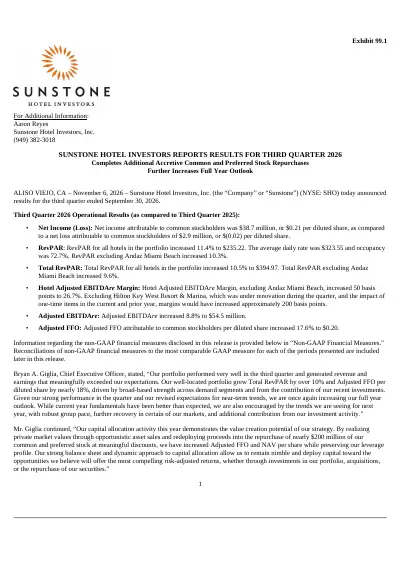
Thank you, Aaron, and good morning, everyone. The third quarter saw solid performance all around as better-than-expected industry fundamentals added to earnings growth generated from disciplined cost controls at the corporate level and from our meaningful share repurchase activity.
Our well-located portfolio benefited from broad-based strength across all segments and contributed to total portfolio RevPAR growth of 11.4%. Excluding Andaz Miami Beach, comparable RevPAR still increased by a very impressive 10.3%.
The stronger-than-expected revenue performance allowed us to deliver nearly 9% growth in adjusted EBITDA compared to last year. Since the start of the third quarter, we repurchased an additional $130 million of common and preferred stock, bringing our year-to-date total to nearly $200 million of accretive buyback activity.
This has not only helped to grow NAV, but also contributed to a nearly 18% increase in adjusted FFO per share this quarter and lays the groundwork for additional growth in per-share earnings in 2027. I will share some additional thoughts on our capital allocation strategy shortly, but first let's review some highlights from Q3 operations.
For the fourth quarter in a row, our resorts led the portfolio with combined RevPAR growth of over 22%, including the benefit of Andaz Miami Beach. Wailea Beach Resort delivered another impressive performance as RevPAR grew nearly 27% in the quarter and total RevPAR increased almost 31%.
The resort has recovered its competitive position, growing occupancy by 19 points in the quarter and demonstrating the strength of the current appetite for leisure travel. As we shared with you last quarter, we were encouraged by the momentum we saw in Maui with strong production through midyear.
This trend accelerated through the third quarter, with group pace for 2027 now up over 20%. Our wine country resorts also saw increased demand, with third quarter occupancy growing nearly 8 points and combined total RevPAR 11% higher.
At Andaz Miami Beach, we opened the resort's signature dining destination, Bazaar Meat by José Andrés, in late October, and José was on site to help kick things off. This is an exciting milestone as the full resort campus is now activated, and we look forward to benefiting from significant growth over the coming months as we move into Miami's high season.
Our urban hotel portfolio drove the greatest degree of outperformance relative to forecast, with combined total RevPAR growth of 12.8% in the quarter. The strength was broad-based, with each of our urban hotels generating at least 10% growth.
While rate performance was solid at 5.5%, strong demand for group events and corporate travel also drove a healthy lift in room night volume. We continue to be pleased with the booking patterns we are seeing at our urban hotels as we move into the fourth quarter.
Group pace for our urban portfolio is up meaningfully, and we are seeing strength in corporate transient rates. This combination should allow our operators to take advantage of the compression and maximize yield.
This set up looks particularly good for the Marriott Boston Long Wharf and the JW Marriott New Orleans, as these two very well-located hotels can drive significant premiums to the market. Performance at our convention hotels reflected a continuation of the same trends we have seen all year, with incremental transient demand partially offsetting a more subdued event calendar in a couple of our larger markets.
San Antonio was our best performing convention hotel, with the Hyatt Regency on the Riverwalk generating total revenue growth over 40% in the quarter on a much more favorable group event calendar and the benefit of our recently renovated meeting space. While our other convention hotels generated lower growth, overall performance was better than forecast.
As we have shared with you on prior calls, we expected some headwinds this year due to less favorable event calendars in some of our key group markets. The good news is that as of the third quarter, most of that is behind us, and the outlook is much more encouraging.
In Orlando, quarterly group revenue production for all future periods was up over 40% and set a record for third quarter booking activity. While year-to-date performance in San Diego has been soft, we are moving into a stronger backdrop for the market and expect substantially better results in the fourth quarter and into next year.
We are off to the right start with October RevPAR at Hilton Bayfront up over 20% to last year. Across the country in Washington, D.C., where the group calendar and local market dynamics have been challenging, we have seen some recent positive signs, with 2027 group pace at the Westin increasing several points since last quarter.
Overall, we are encouraged by a more constructive group set up for our portfolio next year. On the expense side, our occupancy-driven growth resulted in an 8.9% increase in total comparable portfolio expenses during the quarter, or 2.7% per occupied room, which led to EBITDA margin increasing only 50 basis points.
Our margin performance during the quarter was impacted by renovation work at the Hilton Key West and by several one-time items that skewed comparability. Adjusting for these impacts, we estimate margins would have expanded nearly 200 basis points.
As we shared with you on prior calls, a more transient-heavy mix of business at our largest group hotels this year has limited their ability to operate at peak efficiency. We expect a return to more normalized segmentation for these hotels next year, which should drive meaningfully better flow-through and increase profitability.
We expect our Hilton San Diego Bayfront, with group pace up over 10% in 2027, could have a meaningful benefit to margins next year. Additionally, our other large group hotels in Washington, D.C.
and San Antonio also have strong group pace growth that should support better flow-through next year. We continue to focus on driving labor efficiencies where possible and working with our operators to mitigate growth in other property-level costs.
We expect that increased utilization of technology will help drive down operating costs over time, and while it is difficult today to forecast the exact cadence and magnitude, we think it is reasonable to assume that we will begin to realize some of these benefits of our operators' recent technology investments as we move into next year. We have also been focused on minimizing expenses at the corporate level and ensuring that our overhead costs are aligned with the needs of the company.
As I noted on the start of the call, we have now repurchased nearly $200 million of common and preferred stock so far this year, recycling about 70% of the proceeds from the sale of the Hyatt Regency San Francisco. This has been a very successful and efficient round trip of capital, done without earnings drag created from holding cash for an extended period.
We realized an attractive private market value for an asset that was expected to remain low yielding, and deployed most of those proceeds back into our common and preferred stock at a much higher implied yield and at an attractive discount to NAV. The revised full-year outlook that Aaron will discuss shortly reflects not only the benefit from stronger trends across the portfolio, but also the contribution from this repurchase activity, which also gives us a head start on per-share earnings growth for next year.
To put this into perspective, we sold an asset at a strong value, repurchased a meaningful amount of common and preferred stock, increased NAV and FFO per share, and did all of this on a leverage-neutral basis while still retaining capital to deploy. Our nimble size and decisive action allowed us to quickly realize value and acquire our equity at a significant discount to NAV and to today's stock price.
We have remaining proceeds from the sale, together with balance sheet capacity, that we can use to further drive growth in earnings per share. We expect to remain opportunistic with our repurchase activity as pricing allows.
At current levels, our buyback efforts will be focused on preferred stock over common stock. We are also continuing to monitor opportunities in the transaction market, but expect to remain disciplined in our approach and ensure we retain full strategic optionality as it relates to our ability to create value for our shareholders.
With that, I'll turn the call over to Robert to give some additional details on our capital investment activity.
Robert Springer
Thanks, Bryan. We have made solid progress on our 2026 capital plan, delivering several key projects that should position us for future growth.
In San Diego, we completed a meeting space renovation earlier this year, and are already seeing the benefits of that investment in our booking velocity. We expect to see significant revenue growth as we move into the fourth quarter of this year, and our 2027 group revenue pace is more than 10% higher compared to the same time last year.
At Andaz Miami Beach, the property's transformation is now complete, with the resort's signature dining destination, Bazaar Meat, now open. We will conduct a formal grand opening celebration early next year to coincide with peak season, but initial response has been great, with a variety of press and media coverage bringing additional energy and awareness to the resort.
Work is also underway on a room refresh and facade restoration at our recently converted Hilton Key West Resort & Marina. We are scheduling the work in phases through mid-2027 to minimize disruption and take advantage of peak demand periods.
This renovation work, and the resort's new brand and manager affiliation, are intended to drive incremental earnings as the property benefits from Hilton's stronger distribution channels, operating expertise, and lower customer acquisition costs compared to its prior independent operating model. Last, we are moving into the final phase of remediation work at Wailea Beach Resort following the damage incurred from the storms that impacted the Hawaiian Islands earlier this year.
Work in the guest rooms and public spaces is complete, and the roof and facade repairs are underway now, so that we can have them done by the busy festive season. While this was not a project that was on our to-do list at the start of the year, our team mobilized quickly to complete significant repair work while not disrupting the strong demand recovery we are seeing at the resort this year.
While this work added several million dollars to our total capital investment in 2026, nearly all of this incremental spend is being reimbursed by our insurance programs. We are working through our capital planning for 2027 and will have more to share with you next quarter.
As it stands now, we expect a significant portion of our capital spend for next year to be funded from existing FF&E reserves, with a smaller contribution of owner capital relative to prior years. With that, I'll turn it over to Aaron.
Please go ahead.
Aaron Reyes
Thanks, Robert. As we noted at the top of the call, our earnings results for the third quarter came in ahead of expectations, driven by broad-based strength across the portfolio.
Rooms RevPAR for the total portfolio grew an impressive 11.4% in the quarter, including a 110 basis point benefit from Andaz Miami Beach. Total RevPAR for all hotels increased 10.5%, including a 90 basis point benefit from Andaz.
The stronger top-line performance in the quarter contributed to earnings that were ahead of our expectations, including adjusted EBITDAre of $54.5 million, an increase of 9% relative to last year. When combined with the added benefit of our accretive repurchase activity, adjusted FFO per diluted share was 20 cents, an increase of 18% from last year.
As of the end of the third quarter, we had $237 million of unrestricted cash and over $80 million of additional cash held in FF&E reserves. Together with full availability on our credit facility, this equates to nearly $820 million of liquidity.
Net leverage as of the end of the quarter stood at only 2.8 times trailing earnings, or 3.7 times including our preferred equity. Despite deploying a significant amount of capital into buyback activity this year, we have been able to preserve our low-leverage position by taking advantage of opportunities to repurchase our preferred stock at attractive discounts.
These repurchases have not only reduced our preferred dividends by nearly $4 million per year on a run-rate basis, but have also contributed to growth in NAV. Included in our press release this morning are the details of our updated outlook for 2026.
We are once again revising our expectations higher to capture the outperformance in the third quarter and to reflect the improved near-term trends we are seeing as we move into the fourth quarter. Our updated guidance also includes the benefit of incremental savings in corporate G&A and the benefit of higher FFO and FFO per share created by our accretive common and preferred stock repurchases.
Based on what we see today, we now expect that rooms RevPAR for all hotels in the portfolio will grow between 9.5% and 10.5%, or an increase of 200 basis points at the midpoint, to a range of $245 to $247. This reflects the full-year benefit of Andaz Miami Beach, which is expected to contribute approximately 450 basis points of growth at the midpoint.
Total RevPAR is now expected to increase between 8.5% and 9.5%, to a range of $409 to $413, with a similar 450 basis point benefit from Andaz. As we noted in our press release and supplemental, our year-to-date RevPAR and total RevPAR growth for the total portfolio was a robust 10.8% and 9.9%, respectively.
Based on the midpoint of our updated ranges, this would imply a mid- to high-single-digit revenue growth expectation for the fourth quarter, with approximately 150 basis points of benefit from Andaz. This revised revenue growth is now expected to translate into adjusted EBITDAre in the range of $254 million to $259 million.
Our FFO per diluted share has been revised higher to also incorporate a further reduction in preferred dividends and a lower share count as a result of our repurchase activity, and is now expected to range from $1.00 to $1.03. Given that our repurchases were concentrated in the second half of this year, we will continue to see the benefit of this activity in our per-share earnings as we move into 2027, with approximately 178 million current shares outstanding, a reduction of nearly 6.5% from the start of the year, and nearly 20% since the start of 2022.
Turning to our return of capital. Since the start of the year up through this week, we have repurchased approximately $143 million of common stock at a blended price of $10.43 per share, a meaningful discount to consensus estimates of NAV and our current trading levels.
In addition, we have also repurchased nearly $54 million of our preferred stock at a blended price of $21.03 per share, or a 16% discount to its liquidation value. This common and preferred stock repurchase activity has been accretive to both NAV and earnings per share.
While we expect to continue opportunistically repurchasing common and preferred stock when pricing is compelling, our revised 2026 outlook does not assume the benefit of additional buyback activity. Our board of directors has authorized a 9 cent per share common dividend for the fourth quarter.
Given the tax impact associated with our sale of Hyatt San Francisco earlier this year, our current dividend will satisfy our distribution requirement this year. If we adjust for the sale impact, the portfolio is generating cash flow per share meaningfully in excess of our current payout rate, and should support incremental capital return as we move into 2027.
Our board has also declared routine distributions for our Series G, H, and I preferred securities. While an attractive combination of implied yield and NAV growth has focused our preferred repurchase activity on our two publicly traded series, we retain the option of redeeming some or all of our Series G preferred at any time at our election, and is another lever we can pull to drive growth in FFO per share moving forward.
Before we conclude our prepared remarks, I'll turn it back over to Bryan for some additional thoughts.
Bryan Giglia
Before we open the call to questions, I want to provide an update on our 2026 objectives and our progress towards them. In July, we sold the Hyatt Regency San Francisco at attractive pricing of nearly 20 times trailing EBITDA, realizing a private market value that far exceeded its valuation inside our portfolio and appropriately capturing the present value of its future growth.
Importantly, we promptly redeployed most of the proceeds into the repurchase of common stock at a discount to both NAV and our current trading price, and into the repurchase of preferred stock at a 10% to 20% discount to redemption value. Our combined repurchases increased value and FFO per share while maintaining a leverage-neutral balance sheet.
At the same time, we retain additional capital and balance sheet capacity to deploy into the most compelling opportunities available to us. Looking ahead to 2027, the combination of embedded growth in our portfolio, reduced corporate G&A, lower fixed charges from preferred stock repurchases, a lower share count, and the remaining proceeds we have to deploy has increased our expected distributable income per share despite the earnings we forego from selling San Francisco.
Taking all of that into account, we expect our 2027 quarterly dividend distribution requirement to be between 11 and 12 cents per share, or approximately 20% to 30% above our 2026 quarterly distribution. This is based on what we see today, and we will revisit our 2027 dividend payout approach early next year.
Taken together, our 2026 capital allocation decisions demonstrate our ability to unlock and create shareholder value by selling assets when private market valuations are compelling and dynamically redeploying that capital where we see the best risk-adjusted returns. We remain disciplined and nimble, with the balance sheet capacity and liquidity to continue opportunistically allocating capital across acquisitions, investments in our portfolio, share repurchases, and other opportunities that we believe will generate superior long-term value for our shareholders.
With that, we can now open the call to questions. Operator, please go ahead.
Operator
We will now begin the question-and-answer session. Please limit yourself to one question and one follow-up.
If you would like to ask a question, please press star one to raise your hand. To withdraw your question, press star one again.
We ask that you pick up your handset when asking a question to allow for optimum sound quality. If you are muted locally, please unmute your device.
Stand by while we compile the Q&A roster. Your first question comes from the line of Smedes Rose with Citi.
Your line is open. Please go ahead.
Smedes Rose
Hi. Good morning, Bryan.
Thanks for providing all that detail. I guess I wanted to ask my first question just a little more if you could just discuss group pace, I guess portfolio-wide for '27, I know you mentioned it for a couple of your assets, but what are you seeing so far for the whole group?
Bryan Giglia
Good morning, Smedes. We are up right now mid to high single digits right now, but when you look at the big components of that and you look at it, especially one of the hotels that has struggled this year on the group side, which we knew going into it, is San Diego is one of the big ones that has meaningful over 10% growth.
Wailea also has significant growth, and then also San Antonio and D.C. When you look at our largest hotels from both a top line and then the ancillary spend and the margin impact you'll get, those are big movers for the portfolio and will benefit the portfolio next year.
Smedes Rose
Thanks. Then I guess I wanted to ask sort of along that same lines, I feel like a focus on this quarter's calls has been kind of issues or expectations around flow-through, and some of the feedback has been that higher transient-driven occupancies have driven up variable costs and maybe impacted some of the flow-through.
It sounds like in your remarks you anticipated kind of a more normal segmentation for next year. Could you maybe talk about that a little bit and maybe what some of the margin implications are for the portfolio?
Bryan Giglia
Sure. For starting with the group hotels first, both San Diego and D.C.
that had a weaker group pace for this year, 2026, we were able to partially backfill a good portion of that with transient demand, because short-term transient demand year-to-date and looking forward for the next six months continues to be very strong. That was able to backfill some of that demand, but then hotels that typically do larger group percentages of their overall revenue, San Diego and D.C.
specifically, they become less efficient. Banquets is a big piece of that, meeting room rental, AV, those are all more profitable than what the transient guests will spend.
That was a portion of the flow-through that we will see both San Diego and D.C. revert back to their more normalized segmentation next year.
That's a tailwind for margins. Then for this year also, there were some tougher comps to 2025.
We had some real estate tax credits. We also had a lot more cancellation and attrition in 2025, which has a better flow-through.
That is something we won't have to compare to next year. Then we had across the portfolio, you look at Wailea specifically, large pickups in occupancy, and so as we look at transient bookings going forward and even some of the group bookings going forward, while this year occupancy was a bigger component of it, next year rate will be a bigger component.
That will also benefit. Then last, even though Wailea is having a phenomenal year, and the year we talked about and expected with regaining its position on the island, third quarter they didn't do damage to the hotel like we had in the second quarter, but there were several storms that moved through Maui, and so each one of those has its own level of disruption, and then on the repairs and maintenance, landscaping clean up there, there's a lot of costs running through the P&L that hopefully will not have next year.
Great,
Smedes Rose
thank you. Appreciate it.
Operator
Your next question comes from Conor Peaks with Wells Fargo. Your line is open.
Please go ahead.
Conor Peaks
...San Francisco, bought back nearly $200 million of stock, and worked to 13 hotels at this point. How do you think about the right size and mix of the portfolio from here, and what does Sunstone look like in 2 or 3 years?
Good
Bryan Giglia
morning, Conor. I think you cut off a little bit, but I think I got your question, if I miss anything just please we can follow up on it.
As far as what is the right size for Sunstone, we like being the size that we are. We like being nimble and being able to allocate capital in a manner that is meaningful to all aspects, our NAV per share, our FFO growth, our our overall impact to share price through reducing share count.
We like to be able to with San Francisco specifically, look to sell an asset into a market and realize a private market value that is well in excess of where it is valued in our portfolio, and getting the value of the future cash flows today. Then being able to then take those proceeds and allocate them in the manner of which we think we're going to get the best risk-adjusted return.
At that moment in time, our stock was trading at a level that was a significant discount, and well outside of where assets were trading in the market. The right allocation at that time was to repurchase our own portfolio, also being able to repurchase our preferred stock at a discount, being able to do all that leverage neutral and retaining capital to go deploy further.
Lowered the share count, kept the leverage level the same, which should benefit our taxable income and distributions next year, and have some dry powder to deploy after all that. Where we stand today, with the stock where it has moved, preferred is still very attractive.
Acquisitions are more attractive now, but again, we need to find the right one, and looking at the transaction market, specifically in Q3, you see that overall transactions are up, but when you dig into it a little deeper, you see that very small transactions are up, and very large $250 million-plus transactions are up, but when you look at the sweet spot of where we would want to acquire, that's, call the $50 to $200 million range, those transactions were actually down. I think the market is improving, and so where we stand today, and where we'll stand in the future, will be dependent on all the factors I just went through.
We will continue to allocate capital in a manner that is going to benefit our shareholders the best. I think overall we've made the right changes from an overhead costs and made sure that we are adequately sized for our current portfolio and have capacity to grow the portfolio under the right circumstances.
Conor Peaks
Thank you, really appreciate that. Sorry, am I coming a little clearer now?
Bryan Giglia
Yes.
Conor Peaks
Awesome. Maybe shifting to Wine Country, it looks like it could contribute about 7 cents on the stabilized FFO bridge.
How is that pacing today, maybe what's the main constraint or area of improvement you're looking for to drive this recovery?
Bryan Giglia
We continue to see steady growth year-over-year from both the assets. Both of them are having very good years this year.
The demand and the short-term demand in the market has been very strong. You can see in Q3 we picked up quite a bit of occupancy.
The short-term demand is both on the transient and the group side, and so and part of that is a little bit of a surprise, especially the booking window for these hotels can be within a few days for weekend travel, and even on the group side, we were just speaking with the hotel, and they're picking up group 1 or 2 weeks out still, smaller groups mainly from the Bay Area. When we look forward, we look at both of them have great transient demand patterns for the next 6 6 months, and we're seeing more picking up more on the rate side, we'll look to continue to compress rate going forward, and then as we have seen a big jump in the occupancy levels this year, again, then it's time to go in and really try to fine-tune the overall cost model of each of these resorts, and our expectation is we'll continue to see steady growth in EBITDA next year and continuing on.
Operator
Your next question comes from Dwayne Pfennigwerth with Evercore ISI. Your line is open.
Please go ahead.
Peter Eames
Hi, this is Peter on for Dwayne. Thanks for taking the question, and good morning.
Could you just discuss what's implied for the fourth quarter? If our math is correct, seems like RevPAR maybe in the mid-single digits.
Just kind of describe the puts and takes on what changes from 3Q to 4Q, and maybe some of the clues that you saw in October.
Bryan Giglia
Okay. Let me start, and then Aaron can cover some more of the specifics.
Looking at Q4, it's mid to mid-high-single-digit growth for the quarter, I think is what's implied. October is the strongest month, and obviously the one month that's behind us, October was, from a comp basis and especially with some of our larger hotels, group hotels starting to have some of that group pickup that I talked about earlier starting to materialize in the fourth quarter.
October was a strong month. November of the three months will be the lowest growth month, and then as we get into December, specifically the back half of December, we see strong festive demand across our resort portfolio: Wailea, Wine Country, and Miami.
Aaron Reyes
Sure, Peter, what I might just add to that, I think Bryan hit the high points, but we had anticipated that October would be the strongest month of the quarter from a RevPAR growth perspective, and that would come in kind of in the mid-teens area, and then we would step down for November and December, just based on the cadence of the booking patterns that we had at the start of the quarter. We've been pleased at what we've seen in October, I think what we can see from preliminary data is that occupancy came in generally in line, but that rate was a touch better, some encouraging signs for October.
We'll overall expect a kind of a mid- to high-single digits as we move through the quarter, with October being the best.
Peter Eames
Thank you. Appreciate that.
I guess just quickly, Bryan, you finished up on Miami there, I'll follow up. Was there anything to note about the 3Q performance?
I know it's low season, but was it a pretty typical 3Q that kind of aligned with your expectations, and then just talk about some of the transient pacing into 4Q and next year. Appreciate it.
Bryan Giglia
Sure. Q3 was I would say generally within expectations.
For Miami, we didn't get a lot, and we talked about this on the last call, we didn't have a lot of the FIFA impact at this hotel specifically. One, that was either the way we were positioned or what we didn't see that, but that will obviously not be a headwind for this hotel next year.
I think we have a game plan also for next year when we look at Q3 in this market, kind of taking the blueprint that we have used in Wine Country in Q1, where you have a highly seasonal market with some pretty big variances in rate and occupancy between your low season and your high season. Really what we're focused on with the resort and what we did in Wine Country was to really push that group base as best as you can, and which that means going to get group customers that are not necessarily that customer in the high season, but they're in other local markets or other regional markets, and going in and pulling that group base.
As we saw in Wine Country, it'll be at a lower rate, but it comes with all of the ancillary spend, and then that allows you to then compress the transient business. I think for year one post renovation, Q3, it's a good start.
We've got a long way to go, and I think that there's a lot of upside here where we can do much better. Now, looking forward, there's Q4, festive period specifically, we're seeing really strong transient demand.
We're seeing rates pick up like we would want. Festive is several hundred dollars higher in rate than it was last year, still have a lot of room to go to the market, which is good, but I think we're going to make another major stride this year, which was our expectation.
Also, the Art Basel time period with all of our meeting space available this year, and also having the Bazaar restaurant done, which it can be used for buyouts, just further enhances the entire resort and the resort experience, especially for the group customer. I think the combination of those two, we'll have a very good festive season, but like Q3, and as we said before, these are all building blocks, and so, that will just carry us into '27, and we have a lot of growth that we expect and that I believe we're on target to achieve.
Operator
Your next question comes from David Katz with Jefferies. Your line is open.
Please go ahead.
David Katz
Hi. Good morning, afternoon, everyone, depending where you're sitting.
I think you've talked about this a bit, and so if I'm triple clicking on it, I think it's worthwhile. You made a mention about Orlando and booking pace, I believe, plus 40, and broadly on the portfolio, group booking pace, was it 10%, right?
Can you just go back through what the drivers of that are and just make sure that we're getting that right? Group revenue pace is more than 10% higher, I think is what you said, and where specifically in the portfolio that is, that we can sort of point to?
Thanks.
Bryan Giglia
Sure. For total group pace, we said mid- to high-single digits for the entire portfolio.
The 10% you referenced, I believe was San Diego. Why don't we start with the building blocks for next year,
David Katz
and
Bryan Giglia
then we can double back. Good morning, David.
When we look at how the portfolio is positioned next year, both from a top line and a margin standpoint, we can start with where the most EBITDA comes from, and that would be our large group hotels. Like I said, our group pace is up mid to high mid-single digits.
Looking at the specific hotels, San Diego is up 10% in group pace. Wailea is up in the 20s.
Then our larger group hotels in San Antonio and D.C. are both up meaningfully.
Those, looking at the EBITDA generation just between those hotels, that is a big plus to not only top-line growth next year, but at the group hotel, San Diego and D.C. specifically, to really get that ancillary revenue and right-size their margin performance.
When we look at transient pace, transient pace is up, and this is transient's a shorter window, it's the next 6 months, transient pace is up 9% for the portfolio. That is pretty much all rate, and it's really across the board.
Certain hotels maybe if they have a lot of group on, like San Diego, the transient pace might be down a little bit, but really that's building on the occupancy that we built in 2026, going to rate in 2027. That should be very beneficial for our margin growth also.
We've seen, and probably the biggest surprise this year has been that transient demand and how broad-based it is. It's not just the leisure.
It's business transient, and it's throughout the portfolio. Then one-offs for next year for growth, you have Andaz.
Andaz, we expect significant growth, we have significant growth this year, as it ramps up, it will continue to provide additional growth to the portfolio next year. I think those are the major building blocks.
Then, on top of that, our markets have a great supply picture for the next several years, at or around historically low levels of supply in the majority of all of our markets. Then from an earnings perspective, you've got the full-year benefit of our share repurchase, which will be fully annualized next year, which will help, and then also our balance sheet capacity and additional liquidity we have from the San Francisco sale to redeploy.
I think all of those together, you look at, we're pretty well positioned for 2027, and having our largest hotels with the best growth is a good formula for the next 12 months.
David Katz
I appreciate every bit of that. I just want to confirm one detail.
I thought what I heard on Orlando was group pacing plus 40. Did I hear that right?
Hey,
Aaron Reyes
David, it's Aaron. The metric that we're referring to is quarterly group revenue production, and so you did hear that right at 40%, which is a great indicator of booking velocity there.
Just to note that quarterly booking patterns can fluctuate as you move from year to year, but it's certainly nonetheless a good story of what we were seeing in Orlando.
Bryan Giglia
Beyond Orlando, year-to-date, we're having the best production year we've had in a decade. All of the group hotels are our booking business, part of that into '27, part of it beyond '27.
As far as when you look at all the different segments, transient is great pace booking into the next 6 months. Group is booking into the out years and booking at a rate more than we've seen in the last several years.
Operator
Your next question comes from Michael Bellisario from Baird. Your line is open.
Please go ahead. Hey,
Michael Bellisario
thanks. Good morning, guys.
Bryan Giglia
Morning.
Michael Bellisario
Two parts here, I'll hit the first part here. Just in terms of the buybacks and the step up there, how much of that was due to fundamentals getting better and you getting ahead of that versus you not seeing attractive enough acquisition opportunities?
What are the puts and takes that you were thinking about there in the quarter?
Bryan Giglia
Good morning, Mike. We have proceeds from San Francisco, and while we need to make the best capital allocation decision with those and we don't have to do something immediately, we are also aware of the costs of that cash sitting on the balance sheet for an extended period of time.
Quite honestly, when we looked at our portfolio and we looked at where we saw things going, and in line with where we've guided things going, is that we felt that the value in our own shares compared to what was available and where current pricing was in the market, was just too big of a discount that it would be very difficult to make that up through a hotel acquisition. I think we were measured and still didn't deploy everything, but between the combination of common and preferred, and then having some capital left to deploy, we were able to, on a stabilized basis buy back our stock probably close to a mid 8s to 9 cap for the stabilized portfolio, and do that on a leverage-neutral basis, that we believe that that was a superior allocation of capital.
Michael Bellisario
Got it. Understood.
Then just one more on transactions. Sounds like maybe volume might not have been the best, but perhaps getting directionally better.
What did you see in terms of pricing expectations, underwriting returns? Just how have those been trending, and if you're seeing any changes in seller expectations or the bid-ask spread?
Thank you.
Bryan Giglia
I think you're seeing a little bit of a convergence on the bid-ask spread, but it depends, and some of the larger deals we've seen, the pricing seems a little bit more reasonable, but sometimes that's for specific reasons, whether it's a structural issue with the hotel or some reason. There's usually always a reason for the pricing.
I think as we see in that, call it, $50 million to $200 million range, there were very few deals, and I think that those were more of a seller's market for that type of hotel. If something needs not a lot of capital, is in a good market, is in a good labor market, those were highly desirable, and for whether it be REIT or private equity, those were bite-sized deals that I think investors wanted and were willing to do.
Then so those were a little bit fewer and far between in the quarter. My hope, and what I think we've seen a little bit now, is we're starting to see more of those, and as there's more capital out to deploy, that should bring more of these to the market, call it in that 8 cap range.
Operator
Your next question comes from Chris Woronka with Deutsche Bank. Your line is open.
Please go ahead.
Chris Woronka
Hey, guys, good morning. Thanks for taking the question.
I was hoping we could circle back for just a minute on kind of the mix dynamic that I think affected you in Q3, where you had more transient and it may have been at a pretty good rate, but you didn't get the group with all the higher-margin ancillary. Is that something you contemplated at the beginning of the year or was this more of the shorter-in kind of groups that didn't fill in, just trying to square it all up because it affected all your peers as well, just seems like a little bit of an odd dynamic that unfolded.
Thanks. Good
Bryan Giglia
morning, Chris. This is something with San Diego, you know 1 2 years out where your group sits.
That was something that we were aware of. D.C.
also, aware of it going into the year. I think we were a little bit more concerned, and where we were pleasantly surprised is that the transient demand was greater than we thought, but you're exactly right, when that transient customer does not spend what the group customer does at those hotels.
Other markets had strong group quarters and strong citywides, I don't know if this is an industry thing, or what we'll obviously focus more is our specifics of our portfolio. For us, this was something we knew going in, and we knew that it would be a tougher year on the margin front at these larger hotels.
I think on Wailea, we were a little bit surprised at the amount of shorter-term transient demand, so that's a plus, and that's something that came up in the year. The other thing at Wailea is we weren't expecting the number of storms we had, and typically during the hurricane season, you're focused more on the Atlantic than the Pacific, but that was the opposite this year.
That cost associated with each one of those that came through is, even with little damage or no damage, it's still a couple hundred thousand dollars each time of cleanup and other work. I think to answer your question, most of it we expected, and our expectation is that it will reverse itself next year, I think that we're in a good position going forward.
Chris Woronka
Fair enough. Thanks for all the detail, Bryan.
Just quick follow-up on Miami, Andaz. Looking out a little bit here now, I think the Grand Hyatt Convention Center opens in the fall of '27, I believe.
Do you guys anticipate any impact, good or bad? I know it's in a different neighborhood and it's convention-oriented, but it's a Hyatt Hyatt family.
Is there anything to think about or do you guys expect any I would think benefit from having another distribution there?
Bryan Giglia
The distribution is absolutely beneficial. I think that it's a very different product, from a redemption in the Hyatt system from World of Hyatt, that's a very different stay.
I don't see a lot of impact from there. Look, is there a chance that for a convention that some of the higher rated guests might want to stay at the beach?
Absolutely. I think that that's a plus, and having that in the market is a plus.
Then hopefully, while it's not done and we're not at this point yet, but hopefully from the cost side, there'll be some complexing and some other things that we can do with Hyatt to help on the cost front. Overall, I think it'll be a positive.
Operator
Your next question comes from Michael Herring with Green Street. Your line is open.
Please go ahead.
Michael Herring
Hi, good morning, thanks for taking the question. Maybe just sticking on Miami for a second.
The market has performed really well this year, and I think you had mentioned this time last year that it had softened a bit, but I'm just curious how you're thinking, relative to your original underwriting, where the asset sits, and as it ramps up and gets to that original target.
Bryan Giglia
No, I'm not sure about the softening comment, but as far as I think I know it. I think we said last year the market pulled back a little bit, but still well ahead of where our underwriting was.
When we look at the competitive set and the rate, we're still several hundreds of dollars behind it, and so there's a lot of room for us to run. Our neighborhood and the mid-beach market continues to move upscale.
There's some new supply coming in, but they're very very high-rated luxury, and so that's good for the overall market. I think that our positioning and our expectations of rate in the market are right where they should be.
Going forward, we're very happy with our product relative to the higher price point hotels. We're very happy that we have the full campus functioning now, with Bazaar Meat open, and the beach club open, and so we have all of the amenities that are going to be important to both the transient and the group customer going forward, and having a flagship restaurant in the hotel is already, and we're not even in high season yet, is already bringing a lot of notoriety to the resort.
I think all this, based on where our underwriting was and our expectations for the market, is right where it needs to be, and we look forward to what the resort will do next year.
Michael Herring
Makes sense. Then maybe just one other, maybe asking about how you're thinking about the portfolio generally from a different direction.
There's quite a few larger group-oriented hotels, and maybe your concentration to that segment of demand is a little bit elevated and caused some lumpiness in results. Just curious how you're thinking about maybe diffusing that relative concentration and diversifying going forward.
Bryan Giglia
Going forward, and I think I laid it out when I said that the area of transactions that we'd be looking at were in the $50 to $200 million range, not the $500, $600, $700, $800 million range. I think that, having balance sheet capacity and additional liquidity from the San Francisco sale, acquiring at the point where it makes sense, if we were to add additional assets to the portfolio to add a little bit more balance, knowing that we have some really large hotels that will move a portion of the portfolio at time to time, but at the same time, those are some really great hotels in some really great markets in some irreplaceable real estate.
While, yes, there will be ups and downs, I think over time, when looking at value, which is most important, that these are assets that I think we want to be invested in and will return the best over time. I think in the short term, adding a little bit more diversity to the portfolio helps that, but I think next year, especially, we're going to be very happy that we have San Diego and Wailea in the portfolio.
Operator
The last question this afternoon comes from Michael Hirsch with J.P. Morgan.
Your line is open. Please go ahead.
Michael Hirsch
Hi, thank you for taking my question. Regarding expense growth, are there any specific markets you'd call out as seeing above-average cost pressures, and what is your early view on 2027 wage and expense growth?
Bryan Giglia
On the cost side, like look, your your urban markets are going to have higher wage and and benefits costs typically. Looking at at salaries and wages for next year, it it should moderate a bit from where we are this year.
I don't think there's going to be as much pressure on it. If we're labor this year is kind of running at the 4% to 5%, we should, my expectation would be at the lower end of that.
Then I think where we can pick up on that is is on the productivity side, and while we are in the very early stages, and our our our managers have been investing, I do think that there is a chance that we start to see the beginnings of some of some of their AI investment help, and probably the early stage of that will be productivity, scheduling, that is is probably one of the first steps. Hopefully next year, we should be able to start to see some some offsetting of of some of these costs by by making sure that things are are scheduled and and we get more productivity out of out of the the different departments.
Looking at other costs, I probably the the biggest cost that's, has been a bigger expense this year than anticipated is energy. Energy is something that is a little bit, out of our control.
We've we've made improvements where we can with solar in in Wailea, but we've, that's something that will, we'll have to manage going forward, but is is somewhat out of our control. Insurance, property taxes are all kind of stabilized at this point, those those shouldn't be really an impact on next year.
Aaron Reyes
Hey, Michael, it's Aaron. I'm going to give you a little more color, particularly on the property tax side.
We had a number of favorable outcomes that benefited us in 2025. We'll have property tax appeals in process in pretty much every municipality and jurisdiction that we operate in.
It's just hard to pick the timing and the velocity with those will come, and so 2026 was a quieter year for us on the appeal front. I think that sets us up a little bit better as we move into 2027 that we have an easier comp, and hopefully we get a couple of these appeals across the line as well.
I think that that should overall be helpful from a flow-through perspective as we move into next year.
Michael Hirsch
That's helpful context, appreciate that. Just a quick follow-up on Key West.
I believe RevPAR was down 10% in the quarter. Just quickly your expectations on this asset going forward would be helpful.
Bryan Giglia
We're rebranding and renovating right now, there's displacement there. We rebranded it the Hilton Key West.
Hilton is in as the manager. The asset is several buildings, we're working through the renovation right now.
The RevPAR is a reflection of that displacement. Our expectations with the Hilton reservation system and what we've seen on the rate side so far, we think that we'll start to see some of that recover as we get into next year.
There'll be some renovation running into next year, but our expectations is then that will normalize back to where you saw it performing before.
Operator
There are no further questions at this time. I'll now turn the call back to Bryan Giglia for closing remarks.
Bryan Giglia
Thank you everyone for your time and interest, and we look forward to seeing many of you at upcoming conferences and property tours. Thank you.
Operator
This concludes today's call. Thank you for attending.
You may now disconnect.