SiteOne Landscape Supply, Inc.
Q3 FY2026 · Earnings Call TranscriptOctober 28, 2026
Operator
Greetings, and welcome to SiteOne Landscape Supply, Inc. third quarter 2026 earnings conference call.
At this time, all participants are in a listen-only mode. A brief question-and-answer session will follow the formal presentation.
If anyone should require operator assistance during the conference, please press *0 on your telephone keypad. As a reminder, this conference is being recorded.
It's now my pleasure to introduce your host, Eric Elema, Chief Financial Officer. Please go ahead.
Eric Elema
Thank you, and good morning, everyone. We issued our third quarter 2026 earnings press release this morning and posted a slide presentation to the Investor Relations portion of our website at investors.siteone.com.
I am joined today by Doug Black, our Chairman and Chief Executive Officer, and Daniel Laughlin, SVP, Strategy and Development. Before we begin, I'd like to remind everyone that today's press release, slide presentation, and the statements made during this call include forward-looking statements within the meaning of the Private Securities Litigation Reform Act of 1995.
These statements are subject to risks and uncertainties that could cause actual results to differ materially from our expectations and projections. Such risks and uncertainties include the factors set forth in the earnings release and in our filings with the Securities and Exchange Commission.
Additionally, during today's call, we will discuss non-GAAP measures, which we believe can be useful in evaluating our performance. A reconciliation of these measures can be found in our earnings release and in the slide presentation.
I would now like to turn the call over to Doug Black.
Doug Black
Thanks, Eric. Good morning, and thank you all for joining us today.
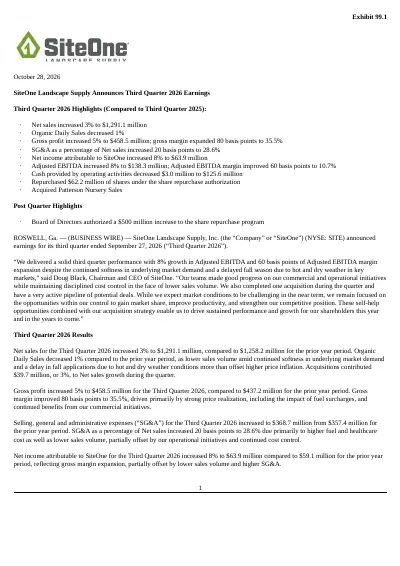
We delivered a solid third quarter performance with 3% growth in net sales, 8% growth in adjusted EBITDA, and 60 basis points of adjusted EBITDA margin expansion compared to the prior year period, despite continued softness in underlying market demand and a delayed fall season. Our teams made good progress on our commercial and operational initiatives and maintained strong cost discipline in the face of lower sales volume.
Our acquisitions continue to perform well, and we were able to add another excellent company to SiteOne through acquisition during the quarter. We also continue to leverage our strong cash flow and balance sheet to take advantage of our recent share price weakness, and returned over $62 million to shareholders during the quarter through our share repurchase program.
Our board recently increased our share repurchase authorization by $500 million, and we plan to continue returning capital to shareholders opportunistically in the coming years. While we expect market conditions to be challenging in the near term, we remain focused on the opportunities within our control to gain market share, improve productivity, and strengthen our competitive position.
These self-help opportunities, combined with our strong cash flow and acquisition strategy, enable us to drive sustained performance and growth for our shareholders this year and in the years to come. I will start today's call with a brief review of our unique market position and our strategy, followed by highlights from the third quarter.
Eric will then walk you through our third quarter financial results in more detail, and provide an update on our balance sheet and liquidity position. Daniel will discuss our acquisition strategy, and then I will come back to address our outlook and guidance for 2026 before taking your questions.
As shown on slide 4 of our earnings presentation, we have a strong footprint of more than 690 branches and five distribution centers across 45 U.S. states and five Canadian provinces.
We are the clear industry leader, approximately three times the size of our nearest competitor, yet we estimate that we only have about a 13% share of the very fragmented $36 billion wholesale landscaping products distribution market. Accordingly, our long-term opportunity to grow and gain market share remains significant.
We have a balanced mix of business with 66% focused on maintenance, repair, and upgrade, 20% focused on new residential construction, and 14% on new commercial and recreational construction. As the only nationwide full product line wholesale distributor in the market, we also have an excellent balance across our product lines as well as geographically.
Our strategy to fill in our product lines across the U.S. and Canada, both organically and through acquisition, further strengthens this balance over time.
Overall, our end market mix, broad product portfolio, and geographic coverage offers us multiple avenues to grow and create value for our customers and suppliers, while providing important resiliency in softer markets like the market we are in today. Turning to slide 5, our strategy remains straightforward and unchanged.
We leverage the strengths of both our large nationwide organization and our very experienced and highly entrepreneurial local teams. Our goal is to fully utilize our scale, resources, and capabilities in support of local execution to deliver superior value to our customers and suppliers in every market we serve.
We do this through our focused commercial and operational initiatives, which not only build a long-term competitive advantage for all our stakeholders, but also help us overcome the near-term headwinds. These initiatives are complemented by our acquisition strategy, which fills in our product portfolio, moves us into new geographic markets, and adds terrific new talent to SiteOne.
Taken altogether, we expect our strategy to create superior value for our shareholders through organic growth, acquisition growth, and EBITDA margin expansion. At our Investor Day in June, we described our strategy and initiatives in detail, and outlined our financial targets through 2030.
With the current challenging end markets, we believe the execution of our strategy allows us to outperform the market organically, while leveraging acquisition growth and EBITDA margin expansion to deliver solid financial progress. We expect our progress to accelerate as end markets return to normal growth.
Accordingly, we remain highly focused on executing our commercial and operational initiatives, strengthening the business, and continuously improving areas that are within our control. On slide 6, you can see our strong track record over the last 10 years with consistent organic and acquisition growth.
As mentioned, we expect to continue driving organic and acquisition growth while recovering and expanding our EBITDA margin significantly over the coming years. As you can see from the slide, we expanded our adjusted EBITDA margin last year, and expect to make further progress this year, despite soft markets and significant headwinds.
Our ability to deliver EBITDA margin expansion in both soft and healthy market conditions is expected to yield attractive EBITDA growth and improved return on invested capital in the coming years. Finally, with our strong cash flow, we can support our strategy and return capital to shareholders through our share repurchase program.
Overall, we believe that we are well positioned to create solid value for our shareholders in 2026 and significant value over the longer term. We have completed 109 acquisitions across all product lines since the start of 2014, adding approximately $2.2 billion in trailing 12-month sales to SiteOne, which demonstrates the strength and durability of our acquisition strategy.
Our pipeline of potential deals remains robust, and we expect to continue adding and integrating more companies in 2026 to support our growth. Given the fragmented nature of our industry and our current modest market share, we believe that we can add over $2 billion of acquired trailing 12-month revenue to SiteOne over the next 10 years.
Slide 7 shows the long runway that we have ahead in filling in our product portfolio, which we aim to do primarily through acquisition, especially in the nursery and hardscapes lines of business. We are well connected with the best companies in our industry, and expect to continue filling in these markets systematically over the next decade.
I will now discuss some of our third quarter performance highlights, as shown on slide 8. Net sales increased 3% to $1.29 billion compared to the prior year period, while organic daily sales decreased 1%.
Higher price contribution was more than offset by lower sales volume amid continued softness in underlying market demand, while acquisitions continued to contribute to growth. Note that we experienced hot and dry weather in key markets during August and September, which pushed some of the fall season into October.
We are encouraged to see those sales come through this month, with organic daily sales growth of approximately 2% so far in October, yielding modest organic daily sales growth of flat to up 1% for the four-month period of July through October. Gross profit increased 5% to approximately $459 million, and gross margin improved by 80 basis points to 35.5%, reflecting strong price realization and continued execution of our commercial initiatives.
SG&A as a percentage of net sales increased 20 basis points to 28.6%, as lower sales volume and higher fuel and healthcare costs more than offset the benefits of our operational initiatives and strong overall cost control. Note that increased fuel costs added approximately 15 basis points to SG&A as a percentage of sales, while our fuel surcharges added an offsetting 15 basis points to gross margin.
Adjusted EBITDA increased 8% to $138.3 million, and adjusted EBITDA margin improved by 60 basis points to 10.7%. Overall, we were pleased to expand adjusted EBITDA margin despite the challenging demand environment and organic daily sales decline.
In terms of initiatives, we continued to make solid progress during the quarter despite the lower end market demand, executing specific actions to improve our customer experience, drive organic sales, expand gross margin, and control SG&A. For organic sales and gross margin expansion, we achieved good organic daily sales growth with our small customers, and grew our Pro-Trade, Solstice, and portfolio private brand products collectively by 23% during the quarter and over 35% year-to-date.
Our percentage of branches with bilingual capability is nearly 70%, despite adding 12 Rhinders branches earlier this year without this capability. We continue to execute our Hispanic marketing strategy to drive growth in this important customer segment.
We increased our digital sales on SiteOne.com by over 45% year-to-date versus the prior year period, while also increasing our regular active users by approximately 35%. We believe we are gaining market share with the customers who are engaged with us digitally, as we achieved strong positive total sales growth with these customers during the quarter.
SiteOne.com helps customers to be more efficient, and helps us increase market share while making our associates more productive, a true win-win-win. On the SG&A front, we continue to lower our net delivery expense during the third quarter with increased efficiency along with improved pricing.
As mentioned, our teams have done a good job of working with our customers to pass through fuel surcharges to mitigate the significant near-term increases in fuel costs. We have reduced net delivery expense by over 35 basis points year-to-date, and expect to drive additional improvements in 2026 and for the next several years as we execute our local market delivery strategy and best practices.
We also continue to achieve improved profitability with our underperforming branches or focus branches during the quarter, though they were also negatively affected by low organic daily sales growth. We expect to drive steady improvement with these branches in 2026, which should accelerate with normal end market demand in the coming years.
In total, our ability to execute our commercial and operational initiatives we believe enables us to outperform the market and deliver EBITDA margin expansion despite lower end market demand. Furthermore, we expect these initiatives to help us drive organic growth and expand our adjusted EBITDA margin over the next several years toward our 2030 targets.
On the acquisition front, we have added three companies to our family so far in 2026 with approximately $125 million in trailing 12-month sales. Our latest acquisition, Paterson Nursery, not only expands our high-performing Devil Mountain business, but will help us provide high-quality West Coast nursery material to customers across the entire country.
We continue to have an active pipeline of additional companies, and we expect to close more acquisitions during the remainder of the year. With an experienced acquisition team, broad and deep relationships with the best companies, a strong balance sheet, and an exceptional reputation as the acquirer of choice, we remain well positioned to grow consistently through acquisition for many years in our very fragmented market.
Now Eric will walk you through the third quarter in more detail. Eric?
Eric Elema
Thanks, Doug. I'll begin on slide 9 with some highlights of our third quarter results.
Net sales increased 3% to approximately $1.29 billion during the quarter, compared to approximately $1.26 billion for the third quarter last year. Organic daily sales decreased 1%, driven by lower sales volume with continued softness in underlying market demand and a delay in fall applications, as Doug mentioned, which more than offset higher price inflation.
Acquisition sales, which include sales attributable to acquisitions completed in 2025 and 2026, contributed approximately $40 million, or 3%, to our net sales growth during the quarter. From a demand perspective, conditions remain challenging with sales volume declining approximately 5%, more than offsetting price contribution of 4%.
We believe that the delayed start of the fall season reduced the third quarter organic daily sales growth rate by approximately 70 basis points. Pricing strengthened during the quarter and was positive across all product categories, including grass seed and PVC pipe, where prices were up 6% and 2%, respectively.
For the first time since the first quarter of 2023, we did not experience deflation in grass seed, PVC pipe, or fertilizer products in the quarter. Price contribution is expected to continue to track near 4% for the fourth quarter as inflationary pressures are likely to keep prices elevated.
Pricing for the full year is expected to be up approximately 4%. From a regional perspective, performance continued to vary.
The Central region remained our strongest performer with organic sales growth of approximately 7%, supported by solid underlying market performance and our stronger market position following the Rhinders acquisition earlier this year. California also improved meaningfully from the first half of the year with organic sales up approximately 1% for the quarter, driven by share gains and the performance of our Devil Mountain nursery business within that market.
Organic sales declined in three of our other regions during the quarter due to the later start of the fall application season. However, these regions have recovered with positive organic sales growth so far in October.
Sunbelt markets such as Texas and Arizona continue to face headwinds due to weak new residential construction and repair and upgrade demand. Organic daily sales for agronomic products, which include fertilizer, control products, ice melt, and equipment, decreased 1% during the third quarter, due primarily to the delayed fall applications.
We also believe that higher prices for certain agronomic products like fertilizer continue to weigh on volume in the short term as our customers deal with fixed maintenance budgets. Organic daily sales for landscaping products, which include irrigation, nursery, hardscapes, outdoor lighting, and landscape accessories, were flat in the third quarter compared to the prior year period, reflecting weakness in new residential construction and softer repair and upgrade activity, offset by price inflation for certain product categories such as irrigation, landscape accessories, and outdoor lighting.
Gross profit increased 5% to approximately $459 million, and gross margin expanded 80 basis points to 35.5%. The improvement was driven primarily by strong price realization, including the benefit of fuel surcharges, and continued execution of our commercial initiatives.
These benefits were partially offset by higher freight distribution costs resulting from fuel inflation and the addition of our fifth distribution center, which wasn't operational in the third quarter last year. Selling, general, and administrative expenses increased to approximately $369 million from $357 million for the same period last year.
SG&A as a percentage of net sales increased approximately 20 basis points to 28.6%. Higher healthcare and fuel costs were the primary headwinds, while our operational initiatives and continued cost control efforts helped partially offset these higher costs, as well as the deleverage effect of lower sales volume for the quarter.
As Doug mentioned, fuel inflation represented approximately 15 basis points of pressure in SG&A, which was effectively recovered through fuel surcharges in gross margin. SG&A in the base business on an adjusted basis increased approximately a half a percent compared to the prior year period.
The modest increase in base business SG&A was due primarily to the higher healthcare and fuel expenses, partially offset by the benefits of our cost reduction actions. The effective tax rate was 26.0% for the third quarter compared to 20.4% for the same period last year, due mainly to a decrease in excess tax benefits year-over-year.
There were no excess tax benefits recognized in the third quarter compared to $4 million in the prior year period. We continue to expect the effective tax rate for fiscal 2026 will be between 25% and 26%, excluding discrete items such as excess tax benefits.
Net income attributable to SiteOne increased 8% to $63.9 million compared with $59.1 million in the prior year period. The improvement for the quarter primarily reflects gross margin expansion, partially offset by lower sales volume, higher SG&A, and an increase in the effective tax rate.
Our weighted average diluted share count was approximately 43.8 million for the third quarter, compared to approximately 45.0 million for the same period last year. During the third quarter, we repurchased approximately 646,000 shares for approximately $62 million, at an average price of $96.29 per share.
In addition, as Doug previously covered, our Board of Directors approved an increase of $500 million to our share repurchase authorization post quarter-end. We also have approximately $38.3 million remaining for repurchases under the prior authorization.
We plan to continue executing opportunistic share repurchases, considering the lower stock price. Adjusted EBITDA increased approximately 8% to $138.3 million for the third quarter, compared with $127.5 million in the prior year period, and adjusted EBITDA margin improved 60 basis points year-over-year to 10.7%.
We're pleased with the margin expansion for the quarter given the lower demand environment and the delayed start of the fall application season. I'll now provide a brief update on our balance sheet and cash flow statement, as shown on slide 10.
Working capital at the end of the quarter was approximately $1.09 billion compared to $1.06 billion at the end of the same period last year. Cash provided by operating activities decreased $3 million to approximately $126 million, primarily due to working capital changes, partially offset by higher net income.
We made cash investments of approximately $24 million for the third quarter, compared to approximately $16 million for the same period last year. Capital expenditures for the third quarter were approximately $17 million compared to $10 million for the same period last year, due to increased investments in our branch locations and branch equipment.
Net debt at quarter-end was approximately $523 million compared to $423 million at the end of the third quarter last year. Net debt to trailing 12-month adjusted EBITDA was 1.2 times, which is within our target leverage range of 1 to 2 times, and compares to 1 times at the same time last year.
Available liquidity at the end of the quarter totaled approximately $566 million, consisting of $88 million of cash on hand and $478 million of available borrowing capacity under our ABL facility. As a reminder, our priority from a balance sheet and liquidity perspective is to maintain our financial strength and flexibility, so that we can execute our growth strategy and complete opportunistic share repurchases in all market environments.
I will now turn the call over to Daniel for an update on our acquisition strategy.
Daniel Laughlin
Thanks, Eric. As shown on slide 12, we completed the acquisition of Paterson Nursery Sales through our Devil Mountain business in the third quarter.
Paterson is a leading grower and distributor of premium Oregon nursery products, serving customers coast to coast. The acquisition expands our nursery product line into the Pacific Northwest, and strengthens our ability to distribute high-quality West Coast nursery products efficiently across the country.
This is our third acquisition of the year, and brings our combined trailing 12-month acquired net sales to approximately $125 million year-to-date. Since 2014, we have acquired 109 companies, with approximately $2.2 billion in trailing 12-month net sales added to SiteOne.
Summarizing on slide 13, our acquisition strategy continues to create significant value for SiteOne by adding excellent talent and moving us forward toward our goal of providing a full line of landscape products and services to our customers in all major U.S. and Canadian markets.
We continue to drive steady acquisition growth with a focus on building strong relationships with potential targets that lead to negotiated deals when they are ready to sell. We have several letters of intent currently, and expect to close more deals in the remaining months of 2026 and into 2027.
Overall, we remain confident in the long-term acquisition opportunity in front of us. Our pipeline is active, our relationships remain strong, and our competitive advantages as a buyer continue to resonate with prospective sellers.
We believe SiteOne remains uniquely positioned to play a strong role in consolidating our industry for many years to come. I will now turn the call back to Doug.
Doug Black
Thanks, Daniel. I'll wrap up on slide 14.
We believe that the ongoing energy volatility, higher interest rates, weak consumer confidence, and increased macroeconomic uncertainty are collectively having a negative effect on the already weak new residential construction end market, and the typically more resilient repair and upgrade end market. These trends are more than offsetting the more resilient maintenance and new commercial construction end markets.
Pricing continues to be positive, and we believe that pricing will contribute approximately 4% to net sales growth for the full year. Overall, with the benefit of our commercial initiatives, and with the 53rd week reducing organic daily sales by 80 basis points, we expect full-year organic daily sales to be flat to down 1%.
In terms of end markets, we are experiencing significant weakness in new residential construction demand, which comprises 20% of our sales, and we expect this market to be down double digits for the full year 2026, in line with lower new home completions. New commercial construction demand, which represents 14% of our sales, has been solid so far, and we believe it will remain approximately flat in 2026.
We believe the repair and upgrade market, which represents 30% of our sales, was down in 2025 and has taken another step down this year, with higher interest rates and inflation, and continued weak consumer confidence and existing home sales. While the long-term fundamentals for this end market are strong, we believe that repair and upgrade demand will continue to be down through the remainder of this year.
Lastly, in the maintenance end market, which represents 36% of our sales, we achieved excellent sales volume growth in 2025 as our teams gained profitable market share on top of steady demand growth. We have seen steady demand so far this year, though there has been some near-term volume reduction in response to higher fertilizer prices, where customers' maintenance budgets are fixed for the year.
Overall, we expect the maintenance end market to be flat in 2026. In total, we expect end market demand to be down this year, driven by weakness in new residential construction and repair and upgrade.
We expect gross margin to be higher through the remainder of the year and for the full year 2026 compared to the same periods of 2025, driven by price realization and our commercial initiatives, partially offset by higher freight and logistics costs supporting our growth. Given the lower sales volume, higher fuel and healthcare costs, and the negative effect of the 53rd week, we expect SG&A as a percentage of net sales to be up for the full year, as these factors more than offset our operational initiatives and actions to reduce SG&A.
We are managing SG&A tightly and making necessary changes to optimize our cost structure in anticipation that 2027 will continue to be challenging from a demand perspective. Accordingly, we plan to reduce our workforce and consolidate or close branches in the fourth quarter, and incur a corresponding charge to adjusted EBITDA of approximately $6 million to $8 million.
Despite this charge and the negative effect of the 53rd week, which we anticipate will reduce adjusted EBITDA by an additional $4 million to $5 million in the fourth quarter, we expect to expand adjusted EBITDA margin slightly in fiscal 2026. In terms of acquisitions, as Daniel mentioned, we have a good pipeline of high-quality targets, and we expect to add more excellent companies to the SiteOne family during the remainder of the year.
With all these factors in mind, we expect our full-year adjusted EBITDA for fiscal 2026 to be in the range of $425 million to $440 million. This range does not factor in any contribution from unannounced acquisitions.
In closing, I would like to sincerely thank all our SiteOne associates, who continue to amaze me with their passion, commitment, teamwork, and selfless service. We have a tremendous team, and it is an honor to be joined with them as we deliver increasing value for all our stakeholders.
I would also like to thank our suppliers for supporting us so strongly, and our customers for allowing us to be their partner. Operator, please open the line for questions.
Operator
Thank you. We will now be conducting a question-and-answer session.
If you would like to ask a question, please press *1 on your telephone keypad. A confirmation tone will indicate that your line is in the question queue.
You may press *2 if you would like to remove your question from the queue. For participants using speaker equipment, it may be necessary to pick up your handset before pressing the star keys.
We ask that analysts please limit themselves to one question and one follow-up so that others have a chance to do so as well. One moment, please, while we poll for questions.
Our first question comes from David Manthey with Baird. Please proceed with your question.
David Manthey
Thank you, and good morning, everyone. On the actions that you're taking here, were any of these contemplated when you were going through your self-help items on that slide 108 from the Investor Day, where you'd waterfall to 2030 EBITDA?
Second and related, does this represent a change in your view on 2027? I think at Investor Day, you expected the market to be flat.
Doug Black
Good question, David. We're always kind of monitoring where we're at and where we need to be.
We have seen the markets kind of weaken as we've gone through this year, and we've been taking actions to reduce SG&A. When we look into next year, we haven't necessarily changed our outlook, but we felt like there were additional actions that we could take to not only prepare us for next year to perform, but also in line with that long-term goal.
We have a target for where we want SG&A to be longer term, and these are all just steps to make progress toward that. We've identified additional workforce reductions that we can make, and they're throughout the company, kind of targeted in certain areas.
Then, we've identified other branches, largely kind of struggling branches that we are able to consolidate into other branches to improve the performance and the cost structure of the network. It prepares us for next year.
It's not that we've changed our outlook. We expect next year to be similar to this year, but it also sends us toward our long-term target, which is important.
David Manthey
Great. Thanks, Doug.
That's helpful. Then, second, on the M&A pipeline, as we look back here, you've described it as solid and healthy, and now you're saying it's very active.
I'm just trying to get a read on if you realistically are looking at your funnel right now, is the current pipeline moving in the right direction? Is it getting materially better than it was 90 days ago or a year ago?
Or is it just, it's good, solid, and we don't know when something will turn into a transaction?
Daniel Laughlin
No, David, this is Daniel. I think it's consistent with historically where we've operated.
If we land some of the LOIs that we have under LOI right now, we should deliver towards the bottom end of that range we said at Investor Day, which was between $200 and $300 million. We should sort of be in excess of what the average has been the last 12 years.
We feel good about where we're going to end this year. Then, the active conversations that we have going on should trickle into delivering a hopefully improved year in 2027, but at least in line with that $200 to $300 million that we've been quoting for a while.
David Manthey
That's great. All right, guys.
Thank you.
Doug Black
Thanks, David.
Operator
Our next question comes from Ryan Merkel with William Blair. Please proceed with your question.
Ryan Merkel
Hey, good morning. Thanks for the questions.
I wanted to start with a revenue question. Can you talk about or quantify the impact of the shift in the fall application from 3Q to 4Q?
Then, with the increase in interest rates, have you guys seen a slowdown in housing or big-ticket R&R?
Doug Black
I think we quantified that the impact was about 80 basis points.
Eric Elema
70. Yeah.
Doug Black
70 basis points.
Eric Elema
On the Q3 rate.
Doug Black
On the Q3 rate. You can kind of add that to the Q3 rate, subtract it to what we're calling the run rate in October of 2%.
When we make that shift, and when we look at kind of the four months of July through October, absent the 53rd week effect, we're flat to up 1% is where we would be. That's the shift.
I forget the second part of the question.
Eric Elema
Distant markets, volume.
Doug Black
So...
Ryan Merkel
Increase in rates and if you've seen an impact since that happened.
Doug Black
We've just seen that, and if you track completions, they've deteriorated all year in terms of residential completions from last year to this year. Completions are now going to be down what, 10, 12%.
We think that rate increases, the consumer confidence, the inflation with fuel, these factors affect, not only home completions, but the DIY market as well, the repair and upgrade. Again, the top end of repair and upgrade is strong, folks that are paying in cash.
In terms of those middle projects, they've really been, I think, affected significantly by some of the things going on, including interest rates. We'll see how things develop.
Hopefully, we're seeing kind of a bottom here, but we'll see how it develops going through the fourth quarter and into next year.
Ryan Merkel
To to be clear, you haven't seen a step-down in activity in the last two months, call it?
Doug Black
Not in the last two months, but we've certainly seen it through the year.
Eric Elema
Yeah. Certainly, the overall macro conditions have gotten worse, but we're kind of trending in where we've been the last couple months.
Doug Black
Yes, yeah. It's from third and fourth quarter, we're seeing the same trend, if you will.
Eric Elema
Yeah.
Ryan Merkel
Okay. Then, second question, gross margins, that was a nice result.
Was that mostly price/cost? Can you quantify how much price/cost lifted margins year-over-year?
I'd also be curious for '26 now, how much price/cost will lift gross margins?
Eric Elema
We called out the fuel surcharge impact, so that's 15 basis to that 80, and then elevated price, maybe in the 10 to 20 range, a little better, stronger. There's just overall price/cost from where it normally runs, and our commercial initiatives together is about 20 to 30 basis points, maybe even a little stronger.
It's probably, I don't know, 30, 30-plus basis points incremental right now. Looking forward into the fourth quarter, we still expect gross margins to be up year-over-year.
Continuing benefit through the rest of the year.
Ryan Merkel
All right. Thanks a lot.
Pass it on.
Doug Black
Thank you.
Operator
Our next question comes from Mike Dahl with RBC Capital Markets. Please proceed with your question.
Chris Kalata
Hi. This is Chris on for Mike.
Thanks for taking our questions. Just on pricing, I was hoping you guys could flesh out what the 4% in 4Q you guys are assuming, how that looks between commodity, non-commodity, and when we think about exit rates, on the commodity side in particular, what that implies for carryover for next year?
Eric Elema
Exit rate, we think, approximately around 3%. On the commodity side, we disclose grass seed in the third quarter was in the mid-single-digit range.
That'll continue through the first half of next year, through the fourth quarter this year as well. PVC pipe, it's finally positive, but low single digits.
There's pressure in the softer demand environment. We'll see if that holds up.
There could be some pressure on that in the first part of next year. Then, fertilizer is volatile, it's kind of hard to call, but it's kind of been elevated through the third quarter, and we'd expect that to kind of remain through the end of the year.
We will lap the significant fertilizer price increases in the second quarter, would expect that, year-over-year to flatten out, maybe step down. Exit rate, like I said, around three for this year into the first quarter, and then we'll start comping in the second quarter the more significant increases.
Finished goods, that's run up a little higher this year with inflationary pressures, but would expect next year to be kind of low single-digit price increases, perhaps in the 1 to 2 range.
Chris Kalata
Understood. That's helpful.
Then, just for my second question, on SG&A and some of the underlying costs there, healthcare, fuel, how are you guys thinking about that as you exit this year into next year?
Doug Black
Anyone want to comment on that?
Eric Elema
Healthcare has been elevated the last couple quarters, a little bit of higher run rate, but also kind of episodic expense. We'd expect that to run a little lower going forward, but it's been an elevated SG&A overall.
You can see the actions that we're taking to take cost out. That's going to benefit us next year.
We're planning on the continuation of these current market conditions, we're working hard to get SG&A in a position where it doesn't grow next year on a base business rate. You can see in the third quarter, base business SG&A was only up a half a percent, so that's high-level thinking.
Was there another part of your question I didn't address?
Chris Kalata
It was about fuel.
Eric Elema
Oh, fuel.
Chris Kalata
Yeah.
Eric Elema
Fuel is going to continue to be a headwind right now, the elevated pricing, diesel up what, 70% year-over-year. We have effectively passed that on to keep that net neutral on an EBITDA basis, but it's been running about 15 basis a quarter deleverage impact, but corresponding benefit in gross margin.
Chris Kalata
Understood. Appreciate that.
Operator
Our next question comes from Charles Perron-Piché with Goldman Sachs. Please proceed with your question.
Charles Perron-Piché
Thank you. Good morning, everyone.
First, I just want to talk about pricing a little bit more. With the factors you just highlighted, Eric, and the outlook potentially for '27, how do you approach the potential for testing price elasticity with certain end markets and customers, considering the weaker micro backdrop that you're seeing out there?
Eric Elema
I missed the first part. Did you say testing?
Charles Perron-Piché
Testing the price elasticity. Sorry.
Eric Elema
Our market's effective in passing on price increases. On the elasticity side, there has been some of that, especially on the, think fertilizer pricing, where there's been short-term negative volume impacts and skipped applications.
That pricing has been effectively passed on, and that's typical of all of our products. In terms of testing, we work closely with our customers to ensure that we have the right pricing with them, and we make decisions where we need to adjust price to continue to maintain our relationships.
Doug Black
For most of our products, there's not a great deal of elasticity. We're talking about kind of low- to mid-single price increases.
The majority of the cost of a installed product in terms of like irrigation or hardscapes or nursery is the labor of the contractor, and the material cost of that job is actually pretty low, price elasticity tends not to be high. Where we do see it is more kind of in the fertilizer chemical space, where you have maintenance contractors with fixed budgets, and when those prices move significantly, then they tend to cut back on applications in the short term.
They can't do that for a long-term strategy. We've seen some of that this year.
We would not anticipate that next year. Fertilizer prices were up this year, they're going to level out year-over-year, budgets get reset, and so, at this point, we wouldn't expect that to be a major factor for next year's volume, but we'll see how things progress.
Charles Perron-Piché
Got it. That's good color.
It's good to see the restructuring initiatives announced this morning and your ability or willingness to protect the SG&A leverage. Considering the shifting market condition, does that influence the timing and magnitude of some of the initiatives that you've highlighted at Investor Day in terms of focused branches or delivery optimization, and the timing of some of those efforts to drive further SG&A deleverage going forward?
Doug Black
Obviously it accelerates it. We have been very careful that any reductions that we're making does not degrade our ability to drive our initiatives in terms of focus branch improvement, net delivery, cost reduction, private label growth, small customer growth, organic growth in general.
We're trimming where we're able, and obviously, some markets are off more than others. Not all markets are equal.
We're doing it in a way that preserves our ability to drive our initiatives, and continue to create that EBITDA margin expansion that we are looking for and anticipate that we will be successful next year in making significant progress there.
Eric Elema
Keeps us on track towards how we laid that out at Investor Day to the 13% target.
Doug Black
Right. Target.
We're going to get a little bit this year, obviously, the 53rd week and the charge itself will mitigate some of our progress this year, but we're looking longer term toward 2030, and we expect to be on track to our goals when you combine this year and next year.
Charles Perron-Piché
Got it. That's good detail, guys.
Thank you for the details, and good luck with the quarter.
Doug Black
Thank you.
Operator
Our next question comes from Matthew Bouley with Barclays. Please proceed with your question.
Elaine Ku
Good morning. You have Elaine Ku on for Matt today.
Thank you for taking my questions. I just wanted to clarify 4Q first.
If October is currently trending up 2% in organic daily sales, 4Q appears to be implied down. I guess, what are your assumptions there, maybe around volume?
Is there any conservatism, and kind of how does that lead into 2027?
Eric Elema
The the 2% growth for October includes the kind of the catch-up or recovery of what was pushed out of September. On a year-to-date basis, we're up in that flat to one range.
We'd expect that trend to kind of continue across November and December. If you look at the overall fourth quarter, on year the full year, we'd be slightly positive.
We have that 53rd week, which happens right at the end of the year, that's dilutive in about the 80 basis point range. That's where you get the flat to down full-year guide.
Elaine Ku
Got it. Thanks.
I guess on maybe the labor front, have you observed anything around changing labor supply or just what are you seeing there?
Doug Black
No, we've seen that be pretty steady. Obviously, these are tougher times, if anything, the constraint on labor is a bit better, but it's still there for our customers.
In terms of SiteOne, we are able to hire the people that we need to drive our business. It's not a significant constraint for us.
I would say it's still a moderate constraint for our customers, but not as pronounced as it would have been a couple years ago.
Operator
Our next question comes from Matt Johnson with UBS. Please proceed with your question.
Matt Johnson
Hey, good morning, guys. Appreciate the time.
I guess, first off, I think you guys said you expect a $6 to $8 million charge to EBITDA related to the branch closures. Now, I think this compares to roughly, and I could be wrong, but I think it compares to about a $4.5 million charge last year when you closed 20 branches.
I guess is there just any kind of help you can give, at least directionally, in terms of how many branches you're expecting to close in the fourth quarter and how much that could impact sales next year?
Eric Elema
Right. Just to clarify, that the charge includes reduction in force and branch closures, and the larger component is reduction in force.
The branch closures is actually a lower amount compared to the last two two years of closures. The the impact on a cost basis is less than half of what it was a year a year ago, and the number of branches closing is less than what we've done the last couple of years.
Just just to clarify those points.
Matt Johnson
That's great. Thanks, Eric.
Then, I guess second, I guess as demand has come under pressure this year, how would you guys characterize just the competitive intensity across the industry, particularly is there any kind of difference in the competitive intensity across customer size, whether it be small, medium, large customers, and kind of where it is specifically in the business you're seeing competition intensify, if anywhere?
Doug Black
Obviously, in tougher times, the competition intensifies, right? There's a significant amount of competition out there.
It's really tends to be focused on the larger customers, right? Those are the ones that are the easiest to go after.
That's where we know how to fight as hard as anybody in the market, and we feel like we're holding our own there with the larger customers. It's certainly a competitive market there.
We've seen steady progress in terms of share gain and success with the small, medium customers. That's a harder set to go after.
You have to be more broad-based and more organized with marketing and etc. We've seen continued success there, and we feel like we're continuing to gain market share there.
Yes, very competitive market. Focus tends to be on the larger customers.
We have the capability of being as competitive as anybody in the market, and then we continue to court the small, medium customers, and are having some success there.
Matt Johnson
That's great. Thanks, Doug.
Doug Black
Thank you.
Operator
Our next question comes from Jeffrey Stevenson with Loop Capital Markets. Please proceed with your question.
Jeffrey Stevenson
Hi, thanks for taking my questions today. Doug, you talked about some temporary maintenance project delays due to higher commodity pricing such as fertilizer beginning at the end of the second quarter.
Has that trend moderated at all as we move through the back half, or is that continuing to be the case with some of the increases we've seen on the commodity side of the business?
Doug Black
I think we've seen that. It's been pretty consistent through that period starting in the second quarter.
Obviously, you have the fall season, right? The fall season is September and October.
Yes, we've seen it be consistent in September and October. That's tend to how it runs, right?
The prices are elevated as you enter into the season, you're going to make those calls and make those adjustments during the season. As the fall season dissipates and you go into the winter, then obviously you have a chance to adjust your budgets and get prepared for the spring.
That's how that elasticity works. It's been consistent through the fall season and through where we've been so far in October.
Jeffrey Stevenson
Got it. Obviously, residential continues to see headwinds.
Commercial remains resilient, you maintain your flat guidance there. Just if you provide an update on kind of bidding activity and backlogs as you kind of move through the end of the year into 2027 and whether you expect the resilience to continue moving forward?
Doug Black
On the commercial market, which is 14% of our sales, it's been stable. It's been flat.
I would say it's still stable through the remainder of this year, and we'll kind of see how it works into next year. I would call backlogs stable.
Our bidding activity is, I'd call it flat, maybe slightly down as we end this year. Our customers tend to be optimistic.
We'll see. Don't have a big lens into next year, but we'll see how things develop.
Then, just one more part on the maintenance side. The maintenance is where we're particularly strong.
We feel like we can gain market share. We are gaining market share.
We're seeing a strong October in terms of maintenance, and so, it is encouraging, even though we still think that elasticity is out there. We're having a very good finish of the season.
We've had a strong early order program this year, and feel great about our maintenance business as we go into next year. Maintenance is 36% of our business, it's a bigger, more important factor, obviously, than the new commercial.
Jeffrey Stevenson
Great. Thanks, Doug.
Operator
Our next question comes from Andrew Carter with Stifel. Please proceed with your question.
Andrew Carter
Hey, thank you. Good morning.
I wanted to press a little bit on the competition question and, I guess, two parts. One of the first things you said, I don't want to entangle your comments around PVC.
You mentioned that it is inflationary, but you're kind of watchful of the market out there, what it would take. I want to make sure, is that a manufacturer comment, or is that you making specific actions that is divorced from the manufacturer, which would be a break with kind of the typical way of pricing?
The second on the competition, you mentioned large customers. I just wanted to specifically ask, is that Heritage?
What are you seeing from them in their markets? I guess I'll give you a chance to kind of address what they said earlier this year on a call, which is that we're outperforming our peers by hundreds and hundreds of basis points.
Anything you can help with that. Thanks.
Doug Black
Eric, I think you were referred to the manufacturer, right?
Eric Elema
Yeah. On the PVC front, the price increases have gone in.
They went in during the second quarter. It's just into the softest end market, just more indexed to new residential construction, there's obviously pressure there.
I think a inflationary outlook would be we're running low single digits now. I think that would hold through the rest of the year, and I guess we'll see as the first part of next year.
A reminder too, PVC as a percentage of our overall sales is in the 3 to 4% range, I wouldn't necessarily focus overly much on PVC.
Doug Black
We're a small part of the broader pipe market,
Eric Elema
right?
Doug Black
The pipe manufacturers make their decisions. I think the point there is that, hey, in weak markets, it may get more competitive for them with each other, and that may cause them to lower prices, but...
Eric Elema
The prices held up since that May increase for this year.
Doug Black
Right. That's purely speculative.
Eric Elema
Right. Yeah.
Doug Black
In terms of large customers, it's everybody. Heritage isn't the only one out there that's competitive, Ewing, Horizon, our small competitors.
I would broaden it more than Heritage. Obviously, Heritage tends to be very competitive.
When markets get competitive when demand is down, folks are fighting for the demand that's there, right? It tends to be centered on the large customers.
We know how to battle that as well as anybody. The hundreds and hundreds of basis points, I just can't react to that because we'll see.
If they want to disclose their numbers, then that's fine. We feel like we're holding our own and doing well.
Andrew Carter
Thanks. I'll pass it on.
Operator
Our next question comes from Connor Winston with Truist Securities. Please proceed with your question.
Connor Winston
Hi, good morning. Connor Winston on for Keith Hughes.
Just a quick question regarding the increased share repurchase authorization. Was wondering how we should think about capital allocation priorities going forward.
Will M&A remain kind of the preferred use of cash when attractive opportunities arise, or should we expect a greater emphasis on buybacks?
Eric Elema
You've seen an elevated buyback rate this year, but M&A in investing in our growth remains number one. We laid out a long-term run rate that assumed more normalized conditions where M&A is $200 to $300 million of acquired annual sales.
Obviously, the deployment of capital is a little less than that, and share repurchases would be in the $100 to $200 million range. This year, we're going to be over the top end of that with share repurchases.
The lower stock price provides that opportunity as an attractive deployment of capital, and in the near term, we would push up, but stay within our 1 to 2 times leverage range. You'd see the last few years, it's been on the low end of that range, where we would push up more to the midpoint and be opportunistic on buying back shares.
Expect a continuation of that in the near term, and with this increased authorization, it gives us that latitude now for years ahead to pursue and execute our share repurchase and capital deployment strategy.
Connor Winston
Great. Then, can you also help frame kind of the magnitude you're seeing in commercial relative to residential growth, and maybe how you expect to see that gap evolve heading into 2027?
Doug Black
We've seen commercial flattish, and new residential down, double digits, with home completions. We're indexed to single family residential much more than the multifamily.
That's what we've seen. As we look into next year, residential starts are actually down kind of mid-single digits, so that we would expect the market in terms of residential for us to be less down next year.
We think this is probably a bottom, but too early to call. Commercial seems stable as we exit this year.
Connor Winston
Great. Thank you guys for taking our questions.
Good luck with the quarter.
Eric Elema
Thank you.
Operator
We have reached the end of our question-and-answer session. I would now like to turn the floor back over to Doug Black for closing comments.
Doug Black
Thank you all again for joining us. We appreciate your interest in SiteOne, and we look forward to speaking to you again next year after we've completed 2026.
Also, a big thank you to our terrific associates for all that they do, our suppliers for supporting us, and our customers for allowing us to be their partner. Thank you.
Operator
This concludes today's teleconference. You may disconnect your lines at this time.
Thank you for your participation.