ABB Ltd.
Q3 FY2026 · Earnings Call TranscriptOctober 20, 2026
Ann-Sofie Nordh
Greetings, and welcome to this presentation of ABB's third-quarter results. You will hear from our CEO, Morten Wierod, and also from our CFO, Christian Nilsson.
They will talk through the results as per usual. After this, we will open up for Q&A.
I'm Ann-Sofie Nordh, Head of Investor Relations. With that, let me hand over to you, Morten, to kick off the presentation.
Morten Wierod
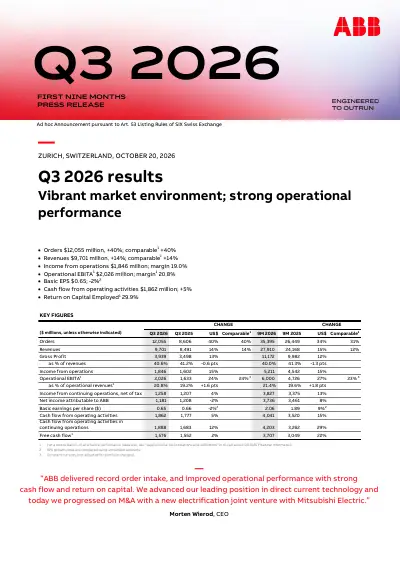
Thank you, Ann-Sofie. In the third quarter, we continued to see a strong market with orders once again reaching just above $12 billion.
I will say that we performed well in a vibrant market. When it comes to our operational performance, we progressed more or less as planned and guided for, a good mid-teens revenue growth, and the 20.8% operational EBITA margin is the strongest Q3 margin ever for ABB.
The same is actually valid also for the EBIT margin of 19%. We continued to generate a standout return on capital employed, which was at 29.9%, and I expect our business to continue to improve and support ROCE.
We have said that we will deliver more than 20% return on capital employed also when we start making more sizeable acquisitions. Speaking of acquisitions, following the Rotork announcement in July, we today announced further capital allocation toward M&A.
We will take a 51% ownership in a joint venture formed with Mitsubishi Electric's low-voltage power distribution business, and we also have a clear mid-term path to full ownership. This deal makes us the low-voltage market leader in Japan, and one of the world's largest electrification markets, where we have had limited reach until now.
We also view this as a door opener for growth across Southeast Asia, to markets like Malaysia, Thailand, Vietnam, and Indonesia. On the product side, they bring circuit breakers, motor starters, contactors, and control devices, and beyond that, energy measurement and monitoring equipment.
The product portfolios are similar, and we can apply a best of both worlds integration principle for platforms and technology. The Mitsubishi business coming into the JV has around 2,800 employees.
In fiscal year 2025, it generated around $640 million of revenues with a low double-digit EBITDA margin. In terms of performance improvement, it will be similar to what we successfully did with the GE Industrial Solutions acquisition.
We will drive profitability by expanding sales through combined channels, and we will introduce ABB products and technology to Mitsubishi Electric's customer base. We aim for the JV to be running at an operational EBITDA margin of at least 20% five years after deal completion.
The transaction values the new company at an EV of around $890 million. This translates to EV over sales of 1.4 and EV over EBITDA of 11.1 based on 2025 actuals.
Performance is initially low in the JV, hence multiples paid are at a meaningful discount to ABB, even before accounting for synergies. When we include the expected synergies, the EV over EBITDA multiple reduces into the mid- to high single-digit range.
We see strong returns on this deal with internal rate of return well above our cost of capital, and we expect the deal to close during the second half of 2027. Another significant milestone this quarter was the launch of the Infinitus direct current portfolio.
This new portfolio enable us to support AI data center customers across the full spectrum of DC architectures from source to rack. It spans across the white space localized DC designs to native centralized high-density architectures.
DC is not new to us. We started our R&D investments into solid-state technology already 15 years ago, but at that time, it was aimed at marine applications.
Now, there are multiple examples where direct current solutions drive the industry forward, like in rail, renewable energy, microgrids, and now also in future AI data centers. We decided to invest early in DC because the technology solves real customer needs.
First, it enables higher power levels. It facilitates data center rack densities to shift up to 1 MW, and facilities can scale from 200 MW to 1.5 GW.
Second, DC is more energy efficient. Fewer AC/DC conversion stages mean lower energy losses.
A 500 MW data center shifting to DC architecture can reduce conversion losses by more than 5%. This would save almost 200 GWh annually.
That's the electricity consumption of 60,000 European households or some tens of millions of dollars in cost savings. For 100 MW facility, a 5% improvement in energy efficiency can free up additional 5 to 6 MW for token generation.
This is worth close to $100 million in potential annual revenue for the operator. Our portfolio is built on the concept of five modular building blocks.
This allows our customers to select and combine what they need to construct a complete system. This means we can support diverse data center topologies from hybrid transitional architectures to optimized target design.
The building blocks span the entire power path from medium-voltage grid connectivity or behind-the-meter generation to DC conversion and distribution to power protection systems and cooling optimization. The modularity is critical because the transition to native DC architecture will be staged rather than immediate.
We talk about four distinct design phases. I've said earlier that we view the sidecar as an interim solution, and we rather expect the economics of centralized DC architectures to ultimately drive customer decisions.
With the Infinitus portfolio, we are ready, including our solid-state transformers available to order in the second half of 2027. That said, there will be no universal architecture.
The market will evolve across a spectrum, and with the Infinitus portfolio, we can serve every segment. When you compare the localized DC with a centralized design labeled 2 to 4 on this slide, it is visible how the weight of the electrical power infrastructure shifts from the white space to the gray space.
We believe that in the target DC architecture, as much as 75% of the spend on electrical power infrastructure can be linked to the gray space. This compared to about 55% in a legacy AC architecture.
The gray space already represent the majority of our data center exposure today, and the shift towards centralized high-density DC meaningfully expands our addressable scope. Another proof point of our DC capabilities is our partnership with Ferrari Hypersail.
We will support Ferrari Hypersail with expertise across marine power, DC technology, and advanced electrical systems. Our solutions will be installed on their 100-foot oceanic full-foil monohull yacht powered by renewable energy.
The DC architecture will function as a high-performance self-sufficient microgrid with systems operating at 48V and 800V DC. The vessel is designed to bring together speed, resilience, and safety with on-board energy generation and management in one of the most technically demanding environments.
Yet another DC happening in September was the report we published in collaboration with BCG. The report makes the case that direct current technology is moving from the periphery to the center of industrial, commercial, and digital infrastructure.
The future of power distribution is not an either/or choice between AC and DC, but a hybrid system that combines the strengths of both technologies. AC and DC each have important roles to play, and together they can help build a more efficient, resilient, and future-ready electrical system.
Now, let's turn back to the third-quarter results. I already mentioned the order intake of $12 billion.
This reflects a comparable increase of 14% from last year, and we're in a good market situation for all three of our business areas. Orders were supported by strength across our entire portfolio, meaning short-cycle products, service, as well as the projects and system businesses.
We saw orders increasing in the majority of our customer segments. Data center was the standout, delivering triple-digit growth with no signs of demand softening or CapEx hesitation from our customers.
There are some softer areas. Similar to previous quarters, we see low customer activity linked to process industries and residential buildings.
I let Christian go into segment details when he talks through each business area. In total, book-to-bill reached 1.24, and the order backlog expanded to just about $32 billion, almost equivalent to 2025 full-year revenues.
There is always a mix of short and long cycle, but naturally, it is the project and system business that predominates in the backlog. As we have had very good order intake from segments like data centers, marine, and rail.
These are businesses with long lead times, skewing mix in our backlog further toward longer delivery times. Mix in the backlog is one thing to keep in mind.
The other is production capacity. We have an overall good position, and you often hear me talk about our strong delivery track record.
This is important to us, and we are investing incrementally as you have seen in our announcement. CapEx is tracking at a higher level of around $1 billion.
With demand having been so strong in the last 12 to 18 months, some product lines are now approaching high utilization, mostly so in Electrification, until ongoing investments gradually becomes fully operational during 2027. All three business areas contributed to comparable revenue growth of 14%.
Volume expansion was the primary driver, complimented by net pricing realization of just about 2%, a stronger contribution than in Q2. We saw double-digit improvements for both the short- and long-cycle businesses.
Looking at the different geographies, comparable orders were up by double digits in all three regions. The Americas continues to be the strongest growth driver and increased by 17%.
This was driven by the US, where orders were up by as much as 82%. This high number includes large bookings, but base orders were very strong and improved by about 50%.
Europe was up by 10%, supported by increases in most of the top 10 markets. Asia, Middle East, Africa improved by 29%, with China up 25%.
China orders increased in all three business areas with strong double-digit growth in both Electrification and Motion. Now we turn to earnings, which reflect both favorable market conditions and a strong operational execution.
We improved operational EBITA by 24% to $2 billion, up in all three business areas. As I mentioned in the beginning, a group margin of 20.8%.
Operational leverage on higher volumes was the main contributor to our improved result. The solid price execution and the forever ongoing efforts on continuous improvements compensated for inflationary cost impacts and higher spend on R&D and SG&A.
We reduced expenses in corporate and other, and losses were lower in the E-mobility business. All included, a job well done by the team, and we keep moving in the right direction.
That said, while we improved business performance, the earnings per share of $0.65 actually reduced by 2% from last year. There are two main drivers to this, the first being a non-cash unrealized FX hedge linked to the ongoing Rotork acquisition, which weighed on earnings by about $115 million.
Depending on FX movements, we may have some additional volatility in finance net until we close the deal in the first half of 2027. Secondly, we had a lower result in discontinued operations.
This is, of course, linked to the ongoing separation process in the Robotics business. We are working towards our ambition to complete this divestment by the end of the year.
With that, I hand it over to you, Christian.
Christian Nilsson
Thanks, Morten. Let's take a look at what happened in the different business areas, starting with Electrification.
Demand remained persistently strong and drove order intake to new record of close to $7.7 billion. This represents a standout increase of 70% from last year.
It was also up from the already high level of second quarter. What drives this exceptional demand?
The segment trends have not really changed from what we've seen earlier in the year. The data center segment stood out again with a triple-digit order growth with no signs of slowing customer activity.
That said, it is a tall order to expect triple-digit growth in each quarter going forward. It may be as simple as impact of timing of order bookings, and also the base is getting rather sizeable.
Electrification is not all about data centers. It was very encouraging to see order growth excluding data center reaching the high teens level.
All our large customer segments in Electrification grew at a double-digit pace. To mention a few, we saw a strong increase in the utility business with investments going into grid refurbishment and expansion.
Orders in the building segments was up due to strong commercial demand. It improved also in China, where we performed well in an otherwise bleak commercial building market.
We have executed well in areas like high-end hospitality as well as niche-backed public funding like healthcare and education. Turning now to revenues, which amounted to $5.4 billion.
The very strong comparable growth of 21% was above all supported by higher volumes. The team did a good job on pricing, which contributed with around 3%.
This is a stronger contribution compared to Q2, a good realization trend. It was encouraging to see that pricing now broadly offset commodity inflation.
The strong revenue growth with added contribution from continuous improvement efforts converted to 27% improvements in operational EBITDA to $1.4 billion. The margins was up by 110 basis points to 25.6%.
Again, new records for Electrification. All included, a great performance by the team.
Now, looking at the fourth quarter, we expect comparable revenue growth to be in the high teens to low 20% range. While we expect a repeat of the usual seasonal pattern of sequentially softer margins in Q4, we anticipate a slightly softer drop compared to historical average of around 150 basis points.
Now, we turn to Motion, where order intake of $2.5 billion corresponded to a strong comparable growth of 12%. This improvement was driven by the short-cycle business with large order declined from last year's high comparable.
Similar to previous quarter, we saw strength in the grid-related investments. HVAC for commercial buildings and data center cooling, as well as food and beverage, also contributed to the growth.
A more stable trend was noted in oil and gas, and while there may be quarterly differences, I would say that process industry-related demand in pulp and paper and chemicals continues to be overall muted. Turning now to the revenue at $2.3 billion, which grew by 9%.
The increase was mainly driven by strong demand in the short-cycle business, while we also executed on the order backlog. Main driver for revenue growth was higher volumes with added contribution from a solid price development.
In Motion, we also had about 2% revenue contribution from M&A. As in recent quarters, profitability in Motion was under pressure despite the positive impact from higher volumes.
Year on year, the operational EBITDA margin declined by 100 basis points to 19.1%. Our Gamesa Electric acquisition hampered margins by about 40 basis points, still operating at a small loss.
Pricing was robust also in Motion, and we were able to offset commodity inflation in absolute terms, although still with some margin dilution. For the fourth quarter, we expect Motion to achieve comparable revenue growth similar to the Q3 level.
In contrast to the usual pattern, we expect operational EBITDA margin to slightly improve sequentially. The stronger than usual quarter-on-quarter development is supported by improved operational performance in the project and system business, where we've had some inefficiencies earlier in the year.
Next, we turn to Automation, where orders remained stable versus prior year at $2.1 billion. The order number is sequentially lower, but this is more due to timing of order placement rather than a real change in underlying customer activity.
We still see good demand linked to our offering for higher energy efficiency and energy resilience. Demand for marine and ports, electrification, and automation remains high.
We see improving market sentiments linked to discrete automation in the machine building segment. Order growth rates were strong, although still on a fairly low comparable.
Demand in the oil and gas segment is generally robust, barring weakness in the Middle East. Similar to what I mentioned for Motion, we continue to see bleak process industry markets for chemicals and pulp and paper.
Orders in mining remained muted in the quarter. Our colleagues are mentioning that they send some initial improving sentiments in the customer interactions about future mining projects.
Early days, let's see and follow up on this one. Nuclear is a small segment for us, but an area where we see high customer activity.
Revenues reached $2.1 billion, up 5% on a comparable basis. The improvement was driven across the spectra of backlog execution, product business, and service.
Despite gross margin pressure from items like unrealized FX and commodity derivatives and some cost inflations, the operational EBITDA margin improved to 14.8%, up 90 basis points from last year. The margin improvement was driven by solid execution of the order backlog with an increased profitability.
Also, a stringent cost control in SG&A, in R&D, which reduced in relation to revenues. For Automation's fourth quarter, we expect a low to mid-single-digit comparable revenue growth.
We have the ambition to keep the operational EBITDA margin broadly stable from Q3. This will be a stronger outcome than the usual pattern of a sequential drop in Q4.
Looking at cash flow, it was another solid quarter with free cash flows of $1.6 billion, supported to our strong free cash flow margin trend. The slight year-on-year increase of 2% was driven by higher operational earnings in continuing operations.
We also kept disciplined in our trade networking capital management with no material cash impact. This was partially offset by somewhat higher CapEx spend and the lower cash flows in discontinued operations.
All in all, it was a good cash quarter. Far this year, we have generated $3.7 billion in free cash flow.
We expect good business-driven performance also in our fourth quarter, and we received the cash contribution of around $300 million linked to the real estate sale we just announced. We are well on track towards improving free cash flows from last year's $4.6 billion.
With that, I hand it back to you, Morten.
Morten Wierod
Thanks, Christian. Let's finish off with the outlook.
For the fourth quarter, we expects comparable revenue growth to be broadly similar to the third quarter. When it comes to the operational EBITDA margin, we have a seasonal pattern of a softer Q4.
We expect a sequential decline also this year, but slightly less than what we normally see. Note that this guidance does not include the positive one-off linked to a real estate sale we just completed.
This sale will trigger a gain of about 240 million Swiss francs, booked in the fourth quarter. This results in a slight upgrade for the full-year 2026 guidance.
We now call for comparable growth to be in the low-teens range, and we expect the reported operational EBITDA margin to improve by at least 270 basis points from 2025, including real estate sales. Now, Ann-Sofie, let's open up for questions.
Ann-Sofie Nordh
Yes, we're ready. Let's do it.
First, a quick reminder for those of you who have dialed in on your phones. Please press star-14 to register to ask a question, and also remember to mute the webcast when your line is opened.
We also, as per usual, we kindly ask you to limit yourself to one question at a time. This is so we can allow for as many of you as possible to be heard.
You can also put your questions through the online tool in the webcast, and I will then voice them over from here. With that, let's take the first question.
We open up the conference call line for Will at Kepler Cheuvreux. Are you with us, Will?
Will Mackie
Yes, very good morning to you. Thank you.
My question would relate to the strength of the order intake in Electrification specifically around data center. We've seen two quarters above 100% or above 130% in North America.
What levels of risk control are you putting in place to ensure the durability of the orders, and to ensure there's not elements of pre-ordering or orders that may fall subject to cancellation in the event of a change in the economic conditions? Thank you.
Ann-Sofie Nordh
Thanks.
Morten Wierod
Oh, yeah, thanks, Will. When we do the normal risk approach of when it comes to customer assessment before we take the order, and most of them also come with a significant advance payment or clear cancellation policies, which is part of how we do with every large project at ABB.
You have to remember also that these data center designs, even if they are standard products, they are not kind of standard solutions. It is still engineering involved.
It means that the order is for a specific site, which already have a permit to have a grid connection, who have kind of the funding in place to be built. That's when we get the order, then is all about execution, and as we said, lead time can vary now from 12 to 24 months, and that's more depending really on the project when they want the delivery on site.
We are normally not the limiting factor when it comes to the lead times. That's kind of how we look at it.
We do not see any pre-ordering and I don't see any kind of build up for something which is anyway build to a site. It's very difficult to handle this by pre-ordering as well.
Super,
Will Mackie
thank you very much.
Ann-Sofie Nordh
Thanks, Will. We open up for the next caller, James from Rothschild.
James Moore
Yes, good morning, everybody. Hi, Morten, encouraging to hear your comments on data centers and that you see no sign of slowing customer activity, but I wondered if I could ask your thoughts on the wider equity AI ecosystem market debate and concerns that are going on.
Specifically, we've got this known path of AI supply ambition with huge amounts of gigawatts and an ambition from hyperscalers to build those. I can see a path to orders increasing and the desire to continue those starts and complete the existing and the announced but not yet started.
On the demand side of the equation, when you look at the model players and the hyperscaler players, do you look much and think much about what kind of returns and demand that side of the equation is seeing, whether it's sufficient to support the kinds of industry CapEx levels that we're heading to?
Morten Wierod
Of course, we discuss and talk with our customers like the hyperscalers about their both financing models, but also their revenue models of the future. The confidence there, and I think, but you can hear that directly from them as well, the confidence there that these investments that is being made now will have very solid returns.
I often say that the hyperscaler or the data center industry do have deeper pockets than most kind of standard industrial customers when it comes to getting those grid connection. I think that's more for me would be the discussion longer term that we see if you're running out of grid, who will take that capacity?
You have a choice between decarbonization of industries or building data centers. That's more of the industrial debate that is happening in many countries.
I think where we are doing there is to help building these data center much more energy efficient and that we can do more with less, and at the same time helping more energy and electricity supply to come online. I think that is the part of the equation for the coming years.
We will see much more investment where hyperscalers and the whole data center industry will take a bigger part also bringing equity or capital into the electricity power generation because in the end, there will not be enough free capacity to pick up. Therefore, you will also need to have more grid expansion.
We see that especially in the United States with a lot of LNG and other grid expansion activities happening. I think we'll see that also here in Europe in the coming years.
That, again, it's a sweet spot for ABB and where we play. That's kind of how I see it and therefore I'm confident when it comes to the longer-term develop also for this market.
Both the demand and the supply side needs to be part of that discussion.
James Moore
Thank you.
Ann-Sofie Nordh
Thanks, James. We open up for Magnus at Nordea.
Magnus?
Magnus Kruber
Hi, Morten, Christian, Ann-Sofie. Magnus here at Nordea.
I think you delivered a very solid 85% growth in the backlog in the Electrification in the quarter and you're guiding for very explicitly revenue growth into the fourth quarter. Looking beyond, what limits your backlog conversion into 2027?
Is it more about your own capacity, or is it the customer's ability to take deliveries, or how should we think about backlog conversion and revenue growth into next year? Thank you.
Morten Wierod
Thanks. We come out in January when we do our fourth quarter, we'll come also with the full-year 2027 guidance.
I leave it that part till then. What I can say is kind of how we are dealing with the capacity build out and electrification.
It is a mix here of how we bring new capacity online, and you've seen with higher CapEx spend where a lot of that has been allocated of course to Electrification with a factory and manufacturing build out. You may see quite a few news stories where ribbon cutting and groundbreaking over the last years.
Those are investment now coming online, and that's why you see a higher revenue in Electrification business. It's a mix here of what is our own capacity, but it's also has to do at the customer side.
We are very seldom really the bottleneck when it comes to deliveries. Like a data center we talked about, when that is being built, it's both the construction work, but it's also a lot of other equipment like power transformers that goes in here, gas turbines, and those are more longer lead item than what we do as ABB.
We are very seldom kind of the limiting factor there for the build out on projects.
Magnus Kruber
Thank you very much.
Ann-Sofie Nordh
Thank you, Magnus. We have a question here via the online tool regarding CapEx.
It's from Fredrik at SEB. He says, given the growing backlog and high utilization rates, could you please update us on expected CapEx profile for 2027 to 2029?
That's for you, Christian.
Christian Nilsson
I can take that. The CapEx plan for this year is around the $1 billion, as we have communicated in the past, and we don't expect that to grow significantly as we move across the next few years either.
This is really a good level for us. As a reminder, of course, this has grown quite a bit since some years back.
Around the $1 billion or so is still the target.
Ann-Sofie Nordh
Very good. Then we open up for another question from the call.
It's from Andre at UBS. Andre, please.
Andre Kukhnin
Yes, hi. Thanks so much for taking my question.
I wanted to ask about the margin implications from the capacity ramp-up. Far, I think you've delivered very creditable 30-35% operational gearing in Electrification with sales obviously ramping 20%.
I think for next year, just judging by the speed of your orders growth in the last four quarters at 50%, it may well accelerate, and you've just talked about adding capacity in various ways. Should we think about operational kind of drop-through implications from that additional capacity ramp, or do you think you can maintain that kind of operational gearing that you've delivered so far this year?
Morten Wierod
You want to take that?
Christian Nilsson
Yeah.
Morten Wierod
I'll take it. That gearing is going to be similar as we move forward.
That's a good performance from us so far, and there's nothing changing necessarily in the profile going forward for that.
Andre Kukhnin
Super clear. Thank you.
Ann-Sofie Nordh
Very good. Then we have a question from Max at Morgan Stanley.
Your line should be open, Max.
Max Yates
Thank you. Maybe just to ask one sort of off the topic of data centers.
Just in terms of the Automation business, obviously, step down in sequential orders. You talk about kind of timing of orders in the Middle East.
I'm just trying to understand are those two comments connected? Was it one particular kind of larger order that maybe slipped from the quarter?
Is there any kind of underlying weakness? Maybe just unpacking that sequential order deceleration that we've seen, and maybe the moving parts between that.
Thank you.
Morten Wierod
Thanks, Max. As always in the automation business, there is more volatility in the order intake, especially on the large project.
As I'm sure you remember, we have had quite a few of those large projects in previous quarters also last year. Sometimes the comparable got a bit tough.
If you look at the Automation business when we're looking for this quarter, we had good activities in the power generation on the energy side. I would also say on the machine building, on the B&R business.
Where it is a bit slower is more kind of on the process, some of the process side, where we see we have more optimistic when it comes to the future in mining, and there we see kind of more conversation, not on the numbers side, but more on the conversation with customers. While when we look at the part of, let's say, traditional process industries, pulp and paper, the metals industry, and so on, cement, those are more kind of a bit of a tougher market.
That's kind of the overall outlook. When we talk about the electrification trend that benefits the automation side as well, that be in when you're looking at capacity, like in LNG is going well, the oil and gas side, but also and to the machine building.
Those are our elements that is driving. I think overall, we are optimistic also when we're looking at the future intake here.
As I say, we also always need to look a bit kind of through some of these large order bookings when we looking. We look quite a bit on the base orders, what we call it also in ABB, when we looking at the automation side and then it's growth on the base orders, but again a bit short on large orders just this quarter.
Yeah.
Ann-Sofie Nordh
If I can just add.
Max Yates
Thank you.
Ann-Sofie Nordh
I can just add, if I may, that the timing comment was not directly linked to Middle East. There, you should see them at two separate things, because Middle East has been on the soft side since the beginning of Q1 and that hasn't changed.
With that said, we have a next question. We open up the line for Ben at OxCap.
Please, Ben.
Ben Uglow
Oh, good morning, everyone. Thank you for taking the question.
It was about the joint venture with Mitsubishi Electric. Very interesting deal.
Could you just talk through the kind of strategic rationale? Of that 640 million of sales, how much is Japan versus other markets?
I'm assuming, and tell me if I'm wrong, that this is about gaining access and penetration mainly in Japan. The kind of related question is the scope of it is literally just the low-voltage distribution products, but when I look at your businesses, there's a huge amount of complementarity actually between the two in energy systems and factory automation.
My question is, is this really just about low-voltage distribution, or could this be something broader in the medium term?
Morten Wierod
Yeah. No, thanks, Ben, for the question.
This is a joint venture what we talk about now between Mitsubishi Electric and ABB that is limited so far to the low-voltage product of the electrification market. The main reason why we want to go in here is that Japan is one of the largest electrification market globally, but it has been so far let's say difficult for us as ABB come into the market.
Mitsubishi is a clear market leader in this space, and that is now with this joint venture we taking a 51% controlling stake will make us the local market leader overnight. You can think about it like the GE Industrial Solution case all over again, where we're bringing in a global platform of products like circuit breakers, contactors, all the industrial devices that is needed in that electrification space.
Then we're taking the best of the two when we're looking at those two portfolio, and we will manufacture that in majority in this new JV operational unit in Japan. That is as you say, the majority of business out of the 640 is done in Japan, as you say, with a clear market leadership.
We're looking at how we, as I say, when we are taking the best of the two based on the GIS acquisition kind of principles, we will also see how we can bring up the performance of the unit from today, of a double-digit EBITDA margin and up to at least 20%. It will take a few years because we know, as we have done it before, it will take a couple of years to get there.
We are very confident that we will get there and been able to create a lot of value for the company. We also have a firm deal for when we'll take over 100% control of that new entity.
Then if we can do more together in other areas, that is more discussions kind of to be held in the time. Now the focus is to do this successfully, and then we will build on that success onwards.
Ben Uglow
Understood, thank you.
Ann-Sofie Nordh
Thanks, Ben. Then we have another question here from the online channel from Thomas Jaeger, who says, free cash flow looks to be really good in 2026, and significantly up from last year, approaching 5 billion.
Do you agree, and can you talk about the drivers?
Christian Nilsson
I certainly can, and I do agree that year-to-date, the free cash flow of $3.7 billion is really really strong. Good operational performance on that.
If we walk from that level into, as the question alluded towards the finalization of Q4, of course, there's different puts and takes. First, of course, the continuation of our strong operational performance will, of course, generate positive cash flow in Q4.
Adding to that is the real estate that we have talked about at $260 million also adding to that. Of course, subtracting of the opposite of that is our continuous investment, as we mentioned before, around CapEx that we support our customers.
Net working capital probably a little bit of drag also on that as we are supporting our growth into Q4, and then discontinued operations. If we put it all together, I think the fair path is that we are moving towards a number, indeed, that is starting with a five, the 5 billion or so.
I would agree that it is a good performance so far, and then we have a good path to a 5 billion.
Ann-Sofie Nordh
Then we take a question from the conference call, Delphine at Oddo, please.
Delphine Brault
Yes, good morning, all. Thanks for taking my question.
It's another question not on the data center field. Your margin in Motion was down 100 basis point, or 60 basis point stripping out the Gamesa impact.
Can you detail the main components of these minus 60 basis point, and if you believe Q4 will show better trend notably in terms of price-to-cost equation?
Morten Wierod
You want to take that, Christian?
Christian Nilsson
Indeed, for Motion, as we have had throughout the year, we call out some different areas of pressure points. Gamesa is indeed still there, and that will remain as we move forward with continuous improvements a little bit, still operating at a small loss.
Then it's a little bit of the operational issues we have experienced in areas such as high power that is continue to be there, but kind of keeps improving. We have said throughout the year that the margin of Motions should sequentially improve, and they have so far, and that's, I think, it's a good path for the team.
I think those are the main components for the situation of margins in Motion.
Ann-Sofie Nordh
Thank you. Thanks, Delphine.
Then we have a question here from the online tool from Mattias Holmberg, who says, how is ABB using AI internally, and what value are you seeing in cost, efficiency, time savings, or product and service improvements? Please quantify where you can.
Morten Wierod
How we say use AI at ABB, maybe I give you a bit of an overview how we are working on it. We have defined as three pillars, which is AI for people, AI for business and functions, and AI for technology or for products, systems, and solutions.
If you talk about AI for people, it's kind of how we upgrade our whole population of ABB. We have today, our own employees are kind of doing all the AI certification internal training programs that we have put in place.
We have also our teams have created today, it's almost 10,000 agents that is also working for our team members. I think here, and of course all of these are driving the efficiency and how we are able to that we've tried to that everybody should use AI, and everybody should drive their own kind of self-efficiency, and to drive this as an improvement program.
That's also how we measure it. We measure both the improvement, but we also measure the token cost internally, so that we have a control of the expenses.
Then it's about not just about speeding up the internal processes that is being used, but it's also redesigning. Then we're into the AI how it's used for business and functions.
That is a redesign often of a process that we can make it kind of an AI-original, and not just automate the manual process with AI tools. That is a significant program.
It's part of our transformation and our what we call data system modernization program at ABB and how we link that together. Then thirdly is about AI for our customers and in the technology.
There is investments into service agents that can be on customers on-premise on their system to help them kind of being that local service technician online that can help you immediately without you don't need to call or you don't need to send anyone to site. These are some of the very kind of practical example how we do it.
Then, of course, we internally is very much about how we drive efficiency when it comes to speed and responsiveness and the internal efficiency. When it comes to the outside, it's how we can also use that to drive revenue growth together with and making our customers more competitive.
What we have done to put in place also is say both the control or the monitoring of the cost side, but also and what's the benefits. I cannot give you a number.
This has made ABB, like 18% or whatever is the percent a number faster. What we do is to measure it in function by function and in the different parts of our business that we are really getting the real return of the investments we're doing.
I think, for us, it's more important that everybody have an chance and have a opportunity to use it. Then we have been more focused on this to get the awareness and the usage of AI up in the company more than just strictly controlling the cost of using it.
That's a process we talk about. We're probably moving more into now.
When we get more mature, you're also need to be more critical to what are the applications and you really using it for. These are our and how we use it, those three main pillars is how we use it inside ABB.
Ann-Sofie Nordh
Very good. Then we open up for Ben at Bank of America Merrill Lynch from the conference call.
Please, Ben.
Ben Heelan
Morning, and thank you for the question. I just wanted to come back on the margins on Electrification, because they are very strong.
Could you give us a bit of an update in terms of where you are regionally for margins, and in particular on the US, given that's historically where some of the weakness in Electrification was? That would be great.
Thank you.
Morten Wierod
I may start. We have the development then on margin as Christian answered here as well kind of the drop-through when we have a significant volume growth to come out also as in improved drop-through margin.
That's what we expect. There are still regional differences, where the United States is somewhat behind, but we are improving step by step.
As we get more capacity online, we're getting also more mature in our US operation. We're still not kind of at the level where we'd say that the job is done.
We have more work to do especially in the United States. I would say, in general, we are looking also how can we drive this continuous improvement journey.
This comes always with an expectation, especially when you're growing, there should always be an opportunity to also to drive efficiency that you can get even more. It's very hard to improve margins when you're going down, but so it's always easier when you're growing.
I think that is what the team is also showing an excellent performance in this year, and also especially with the numbers this quarter. There is still more work to be done to continuously and even go to an even higher level.
Christian Nilsson
Yeah. Maybe I just add on a bit of that journey.
I think it is definitely a journey and a path. There's more to come.
I think we can think about the margins improvement to go up towards kind of high teens as we are today. That means that we, of course, have still further opportunities to improve even better in the US for Electrification.
Ann-Sofie Nordh
Very good. Linked to, let's see, Electrification, from George, your Electrification backlog is up high double-digit year on year.
How much of this is data centers, and can you help us with the phasing of these orders converting to revenue?
Morten Wierod
Talking about when it converts, what I can say is that normally a normal lead time here would be 12 to 18, 24 months in the data center space. That's kind of the normally requested lead time from customers on these projects.
That's the orders we booked this year should go out in '27 or in '28. While in the Automation business, it is a longer lead time.
There we have projects that could go over, even up to 10 years. In Electrification, it's normally down to a couple of years.
That's what we see on the backlog. Yeah.
Christian Nilsson
Maybe I add on the backlog generally for ABB, of course, closing this quarter at the record $32 billion and some change, that will convert into next year at around 40% as we stand right now across ABB. Then, of course, mix is always also an impact of that, also.
Ann-Sofie Nordh
Very good. Then we open up the call with a question from Alex at Evercore.
Alex, please.
Alex Virgo
Thanks, Ann-Sofie. Morning, Morten.
Christian, I wondered if you could talk a bit about the acceleration in green utility spend. It feels like that's really actually started to build a lot more momentum as you've gone through the year.
I appreciate it's probably a bit of the halo effect from data center demand. Can you give us a bit more color on the utility behavior, what they're sort of planning for, the visibility that you have, and, I guess, any broader developments or color on the regional split would be really helpful?
Thank you.
Morten Wierod
Yeah. No, we see that on the utility space is going well in all three of our reporting regions.
We see that and one is, of course, as you say, due to the data center higher demand there that we also need to balance on the supply side. It's not only related to that.
It's the whole electrification of society that is driving that, where you need more electricity available for more cooling of buildings, where HVAC is a good growth area, but it's also about the whole electrification of transport, and then comes the data center on top. All of these things kind of is a higher demand for electricity, and then this is on the supply side.
Building out a stronger grid and having better grid resilience and reliability is one of the key aspects here. We see that China has invested for many years in this space and continue to do so, because their carbon neutrality that is committed in 2060 means that there need to be a significant investments into this energy transition, as they do.
It's the same in India have a similar commitment with also their good growth in the market. If you look at and then we talk about US, and we all know about the also there the aging infrastructure.
Often when you think about grids and utility business, it's about an aging infrastructure. It's about energy expansion that we need more electricity, and then you have the energy transition on top.
These three elements come together means this massive need of investment on the utility side. That's what we see kind of in region by region, that this is clearly not linked with the GDP growth, it's really about how you can get more electricity online.
That's what's reflected in the utility number when we looking at that well above double-digit growth.
Alex Virgo
Thanks very much. Very good.
Ann-Sofie Nordh
Thanks, Alex. Then we take another question from the conference call from Eric at CIC, please.
Eric Lemarié
Yes. Hi.
Good morning. Thanks for taking my question.
I was wondering regarding the 800 VDC architectures, do you expect the emergence of new competitors in that space? Some new players trying to grab a share of these promising market, and maybe new players with, I don't know, maybe new technology?
Morten Wierod
I think always when you make a technology shift, there is always an opportunity to make market changes. We want to be one of those disruptors in this field, because we are very strong today on the gray side of the data center, not that strong on the white side.
Now, and I showed that earlier in the presentation, more of that investment is moving from the white space to the gray space. With our leading technology here on the 800V DC and that DC architecture, we believe that this is a great opportunity for us to capture more of that growth, and more of those opportunities with our leading technology.
That's why you have seen this significant investment from our side in R&D and technology, also some with partnership, that we're building up a complete DC portfolio. I think it's what I hear also from customers and our partners, it is clearly one of the leading or the leading platform and technology platform to build that new DC architecture.
I think this is a great opportunity for us, and we want to be one of the disruptors here that we can take an even larger share in that market than what we have today.
Eric Lemarié
Understood. Thank you.
Ann-Sofie Nordh
Thank you, Eric. We follow up with a question here from the tool, from Andre.
He says, can you please comment on your mix of exposure by customer group in the data center segment? I assume he means like mix of hyperscalers, neocloud, colos, etc.
Morten Wierod
It is a mix. It's really we don't go out with the full thing, but majority of what we do is with clear majority with hyperscaler and co-locators.
That's kind of the big majority of side, but also some on the neocloud solutions. As I say, by far vast majority sits with the hyperscaler and the co-locators.
That's the mix what we have, without going into the number side of it, yeah.
Ann-Sofie Nordh
I think we can squeeze in one more question. We open up the line for Daniela at Goldman Sachs, please.
Daniela Costa
Hi, good morning. Thank you for squeezing me in.
Just wanted to ask in terms of how should we think about balance sheet capacity from here, and also your own management capacity to deal with further M&A, and whether there are any divisions in particular where we see a bigger white space of things that are still possible to do? Yeah.
Morten Wierod
Yeah. Let me start with the management capacity, maybe first.
I think this is one of the advantage and strengths of our ABB Way operating model that the divisions that sits in our three business areas are the ones who have also having the integration capacity. Take the Rotork deal that sits with the Automation team, are not affected, to say, by the Mitsubishi Electric deal that we did now in the Electrification space.
Even there, it's limited really to two operating divisions who will run that program as we did on the GIS side. I think that's the strength of the model, that means we have management capacity to continue to do deals.
That's also what we of course, take this into consideration when we make new ones. In general, I would say we have that management capacity as part of our ABB Way operating model.
Maybe, Christian, you comment on that.
Christian Nilsson
We have management capacity, and indeed we also have the financial capacity. Now, as we close Q3, we have a net debt over EBITDA around 0.2, of course quite low, and we could feel like we could, as I said before, easily move up towards the 2 times staying in our rating area that we are, and that would, of course, free up call it 13 to 14 billion.
Then we have, of course, our general continuation of our strong cash flow that we get from operating activities. We definitely have both management capacity and financial capacity.
Ann-Sofie Nordh
On that strong note, I think we close this session. Thank you very much for taking the time to join us today.
If not before, we'll see you in a quarter's time.